INTRODUCTION
In the past 15 years, art therapy has become an innovative feature in psycho-oncology: art therapy has been used to offer support to cancer patients at different stages of their illness and with a variety of interventions, especially in the United Kingdom (Pratt & Wood, Reference Pratt and Wood1998) and in the United States (Malchiodi, Reference Malchiodi1999). Art therapy has shown its effectiveness with posttreatment cancer patients (Luzzatto & Gabriel, Reference Luzzatto and Gabriel2000), with patients in isolation for bone marrow transplantation (Gabriel et al., Reference Gabriel, Bromberg and Vandenbovenkamp2001), and with patients during radiotherapy treatment (Oster et al., Reference Oster, Svensk and Magnusson2006). Nevertheless, the specific therapeutic factors of art therapy with cancer patients are still not well understood.
Art therapy started in Italy with a number of open studios in psychiatric hospitals or day centers in the 1980s and 1990s, and more recently it developed as a form of supportive and insight-oriented therapy also in other areas (prisons, substance abuse, eating disorders, and in the medical field). There is little literature about the use of art therapy in psycho-oncology in Italy, although the number of art therapists who work with cancer patients is growing, especially in oncology day centers, supported by charities and by patients' associations. As art therapy is still not a recognized profession in Italy, it is also difficult to get funding to do research in this field. The first publications in the area of psycho-oncology were made by an art therapist who trained in New York and returned to her home town (Catania, Sicily) to work in a pediatric oncology hospital (Favara-Scacco et al., Reference Favara-Scacco, Smirne and Schilirò2001). Some guidelines about the use of art therapy in psycho-oncology in Italy have been published by Luzzatto (Reference Luzzatto and Bellani2002a, Reference Luzzatto and Bellani2002b, Reference Luzzatto2009). Tuscany is one of the first regions in Italy where an art therapy project has been funded by the state, within the Tuscany Oncology Network (Istituto Toscano Tumori) to support cancer patients during the stressful time of their illness.
OBJECTIVES
This project is focused on the role that art therapy might be able to play in the effort of responding to the psychological needs of cancer patients coming to a Day Hospital during their course of chemotherapy. The aim of this project is twofold: (1) to assess whether patients during chemotherapy sessions perceive the encounter with the art therapist as helpful and (2) to outline in which way art therapy is perceived as helpful.
MATERIALS AND METHODS
Between June 2008 and February 2009, the cancer patients attending the Day Hospital Oncology in Siena were informed that a qualified art therapist (S.F.) would be available to see them individually for psychological support through the art therapy modality during their chemotherapy sessions. The art therapist came to the day hospital 2 days a week, and saw 157 patients (69 men and 88 women). All patients signed a consent form to participate in the project. The patients saw the art therapist for an average of 4 or 5 sessions (between 1 and 10). Each session lasted an average of 40 minutes (between 20 and 60 minutes).
The first art therapy session followed a protocol. After the first session, the art therapist and the patient decided together how to continue, according to the content and feelings that emerged during the first session. The initial art therapy experience was based on the “collage technique” (Landgarten, Reference Landgarten1993). According to this technique, the art therapist asks the patient to select some pictures—relevant to the patient—from illustrated magazines, combining them on a white page, and giving a personal title to the finished composition. This technique does not require any artistic background or ability, and it stimulates symbolic connections between the selected pictures and personal life events and emotions, leaving the patients free to talk or not to talk about them. For the following sessions, magazines for collage, markers, oil pastels, and watercolors are available.
The patient sample was homogeneous for geographical area (Tuscany) and for type of treatment (chemotherapy), but heterogeneous for cancer diagnosis and prognosis, age, and sociocultural background. The art therapist kept accurate process notes and kept the artwork in personal folders for each patient.
The psychologist (M.P.) worked independently from the art therapist. She came to the day hospital 1 day a week and saw individually a randomized group of 54 patients who had concluded the chemotherapy treatment and who had seen the art therapist at least once. She had with her a semistructured questionnaire, based on two questions. The first question implied a yes or no answer: “Was art therapy helpful to you, or not helpful?” The second question was: “In case you have answered yes, can you say in which way art therapy was helpful to you?” This was an open question, without any list of preconstructed answers. The conversation started from what was important for the patient, provided this was related to the art therapy sessions and to the patient's life experience. These patients were all cooperative; they were willing to explain to the psychologist what had been helpful or unhelpful for them in the art therapy. Some patients wrote the replies, but most of them preferred to talk about their feelings. Sometimes it was not easy for them to explain verbally the nonverbal aspect of the art therapy experience, and they said so. The psychologist spent enough time with each of them (between 30 and 45 minutes) to make sure she understood the meaning of their responses.
The material that emerged from the interviews was subjected to content analysis in order to recognize meaningful clusters and common themes from the point of view of the patients' subjective experience of the art therapy sessions (Qualitative Solutions & Research Pty. Ltd, 1997; Auerbach & Silverstein, Reference Auerbach and Silverstein2003). The analysis was later discussed with the art therapist, and the psychologist and the art therapist together connected the patients' subjective perception of helpfulness with the patients' artwork and self-narrative developed during the art therapy sessions contained in the art therapist's notes. The project had the approval of the Ethics Committee of the Hospital.
RESULTS
The content analysis of the 54 interviews identified a small group of 3 patients who said art therapy had not been helpful and a large group of 51 patients who described the art therapy experience as helpful.
Group I
Three patients (5.5%) felt art therapy was not helpful. They had only one art therapy session. They focused their conversation with the psychologist on the feeling of not understanding the modality or saying it was superficial or childish. Here are their main statements:
I think I am not ready, or maybe I do not understand. … The pictures I selected did not tell me anything, or maybe I cannot connect them with my life.
I did not find anything particularly useful in it: Afterwards I felt as before [she makes a gesture of opening her hands]. It is a little chat with a person who maybe can understand you, but in the end …
Yes, it may be useful as a distraction … like a game for a child. The other lady near me was more interested, but as for myself … [at this point it seems she is going to cry. She talks about wanting to go to the church].
Group II
Fifty-one patients (94.5%) defined the art therapy experience as helpful. They had seen the art therapist an average of four or five times. The psychologist tried to identify, in the conversation with the patients and through the patients' words, which factors were perceived by them as most helpful or had affected them more deeply. It became quite clear that there was a continuum, from a more light, often physical experience (e.g., “I was able to relax”) to more profound experiences (e.g., “I got in touch with my unconscious”) triggered by the art therapy process. Within this continuum, and with some overlapping, it was possible to identify three subgroups: (A) 19 patients (37.3% of the total of 51 patients) perceived art therapy as helpful because they reached a positive psychological state: relaxing and/or creative. We call this perception “generally helpful.” (B) 17 patients (33.3%) perceived art therapy as helpful because they moved from the artwork to self-narrative: talking about oneself and feeling listened to. We call this perception “helpful because of the dyadic relationship.” (C) 15 patients (29.4%) perceived art therapy as helpful because they expressed and elaborated their emotions and found new meanings. We call this perception “helpful because of the triadic relationship: patient–image–art therapist.”
For each subgroup, we have selected some relevant statements made by the patients during the interviews with the psychologist and some art therapy illustrations describing a process recorded by the art therapist.
Group A
Nineteen patients (37.3%) perceived art therapy as helpful because they reached a positive psychological state: relaxing and/or creative (art therapy as generally helpful).
These patients focused their conversation with the psychologist on the pleasure provided by the art therapy activity. For some of them, it was the concrete “doing” that gave them pleasure; for others it was the “relaxation” from previous tension; for others it was a “creative feeling” or development of their creativity. Here are some of representative statements:
It helps me, because from the early morning the thought of coming here makes me feel tense and anxious. … Instead, during these two hours I do not think of my illness, I think only of what I am doing.
It is helful, because it widens one's horizon, it moves one's attention to other things.
It helps to spend the time in a useful way, and the little creativity we have … it gets stimulated!
It opens your brain a bit, and you feel you have made something: I feel stronger, I mean, in the personality.
I came out of this gray feeling, when we are all in this room and we look at each other faces.
It helps me to be less obsessed with this illness, which I think about all day: here I forget about it!
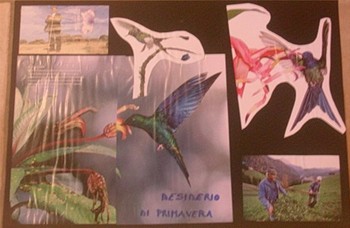
Art therapy illustration 1: The relaxing/creative image (see Fig. 1)
This is the third art therapy session for B. B. looks tired and anxious. She sounds little motivated and even not sure whether there is any point in doing art therapy today. I tell her I brought new magazines, and I invite her to make a collage: She could try to find pictures that have some resonance with her own feelings. B. starts to look at the new magazines and does select some pictures: She places a very colorful bird in the center, other birds and flowers around it, then two pictures of men working in the country. We look at her collage together, and B. says: “This morning I was not feeling well. Then I started to look at these magazines, I saw these colorful pictures, and I started to feel something like ‘a need for spring.’” I ask her whether she wants to write a title to her finished work. She writes: Desiderio di Primavera (A Wish for Spring). Then she smiles and, looking at her picture, she adds: “I feel new energy inside myself, exactly what happens during this season: the spring.”
(Color online) A Wish for Spring (B., woman, 60 years old, diagnosed with colon cancer).

Comment by the art therapist
B. was in the middle of her chemotherapy treatment and complained of feeling physically and psychologically weak. She showed little motivation, but as she started to activate herself in the search for new images and in the creative process of making the collage, B. came out of her passive state of mind. The images of colorful nature and of life in the country evoked in her some positive memories, as she herself had grown up in the country, and she had good memories about her childhood. These images stimulated B. to reawaken inside herself the energy symbolized by nature and spring. She was pleased with what she had done and surprised to see how much her mental state had changed. She had moved from the impact with colors to the idea of spring and to the feeling of energy inside herself.
Group B
Seventeen patients (33.3%) perceived art therapy as helpful because they moved from the artwork to self-narrative: talking about oneself and feeling listened to (art therapy as helpful because of the dyadic relationship).
These patients described the art therapy experience as a very helpful encounter with the art therapist, giving less importance to the artwork. Nevertheless, it seems important to point out that it was always the artwork that facilitated the relationship with the art therapist. The relationship was valued because it offered containment for their anxiety and preoccupation, and also because it offered an opportunity to talk: about themselves, their illness, and their life.
The art therapist helped me to express how I felt, using the images, and then I was able to explain my approach to life.
It was very good to be able to talk to someone.
After I made an image, I felt I was able to talk: I talked about myself, my illness, my family … and I felt listened to.
I felt she [the art therapist] really understood what I am going through.
Art therapy illustration 2: From the artwork to self-narrative (see Fig. 2)
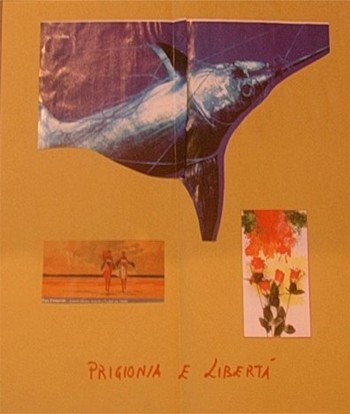
The patient (G.) looks rather shy, but she decides to try the first art therapy session. After she has finished, we look together at her collage. She seems to be more confident, and she says: “This collage describes how I feel in this moment. I feel like this fish, trapped inside a net. I selected also a seascape with warm colors: In fact, I wish that after the thunderstorm the sun will shine again. On the right, I placed some flowers: I chose the flowers because I always like them.”
(Color online) Imprisonment and Freedom (G., woman, 54 years old, diagnosed with breast cancer).

G. looks at me a bit perplexed, and she adds: “You know, in this case I look at them and I feel sad!” We look at her collage in silence, and she continues: “I thought I chose flowers to represent freedom; instead, they evoke to me a loss that is still painful. I am a prisoner of my past.”
G. says she is surprised of what has emerged from just three pictures. At this point she starts to cry. When she calms down, she says she wants to talk more, to talk about the loss of her husband, which happened about 1 year ago. “I thought I had overcome this loss; instead I now realize how lonely I still feel, especially now that I have to face this illness.” G. talks also about her difficult relationship with her 18-year-old daughter: She feels even more lonely because of this. At the end of the session G. gives a title to her image: Prigionia e Libertá [Imprisonment and Freedom].
Comment by the art therapist
This patient used the artwork to move into a narrative process about her past and her emotions. She selected the fish to represent “feeling trapped,” and the seascape to represent her “need to feel peaceful”: This is what she was aware of. But when she looked at the flowers, this was a real breakthrough: She had chosen the flowers to represent a positive feeling and suddenly they came to represent her unresolved loss. She started to talk about the death of her husband, the difficult relationship with her daughter, and the emotions she had kept hidden inside herself for so long. She continued to do so in the following sessions, always using the same modality: starting from an image as a tool to move into narrative. At the end of the art therapy process, after six sessions, she sounded more open and confident and capable of sharing her feelings and her needs.
Group C
Fifteen patients (29.4%) perceived art therapy as helpful because they expressed and elaborated their emotions and found new meanings (art therapy as helpful because of the triadic relationship: patient–image–art therapist).
In this group, patients' understanding of the art therapy process was more developed. They were more aware of the symbolic power of the images. Patients entered the dimension of self-discovery, and they may have found new answers and new meanings. They talked to the art therapist, but they also talked to the image, and they said the image “talks” to them. Here the relationship is not dyadic any more, and has become triadic: patient–image–art therapist.
I selected some sentences from magazines, just sentences that would attract my attention. In the end I understood that I had activated my unconscious: My unconscious was sending messages to me. I feel I have done something important, I have used this time for a work that was useful to me. I feel better, and it seems a very simple statement, but it is not: I really am better.
It is a very helpful experience; it helps a person to understand oneself. One day I saw the image I made the previous time. I asked myself, “Why did I made this picture?” and I gave the answer I did not know last time. … I suddenly understood why I had been attracted by those images.
It is strange, through the images you see something … but really you see yourself!
It was useful. … I was able to talk to myself, like if my real self had come out from inside me, and it was on that page, in that image, and it was talking to me. … I could see myself on the page.
Art therapy illustration 3: Elaboration of emotions and searching for meanings (see Fig. 3)
This is R.'s first art therapy session. R. is interested in doing anything that can help him. It seems he knows what he wants to do. Slowly he selects five pictures and puts them together on the page, one by one, to make the collage. At the end he gives this title: Open Your Eyes, Open Your Soul.
(Color online) Open Your Eyes and Your Soul (R., man, 43 years old, diagnosed with metastatic lung cancer).

R. explains to the art therapist the meaning of his images, in a very assertive way: “The first picture [a man and a boy in a hospital] is about a painful rage, and a feeling of powerlessness. … The second one [a group of four penguins] is about the freedom of the penguins in nature. … The third image, in the center—maybe the most important one [two Indian women nursing a little antelope]—talks about my sorrow and regret for having been a hunter. … The fourth one [an image of a volcano, Vesuvio, the Indomitable Mountain) shows a cruel and punishing aspect of nature. … The fifth and last image [a little wooden hut in the mountains in the snow] is about my need for infinity.”
R. explains that, after he discovered his illness, he realized he had lived his life without giving importance to his family and to his emotions; he had always been busy, rushing and running because of his work. Recently he went to live in the country with his family. R. adds: “I now realize there is still something. … I feel this regret for having been a hunter. … You know, at that time I enjoyed killing animals: They had not done anything wrong, and they were unprotected. Maybe now nature is taking its revenge on me.”
Comments by the art therapist
Through the integration of five symbolic pictures into a collage, R. expressed and integrated several aspects of his complex emotional world. Each image was connected with different aspects of his life experience. During the following sessions, R. was able to use this collage as a starting point to continue the process of self-awareness and transformation. He had already made important life decisions. The art therapy process helped him to work on a negative, painful feelings, which was still inside him: his “regret” for his past behavior as a hunter, and his “fear of being punished by nature.” Slowly he became able to give a new meaning to his life experience, from a broader perspective, and he felt more peace inside himself and not punished by nature.
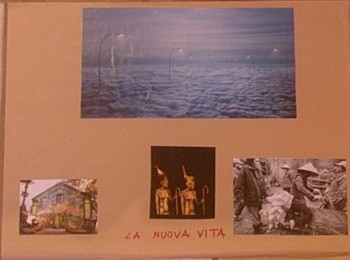
Art therapy illustration 4: Elaboration of emotions and searching for meanings (see Fig. 4)
This is C.'s second session. During the first session she was very talkative. This time she is very silent: She finds the images she wants and she glues them on the page in a deep state of concentration. We look together at her collage. She says: “I have lived for a long time without wanting to see what was behind those clouds. Now I wish a new place where to live, a new way to live. But I also feel angry with myself for not wanting to see, not wanting to understand what was happening.” Here C. starts to cry, and then she repeats to me that she lived for the last year in the fog, not wanting to face the symptoms of the illness. She focuses on her collage again, and she wants to explain the meaning of the other images: “On the left I put this house that for me is a symbol of the love and attention I have not received in my life. In the center, these symbolic Egyptian figures represent my belief that change is possible, and that I want to change my life. On the right, I have put an image of poverty and hard work, because this is my situation now; I have decided to come down from the clouds and face the difficulties of my illness and of my treatment. I also have to question my marriage, as I don't think it is good for me.”
(Color online) The New Life (C., woman, 51 years old, diagnosed with metastatic breast cancer).

Comment by the art therapist
I realized that C. was struck by the image of the clouds. When she saw it, she became very silent, and she immediately decided to select it for her collage. Then she remained silent throughout her work, until the collage was finished. It was as if she entered into the image of the clouds, and then she realized she wanted to come out of it. In fact, the other three images represented for her another level: the level of reality. Talking about her collage to me helped her to elaborate her emotions. During the following sessions, C. reviewed her life and became aware of what she called her “self-destructive side.” She told me that maybe in denying her illness, unconsciously she wanted to die. Through the art therapy process, moving all the time from images to words and from words to images, she reached the conclusion that maybe she wanted to be loved and rescued by somebody else. C. questioned her husband's commitment and his lack of concern for her, but she also became aware that she could give to herself that love and care that she had not received. This whole process made her feel very relieved and more determined to complete the medical treatment.
DISCUSSION
This project had two specific objectives, which were indeed interconnected: The first objective was focused on the perception of helpfulness/unhelpfulness of the art therapy experience from the point of view of the patients; the second objective was based on the wish of the psycho-oncology team (doctors, psychologists, and nurses) to better understand the potential therapeutic factors of art therapy for their patients attending the day hospital.
The great majority of patients who saw the art therapist during their chemotherapy sessions told the psychologist that they had perceived art therapy as helpful, and in fact the majority of them continued to have art therapy after the first experience.
Three therapeutic factors of different quality emerged, which are relevant for the issue of “coping” in psycho-oncology: the “positive psychological state” (Rogers, Reference Rogers1993; Folkman, Reference Folkman1997; Favara-Scacco et al., Reference Favara-Scacco, Smirne and Schilirò2001; Goodwin, Reference Goodwin2004); the “self-narrative” factor (White & Epston, Reference White and Epston1990; Launer, Reference Launer1999; Carlick & Biley, Reference Carlick and Biley2004; Thomas-MacLean, Reference Thomas-MacLean2004; Collie et al., Reference Collie, Bottorff and Long2006); and the “search for meanings” (Horovitz-Darby, Reference Horovitz-Darby1994; Breitbart, Reference Breitbart2001; Bennett et al., Reference Bennett, Compas and Beckjord2005).
The authors have worked together on this project with the desire of making the therapeutic factors of art therapy better understood and eventually make art therapy available in future to patients who would request it as a psychology support during the course of chemotherapy. This study shows that art therapy is a very flexible modality and does not need a large art room and many art materials to become an effective tool for psychological support. Art therapy may be helpful even with patients who are physically restrained in their movements and lacking energy and motivation. The flexibility of art therapy is an important feature in the planning for innovative supportive interventions for cancer patients at different stages of their illness. In particular, the “free collage” technique proved to be a suitable and stimulating starting point, leading the patients into any of the three above-mentioned directions (positive mood, self-narrative, and search for meanings), according to their own different needs.
ACKNOWLEDGMENTS
We are grateful to Paola Luzzatto for her stimulating supervision of the art therapy work. We thank Francesca Rastelli for her encouragement throughout this project. We thank Amalia Falzetta and the nursing staff of the Day Hospital for their support. The cooperation of the psychologist Gianluca Contemori is acknowledged. We thank the Association for the Support of Oncology Science and the Accademia Italiana della Cucina, Chianciano, for their financial and psychological support. We express our gratitude to all the patients who have participated to this project and shared their thoughts and feelings with us. This study was funded by a grant from the Istituto Toscano Tumori (7732, 2007).