Two issues of major interest in developmental psychopathology have been the relation of children's self-regulation to their maladjustment and the role of parenting quality in the aforementioned relation. Investigators examining these issues have often highlighted the prediction by parenting quality of children's self-regulation and maladjustment and the role of self-regulation as a predictor of maladjustment (e.g., Eisenberg, Spinrad, & Eggum, Reference Eisenberg, Spinrad and Eggum2010). However, some researchers (e.g., Bell & Chapman, Reference Bell and Chapman1986; Choe, Olson, & Sameroff, Reference Choe, Olson and Sameroff2013b; Eisenberg et al., Reference Eisenberg, Fabes, Shepard, Guthrie, Murphy and Reiser1999) have argued that children's self-regulation and maladjustment can affect parenting, and researchers have occasionally examined the effects of externalizing problems on children's self-regulation. Thus, current wisdom is that bidirectional relations are likely between parenting and children's characteristics and behavior, at least at some ages or with some measures, and that children's characteristics/behavior might affect one another in complex ways. Nonetheless, because there are few relevant longitudinal studies, especially those using stringent panel analyses in which stability of measures is taken into account, knowledge of the nature of these developmental pathways is limited. Information regarding the direction of effects is critical for an understanding of psychopathology because externalizing problems early in life tend to predict later maladjustment (Keenan, Shaw, Delliquadri, Giovannelli, & Walsh, Reference Keenan, Shaw, Delliquadri, Giovannelli and Walsh1998).
In most research on the relations of quality of parenting to young children's self-regulation and externalizing problems, investigators have examined the relatively global constructs of positive parenting (e.g., parental warmth, support, positive affect, sensitivity) or negative parenting, with the latter typically including punitive and hostile parenting and sometimes parental intrusiveness or overcontrol (e.g., Blair et al., Reference Blair, Granger, Willoughby, Mills-Koonce, Cox and Greenberg2011; Gilliom & Shaw, Reference Gilliom and Shaw2004; Gustafsson, Cox, & Blair, Reference Gustafsson, Cox and Blair2012; Propper, Willoughby, Halpern, Carbone, & Cox, Reference Propper, Willoughby, Halpern, Carbone and Cox2007; see also Karreman, van Tuijl, van Aken, & Dekovic, Reference Karreman, van Tuijl, van Aken and Dekovic2006). Parental intrusiveness, defined in general as overcontrolling behavior that limits the child's autonomy (usually autonomy of action in studies of young children through excessive directiveness, controllingness, and guiding the child) has been examined less frequently (see Graziano, Keane, & Calkins, Reference Graziano, Keane and Calkins2010; Stevenson & Crnic, Reference Stevenson and Crnic2013, for exceptions).
The focus of the current study was on potential bidirectional relations among intrusive maternal parenting, children's effortful control (EC), and children's externalizing problems at 30, 42, and 54 months. A panel structural equation model was used to examine relations among these constructs when controlling for prior levels of the variables (i.e., controlling for stability). Much of the existing relevant research using longitudinal panel models has been conducted with school-age children; thus, it is important to delineate the relations among these variables in early childhood when these relations are emerging and possibly consolidating. In addition, the limited research regarding parenting quality and children's self-regulation and/or externalizing problems with young children has resulted in mixed findings (Choe, Olson, & Sameroff, Reference Choe, Olson and Sameroff2013a; Eisenberg, Spinrad, Eggum, Silva, et al., Reference Eisenberg, Spinrad and Eggum2010; Eisenberg, Vidmar, et al., Reference Eisenberg, Vidmar, Spinrad, Eggum, Edwards and Gaertner2010) and, as already noted, often has assessed parental warmth and positive affect and/or negative affective/hostility rather than other aspects of parenting, such as intrusiveness. There is a need for research tapping more specific aspects of parenting. Given the evidence that externalizing problems in toddlerhood tend to predict later maladjustment (Campbell, Shaw, & Gilliom, Reference Campbell, Shaw and Gilliom2000; Keenan et al., Reference Keenan, Shaw, Delliquadri, Giovannelli and Walsh1998), and that parenting quality, externalizing problems, and self-regulation-related constructs exhibit moderately strong rank-order stability from fairly early in life (e.g., Choe et al., Reference Choe, Olson and Sameroff2013a; Eisenberg, Spinrad, Eggum, Silva, et al., Reference Eisenberg, Spinrad, Eggum, Silva, Reiser and Hofer2010; Kochanska, Murray, & Harlan, Reference Kochanska, Murray and Harlan2000; Stevenson & Crnic, Reference Stevenson and Crnic2013), understanding how child characteristics (EC, externalizing problems) and intrusive parenting quality affect one another over time is critical for prevention and intervention efforts.
Self-Regulation and Its Relation to Maladjustment
Children's capacities to effortfully modulate their emotions and behavior are considered to be important building blocks for the development of successful social adaptation and adjustment versus maladjustment (Shonkoff & Philips, Reference Shonkoff and Phillips2000). Moses and Barlow (Reference Moses and Barlow2006) argue that issues related to emotion-related regulation (e.g., EC) and dysregulation are fundamental to understanding emotional disorders. Although EC generally is believed to predict externalizing problems, EC and externalizing problems are not viewed as identical constructs (e.g., Rothbart & Bates, Reference Rothbart, Bates, Damon, Lerner and Eisenberg2006). Some externalizing behaviors undoubtedly are unregulated, but others can involve planning and self-regulation (Anderson & Bushman, Reference Anderson and Bushman2001). The two constructs are typically related but separate constructs in structural equation models (e.g., Eisenberg, Spinrad, Eggum, Silva, et al., Reference Eisenberg, Spinrad, Eggum, Silva, Reiser and Hofer2010; Spinrad et al., Reference Spinrad, Eisenberg, Gaertner, Popp, Smith and Kupfer2007).
Individual differences in self-regulation skills are believed to have their origins in early emerging temperament and personality traits (Caspi & Shiner, Reference Caspi, Shiner, Damon, Lerner and Eisenberg2006; Rothbart & Bates, Reference Rothbart, Bates, Damon, Lerner and Eisenberg2006). The aspect of temperament viewed as reflecting regulatory capacities is EC, which is defined as “the efficiency of executive attention, including the ability to inhibit a dominant response and/or to activate a subdominant response, to plan, and to detect errors” (Rothbart & Bates, Reference Rothbart, Bates, Damon, Lerner and Eisenberg2006, p. 129). EC includes the abilities to voluntarily or willfully focus and shift attention and inhibit or initiate behaviors as needed for adaptation and goal achievement; these skills are viewed as tools for managing the experience of emotion, the expression of emotion, and emotion-related behavior (Eisenberg, Hofer, Sulik, & Spinrad, Reference Eisenberg, Hofer, Sulik, Spinrad and Gross2014; Rothbart, Ziaie, & O'Boyle, Reference Rothbart, Ziaie, O'Boyle, Eisenberg and Fabes1992). Rudimentary EC appears to develop somewhat in the first and second year of life (Diamond, Reference Diamond1990; Putnam & Stifter, Reference Putnam and Stifter2002; Ruff & Rothbart, Reference Ruff and Rothbart1996), and EC improves considerably from approximately age 3 to age 5 (Carlson, Reference Carlson2005; Kochanska et al., Reference Kochanska, Murray and Harlan2000; Mezzacappa, Reference Mezzacappa2004; Reed, Pien, & Rothbart, Reference Reed, Pien and Rothbart1984; for a review, see Eisenberg, Spinrad, & Eggum, Reference Eisenberg, Spinrad and Eggum2010). Moreover, individual differences in EC appear to be moderately stable across individuals in the early years (e.g., Eisenberg, Spinrad, Eggum, Silva, et al., Reference Eisenberg, Spinrad, Eggum, Silva, Reiser and Hofer2010; Kochanska et al., Reference Kochanska, Murray and Harlan2000).
In infancy, attentional orienting serves a regulatory function in regard to negative emotion (Ruff & Rothbart, Reference Ruff and Rothbart1996; Stifter & Braungart, Reference Stifter and Braungart1995); in the preschool years, EC has been linked to the modulation of emotion during disappointment (Kieras, Tobin, Graziano, & Rothbart, Reference Kieras, Tobin, Graziano and Rothbart2005), when frustrated (Gilliom, Shaw, Beck, Schonberg, & Lukon, Reference Gilliom, Shaw, Beck, Schonberg and Lukon2002), and in interactions with peers that evoke negative emotion (Eisenberg, Fabes, Nyman, Bernzweig, & Pinuelas, Reference Eisenberg, Fabes, Nyman, Bernzweig and Pinuelas1994). Thus, it is not surprising that EC has been linked conceptually to low levels of young children's externalizing problems. EC is expected to reduce externalizing problems by contributing to the intake and processing of information, as well as to the modulation of emotion and behavior in challenging/emotional contexts. For example, the tendencies to shift attention from negative thoughts and to focus on affectively neutral or positive thoughts and activities appear to be useful methods of managing negative emotion and have been associated with low levels of anger/frustration, anxiety, and depression (Crockenberg, Leerkes, & Jó, Reference Crockenberg, Leerkes and Jó2008; Derryberry & Reed, Reference Derryberry and Reed2002; Derryberry & Rothbart, Reference Derryberry and Rothbart1988; Gilliom et al., Reference Gilliom, Shaw, Beck, Schonberg and Lukon2002; Roben, Cole, & Armstrong, Reference Roben, Cole and Armstrong2013; Silk, Steinberg, & Morris, Reference Silk, Steinberg and Morris2003). Focusing on nondistressing stimuli or engaging in a new, distracting activity appears to reduce arousal (Crockenberg & Leerkes, Reference Crockenberg and Leerkes2004; Erber & Tesser, Reference Erber and Tesser1992; Feldman, Dollberg, & Nadam, Reference Feldman, Dollberg and Nadam2011; Harman, Rothbart, & Posner, Reference Harman, Rothbart and Posner1997) and might foster information processing and planning (Eronen, Nurmi, & Salmela-Aro, Reference Eronen, Nurmi and Salmela-Aro1997; NICHD Early Child Care Research Network, 2005), which can be used to cope with frustration and stress. Moreover, EC tends to predict internalized compliance with adults’ expectations (Spinrad et al., Reference Spinrad, Eisenberg, Silva, Eggum, Reiser and Edwards2012), especially in less than optimal parent–child interactions (Kochanska & Kim, Reference Kochanska and Kim2013), which would be expected to relate to fewer externalizing problems.
Conversely, high levels of externalizing problems might undermine the development of EC. Young children with relatively high levels of externalizing symptoms, in comparison to those with lower levels, might evoke hostile/negative responses from their social environment, less social communication, and less effective socialization encounters, and they might be less likely to create or utilize opportunities to learn attentional and behavioral self-regulation skills. For example, children high in externalizing problems would be expected to elicit punitive and inconsistent parenting (Patterson, Reference Patterson1982), which would be expected to undermine the development of EC (for a review, see Eisenberg, Spinrad, & Eggum, Reference Eisenberg, Spinrad and Eggum2010). In addition, aggressive children would be expected to become increasingly involved in dysregulated interactions with peers, which could hinder the development of EC.
In empirical studies, as expected, EC and related measures of self-regulation have been fairly consistently associated with low levels of externalizing problems, even in the toddler and preschool years (Eiden, Colder, Edwards, & Leonard, Reference Eiden, Colder, Edwards and Leonard2009; Kochanska, Barry, Aksan, & Boldt, Reference Kochanska, Barry, Aksan and Boldt2008; Olson, Sameroff, Kerr, Lopez, & Wellman, Reference Olson, Sameroff, Kerr, Lopez and Wellman2005; Raaijmakers et al., Reference Raaijmakers, Smidts, Sergeant, Maassen, Posthumus and Engeland2008; Rydell, Berlin, & Bohlin, Reference Rydell, Berlin and Bohlin2003; cf. Murray & Kochanska, Reference Murray and Kochanska2002). EC sometimes predicts subsequent externalizing problems even when controlling for earlier problem behaviors. For example, Choe et al. (Reference Choe, Olson and Sameroff2013a) found that EC at age 3 predicted relatively low externalizing symptoms at age 6 while taking into account prior externalizing problems at age 3. However, although Spinrad et al. (Reference Spinrad, Eisenberg, Gaertner, Popp, Smith and Kupfer2007) found the expected negative relation between EC and externalizing problems within time at 18 and 30 months of age, EC at 18 months did not predict externalizing at 30 months when accounting for individual differences in externalizing problems (and quality of parenting experienced) at 18 months. Moreover, in the same sample, Eisenberg, Spinrad, Eggum, Silva, et al. (Reference Eisenberg, Spinrad, Eggum, Silva, Reiser and Hofer2010) did not find that EC at 30 months predicted externalizing problems at 42 months of age when controlling for externalizing at 30 months; however, supportiveness of parenting (which correlated with both EC and externalizing problems) was also in the model and could have affected the pattern of results. It is difficult to draw causal conclusions because most investigators have used concurrent data or have not controlled for prior levels of EC and externalizing problems in longitudinal analyses; moreover, results might vary as a function of type of parenting examined.
Often investigators have not examined if externalizing problems predict subsequent self-regulation. In some research, model modification indices did not support relations from externalizing to EC (Spinrad et al., Reference Spinrad, Eisenberg, Gaertner, Popp, Smith and Kupfer2007). However, researchers have found some evidence of bidirectional relations between self-regulation and externalizing problems from the preschool to early elementary school years (Chang, Olson, Sameroff, & Sexton, Reference Chang, Olson, Sameroff and Sexton2011; Choe et al., Reference Choe, Olson and Sameroff2013a) and across the school years (Eisenberg et al., 2004; contrast with Lengua & Kovaacs, Reference Lengua and Kovacs2005). Eisenberg, Spinrad, Eggum, Silva, et al. (Reference Eisenberg, Spinrad, Eggum, Silva, Reiser and Hofer2010) found that, although externalizing problems at 18 months did not predict EC at 30 months, 30-month externalizing problems predicted 42-month EC when controlling for prior EC. They did not find evidence of bidirectional relations and including supportive (vs. nonsupportive) parenting in the model as a predictor might have had an effect on the relation between EC and externalizing. Thus, there is initial evidence that externalizing problems predict lower levels of young children's subsequent EC, but the evidence is somewhat limited and inconsistent.
The Relations Between Maternal Socialization (Especially Intrusive Parenting) and Children's EC and Externalizing Problems
Research from behavioral and molecular genetics suggests that children's EC and externalizing problems are affected by both heredity and the environment (Belsky & Beaver, Reference Belsky and Beaver2011; Kochanska, Philibert, & Barry, Reference Kochanska, Philibert and Barry2009; Saudino & Wang, Reference Saudino, Wang, Zentner and Shiner2012). Parents likely are especially important socializers of both young children's EC and their externalizing problems because parents help children modulate their emotions and behavior, provide a context for developing regulatory and social skills, affect children's physiological arousal, and teach and model self-regulatory skills (Eisenberg, Cumberland, & Spinrad, Reference Eisenberg, Cumberland and Spinrad1998; Gottman, Katz & Hooven, Reference Gottman, Katz and Hooven1997; Kopp, Reference Kopp1989).
As already noted, the aspects of parenting examined in most studies of young children are warmth/support and sensitivity (i.e., responsiveness to a child's cues and the appropriateness of the parent's responses to the child's emotions) versus punitiveness/hostility. Studies of relations of maternal intrusiveness to child outcomes have been relatively rare and, in many such studies, intrusiveness and punitiveness/hostility were combined. Given that warmth and hostility need not covary with intrusive parenting, it is important to examine the relation of the latter to externalizing symptoms and self-regulation, separately from hostile/punitive parenting.
Theoretical perspectives
Intrusive parenting might be expected to undermine opportunities for the child to learn behavioral and emotional self-regulation (e.g., Graziano et al., Reference Graziano, Keane and Calkins2010). When parenting is too directive and overcontrolling, children have fewer opportunities to try out or improve various strategies for self-regulation and for dealing with social conflicts in constructive ways. In addition, overcontrolling parents are unlikely to provide sensitive, age-appropriate scaffolding of the child's abilities, which would result in lost opportunities for learning to self-regulate and behave in socially constructive ways. Moreover, if parental intrusiveness is experienced as frustrating or hostile, children might experience physiological arousal in socializing contexts, which would be expected to undermine their learning (Eisenberg et al., Reference Eisenberg, Cumberland and Spinrad1998; Hoffman, Reference Hoffman2000).
In contrast, individual differences in young children's regulation and externalizing behaviors might be expected to affect mothers’ intrusive parenting. Children who are unregulated, aggressive, and defiant might elicit increased maternal attempts to manage and channel children's behavior. Mothers’ intrusiveness might reflect attempts to curb inappropriate behavior or make the child act as desired. In addition, mothers who are frustrated by unregulated or acting out behaviors might have limited patience, or might be too aroused, to engage in sensitive, appropriately responsive behavior or to sensitively scaffold their child's learning of appropriate behavior. Minde (Reference Minde and Zeanah2000) argued that parents often resort to intrusive tactics when their infants exhibit low self-regulation, low levels of consistent attention, and unclear communicative signals, behaviors characteristic of young children with externalizing and regulation problems.
Empirical findings
Research findings provide some support for an association between maternal intrusiveness and young children's EC as well as children's externalizing problems.
Parental influence
Maternal sensitivity is a construct that is moderately negatively related to intrusiveness (Whiteside-Mansell, Bradley, Tresch Owen, Randolph, & Cauce, Reference Whiteside-Mansell, Bradley, Tresch Owen, Randolph and Cauce2003) and has sometimes been combined in aggregate measures of parenting. Such composite indices of maternal sensitivity/low intrusiveness have been associated with infants’ and young children's self-regulation (Eiden, Edwards, & Leonard, Reference Eiden, Edwards and Leonard2007; Leerkes, Blankson, & O'Brien, Reference Leerkes, Blankson and O'Brien2009; Reising et al., Reference Reising, Watson, Hardcastle, Merchant, Roberts and Forehand2013; Spinrad et al., Reference Spinrad, Eisenberg, Gaertner, Popp, Smith and Kupfer2007; also see Wang & Dix, Reference Wang and Dix2013). Moreover, intrusiveness, when combined with punitive/hostile maternal behavior, has been positively related to young children's externalizing symptoms (e.g., Barnett, Shanahan, Deng, Haskett, & Cox, Reference Barnett, Shanahan, Deng, Haskett and Cox2010) and low levels of executive functioning/EC skills (Blair et al., Reference Blair, Granger, Willoughby, Mills-Koonce, Cox and Greenberg2011).
Sometimes concurrent relations with EC or externalizing problems have been found with purer measures of intrusiveness (e.g., Cabrera, Shannon, & Tamis-LeMonda, Reference Cabrera, Shannon and Tamis-LeMonda2007; Whiteside-Mansell et al., Reference Whiteside-Mansell, Bradley, Tresch Owen, Randolph and Cauce2003). In regard to longitudinal findings, Graziano and colleagues (Reference Graziano, Keane and Calkins2010) reported that children who were high in EC at 5.5 years, compared to those who were low, had mothers who exhibited low levels of overcontrolling/intrusive behavior at age 2 (prior level of EC was not taken into account). Keown (Reference Keown2012) found relations of observed maternal and paternal intrusiveness with their 4-year-old sons to the boys’ inattention (attention-deficit/hyperactivity disorder) symptoms 2.5 years later. Moreover, in a study of children with developmental delays, Stevenson and Crnic (Reference Stevenson and Crnic2013) found that fathers’, but not mothers’, observed intrusiveness at 54 months was positively correlated with mother-reported problem behaviors (internalizing and externalizing combined) at 48 months, suggesting a possible child effect. Although not all researchers have found relations (or consistent relations) between parental intrusiveness and measures indicative of regulation or maladjustment (e.g., Fish, Stifter, & Belsky, Reference Fish, Stifter and Belsky1991, in regard to change in young infants’ negative emotionality), the empirical literature generally suggests that intrusive parenting is associated with children's low self-regulation and problem behaviors.
Child effects on quality of parenting
Of importance to the theme of this Special Section is that in most of the aforementioned studies, relations from children's EC and externalizing problems to later levels of parent intrusiveness seldom have been studied. Child effects have been found in studies of other aspects of parenting. For example, Verhoeven, Junger, van Aken, Deković, and van Aken (Reference Verhoeven, Junger, van Aken, Deković and van Aken2010) found that toddler boys’ externalizing behavior predicted parent-reported support, lack of structure, psychological control, and physical punishment. Other investigators have found that a decline in infants’ self-regulation in the first year of life predicted more negative parenting (power assertive, permissive, and/or practices that unintentionally reinforce misbehavior) at 18 months (Bridgett et al., Reference Bridgett, Gartstein, Putnam, McKay, Iddins and Robertson2009) and that children's attentional regulation predicted mothers’ sensitivity/support across time (and vice versa) from 54 months to fifth grade (Belsky, Fearon, & Bell, Reference Belsky, Fearon and Bell2007; see also Eisenberg et al., Reference Eisenberg, Fabes, Shepard, Guthrie, Murphy and Reiser1999, for a child effect in a sample of elementary school children). Moreover, children's EC at 18 and/or 30 months has been found to predict mothers’ use of sensitive teaching techniques (e.g., asking questions, scaffolding the child's knowledge) and less use of directive practices a year later when controlling for prior levels of each parenting technique (Eisenberg, Vidmar, et al., 2010).
Feldman (Reference Feldman2007) found that infants’ negative emotionality at 4 months (reported and observed) was related to intrusive parenting (physical manipulation of infant's body, interruption of infant's activity, breaking gaze while infant is looking, disregard of infant's signals, parent leading the interaction). Although Feldman suggested that infant negative emotionality was driving the relation, the data were not longitudinal, and the relation could have been from parenting to negative emotionality. In one of the few studies to examine the prediction of intrusive parenting across time from EC, Taylor, Eisenberg, Spinrad, and Widaman (Reference Taylor, Eisenberg, Spinrad and Widaman2013) found that EC at 18 or 30 months did not predict observed maternal intrusive behavior a year later when controlling for level of intrusive parenting the year before in a panel model. In contrast, intrusive parenting at 18 and 30 months did predict low EC a year later when controlling for earlier levels of EC. Perhaps maternal intrusiveness increasingly predicts children's EC or problem behavior with age or predicts to a greater degree in contexts in which parental intrusiveness is relatively likely.
Mediated pathways
Eisenberg et al. (Reference Eisenberg, Cumberland and Spinrad1998) proposed that some of the relations between parenting and children's problem behaviors are mediated through children's emotion-related regulation (including EC); conversely, EC or externalizing could have an effect on intrusive parenting through their effects on one another (e.g., externalizing problems might undermine the development of EC, which in turn increases parental intrusiveness). Some support has been found for the mediation by EC of the relation between positive and/or negative parenting in work with children 4.5 years and older (Belsky et al., Reference Belsky, Fearon and Bell2007; Eisenberg et al., Reference Eisenberg, Fabes, Shepard, Guthrie, Murphy and Reiser1999; Eisenberg et al., Reference Eisenberg, Zhou, Spinrad, Valiente, Fabes and Liew2005; Hofer, Eisenberg, & Reiser, Reference Hofer, Eisenberg and Reiser2010; Kim & Brody, Reference Kim and Brody2005; Valiente et al., Reference Valiente, Eisenberg, Spinrad, Reiser, Cumberland and Losoya2006). Parental warmth, support, and positivity, sometimes combined with other aspects of positive parenting or with low parental negativity, have been positively associated with children's EC or other measures of self-control, which in turn have predicted subsequent low levels of externalizing problems. In one of the only studies examining this set of relations in very young children, using the sample in this study, Spinrad et al. (Reference Spinrad, Eisenberg, Gaertner, Popp, Smith and Kupfer2007) found that, at both 18 and at 30 months, sensitive, supportive parenting related to concurrent EC, which in turn related to low concurrent externalizing behavior. Across time, 18-month positive parenting predicted 30-month EC when accounting for prior levels of the constructs; however, 18-month EC did not predict 30-month problem behaviors above and beyond the within-time correlations between these two constructs. Moreover, beyond relations of EC to parenting over time, little evidence has accrued for a mediated pattern from EC or externalizing problems to one another and then to parenting quality in the early years (Belsky et al., Reference Belsky, Fearon and Bell2007; Eisenberg, Spinrad, Eggum, Silva, et al., Reference Eisenberg, Spinrad, Eggum, Silva, Reiser and Hofer2010). An exception is that Choe et al. (Reference Choe, Olson and Sameroff2013b) found that positive parenting (inductive discipline and maternal warmth) when children were 3 years old predicted EC at age 3, which in turn predicted externalizing problems at age 6 when controlling for externalizing at age 3. However, they did not test for the mediated sequence when controlling for earlier levels of EC. Thus, evidence of mediated relations among parenting, EC, and externalizing in children younger than 4 years of age is weak.
Most of the aforementioned work on mediation involved measures of general positive and/or negative parenting; few researchers have examined mediated relations among intrusive parenting, children's EC, and children's externalizing problems or similar child outcomes. Stevenson and Crnic (Reference Stevenson and Crnic2013) found that fathers’ (but not mothers’) observed intrusive parenting when children with developmental delays were 54 months old predicted children's dysregulation at age 5, which in turn negatively predicted teacher-reported social skills at age 6. However, as previously noted, earlier social skills and child dysregulation were not controlled in the model. In a study of typical children using the sample in this study, children's EC at 30 months mediated the relation between observed intrusive behavior at 18 months and children's low ego resiliency at 42 months when controlling for prior levels of EC or ego resiliency (Taylor et al., Reference Taylor, Eisenberg, Spinrad and Widaman2013), suggesting that EC may mediate relations of maternal intrusive parenting to some positive child outcomes. No evidence of a reverse pattern of mediation was found. To our knowledge, no one has tested possible mediated relations among intrusive parenting (rather than supportive and nonsupportive parenting), EC, and externalizing problems.
The Present Study
In past research, there is limited evidence of bidirectional relations between intrusive parenting and EC but little evidence regarding whether EC mediates the relation between children's externalizing problems and parenting (of any sort) in children under 4 years of age (or vice versa). Moreover, few researchers have examined whether EC predicts externalizing problems or vice versa in the toddler/preschool years in a stringent model controlling for stability of the constructs (i.e., prior levels of the dependent variable). In addition, little of the prior longitudinal research has pertained to intrusive maternal behavior (separate from maternal punitiveness or hostility). The goal of the present study was to examine parent and child effects (EC and externalizing problems) on one another in the early years with a focus on maternal intrusiveness. We used the same sample as Spinrad et al. (Reference Spinrad, Eisenberg, Gaertner, Popp, Smith and Kupfer2007); however, in prior papers, supportiveness of parenting (sensitivity, warmth, supportive/nonsupportive responses to the child's expression of emotion) instead of maternal intrusiveness was included as the measure of parenting or externalizing problems were not examined as an outcome. Moreover, the children were older at the initial and final assessments than in prior research with this sample using intrusive parenting (Taylor et al., Reference Taylor, Eisenberg, Spinrad and Widaman2013).
To examine child effects, paths from child maladjustment and EC to intrusive parenting were examined, as were paths between maladjustment and EC and within-time associations among parenting, EC, and maladjustment. Based on previously reviewed research (e.g., Eisenberg, Spinrad, Eggum, Silva, et al., Reference Eisenberg, Spinrad, Eggum, Silva, Reiser and Hofer2010), we expected externalizing problems to predict intrusive parenting across time; we were less confident that EC would predict intrusive parenting. We also examined paths over time from intrusive parenting to children's EC and externalizing symptoms. In addition, we examined whether, consistent with findings for older children (e.g., Eisenberg et al., Reference Eisenberg, Zhou, Spinrad, Valiente, Fabes and Liew2005; Valiente et al., Reference Valiente, Eisenberg, Spinrad, Reiser, Cumberland and Losoya2006), the quality of parenting would predict children's EC, which in turn would predict children's externalizing problems (e.g., Eisenberg et al., Reference Eisenberg, Cumberland and Spinrad1998; Gottman et al., Reference Gottman, Katz and Hooven1997). We were unsure whether we should expect this relation based on the lack of such mediation in the prior research on supportive parenting with this sample (Spinrad et al., Reference Spinrad, Eisenberg, Gaertner, Popp, Smith and Kupfer2007). A panel structural equation model was used to test for relations across time so that we could take into account stability of relations. In addition, because relations of socioeconomic status and sex to the variables in our study have sometimes been noted (e.g., Choe et al., Reference Choe, Olson and Sameroff2013b; Else-Quest, Hyde, Goldsmith, & Van Hulle, Reference Else-Quest, Hyde, Goldsmith and Van Hulle2006; Popp, Spinrad, & Smith, Reference Popp, Spinrad and Smith2008; Taylor et al., Reference Taylor, Eisenberg, Spinrad and Widaman2013), we controlled for socioeconomic status and sex in the analyses.
The sample was not a clinical sample; however, externalizing problems, especially overt aggression, appear to be moderately stable across childhood. Moreover, there is a group of children with externalizing problems that has a high level of such problems in adolescence (Eisner & Malti, Reference Eisner, Malti, Lerner and Lamb2015). Given the predictive power of early externalizing problems for later psychopathology, some of the children in this sample, especially those with higher levels of externalizing symptoms, would be expected to develop clinical levels of problem behaviors over time (Campbell et al., Reference Campbell, Shaw and Gilliom2000; Keenan et al., Reference Keenan, Shaw, Delliquadri, Giovannelli and Walsh1998). Thus, our findings would be expected to be relevant for understanding the emergence of clinical levels of psychopathology.
Method
Sample and procedure
Participants were preschool-aged children and their families residing in a large Southwestern U.S. city who were part of a longitudinal study of socioemotional development (N = 256 at the first laboratory visit at 18 months). Full-term, healthy infants with adult parents were recruited at birth at three hospitals by hospital staff or a research assistant who approached parents in the hospitals (see Spinrad et al., Reference Spinrad, Eisenberg, Gaertner, Popp, Smith and Kupfer2007). If mothers were interested, they filled out a form so they could be contacted at a later time. Mothers completed at-home questionnaires and accompanied their children to laboratory visits lasting about 1.5 to 2 hr once a year, starting when their children were 18 months of age. Mothers were videotaped interacting with their children during a number of tasks, including a challenging puzzle-teaching task and a free-play task.
The present study used data collected when the child was 30 months, Time 1 (T1); 42 months, Time 2 (T2); and 54 months old, Time 3 (T3); N = 231 total (55% boys). Participants included 231, 210, and 191 mothers and children at T1, T2, and T3, respectively. Mothers reported on multiple characteristics of their children's behavior, as well as on some of their own characteristics and demographic information (e.g., race, ethnicity, and family income level). Fathers additionally completed questionnaires (ns = 161, 131, and 116 for T1, T2, and T3, respectively). Mothers also provided contact information for an additional nonparental caregiver who knew the child well (e.g., babysitter, teacher; ns = 153, 151, and 145 for T1, T2, and T3, respectively) and consent to contact that person. The nonparental caregivers were contacted by telephone or by letter and asked if they would like to participate. If the nonparental caregivers consented, questionnaires and an informed consent form were mailed to their homes. More than one third of these nonparental caregivers remained the same from one assessment to the next (35%–36%).
In terms of ethnicity, 77% of the children were non-Hispanic and 23% were Hispanic. In terms of race, 81% of the children were Caucasian, although African Americans (5%), Native Americans (4%), Asians (2%), and Pacific Islanders (less than 1%) were also represented. Mean parental education was some college or a 2-year degree (range = eighth grade to graduate level), and mean annual family income was $45,000–$65,000 (range = $15,000–$100,000; see Table 1 for means and standard deviations). We compared families who participated at all assessments to those who did not participate at T3 (N = 45). No significant differences were found between participating and nonparticipating families for any of our variables or covariates. We also compared families in the present study to those in the full sample who were recruited at 18 months of age and did not participate at the last time point (N = 32). Families who dropped out from the original sample had significantly lower levels of mother's education (mean difference = –0.57, SE = 0.20, p > .01, t = –2.87, df = 225), lower incomes (mean difference = –0.76, SE = 0.34, p > .05, t = –2.23, df = 225), and higher levels of caregiver-reported aggression/defiance (mean difference = 0.21, SE = 0.08, p > .01, t = 2.63, df = 166) compared to the present sample.
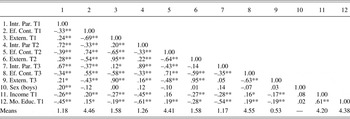
Zero-order correlations among constructs and covariates (N = 231)

Note: Int. Par., intrusive parenting; T1, Time 1 (30 months); Ef. Cont., child's effortful control; Extern., child's externalizing symptoms; T2, Time 2 (42 months); T3, Time 3 (54 months); Mo. Educ., mother's education. Correlations were taken from the MPlus output. See text for rating scales.
*p < .05. **p < .01.
Measures
Observed intrusive parenting
Intrusive parenting was measured using observations of mother–child interactions during the laboratory visits when the child was 30, 42, and 54 months of age. This single indicator latent variable included mothers’ intrusive behaviors during 3 min of free play and 3 min of a teaching task. During the free-play task, mothers were presented with a basket of toys and asked to play as they normally would at home. For the teaching task, mothers were instructed to teach their child to complete a puzzle (T1) or Lego model (T2 and T3) with whatever strategies they would use if at home. Mothers’ behavior during each task was rated for intrusiveness on a 4-point scale every 15 s during free play and every 30 s during the teaching task (1 = no overcontrolling behavior observed, 4 = extreme intrusive or overcontrolling behaviors). Mothers’ overcontrolling, intrusive behaviors included overstimulating the child with toys, employing intrusive physical interactions, or intervening to help the child when not required (alphas for the 18 codes = 0.72, 0.74, and 0.75 at T1, T2, and T3, respectively). Interrater reliabilities (intraclass correlation coefficients [ICCs]) were assessed for approximately 23% of the sample for the puzzle-task and were 0.71 (T1), 0.83 (T2), and 0.62 (T3). ICCs (based on 30% of the sample) for the free-play task were 0.81 (T1), 0.83 (T2), and 0.69 (T3).
EC
The latent variable for EC used three subscales (attention-focusing, attention-shifting, and inhibitory-control) from the Early Childhood Behavioral Questionnaire (ECBQ; Putnam, Gartstein, & Rothbart, Reference Putnam, Gartstein and Rothbart2006) at T1 and the Child Behavior Questionnaire (CBQ; Rothbart, Ahadi, Hershey, & Fisher, Reference Rothbart, Ahadi, Hershey and Fisher2001) at T2 and T3. Mothers and nonparental caregivers rated items at 30, 42, and 54 months on a scale ranging from 1 = never to 7 = always. Attention focusing is the ability to concentrate on a task and included 12 and 14 items from the ECBQ and CBQ, respectively, such as “When engaged in play with his/her favorite toy, how often did your child stay involved for 10 minutes or more?” (ECBQ) and “Sometimes becomes absorbed in a picture book and looks at it for a long time” (CBQ). Attention shifting is the ability to move attention from one activity to another and included 12 ECBQ or CBQ items, such as “After having been interrupted, how often did your child return to a previous activity?” (ECBQ) or “Has a lot of trouble stopping an activity when called to do something else.” (CBQ). Inhibitory control is the ability to voluntarily control behavior and included 12 ECBQ or 13 CBQ items such as “When told ‘no’, how often did your child stop the forbidden activity?” (ECBQ) or “Can lower his/her voice when asked to do so” (CBQ). Reliabilities for each subscale and each reporter ranged from 0.67 to 0.88 (mean = 0.78). Mothers’ and caregivers’ reports of overall EC were significantly correlated (rs = .18, .25, and .31, ps < .05, .01, and .01, at T1, T2, and T3, respectively). To reduce the number of indicators to 3, mothers’ and caregivers’ reports were combined for each subscale. Correlations between the three subscales at each time point ranged from .30 to .60 (mean = .46).
Different measures of EC were used because there was no measure that was age-appropriate across the age span in the study; however, EC scores for the measures tend to be substantially correlated from the toddler (ECBQ) to preschool (CBQ) years (e.g., .40 to .51; Putnam, Rothbart, & Gartstein, Reference Putnam, Gartstein and Rothbart2008). In later analyses, we employed constraints on factor loadings across times of measurement. To ensure that indicators would be on a sufficient scale for such constraints, we used statistics (means and standard deviations) of measures from T1 to standardize the three indicators of EC at T1 and used statistics (means and standard deviations) of EC measures at T2 to standardize the EC indicators at T2 and T3. Harmonizing of variables has become a topic of intense interest in integrative data analysis (Curran & Husong, Reference Curran and Husong2009; Hofer & Piccinin, Reference Hofer and Piccinin2009), and our standardization of indicators across the two versions of the questionnaire represent one approach to harmonization that enabled meaningful constraints to be invoked on factor loadings across time for the indicators of EC. With this form of standardization, equality constraints on factor loadings could be interpreted meaningfully.
Externalizing symptoms
The latent variable for externalizing symptoms used 12 items from the Aggression/Defiance Scale (items on defiance, relational defiance, dispositional aggression, and oppositional/defiant aggression) from the Infant and Toddler Social and Emotional Assessment (ITSEA; Briggs-Gowan & Carter, Reference Briggs-Gowan and Carter1998; Carter & Briggs-Gowan, Reference Carter and Briggs-Gowan1999; Carter, Briggs-Gowan, Jones, & Little, Reference Carter, Briggs-Gowan, Jones and Little2003). Items (“Is disobedient or defiant … refuses to do as you ask,” “Is stubborn,” “Has temper tantrums,” “Acts bossy,” “Misbehaves to get attention from adults,” “Is sneaky. Hides behavior,” “Acts aggressive when frustrated,” “Hits, bites, or kicks you,” “Swears,” “Is destructive. Breaks or ruins things on purpose,” “hurts animals on purpose,” “Purposefully tries to hurt you”) were rated from 1 (not true) to 3 (very true or often true) and were averaged. To be consistent with Carter and Briggs-Gowan (Reference Carter and Briggs-Gowan2006), we converted the data to a 0–2 scale. Mothers, fathers, and nonparental caregivers each reported on children's aggressive/defiance at 30, 42, and 54 months. Alphas for the combined scales for each reporter at the three time points ranged from 0.72 to 0.85 (mean = .79). Mothers’, father, and caregiver reports of children's externalizing symptoms were significantly correlated at all time points and ranged from r = .25, p < .01 to r = .50, p < .01 (mean = .38).
Control variables
The following variables were included in the analysis: sex (0 = girls, 1 = boys), mothers’ education level (1 = grade school to 7 = PhD or MD), and household income (1 = less than $15,000 to 7 = over $100,000). Means are shown in Table 1.
Analysis strategy
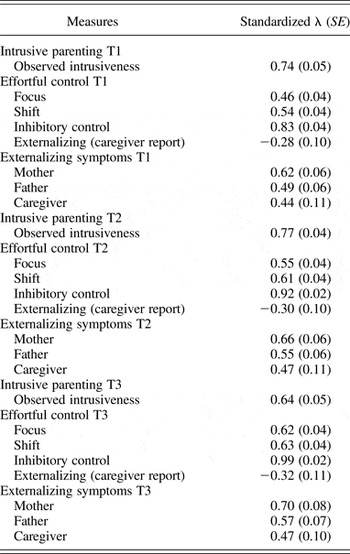
We first examined correlations among the variables (Table 1). We then used structural equation modeling to evaluate the statistical model (Figure 1) using the Mplus software program, Version 6 (Muthén & Muthén, Reference Muthén and Muthén2010). We specified a structural equation model with nine constructs and three control variables (Figure 1). Factor loadings for the indicators of each latent variable are shown in Table 2. Intrusive parenting was a single-indicator latent variable, EC was estimated from the three CBQ subscales, and externalizing problems were estimated with mothers’, fathers’, and caregivers’/teachers’ reports. When fitting structural models, the caregiver/teacher indicator of child externalizing was allowed to have a secondary loading on the EC factor at each time of measurement; secondary loadings of this sort are often required, as recognized in early work on exploratory factor analysis (Thurstone, Reference Thurstone1947) and recently discussed in the context of confirmatory factor analysis (Widaman, Reference Widaman, Cooper, Camic, Long, Panter, Rindskopf and Sher2012; Widaman & Grimm, Reference Widaman, Grimm, Reis and Judd2014). When modeling relations among primary mental ability factors, Widaman (Reference Widaman, Cooper, Camic, Long, Panter, Rindskopf and Sher2012) demonstrated that correlations among the factors were lessened and presumably less biased when allowing secondary loadings for 2 of 12 indicators. In the current application, allowing the secondary loading led to a lower, and thus presumably less biased, estimate of the correlation between the EC and child externalizing latent variables, and the secondary loading was subjected to the same invariance constraints across time as for the primary loadings.
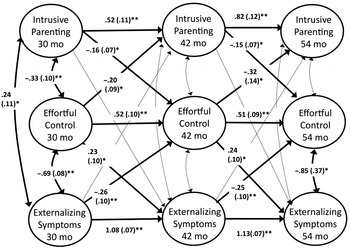
Results of structural equation model (N = 231). χ2 (214, N = 231) = 299.86 p > .05; root mean square error of approximation = 0.042, 95% CI = (0.030, 0.052), comparative fit index = 0.950, and Tucker–Lewis index = 0.936. *p < .05, **p < .01 (two-tailed test). Results are standardized coefficients with standard errors in parentheses. Dotted lines are nonsignificant paths. Control variables (sex, household income, and mothers’ education) were assessed on all variables. Factor loadings and beta pathways for constructs were constrained to be equal; however, standardized coefficients are shown in the figure.

Factor loadings for latent variables (N = 231)

Note: All loadings were significant at p < .001.
To address the issue of missing data (which was relatively limited; see sample sizes above), we used full information maximum likelihood, which involves the fitting of covariance structure models directly to the raw data from each participant subjects with missing data and has been found to be efficient and unbiased when data are missing completely or are missing at random (Arbuckle, Reference Arbuckle, Marcoulides and Schumacker1996). To evaluate the fit of a structural model to data, we used the standard chi-square index, as well as the root mean square error of approximation (RMSEA; Browne & Cudeck, Reference Browne, Cudeck, Bollen and Long1993), the comparative fit index (CFI; Bentler, Reference Bentler1990), and the Tucker–Lewis index (TLI; Tucker & Lewis, Reference Tucker and Lewis1973). The RMSEA is an absolute index of fit with values under 0.05 indicating a close fit to the data. For the CFI and TLI, fit index values should be greater than 0.90 to consider the fit of a model to data to be acceptable (Bentler & Bonnett, Reference Bentler and Bonnett1980).
Results
Preliminary results
None of the variables had high levels of skew or kurtosis. Zero-order correlations (computed in MPlus) are shown in Table 1, and were largely as expected. Intrusive parenting was negatively associated at all time points with children's EC. Intrusive parenting was mainly positively associated with externalizing symptoms (both concurrently and across time). EC and externalizing symptoms were negatively correlated concurrently and across time. Child sex (for boys) was positively significantly correlated with intrusive parenting at T1. Correlations between our variables of interest and income and mother's education were as expected (e.g. intrusive parenting was negatively associated with income and education).
Structural equation results
We fit a series of structural models to the data. In our baseline model, termed Model 1, we constrained factor loadings to be invariant across time so that the same latent variables were identified at each time of measurement. In addition, the three control variables (child sex, maternal education, and family income) and the three core constructs of parental intrusiveness, EC, and child externalizing behavior, were allowed to covary freely at T1; the three control variables were specified as predictors of the three core constructs at T2 and at T3; and the longitudinal stability and lagged relations among the three core constructs shown in Figure 1 were also estimated freely. Model 1 had quite acceptable fit to the data. Although the statistical index of fit showed significant model misfit, χ2 (199, N = 231) = 289.80, p < .01, all practical fit indices provided evidence that the model fit the data closely, with RMSEA = 0.045, 95% CI = (0.033, 0.055), and CFI and TLI of 0.947 and 0.927, respectively.Footnote 1
In Model 2 we constrained all paths between core constructs from T1 to T2 to be invariant with comparable paths between constructs from T2 to T3. That is, we constrained the stability coefficient of parent intrusiveness from T1 to T2 to be identical to the stability coefficient for parent intrusiveness from T2 to T3. Similar constraints on stability coefficients for EC and for child externalizing behaviors were also invoked. In addition, comparable lagged coefficients were also constrained to invariance. Thus, the path coefficient from parent intrusiveness at T1 to child EC at T2 was constrained equal to the path coefficient from parent intrusiveness at T2 to child EC at T3. Again, comparable constraints were placed on all path coefficients from T1 to T2 with comparable paths from T2 to T3. As shown in Figure 1, a total of nine paths are shown among the core constructs from T1 to T2 (three stability paths and six cross-lagged paths), and nine comparable paths are shown from T2 to T3. In Model 1, all 18 of these paths were freely estimated; in Model 2, only 9 constrained estimates of these path coefficients were made. Model 2 once again had a significant statistical index of model misfit, χ2 (208, N = 231) = 297.19, p < .01. However, the practical fit indices indicated improved fit of the model to the data, with RMSEA = 0.043, 95% CI = (0.031, 0.054), and CFI and TLI of 0.948 and 0.931, respectively. Furthermore, the difference in fit between Models 1 and 2 was nonsignificant, Δχ2 (9, N = 231) = 7.39, ns, indicating that the path coefficients from T1 to T2 did not differ significantly from comparable path coefficients from T2 to T3.
In Model 3, we constrained path coefficients from the child sex control variable to the three core constructs at T2 and T3 to zero. Child sex had a relatively small but significant correlation with parent intrusiveness at T1, r = .22 (SE = 0.10), and with EC at T2, r = .15 (SE = 0.075), but it was not significantly correlated with other core variables at T2 or T3. Therefore, paths coefficients from child sex to the core variables at T2 and T3 were fixed at zero. The statistic index of fit for Model 3 was significant, χ2 (214, N = 231) = 299.86, p < .01, but the practical fit indices were again improved, RMSEA = 0.042, 95% CI = (0.030, 0.052), and CFI and TLI of 0.950 and 0.936, respectively. Furthermore, the difference in fit between Models 2 and 3 was nonsignificant, Δχ2 (6, N = 231) = 2.67, ns, indicating that the relations between the child sex covariate and the core constructs were essentially nil in magnitude. Because mother education and family income were significantly related to core constructs at T2 and T3, we opted to retain Model 3 as our final model, leaving intact all statistical controls for mother education and family income on relations shown in Figure 1.
Stability paths and concurrent relations
As shown in Figure 1, the three core constructs of parent intrusiveness, EC, and child externalizing were fairly stable across the three time points. As noted above, stability paths from T1 to T2 were constrained equal to comparable paths from T2 to T3; because path coefficients shown in Figure 1 are standardized coefficients, the stability paths appear to differ slightly across time. Still, parent intrusiveness was quite stable across the two time points (see Figure 1). Child EC was the least stable but still moderately stable. Child externalizing problems exhibited the highest level of stability, with simple correlations of r = .95 from T1 to T2 and from T2 to T3 (see Table 1). All three core constructs were significantly correlated at T1, but only EC and child externalizing had significant residual correlations at T2 and T3.
Cross-lagged paths
Turning to cross-lagged paths, consider first the parent-to-child paths. In Figure 1, parent intrusiveness can have predictive effects on two child variables—EC and externalizing—at the next time of measurement. As shown in Figure 1, the effect of parent intrusiveness on child EC was significant and negative both from T1 to T2 (β = –0.16, SE = 0.07), and from T2 to T3 (β = –0.15, SE = 0.07). Thus, higher levels of parent intrusiveness were associated with lower levels of later child EC, holding constant prior levels of child EC. The path coefficient from parent intrusiveness to child externalizing problems was nonsignificant for both the T1–T2 and T2–T3 lags.
The next set of path coefficients to evaluate was the child-to-child paths. As shown in Figure 1, child EC and child externalizing problems had possible cross-lagged relations between consecutive times of measurement. The child externalizing to later child EC paths were significant and negative from both T1 to T2 (β = –0.26, SE = 0.10), and from T2 to T3 (β = –0.25, SE = 0.10). Thus, as hypothesized, higher levels of child externalizing were associated with lower levels of later child EC, holding constant prior levels of child EC. The path coefficients from EC to later child externalizing were significant and positive from T1 to T2 (β = 0.23, SE = 0.10), and from T2 to T3 (β = 0.24, SE = 0.10). Thus, higher levels of EC were associated with higher levels of later child externalizing, holding constant prior levels of child externalizing. These paths were in the direction opposite from that hypothesized, as we had expected that, should these paths be significant, they would be negative, indicating that child EC has a dampening effect on later child externalizing.
The final sets of path coefficients to consider are those associated with child-to-parent paths. Child EC and child externalizing could each have a predictive effect on parent intrusiveness at the next time of measurement. This effect was significant for EC from T1 to T2 (β = –0.20, SE = 0.09), and from T2 to T3 (β = –0.32, SE = 0.14); high levels of children's EC predicted lower levels of intrusive parenting a year later. The direct effect of child externalizing to parent intrusiveness was not statistically significant at either the T1–T2 or T2–T3 lags. Finally, the indirect effect of child externalizing at T1 on parent intrusiveness at T3 mediated by child EC at T2 (indirect effect = 0.082) was nonsignificant, bootstrapped 95% CI = (–0.21, 0.38).
Control variables
Intrusive parenting at T1 was significantly positively correlated with child sex (r = .20, SE = 0.10. p < .05; boys received higher levels of intrusive parenting), and negatively correlated with income (r = –.26, SE = 0.10. p < .05) and mothers’ education (r = –.45, SE = 0.01. p < .01). Child EC was significantly correlated only with income (r = .20, SE = 0.08, p < .05), and was nonsignificantly correlated with sex and mothers’ education. Externalizing symptoms at T1 was negatively correlated with education (r = –.19, SE = 0.09. p < .05) and income (r = –.27, SE = 0.09. p < .05). Education was positively related to income (r = .61, SE = 0.04. p < .01) and predicted less intrusive parenting at T2 (β = –0.28, SE = 0.11, p < .01).
Discussion
In the present study, we examined bidirectional relations among maternal intrusive parenting, children's EC, and children's externalizing problems in a longitudinal panel study from age 30 to 54 months. We obtained evidence for both parent and child effects; however, some mediated relations that might be expected based on prior work with older children were not obtained.
Child effects
Overall, we found moderate evidence for child effects in the preschool years. Children's EC at both 30 and 42 months inversely predicted mothers’ intrusive parenting across 1-year lags. These relations were found when controlling for stability in the variables and including correlations among variables within time. In contrast, no direct paths from externalizing symptoms to intrusive parenting were found, although the two constructs were inversely correlated at 30 months. Of course, the data are essentially correlational and cannot prove causal relations, but the stringent longitudinal model renders causal assumptions more plausible than in most prior studies.
Low levels of children's EC might evoke intrusive parenting in a number of ways. Children low in EC are less likely than other children to have high-quality, supportive relationships (see Choe et al., Reference Choe, Olson and Sameroff2013a; Eisenberg et al., Reference Eisenberg, Fabes, Shepard, Guthrie, Murphy and Reiser1999). It is also likely that dysregulated children tend to evoke coercive and hostile responses (e.g., Patterson, Reference Patterson1982), which would be expected to undermine the quality of discipline and teaching in the given context, to increase children's arousal in the context, and to alter adults’ expectations for the child and their typical response to children's behavior. If unregulated children elicit an environment that is not conducive to the further growth of EC, mothers may become more controlling over time with their children because they find it easier to direct them than to use more sensitive parenting techniques. Children with low EC might also tend to be highly aroused because of difficulties in modulating their emotion; such arousal would be expected to undermine learning in those social contexts (Eisenberg et al., Reference Eisenberg, Cumberland and Spinrad1998; Hoffman, Reference Hoffman2000). The findings in this study are consistent with those in the same sample (Eisenberg, Vidmar, et al., 2010) indicating that children with relatively low EC tend to be exposed to more directive and less sensitive verbal teaching procedures over time in a mother–child teaching task.
The finding of prediction by EC of later intrusive parenting at 42 and 54 months differs from findings in Taylor et al. (Reference Taylor, Eisenberg, Spinrad and Widaman2013) using the same sample. One major difference between the Taylor study and the current study was the child age span included in the analyses: the former study concerned links among variables between 18 and 42 months of child age, whereas the present study modeled relations from 30 to 54 months of age. Individual differences in children's EC might become more salient and stable aspects of behavior as children develop during the preschool years. Because children attain more stable levels of self-control and autonomy with age, their behavioral patterns might have a more consistent impact on other variables in the system, including on intrusive parenting. Thus, inclusion of the children at an older age could account for the appearance of these predictive paths in the current study. A second difference across studies was the child behavioral outcome: the prior study used ego resiliency as the child variable, whereas the present study used externalizing problems. Predictive effects of EC on intrusive parenting that are found in the context of externalizing problems might have been masked in some fashion when ego-resiliency was included in the model because EC mediated the relation of ego resiliency to intrusive parenting.
Although children's externalizing problems predicted lower levels of their EC and EC in turn predicted less intrusive parenting, the path from externalizing problems to intrusive parenting was not mediated by EC. Nonetheless, that children with externalizing symptoms had lower EC a year later in our stringent panel design suggests externalizing problems may have broad effects on children's behavior by undermining their EC. If this is true, it is likely that externalizing problems have some effects on children's social environment, including aspects of parenting because, as already discussed, children low in EC are likely to evoke negative responses from others, resulting in a suboptimal socialization environment.
The positive relations of EC to externalizing problems are difficult to interpret with certainty. Perhaps the positive valence of these path coefficients reflects the possibility that children with high EC are adept at executing externalizing behaviors in a calculating fashion (although not all the externalizing items tap calculated behavior). It is also possible that if children are high in EC, parental perceptions of the degree to which children's externalizing problems are willful increase over time. However, because the zero-order correlations between EC at T1 or T2 and later child externalizing (at T2 and/or T3) were strongly negative (see Table 1), it is very likely these paths reflect a suppression effect rather than a reliable finding.
Parent effects
In terms of parent effects, intrusive parenting at 30 and 42 months predicted EC a year later, although EC did not in turn predict lower externalizing problems a year later (recall these were the pathways with suppression effects). This pattern of findings is consistent with the view that intrusive parenting undermines EC across time. These findings are also consistent with findings in the same sample by Taylor et al. (Reference Taylor, Eisenberg, Spinrad and Widaman2013) for the 30- and 42-month data; however, the authors of that prior article did not examine the relation of intrusive parenting at 42 months to EC at 54 months (or to externalizing problems). The two different cross-lagged paths from intrusive maternal behavior to children's EC in the present study suggest that the effects of intrusive parenting on EC are ongoing over a considerable period of time. Moreover, the negative effects of intrusive parenting on children's EC appear to cycle back to further increase intrusive mothering (and vice versa).
It is interesting that intrusive parenting at 30 months predicted higher EC at 42 months, whereas (Eisenberg, Spinrad, Eggum, Silva, et al., Reference Eisenberg, Spinrad, Eggum, Silva, Reiser and Hofer2010) found that 30-month supportive/unsupportive parenting (rather than intrusive parenting) did not have an additional predictive effect on 42-month EC after accounting for relations at younger ages. Perhaps intrusive parenting is more detrimental than less supportive parenting during the third year of life when EC is rapidly developing. Intrusive parenting would be expected to directly curtail the child's autonomy of action, which may be especially important to children's emerging EC at this age.
The lack of prediction of externalizing problems from intrusive parenting may be due to the age of the children in the present study. Perhaps by school age or adolescence, intrusive parenting is resented more by offspring and thus has a direct effect on externalizing problems. Alternatively, intrusive parenting might have negative effects on externalizing problems, or vice versa, prior to age 30 months, which could account partly for the substantial negative relation between EC and externalizing problems already present by 30 months.
This lack of across-time predictive positive relations between lower quality of parenting and children's externalizing problems is inconsistent with results from studies of supportive parenting of older children. In studies of children approximately 5 years old to preadolescence, researchers have found an inverse relation of high-quality, supportive parenting with later externalizing problems that is mediated by level of children's EC (e.g., Belsky et al., Reference Belsky, Fearon and Bell2007, Eisenberg et al., Reference Eisenberg, Zhou, Spinrad, Valiente, Fabes and Liew2005; Valiente et al., Reference Valiente, Eisenberg, Spinrad, Reiser, Cumberland and Losoya2006). However, Spinrad et al. (Reference Spinrad, Eisenberg, Gaertner, Popp, Smith and Kupfer2007), using longitudinal panel models, did not find that supportive parenting had a significant relation to externalizing problems across time (although they found predictive effects for social competence). The relation found between positive parenting and low levels of externalizing behavior during the elementary school years in other research might be due to supportive, positive parents engaging in a somewhat different and more sophisticated array of scaffolding, modeling, teaching behaviors (e.g., modeling constructive coping, helping children to learn methods for regulating emotions, discussing emotions and their regulation; see Eisenberg et al., Reference Eisenberg, Cumberland and Spinrad1998; Gottman et al., Reference Gottman, Katz and Hooven1997; Power, Reference Power2004) than those used by mothers of toddlers/preschoolers, behaviors that foster aspects of EC that are especially relevant for curbing externalizing problems.
Overall, the results of the present study suggest that intrusive parenting, like supportive parenting, is correlated with externalizing problems over time but does not actually cause them in the early years of life. Perhaps some components of parenting have different effects on children's externalizing problems depending on the developmental level of children and the types of externalizing problems prevalent at a given age. For example, indices of toddlers’ and young preschoolers’ aggression/defiance may be less severe than those assessed with older children and thus relate less to parenting quality. In future work, it would be useful to examine multiple measures of parenting as additive and unique predictors of children's problem behaviors (and mediation of these parenting effects by EC).
Consistent with the findings of Spinrad et al. (Reference Spinrad, Eisenberg, Gaertner, Popp, Smith and Kupfer2007) using 18- and 30-month assessments, EC did not negatively predict young children's externalizing problems over time when controlling for prior levels of externalizing. Perhaps EC reduces maladjustment only after children's EC is fairly sophisticated and mature. However, it is noteworthy that EC and externalizing problems in the present study were significantly negatively related at the first and third assessments in the structural equation panel model even when taking into account the prediction of EC by externalizing problems across time. This pattern of findings suggests that EC and externalizing behavior could be inversely affecting one another within time. However, correlations within time might also reflect emerging genetic factors affecting both EC and externalizing problems; alternatively, they could result from parents’ geneotypes affecting their parenting, with parenting then affecting both EC and externalizing problems over time. In line with the former possibility, Lemery-Chalfant, Dolger, and Goldsmith (Reference Lemery-Chalfant, Doelger and Goldsmith2008) found that shared additive genetic influence accounted for much of the covariation between self-regulation and elementary school children's symptoms of psychopathology. Such a genetic effect differs from the evocative genetic effect that probably partly explains the prediction of intrusive parenting from both EC and externalizing problems. Consistent with the notion of an evocative effect, Pener-Tessler et al. (Reference Pener-Tessler, Ivinun, Uzefovsky, Edelman, Ebstein and Knafo2013) reported an evocative effect whereby boys’ self-regulation mediated the relation of the serotonin transporter linked polymorphic region gene (5-HTTLPR) on parental positivity.
Because of the high relation between the latent constructs of externalizing problems and EC, one might question whether these are different constructs. However, as previously noted, temperamentally based EC generally has been seen as a predictor of, or contributor to, externalizing problems, not as the same construct. Moreover, in the present study, zero-order correlations between the three indicators of EC (attention focusing, attention shifting, and inhibitory control) and the three reports of aggression/defiance (mother, father, caregiver) ranged from –0.01 to –0.49 at 30 months (M = –0.27), from –0.17 to –0.53 at 42 months (M = –0.35), and –0.09 to –0.61 (M = –0.34) at 54 months, suggesting only modest to moderate associations between the two constructs.
In the structural equation model, intrusive parenting, EC, and externalizing were all quite stable across time. Although stability was expected (see introductory section; e.g., Eisenberg, Spinrad, Eggum, Silva, et al., Reference Eisenberg, Spinrad, Eggum, Silva, Reiser and Hofer2010; Taylor et al., Reference Taylor, Eisenberg, Spinrad and Widaman2013), such stability would make it more difficult to obtain predictive effects over time when controlling for the stability of the constructs. Thus, the number of significant findings in the longitudinal model is more than what might have been expected.
Strengths and weaknesses
Strengths of the study include the use of multiple methods and reporters and a stringent panel design. However, as previously noted, even the use of such a structural equation panel model does not allow for strong conclusions regarding causal relations among variables. A weakness of the study is that the measure of EC differed somewhat at 30 and 42 months; however, this did not seem to be a major problem because we were able to constrain the factor loadings to be equal across time in the structural equation model in a model with a good fit (using a harmonization procedure). In addition, the raters of EC and externalizing problems were the same (although multiple raters were used). Moreover, although the sample was relatively diverse, it included primarily working and middle-class families and the majority of families were Caucasian (non-Hispanic). Thus, the results might not generalize to low socioeconomic families or some minority groups. Moreover, we did not assess fathers’ intrusive parenting, and its relations to young children's regulation and EC may differ from mothers’ intrusive parenting (Kochanska, Kim, Boldt, & Yoon, Reference Kochanska, Kim, Boldt and Yoon2013; Stevenson & Crnic, Reference Stevenson and Crnic2013). It would be useful to consider both mothers’ and fathers’ intrusive parenting simultaneously in future research.
Relevance to the issue of the influential child
In summary, the findings of this study support child effects in the relation between EC and intrusive parenting, as well as a predictive effect of intrusive parenting on children's EC. The data provide some evidence of bidirectional effects. In contrast, there was no evidence for direct effects of parenting on externalizing symptoms or evidence that EC mediated the positive relation between intrusive parenting and externalizing problems in the preschool years. However, relations between EC and externalizing problems within time at T1 and T3 (even when controlling for stability of the variables and the effects of externalizing on EC over time) suggest that EC or externalizing symptoms (or both) inversely affect one another within time, at least at some ages. The general pattern of findings, in comparison to findings with older children, suggests that causal relations among parenting, EC, and externalizing problems might change with age of the child. Consideration of the role of development and transitions (e.g., entry into school) in the pattern of relations among parenting, EC, and externalizing might be a fruitful direction for future inquiry.
Implications for developmental psychopathology
Because we used the ITSEA to assess externalizing symptoms, which does not have clinical cut-off points at 54 months (although Alice Carter indicated that the scale works well at that age), we were unable to assess if the children in our study had clinical levels of externalizing problems at the last assessment. However, Carter and Briggs-Gowan (Reference Carter and Briggs-Gowan2006) present scores for 30- to 35-month-old children in the top 10% in their sample in terms of problem behaviors: those considered at clinical risk by Briggs-Gowan and Carter (Reference Briggs-Gowan and Carter2001) or “of concern” (Carter & Briggs-Gowan, Reference Carter and Briggs-Gowan2006). Those children had average scores of 0.79 for girls and 0.81. In our sample, at 30 months the percent of children with scores at or above these cutoffs were, for mothers’, fathers’, and caregivers’ reports, 29.5%, 11.9%, and 14.9% for girls and 25%, 31.0%, and 18.3% for boys. Thus, our sample was at fairly high risk, although the high scores are partly due to our 30-month-old subjects being on the lower end of the age range (e.g., cut off scores for 24- to 29-month-olds were somewhat high, being 0.82 and 0.95, respectively, for girls and boys). Given the stability of externalizing problems on the ITSEA over the early years, there is reason to expect that some of the children in the study would eventually be diagnosed with externalizing problems. Moreover, given the current emphasis on the dimensional nature of psychopathology, findings regarding the correlates of externalizing symptoms are important to understanding the emergence of externalizing problems and their effects on children's social environment and self-regulation. Nonetheless, in future studies, it would be useful to examine the same issues as in this study in a sample containing substantial numbers of children who develop clinical levels of psychopathology.
Despite the nonclinical nature of the sample, our findings suggest that externalizing symptoms in the early years might undermine the emergence of children's EC. Consequently, children with early externalizing problems would be expected to be at risk for subsequent maladjustment because of the potential effects of their externalizing behaviors on their subsequent development of self-regulatory skills. Factors that undermine EC are especially important because of the fundamental role that EC is believed to play in many types of psychopathology (e.g., Moses & Barlow, Reference Moses and Barlow2006). Moreover, as already noted, that early externalizing problems were correlated with both quality of parenting and EC at the first assessment also indicates that the development of externalizing symptoms could be affected by socialization prior to 30 months and by rudimentary EC capabilities, or might affect early intrusive parenting. Research is needed to chart relations among parenting quality, EC, and externalizing problems in the first few years of life and their prediction of clinical problems at older ages.
Future directions for translating research on the influential child into preventive interventions
Because of the lack of the expected pattern of prediction of externalizing problems by either EC or parenting, suggestions for interventions to prevent externalizing problems must be nuanced. Nonetheless, parental awareness of how their child's EC could affect their parenting, and the negative effects of intrusive parenting more generally, could be heightened in prevention/intervention programs. This suggestion is further supported by the finding that intrusive parenting predicted (inversely) children's EC across time because low self-regulation has been implicated in a number of disorders. Moreover, there is some evidence that warm/supportive parenting predicts EC and low externalizing problems over time, especially in the elementary school years. Such findings provide some support for implementing programs that promote warm, sensitive parenting. In addition, because of the prediction of intrusive parenting by low EC, efforts to promote children's EC could foster mother–child interactions that are associated with children's healthy development more generally. Similarly, the findings suggest that interventions that reduce children's externalizing problems might also enhance their EC, which would be expected to have positive effects on a number of domains of functioning. Given the stability of externalizing symptoms, EC, and parenting quality in this study across the preschool years, the findings suggest that it is important to identify factors affecting externalizing problems prior to 30 months of age so that successful interventions can be implemented in the toddler years.