Introduction
An experience of shared reality, in which older parents live with abusive adult children, is known as part of the elder abuse phenomenon (Lachs and Pillemer, Reference Lachs and Pillemer2004). It is estimated that between 35% and 75% of adults with mental illness reside with family members, especially parents (Kaufman et al., Reference Kaufman, Scogin, MacNeil, Leeper and Wimberly2010). The purpose of this paper is to describe the daily aging experience of parents abused by an adult child with mental disorder, its impact on their life, and the challenges they confront in this shared reality.
Aging parents caring for an adult child coping with mental disorder
In recent decades, social and medical changes have impacted the lives of people with mental disorders. These changes have included deinstitutionalization, which has contributed to the integration of the mentally ill into the general community, new drug treatments, and greater access to social resources (Cook et al., Reference Cook, Cohler, Pickett and Beeler1997). As a result of these changes, people with mental disorders who previously lived in various forms of institutionalized arrangements are now residing in the community, often with their parents (Saunders, Reference Saunders2003).
As parents age, they confront the dual stressors of the ongoing care for their child, while dealing with their own aging-related changes in health and functioning, such as physical disability and greater vulnerability to illness (Lefley, Reference Lefley and Cohen2003). Baltes and Baltes (Reference Baltes, Baltes, Baltes and Baltes1990) mention that these aging challenges are dealt with using three major mechanisms: selection, optimization, and compensation. In the process of selection, people choose their goals while considering the resources at hand. The optimization process leads them to re-evaluate the means and the resources available for achieving these goals, and finally, in the process of compensation, people are occupied with maintaining quality of life while compensating for lost resources and for goals that have lost their meaning. This model puts the special needs of old age as elder persons’ first priority as they attempt to make the transition into aging easier.
Sharing a household with adult children with mental disorder requires the resumption of parent's role as active caretakers, regardless of their age and of their physical and mental condition (McGarry and Arthur, Reference McGarry and Arthur2001, p. 182). Studies dealing with older parents of adults with mental disorder suggest that these parents experience greater levels of caregiver burden (Greenberg et al., Reference Greenberg, Seltzer and Greenley1993; Cook et al., Reference Cook, Lefley, Pickett and Cohler1994), poorer health (Seltzer et al., Reference Seltzer, Greenberg, Floyd, Pettee and Hong2001; Ghosh and Greenberg, Reference Ghosh and Greenberg2009), higher rates of chronic health conditions (Magaña et al., Reference Magaña, Greenberg and Seltzer2004), neglect of health, and higher risk of mortality (Addington et al., Reference Addington, McCleery and Addington2005), and elevated levels of general medical symptoms (Seltzer et al., Reference Seltzer, Greenberg, Floyd, Pettee and Hong2001) compared to other parents.
A life course perspective as a theoretical framework addressing parents caring for adult children with mental disorder
Several researchers have highlighted the usefulness of a life course perspective in describing the impact of mental illness on families (Cook et al., Reference Cook, Cohler, Pickett and Beeler1997). This perspective is a theoretical framework that focuses on the historical–social process of families and the individual. It examines how individuals change over time, and how transitions and life paths are linked by way of various family subsystems over the course of their lives (Elder, Reference Elder and Jr1998). Age norms delineate activities appropriate to each stage of life providing a sense of when people should accomplish major social role transitions such as living independently from parents, obtaining employment, getting married, having children, and retiring from work (Elder, Reference Elder and Jr1998). The accomplishment of these life tasks is not a given for people with mental disorder. Some do achieve them, whereas others do not integrate into society due to a lack of ability, skills, and social opportunities (Cook et al., Reference Cook, Cohler, Pickett and Beeler1997; Stein and Wemmerus, Reference Stein and Wemmerus2001).
Elder abuse and an adult child with mental disorder
A close examination of this growing population of aging parents indicates that some of them are living in high-risk situations where they have to contend with unpredictable, often aggressive behavior from their adult child with mental disorder.
The World Health Organization and the International Network for the Prevention of Elder Abuse (2001) define elder abuse as: “A single, or repeated act, or lack of appropriate action, occurring within a relationship where there is an expectation of trust which causes harm or distress to an older person.” Elder abuse can take various forms, such as physical, psychological/emotional, sexual, and financial abuse.
Studies refer to the deviant behavior of adult children with mental disorder in relation to their relatives who support and care for them, and report experiences such as verbal and physical abuse, including shouting, swearing, threats, and serious injuries (Vaddadi et al., Reference Vaddadi, Gilleard and Fryer2002). Between 15% and 19% of patients admitted to a locked psychiatric unit had assaulted another person within two weeks of admission. More than half of these assaults were against family members, primarily parents and spouses (Binder and McNiel, Reference Binder and McNiel1986; Straznickas et al., Reference Straznickas, McNiel and Binder1993). The existence of such interactions described by other researchers (Vaddadi et al., Reference Vaddadi, Gilleard and Fryer2002, p. 151) indicates that 32% to 40% of family members had been assaulted by their relative with mental disorder.
Various explanations are given for this violent behavior among persons with mental disorders; those include the person's aggressive temperament, a lack of self-control, psychopathic personality, and feelings of rage and anger (Monahan and Steadman, Reference Monahan and Steadman1994). Other researchers emphasize the relationship dynamics as a major factor in the etiology of the violent behavior. These researchers use the theory of co-dependency in order to explain the relationships between an abused parent and his abusive child (Wolf, Reference Wolf1996; Lachs et al., Reference Lachs, Williams, O’Brien, Hurst and Horwitz1997). Codependency refers to a relationship in which a person is controlled or manipulated by another who is affected with a pathological condition (Davis, Reference Davis2009). In this context the victim is strongly dependent on the abuser. Codependent individuals are also more likely to attract further abuse from aggressive individuals, more likely to stay in stressful relationships, and less likely to seek medical attention when needed (Sadock et al., Reference Sadock, Kaplan and Sadock2007).
The relationship dynamics between older parents and their adult children with mental disorder have been poorly documented. A possible reason for this is that until the past decade, investigation of the association of violence and mental disorders were generally restricted to inpatient settings (Solomon et al., Reference Solomon, Cavanaugh and Gelles2005).
The body of knowledge about elder abuse and families with adult children with mental disorder has evolved as two separate topics. The few studies that have attempted to address them as a unified theme did not focus on the subjective aging experience of the parents living in a shared reality with abusive adult children with mental disorder and its impact on their aging process.
In light of this gap in the literature, the main research questions of the present study were as follows: How do parents experience their aging process in the context of being abused by their adult children with mental disorder? How do they describe the influence of the aging process on the relationship dynamics? How does living in such shared reality impacts their aging needs?
Method
This study was qualitative and was inspired by the phenomenological approach (Smith et al., Reference Smith, Flowers and Larkin2009). The aim of the study was to describe the daily aging experience of parents abused by an adult child with mental disorder and the challenges they confront in this shared reality. The qualitative phenomenological approach is useful for studying sensitive topics, which involve self-disclosure by the participants (Dickson-Swift et al., Reference Dickson-Swift, James, Kippen and Liamputtong2007). In the present context, the sensitive topic was the impact of the encounter with elder persons subjected to violence and abuse by their children.
Sample and participants
The study used a purposive sample of “information rich” informants (Patton, Reference Patton2002), meaning focusing on the selection of participants who best represent their population and best reveal the studied phenomenon (Mason, Reference Mason1996). Thus, the sample included 16 parents (11 mothers and five fathers), all Israeli citizens, ranging in age from 58 to 94 years. This wide age range is part of the concept of purposive sample which enables capturing the lived experience of the phenomenon.
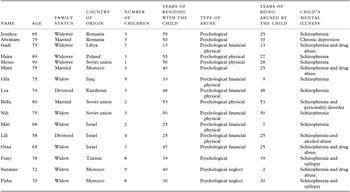
Participants were all parents coping with abuse by their adult children with mental disorder. The sampling criteria were that they be Hebrew-speakers, with no cognitive deterioration, and good verbal capabilities. Most of the participants that were initially approached agreed to take part in the study, except one woman who refused to participate and one man that did not feel well at the time the interview took place. All participants were recognized by the welfare services as individuals exposed to abuse and mistreatment at the hands of their adult children coping with mental disturbance. Participants had medium to low income rates and most of them were secular, with basic education level and deteriorating health status (Table 1).
Characteristics of the participants and their adult children

The final sample size (16 participants) was determined according to the theoretical saturation principle, meaning that saturation was reached when the researcher gathers data to the point of diminishing returns or when no new information was being added (Green and Thorogood, Reference Green and Thorogood2006; Bowen, Reference Bowen2008).
Data collection
For the purpose of this study, an interview guide was developed, covering several domains: the nuclear family, parent−child relations over the life course (for example: If I ask you to choose three things you can say about your family and your parenthood, what will you choose?); abusive relationships over the years (for example: How do you experience your relationship with the abusive child throughout the years in comparison to the relationship with your other children?); abusive relationships in parents’ later years (for example: Now that your child is an adult and you are aging, how do you characterize your relationship?).
The interviewers encouraged the participants to narrate their stories from a reflective position. In so doing, the participants constructed their narratives according to their temporal, relational, and spatial shifts and flow of experiences, while elaborating on issues that they perceived as essential for understanding the subject under study.
Procedure
The data presented in this paper were drawn from a wide-scale study conducted by researchers from the University of Haifa. Participants were recruited through welfare agencies. One of the researchers is a social worker engaged closely with the elder population, and is well-trained in forming therapeutic alliance with abused old parents. Nevertheless, the recruitment of participants lasted a year because the sample criteria which included cohabitation with the adult child with mental disorder, exposure to violence, and un-deteriorated cognitive statues, caused a long duration of candidate detection for the study. The identification of elder persons who met these criteria was part of the gerontological social worker expertise. Another reason for this long duration of candidate recruitment was that social workers that were approached sometimes served as “gatekeepers” thus refusing to collaborate with the study. The researchers explained the aim of the study and asked for older parents who are abused by their adult children with mental disorder to participate. The social workers provided a list of potential participants. Subsequently, each researcher contacted them directly by telephone, introducing themselves and seeking their consent to be interviewed. This introductory telephone conversation was essential for informing the participants of the topic of inquiry and establishing an initial rapport and trust. The interviews took place at the participant's location of choice following signing a consent form. In most cases, this was the participant's home, or in public locales (such as parks and cafés). It lasted approximately an hour and a half. Each interview was tape-recorded and later transcribed verbatim.
Data analysis
Data analysis was performed according to the phenomenological method. First, to establish “bracketing,” the researchers reflected on their experiences, biases, and prejudices regarding elder abuse and mental illness (Gearing, Reference Gearing2004). Three researchers were involved in analyzing the data. Each researcher, separately, then conducted thematic content analysis of the data prior to a joint comparative examination of the individual analyses. The analysis was performed using horizontal coding process by finding statements about the participants’ experiences with the phenomenon, e.g. identifying perceptions about aging and feelings about the adult child. The next step was grouping the statements into units of meaning, including quotes to describe the participants’ experiences and perceptions, e.g. gathering quotes relating to influence of old age on the parents’ experience. The following step involved identifying the emerging themes by shifting from the descriptive to the interpretive levels of analysis, e.g. the conceptualization of the parents’ experience as vulnerable (Lincoln and Guba, Reference Lincoln and Guba1985; Smith et al., Reference Smith, Flowers and Larkin2009).
During the content analysis the researchers discussed disparities and sought agreement regarding theme content and interpretation of meaning. Data were organized based on agreed upon themes identified in participants’ narratives (King and Horrocks, Reference King and Horrocks2010). Hence, adherence to this procedure enhanced the study's credibility (Lincoln and Guba, Reference Lincoln and Guba1985).
Results
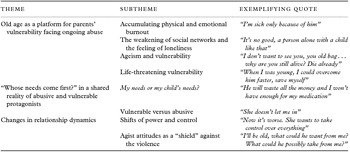
The analysis of the interviews reveals the uniqueness of the period of aging and its effect on the intergenerational relationship. These experiences reflect both an introspective and retrospective view of lifelong coping with their role as parents to children with mental disorder. Three major themes emerged: (1) old age as a platform for parents’ vulnerability facing ongoing abuse; (2) “whose needs come first?” in a shared reality of abusive and vulnerable protagonists; (3) changes in relationship dynamics. A summery of the results is presented in Table 2.
Themes and subthemes – an overview

Old age as a platform for vulnerability of parents facing ongoing abuse
Parents describe a sense of vulnerability that accompanies their aging years. This feeling develops gradually, and is a result of several processes such as the weakening of the body, increased exposure to illness, a long history of coping with family crisis, the dwindling of social resources, and raising an abusive child with mental disorder and impairments. All this brings parents to increased levels of emotional and physical distress and accumulating feelings of burnout, as demonstrated through the following quotes.
“I’m sick only because of him”– accumulating physical and emotional burnout.
Parents describe feelings of exhaustion, which they perceive as a result of the long-term hardships:
I used to be healthy and I worked in construction. Now I’m very sick. I can't sleep at night and I can't sleep during the day. . . I can't walk, because I have a bad heart. I have an inhalation machine here, if something happens, I turn it on. . . he (the son) talks a lot, and looks around; a new stereo system, what for? Buys stuff that no-one needs and there is no-one to stop him. He does whatever he wants. I’m sick only because of him. He is annoying; he would yell at me . . ., to give him things, causing scandals . . . To keep going . . ., since the child was born until today. It's not easy; what can I say? It's never been easy, what can I say. . ., it was hard for me even when I went to work, I would worry: What are they doing? I was alone and there was no-one to help. It affected me, God knows, it's a wonder I made it to this age.” (Joshua, 85 years, father of a 55-year-old son coping with schizophrenia).
Joshua attributes the feeling of vulnerability to the long-term exhausting burden of raising a child with mental disorder while trying to maintain family life in the shadow of his wife's illness. He constructs a narrative of erosion in the physical and emotional resources, to the point of burnout and emptiness. Coping with the son's deviant behavior stands at the center of this process as a significant factor that has directly caused the father's illness. The description of the everyday routine reflects a daily survival struggle. It seems that the child needs constant monitoring and guarding. The father, who is 85 years old, feels helpless and drained in the face of the son's constant needs on one hand, and the sense of health problems eroding his resources, on the other.
“It's no good, a person alone with a child like that” – the weakening of social networks and the feeling of loneliness.
As people age, their social resources tend to dwindle, as demonstrated by these parents. This decrease in social networks contributes to their sense of vulnerability, as can be understood from the following quote:
When they were small, it was nice, but now it's not good. . . we used to travel here and there, and the food was taken care of. . . not like now, I live alone with a child like that. . ., he keeps saying: “Daddy, Daddy.” Daddy (moaning), what can I do with him? It's no good for a man to be alone with a child like that. . . it's because he drives me crazy and I don't know what to do with him, what can I do? . . . look, my wife is dead and I’m left alone. . . the girls come over for 10 min, they don't help out at all, and he keeps driving me crazy. . . And now I’m also sick, I have to have a leg operation. . . and there is no-one to help. . . (Gadi, 75 years, father of a 43-year-old son coping with schizophrenia and drug abuse).
Gadi describes a gradual loss of social resources that leads to tremendous loneliness in his aging years. He describes the void that the loss of this network has left in his life in the instrumental aspect: “the food was taken care of. . .” as well as in the emotional aspect: “he drives me crazy. . .there is no-one to help.” Gadi seems very vulnerable. He has lost both his support system and his health, and feels alone and helpless.
“I don't want to see you, you old bag. . .why are you still alive? Die already” – ageism and vulnerability.
Parents’ feeling of vulnerability is intensified by the use of agist expressions that undermine their own sense of significance, as can be understood from the following quote:
The problem is not the laundry. . .she is the problem. . .she's been out for two days. . .went away. . .I didn't know where she was. It's been days that I’m afraid to talk. . .it's my life, very hard, very hard for me. Let her hear!. . .she is here now! She just opened the door. . .insulting me, saying harsh words, she yells at me: Die already!!! You’re taking up space, you old crow! Go to hell! I don't want to see you again, you disgust me. . .why are you alive? Die already, you make me sick. . .” [Gets up and imitates her daughter's gestures expressing anger and disgust]. (Lea, 79 years, mother of a 48-year-old daughter coping with schizophrenia).
Lea expresses her vulnerability by describing her daily routine with her daughter. This routine involves concern regarding the daughter's whereabouts, while simultaneously facing the agist insults directed toward her.
Lea's very detailed descriptions of her daughter's outbursts reveal insult and hurt. These agist expressions uncover the mother's vulnerability since they indicate a shift in power relations, in which the mother is perceived as weak, helpless, and dependent in comparison to the younger daughter, thus impacting her well-being and sense of worth at this stage of life.
“When I was young, I could overcome him faster, save myself” – life-threatening vulnerability.
Whereas some parents have trouble dealing with feelings of shame and humiliation, others feel burdened by feelings of fear for their lives caused by an atmosphere of horror that might escalate at any time:
When I was younger, I could overcome him faster, save myself, now that I’m old and I have diabetes, now I have to be faster, and I got triglycerides in my blood. Now I’m afraid for my life, afraid he will kill me. . . (Miri, 68 years, mother of a 27-year- old son coping with schizophrenia).
Miri feels that her physical resources are diminishing as she grows older. Consequently, her son's deviant behavior poses a threat to her safety. Whereas in the past, she was able to maneuver within the relationship, she is currently aware of her limitations due to her deteriorating health, which strengthens her feeling of fear and helplessness.
“Whose needs come first?” – in a shared reality of abusive and vulnerable protagonists.
The parents perceive the aging process that is gradually consuming their resources as a turning point in the family power balance. They still feel obligated to respond to the child's needs, but their new vulnerabilities and needs as older people become an issue that changes the power balance and control in the parent−child dynamics.
My needs or my child's needs? “He will waste all the money and I won't have enough for my medication.”
Parents present the aging years as a period characterized by self-involvement with their own physical needs and limited availability for the child's needs. This creates the dilemma of whose needs should come first:
I don't want to live with him but I have no choice. . .he can't live alone and I make sure he doesn't sleep out in the street. . .there is no-one else to take care of him. I sometimes think that maybe, if I will give him five hundred from my pension, and he will put in five hundred, then he can live in his own apartment. But then I’m scared he will waste all the money and I won't have enough for my medication. If he leaves home, I will live. When he isn't here, I feel calm. . .I like to stay at home in the evenings, watch TV, eat and drink whatever I want; I need quiet. (Nili, 75 years, mother of a 50-year-old son coping with drug abuse).
Nili feels trapped in a conflict between her son's needs of money and housing and her own wish to spend her aging years in peace. She emphasizes her responsibilities toward him as the sole caretaker: “there is no-one else to take care of him,” and at the same time, craves release from this responsibility. Understanding that her needs at this point are changing, Nili is occupied with the necessity to rebalance between her son's constant needs and her own needs as an older person.
In the next quote, the dilemma regarding whose needs come first is extremely grave, where living with the child poses a threat to the parent's life:
It's scary; he wants to kill me and that's that. Nothing can change that. He will sit in prison. I can prevent it by removing him from the house, but then, where will he sleep? He doesn't want to go to the rehabilitation center [for violent men]. . .I want to remove him from the house because I want to go on living. I like living, taking it easy. . .now I live in fear. . .I want him to be taken right now. I want to go on living but I’m afraid he will be raped in prison and then his life will be over. . . he also told me that he will kill himself if he goes to prison. . .and the court said to me, you are not helping, you are an accomplice. . .(Miri, 68 years, mother of a 27-year-old son coping with schizophrenia).
Miri feels that she has to choose between her own life and her son's life. She experiences life as a fragile achievement that can be taken from her with every deviant action by her son. The explosive situation between them brings Miri to feel helpless and stuck in a hopeless situation, where every decision she will make might be destructive to herself or to her son. Alongside coping with existential fears, Miri is embittered by the reality of spending her aging years with no sense of freedom and security. She finds herself defending herself both from her son and the authorities, who accuse her of being an “accomplice.”
Vulnerable versus abusive – “She doesn't let me in.”
It seems that in the context of the struggle over whose needs come first, the parents feel that only they are concerned by this, and perceive the children as insensitive to their parents’ needs:
She gets up in the middle of the night and goes into the shower. I get up and want to go to the bathroom, and I can't because she is already there! And she doesn't let me in. I’m taking Fusid [a diuretic] and I can't hold it in. . .when I come to the bathroom, she tells me to go to the neighbors bathroom. Well, how can I go knock on their door in the middle of the night? And this Fusid, it has no mercy, I just have to go, excuse me for saying this, but I finally pee inside a bottle. I’m embarrassed to tell you this. . . (Lea, 79 years, mother of a 48-year-old daughter coping with schizophrenia).
Although Lea is used to her daughter's deviant behavior, at this point in her life, she has difficulty integrating her new health-related needs into the relationship. The daughter seems to be oblivious to her mother's situation. She continues to put her own needs first while subjecting her mother to health-threatening conditions. As a result of her daughter's disregard of her needs, Lea finds herself humiliated and relieving herself in a bottle.
Changes in relationship dynamics
The parents’ emerging age-related needs lead to dramatic changes and relationship transitions.
Shifts of power and control – “Now it's worse. She wants to take control over everything.”
The parent's vulnerability and needs are perceived as undermining their powerful position in the presence of their children with mental disorder:
[The daughter enters the room and turns to her mother]: “What are you talking about? What?” [smiles defiantly]. [Lea turns to the interviewer]: I can't do it anymore, she has got the upper hand. . .she's not going to be here, she's out I’ve been considerate so far but no more, I’ve got a warrant and the cops will have to take her out; she will leave in a police car!
[The daughter goes out of the room and turns to the interviewer]: “Don't believe anything she says. . .she doesn't know what she is talking about and I can prove it; even her son said she is lying.”
Lea: “No, you are leaving this house!” [Turns to the interviewer] “Now it's worse. She wants to take control over everything, and this is my house!! Not hers!” She wants it, she thinks it's hers. [Turns to her daughter] “Don't run off when the cops come.” (Lea, 79 years, mother of a 48-year-old daughter coping with schizophrenia).
Aging processes challenge the mother−daughter relationship. These changes are manifested in a daily Sisyphean struggle over power and control. It seems that following the mother's weakening as a result of lifelong coping with her deviant daughter with a mental disorder and the emerging age-related problems, the daughter is now a threat to the mother's status and authority. The mother is not willing to accept this change and takes a firm approach against the daughter, while using some concrete threats of removing the daughter from the house to regain control of the situation. The statement “This is my house!! Not hers!” emphasizes the struggle over territory as a metaphor for struggle over status and relevance.
Another variation of the changes in power and control is expressed through the struggle over the parent's time distribution: as demonstrated through the following quote:
She keeps putting me down: “What kind of mother are you? I won't be like you. . .look at you.” Why? How do I look? I dress up, I put on make-up, what's the problem? She says harsh words: “Probably because you don't have a man, [you don't have sex], that's why you are not relaxed.” How can you talk to your mother like that? How? So I threw something at her, and she threw it back, and it broke on me and my back was seriously hurt. . .I couldn't keep quiet anymore so I called the police. But I couldn't bear the thought that I will file a complaint and my daughter will get arrested. I can’t. It's very hard for me. . . (Lili, 58, mother of a 27-year-old daughter coping with alcohol addiction).
Lili and her daughter maintain a relationship containing acts of physical and emotional violence. These dynamics have apparently been going on for many years, and now, as the mother ages, she is becoming more concerned with her own health and therefore less available for her daughter. This lack of availability adds tension to the relationship and leads to escalation of the violence. Lili and her daughter present a violent way to regain power and control over the life of the family, but it seems that whereas the mother's behavior is restrained, the daughter is aggressive and out of control. She expects her mother to meet her immediate needs, while perceiving her as lacking in authority and status, and being highly insensitive to her needs.
Agist attitudes as a “shield” against the violence – “I’ll be old, what could he want from me?”
Unlike the relationship dynamics characterized by a power struggle, the findings reveal another form of relationship dynamics based on internalized agist attitudes and lack of competence in the face of the child's deviant behavior. Hence, the agist attitudes serve as a “shield” against the violence, as demonstrated through the following quote:
It will get better. I’ll age and get older. He won't be able to do anything to me because I’ll be old. . .I’ll be old and he will be married; I’ll be old, what could he want from me? What could he possibly take from me? If he wants money, I’ll give him money, What can I give him? A sack of potatoes? If I’m old, he can't touch me, that's how it goes. . .he helps old people, he goes to my sister and asks her: “Do you want me to take you for your chemotherapy treatment?” She is 86 years old. . .he loves old people because he grew up with old parents. (Miri, 68 years, mother of a 27-year-old son coping with schizophrenia).
Miri's adoption of agist attitudes is demonstrated by her words: “He won't be able to do anything to me because I’ll be old. What could he possibly take from me? She presents old age as parallel to weakness, incompetence, and a lack of economic resources. Miri cannot imagine her son hurting weak old people, and therefore uses old age as a future “shield” against the violence that she is currently experiencing at the age of 68 years. For Miri, old age holds hope for the future empathy and warmth toward her that will replace the violent behavior.
The use of agist attitudes in presenting the inferiority of the parents serves as an account for leaving the child at home as a means of relieving loneliness and receiving close care:
Now he does whatever he wants. He doesn't obey me. It's harder for me now. Where would he go? America?. . .[laughs]. We take care of each other, he is the best out of all my children. . .he will go to the grocery store for me to get me something. What can I say. . .when he is not home, I go crazy. . .I’ll die. . .I can’t. . .he is fine with me. . .takes care of me better than anyone else. . .he loves me, he says “mother, sit down, lie down, drink,” managing me [laughs]. . .all his nerves, I don't care. . .he is a good boy and I don't care what everybody is saying! No-one could ever take care of me like my son. . .” (Gila, 75 years, mother of a 33-year-old son coping with schizophrenia).
Gila feels weak, inferior, and lonely and her son is perceived as a remedy against these feelings. She understands that her aging has created new power relations characterized by a close, mutual couple, like intimacy: “We take care of each other.” The mother seems to accept these changes in power relations and constructs a relationship narrative in which she is rewarded with feelings of closeness, caring, and attention while interpreting the son's imperiousness as a sign of affection and empathy.
This new narrative brings the mother to neutralize any attempt to separate her from her son. This perception indicates the significance given to this relationship over the years and particularly now in old age. Now that the relationship dynamics contains less conflict, the weighing of pros and cons regarding living together with her son leads Gila to acknowledge the advantages of sharing a home. The statement “he will go to the grocery store for me to get me something” reflects her hopes that her son will adopt the role of primary caregiver, which makes the idea of leaving home unacceptable.
Another way of using agist attitudes to justify the child's staying at home is through the need for care:
What can I do? I can't throw him out; there is no-one to take care of me. Look, now everything is fine, but maybe when he will start making trouble like before. . .his brothers will tell me to throw him out, but I have no choice, no-one would come into my house and help me; no-one! They don't come at all!. . .So I put up with him. There is no-one to bring me even a glass of water; only my son! . . . (Suzanne, 72 years, mother of a 40-year-old son coping with drug addiction).
Suzanne portrays herself as weak, helpless, dependent, lonely, useless, and abandoned. She describes her family's disregarding attitude, and emphasizes the importance of the relationship with her son. While so doing, Suzanne, like the mother in the previous quote, weighs up the pros and cons of keeping her son at home. It seems that despite the suffering resulting from the child's deviant behavior along the life course, aging brings these mothers to prefer living with the child, hoping that they will care for them.
Discussion
The analysis of the findings revealed three major themes: (a) old age as a platform for parents’ vulnerability facing ongoing abuse; (b) “whose needs come first?” in a shared reality of abusive and vulnerable protagonists; (c) changes in relationship dynamics
The time dimension in the context of abusive relationships receives a significant meaning in old age. The evolving nature of the abusive relationship that was constructed over the years peaks at this point due to the body's physical deterioration and increased vulnerability. Thus, the “fruits of the seeds” of abuse that were planted in various periods along the life course are now dramatically being harvested. From a theoretical viewpoint of the life course perspective, family members’ experiences are interwoven into an ongoing shared reality of abuse (Elder, Reference Elder and Jr1998). This constructs a new relationship arena based on codependent ties. In this context, the vulnerability of the aging parent ultimately serves as a means for changing power relations and imposing new relationship rules.
The theory of codependency refers to abuse as a result of a strong mutual reliance between the victim and the perpetrator (Lachs and Pillemer, Reference Lachs and Pillemer2004). In other words, dependency is perceived as a two-way process that involves both sides. This theory can serve as a wide umbrella for the understanding and conceptualization of elder abuse by their child with mental disorder. The parent's transition into old age might lead to some unpredictable changes. The new physical and emotional needs might create intergenerational role reversal causing the parents to become dependent on their adult children (Lachs and Pillemer, Reference Lachs and Pillemer2004). This new shared reality of dependency, whether financial, physical, or interpersonal, might lead to constructing a unique relationship dynamics. This dynamics holds two trajectories: the child can use the parent's dependency as a means of control, whereas the older parent maintains the traditional parental provider role. Another option is that, due to their vulnerability, the parents nourish expectations for increased consideration and decreased abusive behavior.
Agist attitudes seem to play a significant role in a shared reality of codependency and abuse. For the parents, these attitudes serve as a means by which they ask for protection, out of a sense of weakness and the vulnerability of old age. In other words, the more the parents experience themselves as weak and vulnerable, the more they internalize agist attitudes. In accordance with this, they expect the children to internalize agist attitudes that will increase their consideration for the parent. This strategy might assist the parent in developing an “abuse free” zone in which old age becomes a shield against violence. This use of old age can be considered as positive ageism as described by Palmore (Reference Palmore1999). Another way in which agist attitudes play a role in this relationship is when the children use ageism to encourage and strengthen their power in the face of the parent's weakening condition, leading to additional levels and expressions of abuse. Thus, the parent's vulnerability is perceived in a larger context of agist attitudes and is utilized as an additional justification for the violence. Together with this, parents are unable to let go of their parental role and try to maintain it in this current complex relationship dynamics. This daily struggle in a shared reality of abusive and vulnerable protagonists raises some existential dilemmas, one of which is the question of whose needs come first – the parent's or the child’s.
Referring to the SOC (selection, optimization, and compensation) model (Baltes and Baltes, Reference Baltes, Baltes, Baltes and Baltes1990), parents in the present study suffer high levels of burnout, but still place their child's needs over their own. Consequently, the parents’ aging needs are not met, making them even more vulnerable. The compensation process appears to be uniquely manipulated by these parents as they present staying with the child as an advantage, helping to avoid loneliness and attaining assistance from the abusive child.
Putting the child's needs first shows the ongoing parental role. This role is experienced as timeless and never-ending even now, in old age. The life course perspective emphasizes life events, relationships, and behaviors that project on the life trajectories in adult life and old age (Elder and Giele, Reference Elder and Giele2009). In this context, parents of children coping with disability, whether physical or mental, understand that their children “skip”/pass over socially accepted life transitions such as moving out of the parent's home or getting married. The stages omitted from the children's life lead the parents to become very involved in the child's unique needs, at which point their own needs become secondary. These parents may be described as “eternal parents” (Kelly and Kropf, Reference Kelly and Kropf1995) as they continue tending to their child's needs even though the child is an adult. Eternal parenting keeps old parents active and vital (Hatfield and Lefley, Reference Hatfield and Lefley2000), and exposes them simultaneously to health risks, social exclusion, and subjective care burden (Llewellyn et al., Reference Llewellyn, McConnell, Gething, Cant and Kendig2010).
The role of the eternal parent is further validated when reviewing the services that parents could have turned to but did not. The participants in this study were in touch with the welfare agencies and thus were offered services to help them avoid the violence towards them, such as police intervention, legal aid, medical aid and psychotherapy. However, most of the parents preferred not to constantly use legal channels and police interventions even though they were at risk of being killed.
Finally, it seems that old age is an arena for new relationships that combine increased vulnerability, needs of both sides, and changes in power relations. Such a shared reality calls for new insights and deeper understanding.
Limitations and recommendations for further study
This study focused on the parent's perspective. To broaden the understanding of the phenomenon, triangulation can be used by participatory observation or interviews with the child with the mental disorder or with other family members.
In addition, the participants had all been “labeled” by the welfare authorities as victims of violence, and as such, were defined as a clinical sample. Future research including a sample of self-declared victims of elder abuse might enrich the findings of this study. Finally, the research did not cover a wide range of mental disorders and focused mainly on schizophrenia and drug and alcohol abuse. Therefore, we suggest including other mental disorders such as borderline personality, antisocial personality etc.
Practical implications
The present study disentangles the weave of contradicting needs and wishes of both parents and children. It can therefore serve as a framework for developing tuned intervention methods for families, for example developing a treatment program that will empower parents. These programs will focus on both the rights and the needs of aging parents, providing them with resources and tools to fulfill them. As for the adult child, a rehabilitation plan is proposed that will enable them to perform a separation process. Risk factors can be mapped based on the dimensions suggested in this paper for evaluating levels of risk and considering interventions. This mapping includes categorizing shifts in power and control, classifying the aging parent's vulnerability, reevaluating needs, and using legal interventions.
Conflict of interest
None.
Description of authors’ roles
Tova Band-Winterstein designed the study, formulated the research questions, supervized the data collection, analyzed the data and wrote the paper. Yael Smeloy designed the study, formulated the research questions, carried out the data collection and analyzed the data. Hila Avieli wrote the paper.