Introduction
Neuroticism has been a consistently reported predictor of the post-traumatic stress disorder (PTSD) response to traumatic experiences. A longitudinal study of the survivors of the 1983 Australian bushfires reported that, in contrast to the expectation that the intensity of the stressor would be the primary predictor of psychiatric morbidity, neuroticism and history of pre-disaster disturbances emerged as stronger predictors (McFarlane, Reference McFarlane1988, Reference McFarlane1989). Studies of Vietnam combat veterans reported that PTSD and PTSD symptoms were correlated with neuroticism (Castella & Motta, Reference Casella and Motta1990; Talbert et al. Reference Talbert, Braswell, Albrecht, Hyer and Boudewyns1993; Hyer et al. Reference Hyer, Braswell, Albrecht, Boyd, Boudewyns and Talbert1994). In a general population sample of young adults, neuroticism was found to be associated with PTSD among those exposed to traumatic events (Breslau et al. Reference Breslau, Davis, Andreski and Peterson1991). In these studies, neuroticism was measured retrospectively, after the trauma had occurred. Two studies that measured neuroticism prior to the trauma reported a prospective association between neuroticism and PTSD symptoms or post-disaster disturbance (Alexander & Wells, Reference Alexander and Wells1991; Parslow et al. Reference Parslow, Jorm and Christensen2006). Engelhard et al. (Reference Engelhard, van den Hout and Kindt2003) challenged these findings. They reported that the prospectively measured association between neuroticism and subsequent scores on PTSD symptom scale dissipated when they adjusted for baseline PTSD scale scores. Another study by Engelhard et al. (Reference Engelhard, van den Hout and Lommen2009) confirmed the results of their previous study. None of these prospective studies reported on the onset of PTSD proper. Instead, they reported on symptoms of PTSD. It is unclear whether or not the findings on PTSD symptom scales apply to the disorder, as officially defined in the Diagnostic and Statistical Manual of Mental Disorders (DSM). PTSD symptoms are diagnostically ambiguous and, in themselves, do not signify a distinct psychiatric disorder. They characterize other mental disorders and are used in the definition of those disorders. They also are common symptoms of non-specific distress. It is their specified configuration and connection with an identifiable stressor that transform these non-specific symptoms into a distinct disorder, as officially defined and used. In this study, we examine the prospective relationship of neuroticism, measured at baseline, with subsequent PTSD in a sample of the general population.
Neuroticism measures the predisposition to experience negative emotions, such as worry, anxiety, depression, irritability, and vulnerability – diathesis – to psychiatric disorders (Eysenck & Eysenck, Reference Eysenck and Eysenck1964). Genetic control of neuroticism has been reported in numerous studies since the 1970s. Molecular genetics studies, using both association and linkage methods, identified gene regions that are likely to influence variation in neuroticism (Lesch et al. Reference Lesch, Bengel, Heils, Sabol, Greenberg, Petri, Benjamin, Müller, Hamer and Murphy1996; Fullerton et al. Reference Fullerton, Cubin, Tiwari, Wang, Bomhra, Davidson, Miller, Fairburn, Goodwin, Neale, Fiddy, Mott, Allison and Flint2003). Analysis of the Virginia Twin Registry showed that neuroticism was only minimally changed following major depression episodes (Kendler & Prescott, Reference Kendler and Prescott2006), suggesting that reported cross-sectional associations between neuroticism and major depression reflect primarily the effect of neuroticism. Kendler & Prescott (Reference Kendler and Prescott2006) also showed that genetic factors underlying neuroticism are largely shared with those that influence the liability for internalizing disorders, that is, depression and anxiety disorders.
In this study, we examine prospectively the relationship of neuroticism, measured at baseline, with the cumulative occurrence of PTSD during the subsequent 10 years, using data from a longitudinal study of young adults in the Detroit area. We also examine the role of lifetime history of major depression at baseline in the neuroticism–PTSD relationship.
Method
Sample
A sample of 1200 persons was randomly selected in 1989 from all 21- to 30-year-old members of a large health maintenance organization in southeast Michigan. The membership represented the population of the geographic area, with the exception of the extremes of the socio-economic range, at the time of the 1990 US census. Personal interviews were conducted in 1989 with 1007 respondents, 83.9% of the target sample. Follow-up interviews were conducted in 1992, 1994 and 1999–2001 at 3, 5 and 10 years after baseline. Complete data from all four assessments are available on 899 participants, and 990 of the 1007 participants (98.3%) had at least one follow-up interview. Detailed information on the sample and the population was reported previously (Breslau et al. Reference Breslau, Davis, Andreski and Peterson1991, Reference Breslau, Lucia and Alvarado2006).
Assessment of neuroticism, PTSD and major depression
Neuroticism was measured at baseline by the 12 yes/no items of the Short Form Neuroticism scale of the Eysenck Personality Questionnaire – Revised (Eysenck et al. Reference Eysenck, Eysenck and Barrett1985). The National Institute of Mental Health Diagnostic Interview Schedule-III for DSM-III-R (NIMH-DIS) was used to diagnose psychiatric disorders. The baseline interview inquired about lifetime history of disorders, and each follow-up assessment inquired about disorders that had occurred during the interval since the previous assessment. The diagnosis of PTSD in DSM-III-R requires exposure to a qualifying traumatic event and the presence of a configuration of criterion symptoms from three symptom groups that are linked to the traumatic event. The NIMH-DIS opens with a list of qualifying events, using the examples in the text (Breslau et al. Reference Breslau, Davis, Andreski and Peterson1991). Among respondents who report two or more traumatic events, PTSD criterion symptoms are gathered in relation to an event designated by the respondent as their worst, most upsetting, qualifying event. High concordance was reported between the ascertainment of PTSD by trained lay interviews using a structured interview that is closely modeled on the NIMH-DIS and independent clinical interviews, using the Clinician-Administered PTSD Scale for DSM-IV (Breslau et al. Reference Breslau, Kessler and Peterson1998b).
Statistical analysis
Analysis was performed on data from 990 persons on whom follow-up data from one or more follow-up reassessment were available, 98.3% of the baseline sample. We focus on the cumulative occurrence of PTSD caused by new traumas experienced during the 10-year follow-up, combing reports from the 3-, 5- and 10-year reassessments. Because our prospective analysis does not focus on the first PTSD in persons who had never experienced PTSD, all persons with follow-up data were included in the analysis; persons with lifetime history of trauma and PTSD at baseline were not excluded. We used multinomial logistic regression to estimate relative risk (RR) of exposure with and without PTSD, predicted by neuroticism score at baseline. The outcome variable Y had three categories, coded 1 = no exposure during follow-up (reference), 2 = exposure/no PTSD and 3 = exposure/PTSD. Given the small number of males with PTSD during the follow-up period (n = 11) and the statistically indistinguishable estimates between the sexes (sex × PTSD interaction was not detected at α <0.15), results are presented for the total sample. Three models are presented. The first model gives the unadjusted multinomial regression estimates of PTSD on the baseline score of neuroticism. The second model estimates the effect of neuroticism, adjusted for major depression at baseline. The third model is a stratified analysis, with separate multinomial regressions for subsets of the sample with and without history of major depression at baseline. SAS software release 9.2 (proc logistic; SAS Institute Inc., USA) was used for the statistical analysis.
Results
Of the initial sample, 63.2% were women, 80.0% were white, 46.1% were married and 29.0% had completed college. The most common traumatic events reported at baseline and at the follow-up assessments were physical assault, severe injury or accident, witnessing violence, and a family member or a close friend severely injured or killed. Information on lifetime prevalence of exposure to traumatic events and PTSD at baseline has been previously published (Breslau et al. Reference Breslau, Davis, Andreski and Peterson1991).
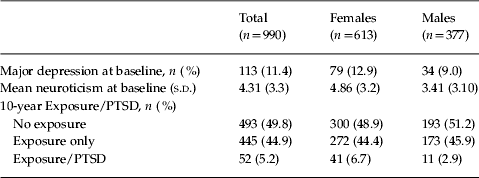
At baseline, 113 (11.4%) of the sample with follow-up data (n = 990) had a history of major depression; 12.9% of females and 9.0% of males (Table 1). The mean neuroticism score at baseline was 4.3 (s.d. = 3.3), and was significantly higher in females than in males (p = 0.0001). Persons with history of major depression at baseline scored markedly higher on neuroticism than persons without history of major depression [7.1 (s.d. = 3.1) v. 4.0 (s.d. = 3.1), p < 0.001]. Of the total sample, 497 (50.2%) experienced a traumatic event during the 10-year follow-up interval; 52 (5.2%) of the sample developed PTSD. The conditional probability of PTSD was 10.5%. Females were slightly less likely to have been exposed to trauma, and more likely to have developed PTSD (Table 1). The conditional probability of PTSD in trauma-exposed females was 13.1% and in trauma-exposed males, 6.0%.
Descriptive information on history of depression and neuroticism at baseline and exposure and PTSD during the 10-year follow-up
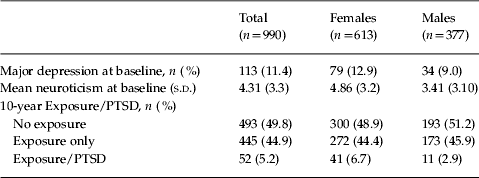
PTSD, Post-traumatic stress disorder; s.d., standard deviation.
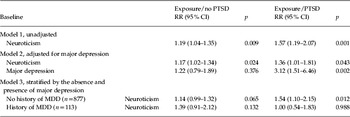
Table 2 presents the results of the multinomial regression models. The first model estimates the unadjusted RR associated with a change of 1 standard deviation in neuroticism score at baseline. Specifically, it presents the change in the risk of exposure/no PTSD v. no exposure (Y = 2 v. Y = 1) and exposure/PTSD v. no exposure (Y = 3 v. Y = 1). Neuroticism increased significantly the RR of exposure/no PTSD and exposure with PTSD, using no exposure as reference. RR of exposure/PTSD relative to exposure/no PTSD (Y = 3 v. Y = 2) (not presented in the table) was 1.32 [95% confidence interval (CI) 1.00–1.74, p = 0.048]. This is the estimate of the conditional risk of PTSD given exposure to a traumatic event.
Estimates from three multinomial regressions of 10-year exposure to trauma and PTSD by baseline neuroticism score (n = 990)a

PTSD, Post-traumatic stress disorder; RR, relative risk; CI, confidence interval; MDD, major depressive disorder.
a RRs for outcomes associated with 1 standard deviation in neuroticism score.
The second model estimates the effect of neuroticism adjusted for history of major depression at baseline, as a covariate. RR of exposure/no PTSD and exposure with PTSD associated with neuroticism at baseline changed little when history of major depression was included in the model. History of major depression at baseline did not significantly increase the risk of exposure/no PTSD, but increased by more than threefold the risk of exposure with PTSD. RRs for exposure/PTSD v. exposure/no PTSD (Y = 3 v. Y = 2) associated with neuroticism at baseline was not significant. No significant interaction was detected between baseline history of major depression and neuroticism (p = 0.197).
In model 3, the analysis was conducted on two strata of the sample; the first stratum consisted of persons without history of major depression at baseline and the second consisted of those with history of major depression at baseline. The results show that among persons with history of major depression at baseline there was no significant effect of neuroticism on either exposure to trauma alone or PTSD. In contrast, among persons with no history of major depression, neuroticism increased significantly the risk of PTSD following exposure (RR 1.54, 95% CI 1.10–2.15, p = 0.012). The increase in the risk of exposure without PTSD did not reach statistical significance (p = 0.065). RRs for exposure/PTSD v. exposure/no PTSD (Y = 3 v. Y = 2) associated with neuroticism at baseline was 1.35 (95% CI 0.96–1.88, p = 0.086).
Discussion
Based on prospective data from a sample of the general population, we found that neuroticism increased the risk of the PTSD response to subsequent trauma. Additional analysis (Table 2, model 3) showed that the increased risk of PTSD during the follow-up period varied by history of major depression at baseline. The RR of PTSD associated with neuroticism was equal to the null value of 1 among persons with history of major depression, but was increased measurably and significantly among those with no history of major depression (although no significant interaction was detected between neuroticism and major depression, a point discussed below).
Major depression at baseline was a strong predictor of subsequent PTSD, and those with major depression did not show the neuroticism–PTSD association, observed in persons with no history of major depression at baseline. The distribution of neuroticism scores varied substantially between the two groups, with mean neuroticism score of those with major depression falling 1 standard deviation to the right of the mean of those without major depression. History of major depression ‘selects’ a subgroup at the upper range of the neuroticism distribution, so that there is no place in this subgroup for further play for neuroticism per se in the prediction of PTSD.
The results confirm previous retrospective studies on neuroticism as a risk factor for PTSD (McFarlane, Reference McFarlane1988, Reference McFarlane1989; Castella & Motta, Reference Casella and Motta1990; Talbert et al. Reference Talbert, Braswell, Albrecht, Hyer and Boudewyns1993; Hyer et al. Reference Hyer, Braswell, Albrecht, Boyd, Boudewyns and Talbert1994). They also are consistent with the prospective studies that reported that neuroticism predicted increases in PTSD symptoms (Alexander & Wells, Reference Alexander and Wells1991; Parslow et al. Reference Parslow, Jorm and Christensen2006). The two prospective studies published by Engelhard et al. (Reference Engelhard, van den Hout and Kindt2003, Reference Engelhard, van den Hout and Lommen2009) reported that the association of neuroticism with subsequent increase in PTSD symptoms dissipated when pre-trauma PTSD symptoms were taken into account. Our results appear to parallel these findings, in part. We also found that pre-exposure psychopathology – baseline history of major depression, in our study – plays a key role in the subsequent risk of PTSD. However, we found that, whereas among those with history of major depression neuroticism had no role in subsequent PTSD, neuroticism remained a significant predictor of PTSD among those with no history of major depression.
The previous prospective studies measured PTSD symptoms. The applicability of their findings to PTSD is unclear. PTSD symptoms are diagnostically ambiguous and characterize other disorders as well as non-specific distress. An analysis of epidemiological data from a general population sample indicated that PTSD, as defined in the DSM, is not equal to a symptom count, and that the specified configuration of symptoms matters – the required number of symptoms from each of three symptom groups (Breslau et al. Reference Breslau, Lucia and Davis2004). That study demonstrates that DSM PTSD is associated with significantly higher levels of impairment indicators, compared with various definitions of ‘partial’ PTSD, or the required six criterion symptoms (irrespective of the specified configuration) (Breslau et al. Reference Breslau, Lucia and Davis2004).
Engelhard et al. (Reference Engelhard, van den Hout and Kindt2003, Reference Engelhard, van den Hout and Lommen2009) did not examine PTSD, but rather the severity of PTSD symptoms. In the second study (Engelhard et al. Reference Engelhard, van den Hout and Lommen2009), they measured PTSD symptom severity pre-deployment and then post-deployment and compared post-deployment scores, controlling for pre-deployment scores, between high and low neuroticism. The PTSD scores at pre-deployment and at post-deployment (that is, due to combat experiences) could not have been linked to the same event. What then do the regression slopes of post-deployment on pre-deployment (or as the authors write, ‘the increase in PTSD symptoms from pre- to post-trauma’) exactly mean?
The size of the sample of this prospective study limits the conclusions that can be securely drawn from the estimates of risk. Despite the large initial sample and high follow-up completion, the 10-year PTSD occurrence, although within the expected range (conditional probability = 10.5%), was not large enough to give definitive answers. Although the test of interaction between major depressions and neuroticism at baseline did not reach statistical significance, we interpret the findings of the stratified analysis in Table 2 model 3 as suggesting that the estimates of PTSD risk in the two strata are disparate. This interpretation relies on the fact that the RR in the subset with history of major depression was equal to the null value of 1. RR in the subset with no history of major depression was 1.54 (95% CI 1.10–2.15). The possibility that disorders other than major depression would have a similar influence on the relationship between neuroticism and subsequent PTSD response to trauma would be of interest.
Note also that sample size limits the conclusions about the relationship of neuroticism and PTSD among males. Of the 52 respondents with PTSD during follow-up, only 11 were males. The small number reflects the lower conditional probability of PTSD among males, relative to females, as reported in previous studies (Kessler et al. Reference Kessler, Sonnega, Bromet, Hughes and Nelson1995, Reference Kessler, Berglund, Demler, Jin, Merikangas and Walters2005; Breslau et al. Reference Breslau, Kessler, Chilcoat, Schultz, Davis and Andreski1998a). The results chiefly reflected the relationship of neuroticism with subsequent PTSD among females. Clearly, far larger samples are needed to replicate these findings firmly and examine related issues.
The strengths of the study deserve mention. The periodic assessments during the 10-year study are likely to have improved respondents' recall of trauma and PTSD and yield more accurate estimates than if data had been gathered only at the 10-year assessment. An important advantage of our prospective study is the use of DSM PTSD as the outcome, in contrast with previous studies that used PTSD symptoms as a continuum. The use of dimensional variables allows for more statistical power, but does not generate findings on PTSD.
In this prospective study, we did not exclude from the analysis persons with lifetime history of PTSD at baseline. We do not estimate the risk of first PTSD associated with neuroticism, but rather the risk of PTSD following a new trauma during the 10-year follow-up. Individuals might have more than one PTSD diagnosis in their lifetime. The official definition is ambiguous on whether PTSD caused by a new trauma, among persons with prior PTSD, is an ‘episode’ of a disorder, in the same way that major depression episode is, or instead a new diagnosis, in the same way that a physical trauma in someone with a previous injury (caused by a previous physical trauma) can cause a new injury.
The results confirm the status of neuroticism as diathesis in the PTSD response to trauma. Neuroticism might account for the process that is PTSD: the way in which an event is perceived and appraised and the typical features of the PTSD syndrome. High neuroticism predicts the repetitions of the past memory in the present (re-experiencing), the phobic avoidance, and the dysphoria and associated concentration and sleep problems that characterize PTSD.
Acknowledgements
This study was supported by grants no. MH44586 and MH071395 (to N.B.) from the National Institutes of Health.
Declaration of Interest
None.