Introduction
Advanced paternal age at birth is a risk factor for psychiatric disorders in offspring, including schizophrenia, autism and bipolar disorder (Malaspina et al. Reference Malaspina, Harlap, Fennig, Heiman, Nahon, Feldman and Susser2001; Reichenberg et al. Reference Reichenberg, Gross, Weiser, Bresnahan, Silverman, Harlap, Rabinowitz, Shulman, Malaspina, Lubin, Knobler, Davidson and Susser2006; Frans et al. Reference Frans, Sandin, Reichenberg, Lichtenstein, Langstrom and Hultman2008). These relationships have been confirmed in meta-analytic studies (Wohl & Gorwood, Reference Wohl and Gorwood2007; Hultman et al. Reference Hultman, Sandin, Levine, Lichtenstein and Reichenberg2011; Miller et al. Reference Miller, Messias, Miettunen, Alaräisänen, Järvelin, Koponen, Räsänen, Isohanni and Kirkpatrick2011) and are independent of important confounds [i.e. maternal age at birth, socio-economic status (SES) and parental psychiatric history] that increase psychiatric risk and are associated with later entry into parenthood (Byrne et al. Reference Byrne, Agerbo, Ewald, Eaton and Mortensen2003; Croen et al. Reference Croen, Najjar, Fireman and Grether2007; Menezes et al. Reference Menezes, Lewis, Rasmussen, Zammit, Sipos, Harrison, Tynelius and Gunnell2010). Recent data also link paternal age to obesity (Eriksen et al. Reference Eriksen, Sundet and Tambs2012). Despite these robust effects, advanced paternal age has never been examined as a risk factor for eating disorders in offspring. Examining this possibility could provide new insights into the complex etiology of eating disorders.
Leading theories propose that de novo genetic mutations are primary mechanisms underlying paternal age–psychiatric risk associations (Malaspina et al. Reference Malaspina, Corcoran, Fahim, Berman, Harkave-Friedman, Yale, Goetz, Goetz, Harlap and Gorman2002). The increased probability of DNA copy error problems with each sperm replication (∼610 replications by age 40) and the accumulation of mutations in the germline of older fathers are thought to lead to disease phenotypes in offspring (Crow, Reference Crow2000). Genetic studies indicate that offspring de novo mutation rates are influenced by paternal age at conception (Kong et al. Reference Kong, Frigge, Masson, Besenbacher, Sulem, Magnusson, Gudjonsson, Sigurdsson, Jonasdottir, Jonasdottir, Wong, Sigurdsson, Walters, Steinberg, Helgason, Thorleifsson, Gudbjartsson, Helgason, Magnusson, Thorsteinsdottir and Stefansson2012) and de novo mutations are implicated in schizophrenia and autism (Awadalla et al. Reference Awadalla, Gauthier, Myers, Casals, Hamdan, Griffing, Côté, Henrion, Spiegelman, Tarabeux, Piton, Yang, Boyko, Bustamante, Xiong, Rapoport, Addington, DeLisi, Krebs, Joober, Millet, Fombonne, Mottron, Zilversmit, Keebler, Daoud, Marineau, Roy-Gagnon, Dube, Eyre-Walker, Drapeau, Stone, Lafreniere and Rouleau2010; Xu et al. Reference Xu, Roos, Dexheimer, Boone, Plummer, Levy, Gogos and Karayiorgou2011; Iossifov et al. Reference Iossifov, Ronemus, Levy, Wang, Hakker, Rosenbaum, Yamrom, Lee, Narzisi, Leotta, Kendall, Grabowska, Ma, Marks, Rodgers, Stepansky, Troge, Andrews, Bekritsky, Pradhan, Ghiban, Kramer, Parla, Demeter, Fulton, Fulton, Magrini, Ye, Darnell, Darnell, Mardis, Wilson, Schatz, McCombie and Wigler2012). However, to our knowledge, no study has directly confirmed that de novo mutations underlie paternal age–offspring psychiatric risk associations.
Twin studies can be used to indirectly examine the role of de novo mutations in paternal age–psychiatric disorder relationships. Because monozygotic (MZ) twins share all of their genes and dizygotic (DZ) twins share, on average, half of their segregating genetic material, MZ twins would be expected to share all de novo mutations whereas DZ twins would be very unlikely to share genetic mutations given their rarity (Zhao et al. Reference Zhao, Leotta, Kustanovich, Lajonchere, Geschwind, Law, Law, Qiu, Lord, Sebat, Ye and Wigler2007; Liu et al. Reference Liu, Zerubavel and Bearman2010; Ronald & Hoekstra, Reference Ronald and Hoekstra2011). If de novo mutations underlie paternal age–psychiatric risk associations, larger differences between MZ and DZ twin correlations should be observed with advancing paternal age because DZ co-twins should become less similar as mutation rates increase.
One previous study examined these processes by investigating twin similarity for autism across paternal age (Lundström et al. Reference Lundström, Haworth, Carlström, Gillberg, Mill, Råstam, Hultman, Ronald, Anckarsäter, Plomin, Lichtenstein and Reichenberg2010). Importantly, differences in MZ/DZ concordance for autism decreased with advanced paternal age, implicating environmental rather than genetic processes. Although the results were limited by the small number of cases in each age category (n = 3–44), they highlight the need to test hypotheses regarding mechanisms for paternal age effects. Twin registries are excellent low-cost resources for such investigations, as they can indirectly examine whether de novo mutations or other competing processes are most likely to underlie paternal age–psychiatric risk associations.
The current study investigated phenotypic and etiologic associations between advanced paternal age and disordered eating symptoms (e.g. weight/shape concerns) in a large, population-based sample of female twins. These symptoms are core features of eating disorders and prospectively predict the development of diagnoses (Jacobi et al. Reference Jacobi, Hayward, de Zwaan, Kraemer and Agras2004); thus, our results should inform risk models of eating disorders. Exploratory analyses examining associations between advanced paternal age and an eating disorder history [anorexia nervosa (AN), bulimia nervosa (BN), binge eating disorder (BED)] were also conducted to investigate whether the results generalize across categorical and continuous eating disorder dimensions (APA, 2000; Insel et al. Reference Insel, Cuthbert, Garvey, Heinssen, Pine, Quinn, Sanislow and Wang2010). Several covariates were included [e.g. maternal age, body mass index (BMI) percentile, SES, fertility treatment, parental psychiatric history] to ensure that associations were not due to confounding factors. Finally, we compared twin similarity for disordered eating across paternal age to explore the mechanisms (i.e. genetic/environmental) underlying paternal age–disordered eating associations.
Method
Participants
Participants were 1722 female twins [488 (28%) MZ, 611 (35%) same-sex DZ and 623 (36%) opposite-sex DZ] between the ages of 8 and 17 years (mean ± s.d. = 13.86 ± 2.39 years) from the ongoing Michigan Twins Project (MTP), a study conducted within the Michigan State University Twin Registry (MSUTR; Klump & Burt, Reference Klump and Burt2006; Burt & Klump, Reference Burt and Klump2013). Twins were recruited using birth records and driver's license databases (see Klump & Burt, Reference Klump and Burt2006). MTP recruitment began in 2008, and response rates (∼56%) are similar to those for other population-based twin registries (Kendler et al. Reference Kendler, Heath, Neale, Kessler and Eaves1992; Lichtenstein, Reference Lichtenstein2002).
Because increases in genetic influences on disordered eating are observed during puberty in females (Klump et al. Reference Klump, Perkins, Alexandra Burt, McGue and Iacono2007; Culbert et al. Reference Culbert, Burt, McGue, Iacono and Klump2009), we only included twins who were in mid-puberty or beyond (i.e. score ⩾2.5 on the Pubertal Development Scale; Petersen et al. Reference Petersen, Crockett, Richards and Boxer1988). The twins spanned a range of racial/ethnic backgrounds (e.g. Caucasian, Black/African American, Asian/Pacific Rim) but, consistent with the region (see www.michigan.gov), most (87%) were Caucasian.
Measures
All data came from the MTP questionnaire completed by the twins' mother or father (93% biological mothers, 6% biological fathers, 1% step/adoptive parents).
Zygosity
Similar to other twin registries (Kendler et al. Reference Kendler, Heath, Neale, Kessler and Eaves1992; Lichtenstein, Reference Lichtenstein2002), zygosity was determined using five physical similarity items. These items have demonstrated more than 95% accuracy when compared to genotyping (Lykken et al. Reference Lykken, Bouchard, McGue and Tellegen1990).
Parental age at birth
Paternal and maternal ages at offspring birth were calculated using birth dates. Average ages at birth (paternal mean ± s.d. = 32.70 ± 5.92 years, range = 15–55; maternal mean ± s.d. = 30.49 ± 4.77 years, range = 17–48) were similar to those from other studies examining parental age effects (e.g. paternal mean ± s.d. = 31.5 ± 6.8 years, range = 13–70; maternal mean ± s.d. = 28.8 ± 5.9 years, range = 12–53) (Croen et al. Reference Croen, Najjar, Fireman and Grether2007).
Disordered eating symptoms
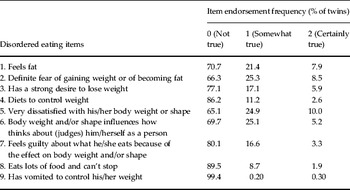
Disordered eating was assessed using nine items from the Eating Disorder Examination Questionnaire (EDE-Q; Fairburn & Beglin, Reference Fairburn and Beglin1994) (see Table 1). The EDE-Q assesses core eating disorder symptoms including weight/shape concerns, dietary restraint, binge eating and compensatory behaviors. EDE-Q items were included if they: (1) represented key attitudinal and behavioral symptoms; (2) exhibited significant correlations with the EDE-Q Global Score (mean r = 0.76); and (3) were developmentally appropriate for pre- and early-adolescent participants. Importantly, these symptoms are well-established risk factors for eating disorders (Jacobi et al. Reference Jacobi, Hayward, de Zwaan, Kraemer and Agras2004).
Disordered eating items and frequency of item endorsement

EDE-Q items were modified for use in this large-scale, mail-in twin registry. Parent, rather than child, reports were collected to keep the MTP questionnaire brief and easy to complete. This was necessary for recruiting as many families as possible into the registry (which serves as a participant bank; see Burt & Klump Reference Burt and Klump2013). Although parent reports of disordered eating are less commonly used than parent reports of other psychiatric symptoms, data from another ongoing MSUTR study (Klump et al. Reference Klump, Keel, Sisk and Burt2010) show that the parent–child correlation for the MTP disordered eating items (r = 0.52) is similar or better than parent–child correlations for externalizing/internalizing symptoms (r's = 0.14–0.48) (Kolko & Kazdin, Reference Kolko and Kazdin1993; Youngstrom et al. Reference Youngstrom, Loeber and Stouthamer-Loeber2000). EDE-Q parent reports also demonstrated expected correlations with external correlates in the Klump et al. (Reference Klump, Keel, Sisk and Burt2010) sample (i.e. BMI, r = 0.58; depressive symptoms, r = 0.35).
Parents rated their children's disordered eating based on what they ‘generally are like’ using a three-point scale (‘not true’, ‘sometimes true’, ‘certainly true’) rather than the original EDE-Q format (i.e. number of days a symptom was present in the past month). This was necessary to match other MTP items and to index trait rather than state levels of disordered eating. Our data suggest that this rating format does not substantially affect the validity of the EDE-Q. In a subsample of twins whose mothers rated disordered eating using the MTP EDE-Q and the original EDE-Q, ratings were highly correlated (r = 0.59) despite occurring an average of 1.5 years apart (s.d. = 0.77, range = 0.23–2.90 years).
Internal consistency for the MTP items was excellent (α = 0.86). There was significant variability in disordered eating, with the rate at which most symptoms were ‘sometimes’ or ‘certainly’ true ranging from 10–35% (see Table 1). Levels of disordered eating were similar to those from other MSUTR studies examining a similar age range but using the original EDE-Q (item endorsement = 7–42%) (Klump et al. Reference Klump, Keel, Sisk and Burt2010, Reference Klump, Keel, Racine, Burt, Neale, Sisk, Boker and Hu2013). As would be expected in a population-based, adolescent sample (Wade et al. Reference Wade, Byrne and Bryant-Waugh2008), attitudinal symptoms (e.g. fear of fatness) were the most highly endorsed, although behaviors (e.g. dieting, binge eating) also showed sufficient variation. Correlations with BMI were in the low-to-moderate range (range = 0.009–0.42; mean r = 0.25; average percentage variance shared = 6%), suggesting that our measure taps disordered eating symptoms that are not merely a reflection of weight status/obesity.
Eating disorder diagnosis
Lifetime histories of eating disorders (AN, BN or BED) were assessed through parent report. Of the 1668 twins with available data, 11 (1%) had a history of an eating disorder [6/11 (55%) AN, 4/11 (36%) BED, 1/11 (9%) AN and BN], of whom seven (64%) received previous treatment and four (36%) did not. These percentages are similar to the prevalence of eating disorders in female children/adolescents (Merikangas et al. Reference Merikangas, He, Brody, Fisher, Bourdon and Koretz2010; Swanson et al. Reference Swanson, Crow, Le Grange, Swendsen and Merikangas2011). As expected, twins with an eating disorder history had substantially higher MTP disordered eating scores (mean ± s.d. = 7.81 ± 5.98) than those with no history (mean ± s.d. = 2.31 ± 3.16, p = 0.01, Cohen's d = 1.15). Disordered eating scores did not differ meaningfully between patients with a history of AN (or AN/BN) (mean ± s.d. = 8.14 ± 7.40) versus BED (mean ± s.d. = 7.25 ± 2.98).
Covariates
Several covariates were examined to ensure that associations between paternal age and eating pathology were not accounted for by confounding factors. Covariates included: twin age, ethnicity and BMI percentile (i.e. BMI adjusted for age); SES; parental fertility treatment and psychiatric history. Selected covariates have been associated with disordered eating and/or later paternal age at birth (Hare & Moran, Reference Hare and Moran1979; Lilenfeld et al. Reference Lilenfeld, Kaye, Greeno, Merikangas, Plotnicov, Pollice, Rao, Strober, Bulik and Nagy1998; O‘Dea & Caputi, Reference O'Dea and Caputi2001; Croll et al. Reference Croll, Neumark-Sztainer, Story and Ireland2002; Doornbos et al. Reference Doornbos, Maas, McDonnell, Vermeiden and Hennekam2007; Sobotka, Reference Sobotka and Tremmel2010; Eriksen et al. Reference Eriksen, Sundet and Tambs2012). Parent reports of twin height and weight, which correlate highly with laboratory measurements (r's = 0.79–0.81; Huybrechts et al. Reference Huybrechts, Himes, Ottevaere, De Vriendt, De Keyzer, Cox, Van Trimpont, De Bacquer and De Henauw2011), were used to calculate BMI. BMI values were transformed to percentiles (see www.cdc.gov) to capture age-related variation in our child/adolescent sample. Family yearly income and parental education (i.e. highest level of education achieved by mother or father) were used to assess SES. A history of depression, anxiety disorder (i.e. panic, obsessive–compulsive, post-traumatic stress, separation anxiety) or eating disorder (i.e. AN, BN, BED) in the biological mother and/or father was assessed using a family history checklist coded ‘yes’ if at least one parent suffered from one or more disorder or ‘no’ if neither parent reported a history of the disorders.
Statistical analyses
Phenotypic associations
Paternal age at birth was examined as a predictor of disordered eating symptoms and history of an eating disorder. Paternal age was modeled continuously as well as categorically (i.e. <25, 25–29, 30–34, 35–39, ⩾40 years) to increase statistical power and identify particularly high-risk age thresholds (e.g. paternal age >35 years; see Wohl & Gorwood, Reference Wohl and Gorwood2007).
Generalized linear mixed models (GLMMs) were used as they could account for the non-independence of twin data [i.e. by nesting a level 1 variable (individual twin) within a level 2 unit (family)] and could examine both continuous and categorical outcomes. GLMM linear regressions (normal distribution with identity link) and binary logistic regressions (binomial distribution with logit link) were used to examine disordered eating and eating disorder history respectively. We standardized all variables prior to analysis to interpret unstandardized coefficients as standardized coefficients.
GLMMs were run twice: (1) controlling only for maternal age at birth and (2) controlling for all covariates. This two-step process allowed us to identify the effects of covariates on paternal age–eating pathology associations while always controlling for maternal age because maternal age correlated highly with paternal age (r = 0.72)Footnote 1 Footnote † and is associated with other psychiatric disorders (Croen et al. Reference Croen, Najjar, Fireman and Grether2007; Menezes et al. Reference Menezes, Lewis, Rasmussen, Zammit, Sipos, Harrison, Tynelius and Gunnell2010). Controlling for maternal age also ensured that our independent variable (i.e. paternal age at birth) and dependent variables (i.e. parent-reported eating pathology) were not confounded, as 93% of MTP questionnaires were completed by biological mothers.Footnote 2
Genetic associations
We investigated genetic influences on paternal age effects by comparing MZ and DZ twin similarity for disordered eating as a function of paternal age at birth. Given that very few participants had an eating disorder history, analyses focused on disordered eating symptoms. Furthermore, although same-sex and opposite-sex twins were included in phenotypic analyses, twin analyses included same-sex twins only, as male co-twins of opposite-sex females were not examined because of low eating disorder prevalence in males (Swanson et al. Reference Swanson, Crow, Le Grange, Swendsen and Merikangas2011).
Twin intraclass correlations were calculated in the full sample and each paternal age category to provide an initial indication of genetic/environmental effects on disordered eating across paternal age. Additive genetic effects (A; genetic influences that add across genes) are indicated if the MZ twin correlation is approximately twice the DZ twin correlation whereas non-additive genetic effects (D; interaction of genetic effects at same locus) are suggested if MZ correlations are more than double DZ correlations. De novo mutations are considered a non-additive genetic process in twin studies, as DZ twins would share far less than half of their mutations because of their rarity (Liu et al. Reference Liu, Zerubavel and Bearman2010). Therefore, if de novo mutations underlie paternal age–disordered eating relationships, we would expect larger MZ/DZ differences with advanced paternal age.
Twin studies also decompose variance into two forms of environmental effects. Shared environmental influences (C; factors that make co-twins similar to one another) are inferred if MZ and DZ twin correlations are approximately equal whereas non-shared environmental influences (E; factors that make co-twins different from one another, including measurement error) are implied if the MZ correlation is less than 1.0. If differences between MZ/DZ correlations decrease with paternal age, shared environmental processes would be implicated, as co-twins would increase in similarity regardless of genetic sharing. Finally, decreases in the MZ correlation would indicate non-shared environmental influences on paternal age–disordered eating effects.
We then used twin moderation models (see Purcell, Reference Purcell2002) to statistically quantify the degree to which genetic/environmental influences on disordered eating vary by paternal age (the moderator). ACE and ADE models were examined to test for differences in both additive and non-additive genetic effects. Model fitting was conducted using full information maximum-likelihood raw data techniques with Mx statistical software (Neale, Reference Neale1997).
Following previous recommendations (Purcell, Reference Purcell2002), we fit ‘full’ ACE and ADE moderator models that included linear and non-linear moderators to directly test whether genetic/environmental estimates vary linearly or non-linearly with paternal age. We compared full models to two more restrictive models: (1) linear moderation models that dropped nonlinear moderation coefficients and (2) no moderation models that estimated only genetic/environmental paths. To minimize the number of models fit, we did not drop individual moderation coefficients one by one. Instead, we determined whether each etiologic influence varied by paternal age by examining whether confidence intervals for moderator estimates overlapped with zero.
The best-fitting model was determined using both the difference in minus twice the log likelihood (Δ – 2lnL) and Akaike's Information Criteria (AIC). Δ – 2lnL was used to compare full and nested moderation models, and AIC was used to compare the unnested ACE and ADE models. Statistically significant differences in −2lnL suggest that dropping moderator coefficients results in a significantly worse model fit whereas lower AIC values indicate a better model fit.
Although definition variables can be used to account for covariate effects in twin models (Neale et al. Reference Neale, Aggen, Maes, Kubarych and Schmitt2006), it was not possible to simultaneously include all eight covariates as definition variables in one model, as this would reduce the statistical power to detect differences in etiologic effects across paternal age (Agrawal et al. Reference Agrawal, Balasubramanian, Smith, Madden, Bucholz, Heath and Lynskey2010). Consequently, we ran individual models that included each covariate as a definition variable one by one to examine individual covariate effects. Because findings were unchanged in each run of the model, we focused our results on models that included maternal age at birth as the definition variable to mirror our first set of phenotypic analyses described earlier.
Results
Phenotypic associations
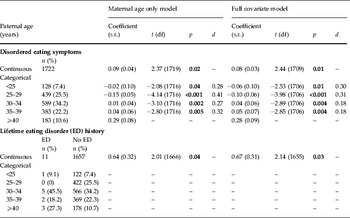
Consistent with hypotheses, paternal age was positively associated with disordered eating symptoms in female offspring, even after controlling for several important covariates (e.g. maternal age, BMI percentile; see Table 2). Similar to other disorders (Byrne et al. Reference Byrne, Agerbo, Ewald, Eaton and Mortensen2003), a threshold effect was detected, such that mean levels of disordered eating were significantly higher in offspring of fathers aged ⩾40 years compared to offspring of younger fathers (see Table 2). Effect sizes indicate that the phenotypic effect of paternal age on disordered eating is small to medium in magnitude (β's = 0.08–0.09, d's = 0.18–0.41).Footnote 3
Paternal age at birth as a predictor of disordered eating symptoms and lifetime eating disorder history in offspring

s.e., Standard error; df, degrees of freedom.
Significant p values are indicated in bold font.
The ‘maternal age only’ model controlled for maternal age at birth only. The ‘full covariate’ model controlled for maternal age at birth, child age, child ethnicity, child body mass index (BMI) percentile, family education and income, fertility treatment, and parental psychiatric history. Coefficient = standardized β in continuous paternal age models; standardized mean in categorical paternal age models. The ⩾40 years group was coded as the reference group for t test comparisons in categorical paternal age models.
Exploratory analyses revealed that paternal age at birth, measured continuously, also predicts a lifetime eating disorder history. Small sample sizes prevented examining paternal age as a categorical predictor of eating disorder diagnosis; however, there were a disproportionate number of cases in older age categories (see Table 2), and this effect was not driven by a specific diagnosis (i.e. AN and BED were both present in the older age groups).
Genetic associations
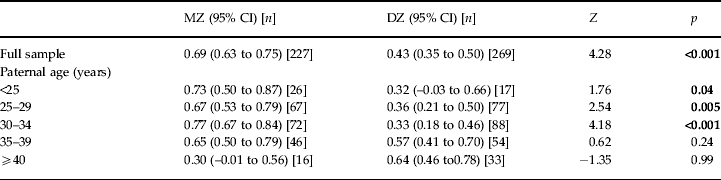
Similar to previous research in pubertal females (Klump et al. Reference Klump, Perkins, Alexandra Burt, McGue and Iacono2007; Culbert et al. Reference Culbert, Burt, McGue, Iacono and Klump2009), higher MZ than DZ correlations and an MZ correlation less than 1.0 indicated the presence of genetic and non-shared environmental influences on disordered eating in the full sample. However, differences in MZ/DZ correlations across paternal age suggested significant heterogeneity in etiologic effects (see Table 3). Before age 35, the MZ correlation was twice the DZ correlation, suggesting additive genetic effects but little to no shared environmental or non-additive genetic influences. By contrast, after age 35, the DZ correlation increased and was comparable to most of the MZ correlations, indicating a complete lack of additive or non-additive genetic effects but significant shared environmental influences. The lower MZ correlation in the oldest paternal age group could reflect greater non-shared environmental effects, although conclusions are difficult to draw given the group's small sample size (n = 16 pairs) and the fact that this correlation does not differ significantly from MZ correlations in most younger paternal age groups (as evidenced by overlapping confidence intervals; see Table 3). Overall, twin correlations suggest increasing shared environmental influences on disordered eating after age 35, arguing against increases in genetic or de novo mutation effects with advanced paternal age.
Twin correlations for disordered eating by paternal age category

MZ, Monozygotic; DZ, dizygotic same-sex twins; CI, confidence interval; n, number of twin pairs; Z, test of equality examining whether MZ correlation is higher than DZ twin correlations; p, one-tailed significance value for Z test of equality.
Maternal age at birth was regressed from each twin's disordered eating score, and standardized residual scores were used to calculate twin correlations.
Because twin correlations suggested no differences in etiologic effects until age 35, we created two paternal age groups for analyses (<35 versus ⩾35 years) to maximize power and capture key etiologic differences across paternal age.Footnote 4 Non-linear moderation cannot be examined with only two moderator levels, so we focused on linear and no moderation models. ACE models fit better than ADE models (i.e. lower AIC), which is not surprising given that non-additive genetic effects were non-significant (i.e. 95% confidence intervals included 0).
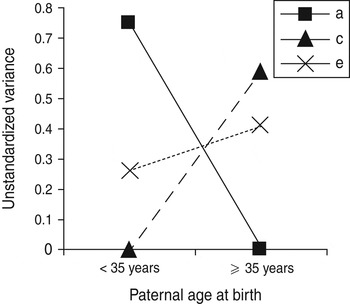
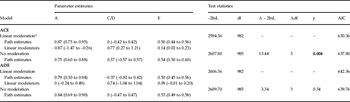
Within the ACE models, a statistically significant Δ–2lnL indicated that the linear moderation model fit better than the no moderation model and that genetic/environmental influences on disordered eating varied by paternal age. Following previous recommendations (Purcell, Reference Purcell2002), we report unstandardized path and moderator estimates in Table 4 and Fig. 1 so as to depict absolute changes in genetic/environmental influences rather than changes in proportions of total variance. Nonetheless, to compare genetic/environmental estimates to previous twin studies of disordered eating, we also report standardized estimates (calculated by squaring the path coefficients in the < 35 age group, and squaring the sum of the moderator estimates plus the path coefficients in the ⩾35 age group).
Unstandardized additive genetic (a), shared environmental (c) and non-shared environmental (e) variance contributions to disordered eating by paternal age at birth.

Unstandardized parameter estimates and test statistics for the comparison of linear moderation and no moderation models

A, Additive genetic; C, shared environmental; D, non-additive genetic; E, non-shared environmental; –2lnL, minus twice the log likelihood; df, degrees of freedom; AIC, Akaike's Information Criteria.
Linear moderation: genetic, shared environmental, and non-shared environmental parameter estimates vary linearly by paternal age at birth.
No moderation: genetic, shared environmental, and non-shared environmental parameter estimates do not vary by paternal age at birth.
a Best-fitting model.
Significant paths and moderator estimates are indicated by confidence intervals that do not overlap with zero.
Significant p values are indicated in bold font.
As shown in Table 4, a, c and e moderator estimates were statistically significant, suggesting that all three differ across paternal age. The most substantial change occurs for additive genetic and shared environmental influences (see Fig. 1). Before age 35, additive genetic effects contributed primarily to disordered eating (A = 75%), with the remaining variance due to the non-shared environment (E = 25%). By contrast, after age 35, the variance in disordered eating was entirely due to shared and non-shared environmental factors (C = 59%, E = 41%).Footnote 5
Discussion
Using a large, population-based sample of female twins, we have demonstrated for the first time that advanced paternal age at birth is a significant risk factor for offspring eating pathology. This phenotypic effect was robust, in that it was present for eating disorder symptoms and diagnoses, and effects were independent of several important covariates (e.g. maternal age, BMI percentile, SES and parental psychiatric history). We also examined differences in etiologic influences across paternal age to investigate whether genetic factors (more specifically, de novo mutations) might underlie paternal age–disordered eating relationships. However, the results strongly suggested that genetic contributions to disordered eating decreased, rather than increased, with paternal age.
These findings contribute to a growing body of literature implicating advanced paternal age in offspring psychiatric risk, as indicated for schizophrenia, autism and bipolar disorder (Malaspina et al. Reference Malaspina, Harlap, Fennig, Heiman, Nahon, Feldman and Susser2001; Reichenberg et al. Reference Reichenberg, Gross, Weiser, Bresnahan, Silverman, Harlap, Rabinowitz, Shulman, Malaspina, Lubin, Knobler, Davidson and Susser2006; Frans et al. Reference Frans, Sandin, Reichenberg, Lichtenstein, Langstrom and Hultman2008). A relationship with disordered eating is novel and suggests that eating disorders may share some, perhaps more general, etiologic risk factors with these disorders. This is important given that sociocultural influences (e.g. pressures for thinness) have led to views that eating disorders are etiologically distinct from ‘neuropsychiatric’ illnesses (Klump et al. Reference Klump, Bulik, Kaye, Treasure and Tyson2009). Instead, eating disorders may be uniquely associated with both the internalizing and neuropsychiatric spectrums of psychopathology. This possibility is being explored by researchers investigating social/cognitive similarities between AN and autism (Zucker et al. Reference Zucker, Losh, Bulik, LaBar, Piven and Pelphrey2007) and also other neuropsychiatric disorders (Steinglass et al. Reference Steinglass, Eisen, Attia, Mayer and Walsh2007).
De novo mutations have been proposed as a potential biological mechanism underlying paternal age–psychiatric risk associations, although our results argue against de novo mutation effects for paternal age–disordered eating relationships. We observed a sharp decrease in the magnitude of genetic influences on disordered eating in the paternal age ⩾35 group, as DZ twins (who would not share de novo mutations) became more rather than less similar with paternal age. Our results converge with those of an autism twin study (Lundström et al. Reference Lundström, Haworth, Carlström, Gillberg, Mill, Råstam, Hultman, Ronald, Anckarsäter, Plomin, Lichtenstein and Reichenberg2010), suggesting that de novo mutations may not account for paternal age effects. However, if only the frequency (rather than the location) of mutations confers risk, paternal age-related mutations could theoretically increase the similarity of DZ twins born to older fathers, as DZ twins may have a similar mutation burden but, unlike MZ twins, would not share specific mutations. We presumed that sharing specific mutations, rather than frequency alone, would influence twin similarity for eating pathology, consistent with the prediction that de novo mutations increase heritability estimates in twin studies (Liu et al. Reference Liu, Zerubavel and Bearman2010; Ronald & Hoekstra, Reference Ronald and Hoekstra2011). Nonetheless, we cannot definitively rule out the importance of de novo mutations. Future twin and molecular genetic studies are needed to further examine the mutation hypothesis for paternal age–psychiatric disorder relationships.
Another leading mechanism proposed to underlie paternal age–psychiatric disorder associations is disruptions in epigenetic processes (i.e. activation–inactivation of genes and/or changes to chromatin structure) that occur with advanced paternal age (Perrin et al. Reference Perrin, Brown and Malaspina2007). Although epigenetic mechanisms have been implicated in eating disorders and other psychiatric illnesses (e.g. Schanen, Reference Schanen2006; Frieling et al. Reference Frieling, Römer, Scholz, Mittelbach, Wilhelm, De Zwaan, Jacoby, Kornhuber, Hillemacher and Bleich2010), epigenetic disruptions that accumulate in the male germline and are passed to twin offspring should increase MZ/DZ twin differences. Indeed, MZ twins, formed from one sperm, should share these epigenetic errors at a higher rate than DZ twins who develop from two different sperm. Thus, similar to studies showing greater epigenetic similarity for MZ versus DZ twins (Kaminsky et al. Reference Kaminsky, Tang, Wang, Ptak, Oh, Wong, Feldcamp, Virtanen, Halfvarson, Tysk, McRae, Visscher, Montgomery, Gottesman, Martin and Petronis2009), paternal age-related epigenetic errors would be expected to increase genetic influences on disordered eating. We instead observed an increase in DZ twin similarity, and thus shared environmental effects with paternal age, arguing against epigenetic mechanisms. Of course, replication, particularly with molecular genetic designs, is needed.
Several covariates examined (e.g. maternal age, SES) could contribute to paternal age effects by decreasing genetic and increasing shared environmental influences on disordered eating. However, these factors did not account for paternal age–disordered eating associations and are unlikely to be strong mechanistic candidates. Additional unexamined factors that could account for paternal age effects and increased shared environmental influences include birth/obstetric complications and paternal weight concerns/behaviors. First, older paternal age has been associated with several birth/obstetric complications in offspring (e.g. pre-term birth, pre-eclampsia, cesarean section) (Harlap et al. Reference Harlap, Paltiel, Deutsch, Knaanie, Masalha, Tiram, Caplan, Malaspina and Friedlander2002; Tang et al. Reference Tang, Wu, Liu, Lin and Hsu2006; Sartorius & Nieschlag, Reference Sartorius and Nieschlag2010; Shah, Reference Shah2010), and birth/obstetric complications are linked to risk for eating disorders and other psychiatric illnesses (Cannon et al. Reference Cannon, Jones and Murray2002; Favaro et al. Reference Favaro, Tenconi and Santonastaso2006). These paternal age and birth/obstetric complication associations are present after controlling for maternal age (Harlap et al. Reference Harlap, Paltiel, Deutsch, Knaanie, Masalha, Tiram, Caplan, Malaspina and Friedlander2002; Tang et al. Reference Tang, Wu, Liu, Lin and Hsu2006), suggesting that they might account for the unique effects of paternal age on offspring psychiatric risk. However, maternal age has been shown to be a stronger predictor of birth/obstetric complications than paternal age (Harlap et al. Reference Harlap, Paltiel, Deutsch, Knaanie, Masalha, Tiram, Caplan, Malaspina and Friedlander2002; Shah, Reference Shah2010), and the lack of association between maternal age and disordered eating in our data makes it less likely that birth/obstetric complications could entirely account for our findings.
Second, longitudinal research suggests that weight concerns and dieting increase with age in men, such that these attitudes/behaviors are higher in older adulthood than earlier adulthood (Keel et al. Reference Keel, Baxter, Heatherton and Joiner2007). In older fathers, weight concerns and dieting may be highest when children are being raised and could be transmitted environmentally to offspring in the form of paternal expectations and/or criticism. Importantly, although older women continue to report significant weight/shape concerns and eating disorder behaviors in mid-life (Gagne et al. Reference Gagne, Von Holle, Brownley, Runfola, Hofmeier, Branch and Bulik2012), longitudinal data suggest that women experience a relative decrease in weight concerns/behaviors with advancing age (Keel et al. Reference Keel, Baxter, Heatherton and Joiner2007). Sex differences in these longitudinal trajectories could potentially explain differential relationships between paternal and maternal ages at birth and offspring eating pathology. Clearly, these possibilities are speculative, particularly given that paternal weight concerns/behaviors may also have genetic (and/or gene–environment interaction) effects on offspring disordered eating. Further research is necessary to examine whether these types of mechanisms contribute environmentally to paternal age–eating pathology associations.
Despite notable strengths of our study (e.g. a large, population-based twin sample, examination of confounding factors), our study was not without limitations. Given that the maximum age of our participants was 17 years, we were unable to capture the entire period of risk for eating disorders, which can extend up until at least age 25 (Lewinsohn et al. Reference Lewinsohn, Striegel-Moore and Seeley2000). However, disordered eating symptoms are present as early as childhood and increase across the pubertal period in females (Maloney et al. Reference Maloney, McGuire, Daniels and Specker1989; Killen et al. Reference Killen, Hayward, Litt, Hammer, Wilson, Miner, Taylor, Varady and Shisslak1992). Therefore, meaningful variance in disordered eating was probably captured in our sample of twins, who are in mid-puberty and beyond. Nonetheless, future research should examine young adult samples to ensure results generalize to other periods of risk.
Eating disorder symptoms and diagnoses, along with covariates, were assessed through parent report. Parent reports allowed us to collect data on a large sample of twins, which was necessary for twin models investigating mechanisms underlying paternal age effects. However, parent reports may miss significant eating disorder symptoms/diagnoses that would be captured by self-reports, and limiting assessment of all covariates to a single parent report could introduce error due to shared method variance. Fortunately, our identified eating disorder cases performed as expected on measures of disordered eating and external correlates, and initial MSUTR data suggest that parent–child concordance for disordered eating is better than that observed for other phenotypes routinely assessed by parent report (see Method). Future studies should nevertheless confirm that advanced paternal age predicts eating pathology when examining self-reported symptoms/diagnoses using questionnaire and interview data. Using multiple methods to assess covariates (e.g. laboratory height/weight measures) could also help to minimize potential influences of shared method variance.
Finally, given the small number of twins with eating disorder histories, phenotypic links between paternal age and eating disorder diagnoses could only be examined cursorily, and paternal age–diagnosis relationships were not investigated using twin models. Although the symptoms we examined are risk factors for eating disorders (Jacobi et al. Reference Jacobi, Hayward, de Zwaan, Kraemer and Agras2004), additional studies with larger samples are needed to investigate phenotypic and etiologic relationships between paternal age and the broad eating disorder category, along with the specific diagnoses of AN, BN and BED. Such analyses could increase our understanding of the role of paternal age in eating disorder risk and identify specific mechanisms contributing to differential symptom presentations.
Acknowledgments
Data collection was supported by grants from Michigan State University (K. L. Klump and S. A. Burt). Data analysis was supported by grants from the Canadian Institutes of Health Research (MDR-96630; S. E. Racine) and the National Institute of Mental Health (5 T32 MH082761 and 1 F31 MH0844701; K. M. Culbert; 1 R01 MH0820-54 and 1 R01 MH092377-01; K. L. Klump and S. A. Burt). The content is solely the responsibility of the authors and does not necessarily represent the official views of Michigan State University, the Canadian Institutes of Health Research or the National Institute of Mental Health.
Declaration of Interest
None.