Introduction
The critically endangered (National Institute of Biological Resources 2013) Callipogon relictus Semenov (Coleoptera: Cerambycidae: Prioninae) (also known as the Korean relic longhorn beetle) is the only Palaearctic representative of the otherwise Neotropical genus (Callipogon Audinet-Serville; Semenov Reference Semenov1899). Callipogon relictus is the largest beetle found in northeastern Asia, with adult males often reaching 100 mm in length, a feature that attracts the attention of amateur entomologists and promotes illegal collection. Callipogon relictus is found in the Russian Far East, northeastern China, North Korea, and in a single location in northern South Korea (Kuprin and Bezborodov Reference Kuprin and Bezborodov2012; Yi et al. Reference Yi, Kuprin and Bae2018).
Callipogon relictus is one of only a few species that are considered endangered in the Old World and introduced pest species in the New World. More specifically, the species has been listed as endangered (Category I) in the Red Data Books of both Russia (Red Book of Amur Province 2009; Kuprin and Bezborodov Reference Kuprin and Bezborodov2012) and South Korea (National Institute of Biological Resources 2013) but has also been included on the Canadian Food Inspection Agency list of invasive quarantine pests since 2010 (Canadian Food Inspection Agency 2010). Meanwhile, in South Korea, C. relictus is both designated as a National Natural Monument (number 218) and featured in the logo of the Entomological Society of Korea. Furthermore, because C. relictus is limited to a small fragmented population in South Korea (Gwangneung forest near Seoul) and is nearly extinct in the country, the Korean Ministry of Environment recently nominated C. relictus as the first invertebrate priority target species for a recovery programme of the endangered species (Yi Reference Yi2014).
Unfortunately, the life history of xylophagous longhorn beetles is difficult to study, owing to the unseen and cryptic habits of the wood-boring larvae (Pershing and Linit Reference Pershing and Linit1988; Panzavolta Reference Panzavolta2007), especially when the larval period of the species lasts for several years, or the species is either rare or legally protected. Callipogon relictus is a saproxylo-mycetophagous longhorn beetle that primarily feeds inside the wood of dead or decaying broadleaf trees, and its larvae likely take five to seven years to develop under natural conditions (Li et al. Reference Li, Drumont, Zhang, Gao and Zhou2012). For these reasons, the number of instars for the species is poorly understood, and further research is needed to identify the instar numbers and temperature requirements under which growth of the larvae can be optimised for artificial rearing for conservational purposes.
The present study investigates the effects of various laboratory conditions on the progress of larval growth of C. relictus, with the goal of minimising the duration of the larval development period in order to facilitate mass rearing. In previous studies, which were performed from August 2008 to May 2012, C. relictus larvae were fed oak sawdust at 20 °C and 60% relative humidity (Yi Reference Yi2014). In the following study, which was performed from October 2015 to January 2016, C. relictus larvae were fed an artificial fungal diet at 25 °C and 60% relative humidity (Yi et al. Reference Yi, Kuprin, Lee and Bae2017). In this study, which was performed from December 2016 to August 2017, the growth of C. relictus larvae was measured at 20, 25, and 30 °C. We present data for the number of instars for the larvae reared at 30 °C and 60% relative humidity, conditions under which larval development was the most rapid. The aims of the present study were (1) to determine the number of instars for C. relictus, (2) to determine the optimum temperature for mass rearing C. relictus larvae under laboratory conditions, and (3) to provide a rearing protocol for a recovery programme.
Materials and methods
Insects
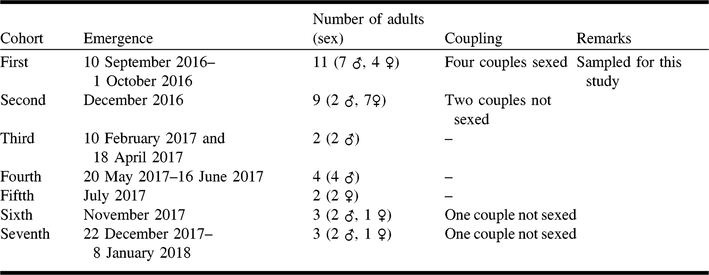
In August 2015, we imported two pairs of live C. relictus, which were collected from North Korea (Cheonma-san, Pyeonganbuk-do, North Korea, 28 July to 4 August 2015), via Dandoong, Liaoning province, China. We obtained 53 first-generation offspring (larvae) from one of the pairs (the other pair was not sexed) and reared the resulting larvae at 25 °C and 60% relative humidity using a newly developed artificial diet (Yi et al. Reference Yi, Kuprin, Lee and Bae2017). Of the 53 larvae, 34 have emerged and five died, whereas the remaining 14 larvae are still growing. The sequence of cohorts and numbers of emerged adults are indicated in Table 1.
Multiple cohort development of the progeny of the first-generation (F1) Callipogon relictus at 25 °C and 60% relative humidity.

All but first adult had emerged on 10 September 2016; the last one delayed until 8 January 2018. The period from first instar to adult, therefore, covered 11–25 months.
Four pairs were established from the 11 adults in the first cohort, and 105 larvae were obtained from one of four couples. Ten randomly selected larvae each were then assigned to 20, 25, 30, 35, and 40 °C treatment groups and reared in a growth chamber (DS-50CPLH; Dasol, Whasung, South Korea). However, the 35 and 40 °C groups were discontinued, since the fungal mycelia decomposed at these higher temperatures. Small sample sizes (i.e., 10 larvae) were used owing to the difficult procedure necessary for a direct observation of the exuviae: this time-consuming and careful procedure necessitated the hardened fungal mycelia be broken weekly, a process that could potentially harm or kill the larvae. Therefore, the negative effects of trauma to the larvae caused by this handling were unavoidable.
Rearing
From our previous experiments conducted both in Ussurisk, Russia (Kuprin et al. Reference Kuprin, Bezborodov, Yi and Kotlyar2014), and in Yeongwol, South Korea (Yi et al. Reference Yi, Kuprin, Lee and Bae2017), C. relictus is primarily fungivorous. The efficiency of a fungal diet on the speed of larval development was remarkable compared with that of raw sawdust at the same temperature condition of 25 °C; the duration of larval development on a fungal diet was approximately one-fourth the time compared with using saw dust.
The larvae were reared on a newly developed artificial diet of fungal mycelia (see Supplementary Appendix 1) that was produced using the white-rot fungus Pleurotus florida Eager (Pleurotaceae). Fungal mycelia were cultivated in polypropylene containers (1300 mL) and stored at 5 °C until use.
For all the experiments, newly hatched neonate larvae (under three days old) were transferred, using larvae forceps, to glass vials (ф = 26.6 mm, length = 102 mm) that were filled with fungal mycelia to facilitate a direct observation of the tiny fragile moult skin. Ten first instars each were assigned to 20, 25, and 30 °C treatment groups and then reared at 60% relative humidity (0:24 light–dark photoperiod) conditions in three programmable culture chambers (DS-50CPLH; Dasol, Whasung, South Korea). The actual temperature experienced by the insects was recorded using a data-logger programme (TCCMS 1.31, Dasol, Whasung, South Korea).
As the size of the larvae increased, larvae reared in small glass vials until the third instar were transferred to polypropylene bottles (1300 mL, ф = 130 mm) that were filled with fungal mycelia and then reared until the larvae were ready to pupate. Access to the mycelia was obtained by bisecting the polypropylene containers every week using an electronic disc grinder (Bosch, Gerlingen, Germany) with 10.2 cm circular cutter saw in order to check out moult skins for a direct observation. Fresh diet was provided weekly, and care was taken to ensure that the C. relictus larvae were not exposed to direct sunlight or strong artificial light. For detailed information, a protocol for fast rearing of C. relictus on fungal diet is provided in Supplementary Appendix 1.
Instar determination
Two commonly used methods for determining instar number, namely the direct observation of exuviae and a maximum likelihood approach (Hunt and Chapman Reference Hunt and Chapman2001; Flaherty et al. Reference Flaherty, Régnière and Sweeney2012), were applied simultaneously, owing to the small sample size. All larval containers were checked for exuviae every 48 hours until the third instar and then weekly until the prepupal (= pharate pupa) stage. The head capsule width of each larva was measured using a stereoscope (Olympus SZX7, Tokyo, Japan) that was equipped with a digital micrometer (Olympus DP27, Tokyo, Japan) until the sixth instar and then using a digital caliper (Mitutoyo, Kawasaki, Japan) until the last instar, owing to the large size of the larvae. A fresh container of fungal diet was provided whenever an exuvia check was performed.
Results
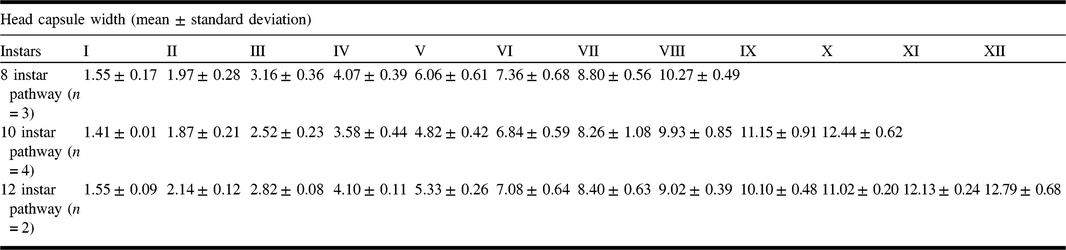
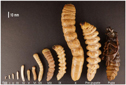
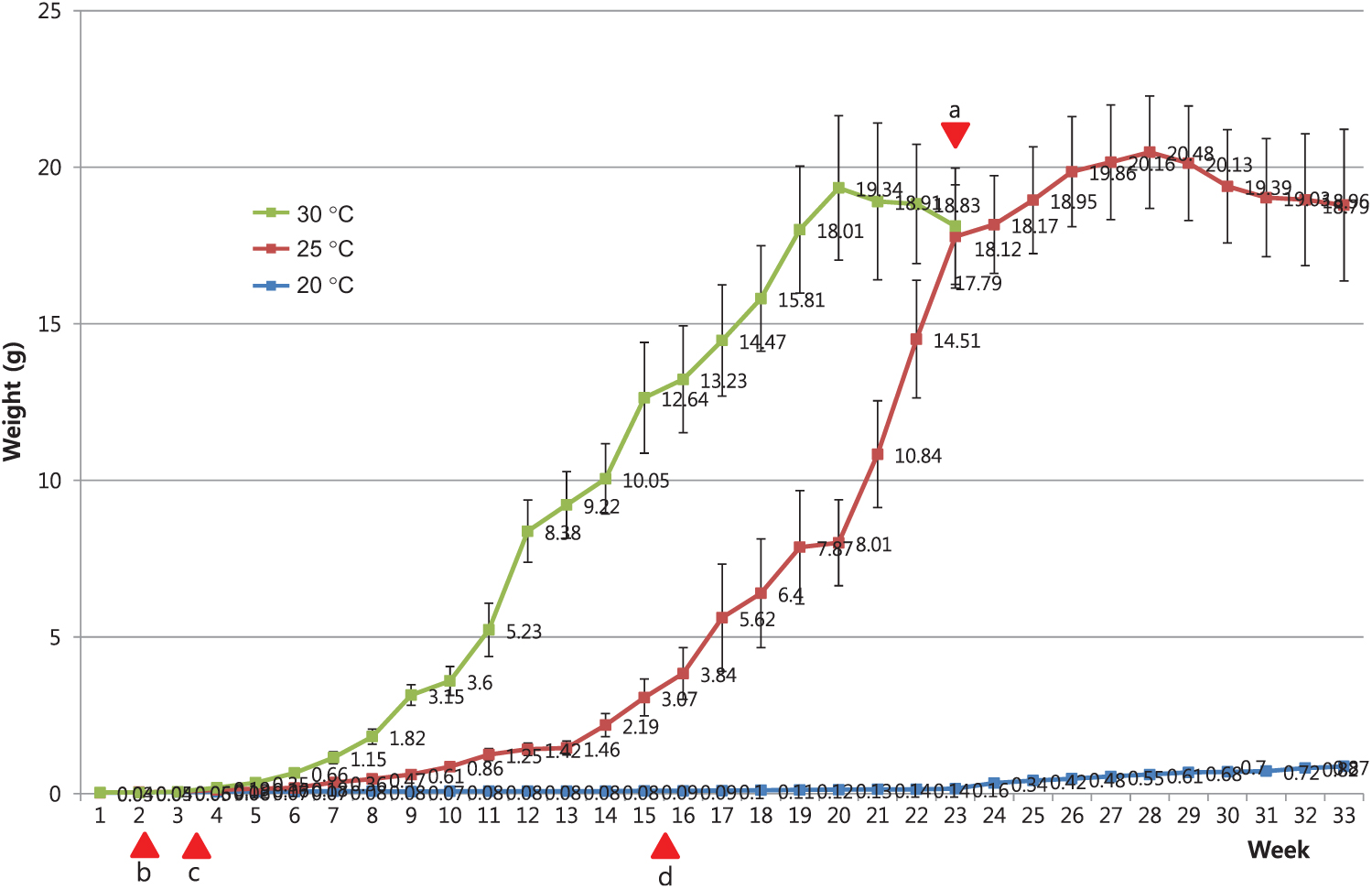
Three instar pathways were observed when the larvae were reared at 30 °C. Of the 10 larvae, three pupated after passing through eight instars, four pupated after 10 instars (Fig. 1), and two pupated after 12 instars (Table 2), whereas the remaining larva died at an early stage of development. Nine of the 10 larvae (90%) reared at 30 °C and 60% relative humidity, without diapause, completed development within seven to eight months (226.89 ± 66.93 days), which is the shortest larval period reported for C. relictus to date.
Head capsule width of the three different Callipogon relictus instar pathways of larval development.

Least square means (mean ± standard deviation) of head capsule width (mm) were measured using a binocular microscope until the sixth instar, and then measured using digital Vernier calipers from the seventh instar due to the larger size.
A progress of 10 stadiums in Callipogon relictus larval development (the first instar measured 6–7 mm and the last instar measured 124 mm).

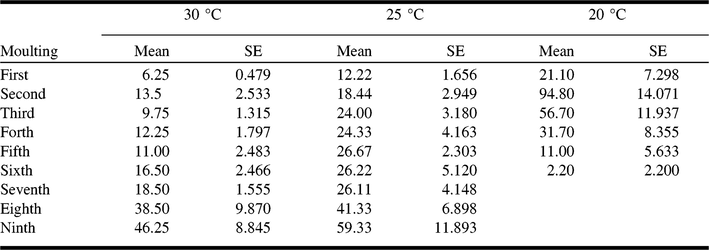
Among the three tested temperatures (20, 25, and 30 °C), the nine larvae grown at 30 °C completed their development in 22–24 weeks, which is the most rapid development time reported to date. We confirmed that the development rate of each instar at 30 °C is faster for all instars (Table 3).
Durations of each Callipogon relictus instar at three different temperatures. SE, standard error.

The second moulting of 10 larvae at 20 °C occurred as late as 94.8 (± 14.071) days after the first moulting. The seventh moulting at 20 °C did not occur until the last instar at 30 °C pupated. SE, standard error.
The weight of C. relictus larvae gradually increased until reaching the final instar and then declined rapidly during the pre-pupation period (Fig. 2). The larvae incubated at 30 °C developed relatively more rapidly than those incubated at 25 °C, and the growth of the larvae incubated at 20 °C was the slowest. As Fig. 2 shows, the second instars from the 20 °C treatment groups did not moult until the 15th week, while the groups at 25 and 30 °C completed their growth within the fourth week.
Weekly-intervalled growth curves of Callipogon relictus larvae at three different temperatures. The first occurrence of pupation for the 30 °C group at arrow a, the second moulting point is at arrow b for the 30 °C group, arrow c for the 25 °C group, and arrow d for the 20 °C group.

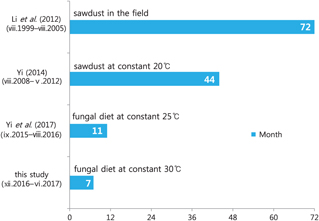
The growth curve of the 10 larvae grown at 20 °C was similar to previously reported growth curves in which larval development (n = 5) extended over 44 months (1360.2 ± 1.72 days) (Yi Reference Yi2014), and the growth curve of the 10 larvae grown at 25 °C was similar to previously reported growth curves in which larval development (n = 11) was completed within 11 months (338.5 ± 2.3 days) (Yi et al. Reference Yi, Kuprin, Lee and Bae2017). The survival rate of the 10 larvae grown at 30 °C was 60%; one larva died before pupation, and three died during the pupal stage. Meanwhile, the survival rate of the 25 °C group was 84%; two of 11 individuals died before pupation.
Although the present study showed that higher temperatures accelerate larval growth rate in C. relictus (Fig. 3), we were not able to statistically test the temperature effect on adult body size because of small sample size. The trend observed is a negative effect of temperature on adult body size, with larger adults at 25 °C (99.68 ± 5.87 mm, n = 4♂; 82.57 ± 3.78 mm, n = 7♀) than at 30 °C (67.48 ± 4.96 mm, n = 4♂; 76.59 ± 2.87 mm, n = 2♀).
Comparison of speed of larval development of Callipogon relictus according to different temperatures. The statistical data are as follows: 44 months (1360.2 ± 1.72 days, n = 5), 11 months (338.5 ± 2.3 days, n = 11), and seven months (226.89 ± 66.93 days, n = 9).

Discussion
Variations of instar numbers and flexible lifespan
Our study measured the developmental duration and pattern of C. relictus larvae incubated at three temperatures (20, 25, and 30 °C). Three instar numbers (eight, 10, and 12) were observed at 30 °C. Variation in lifespan is a significant characteristic in the life history of ectothermic invertebrates, and variation in life cycle duration is especially prevalent among insect species (Danks Reference Danks2000). It is also well documented that flexible time-to-adult duration is influenced by intrinsic biotic factors of each species, as well as by abiotic factors (e.g., temperature – Choudhuri Reference Choudhuri1963; Howe Reference Howe1967; host or diet quality – Lamb et al. Reference Lamb, MacKay and Gerber1987; Greene Reference Greene1988; and food availability – Danks Reference Danks2000; Munyiri et al. Reference Munyiri, Shintani and Ishikawa2004). Furthermore, insects can be categorised based on lifespan, with one group possessing a regular life cycle duration (or instar number), regardless of environmental factors, and a second group possessing flexible life cycle durations, which are influenced by environmental factors. Members of the Hemiptera, for example, consistently exhibit five instars (Drummond et al. Reference Drummond, James, Casagrande and Faubert1984; Ruberson et al. Reference Ruberson, Tauber and Tauber1986; Klingenberg and Zimmermann Reference Klingenberg and Zimmermann1992), belonging to the former group, whereas most other insects belong to the latter group.
Meanwhile, identifying the life histories and larval-instar numbers of the wood-boring Buprestidae (Coleoptera) (Beer Reference Beer1949; Smith Reference Smith1962; Loerch and Cameron Reference Loerch and Cameron1983) and Cerambycidae, which usually have relatively long lifespans, requires more patience and the use of sophisticated skills. Ecological interest in the Cerambycidae has recently increased as international fire wood trades have become more frequent. However, most of this interest has been directed toward the genera of Lamiinae (Cerambycidae) (Naves et al. Reference Naves, Sousa and Rodrigues2008; Lupi et al. Reference Lupi, Jucker, Rocco, Cappellozza and Colombo2015; Trotter and Keena Reference Trotter and Keena2016), and instar numbers of other members of the Cerambycidae remain poorly understood. All of the previous studies were of Lamiinae (Rasmussen Reference Rasmussen1967) and Spondylidinae (Cerambycidae) (Flaherty et al. Reference Flaherty, Régnière and Sweeney2012), and this study is the first experiment on instar numbers for Prioninae (Cerambycidae).
Effect of temperature on larval development
Because the present study was initially designed to conclude when the earliest group emerged, it was impossible to compare the instar number variation of all C. relictus groups (i.e., 20, 25, and 30 °C). Yet, our experiments demonstrated that larval growth rate decreased with decreasing temperature (Table 3; Figs. 2–3), as reported for other longhorn beetles (Štefková et al. Reference Štefková, Okrouhlik and Dolezal2017). Trotter and Keena (Reference Trotter and Keena2016), in their phenological modelling study of Anoplophora glabripennis (Motschulsky) (Coleoptera: Cerambycidae), reported that this species, which normally has a three-year life cycle in the native Asian range, delayed its development time by up to six years when reared in Helsinki, Finland, where the average minimum temperature is below –10 °C. Of course, this prolonged life cycle does not directly indicate that instar number would increase proportionally. It is also worth noting that Psacothea hilaris (Pascoe) (Coleoptera: Cerambycidae) was reported to moult three to six times at 30 °C, but up to nine times at 25 °C (Iba Reference Iba1988).
These results suggest that the lifespan of C. relictus in its northernmost population in Khabarovsky, Russia (48°27′N, 135°05′E) (Kuprin and Bezborodov Reference Kuprin and Bezborodov2012; Yi et al. Reference Yi, Kuprin and Bae2018), lasts approximately 72 months, as described by Li et al. (Reference Li, Drumont, Zhang, Gao and Zhou2012), who reared larvae on semi-artificial diet in the field at Fangzheng, Heilongjiang Province, China (45°50′N, 129°12′E). However, the lifespan of C. relictus in its southernmost population in South Korea (37°44′N, 127°09′E) must be shorter than six years, owing to differences in annual average temperature (i.e., 7.83 ± 0.05 °C; Yi Reference Yi2014). The instar numbers and larval durations of C. relictus population in Russia, China, and South Korea would vary according to latitude and among individuals at the same latitudes, which is a common phenological trend in the Cerambycidae.
Our trend of reduced adult body size with higher temperatures, in parallel with the accelerated growth, is in agreement with the temperature–size rule for ectotherms (Angilletta and Dunham Reference Angilletta and Dunham2003). Although the number of eggs of C. relictus is proportional to the body size of the female (Li et al. Reference Li, Drumont, Zhang and Lin2013), the potential thermal dependence of adult body size cannot compensate for the dramatic effect of temperature on the life cycle duration. Thus, we would conclude that the optimum temperature for mass rearing of C. relictus larvae on a fungal diet for long-term benefit of reproduction to be used for restoration purposes is 30 °C. Nonetheless, further experiments are needed to establish the threshold of larval development and the optimum moisture levels.
Supplementary material
To view supplementary material for this article, please visit https://doi.org/10.4039/tce.2019.27.
Acknowledgements
This research was supported by funding both from the Cultural Heritage Administration, Government of Republic of Korea, and the Research Center of Natural Monument Insect, Yeongwol County.