Introduction
When Ernest Newman died in 1959 he went to the grave with unfinished business. Among the many books he planned to write, but for which he never found the time – or a willing publisher – were a history of music (in three volumes), a study of Parsifal and a biography of Berlioz.Footnote 1 Work on the history of music never commenced, while the idea for the book on Parsifal languished because Newman decided to take up this project towards the end of his life, but then was far too ill to work on it. Although a Berlioz biography had been in the back of Newman's mind for decades, it too was never written; however, an early draft of one of the proposed chapters, ‘The Prose of Berlioz’, was published in the June 1899 volume of Chord.
‘The Prose of Berlioz’, which was not included in Peter Heyworth's anthology of Newman's essays on Berlioz,Footnote 2 and is discussed here for the first time, is a significant work today for three reasons. First, ‘The Prose of Berlioz’ is the only work on a musical topic by any writer that I have identified as drawing on the work of the French critic and theorist, Emile Hennequin. Second, the history of the genesis of the ‘The Prose of Berlioz’ reveals much about Newman's early writing career. This background uncovers the many projects that Newman and his publisher chose to abandon for economic and intellectual reasons, demonstrating some of the difficulties Newman faced in establishing himself as a biographer and critic in his formative years, the 1890s, a period of his life that has only recently been studied in detail.Footnote 3 Third, the Berlioz article is an ideal case for a study of the history of musical biography in the late nineteenth century, because it illustrates the significant degree to which some authors crossed disciplinary boundaries in writing.
The present article explores the alleged influence of Hennequin's theories – particularly an essay by him on Flaubert – on ‘The Prose of Berlioz’. I argue that Newman's claim that Hennequin was his sole inspiration is not true, that his methodology in ‘The Prose of Berlioz’ was derived from a number of other studies on style, such as those by Walter Pater and John Earle. Ironically, although Hennequin had developed a theory of biography, Newman did not draw on it for the Berlioz project, which raises the question of how deeply Newman had engaged with the French theorist's works, especially since his close friend and mentor, John M. Robertson, was a keen advocate of Hennequin's biographical method.
Theorizing Musical Biography
In recent studies theorizing musical biography, Jolanta T. Pekacz challenges musicologists to take the study of musical biography more seriously, especially its methodologies, which she claims are too often assumed to be self-evident.Footnote 4 In many respects Ernest Newman is a fitting subject for a study of the methods of musical biography, not just because he was a prolific biographer, but because he utilized a variety of methodologies in writing them.Footnote 5 Some of these methods were derived from literary models, demonstrating the ease to which he – and indeed many writers of the Victorian period – worked across the disciplines as we know them today. For example, Edmund Gurney's The Power of Sound, first published in book form in 1880, combined studies in aesthetics and psychology.Footnote 6 Indeed, it was common in the nineteenth century for writers to work across fields, and many saw themselves not as experts within a specific discipline but as knowledgeable generalists, even polymaths. As the historian Bill Cooke has noted, ‘Polymaths are people who are hard to bracket as a philosopher, historian, scientist or artist. They may be a mixture of all these, and more.’Footnote 7 Consequently, such varied intellectual outlooks produced works, such as Gurney's, that were not, by today's standards, discipline-specific.
This blending of approaches or methods is evident in Newman's first biography, Gluck and the Opera (1895), which employed the comparative method and comprised a mixture of literary, historical and scientific discourses fashioned into ‘a study of musical history’, the book's sub-title.Footnote 8 Today the comparative method is associated with the development of the study of comparative literature in the nineteenth century, in which national literatures are compared and contrasted.Footnote 9 Yet the use of the comparative method was so widespread by the end of the nineteenth century that Newman claimed it needed no explanation for it was ‘so distinctive of our century’ and that its application, not only in literary history, was ubiquitous, except in studies on music.Footnote 10 There is, as yet, no detailed study on the origins and development of the comparative method in inter-disciplinary context. Yet its foundation has been attributed to a variety of well-known writers including Goethe and Matthew Arnold, and to lesser-known figures such as the literary scholar Abel-François Villemain (1790–1870), philologist Jean-Jacques Ampère (1800–64) and the anatomist, Georges Cuvier (1769–1832).Footnote 11 The use of comparison across all disciplines is often attributed to the rise of ethnology in Germany in the 1850s, and, in England, through the efforts of Edward B. Tylor (1832–1917), in the later nineteenth century.Footnote 12 Thus as Newman intimated in his preface to Gluck and the Opera, separate comparative methods developed across a broad range of areas and eventually merged; indeed Gluck and the Opera is one example of this fusion of models in literary and musical history; the same is also true of Newman's cross-disciplinary endeavour in ‘The Prose of Berlioz’.Footnote 13
Genesis of ‘The Prose of Berlioz’
The idea for writing a Berlioz biography was first suggested by Newman in 1898, in correspondence with his publisher, Bertram Dobell.Footnote 14 Newman had known Dobell since 20 May 1895 when they began corresponding over the publication of Gluck and the Opera (1895). Dobell then went on to commission Newman's A Study of Wagner in 1899. The correspondence between the pair reveals that Dobell was much more than a publisher to Newman; he became a close friend to the writer and lent him books, as well as money and a sympathetic ear, at times of crisis. Moreover, it was Dobell's support that was largely responsible for launching Newman's career as a music biographer with the publication of Gluck and the Opera.Footnote 15
In a letter to Dobell dated 22 February 1898 Newman outlined the scope of the Berlioz book: ‘My plans for the Berlioz are to do a little monograph of about 150 pages – just a longish essay, as it were; but of course I can't tell exactly how big the book will be till I get some of the material together’. About six months later, having done more work on the project, Newman wrote once more to Dobell with an update:
I have not used all my material [for the Wagner volume], as I was appalled at the length to which the book was running; but I can make use of it when writing on Berlioz, whose problem overlaps that of Wagner at so many points. I have already commenced operations on the Berlioz, and won't be very long over it. It will not of course be anything like the length of the Wagner. If I can, I want to utilise the material for an article.Footnote 16
Over the next few months Newman's progress on the Berlioz project was slow due to various distractions. On 26 November 1898 Newman wrote to Dobell explaining that he could not get the Berlioz written before the following April because he had an essay to write for the Bankers’ Institute that was delaying him.Footnote 17 Then another project – a proposal by Newman to Dobell for another possible book, Rationale of English Verse – potentially scuttled the Berlioz volume altogether; however, this too was abandoned as Dobell deemed it financially unviable.Footnote 18 Meanwhile, the completion date for the Berlioz book was moved to the following September.Footnote 19
By February 1899 Newman had at least chosen a methodology: ‘I think I have got hold of some good material for a study of Berlioz. I shall begin by a rather minute dissection of his prose-style, and thereby throw much light on the characteristics of his music. This will be interesting and entirely new.’Footnote 20 A few days later Newman wrote again to Dobell asking to procure for him a copy of Berlioz's Les soirées de l'orchestre.Footnote 21 Clearly, Newman's work on Berlioz was well under way, despite some hiccups, and he had settled upon a methodology. In the meantime, A Study of Wagner was published.
While the Wagner study attracted reasonably positive critical acclaim, it failed to sell in satisfactory numbers, just as Gluck and the Opera had.Footnote 22 Anticipating Dobell's growing sense of unease at having produced yet another unsuccessful product, Newman wrote the following offer to his publisher on 16 April 1899:
I think with [you] that it would be better to let the Berlioz stand over a little while. I shall go on with it, because I have all the material fresh in my mind now, and I can finish the book comfortably during the summer. In any case, this will be so small a book that the pecuniary loss on it, if any, cannot be large.
Dobell's reply to Newman has not survived, although Dobell must have been annoyed at Newman's ambivalence about the financial matters. With the possibility that the Berlioz might be unprofitable and thus unpublishable, Newman let himself get distracted once more on other books he was confident he could write which would return a profit, including a monograph on Nietzsche and a book on George Meredith.Footnote 23 Newman also wrote to Dobell proposing a book on Zola, but dismissed out of hand Dobell's idea for a volume on Edward Fitzgerald because the ‘literature is very slight’.Footnote 24
By 11 August 1899, after pursuing many other ventures, Newman once again wrote to Dobell reporting that the Berlioz book might be ready the following year, by which time he would be free to write another book, on Tchaikovsky. However, Newman's enthusiasm for the Berlioz project had now begun to wane – not because he found Berlioz uninteresting, but because he had to find topics that would sell and thus lift his profile, and he knew the Berlioz biography could not achieve these aims. While Newman struggled to decide whether to remain a critic or try and carve a career in the commercial world, many projects, including his Berlioz biography, were set aside, never to materialize. What did materialize however, was ‘The Prose of Berlioz’.
Aims of ‘The Prose of Berlioz’
Newman's aim in this article was ‘to call attention to certain curious elements in [Berlioz's prose works] that have not, so far as I am aware, been pointed out before, and that are extremely interesting to the student of so strange and complex a personality as Berlioz.’Footnote 25 The novelty of this project was not just its mere narration of so-called ‘curious elements’, but the unravelling of particular psychological insights within them, especially those proposed by Hennequin's style theory.Footnote 26 Despite Newman claiming that he drew on Hennequin's theory, it becomes clear that Newman utilized a wider body of literature and that Hennequin was not the only theorist to whom Newman turned for inspiration. In other words, ‘The Prose of Berlioz’ represents not only Newman's specific interest in the work of Hennequin, but his interest in late nineteenth-century style theory in general.
Hennequin and Style Theory
Emile Hennequin (1858–1888) is best remembered for three books: La Critique scientifique (1888), and two volumes of collected criticism, Ecrivains Francisés (1889) and Quelques écrivains français (1890).Footnote 27 Newman was probably alerted to Hennequin's works by John M. Robertson, who had praised the French critic's work in the preface to his book Essays Towards a Critical Method (1889), a copy of which he gave to Newman as a gift upon publication.Footnote 28 In the preface to his Essays Robertson lamented that he had come across La Critique scientifique too late to re-cast his own book in light of reading it.Footnote 29 Newman would also have found Hennequin's work appealing for they shared a common interest in the works of Wagner and Herbert Spencer. Indeed, Hennequin wrote an essay on both men in Revue Wagnérienne in 1885. It is likely Newman would have known this essay, given his interest in Wagner, Spencer and Hennequin, and his reputation for extensive wide reading in literary theory.Footnote 30
In ‘The Prose of Berlioz’, Newman briefly outlined the basic tenets of Hennequin's theory of style, yet he was quite specific about the Frenchman's particular influence: an essay on Flaubert entitled, ‘Gustave Flaubert: étude analytique’, the first essay from Quelques écrivains français, which was originally published in the Revue contemporaine of September–December 1885.Footnote 31 This essay comprises three sections: ‘Les moyens’, ‘Les effets’ and ‘Les causes’. Broadly, the first section describes Flaubert's use of grammar, where Hennequin attributes to Flaubert a certain style of ‘words, phrases, aggregates of phrases. Flaubert's style excels because of the right words, beautiful and large, assembled in coherent phrases, autonomous and rhythmical.’Footnote 32 Hennequin was also enthusiastic about Flaubert's precision in his use of language, its rhythmic quality, and his correct and concise use of syntax.
The second section discussed a ‘double’ feature of Flaubert's work: the division of truth and beauty, or realism and symbolism. As Catherine LeGouis has pointed out, this division is not as clichéd as it sounds in English. What Hennequin was suggesting was that, on a universal level, Flaubert's works embody the positivist ideal of truth through harnessing ‘the majesty of the law and the precision of science’,Footnote 33 while at a microscopic level the works attain ‘a beauty characteristic of symbolism’ through the use of a carefully chosen word or metonym.Footnote 34
The third section seeks to demonstrate that an analysis of Flaubert's writing techniques – or style – suggests a psychology of the author: ‘After having made an analysis of the vocabulary, syntax, composition, metrics and composition of Flaubert, we have enumerated our processes of description and of psychology that renders him realistically’.Footnote 35 Newman, while believing Hennequin's theory to be ‘not quite convincing’,Footnote 36 nevertheless provides a summary of Hennequin's approach:
Flaubert, [Hennequin] shows, tends always to write thus and thus; he has a vocabulary of such and such a kind, and he tends to build up words in such and such a way. Proceeding from this basis, Hennequin goes on to examine Flaubert's construction of his sentences, then of his chapters, then of his novels, and thus to explain the final form of the books in terms of a fundamental intellectual structure that has been conditioned by a certain verbal faculty.Footnote 37
The voluminous prose writings of Berlioz made him an ideal subject for the Hennequin scheme.Footnote 38 As Newman explained:
The assistance given to the student of musical psychology by the prose writings of musicians is so great, that one could almost wish that every composer of any note had left the world a volume or two of criticism or of autobiography. Not that the books would have added very much to our positive knowledge of life or art, for the prose writings of musicians have as a rule been rather unimportant from the literary point of view. But a book is such an unconscious revelation of its writer, he shows himself in it so faithfully and so completely, no matter how much he may desire to pose or deceive, that the psychologist is able to reconstruct the man's mind from it as the scientist can reconstruct the body of an animal from a few of its bones.Footnote 39
Newman then writes about how he became so captivated by the potential for this psychological or scientific reading of Berlioz's literary works, that when he was ‘happening to read through the prose of works of Berlioz lately for literary purposes, I was struck by certain elements of his prose that seemed to give the key to much that was almost inexplicable in his music and character. “Extravagant,” “theatrical,” “bizarre,”—these are the terms that have always been used of Berlioz’.Footnote 40 Or, as a rather headstrong Newman wrote in 1905, ‘A hundred passages, in his Memoirs, his letters, and his prose works, reveal his temperament as perhaps the most extraordinarily volcanic thing in the history of music’.Footnote 41
And so Newman began to construct a psychological portrait of Berlioz, just as Hennequin had attempted with Flaubert, by attempting to identify personal character traits in the composer's prose, particularly through the use of certain techniques, such as metaphors.
Newman thus defined Berlioz as a grandiose character-type and attempted to prove this by analysing the composer's use of adjectives. According to Newman:
The big effects at which [Berlioz] aimed in music were, indeed, only one form of manifestation of a curious faculty that was always leading him to the grandiose. The ordinary orchestras, the ordinary chorus, the ordinary concert-room, would never do for him; everything must be magnified, as it were, beyond life-size. Similarly in his prose, the ordinary similes, the ordinary metaphors, rarely occur to him; the dilated brain can only express itself in a dilation of language. Thus one adjective is rarely enough for Berlioz; there must generally be at least three, and these of the most exaggerated kind. A thing is never beautiful or ugly for Berlioz; it is either divine or horrible. A scene in his early work, where Cleopatra reflects on the welcome to be given her by the Pharaohs entombed in the Pyramids, is ‘terrible, frightful’. His ‘Francs Juges’ overture in one place is described as ‘monstrous, colossal, horrible.’ On another occasion he writes, ‘There is nothing so terribly frightful as my overture …. It is a hymn to despair, but the most despairing despair one can imagine, horrible and tender’. Everywhere there is the same tumefaction of language …. At no time can he speak of anything that has moved him with this piling-up of the most tremendous adjectives in the language.Footnote 42
Newman then discusses in detail Berlioz's use of similes and metaphors, arguing that they reflect the composer's extraordinary conceptions and desires. Newman was particularly taken with Berlioz's use of Egyptian pyramids as similes and his references to Persia when describing extreme pleasure. Berlioz's happiness was also noted while recalling the sensation of hearing the voices of 3,500 children on a visit to St Paul's Cathedral.Footnote 43 Newman was sure that:
[t]hese examples will be sufficient to show the peculiarity of mind to which I have referred. The ideas of Berlioz seem to bear the same relation to those of ordinary men as a gas does to a solid or a liquid …. in this connection it is interesting to note that from his earliest years he had a love for books of travel and for pondering dreamily over maps of the world; he sought the remoter conceptions that were not limited by any narrow boundary. One gets a curious sensation after reading much of his prose, that the things of the world have lost their ordinary proportions and perspectives; the adjectives are so big and so numerous, that one begins to take this expanded diction as the normal speech of men. Occasionally a truly superb effect of vastness, of distance, is reproduced, an effect we also get sometimes in Berlioz's music.Footnote 44
For Newman, Berlioz's apparently broad imagination and extravagant use of language, especially his effusive use of adjectives, defined his ‘peculiarity of mind’, positioning him as an almost larger-than-life character, a man of ‘expanded’ and extraordinary horizons. It is a pity that Newman failed to continue his character study into the musical language of Berlioz's scores, although that task may well have been among his plans for future chapters of the proposed biography.
A little further on in ‘The Prose of Berlioz’ Newman writes that a ‘study of a man's brain through the medium of his forms of expression’ is a ‘neglected science’.Footnote 45 Newman was wrong on this point. While the extraction of psychological insights from prose works would become popular in the twentieth century in the wake of developments in psychoanalytic theory, a number of studies in the late nineteenth century– aside from Hennequin's work – had attempted to create such a science, and it is likely Newman would have read some of these works. Indeed, the well-worn epithet to describe this kind of analysis, ‘The style is the man’, had been in circulation from at least the time of the eighteenth century.Footnote 46 Moreover, there were at least four other works published on style theory in England at the time Newman was writing, which he would probably have read and which are very likely to have influenced his psychological reading of Berlioz.
Broader Methodological Influences
By 1899, the year in which ‘The Prose of Berlioz’ was published, the literature on style theory had grown considerably. One of the most sensational examples was Max Nordau's Entartung (Degeneration), first published in German in 1892 and translated into English in 1895.Footnote 47 Newman is likely to have read Degeneration, given its coverage of both style theory and Wagner – topics that greatly interested Newman at this time. Nordau's unflattering appraisal of Wagner's prose works – and personality – is discussed in book 2, chapter 5, entitled ‘The Richard Wagner cult’. Nordau's use of style theory did not constitute a forensic analysis of the elements of prose that Hennequin and others adopted (which I will discuss below), but it nonetheless comprised a literary and psychological analysis of some of Wagner's prose works through which Nordau supposed Wagner to suffer from a persecution complex and graphomania (an obsession for writing). In short, Nordau disliked intensely Wagner's philosophizing and his prose style. For Nordau, Wagner wrote ‘in the excitation of the moment’ which gave rise to ‘twaddle’ and ‘nonsensical vagaries’Footnote 48 and ultimately a style of writing that Nordau described at various points as absurd, incoherent and muddled.Footnote 49 Wagner's ‘amorous excitement’ in his writing style, according to Nordau, made the composer exhibit a ‘form of mad delirium’Footnote 50 and proof positive of Wagner's supposed ‘emotional degenerate nature’.Footnote 51
Unlike Hennequin and Newman, Nordau did not concern himself with a minute analysis of Wagner's use of adjectives and parts of speech in which a psychological reading of the composer could be hypothesized; rather he was more concerned by Wagner's supposed inability to put coherent thoughts on paper. Another major difference between Nordau's work on style theory in relation to Wagner, and Hennequin's study on Flaubert and Newman's on Berlioz, was that Nordau's starting point was a dislike of Wagner the man and his music on several fronts. For example, Nordau did not accept Wagner's view that words and music were equal bedfellows; he did not like Wagner's bad temper, which he had read about in various biographies, and disagreed with Wagner on aspects of the idea of redemption, particularly its expression in Parsifal. Completing his distaste for Wagner, Nordau described Wagner cruelly as ‘the last mushroom on the dunghill of romanticism’.Footnote 52
By contrast, Newman's use of style theory presupposed an admiration for his subject and a much closer reading and analysis of the elements of his subject's prose style, which is found in four other works from which Newman could have appropriated a similar style theory, all published in the late nineteenth century. I argue these are most likely to have affected his outlook on the subject. The first was Walter Pater's essay, ‘Style’, published in 1888 in his well-known book, Appreciations.Footnote 53 The next two sources, both published in the 1890s, were ‘Notes on style’, a chapter from the book, Essays Speculative and Suggestive by J.A. Symonds, and English Prose: Its Elements, History and Usage by John Earle.Footnote 54 The fourth work was a book entitled Style, by Walter Raleigh, first published in 1897.Footnote 55 These four works, beginning with Pater's essay, clearly show a growing and cumulative interest in style theory and bear clear parallels to Hennequin's work and striking similarities to Newman's method in ‘The Prose of Berlioz’.
Walter Pater's essay on style was aimed, in part, at championing the craft and beauty of prose, which he believed had been cast in poetry's shadow for much of the nineteenth century. In writing about the processes of creating prose, Pater wrote of an author's concern for ‘making a vocabulary for himself’ by developing an ‘entire system of composition’.Footnote 56 For Pater, a writer needed to find ‘the right vocabulary’ and any writer of value – or in Pater's terms ‘worth translation’ – should have
winnowed and searched through his vocabulary, [being] conscious of the words he would select in systematic reading of a dictionary, and still more of the words he would reject were the dictionary other than Johnson's; and doing this with his peculiar sense of the world ever in view, in search of an instrument for the adequate expression of that, he begets a vocabulary faithful to the colouring of his own spirit, and in the strictest sense original.Footnote 57
One writer whom Pater believed had perfected the art of prose through extensive toiling was Gustave Flaubert, a ‘literary artist’ – to use Pater's own phrase – and ‘the martyr of literary style’.Footnote 58 According to Pater, Flaubert's prose style was so successful because it was able to convey an idea through the systematic and careful use of language. As Pater explained:
In every one of those masterly sentences of Flaubert there was, below all mere contrivance, shaping and afterthought, by some happy instantaneous concourse of the various faculties of the mind with each other, the exact apprehension of what was needed to carry the meaning.Footnote 59
Pater admits that Flaubert's writing method would have been ‘tardy and painful’, but constituted the process of ‘seeking the phrase’, an expression that had become well known by the end of the century.Footnote 60 To be more precise, it meant searching for an exact word or phrase that would, in theory, be recognized by the reader as an ‘effect of intuitive condition of mind’.Footnote 61 Pater did not elaborate on how to read style for psychological insight, nor did he define what constituted ‘good’ style. These skills and definitions would come with the work of later writers, such as J.A. Symonds.
Symonds's large essay comprises an introductory section, ‘History and usage of the word’, in which he poses some preliminary questions (such as ‘Is thought separable from language?’), and speculates on what defines and constitutes ‘good’ style.Footnote 62 He defined style thus:
In its broadest signification, [style] is now synonymous with mode or expression or representation. When we praise a piece of prose for its style, we mean that thoughts have been clearly, precisely, powerfully, beautifully expressed in language.Footnote 63
Symonds then suggests that ‘clear thinking is the first requisite of good style’ and that ‘personality is bound to qualify diction’; moreover, that ‘vocabulary, and not vocabulary alone, but rhythm, cadence, structure of sentence, composition of paragraph, rhetoric, are all conditioned by the artist's individuality’.Footnote 64
Symonds moves his focus from individuals to nations, supposing – in the parlance of evolutionary theory – that language is a set of acquired characteristics; that ‘the language of nations are formed by hereditary modes of thought and feeling, by ethnological and climate conditions, continued through successive generations, mould the mother speech, and give it what we call genius’.Footnote 65 For Symonds, style had a ‘double aspect, personal and national’,Footnote 66 which leads to the second section of his article: ‘National style’.
In this section Symonds argues that ‘Language in a nation is an index to the mental and emotional character of the nation, to its hereditary antecedents and historical experience’.Footnote 67 He argues that languages such as Latin, Italian, French and German have their own particular style and, it might be construed, their own psychology. Symonds supposes Latin to have a ‘lapidary description of proverb and of epigram, of terse sentences and legal edits’, whereas Italian demonstrates ‘liquid numbers and sonorous vowel-sounds’, rendering it ‘the language of melody’.Footnote 68 French, writes Symonds:
being an analytical language, is encumbered with auxiliary verbs, prepositions, explanatory and supplementary conjunctions [which when] compared with English, […] lacks variety and compass. Compared with German, the vocabulary is limited; those concrete and suggestive words which give scope to the metaphysical imagination are wanting.Footnote 69
Symonds clearly thought the French language inferior; indeed, he went so far as to claim that French was ‘the least endowed by nature of the European languages’, although in a somewhat contradictory statement he conceded that French is ‘imbued with psychological colour and association’, making it the ‘perfect instrument of prose’.Footnote 70 Conversely, Symonds regarded the German language as suffering from ‘unwieldiness, cumbrous garrulity, circumlocution, and painfully prolonged suspension of thought through labyrinths of qualifying clauses, parentheses, and otiose excrescences’.Footnote 71
Symonds then works up to the third section, ‘Personal style’, where his psychological theory is applied to the individual. Symonds proposes that style is ‘the sign of personal qualities specific to individuals, which constitute the genius of a man. Whatever a man utters from his heart and head is the index of his character’.Footnote 72 He goes on to write that
certain broad distinctions of moral and emotional temperament may undoubtedly be detected in literary style. A tendency towards exaggeration, toward self-revelation, toward emphasis upon the one side; a tendency to reserve, to diminished tone in colouring, to parsimony of rhetorical resource upon the other: these indicate expansiveness or reticence of the writer.Footnote 73
Symonds veers towards proposing that literary style can be decoded into psychological analysis, and he very soon makes this connection in terms that are extremely similar to Hennequin's essay on Flaubert, and which are echoed in Pater's work on him:
The use of words itself yields, upon analysis, valuable results illustrative of the various temperaments of authors. A man's vocabulary marks him out as of this sort or that sort – his preference for certain syntactical forms, for short sentences or for periods, for direct or inverted propositions, for plain or figurative statement, for brief or amplified illustrations.Footnote 74
Symonds then sets his sights on proposing a methodology. He suggests that ‘autobiographies, epistolary correspondence, notes of table-talk, are of the highest value in determining the correlation between a writer's life and his style’.Footnote 75 And near the end of the article Symonds suggests that: ‘A systematic criticism of personal style would require a volume, and would demand physiological and psychological knowledge which is rarely found in combination with an extensive study of literature and the arts’.Footnote 76 Symonds's words here bear a striking resemblance to Newman's approach in ‘The Prose of Berlioz’ as I discussed earlier.
The third source to deal closely with similar issues espoused by Hennequin and from which Newman may have drawn inspiration was John Earle's book, English Prose. He covered many of the same points as Symonds, although often in less detail. Unlike Symonds, Earle believed that style could not be definedFootnote 77 yet, in concordance with Symonds, he believed that French lent itself to an especial study of prose. As Earle wrote:
This whole discussion opens to our view an important distinction between the English and French prose. The French literary genius seems apt (at least in the these later days) to go with such eager quest after the fitness of word and phrase as to merge Style in Diction. If it is the fitness of the word to the thing signified that constitutes the felicity of Diction, it is the faithfulness of the whole face of the discourse as a reflex of the author's mind that constitutes the genuine physiognomy of Style.Footnote 78
This search for the perfect word was discussed in Walter Pater's essay on ‘Style’ (quoted by Earle):
Possessed by an absolute belief that there exists but one way of expressing one thing, one word can call it by, one adjective to qualify, one verb to animate it, he gave himself to superhuman labour for the discovery, in every phrase, of that word, that verb, that epithet.Footnote 79
However, Earle believed that a literary study in pursuit of style could not be confined to just a single word; he proposed that an entire paragraph must go under the microscope for an impression of style to be viewed or appreciated. Earle wrote, ‘a rich style … comes not from mighty words or gorgeous imagery, but from a stored wealth of association’.Footnote 80 Earle is implying here that only with wide reading – and experience – can an individual style be recognized after careful and wide comparison.
In a turn of phrase reminiscent of Hennequin, Earle concurs that ‘the essence of style is individuality. As no two faces in a million are really alike, but each other has its own character, so, and with at least equal forces of variety, does mind differ from mind’.Footnote 81 In giving advice for writers, Earle writes that:
The young writer should attend to his diction very carefully, but leave his Style to take care of itself. The English language offering the greatest facility for choice and variation, it is for the aspiring author to discover the composition or diction which is most adaptable to his matter and most kindred to his own genius.Footnote 82
However, Earle was not as enthusiastic as Symonds in seeing style analysis as a mirror to a writer's soul. Earle believed, for example, that a writer, especially a journalist, may develop many styles because they are required to write in a particular tone or to the demands of a house style.Footnote 83 Earle also raised the question of how style can be measured or judged when a writer uses quotations and translations.Footnote 84
The potential for psychological readings suggested by Symonds were in part realized a year later in Style by Walter Raleigh. To begin with, this book takes a broad view of the subject, suggesting that the act of writing is a symbol of mankind:
The pen, scratching on wax or paper, has become the symbol of all that is expressive, all that is intimate, in human nature; not only arms and arts, but man himself, has yielded to it. His living voice, with its undulations and inflexions, assisted by the mobile play of feature and an infinite variety of bodily gesture, is driven to borrow dignity from the same metaphor.Footnote 85
Like Symonds before him, Raleigh's position becomes more focused, and he veers towards suggesting that psychological readings of texts ought to be possible: ‘The mind of man is peopled, like some silent city, with a sleeping company of reminiscences, associations, impressions, attitudes, emotions, to be awakened into fierce activity at the touch of words’.Footnote 86 However, before proposing a methodology for unlocking this ‘sleeping company’ – words perhaps pre-empting Freudian parlance of awakening the unconscious – Raleigh issues a warning: that a writer's style may be skewed to suit the expectations of the writer's audience, ‘Many readers bring the worst of themselves to a novel; they want lazy relaxation, or support for their nonsense, or escape from their creditors, or a free field for emotions that they dare not indulge in life.’Footnote 87
Despite recognising that authors alter their styles to suit certain purposes, and even after acknowledging that the epitaph ‘the style is the man’ is ‘debased by social and rhetorical influences’,Footnote 88 Raleigh nevertheless commits to a potential psychological reading: ‘there is no vice, however conscious, no virtue, however shy, no touch of meanness or of generosity in your character, that will not pass on to the paper’.Footnote 89 Perhaps for Raleigh, no amount of skewing prose for characterisation or effect can truly disguise the author's voice.
Hennequin's Method: A ‘Neglected Science’?
Newman's claim that Hennequin's approach was a ‘neglected science’ was far from correct. His assertion may have been valid in the late 1880s when Hennequin's essay was published in book form, but by 1899, when Newman's Berlioz article was published, the subject could hardly be said to have been in a state of neglect, especially since Pater, Symonds, Earle and Raleigh had published on this topic. Their work, like Hennequin's, was concerned with deriving psychological insight from textual analysis and association. Perhaps Newman felt that none of these English writers had developed a workable method; that the literature post-Hennequin was merely derivate or speculative, and failed to offer a concrete form. Moreover, perhaps Newman was experimenting with such a form in ‘The Prose of Berlioz’, even though he admitted that Hennequin's work on Flaubert was ‘not quite convincing’. There is no question that the elements from the works of Hennequin, Pater, Symonds, Earle and Raleigh overlap. This appears to have been lost on Newman, or perhaps he chose to simply ignore them.
Also apparently lost on Newman was, ironically, a biographical method suggested by Hennequin and appropriated by one of Newman's closest friends, the literary critic John M. Robertson.Footnote 90 Given that Newman was engaged on a Berlioz biography at this time, and especially given his interest in Hennequin, it is surprising that this biographical method was not mentioned in ‘The Prose of Berlioz’. Scholars writing recently on Hennequin claim that he did not develop a fully worked out theory,Footnote 91 but John M. Robertson, writing on Hennequin in the 1890s, saw otherwise. In Hennequin's theory of esthopsychologie he saw not only an outline of, but an architecture for biography.
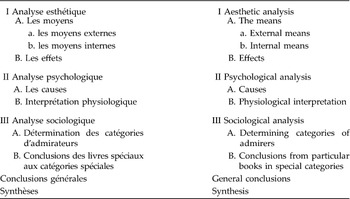
Esthopsychologie was an extension of Hennequin's style theory, especially his insistence that a psychological reading can arise from studying a writer's use of language, which he articulated, for example, in his essay on Flaubert, discussed earlier. However, esthopsychologie was to take this process a step further by advocating three stages of analysis: aesthetic, psychological and sociological followed by a concluding section: synthesis. At the end of La Critique scientifique (in an appendix entitled, ‘A plan for a complete study of esthopsychologie’), Hennequin provided an 18-page outline for how esthopsychologie might be applied to a study of Victor Hugo. It may be summarised in Table 1.Footnote 92
Hennequin's outline

A detailed summary of how Hennequin's plan works was made by John M. Robertson, who reproduced (or rather, appropriated) this plan in his New Essays Towards a Critical Method of 1897, summarizing Hennequin's method in its three stages of aesthetics, psychological and sociological meaning:
To put the plan [of esthopsychologie] in detail, an all-round survey of literature or art must involve (1) a careful study of the book (or picture) to the end of noting the way in which the writer or artist makes his technical effect … (2) a similar analysis of the author's personality, by way of an explanatory hypotheses or statement of his characteristics, squaring these with their results as seen in the book; (3) a survey of the relation of public to author, noting the types of his admirers … with special reference to the different classes of his works. Each analysis ends in a synthesis; the author is shown to work with certain tools in certain ways; to have certain psychological peculiarities, which constitute his gifts and his weaknesses; and all to have certain kinds of admirers for certain parts or all of his work, in virtue of correspondence between him, as a product of faculty and training, and them, as a product of bias and previous literary culture.Footnote 93
This biographical method, this working out of esthopsychologie, which was central to Hennequin's work, was not fully developed in Newman's article. Only the second part of this schema was taken up by Newman, for his literary analysis was concerned with building a portrait of a Berlioz's character. Perhaps had the biography been completed Newman would have engaged more fully with the esthopsychologie, as proposed in models by Hennequin and Robertson, and it would have been interesting, to say the least, to see how this literary analysis would have transferred to a reading of Berlioz's music.
Conclusion
The discourses on the prose writings of artists written in the late nineteenth century clearly excited Ernest Newman's imagination. From the writings of Pater in 1889 through Raleigh in 1897, the possibilities for psychological readings of a writer's work had gained much momentum by the time ‘The Prose of Berlioz’ was published in 1899. Partly fascinated (if not entirely convinced) by Hennequin's particular approach, however, Newman saw the possibilities of such an undertaking with Berlioz. Yet, it was not only to Hennequin that Newman looked for a methodology; as I have argued, it is extremely unlikely that Newman would have relied solely on one source; indeed, his explicit interest in Hennequin would have been ignited and nurtured through the writings of others such as Nordau, Pater, Symonds, Earle and Raleigh.
It is a pity that Newman's biography of Berlioz was never written, because had he fully utilized Hennequin's esthopsychologie it would have represented a radical shift in musical biography. However, what Newman's article does give us is an insight into his interest in the science of biography and the interaction of methodologies across disciplinary boundaries, and it vindicates claims in recent musicological scholarship that the methods of musical biography are sometimes not always what they seem.