1. Introduction
Sedimentary basins are sinks for terrigenous detrital material that essentially records the bedrock geology around them, proximal and distal. Sediment routing of clastic debris, including processes of reworking, may be highly variable depending on the structural and morphological grain of drainage area and basin and on distributary and depositional processes. Recent U–Pb age determinations on detrital zircons from Neoproterozoic sandstones in the central and southern part of the Scandinavian Caledonides (Be’eri-Shlevin et al. Reference Be’eri-Shlevin, Gee, Claesson, Ladenberger, Majka, Kirkland, Robinson and Frei2011; Bingen, Belousova & Griffin, Reference Bingen, Belousova and Griffin2011) have shown that the provenances of the sandstones generally have been basement rocks located in the western part of continent Baltica with a high degree of recycling of clastic zircons. The recycling of detrital zircon from previous sediments renders sandstones as imprecise material for provenance studies; conclusions drawn from such data are general at best.
The present provenance study is from the Neoproterozoic Hedmark Basin (Hedmark Group) in south Norway, using U–Pb and Lu–Hf isotopes from zircon that mainly resides in granitic conglomeratic clasts. Some detrital samples are also included. The basin has been interpreted as a rift basin (e.g. Bjørlykke, Elvsborg & Høy, Reference Bjørlykke, Elvsborg and Høy1976; Nystuen, Reference Nystuen1982, Reference Nystuen1987; Kumpulainen & Nystuen, Reference Kumpulainen, Nystuen, Gee and Sturt1985; Siedlecka et al. Reference Siedlecka, Roberts, Nystuen, Olovyanishnikov, Gee and Pease2004; Nystuen et al. Reference Nystuen, Andresen, Kumpulainen and Siedlecka2008). In such a setting, conglomerates are particularly important as they record the most proximal part of the sedimentary system. This study mainly concerns granitic clasts since these are undoubtedly samples of the crystalline basement. The aim of this study is to map the pre-rifting geology of the basement at the western margin of Baltoscandia. This margin was destroyed in the Caledonian Orogeny; the sedimentary record is therefore one of the best ways to obtain insight into the crustal architecture of the Baltican margin.
2. Geological setting
Baltoscandia was the northwestern part of the continent Baltica during Neoproterozoic time. At c. 650 Ma, Baltica was bordered to the E and NE by margins towards the Pre-Uralides and Timanides, to the SE by the Scytian margin, in the S and SW by margins towards Amazonia, Avalonia and other peri-Gondwana terranes, and to the NW by the margin to Laurentia (e.g. Murphy et al. Reference Murphy, Pisarevsky, Nance and Keppie2004; Li et al. Reference Li, Bogdanova, Collins, Davidson, De Waele, Ernst, Fitzsimons, Fuck, Gladkochub, Jacobs, Karlstrom, Lu, Natapov, Pease, Pisarevsky, Thrane and Vernikovsky2008). After accretion of the Scandinavian Caledonides to Baltica during Silurian–Devonian time, Baltoscandia became part of the present Fennoscandian Shield.
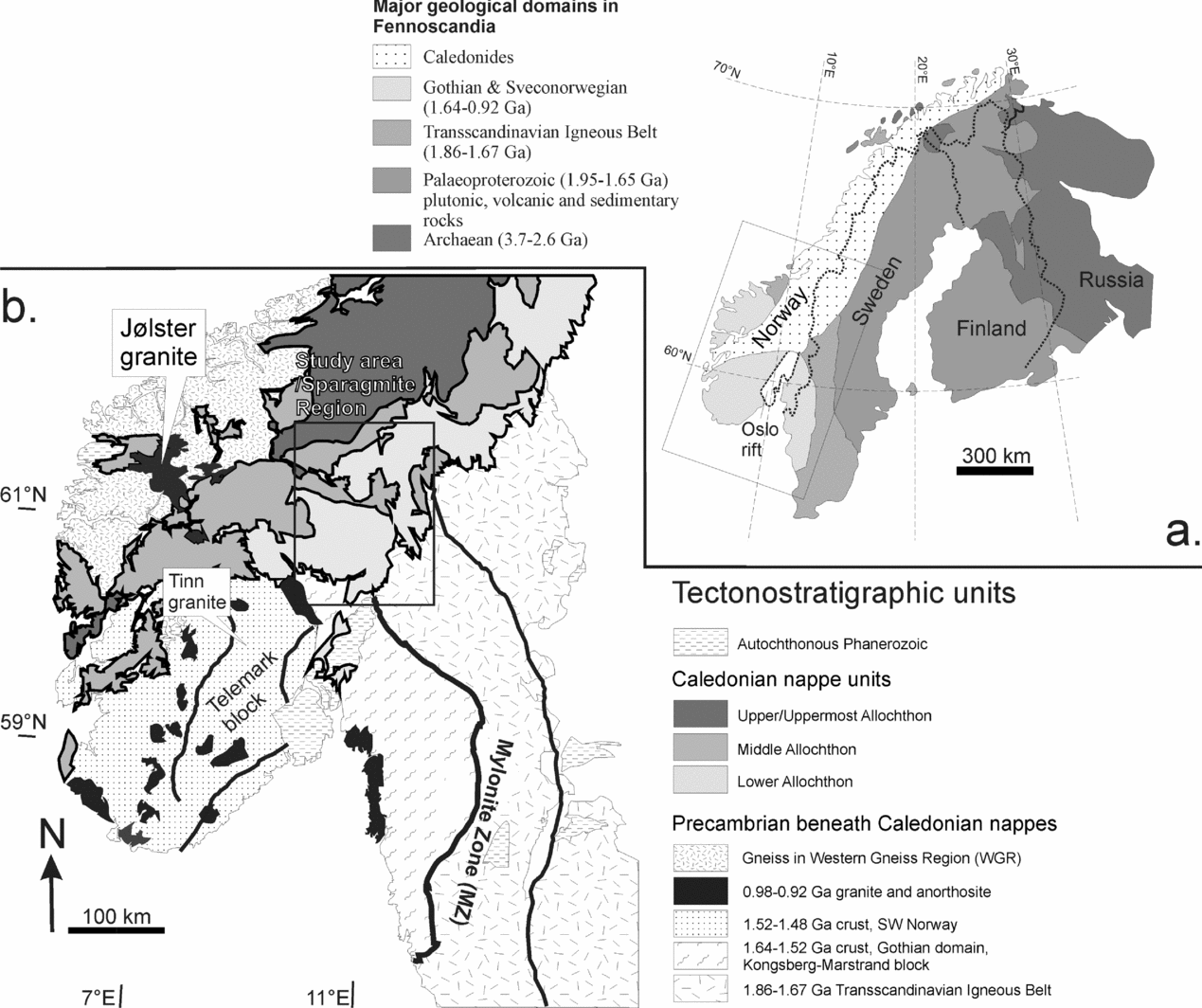
The Fennoscandian Shield is composed of an Archaean domain in the NE and younger Proterozoic crustal domains towards the SW (Fig. 1). SW Sweden and SW Norway make the youngest part of the Fennoscandian Shield. This area has been called the Southwest Scandinavian Domain (SSD; Gaál & Gorbatschev, Reference Gaál and Gorbatschev1987), Sveconorwegian Belt (Bingen, Nordgulen & Viola, Reference Bingen, Nordgulen and Viola2008) or Sveconorwegian Orogen (e.g. Corfu & Laajoki, Reference Corfu and Laajoki2008). The region includes rocks of multiple orogens and ages ranging from late Palaeoproterozoic to late Mesoproterozoic. It is structurally complex including several Precambrian fault and shear zones that generally run from north to south and subdivide it into parts (Fig. 1). In the literature they have been called sectors, terranes and blocks (Andersen, Reference Andersen2005). The non-genetic subdivision into blocks is preferred here.
Simplified geological maps of (a) the Fennoscandian Shield and (b) southwest Scandinavia. Thick lines mark major tectonic faults and shear zones. The classical Sparagmite Region is framed.

The Neoproterozoic record of south Norway comprises large amounts of sedimentary rocks originally representing several sedimentary basins, now present in nappes of the Caledonides (Fig. 1). According to current palinspastic reconstructions of this part of the Scandinavian Caledonides (e.g. Gee, Reference Gee1975, Reference Gee1978; Nystuen, Reference Nystuen1981; Hossack, Garton & Nickelsen, Reference Hossack, Garton, Nickelsen, Gee and Sturt1985; Morley, Reference Morley1986; Rice, Reference Rice2005), these nappes have been laterally displaced from WNW to ESE by a minimum of 50–150 km and perhaps up to 300–400 km or more (Rice, Reference Rice2005).
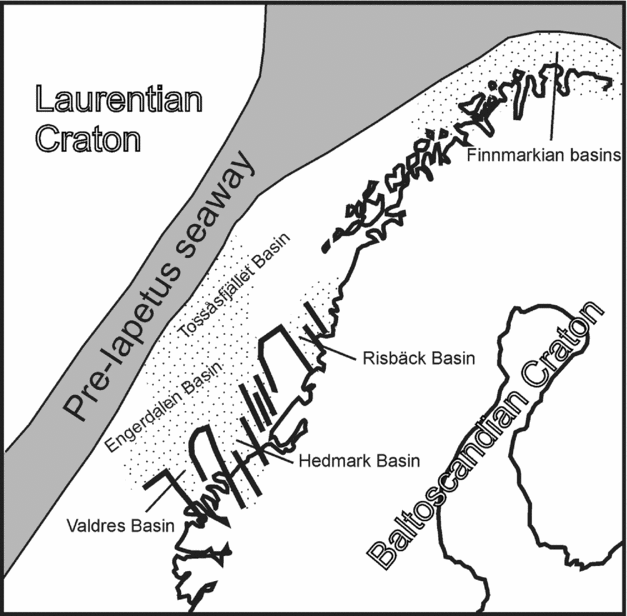
The Neoproterozoic successions have been related to several rift and passive continental margin basins formed along the Baltoscandian margin of the continent Baltica during the break-up of the supercontinent Rodinia some 750–600 Ma ago (Fig. 2). The continental break-up culminated with the opening of the Iapetus Ocean in latest Neoproterozoic to earliest Palaeozoic times, separating the continent Baltica in the east from the continent Laurentia in the west. Subsequent to seafloor spreading, subduction and ocean contraction, Baltica and Laurentia collided c. 400 Ma ago and the Scandinavian Caledonian mountain chain was formed in the Caledonian Orogeny (490–390 Ma). The former Neoproterozoic basin successions were thrust inland from the Baltoscandian margin and stacked in a series of thrust sheets, nappes and nappe complexes (e.g. Kumpulainen & Nystuen, Reference Kumpulainen, Nystuen, Gee and Sturt1985; Siedlecka et al. Reference Siedlecka, Roberts, Nystuen, Olovyanishnikov, Gee and Pease2004; Pease et al. Reference Pease, Daly, Elming, Kumpulainen, Moczydlowska, Puchkov, Roberts, Saintot and Stephenson2008; Nystuen et al. Reference Nystuen, Andresen, Kumpulainen and Siedlecka2008). The crystalline basement of the western margin of the Baltoscandian craton was destroyed and is now partly present in the Western Gneiss Region (WGR; Fig. 1) in south Norway and within tectonic slices in the Osen-Røa, Valdres, Kvitvola and Jotun nappe complexes (e.g. Gee et al. Reference Gee, Kumpulainen, Roberts, Stephens, Thon, Zachrisson, Gee and Sturt1985; Rice, Reference Rice2005; Lamminen, Andersen & Nystuen, Reference Lamminen, Andersen and Nystuen2011).
Palaeogeographic model of late Riphean–Vendian basins on the Baltoscandian margin. Modified from Kumpulainen & Nystuen (Reference Kumpulainen, Nystuen, Gee and Sturt1985).

The Caledonian thrust sheets are traditionally subdivided into the Lower, Middle, Upper and Uppermost allochthons (Fig. 1), each consisting of several nappe complexes. The rocks of the three lowermost allochthons are considered to have originated at the western Baltoscandian margin, whereas the Uppermost Allochthon has Laurentian affinity (cf. Gee et al. Reference Gee, Kumpulainen, Roberts, Stephens, Thon, Zachrisson, Gee and Sturt1985, Reference Gee, Juhlin, Pascal and Robinson2010; Roberts & Gee, Reference Roberts, Gee, Gee and Sturt1985). In south Norway the Lower Allochthon hosts rocks of the Hedmark Basin, whereas the Middle Allochthon includes rocks of the Engerdalen and Valdres basins (Engerdalen and Valdres groups), all with Neoproterozoic successions (informally termed ‘sparagmites’) with overlying Lower Palaeozoic strata. The study area in Figure 1 has also traditionally been called the ‘Sparagmite Region’. The Hedmark and Valdres basins have been interpreted as continental rift basins, whereas the Engerdalen Basin is considered a passive continental shelf basin (Siedlecka et al. Reference Siedlecka, Roberts, Nystuen, Olovyanishnikov, Gee and Pease2004; Nystuen et al. Reference Nystuen, Andresen, Kumpulainen and Siedlecka2008). Neoproterozoic glacial deposits and overlying Cambrian quartz arenites are also located directly on crystalline basement rocks, both in allochthonous and autochthonous positions (Nystuen et al. Reference Nystuen, Andresen, Kumpulainen and Siedlecka2008; Nystuen & Lamminen, Reference Nystuen, Lamminen, Arnaud, Halverson and Shields-Zhou2011). The basin successions are deformed into Caledonian folds, thrusts and duplex structures in addition to post-Caledonian normal faults cutting the nappe complexes (Nystuen, Reference Nystuen1983).
The amount of tectonic displacement of the rocks of the Hedmark Group has been disputed, from being autochthonous or parautochthonous to distinctly allochthonous. The problem was reviewed by Nystuen (Reference Nystuen1981) and further discussed by Kumpulainen & Nystuen (Reference Kumpulainen, Nystuen, Gee and Sturt1985), Morley (Reference Morley1986), Nystuen (Reference Nystuen1987), Siedlecka et al. (Reference Siedlecka, Roberts, Nystuen, Olovyanishnikov, Gee and Pease2004), Rice (Reference Rice2005) and Nystuen & Lamminen (Reference Nystuen, Lamminen, Arnaud, Halverson and Shields-Zhou2011). All studies postdating Nystuen (Reference Nystuen1981) are in favour of an allochthonous origin for the infill succession of the Hedmark Basin. In the present paper we apply the palaeogeographic model (Fig. 2) suggested by Kumpulainen & Nystuen (Reference Kumpulainen, Nystuen, Gee and Sturt1985) and Nystuen & Lamminen (Reference Nystuen, Lamminen, Arnaud, Halverson and Shields-Zhou2011). Recently, the far-travelled origin of the lower and middle allochthonous nappe complexes of south Norway has been supported by evidence of hyperextension along the pre-Caledonian margin of Baltica (Andersen et al. Reference Andersen, Corfu, Labrousse and Osmundsen2012). With the allochthonous position of the Hedmark Basin, both autochthonous and allochthonous basement rocks have to be evaluated as possible source rocks to the basin fill.
The autochthonous basement rocks in the study area belong to the 1.86–1.67 Ga Transscandinavian Igneous Belt (TIB) in the E and SE, and the Gothian/Sveconorwegian domain in the SW (Fig. 1). The formation of the TIB has been subdivided into three magmatic phases (TIB0: 1.86–1.83 Ga; TIB1: 1.81–1.76 Ga; and TIB2–3: 1.71–1.67 Ga; Larson & Berglund, Reference Larson and Berglund1992; Andersson et al. Reference Andersson, Sjöström, Högdahl, Eklund, Högdahl, Andersson and Eklund2004; Gorbatschev, Reference Gorbatschev, Högdahl, Andersson and Eklund2004). The TIB gets younger from SE to WNW, being c. 1.8 Ga in south Sweden and 1.67 Ga in eastern Norway (Heim, Skiöld & Wolff, Reference Heim, Skiöld and Wolff1996). The TIB crops out extensively adjacent to the Sparagmite Region in the E and SE and continues to the W as far as Lake Mjøsa, where it changes into the Gothian domain via a Mylonitic Zone (MZ; Fig. 1). Most of the U–Pb work done on TIB was performed in Sweden (e.g. Högdahl, Andersson & Eklund, Reference Högdahl, Andersson and Eklund2004). On the Norwegian side, Heim, Skiöld & Wolff (Reference Heim, Skiöld and Wolff1996) dated a ‘tricolour’ granite in the Trysil area to 1673±8 Ma. Andersen, Griffin & Pearson (Reference Andersen, Griffin and Pearson2002) dated the Odal granite north of the MZ and obtained 1681±6 Ma. Similar ages from this area have also been reported by Bingen, Nordgulen & Viola (Reference Bingen, Nordgulen and Viola2008). The Brustad augen-gneiss at the MZ south of the Odal granite is 1674±10 Ma (Alm, Sundblad & Schoberg, Reference Alm, Sundblad and Schoberg2002). More (almost identical) ages have been found by Lamminen, Andersen & Nystuen (Reference Lamminen, Andersen and Nystuen2011) from the westernmost outcrops of the autochthonous TIB basement in the Sparagmite Region. These ages can be allocated to the TIB3 phase of Larson & Berglund (Reference Larson and Berglund1992).
The bedrock west of the MZ (Fig. 1) makes up the Kongsberg–Marstrand Block and is built up by various Palaeo-Mesoproterozoic (1.75–1.50 Ga) meta-igneous and metasedimentary rocks, formed in a long-lived and possibly complex subduction zone environment along the western margin of the Fennoscandian Shield (Gorbatschev, Reference Gorbatschev1980; Åhäll & Gower, Reference Åhäll and Gower1997; Andersen et al. Reference Andersen, Griffin, Jackson, Knudsen and Pearson2004; Åhäll & Connelly, Reference Åhäll and Connelly2008). This ‘Gothian’ orogeny overlaps in time with the TIB2–3 phases of the Transscandinavian Igneous Belt (Åhäll & Larson, Reference Åhäll and Larson2000).
Further to the west, the rest of SW Norway is characterized by gneisses not older than Gothian in age, and various supracrustal suites. The ages obtained from these rocks are mainly Mesoproterozoic to early Neoproterozoic (1555–914 Ma), while the youngest rock is a c. 616 Ma mafic dyke belonging to Egersund dyke complex (Bingen, Demaiffe & van Breemen, Reference Bingen, Demaiffe and van Breemen1998). During the Sveconorwegian Orogeny, SW Norway was intruded by several generations of mafic to granitic intrusive rocks at c. 0.98–0.92 Ga, which form a belt of intrusions extending from SW Norway to the WGR (Fig. 1; Andersen, Andresen & Sylvester, Reference Andersen, Andresen and Sylvester2001; Andersen, Graham & Sylvester, Reference Andersen, Graham and Sylvester2009).
The Caledonian nappes contain several basement rocks in allochthonous position. Some of these, assumed to be bound below by blind thrusts, have been called ‘basement windows’ in the Lower Allochthon. In some of the windows there is depositional contact between basement rocks and overlying sedimentary strata associated with them, including the youngest formations of the Hedmark Group and Cambrian shales (Siedlecka et al. Reference Siedlecka, Nystuen, Englund and Hossack1987). Lamminen, Andersen & Nystuen (Reference Lamminen, Andersen and Nystuen2011) dated some of the tectonic basement slices which are not younger than c. 1650 Ma in the Lower Allochthon, whereas c. 1200 Ma ages are found in the Middle Allochthon. These basement slices are direct samples of the basement at the Baltoscandian margin; their erosion in pre-Caledonian position probably provided detritus to the Hedmark Basin.
3. Stratigraphy and sedimentology
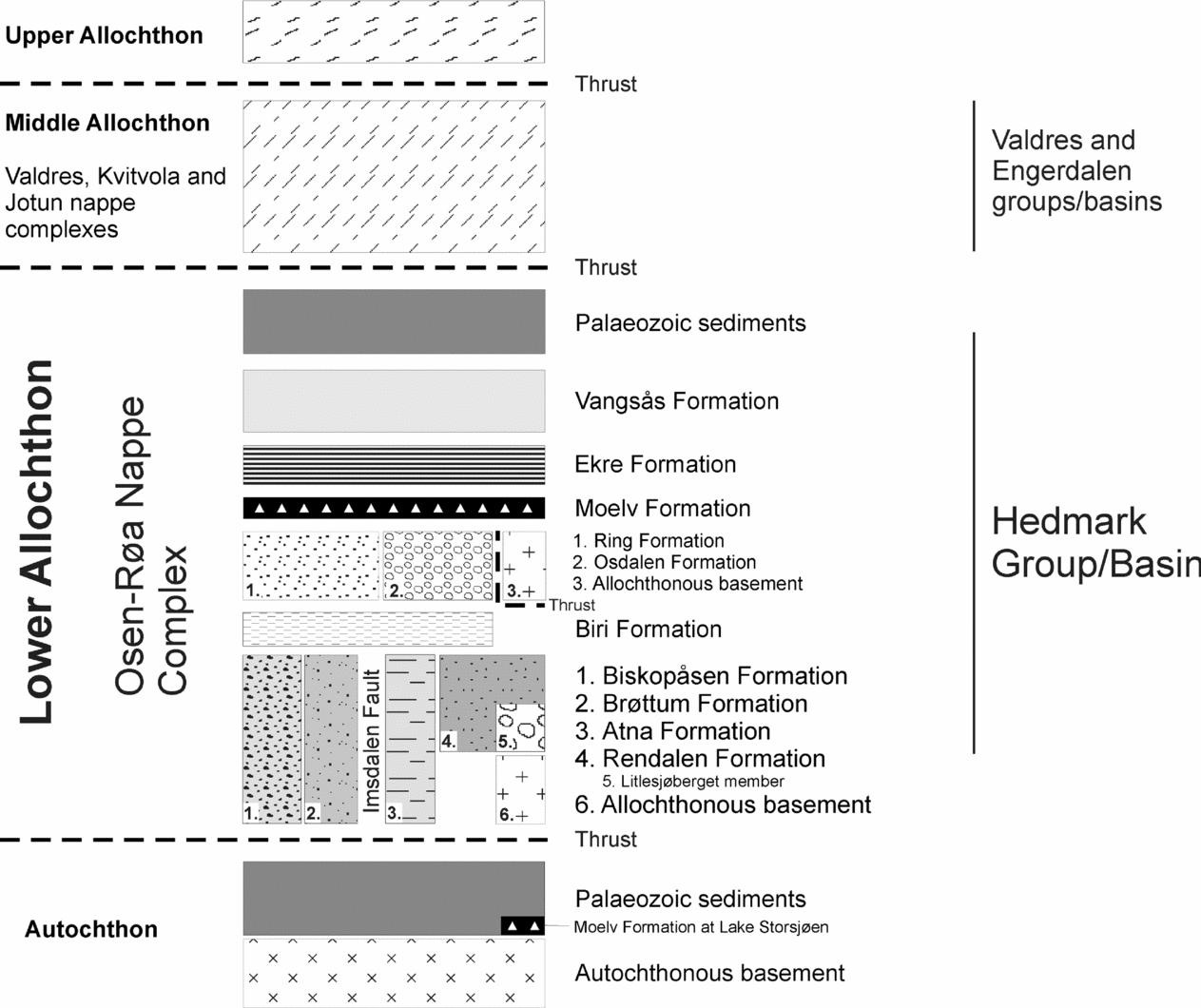
The Hedmark Basin (Figs 3, 4) is essentially made up of two parts: a NE part dominated by fluvial sandstone (Rendalen Formation) and a SW part dominated by turbiditic sandstone (Brøttum Formation). The two parts are separated by a major syndepositional fault, the Imsdalen Fault (Sæther & Nystuen, Reference Sæther and Nystuen1981). The stratigraphy of the Hedmark Group (Fig. 3) is partly different in the eastern and western parts, but formations younger than the Brøttum and Rendalen formations can be correlated across the fault. The Hedmark Group can be subdivided into syn-rift and post-rift formations. Syn-rift deposits reflect rapid creation of accommodation space in the basin during the most active stage of tectonic activity. Post-rift deposits blanket a wider area than the basin, which was over-filled before the post-rift stage (Siedlecka et al. Reference Siedlecka, Roberts, Nystuen, Olovyanishnikov, Gee and Pease2004; Nystuen et al. Reference Nystuen, Andresen, Kumpulainen and Siedlecka2008; Nystuen & Lamminen, Reference Nystuen, Lamminen, Arnaud, Halverson and Shields-Zhou2011).
Tectonostratigraphy of the Caledonian nappe pile and the main lithostratigraphic units of the Hedmark Group, representing the basin infill succession of the Hedmark rift basin. The autochthon consists of crystalline and metamorphic Precambrian basement rocks overlain by a thin cover of Palaeozoic sedimentary rocks (Cambro-Ordovician).

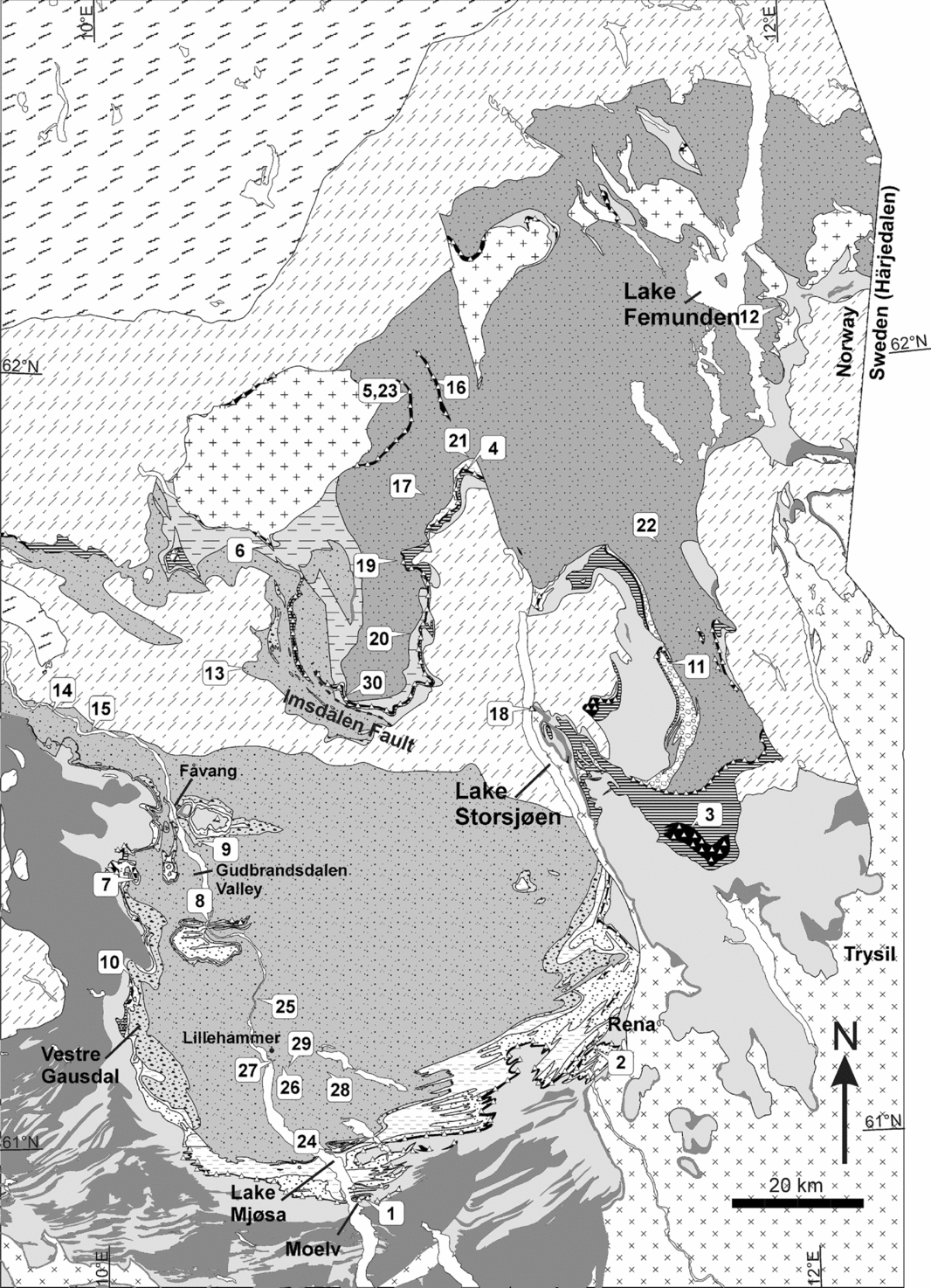
Geological map of the study area (simplified from NGU map sheets, available online at http://www.ngu.no). Only the Lower Allochthon is shown in detail. The sampling sites are marked with numbers and corresponding samples are listed in Table 1. For legend, see Figure 3.

3.a. Brøttum Formation
In the SW part of the Hedmark Basin the oldest formation is the deep marine Brøttum Formation, which comprises turbiditic sandstones and intercalated black shales. The lower boundary of the formation is unknown. The maximum thickness of the Brøttum Formation is at least 4000 m (Nystuen et al. Reference Nystuen, Andresen, Kumpulainen and Siedlecka2008). The sandstones of the Brøttum Formation are generally poorly sorted with up to c. 20% feldspar comprising potassium feldspar and plagioclase, mostly albite (Englund, Reference Englund1973; Bjørlykke, Elvsborg & Høy, Reference Bjørlykke, Elvsborg and Høy1976; Morad, Reference Morad1988). The transport direction was from W to E in the western part of the basin (Englund, Reference Englund1972; Skaten, Reference Skaten2006). Conglomerate beds are present in the Brøttum Formation in the E and NE parts of its outcrop area, here transported from E to W, as the polymictic Imsdalen conglomerate member (Sæther & Nystuen, Reference Sæther and Nystuen1981; Stalsberg, Reference Stalsberg2004). Sandstone samples of the Brøttum Formation are included in the present study.
3.b. Rendalen Formation
The more than 2000 m thick Rendalen Formation forms the lowermost formation in the Hedmark Group in the NE part of the Hedmark Basin. The Rendalen Formation consists of fluvial arkosic sandstone and several conglomerate members. An alluvial conglomerate (Litlesjøberget member) rests with primary depositional contact on a weathered granitic basement rock east of Lake Femunden (Figs 3, 4) (Nystuen, Reference Nystuen1982, Reference Nystuen1987). The Rendalen Formation is considered coeval with the Brøttum Formation, separated by the synsedimentary Imsdalen Fault (Figs 3, 4) (Sæther & Nystuen, Reference Sæther and Nystuen1981). The Rendalen Formation continues into Härjedalen in Sweden (Fig. 4). The sand of the formation is assumed to have been deposited mainly from E to W (see Section 6.c). The Rendalen Formation was sampled in this study.
3.c. Biskopåsen Formation
The Biskopåsen Formation represents coarse-clastic submarine fans passing basinwards into sandstone and shale in the western part of the Hedmark Basin. The formation, being up to more than 400 m thick (Holme, Reference Holme2002), contains subrounded to well-rounded pebbles and cobbles and some boulders, and comprises matrix- and clast-supported conglomerate facies with alternating beds of sandstone and pebbly sandstone. The polymictic clast assemblage encompasses various types of extrabasinal rock types (granite, rhyolitic porphyry, felsites, red and grey quartz arenites and vein quartz) as well as intrabasinally derived clasts (calcareous sandstone, shale, limestone, phosphorite and basalt) (Løberg, Reference Løberg1970; Englund, Reference Englund1972, Reference Englund1973; Bjørlykke, Elvsborg & Høy, Reference Bjørlykke, Elvsborg and Høy1976; Nystuen, Reference Nystuen1987; Vidal & Nystuen, Reference Vidal and Nystuen1990; Holme, Reference Holme2002). Quartz arenite is the most frequent clast lithology in most localities, but in the Fåvang area in the Gudbrandsdalen valley (Fig. 4) the clast composition is dominated by meta-anorthosite (more than 70%) (Ramberg & Englund, Reference Ramberg and Englund1969; Englund, Reference Englund1973). Meta-anorthosite clasts are a unique feature of the western part of the Hedmark Basin and are not found elsewhere in the basin (Ramberg & Englund, Reference Ramberg and Englund1969). Some granitic clasts from the Biskopåsen Formation are analysed in this study.
3.d. Osdalen Formation
This is an alluvial conglomerate located on top of the Rendalen Formation in the eastern part of the Hedmark Basin, above the transgressive shale-carbonate Biri Formation (Figs 3, 4). The conglomerate unit extends 60 km along-strike and is up to c. 400 m in thickness. It interdigitates with arkosic sandstone of similar facies to that in the Rendalen Formation. The clasts, up to the size of boulders, comprise various types of granite and rhyolitic porphyries, felsites, diorite, grey and red quartz arenites, vein quartz, limestone and shale (from the Biri Formation) (Nystuen & Sæther, Reference Nystuen and Sæther1979). Granitic clasts from the conglomerate are included in the present study.
3.e. Moelv Formation
The Moelv Formation is a Neoproterozoic glacial deposit, consisting mainly of diamictite (e.g. Nystuen, Reference Nystuen1976; Bjørlykke & Nystuen, Reference Bjørlykke, Nystuen, Hambrey and Harland1981; Nystuen, Reference Nystuen1985; Nystuen & Lamminen, Reference Nystuen, Lamminen, Arnaud, Halverson and Shields-Zhou2011). The Moelv Formation rests with erosional contact on the Rendalen, Atna, Osdalen, Ring and Biri formations (Figs 3, 4), on a basalt in the central part of the Hedmark Basin (the Svarttjørnkampen Formation, not shown in Figs 3, 4), on crystalline basement rocks in tectonic slices and window structures in the Osen-Røa Nappe Complex and in autochthonous position as at Lake Storsjøen (Fig. 4). Considerable variations in thickness up to c. 160 m and facies distributions are thought to be related to an inherited rift-basin morphology of the Hedmark Basin (Bjørlykke, Elvsborg & Høy, Reference Bjørlykke, Elvsborg and Høy1976; Nystuen, Reference Nystuen1976, Reference Nystuen1985; Nystuen & Lamminen, Reference Nystuen, Lamminen, Arnaud, Halverson and Shields-Zhou2011). The Moelv Formation and its correlative glacial formations in the Valdres and Engerdalen groups and elsewhere in Scandinavia (Kumpulainen & Nystuen, Reference Kumpulainen, Nystuen, Gee and Sturt1985; Kumpulainen, Reference Kumpulainen, Arnaud, Halverson and Shields-Zhou2011) are assumed to have been deposited from a mainly grounded western Baltoscandian ice sheet generally moving westwards, and from local basement highs bordering the basins (Nystuen & Lamminen, Reference Nystuen, Lamminen, Arnaud, Halverson and Shields-Zhou2011). The Moelv Formation contains clasts of various lithologies comprising granitoids, porphyries, metarhyolites, quartz arenites, red sandstone, dolerite, diorite, basalt and limestone. Bjørlykke, Elvsborg & Høy (Reference Bjørlykke, Elvsborg and Høy1976) reported a rather high (>50%) granite clast content in the Moelv Formation. Granitic clasts from the Moelv Formation have been analysed in the present study.
4. Methodology
In this study the main focus is on U–Pb zircon ages obtained from granitic clasts and sandstones. The analytical method is multicollector laser ablation mass spectrometry. Lu–Hf isotopes are analysed from selected clasts. The Lu–Hf isotope system adds a valuable possibility of obtaining petrogenetic information from the host rock where the zircon crystallized (cf. Howard et al. Reference Howard, Hand, Barovich, Reid, Wade and Belousova2009). The Lu–Hf is analogous to the Sm–Nd system, but since Hf substitutes Zr in the crystal lattice of zircon it is robust and not easily reset.
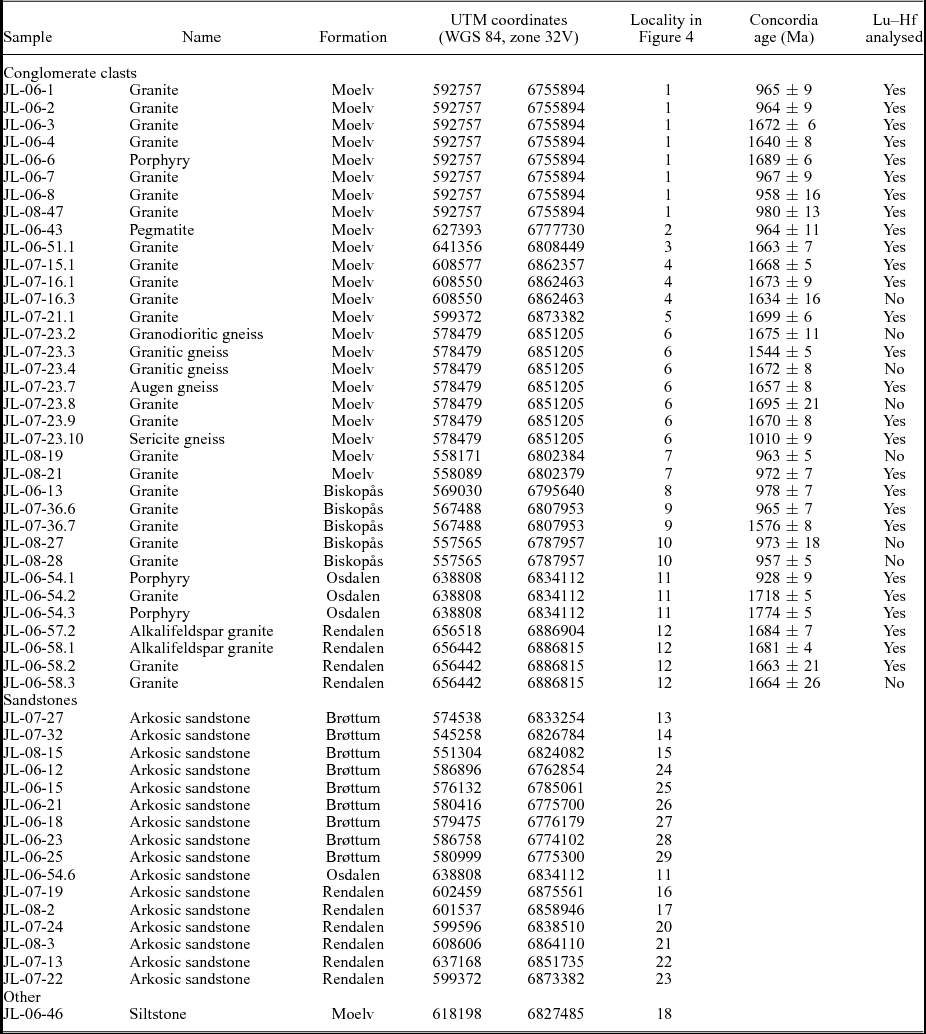
Most conglomerate clast material come from the Moelv Formation. Sampled clasts consist mostly of granites but also include some porphyries, metavolcanites and one pegmatite. All the clasts were larger than 10 cm in diameter, and several of them larger than 15 cm. Most clasts were moderately to well rounded. Characteristics of all the samples are summarized in Table 1, and for full details of the analytical method see the online Supplementary Material (available at http://journals.cambridge.org/geo).
Summary of samples analysed.

5. Results
5.a. Uranium–Lead
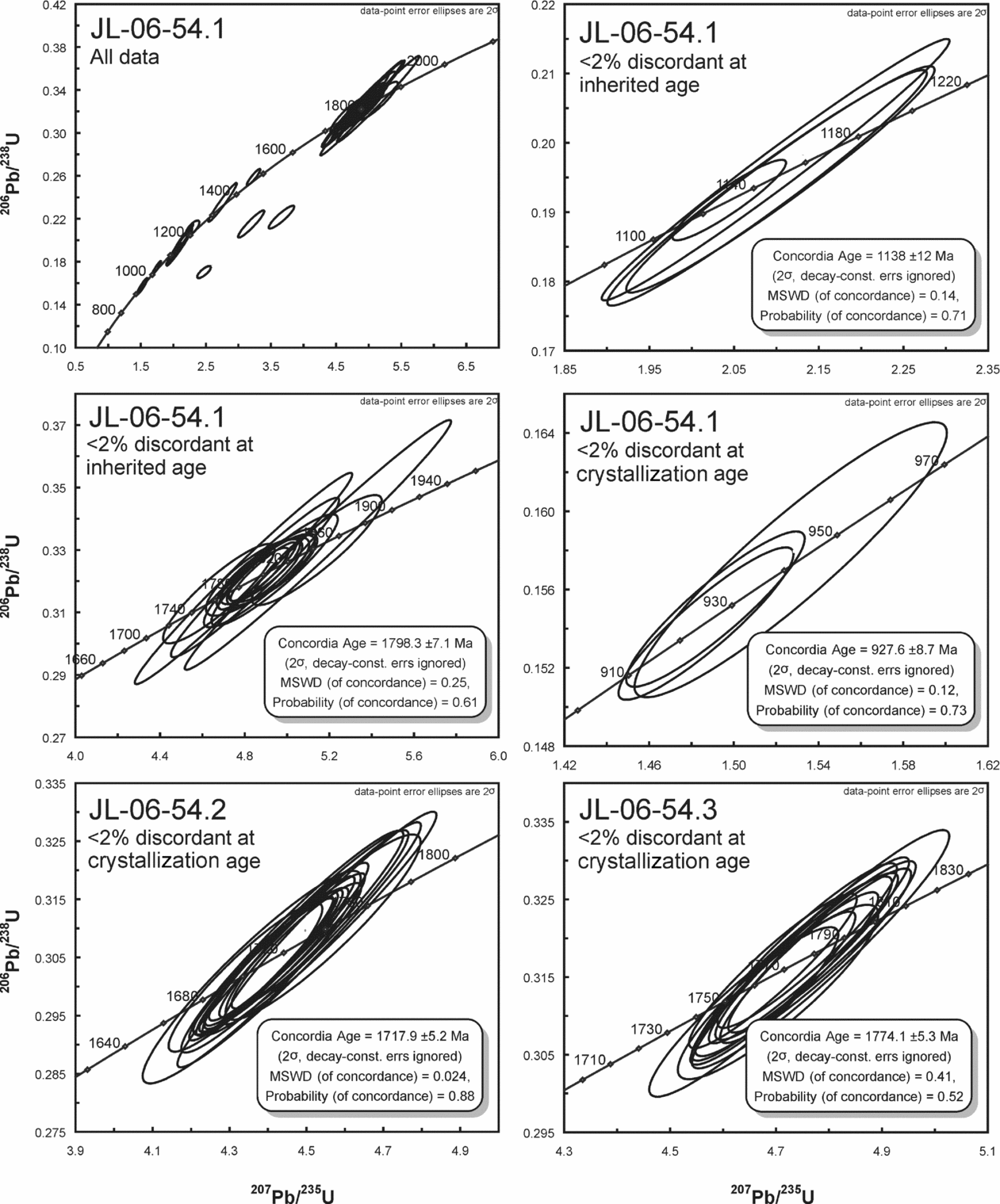
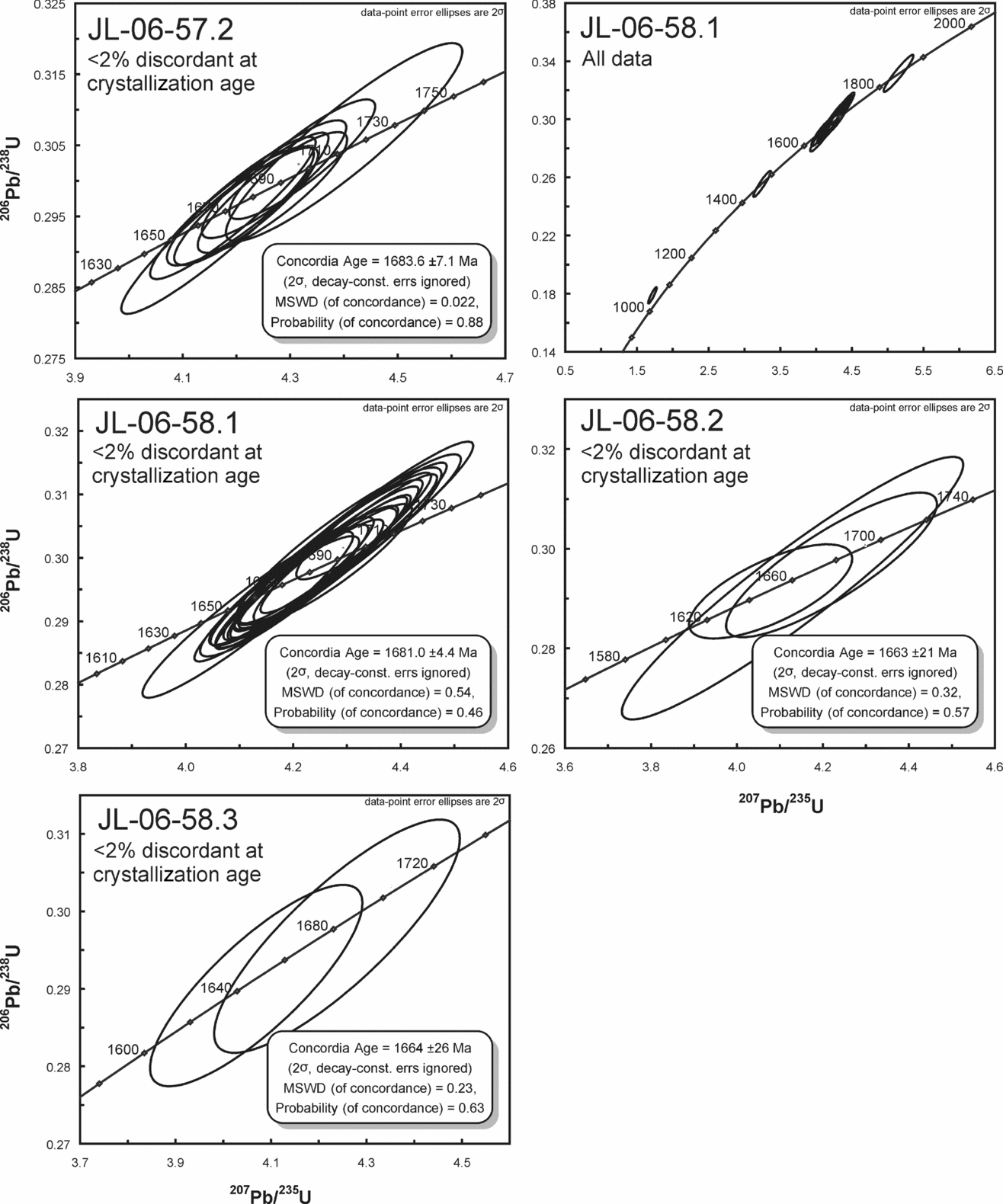
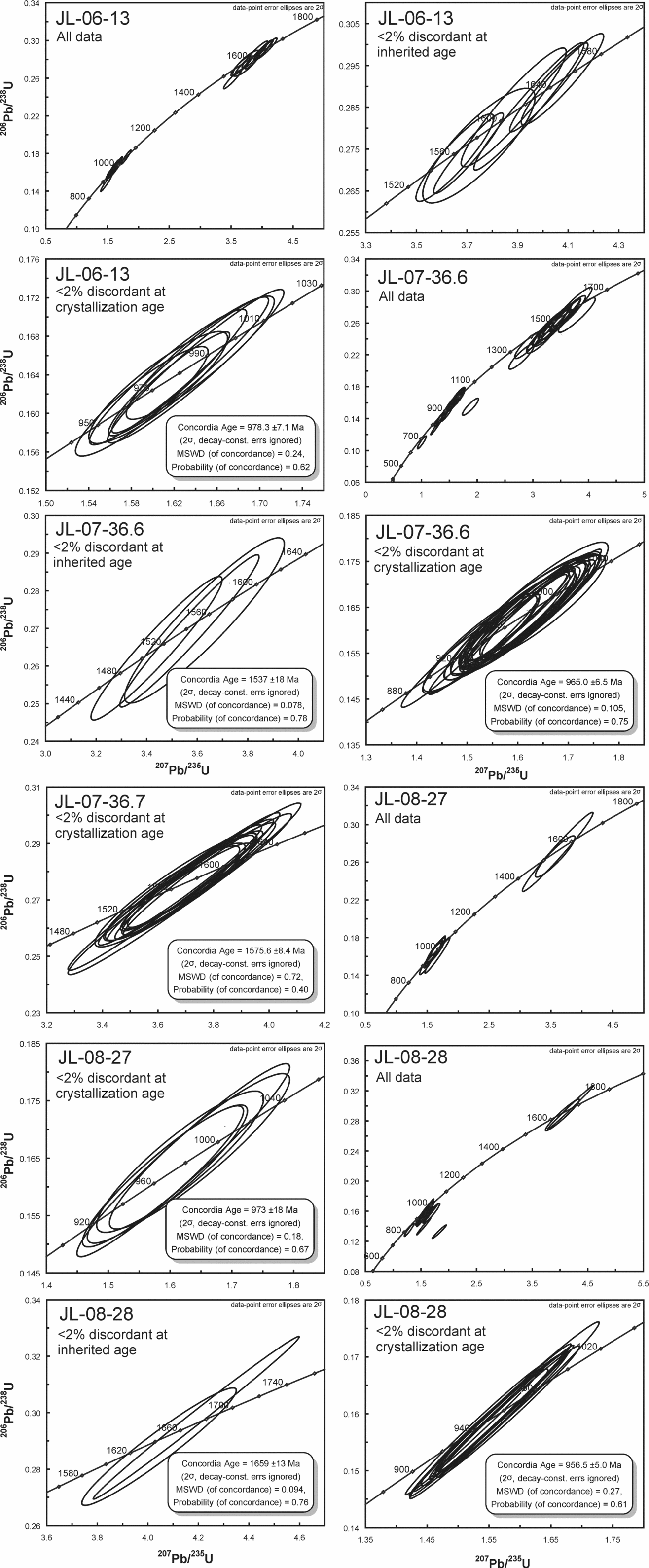
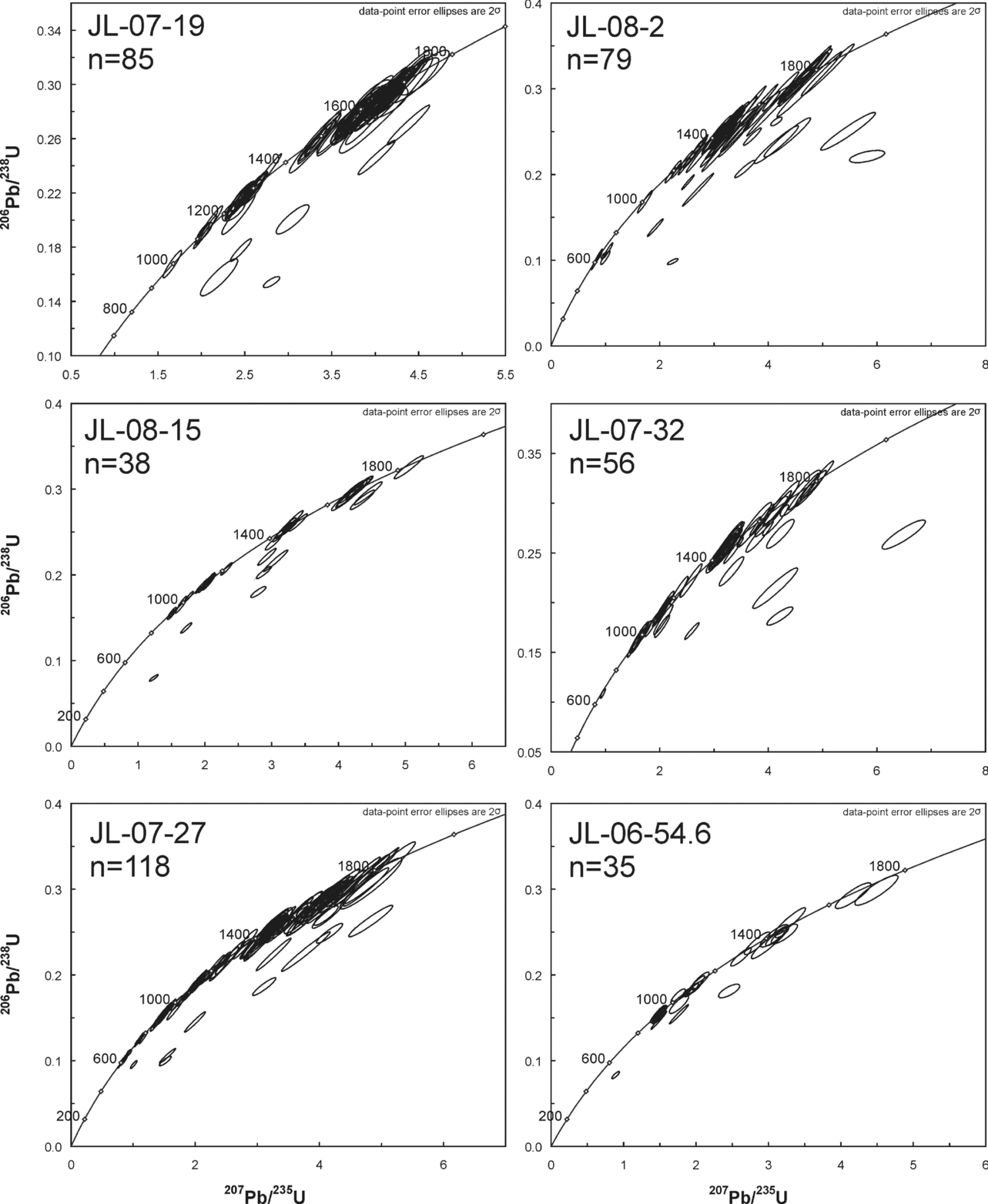
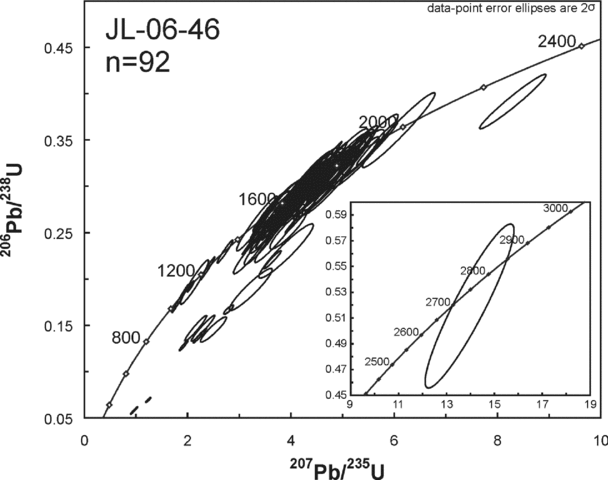
All U–Pb data from clasts and sandstones are provided in the online Supplementary Material (available at http://journals.cambridge.org/geo). Most of the clast analyses are reasonably concordant; highly discordant analyses contain common Pb. In the concordia diagrams of zircons from clasts (Figs 5–8), the best age estimate is the concordia age (Ludwig, Reference Ludwig1998) calculated from <2% discordant analyses which proved to be a valid cut-off limit in the present study. Analyses of the sandstone samples and the siltstone sample are mainly concordant or close to concordia (Figs 9, 10). A cut-off limit of 10% discordance is used for detrital zircon samples. The 207Pb/206Pb age is used as the best age estimate for individual zircon analyses. Within the 10% discordance limits, the detrital zircon ages range from c. 1992 Ma to c. 610 Ma and one grain at c. 2785 Ma.
U–Pb concordia diagrams of zircons from granitic clasts of the Moelv Formation. The complete age distribution is shown only for samples that have inheritance. Concordia ages are calculated from analyses that are <2% discordant.

U–Pb concordia diagrams of zircons from granitic clasts of the Osdalen Formation. The complete age distribution is shown only for samples that have inheritance. Concordia ages are calculated from analyses that are <2% discordant.

U–Pb concordia diagrams of zircons from granitic clasts of the Litlesjøberget member of the Rendalen Formation. The complete age distribution is shown only for samples that have inheritance. Concordia ages are calculated from analyses that are <2% discordant.

U–Pb concordia diagrams of zircons from granitic clasts of the Biskopåsen Formation. The complete age distribution is shown only for samples that have inheritance. Concordia ages are calculated from analyses that are <2% discordant.

Concordia diagrams of the sandstone samples from Brøttum, Rendalen and Osdalen formations.

Concordia diagram of the Autochthonous Moelv Formation siltstone sample (see Fig. 4, site 18).

5.a.1 Clast samples
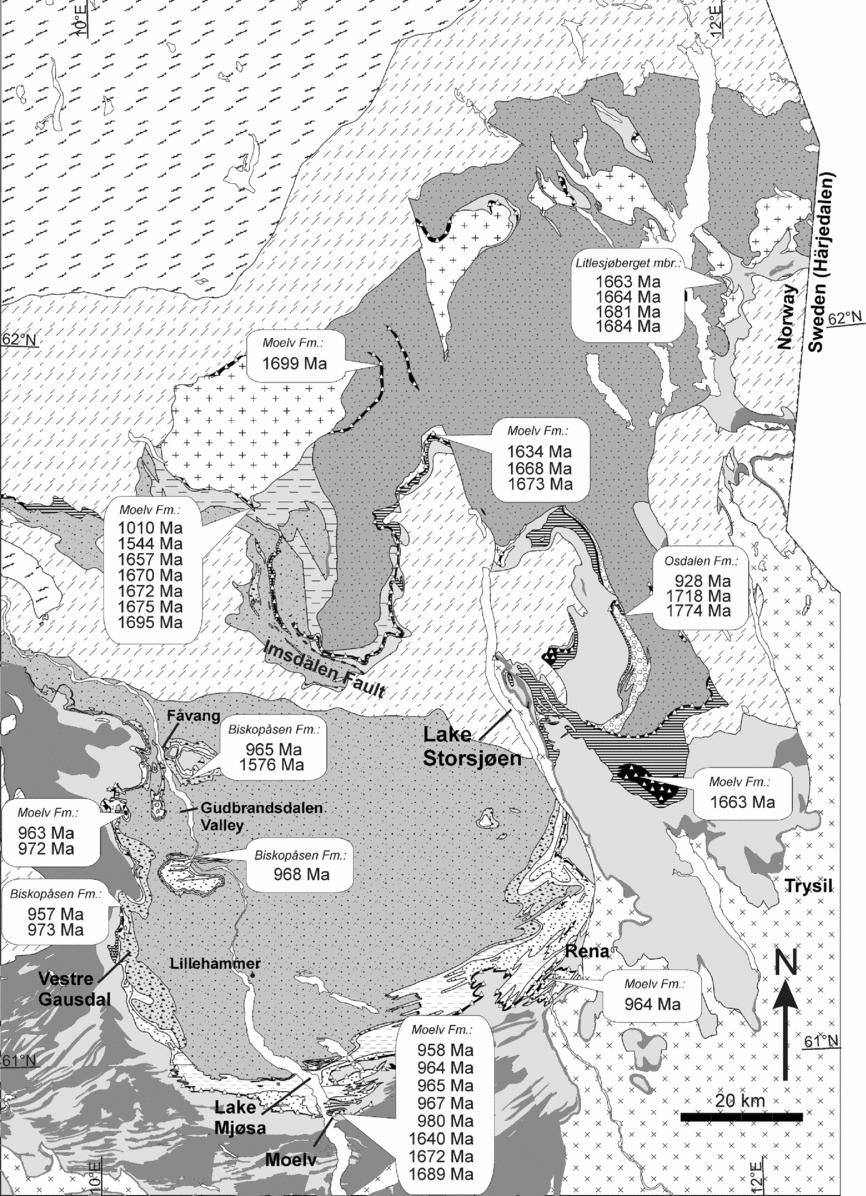
In this study, the crystallization ages obtained from the granitoid clasts are broadly bimodal (Table 1; Fig. 11). Half of the clasts are of age c. 960 Ma and overlap within error. The remaining clasts show a transition from late TIB (c. 1770 Ma) to Gothian (c. 1544 Ma; Åhäll & Connelly, Reference Åhäll and Connelly2008). The majority of the Palaeoproterozoic clasts crystallized at c. 1680–1660 Ma. The zircon inheritance pattern is systematic. The Palaeoproterozoic clasts show almost invariably no inherited zircon, but c. 960 Ma clasts commonly have inheritance. This inheritance is typically c. 1650 Ma and slightly younger. Some clasts show inheritance up to c. 1900 Ma. Samples of Sveconorwegian age showing this above-mentioned inheritance include samples JL-06-2 and JL-06-43 (Fig. 5) and JL-06-54.1 (Fig. 6). There is a tendency for conglomerate clasts of Sveconorwegian age to be found in the W and SW, whereas Palaeoproterozoic clasts are found in the E and NE (Fig. 11).
Geological map of the study area (same as Fig. 4) with summary of ages from conglomerate clasts. Note the younger ages clustering around 960 Ma in the W and SW, whereas clasts with ages corresponding to the TIB granites dominate in the E and NE.

5.a.2 Detrital samples
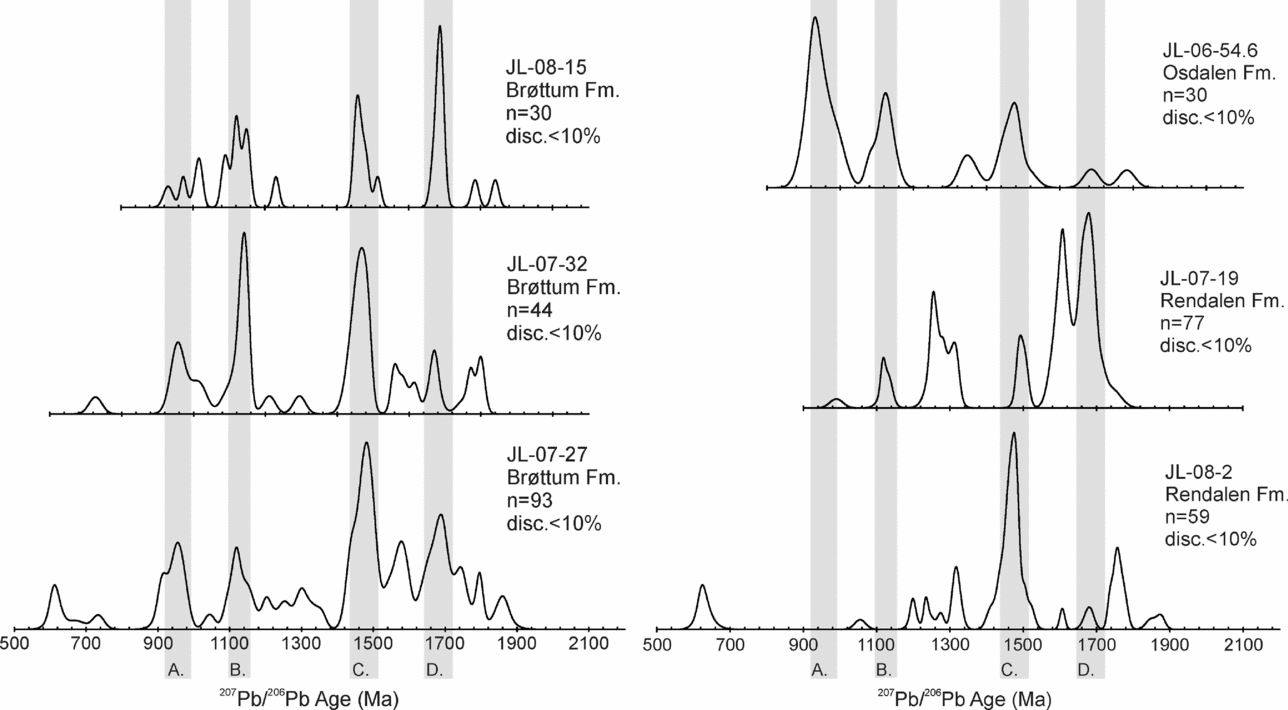
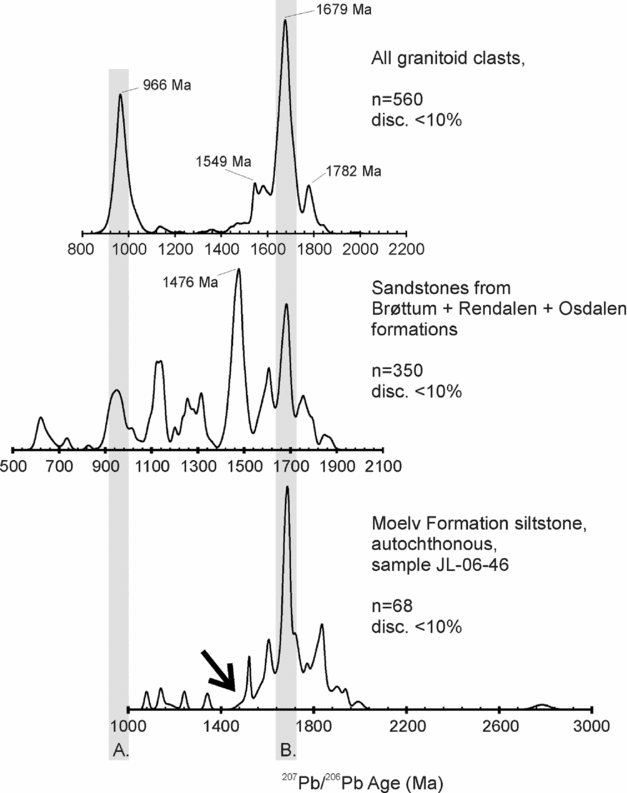
Probability density diagrams are used to show the total age distribution of a sample for comparison purposes (Fig. 12). The age distributions of sandstone samples in Figure 12 show a lot of similarities. Most of the peaks have similar locations, but the heights vary. This is a common effect of random phenomena when the number of analysed grains is less than c. 100; the true geological component therefore cannot be determined with certainty. The results obtained from samples from the Brøttum Formation are almost identical, while results from the Rendalen samples are more varied. The youngest peak is found from sample JL-07-27 and is c. 626 Ma. All the samples share a peak at c. 960 Ma (Fig. 12). The next most common peak or group of peaks is at c. 1120 Ma (Fig. 12), a similar age to some early Sveconorwegian magmatism in south Norway (Bingen et al. Reference Bingen, Nordgulen, Sigmond, Tucker, Mansfeld and Högdahl2003). The most distinct peak in all the samples is at c. 1476 Ma (Fig. 12), which can be located in both the Brøttum and Rendalen sandstones. The only matching age from south Norway is the Tinn granite in the northern Telemark block (Fig. 1; Andersen, Andresen & Sylvester, Reference Andersen, Andresen and Sylvester2002). The third most common age in the samples is at c. 1680 Ma (Fig. 12) which corresponds to the TIB2–3 magmatism in the autochthonous basement of eastern Norway.
Detrital zircon age probability density diagrams of the samples from the Brøttum, Rendalen and Osdalen formations. Grey boxes indicate common peaks or peak groups. Columns A and B: Sveconorwegian and early Sveconorwegian ages are common in all the samples from the Brøttum Formation, but present variably in the Rendalen and Osdalen formations. Columns C and D: the c. 1476 Ma and c. 1680 Ma peaks are present in all the diagrams.

The age distribution of the Moelv Formation sample JL-06-46 (Fig. 13) shows a strong Palaeoproterozoic signature peaking at c. 1680 Ma. The only Archaean age in this study is also found from this sample. The most striking feature is the complete lack of the c. 1476 Ma peak and <1000 Ma ages that are typical for most detrital zircon samples in this study. In Figure 13 the difference between the clasts and detrital zircon is clearly seen. The sandstone samples are dominated by the c. 1476 Ma peak, whereas this peak is almost completely missing in the clast age data.
A comparison of granitic clasts with the detrital zircon populations of the sandstone samples and the siltstone sample. In the upper diagram, all zircon data from the granitic clasts are summarized in the same probability density diagram. Major peaks are marked with their respective ages. The distribution in the granite clasts is bimodal with c. 960 Ma and c. 1680 Ma ages dominating. A marked gap exists between c. 1550 and c. 1000 Ma. The ages from the granitic clasts can be matched with two major peaks in the sandstone data. In general, the sandstones are much more complicated and several peaks can be seen in the diagram. The sample from the Moelv Formation siltstone lacks the characteristic c. 1476 Ma peak (arrow), which is typically present in all sandstone samples from the Hedmark Basin. A peak at c. 960 Ma is also missing. The only Archaean grain in this study comes from this sample.

5.b. Lutetium–Hafnium
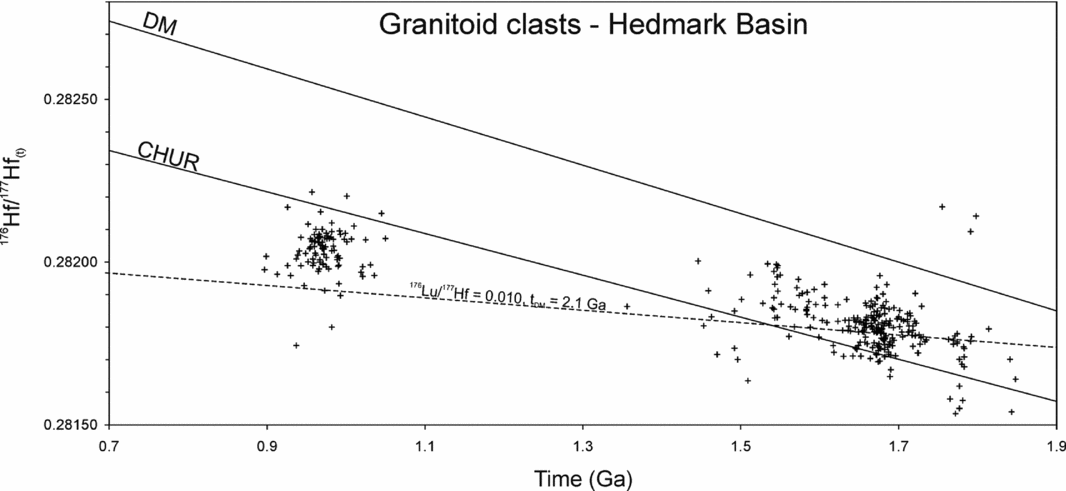
The Hf data in this study come from selected granitic clasts (Table 1). All Lu–Hf data are available as online Supplementary Material (available at http://journals.cambridge.org/geo). Zircon typically has a very low 176Lu/177Hf ratio, less than 0.006 in the entire dataset. Measured 176Yb/177Hf ranges from 0.006 to 0.234 and is mainly <0.1. Ytterbium-176 can cause isobaric interference and results in a larger spread in the measured 176Hf/177Hf ratios. However, the reference material analysed during the analytical sessions covers 176Yb/177Hf at least up to 0.11; in the dataset 302 of 326 analyses are <0.11 and therefore only a small number of analyses may be affected by high 176Yb. Initial 176Hf/177Hf ratios calculated from the zircon U–Pb age vary from 0.281405 to 0.282215 or in epsilon units from –7.26 to 1.26 ɛ. Zircon of age c. 1650–1750 Ma cluster at the same level as the initial 176Hf/177Hf ratio of 0.28170–0.28190 (Fig. 14), which corresponds to published data from the TIB in southern Fennoscandia (Andersen et al. Reference Andersen, Andersson, Graham, Åberg and Simonsen2009). The zircon of age c. 960 Ma have a rather narrow range in the initial 176Hf/177Hf ratio of 0.28200–0.28210 (Fig. 14) and overlap with published data from the Jølster granite from the WGR (Fig. 1; Lamminen, Andersen & Nystuen, Reference Lamminen, Andersen and Nystuen2011). Analyses follow a trend at 1550–1750 Ma, which is parallel to the Chondritic Uniform Reservoir (CHUR). This can be explained by successive mafic additions to old continental crust. Generally, most zircon of Sveconorwegian age lie below the CHUR line supporting mainly reworking of older crust.
Initial 176Hf/177Hf calculated at the 207Pb/206Pb ages of zircons and plotted against their 207Pb/206Pb ages. The Chondritic Uniform Reservoir (CHUR) line represents the evolution of the bulk Earth 176Hf/177Hf, whereas the Depleted Mantle (DM) line represents the evolution of the upper mantle 176Hf/177Hf. The dashed line is an evolutionary path of granitic magma estimated from the data at 1.68–1.75 Ga using the typical 176Lu/177Hf ratio of 0.010 for granites. The model age (t DM) of 2.1 Ga indicates Svecofennian crust as the protosource for the c. 1.75–1.68 Ga granites.

6. Sedimentological constraints
6.a. Sedimentation in rift basin
Rift basin development is traditionally subdivided into pre-rift, syn-rift and post-rift phases, each manifested by a characteristic sediment routing and infill system (e.g. Prosser, Reference Prosser, Williams and Dobb1993; Nøttvedt, Gabrielsen & Steel, Reference Nøttvedt, Gabrielsen and Steel1995; Gawthorpe & Leeder, Reference Gawthorpe and Leeder2000). Our study is concerned with the provenance of syn-rift and early post-rift sediments.
Syn-rift successions can roughly be divided in two major facies associations: (1) coarse-clastic deposits along basin margins, usually consisting of debris derived from uplifted rift flanks and areas beyond, drained by antecedent and axial rivers and deposited as alluvial and subaqueous gravel fans, and (2) sand or/and shale deposits in the middle of the basin, here comprising fluvial, eolian, lacustrine and marine environments. Under-filled basins are commonly dominated by marine or lacustrine mud and turbidite sandstones, whereas over-filled and continental rift basins have transverse and axial rivers flowing into the central part of the basin (Gawthorpe & Leeder, Reference Gawthorpe and Leeder2000; Martins-Neto & Catuneanu, Reference Martins-Neto and Catuneanu2010). Deep-marine shales of the Brøttum and Biri formations are testimony of the early under-filled syn-rift stage of the Hedmark Basin; the conglomeratic Biskopåsen and Ring formations are evidence of proximal rift flank environments of the stage. The arkosic and coarse-grained sandstones and conglomerates of the Rendalen and Osdalen formations are interpreted to represent braided river and alluvial fan deposition in the eastern over-filled part of the basin (Nystuen, Reference Nystuen1987).
6.b. Coarse-clastic sedimentary systems
Clast variability in conglomerates is related to bedrock type and relief in the source area, mode and duration of weathering processes, hydraulic character of the drainage, transport mechanisms and weathering and attrition in the transit stage. Different lithologies resist weathering and transport processes differently. Clast roundness and shape can be related to lithology, but they are usually the product of the duration and distance of transport (Mills, Reference Mills1979; Lindsey, Langer & Van Gosen, Reference Lindsey, Langer and Van Gosen2007). The clasts in the conglomerates of the Hedmark Basin are generally well rounded, except those in the glacial Moelv Formation where they can also be angular (Nystuen, Reference Nystuen1976; Nystuen & Sæther, Reference Nystuen and Sæther1979). The alluvial fan conglomerate in the Osdalen Formation contains exceptionally well-rounded clasts, which suggests extensive attrition during transport. However, large stones and boulders in violently flowing rivers attain a high degree of roundness and sphericity after relatively short distances of a few kilometres (Allen, Reference Allen1985). Diamictites, which are matrix-supported and generally massive and structureless conglomerates, may form as sub-aerial and sub-aqueous debris flows and by glacial processes. Glacigenic diamictites originate subglacially chiefly through glacial abrasion and plucking. This has been documented by the local clast content in basal tills from Pleistocene glaciations (Benn, Reference Benn1992; Sarala & Rossi, Reference Sarala and Rossi2000; Batterson & Taylor, Reference Batterson and Taylor2003; Marich, Batterson & Bell, Reference Marich, Batterson and Bell2005; Brecke & Goodge, Reference Brecke and Goodge2007); clasts in the glacial diamictite of the Moelv Formation are therefore assumed to reflect proximal bedrock lithologies (Nystuen & Lamminen, Reference Nystuen, Lamminen, Arnaud, Halverson and Shields-Zhou2011).
Sedimentary systems resulting in very coarse-clastic deposits and conglomerates typically have fairly limited catchment areas. As an example, the alluvial fans in Death Valley, California are well studied regarding drainage area–sedimentation relationships. The typical size of the catchment areas there are no more than 8 km in diameter, usually much less (Blair, Reference Blair1999). A certain geometrical relationship has been established between the area of the fan and the source area supplying the detritus (Bull, Reference Bull1964; Denny, Reference Denny1965). Generally, the area of the fan is 50% smaller than its source area (Dade & Verdeyen, Reference Dade and Verdeyen2007).
The alluvial fan of the Osdalen Formation could have extended at least 20 km into the basin from east to west (Nystuen & Sæther, Reference Nystuen and Sæther1979; Nystuen, Reference Nystuen1982; Siedlecka et al. Reference Siedlecka, Nystuen, Englund and Hossack1987). In the western part of the Hedmark Basin individual gravel lobes of the submarine Biskopåsen Formation were mapped by Løberg (Reference Løberg1970), who found their lateral extent rarely exceeded 5 km with a depositional direction from west to east. The Biskopåsen fan in the Fåvang area in the Gudbrandsdalen valley (Fig. 4) extended at least 20 km from west to east into the basin (Ramberg & Englund, Reference Ramberg and Englund1969; Englund, Reference Englund1973; Siedlecka et al. Reference Siedlecka, Nystuen, Englund and Hossack1987), and the submarine fan in the Rena area in the SE part of the western Hedmark Basin (Fig. 4) was deposited over c. 30 km from SE to NW (Bjørlykke, Elvsborg & Høy, Reference Bjørlykke, Elvsborg and Høy1976; Siedlecka et al. Reference Siedlecka, Nystuen, Englund and Hossack1987). Holme (Reference Holme2002) calculated the original size of the fan in the type area of the Biskopåsen Formation at Lake Mjøsa to be c. 80 km2, with a depositional direction from SW to NE. Although the Biskopåsen submarine fans are not analogous to the above-mentioned alluvial fans in California, an estimation of catchment area by using a factor of 50% of fan size to catchment size indicates source rock areas for the Biskopåsen fans of the order hundreds of kilometres squared and a corresponding order of dimension for the catchment area of the Osdalen alluvial fan.
The source rocks of the granitic clasts studied in the Hedmark Basin are therefore estimated to have been located within distances of up to a few tens of kilometres from the original basin margins. There is some uncertainty as to whether there existed pre-existing coarse-clastic deposits before the rifting and whether the conglomerate clasts might have been at least partly recycled from such deposits. However, by assuming that the fans of the Osdalen and Biskopåsen formations represent first cycle conglomerates, we can consider the clasts as derived from the basement where the rift basin was formed. Although the Biskopåsen Formation has been interpreted as a series of submarine fans located within the same stratigraphic interval, the fans were probably fed by the gravitational collapse of fan deltas located close to the margin of the deep-water basin (Vidal & Nystuen, Reference Vidal and Nystuen1990).
6.c. Palaeocurrent indications in the Hedmark Basin
Palaeocurrent direction indications within the Hedmark Basin were obtained in conglomerates primarily from internal facies organization, geometry and thickness, as mentioned in the previous section for the alluvial and submarine conglomerate fans in the Osdalen and Biskopåsen formations, respectively. Similar palaeocurrent directions have also been obtained from fan deltas of the Ring Formation (Bjørlykke, Elvsborg & Høy, Reference Bjørlykke, Elvsborg and Høy1976; Kunz, Reference Kunz2002). From the Biskopåsen conglomerate bodies in the Vestre Gausdal area (Fig. 4), Løberg (Reference Løberg1970) described how the clast size increases towards the west and also in places how imbricated clasts show transport direction from west to east. Similarly, Holme (Reference Holme2002) also recorded eastwards transport from imbrication and a-axis orientation of clasts within the type fan of the Biskopåsen Formation. The meta-anorthosite boulders in the fan of the Biskopåsen Formation at Fåvang in the Gudbrandsdalen valley (Fig. 4) strongly support an eastwards direction of transport. Anorthosite plutons occur in the Jotun Nappe of the Middle Allochthon further to the W and NW; these basement rocks, in pre-thrust positions, were the likely candidates for the meta-anorthosite clasts (Englund, Reference Englund1966, Reference Englund1973; Ramberg & Englund, Reference Ramberg and Englund1969).
In sandstones of the Rendalen Formation the dominant palaeocurrent direction has been from east to west with a wide spread in the measurements, as seen from the orientation of channel, trough axes and cross-stratification (Nystuen, Reference Nystuen1982). Facies distribution and clast axis orientation show sedimentary transport to the NW within the submarine Brøttum Formation in the NE outcrop area of this formation, on the western side of the synsedimentary Imsdalen Fault (Stalsberg, Reference Stalsberg2004). In the western part of the depositional area of the Brøttum Formation however, in the district of the Gudbrandsdalen valley (Fig. 4), sole marks reveal turbidity current directions from WNW to ESE (Englund, Reference Englund1972; Skaten, Reference Skaten2006).
7. Provenance of the Hedmark Basin
7.a. Provenance of the clasts
The crystallization ages of the clasts are mainly c. 960 Ma and c. 1680–1660 Ma (Table 1; Fig. 11). Many Sveconorwegian clasts of age c. 960 Ma have abundant Palaeo-Mesoproterozoic inheritance, which is moderately juvenile in Hf isotopes. The inheritance pattern reflects the crustal evolution of the source area, which was penetrated by these Sveconorwegian granites. Inheritance has previously been documented from Sveconorwegian post-orogenic granites (e.g. Andersen, Griffin & Pearson, Reference Andersen, Griffin and Pearson2002). Although rocks on the surface of present-day SW Norway are no older than c. 1600 Ma, evidence for the presence of even older crust has been reported from inherited old zircons and isotopes (e.g. Birkeland et al. Reference Birkeland, Sigmond, Whitehouse and Vestin1997; Sigmond, Birkeland & Bingen, Reference Sigmond, Birkeland and Bingen2000; Andersen, Griffin & Pearson, Reference Andersen, Griffin and Pearson2002). Present-day SW Norway or southern WGR, or the continuation of this rock domain further to the NW, are considered the best candidates for the source of the Sveconorwegian clasts. The Palaeoproterozoic clasts have an obvious source in the TIB.
7.b. Moelv Formation
Provenance of glacial diamictites (tillites) is highly dependent on the flow patterns of glaciers, which are mainly controlled by topography and the existence of ice domes. The Moelv Formation has been found resting on autochthonous basement only at one locality, east of Lake Storsjøen (Fig. 4, site 18). The basement at this locality has been dated to 1676±5 Ma (Lamminen, Andersen & Nystuen, Reference Lamminen, Andersen and Nystuen2011) and is striated due to movements of the glacier. Orientations of the striations are SE–NW trending. The detrital zircon pattern of sample JL-06-46 (Fig. 13) shows a general lack of Sveconorwegian ages and an abundant Palaeoproterozoic signature. This is consistent with a glacier moving from the SE to the NW, since Sveconorwegian rocks are largely missing in the SE (Fig. 1).
The local origin of clasts in the glacial diamictite of the Moelv Formation is well documented in those localities where the Moelv Formation overlies basalt of the Svarttjørnkampen Formation (not shown in Fig. 4), with basalt clasts and basalt detritus abundant at the sole of the tillite. In localities where the glacial formation rests on carbonate rocks of the Biri Formation, the tillite contains carbonate clasts in the lower part. Altogether, the clast content of the Moelv Formation is thought to reflect local bedrock types, either directly below within the basin or from basement rocks adjacent to the Hedmark Basin. The highly angular morphology of the clasts and the abundance of granitic clasts as compared to other lithologies also support a local origin (Nystuen & Lamminen, Reference Nystuen, Lamminen, Arnaud, Halverson and Shields-Zhou2011).
7.c. Sandstone provenance: detrital zircon evidence
Zircon age spectra obtained from the Brøttum and Rendalen sandstones are dominated by ages that are commonly found in southern Scandinavia. The oldest grains are c. 1900 Ma and Archaean ages are missing. A similar lack of Archaean age zircon in sandstones of the Sparagmite Region was also reported by Bingen, Belousova & Griffin (Reference Bingen, Belousova and Griffin2011). This has important implications for the recycled v. primary origin for the sediments. Archaean and Palaeoproterozoic zircon grains are relatively common in Mesoproterozoic sediments in SW Norway. These sandstones were probably eroded and deposited in the Hedmark Basin. Quartz arenite clasts are quite common in all the conglomerates in the Hedmark Basin which supports a certain degree of recycling of older sedimentary rocks. The reason why Palaeoproterozoic and Archaean zircon grains are not common in the Hedmark Basin sandstones could be that the sandstones are heavily diluted by younger (≤1500 Ma) zircon from igneous basement rocks of SW Norway.
Detrital zircon probability density diagrams for sandstones (Fig. 12) show that samples from the Brøttum Formation are similar to each other, and the major age modes can be matched. It can be said that all the studied sandstone samples from the Brøttum Formation were derived from the same provenance region. The three samples analysed from the Rendalen Formation are different from each other (Fig. 12), but the peak locations are similar to the Brøttum Formation sandstones. The depositional environments of the Brøttum and Rendalen formations are markedly different (marine v. fluvial). Sedimentary processes in the marine realm may effectively mix sediments from various sources creating sandstones with similar average age patterns. Fluvial sandstones likely reflect point sources that were actively eroded at a specific time of the rift basin evolution and the source area shifted location parallel to the change in tectonic activity.
The ages in detrital zircon populations suggest bedrock similar to SW Norway as the dominant provenance area for the sandstones of both the Brøttum and Rendalen formations. This is indicated by the extensive Sveconorwegian signature in the zircon record including ages from the ‘inter-orogenic’ period and a major mode at c. 1476 Ma. The magmatism has only been intensive enough in SW Norway to create source rocks that contain significant amounts of zircon at c. 1150, 1200–1300 and c. 1500 Ma. Since the Hedmark Basin is allochthonous, the source areas might have been west of present-day SW Norway. The zircon ages in the sandstones of the Brøttum and Rendalen formations can be explained by derivation from granitic basement of similar age distribution, directly or indirectly by sediment recycling.
Bingen et al. (Reference Bingen, Griffin, Torsvik and Saeed2005) reported zircon ages of 620–677 Ma in one sample, also from the Rendalen Formation below the glacial Moelv Formation. They suggested that the zircons might have been sourced from a granite derivative of the 616±14 Ma Egersund dolerite dyke swarm intrusion in SW Norway, formed during rifting and opening of the Iapetus Ocean (Bingen, Demaiffe & van Breemen, Reference Bingen, Demaiffe and van Breemen1998). No granites with ages in the interval 600–750 Ma are known from south Norway or from the core of Baltica (Põldvere et al. Reference Põldvere, Isozaki, Bauert, Kirs, Aoki, Sakata and Hirata2014). The youngest zircon age population of age 626–700 Ma is therefore thought to represent granitoids which are alien to Baltica. These detrital zircon grains may represent far-travelled sand derived from marginal zones of Baltica in the east or to the south. Granitoids covering this time interval are known from the pre-Uralides and the Timanides at the E and NE margin of Baltica (Kuznetsov et al. Reference Kuznetsov, Soboleva, Udoratina, Gertseva and Andreichev2007; Pease & Scott, Reference Pease and Scott2009; Orlov et al. Reference Orlov, Kuznetsov, Miller, Soboleva and Udoratina2011) and along the S and SW margin to peri-Gondwana terranes (Murphy et al. Reference Murphy, Pisarevsky, Nance and Keppie2004; Miller et al. Reference Miller, Kuznetsov, Soboleva, Udoratina, Grove and Gehrels2011; Põldvere et al. Reference Põldvere, Isozaki, Bauert, Kirs, Aoki, Sakata and Hirata2014). Clastic input from such distal areas implies that a complex sediment routing system within Baltica may have interfered with drainage patterns controlled by the western Baltoscandian rifting.
7.d. Provenance and crustal architecture
The crustal architecture of the Baltican margin was studied by Lamminen, Andersen & Nystuen (Reference Lamminen, Andersen and Nystuen2011) using U–Pb and Lu–Hf isotopes from allochthonous basement rocks in the Lower and Middle allochthons. Further insight into the outermost margin was given by Lamminen, Andersen & Nystuen (Reference Lamminen, Andersen and Nystuen2012) by studying allochthonous basement rocks and conglomerate clasts in the Engerdalen Basin of the Middle Allochthon. These studies suggested a sharp contrast in the pre-Caledonian crust in terms of both U–Pb ages and Lu–Hf isotopes that could reflect an important boundary in the crust. Palaeoproterozoic ages were similar to the TIB and also had a similar Lu–Hf signature, whereas Mesoproterozoic ages were more juvenile in the Lu–Hf composition.
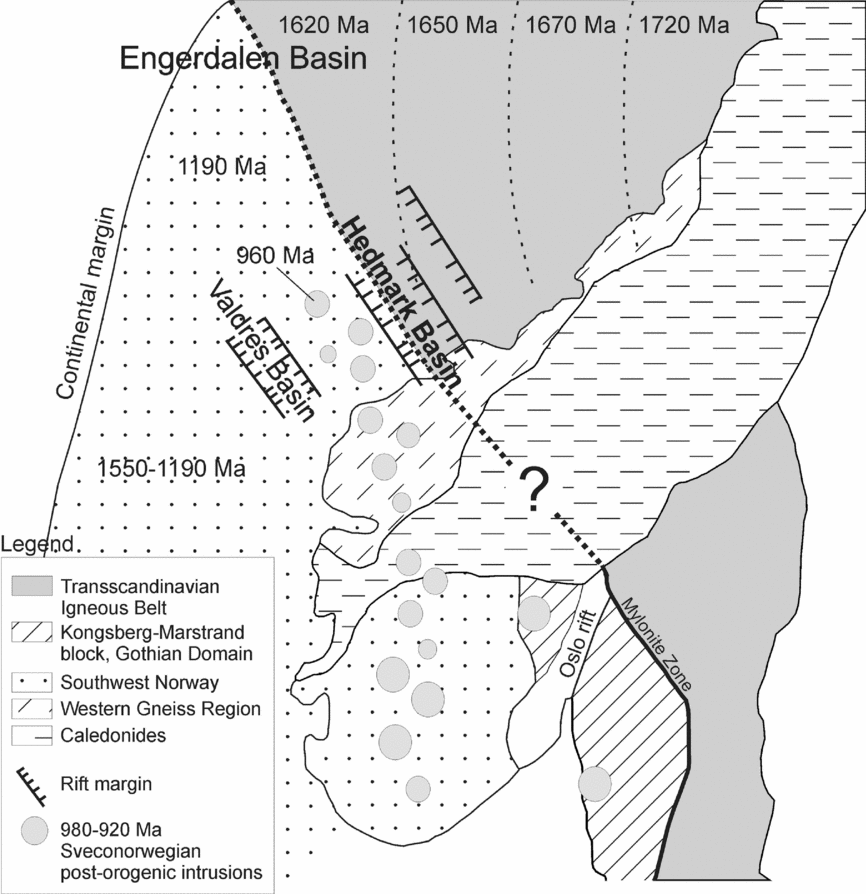
In the SW part of the Hedmark Basin the Sveconorwegian (960–970 Ma) ages are abundant in the clasts, while ages corresponding to the TIB (c. 1.67 Ga) are more commonly found in the NE (Fig. 11). This age distribution can be explained by a crustal structure within the provenance area consisting of TIB rocks in the NE and Sveconorwegian rocks in the SW. It would then indicate that the Hedmark Basin was initiated between these two major crustal domains of Scandinavia. Since the Hedmark Basin is currently in an allochthonous position and was originally closer to the western margin of the continent Baltica, we can hypothesize that these two juxtaposed crustal domains occurred at the margin. The likely explanation is that the present-day SW Norway and the TIB domain continued further west all the way to the Baltican margin (Fig. 15).
The present-day south Norway and a palaeogeographic model of the Baltoscandian margin before the Caledonian Orogeny. Adapted from Lamminen, Andersen & Nystuen (Reference Lamminen, Andersen and Nystuen2011). Positioning the Hedmark Basin between two major domains, Palaeoproterozoic and Mesoproterozoic, is compatible with the observed granitic clast U–Pb age distribution and Lu–Hf compositions.

7.e. Sedimentary recycling
This study has demonstrated that while the submarine Brøttum Formation in the westernmost part of the Hedmark Basin and the fluvial Rendalen Formation in the NE part of the basin have opposite palaeocurrent directions, they still have detrital zircon signatures that point to the same provenance region. Where the difference of provenance is really seen is in the granitic clast data, which are broadly in agreement with the palaeocurrent data. The difference between the obtained granite clast ages and the ages of the detrital zircon population in sandstones does not directly support first-cycle origin for the sandstones. One cannot say with certainty if the zircon grains were directly eroded from the basement or if they were caught in a previous erosional cycle and then eroded again and redeposited. Such a scenario is plausible if we consider the huge amount of time (300–400 Ma) between the assembly (Sveconorwegian Orogeny) and break-up of Rodinia. Erosion of the Sveconorwegian mountain chain and resulting thick accumulations of sediments could easily have been redeposited in the Hedmark Basin. Abundant quartz arenite clasts in the conglomeratic units of the Hedmark Basin support recycling. Bingen, Belousova & Griffin (Reference Bingen, Belousova and Griffin2011) suggested the presence of Neoproterozoic mega-sequences in the Caledonides of Scandinavia, East Greenland, Scotland, Svalbard and Shetland. The mega-sequences are subdivided into three according to age and the Hedmark Group is placed in the youngest group. These sediments were deposited on the margin of the Rodinia supercontinent after the Sveconorwegian Orogeny and their source is inferred to be in the Sveconorwegian Orogenic Belt (Bingen, Belousova & Griffin, Reference Bingen, Belousova and Griffin2011). It is likely that these sediments were eroded during the rifting process of Rodinia and supplied sediments of a mixed age pattern from both the eastern and western side of the Hedmark Basin. In addition to this major sediment transport system, some continental rivers may have intermittently carried detritus into the western Baltoscandian rift basins from the eastern and/or the southern marginal zones of Baltica.
8. Conclusions
-
• Submarine fan conglomerates (Biskopåsen Formation) and glacial diamictite (Moelv Formation) in the SW part of the Hedmark Basin contain mainly Sveconorwegian granite clasts of age c. 960 Ma that have a distinct Palaeo-Mesoproterozoic inherited zircon population which firmly links the sources of the clasts to SW Norway. Granite clasts in alluvial conglomerates (Litlesjøberget member of Rendalen and Osdalen formations) and glacial diamictite (Moelv Formation) in the NE part of the basin contain mostly c. 1670 Ma material from the late Transscandinavian Igneous Belt (TIB), confirming a provenance to the E and NE.
-
• Detrital zircon from turbiditic sandstones of the Brøttum Formation in the syn-rift marine western part of the basin and fluvial sandstones of the Rendalen Formation in the syn-rift and continental E and NE part of the basin show common ages. The sandstones contain a mixture of ages that can be matched with the TIB, 1200–1300 Ma pre-Sveconorwegian magmatism in SW Norway and post-orogenic Sveconorwegian intrusions (c. 960 Ma). Some samples contain a range of young grains of age 800–600 Ma that have no identified source in Scandinavia and which may have been derived from marginal zones of continent Baltica to the east and/or south. Detrital zircon of sandstones is thought to carry a recycled, and hence more varied, signature than the more proximal granite clasts.
-
• Hf isotopes from zircon in granitoid clasts are similar to published data from TIB and post-orogenic granitoids in south Norway.
-
• The clastic detritus of syn-rift and early post-rift conglomerates and sandstones in the Hedmark Basin were sourced from a granitic basement and older sediments. The marked predominance of Sveconorwegian granitic conglomerate clasts in the western part of the basin and a corresponding high abundance of granitic clasts of the same age as the TIB in the eastern part of the basin are thought to reflect the primary basement, which suggests that the Hedmark rift basin was initiated along a zone of crustal weakness between a Sveconorwegian domain in the SW and a TIB domain in the NE. Mixing of sand detritus between the two crustal domains also contributed to the common zircon found in the sandstones.
-
• Provenance signatures obtained from U–Pb zircon ages from granitic clasts in conglomerates deviate from those obtained from U–Pb zircon ages in associated sandstones. This implies that U–Pb zircon provenance data from sandstones, even from rather small basins, may not be easy to interpret in detail. In the presence of other data (e.g. palaeocurrent measurements) the weakness of the detrital zircon method is exposed. Granitic conglomerate clasts give a more unambiguous interpretation of sediment routing.
Acknowledgements
Siri Simonsen and Berit Løken Berg are thanked for technical assistance with analytical instruments at the University of Oslo. Anders Mattias Lundmark, Risto Kumpulainen and Arild Andresen are thanked for numerous discussions. Adrian Read is thanked for his manuscript review and language corrections. Bernard Bingen and Rob Rainbird are thanked for their constructive reviews of an earlier version of the manuscript. Jarmo Kohonen and an anonymous reviewer are thanked for constructive reviews of the second version of the manuscript. This study is part of the first author's PhD thesis on Proterozoic basins in South Norway. This is Contribution No. 20 from the Isotope Geology Laboratory at the Department of Geosciences, University of Oslo.