Introduction
Across species, threats that are predictable (P-threat) and unpredictable (U-threat) elicit distinct, aversive affective states (Grillon et al. Reference Grillon, Baas, Lissek, Smith and Milstein2004; Davis, Reference Davis2006, Reference Davis, Walker, Miles and Grillon2010). U-threat leads to generalized apprehension and heightened, sustained vigilance, whereas P-threat elicits a phasic ‘fight or flight’ response that is time-locked to an identifiable threat (Barlow, Reference Barlow2000; Davis et al. Reference Davis, Walker, Miles and Grillon2010). These two aversive states are labeled anticipatory anxiety (U-threat) and fear (P-threat), respectively, and are pharmacologically distinct (Grillon et al. Reference Grillon, Baas, Pine, Lissek, Lawley, Ellis and Levine2006, Reference Grillon, Heller, Hirschhorn, Kling, Pine, Schulkin and Vythilingam2011) and mediated by overlapping, but separable, neural circuits (Davis, Reference Davis2006; Alvarez et al. Reference Alvarez, Chen, Bodurka, Kaplan and Grillon2011). Of clinical relevance, converging lines of data indicate that individual differences in reactivity to U-threat, but not P-threat, underlie multiple forms of psychopathology (Carleton, Reference Carleton2012; Grupe & Nitschke, Reference Grupe and Nitschke2013), making it a putative transdiagnostic psychophysiological indicator.
One way that U-threat is often assessed is using the No-Predictable-Unpredictable (NPU) paradigm (Schmitz & Grillon, Reference Schmitz and Grillon2012). The NPU task includes three within-subjects conditions – no-threat (participants are safe from threat), predictable threat (threat is signaled by a predictable, discrete cue) and unpredictable threat (threat is unsignaled), in which the temporal predictability of an aversive event (e.g. mild electric shock) is manipulated. Startle probes are delivered throughout the course of the task and startle eyeblink response to the probe is collected as an index of defensive responding as it is reliably potentiated during aversive motivational states (Bradley et al. Reference Bradley, Cuthbert, Lang, Dawson, Schell and Bohmet1999). This paradigm is useful for many reasons including the fact that it can be translated from human to animal studies and vice versa (Davis, Reference Davis1998; Davis et al. Reference Davis, Walker, Miles and Grillon2010), and startle eyeblink potentiation has well-established neural underpinnings (Davis, Reference Davis2006).
Separate studies using the NPU paradigm have shown that relative to healthy controls, individuals with panic disorder (PD) and posttraumatic stress disorder (PTSD) display heightened startle potentiation to U-threat but not P-threat (Grillon et al. Reference Grillon, Lissek, Rabin, McDowell, Dvir and Pine2008, Reference Grillon, Pine, Lissek, Rabin, Bonne and Vythilingam2009b ; Shankman et al. Reference Shankman, Nelson, Sarapas, Robison-Andrew, Campbell, Altman, McGowan, Katz and Gorka2013). Meanwhile, individuals with generalized anxiety disorder (GAD) and major depressive disorder (MDD) display comparable startle to healthy controls during both forms of threat (Grillon et al. Reference Grillon, Pine, Lissek, Rabin, Bonne and Vythilingam2009b ; Shankman et al. Reference Shankman, Nelson, Sarapas, Robison-Andrew, Campbell, Altman, McGowan, Katz and Gorka2013). Within recent years, additional evidence from functional magnetic resonance imaging (fMRI) has supported an exaggerated reactivity to U-threat in PD, PTSD, and specific phobia but not MDD (Simmons et al. Reference Simmons, Flagan, Wittmann, Strigo, Matthews, Donovan, Lohr and Paulus2013; Gorka et al. Reference Gorka, Nelson, Phan and Shankman2014; Münsterkötter et al. Reference Münsterkötter, Notzon, Redlich, Grotegerd, Dohm, Arolt, Kugel, Zwanzger and Dannlowski2015; Lieberman et al. Reference Lieberman, Gorka, Shankman and Phan2017).
Based on these studies, our group and others have speculated that heightened psychophysiological reactivity to U-threat characterizes the ‘fear-based’ internalizing disorders (e.g. PD, social anxiety disorder [SAD], specific phobia) and distinguishes them from the ‘distress/misery’ disorders (e.g. MDD, dysthymia, GAD) (Clark & Watson, Reference Clark and Watson2006). Although most internalizing disorders are indicated by at least some aversion to uncertainty (Carleton, Reference Carleton2016a , Reference Carleton b ), it has been argued that there is a specific relation between psychophysiological reactivity to uncertain, external stressors (such as electric shock) and fear-based psychopathology (Grillon et al. Reference Grillon, Pine, Lissek, Rabin, Bonne and Vythilingam2009b ; Shankman et al. Reference Shankman, Nelson, Sarapas, Robison-Andrew, Campbell, Altman, McGowan, Katz and Gorka2013). This distinction may reflect a difference between physiological reactivity to uncertainty and worry/maladaptive cognitions in response to uncertain situations. Recently, as a test of this hypothesis, our laboratory conducted a study comparing startle reactivity to U- and P-threat across multiple internalizing disorders (Gorka et al. Reference Gorka, Lieberman, Shankman and Phan2016). Our results indicated that regardless of secondary comorbidities, individuals with current, principal fear-based disorders evidenced greater startle potentiation to U-threat, but not P-threat, relative to individuals with distress/misery disorders and healthy controls (who did not differ). These findings importantly support prior evidence of a phenotypic and genotypic distinction between fear and distress/misery (Kendler et al. Reference Kendler, Prescott, Myers and Neale2003; Hettema et al. Reference Hettema, Prescott, Myers, Neale and Kendler2005) and suggest that heightened reactivity to U-threat may be a psychophysiological indicator of principal fear-based disorders.
Understanding the dynamic fluctuations, or lack thereof, is critical to validating U-threat as a biomarker of fear-based disorders. However, the cross-sectional studies reviewed above cannot ascertain if startle potentiation to U-threat is a state effect of the disorder or a stable marker that is present regardless of current disease status. Relatedly, it is also unclear whether startle potentiation to U-threat reflects changes in psychiatric symptoms and is therefore a candidate treatment target for the experimental medicine approach. In support of it as a trait-like marker, startle to U-threat is stable a week apart according to two separate studies (Shankman et al. Reference Shankman, Nelson, Sarapas, Robison-Andrew, Campbell, Altman, McGowan, Katz and Gorka2013; Kaye et al. Reference Kaye, Bradford and Curtin2016). In support of it as a state-like marker, startle to U-threat can be modulated by 2-weeks of selective serotonin reuptake inhibitor (SSRI) challenge in healthy volunteers (Grillon et al. Reference Grillon, Chavis, Covington and Pine2009a ). Thus, it remains unknown if stability of, or treatment effects on, startle to U-threat apply to individuals with psychopathology. Addressing these questions is critical in advancing the mission of modern psychiatry and the National Institute on Mental Health's (NIMH) Research Domain Criteria (RDoC) Initiative, which seek to develop objective dimensional assays that can quantify disease status and recovery/treatment response across categorical diagnostic boundaries (Cuthbert & Kozak, Reference Cuthbert and Kozak2013; Kozak & Cuthbert, Reference Kozak and Cuthbert2016).
The current study examined if startle potentiation to U-threat cuts across internalizing psychopathologies and is malleable to change after 12-weeks of either cognitive-behavioral therapy (CBT) or SSRI treatment. We hypothesized that at baseline, individuals with fear-based disorders would display exaggerated reactivity to U-threat, but not P-threat, compared with controls and distress/misery participants. We also hypothesized that after 12-weeks of effective treatment, startle potentiation to U-threat within the fear-based disorder patients would be attenuated, whereas for healthy controls, startle potentiation over the course of 12-weeks would be stable. Of note, we did not have specific hypotheses regarding differences between CBT and SSRIs as both forms of treatment have been shown to be effective at reducing fear and distress symptoms (Butler et al. Reference Butler, Chapman, Forman and Beck2006; Hieronymus et al. Reference Hieronymus, Emilsson, Nilsson and Eriksson2016). Nevertheless, treatment response is notoriously heterogeneous (Johnsen & Friborg, Reference Johnsen and Friborg2015) and although CBT and SSRIs have overlapping mechanisms of change, there are also some distinctions (e.g. Kennedy et al. Reference Kennedy, Konarski, Segal, Lau, Bieling, McIntyre and Mayberg2007). It is therefore possible that one form of treatment may better target reactivity to U-threat and consequently produce a greater attenuation in startle responding. Comparing CBT v. SSRIs on change in startle reactivity were therefore a secondary aim of the current study.
Methods
Participants and procedure
The current study was designed to be consistent with, and funded by, the NIMH RDoC Initiative (RFA-MH-13-080) and therefore enrolled a community sample of individuals with a full range of internalizing psychopathologies and symptoms. To be included as a patient, participants were required to have a current full-threshold or sub-threshold DSM-5 depressive or anxiety disorder such that SSRI and CBT treatment would be indicated, report a total score of ⩾23 on the Depression, Anxiety, and Stress Scale (DASS-21; Lovibond & Lovibond, Reference Lovibond and Lovibond1995), and a Global Assessment of Functioning (GAF) score of ⩽60. Healthy controls had no lifetime Axis I disorders. Exclusionary criteria for both groups included an inability to provide consent and read and write in English; major active medical or neurological problem; lifetime history of mania, psychosis, intellectual disability, or pervasive developmental disorder; current substance dependence; any contraindication to receiving SSRIs; being already engaged psychiatric treatment; history of traumatic brain injury; and being pregnant. This study was approved by the UIC Institutional Review Board, and informed consent was obtained from all participants.
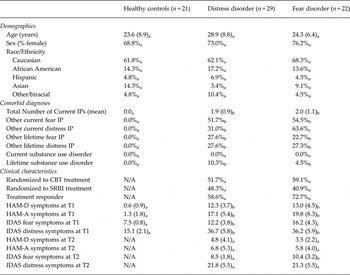
A total of 37 healthy controls and 110 patients initially enrolled in the study. For the healthy controls, 14 dropped out of the study prior to the baseline assessment (Time 1; T1) and two had poor quality startle data [i.e. less than 50% useable blinks per condition at either T1 or Time 2 (T2)], resulting in a final sample of 21 controls. For the patients, 34 dropped out prior to T1, 11 dropped out during active treatment, and 14 had poor quality startle data (same criteria as above), resulting in a final sample of 51 patients. Descriptive information for the final sample is presented in Table 1.
Demographics and clinical characteristics of the sample by principal disorder

Note. Means (and standard deviations) or percentages with different subscripts (a, b) across rows were significantly different in pairwise comparisons (p < 0.05, chi-square test for categorical variables and Tukey's honestly significant difference test for continuous variables). IP, internalizing psychopathology; CBT, cognitive-behavioral therapy; SSRI, selective serotonin reuptake inhibitor; HAM-D, Hamilton Depression Rating Scale; HAM-A, Hamilton Anxiety Rating Scale; IDAS, Inventory of Depression and Anxiety Symptoms – II.
Assessment of psychopathology
At the time of enrollment, lifetime Axis I diagnoses were assessed via the Structured Clinical Interview for DSM-5 Disorders [SCID-5; American Psychiatric Association (APA), 2013] to ascertain exclusionary diagnoses and confirm the presence of an Axis I internalizing disorder. At screening, participants were evaluated by a masters-level assessor, PhD-level psychologist and MD psychiatrist. A consensus panel of at least three study staff/trained clinicians determined subjects’ eligibility and if there were co-occurring disorders, which was the principal disorder warranting treatment. Consistent with the strategy encouraged by RDoC (Morris & Cuthbert, Reference Morris and Cuthbert2012), individuals were not excluded for comorbid disorders but instead classified by their clinician-determined principal diagnosis, as determined by the most severe and impairing symptoms from clinical interviews and self-reports. In the present study, specification of the principal disorder was also used to divide patients into those with a fear-based disorder (i.e. PD = 4, SAD = 14, or PTSD = 4; total n = 22) or distress/misery disorder (i.e. Dysthymia = 2, MDD = 10, GAD = 17; total n = 29). Of note, there is mixed evidence as to whether PTSD can be classified as a fear or distress/misery disorder (Watson, Reference Watson2009). Given that several other studies have shown that PTSD is associated with heightened reactivity to U-threat (Grillon et al. Reference Grillon, Pine, Lissek, Rabin, Bonne and Vythilingam2009b ; Simmons et al. Reference Simmons, Flagan, Wittmann, Strigo, Matthews, Donovan, Lohr and Paulus2013) similar to the fear disorders (e.g. PD), it is coded as a fear disorder in the current study and in prior studies by our laboratory (e.g. Gorka et al. Reference Gorka, Lieberman, Shankman and Phan2016).
At pre – and post-treatment, the Hamilton Anxiety Rating Scale (HAM-A; Hamilton, Reference Hamilton1959) and Hamilton Depression Rating Scale (HAM-D; Hamilton, Reference Hamilton1960) were administered by trained research assessors to measure broad and general anxiety and depressive symptoms, not specific to any particular disorder. In order to capture more specific fear and distress/misery symptoms, participants also completed the Inventory for Depression and Anxiety Symptoms-II (IDAS-II; Watson et al. Reference Watson, O'Hara, Naragon-Gainey, Koffel, Chmielewski, Kotov, Stasik and Ruggero2012), which creates distinct, factor analytically derived symptom scales that map onto DSM-IV fear and distress disorders. A fear-based dimension and a distress/misery dimension were created by Z-scoring and averaging relevant IDAS subscales. For the fear dimension, the panic, social anxiety, claustrophobia, traumatic intrusions, and avoidance subscales were averaged reflecting symptoms of the fear disorders. For the distress dimension, the depression, lassitude, anxious mood, and suicidality subscales were averaged reflecting symptoms of the distress/misery disorders.
At the final treatment session, treating clinicians rated participant clinical improvement using the Clinical Global Impressions Scale (CGI; Guy, Reference Guy1976). Patients with CGI global improvement ratings of 1 or 2 (i.e. very much or much improved) were classified as ‘treatment responders.’
Treatment procedures
Participants were randomized to either 12-weeks of CBT (n = 28) or SSRI treatment (n = 23). For participants randomized to SSRIs (sertraline, fluoxetine, paroxetine, escitalopram, or citalopram), the dosing schedule was flexible depending on tolerability and aimed to reach target dose by week 8 (e.g. 100–200 mg/day for sertraline). The flexibility of the SSRI protocol was designed to match standard real world psychiatric practice. SSRI patients attended medication management sessions that lasted approximately 20–30 min with their study psychiatrist at 0, 2, 4, 8, and 12-weeks. For participants randomized to CBT, treatment was delivered through 12, once-weekly 60-min sessions led by a PhD-level clinical psychologist using evidence-based manuals for the patient's principal diagnosis and predominant symptoms (Beck, Reference Beck1979; Craske et al. Reference Craske, Barlow and O'Leary1992; Barlow & Craske, Reference Barlow and Craske2006). A total of six therapists were involved in the study protocol with, on average, 10.7 years (±5.2; range 6–19) of experience delivering CBT. As per the manualized protocol, sessions began with psychoeducation and cognitive restricting and then expanded to include strategies such as behavioral change (e.g. exposures, behavioral activation) and relapse prevention.
Threat task
Details of our startle laboratory procedures have been published previously including the modified NPU task (Shankman et al. Reference Shankman, Nelson, Sarapas, Robison-Andrew, Campbell, Altman, McGowan, Katz and Gorka2013; Gorka et al. Reference Gorka, Nelson and Shankman2013, Reference Gorka, Lieberman, Shankman and Phan2016) and are briefly noted here. The task included three within-subjects conditions: no shock (N), predictable shock (P), and unpredictable shock (U). The task was entirely passive and each condition lasted 145 s, during which a 4 s visual countdown (CD) was presented six times. Between CDs, there was an interstimulus interval that ranged from 15 to 21 s. During the N condition, no shocks were delivered. During the P condition, participants received a shock every time the CD reached 1 and thus, the CD served as a signal of exactly when the shock was going to occur. During the U condition, shocks were administered at any time (i.e. during the CD or ISI). Startle probes were administered during both the CD and ISI and probes and shocks were separated by at least 10 s. Each condition was presented two times in a randomized order (counterbalanced). Participants received 24 electric shocks (12 in P; 12 in U) and 60 startle probes (20 in N; 20 in P; 20 in U).
Startle data collection and processing
Details of our startle data collection and processing of the modified NPU task have been published elsewhere (Shankman et al. Reference Shankman, Nelson, Sarapas, Robison-Andrew, Campbell, Altman, McGowan, Katz and Gorka2013; Gorka et al. Reference Gorka, Lieberman, Shankman and Phan2016). Startle data were acquired and presented using BioSemi Active Two system (BioSemi, Amsterdam, The Netherlands) and Presentation (Albany, CA). Electric shocks lasted 400-ms and acoustic startle probes were 40-ms duration, 103-dB bursts of white noise. Startle responses were recorded from two 4-mm Ag/AgCl electrodes placed over the orbicularis oculi muscle below the left eye. Data were collected using a bandpass filter of DC-500-Hz at a sampling rate of 2000-Hz. Blinks were processed and scored according to published guidelines (Blumenthal et al. Reference Blumenthal, Cuthbert, Filion, Hackley, Lipp and van Boxtel2005). Peak amplitude was defined within 20–150 ms following the probe onset relative to baseline. Blink magnitude values were used in all analyses.
Data analysis plan
We first conducted a series of planned within-subjects and between-subjects analyses of variance (ANOVAs) to verify that patients and controls differed at baseline on symptoms and that treatment was successful in reducing depression and anxiety. We also probed whether any of our groups differed on demographic and clinical characteristics.
We then conducted Pearson's correlation analyses between startle at T1 and T2 for each group individually. This provides broad information about the change in startle over the course of 12-weeks and allows for direct comparison with the two prior P- and U-threat startle stability papers (Shankman et al. Reference Shankman, Nelson, Sarapas, Robison-Andrew, Campbell, Altman, McGowan, Katz and Gorka2013; Kaye et al. Reference Kaye, Bradford and Curtin2016). In order to directly test whether there were group differences in rank order stability, we conducted Fisher's r to z transformation analyses comparing the correlation coefficients across groups.
We also assessed mean level stability by conducting a time (2; T1 and T2) × threat condition (3; N, P, U) × group (3; controls, fear patients, distress patients) × treatment arm [no-treatment (controls only), SSRI, CBT] omnibus ANOVA. Raw startle magnitude during the CD phase of each condition of the task (N, P, U) was used in the model to capture response to P- and U-threat (and no-threat) and to match the conditions on visual stimuli (i.e. a CD was on the screen) similar to prior publications (e.g. Gorka et al. Reference Gorka, Nelson and Shankman2013). Any significant interactions were followed up using standard simple effects approaches (Aiken et al. Reference Aiken, West and Reno1991).
Lastly, to examine the association between change in symptoms and change in startle potentiation, we conducted Pearson's correlations between change in startle from T1 to T2 and change in IDAS fear, IDAS distress, HAM-A, and HAM-D symptoms.
Results
Descriptive and clinical characteristics
At pre-treatment, patients reported higher levels of HAM-D, F(1, 71) = 177.93, p < 0.01, Cohen's d = 4.0, HAM-A, F(1, 71) = 123.57, p < 0.01, Cohen's d = 3.4, IDAS fear, F(1, 71) = 41.89, p < 0.01, Cohen's d = 2.0, and IDAS distress, F(1, 71) = 218.79, p < 0.01, Cohen's d = 4.1, symptoms relative to controls. Within patients, HAM-D, t(50) = 12.74, p < 0.01, Cohen's d = 2.2, and HAM-A, t(50) = 12.19, p < 0.01, Cohen's d = 2.0, symptoms decreased pre- to post-treatment and on average, patients reported a 65% ± 27.0 and 64% ± 26.0 reduction in depression and anxiety, respectively. With regard to the IDAS, fear symptoms, t(50) = 8.28, p < 0.01, Cohen's d = 1.2, and distress symptoms, t(50) = 14.49, p < 0.01, Cohen's d = 2.2, also decreased pre- to post-treatment (average reduction in fear: 29% ± 19.4 and distress: 38.3% ± 17.8). Extent of reduction in HAM-A, HAM-D, IDAS-fear, and IDAS-distress did not differ based on race, sex, or group (fear-based and distress/misery patients; p s > 0.21). As for treatment modality, it is important to note that CBT resulted in a greater reduction in IDAS fear symptoms, F(1, 50) = 4.59, p < 0.05, Cohen's d = 3.0 compared with SSRIs. The two treatment arms did not yield differences in any other symptom dimension. Based on CGI ratings, 64.7% of participants responded to treatment. Treatment response did not differ between the groups or treatment modalities (p = 0.23).
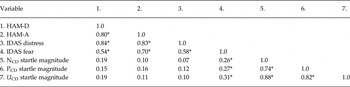
The three groups were comparable on age, sex, and race. The patient groups were not different on number of lifetime and current disorders. The patient groups did not differ on pre-treatment HAM-D, HAM-A, or IDAS distress symptoms; however, fear patients had higher IDAS fear scores (see Table 1). Pre-treatment symptom severity did not differ between the two treatment modalities (p s > 0.20). Correlations between pre-treatment symptom measures and startle magnitude during the NPU task are displayed in Table 2.
Pearson's correlations for pre-treatment (Time 1) symptom and startle task variables

Note. * p < 0.05; HAM-D, Hamilton Depression Rating Scale; HAM-A, Hamilton Anxiety Rating Scale; IDAS, Inventory of Depression and Anxiety Symptoms – II; N CD, No shock countdown; P CD, Predictable shock countdown; U CD, Unpredictable shock countdown.
Twelve-week rank order stability
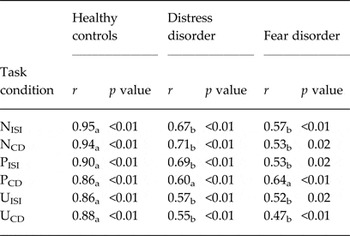
Pearson correlation coefficients reflecting the temporal stability of startle magnitude from T1 to T2 for each task condition are presented in Table 3. Within healthy controls, temporal stability was very high and all condition correlation coefficients were >0.86. Correlation values for each of the six task conditions within patients were significantly lower (see comparison results in Table 3) indicating a group difference in rank order stability and a potential treatment or symptom effect, which was examined below.
Twelve-week temporal stability of startle magnitude for each task condition

Note. Different subscripts (a, b) across rows were significantly different in Fisher's r to z transformation analysis (p < 0.05). N, no-shock condition; P, predictable shock condition; U, unpredictable shock condition; ISI, interstimulus interval; CD, countdown.
Mean-level stability pre- and post-treatment
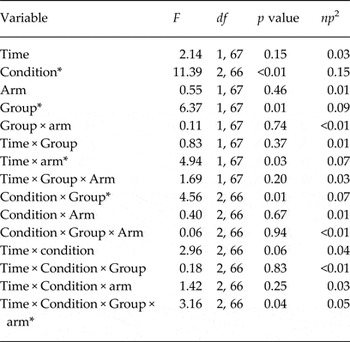
Results of the omnibus ANOVA are presented in Table 4 and significant findings are discussed below. There was a main effect of group such that fear patients displayed greater overall startle magnitude (p s < 0.01) relative to distress patients and healthy controls, who did not differ from each other (p = 0.81). There was also a main effect of threat condition as startle magnitude during the N condition was lower than startle magnitude during the two threat conditions, as expected (p s < 0.01). Additional results revealed a significant threat condition × group interaction such that the effect of group on startle magnitude was more pronounced for the U-threat condition relative to the other two conditions (i.e. P and N; p < 0.05).
Results of the omnibus repeated measures analysis of variance

Note. *p < 0.05; Condition = no-threat, predictable threat, or unpredictable threat; Arm = no treatment (controls only), medication, or cognitive-behavioral therapy; Group = controls, distress patients, or fear patients; Time = time 1 or time 2.
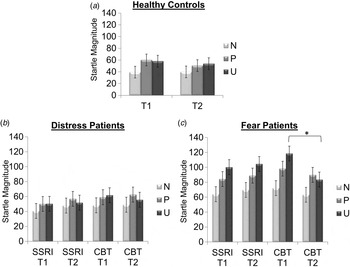
With regard to time, the model indicated a time × treatment arm interaction, which was qualified by a significant time × treatment arm × threat condition × group interaction. Follow-up analyses revealed that startle magnitude decreased from T1 to T2 during the U-threat condition (only) and this effect was specific to the fear disorder patients who received CBT (see Fig. 1).
Mean startle magnitude at Time 1 and Time 2 by treatment arm for healthy controls (a), distress patients (b), and fear patients (c). Distress patients include anyone with principal dysthymia, major depressive disorder or generalized anxiety disorder. Fear patients include anyone with principal panic disorder, social anxiety disorder, or post-traumatic stress disorder. CBT = cognitive-behavioral therapy; SSRI, selective serotonin reuptake inhibitors; T1, time 1 assessment; T2, time 2 assessment’ N, no-threat; P, predictable threat; U, unpredictable threat. Bars reflect standard error.

Association between change in startle and change in symptoms
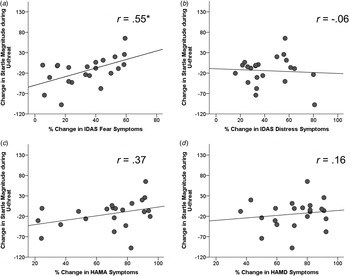
Given the specificity of the above findings, we next probed whether change in symptoms was correlated with change in startle to U-threat within the fear disorder patients (only). Results indicated that greater reduction in startle magnitude during U-threat was associated with greater reduction in IDAS fear symptoms (r = 0.55, p < 0.01; Fig. 2). There was also a trend level association between change in startle to U-threat and change in HAM-A (r = 0.37, p = 0.08). However, there was no association between change in startle to U-threat and change in IDAS distress symptoms (r = −0.06, p = 0.76) or HAM-D (r = 0.16, p = 0.48). The association between U-threat startle change and fear symptom change was not moderated by treatment arm (p = 0.88). The significant association between change in U-threat startle and change in IDAS fear symptoms also remained significant when partialling out IDAS distress and HAM-D symptoms (r = 0.56, p < 0.01), further highlighting the specificity of the present finding.
Scatterplots depicting the association between changes in startle magnitude from Time 1 to Time 2 and percent change in psychiatric symptoms from Time 1 to Time 2. Four different symptom measures are displayed: IDAS fear symptoms (a), IDAS distress symptoms (b), HAMA symptoms (c), and HAMD symptoms (d). IDAS, Inventory of Depression and Anxiety Symptoms – II; HAMA, Hamilton Anxiety Rating Scale; HAMD, Hamilton Depression Rating Scale.

Discussion
Our results broadly suggest that psychophysiological anticipatory anxiety, as indexed by startle to U-threat, maps onto the fear-based dimension of psychopathology and may be a novel, objective psychophysiological indicator of fear disorder status and CBT treatment response. At baseline, individuals with fear disorders displayed heightened startle responding to U-threat compared with both healthy controls and individuals with distress/misery disorders, who did not differ. In addition, within the fear disorder patients only, startle to U-threat decreased from pre- to post-treatment amongst individuals who received CBT but not SSRIs. The extent of decline in startle to U-threat robustly correlated with the extent of decline in fear symptoms but not distress or general depressive symptoms. Meanwhile, within healthy controls startle across the two time points was reliable and stable.
Prior to treatment, individuals with fear disorders displayed greater overall startle magnitude and a particularly heightened response to U-threat relative to healthy controls and individuals with distress/misery disorders. This finding is consistent with several prior studies using this task (Grillon et al. Reference Grillon, Lissek, Rabin, McDowell, Dvir and Pine2008; Shankman et al. Reference Shankman, Nelson, Sarapas, Robison-Andrew, Campbell, Altman, McGowan, Katz and Gorka2013) and was notably observed despite the fact that many of the current patients had secondary comorbidities in addition to their principal diagnosis. This suggests that even in a heterogeneous, clinical sample, exaggerated reactivity to U-threat is relatively specific to principal fear v. distress/misery. The specificity of this pre-treatment finding also fits with contemporary theoretical conceptualizations of PD, SAD, and PTSD (and specific phobias) in that each of these disorders are characterized by hyperarousal and exaggerated anticipatory anxiety in response to temporally unpredictable or ambiguous feared aversive stimuli (i.e. U-threat; e.g. unpredictable panic attacks, social evaluation, and exposure to trauma cues; APA, 2013). Broadly, individuals with fear disorders share an extreme aversion to uncertainty surrounding their disorder-specific feared stimulus. Although individuals with distress/misery disorders, especially GAD, may also dislike uncertainty, they do not have a disorder-specific feared stimulus (like a panic attack), which may contribute to the different pattern of results across these classes of disorders. Maladaptive responding to U-threat is posited to be at the core of fear-based psychopathology and can be objectively measured in the laboratory using startle potentiation. There is also evidence to suggest that heightened reactivity to U-threat may precede fear disorder onset and connote risk for the development of fear disorders (Nelson et al. Reference Nelson, McGowan, Sarapas, Robison-Andrew, Altman, Campbell, Gorka, Katz and Shankman2013). In this sense, startle potentiation to U-threat reflects information regarding both disease risk and status, suggesting that individuals who have, and are at-risk for, a fear-based disorder likely have an exaggerated reactivity to U-threat when presenting to treatment.
A separate question in the field has been whether this individual difference factor is malleable with treatment and fluctuates with changes in symptoms over time. The present study suggests that startle potentiation to U-threat is modifiable within fear patients and that the extent of change in startle to U-threat is directly related to the extent of change in fear symptoms. Although somewhat unexpected, this effect of treatment on change in startle was specific to fear patients who received 12-weeks of CBT, and was not observed in fear patients who received 12-weeks of SSRIs. One clear factor that may account for this finding is that in the current study, across all patients, CBT was more effective at reducing fear symptoms than SSRIs. Thus, it is likely that CBT was more effective at reducing fear symptoms because it as more effective at reducing startle to U-threat within fear patients. Relatedly, it is possible that CBT more directly targets reactivity to uncertain threats/stressors than SSRIs as one of the key components of CBT is exposure therapy which encourages participants to confront feared stimuli without full certainty regarding the outcome. Instead of providing direct reassurances of safety, for example, CBT encourages participants to consider the likelihood of various outcomes as they face feared stimuli. In essence, exposure involves uncertainty. It is therefore possible that exposure exercises, and/or the larger CBT package, is an optimal intervention for fear patients and perhaps, could be used in a preventative way to ameliorate the risk of fear disorder onset within at-risk individuals. These findings also raise the hypothesis that the more reactivity to U-threat is targeted, the more startle decreases pre- to post-treatment. At present, the utility of a U-threat specific treatment is unknown but given the clear link between reactivity to U-threat and fear disorders, modulating anticipatory anxiety appears to be a viable treatment target for this group of patients.
It is important to note that although startle to U-threat decreased within fear patients who received CBT, post-treatment fear patients still displayed greater startle compared with distress/misery and control participants. This implies that startle has some state-independent properties. As we and others have speculated (Nelson et al. Reference Nelson, McGowan, Sarapas, Robison-Andrew, Altman, Campbell, Gorka, Katz and Shankman2013; Shankman et al. Reference Shankman, Nelson, Sarapas, Robison-Andrew, Campbell, Altman, McGowan, Katz and Gorka2013; Carleton, Reference Carleton2016a ) reactivity to U-threat may therefore play a role in the onset, maintenance and treatment response in fear-based psychopathology (similar to other traits; e.g. neuroticism; Soto & Tackett, Reference Soto and Tackett2015). If this is indeed the case, startle potentiation to U-threat reflects some of the aims of the NIMH RDoC Initiative, which seeks to re-define psychopathology based on dimensional, neurobiological constructs (Sanislow et al. Reference Sanislow, Pine, Quinn, Kozak, Garvey, Heinssen, Wang and Cuthbert2010; Kozak & Cuthbert, Reference Kozak and Cuthbert2016). As startle to U-threat is related to fear disorders (across several categorical diagnoses) and not distress/misery disorders, it sheds light on the biological seams within internalizing psychopathology and may guide treatment decisions for individuals with comorbid disorder presentations. Beyond startle physiology, it is essential that future studies continue to explore reactivity to U-threat as a potential organizing ‘Potential Threat’ construct across multiple units/layers (e.g. genes, physiology, circuits, behavior, and self-report) for certain internalizing disorders and an objective, multi-layered indicator of fear disorder status and CBT treatment response. In addition to these findings, within healthy controls, startle was highly stable and reliable across 12-weeks. This adds to the findings of the two prior studies demonstrating high stability of startle magnitude by further demonstrating this effect across a much longer time-frame. Given these psychometric properties, and the entire set of findings presented here, it may be possible to use startle magnitude to create normative cut-offs that accurately reflect fear disorder status and remission. More specifically, startle to U-threat values could be used to diagnose an individual with fear-based psychopathology, suggest the appropriateness of a U-threat targeted treatment, and/or track decline in symptoms and thus help guide decisions regarding treatment termination.
Limitations
Although the current study had numerous strengths, there are also several limitations worth noting. First, the sample size was relatively small, particularly for the three group cells. This prevented us from directly examining the impact of individual diagnoses (e.g. PD, MDD); it should be noted that per RDoC guidelines, parsing out diagnosis-specific effects was never planned. The small sample size may have also left us underpowered to detect additional group differences or time effects. Additional studies are needed to replicate and extend the current findings. In addition, the current study only included two startle assessments and in order to accurately model, and estimate, state and trait influences, more assessment points are needed. Although change in startle was correlated with change in symptoms, and there was a relative difference between the two treatment types (i.e. CBT and SSRIs), the lack of a waitlist control group is also a limitation as it is difficult to discern to what extent the primary findings may have been influenced by regression to the mean. The fact that the sample had high levels of comorbidity, particularly between the distress and fear disorders, can be seen as both a potential strength and limitation. Although it enhances the external validity of the present findings, the potential impact of co-occurring psychopathology on the pattern of results is unclear. Finally, this study was limited to startle physiology, and other units that index U-threat are needed to complement the current findings.
Conclusions
The current study implicates the transdiagnostic utility of reactivity to U-threat as a clinically relevant and dimensional psychophysiological index. First, the findings indicate that pre-treatment startle to U-threat differentiates fear-based disorder patients from healthy controls and distress/misery patients. Second, within individuals with fear-based disorders, startle to U-threat declined pre- to post-treatment amongst individuals who received CBT but not SSRIs. Change in startle to U-threat also correlated with change in fear symptoms pre- to post-treatment, whereas in healthy controls, startle is reliable and stable across 12-weeks. These findings together indicate that startle to U-threat is a reliable and clinically useful psychophysiological indicator that maps onto the fear-based dimension of psychopathology.
Acknowledgements
This study was funded by the National Institute of Mental Health of the National Institutes of Health grant R01MH101497 (to KLP) and Center for Clinical and Translational Science (CCTS) UL1RR029879.
Declaration of Interest
None.