I
During the sixteenth century, Verona was one of the largest and wealthiest cities under Venetian rule in the Terraferma. Advantageously positioned on the Adige river, and protecting the entrance to a major Alpine pass, Verona acted as an intermediary for trade across Italy and the rest of Europe. However, the city has attracted little attention from historians of the Renaissance in Italy. It is unsurprising, therefore, that the role of Verona's artisans in participating in the culture of the Renaissance has been overlooked. For many years, the underlying assumption in studies of early modern consumerism was that only elites were able to engage significantly with the changing market for consumer goods.Footnote 1 However, there is an increasing awareness of the importance of the non-noble classes in changing attitudes towards consumption, luxury, and domestic life in the Renaissance. It has become clear that both noble and non-noble households possessed a wide range of material artefacts which acted to confer status onto the owner.Footnote 2 This was particularly important for the socially mobile artisan who, as the maker of consumer goods, was at the heart of the development of Renaissance material culture.Footnote 3 Marriage, within this structure, was an important occasion for artisans, their wives, and daughters, to build familial relations and augment positions within their community. As Ulinka Rublack has argued, social identity could be adjusted at the point of marriage through the consumption of specific material commodities.Footnote 4 The dowry and the legal protections surrounding it acted as both codifier and store for such material possessions.
What follows is a detailed investigation into the objects found within the dotal inventories of the wives and daughters of artisans in sixteenth-century Verona. This article will investigate the material world of the artisan's home and the objects within it through an analysis of 100 dotal inventories found in the Atti dei Rettori Veneti a Verona; highlighting the range of practical, aesthetic, and luxurious goods found within them. The dowry was amongst the most significant forms of marital exchange in early modern Italy. As such, dotal contracts have been analysed by many historians seeking to understand more about the financial and social consequences of dowry culture, such as price inflation, enforced claustration, and the problems women had in gaining control over their dowries.Footnote 5 However, research into dowries often overlooks the contents of the dotal inventory, in particular, the beni mobili, or, moveable goods, associated with them.
In Verona, dowries were customary amongst all classes, and whilst there was a large difference in the value given by the nobility and by those within the popular classes, in every case a suitable dowry was necessary in ensuring an appropriate match for daughters.Footnote 6 Dowries were intended under Roman law to assist the husband in the care of his new wife and family; however, in late medieval Italy, they had come to be accepted as a woman's stake in her father's patrimony, or ‘pre-mortem inheritance’.Footnote 7 However, whilst the wife had rights over her dowry analogous to an owner, she was not in possession of it. The dowry was instead managed by her husband during marriage, although he was required to manage it in the interests of his wife.Footnote 8
There were, however, a series of legal protections which guarded women against loss of their property at the hands of their husbands. First and foremost, women had a right to restitution of their dowry upon dissolution of their marriage.Footnote 9 There were also legal protections to ensure that such future restitution remained a possibility. In particular, dowries were often secured against the property of the husband to protect against risk.Footnote 10 During marriage, a wife's privilege over preservation of her dowry took precedence over any other privilege, such as, for example, that of creditors seeking to claim funds from her husband's estate.Footnote 11 Stanley Chojnacki has argued that the woman's right to restitution of her dowry was so significant that most husbands actively guaranteed it on their own estate (or in the case that this was insufficient, on that of their kin).Footnote 12 Stefania Montemezzo has similarly argued that in Verona women were encouraged to get dowry security, which protected from loss of their property and thus their honour in widowhood, as well as protecting society from a breakdown in the dotal system.Footnote 13
Furthermore, a wife did not have to wait for dissolution of her marriage to reclaim her dowry. In the event that a woman, or her natal family, felt that her husband was mismanaging the dowry, or if her husband was verging on poverty, thus threatening the restitution of her dowry, a woman had the legal remedy of vergens ad inopiam. Julius Kirshner has argued that the reaffirmation of this Roman law in a number of Italian states allowed women to ‘reclaim’ their original dowry during marriage, or to ‘lay claim to an equivalent amount of the husband's goods’, which protected assets.Footnote 14 This system was, however, open to abuses, with some husbands seeking to have their goods transferred into the possession of their wives, so as to shield them from creditors.Footnote 15 According to Kirshner, the differences between legitimate and illegitimate claims were difficult to distinguish and thus a number of governments required insolvency of claimants to be made public, thus deterring those wishing to abuse the system.Footnote 16 Overall, wives seem to have had considerable leverage over their dowries and the preservation of their patrimonies. Whilst systems were also in place to limit women's autonomy over their possessions during marriage, significant legal protection remained in place to protect them, but more so to protect the integrity of a system that was deemed fundamental to a well-functioning society.
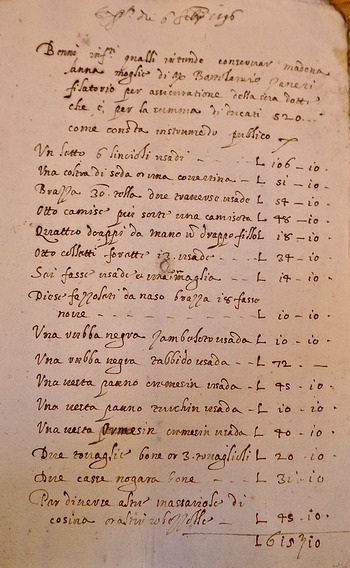
Analysis of legal documentation relating to dowries, their protection, and their restitution can illuminate aspects beyond the dowry itself. In particular, dotal inventories are useful tools in helping us to understand more about the goods within the homes of dowered women and their husbands during the Renaissance. Legal documentation relating to the protection of dowries can be found in abundance within the archives of Verona, especially among the records of the Atti dei Rettori Veneti a Verona. These records contain the proceedings of the judicial offices of Verona, which were headed by the Venetian rectors within the city.Footnote 17 The 100 inventories chosen for this investigation relate to dowry estimation, dowry security, and dowry restitution, all including a list of domestic items documented by a public notary (see Figure 1). They date from the period 1561 to 1596, although the marriages they relate to often occurred much earlier, as testified by the information in the opening of many of the documents, with the earliest date mentioned being 1536.Footnote 18 While the documents consistently provide the name of the woman, her husband, and usually the date on which the marriage contract was drawn, some examples are more informative about the reason for which the inventory was made. The inventory of Magdalena, wife of a smith, for example, states that the goods listed were intended for her conservation lest her husband fall into poverty (ob vergentiam…ad inopiam).Footnote 19 What unites these documents is the underlying purpose to ensure the preservation of the dowry.
Example of a dotal inventory (ASVr, ARV, b. 149, 6 Feb. 1596; reproduced with kind permission of the Archivio di Stato di Verona)

Although underutilized as a historical source, such inventories are often rich and detailed stores of information. In the first instance, many of these Veronese dotal inventories list the estimated value of each item, which is rare in contemporary post-mortem inventories in the Veneto. Secondly, they normally describe the condition of each item, recording if items were in good or new condition, or, conversely, used and old. Moreover, the high number that survive from the non-noble classes provide a wealth of information about a previously understudied group. Of course, dotal inventories also have their limitations.Footnote 20 There is often uncertainty as to whom the goods eventually belonged, as well as to the ruling in individual cases. Similarly, there is scarcely ever an indication of where in the household these items would have been kept – whether they were for public view, or whether they were more private objects. Nevertheless, dotal inventories are an invaluable source for the historian of material culture and particularly for those researching the non-elites of Italian Renaissance towns and cities. Through these documents concerning the protection and preservation of dotal assets, it is possible to gain an insight into the domestic world of married couples in the Renaissance.
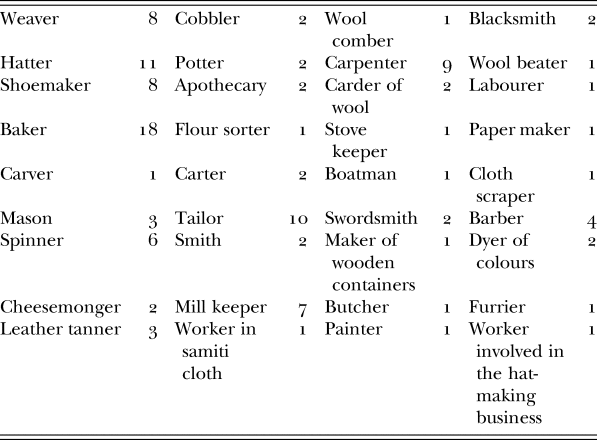
The sources chosen for this investigation are those which list the profession of the husband or father of the woman whose dowry was being protected, where this profession falls within the category of ‘artisan’.Footnote 21 As such, those without professions listed, as well as those with noble titles, and those professions such as notaries, doctors, and merchants, have not been included in the sample. Artisans were a heterogeneous group, ranging from wealthy masters in prestigious trades, to day labourers, working in multiple sectors.Footnote 22 Within the artisan class, there were huge degrees of variation in terms of wealth, with those in the silk industry generally commanding the highest pay, and those in more quotidian occupations, such as weavers and bakers, often less well-off.Footnote 23 In general, the term artisan refers to those within the popular classes whose work focused primarily in the realms of production.Footnote 24 However, there were also those who were involved in the process of managing workmen under their charge, and a number of entrepreneurial artisans who may have started by making items themselves, but whose business expanded as they took on multiple outlets. Most artisans also traded in their products, playing a key role in the exchange of these goods amongst people of different social groupings.Footnote 25 In order to achieve the greatest understanding of the variation in the lives of those involved in production within the city, a broad spectrum of trades has been considered in this analysis, ranging from bakers, to carpenters, and tailors (see Table 1).Footnote 26
Different occupations present in the sample of dotal inventories

The study of inventories presented here suggests that artisans often possessed a wealth of practical, decorative, and luxury goods, which served to enhance the public image of the married couple. There is a consistent pattern of goods listed in these inventories, with the vast majority containing similar items of furniture, clothing, jewellery, and table and kitchenware. This suggests that there was an expected norm of the types of commodities a respectable household should possess, and by analysing these inventories, we can begin to understand more about the ‘ordinary’ Renaissance home. However, what is also clear is that artisans were able to differentiate themselves and the image of their family through the possession of luxurious, or semi-luxurious, material items and as such, some of the more exceptional examples of material commodities will be discussed.
It will be argued that artisans played an active role in the burgeoning market for consumer goods in the Renaissance. The idea of a ‘consumer revolution’ is one which has divided opinion amongst historians, with debate surrounding when, if at all, such a phenomenon took place. Notably, Jan de Vries has argued that there was an ‘Industrious Revolution’ during the long eighteenth century, during which both the supply of and demand for market-oriented goods increased.Footnote 27 Others, such as Renata Ago and Lorna Weatherill, have seen the seventeenth century as the key moment in the rise to consumerism in both Italy and England.Footnote 28 Richard Goldthwaite traced the line further back to argue that it was during the Renaissance that the birth of a recognizably modern consumer society occurred.Footnote 29 Whilst this article will make no claims to the discovery of a ‘consumer revolution’, it will add a new body of evidence to the field by arguing that by the sixteenth century, even outside the major centres of Italy, the working people were able to consume a vast array of material objects which were used to increase both the splendour and the comfort of a home. Artisans were at the core of the culture of the Renaissance; they were not only the makers, but also the shapers, and the participants within the transformations of the time. The evidence within this sample illustrates a combination of concern for both comfort and status and in order to unravel this, the following analysis will highlight three key elements of the dotal inventory and thus, the artisan household: furniture, clothing, and jewellery.Footnote 30 Here, the devotional, symbolic, and aesthetic significance attached to such items will be discussed.
II
In most instances, dotal inventories begin with furniture, with the bed taking pride of place, followed by storage items such as chest and shelves, tables and chairs. The amount of furniture listed in many of the inventories in this sample would be seen as great even by today's standards and the consistency with which some items of furniture were listed suggests that within the artisan community, it was expected that married couples would have a certain number of particular items in their household as a matter of both necessity and honour. An analysis of the types of furniture within these dotal inventories is therefore useful in helping us to understand more about the domestic environment of the time.
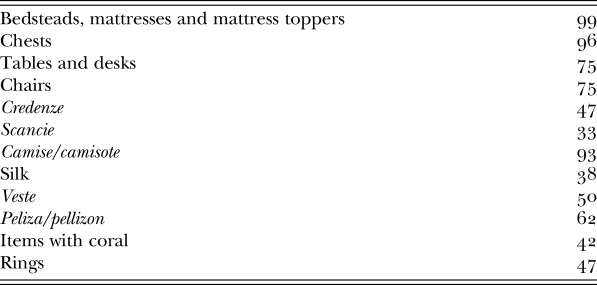
As often the largest piece of furniture in the home, the bed was among the most significant of all moveable goods in the early modern household, both in terms of symbolic status and practical value. They were not only used to accommodate family members, but also at times a point of distinction and a focal point of domestic social interaction. The types of wood used to make the bed, as well as the decoration, carving, and furnishings were all part of a display.Footnote 31 The bed was at the top of the hierarchy of goods and was usually listed together with a mattress or bolster pillow, cushions, covers, and linens. It is perhaps not surprising, therefore, that 99 of the 100 inventories analysed include at least one bedstead, mattress, or mattress topper, with most having more than one (see Table 2). It is not uncommon for a dotal inventory to have a large number of such items. The high number of beds and bedding items in many of these inventories is perhaps a reflection of their status amongst other moveable goods. Footnote 32
Number of inventories in which items appear at least once

There are several important items related to the bed listed in these inventories. The most commonly mentioned item is the letto, which simply translates as ‘bed’, but in this time could refer to an over-mattress, often filled with goose-feathers.Footnote 33 Of the 100 inventories analysed, 95 list at least one letto, and in almost all cases, it is the most expensive item. Also common, although usually less expensive, is the lettiera, which was a large bedstead, often made of walnut, but sometimes made of cheaper wood such as pine. Lettiere were imposing bed frames and were one of the most popular forms of furniture in the Italian Renaissance.Footnote 34 In addition to this large piece of furniture, many of the inventories also list smaller beds, called cariole, which were portable and slid underneath larger beds during the day.Footnote 35 Seventy-five of the sampled inventories include a bedstead such as a lettiera or a cariola. A further twenty-nine inventories also include a separate mattress (materazzo or pagliarizzo). Some of these mattresses (materazzi) would have been filled with wool, whilst pagliarizzi were filled with straw. The inventory of Appolonia, whose husband and father were both bakers, is a good example of the differentiation in values attributed to the different elements of the bed. At the top of the inventory are two letti, the first of which is listed with a bolster (piumazzo) and filled with feathers, valued at 36 lire. The other letto, also stuffed with feathers, is listed with two bolsters and six cushions (cossini), which together are valued at 40 lire. This provides a contrast to the two mattresses (matarazzi) also listed, one of which was stuffed with wool and, together with three cushions, is valued at only 9 lire. Similarly, the two bedsteads themselves, the pinewood (pezzo) lettiere, were painted and valued together at only 5 lire.Footnote 36
There is also a surprising number of beds and bedding accessories in some of the inventories. In the inventory of Margerita, wife of a swordsmith, for example, there are three mattresses (matarazi), three letti, four lettiere of walnut (noghera), a portable bed (cariola), and two further straw mattresses (pagiarizi), in addition to one canopy for a bed (pavilion).Footnote 37 Thus, within their household, Margerita and her husband had four full-sized and one smaller bedstead, in addition to five mattresses and three over-mattresses. A similar example comes from the inventory of Catherina, wife of Battista, a shoemaker from Mantua, who had one walnut lettiera, four pinewood lettiere, three small wool mattresses (mattarazzi di lana), and four small letti.Footnote 38
As the centrepiece of one of the most important rooms in the home, the bed was not only a utilitarian object, but also a place for artisan men and women to express their virtues through ornamentation and decoration.Footnote 39 In the majority of the inventories analysed, the style and decoration of the bed is not listed. However, in a number of cases the evidence hints at the type of decoration which could be used for these beds. The dotal inventory of Barbera, daughter of a baker and wife of a woodcarver, for example, includes two walnut lettiere, one of which was carved (intagliata). Valued at 10 lire for both, these two bedsteads were significantly cheaper than the letto which, listed together with two bolster pillows and six old cushions, was valued at 46 lire and 10 soldi.Footnote 40 However, the fact that one bed was carved demonstrates that this practical object was also being used as a form of decoration. As well as a letto with a bolster pillow and another pillow, the dotal inventory of Flora, wife of a baker, also includes a painted bedstead and two pillowcases worked with black silk (seda). The two silk pillowcases on their own were valued at 12 lire.Footnote 41 Similarly, Anna, wife of a spinner, had an expensive silk bed cover which, along with another coverlet (coltra di seda e una covertina), was valued at 51 lire.Footnote 42 A number of inventories also mention canopied fabrics for the bed, including that of Libera, daughter of a tailor and wife of a baker, who had amongst the items in her dotal inventory an old canopied structure for her bed made with German fabric (una pavagion vechio tella todescha).Footnote 43 As well as providing a practical structure for privacy and to keep insects out, canopied structures were also used to frame the bed and at times were decorated to accentuate further the grandeur of the bed.Footnote 44
Carved and painted chests provided another means by which artisans could embellish their homes. Designed to store and organize the ever-increasing abundance of material objects that were being collected, chests and cases came in many different forms and were one of the most popular types of furniture in Renaissance households at all social levels.Footnote 45 The most common form of chest was the cassa, usually made of walnut or cheaper types of wood, such as pine. Ninety-six of the inventories in the sample mention some form of chest, with most listing a number of such items. The inventory of Margerita, the wife of a swordsmith, for example, includes fourteen different casse and forcieri (chests with lock and key), which were together valued at 36 lire.Footnote 46 In many cases, chests were left plain, or their decoration was not described. However, forty-two of the inventories list painted or carved chests. The inventory of Clara, wife of a hatter, catalogues six painted casse, together valued at 5 lire, and five painted forcieri, also valued at 5 lire.Footnote 47 As is the limitation with this type of source, there is usually no description of the type of painting or decoration applied to these chests. The painting could therefore range from highly ornate designs to simple colour blocks. However, what is clear is that these functional objects were often given a decorative effect which made them part of the overall aesthetic of the household. Artisan case were at times colourful places, with many items of furniture painted to brighten up the living space.Footnote 48 The dotal inventory of Lucia, wife of an artisan involved in the hat-making business, for example, includes a bedstead, four chests, a bench, and a credenza, which was a sideboard used for storing and displaying silverware and other expensive dining materials, all of which were painted.Footnote 49
There were several reasons why chests were a significant part of these inventories. First, they were organizational tools. Artisan homes were often small, consisting of only a few rooms, including a sala, and usually at least one camera.Footnote 50 Chests served as storage for everything from fine clothing, tapestries, and jewellery, to paintings, tableware, and food. Equally, artisans might have wished to store material objects away in chests if they had little practical use and were being kept purely as financial investments.Footnote 51 This trend for containment of material goods within chests was something which transcended class boundaries.Footnote 52 Sansovino, when describing the homes of Venetian noblemen, wrote that ‘“there is no person so miserable, with a casa aperta [a well-equipped house in which visitors were received] that he would not have chests and bedsteads of walnut”’.Footnote 53 This hoarding of objects within numerous chests is indicative of a culture which placed importance on the ownership of material commodities.
Equally important to the organization of a well-equipped home was the provision of seating, so both family and guests could be comfortably entertained. A number of studies into the domestic interior have found that a characteristic which distinguished urban homes from those in the countryside was the prevalence of seating found within them, with those in urban centres having a significant number of items used for seating, even in homes of the lower classes.Footnote 54 This was certainly true for the artisan class in sixteenth-century Verona. Seventy-five of the sample feature some form of chair or stool, with many of the inventories having a high number of individual chairs. Libera, daughter of a tailor and wife of a baker, for example, had twelve regular chairs, or stalls, called scanni, of walnut in her dotal inventory, in addition to four chairs, called cadrege, also of walnut. Similarly, Camilla, wife of a furrier, had a total of eighteen different chairs, including eight cadrege, four of walnut and four with straw seats, and ten scanni.Footnote 55 As well as different types of chairs, many of the inventories also list benches. On top of the six painted chairs (schani) in her inventory, Diamante, daughter of a hosier and wife of a leather tanner, for example, had two painted benches (banche), and three long table benches.Footnote 56 Artisan homes were not only for private use, but places of entertainment for families, guests, and patrons.Footnote 57 It was therefore important not only that a home was able to accommodate comfortably a wide range of guests, but also that the home and its objects had a pleasing aesthetic appearance.Footnote 58
Some pieces of furniture listed in the inventories were more overtly decorative, or at least created for the purpose of displaying other objects within the household. During the Renaissance, new types of storage furniture became increasingly popular, with various pieces used for the exhibition of material commodities. Amongst the most significant of these was the credenza.Footnote 59 As credenze were used for presenting as well as for storing dining materials, they would normally be placed near the table and would at times be decorated with fine materials to accentuate the openly displayed tableware.Footnote 60 Forty-seven of the sample include at least one credenza. Francesca, wife of a cheesemonger, had two painted credenze in her dotal inventory, valued together at 12 lire.Footnote 61 Similarly, Libera, daughter of a tailor and wife of a baker, had within her inventory two pinewood credenze, one of which was old, valued at 1 lire and 10 soldi, and the other which was painted, and slightly more expensive, at 2 lire and 5 soldi.Footnote 62
Less common, yet still mentioned in thirty-three of the inventories, is the scancia, which was a type of shelf over which dishes were arranged in kitchens. Scancie, like credenze, were used for storage and display. However, scancie seem to have a clear association with the display of earthenware. Indeed, in many cases, these shelves are listed along with maiolica and different types of pottery. Francesca, the wife of a cheesemonger, for example, had two scancie listed in her dotal inventory, furnished with white maiolica and other maiolica in colour, valued together at 10 lire and 10 soldi.Footnote 63 Julia Poole has argued that demand for maiolica initially came from the middling classes, as the very wealthy preferred silver.Footnote 64 However, by the sixteenth century, as innovation led to a higher standard of product and decoration, even the wealthiest of patrons were investing in maiolica tableware, suggesting that its status had risen significantly by this point.Footnote 65 Of course, the value of maiolica varied greatly depending on the producer and, above all, the decoration. Whilst no description of ornate, decorated maiolica was found in this sample, as it is always listed alongside and valued together with the scancie, even at the lower end of the market, maiolica commanded high status and its presence within these inventories demonstrates that in a provincial city like Verona, artisans were able to engage with current consumer trends.Footnote 66
III
When painted, carved, or displayed in a sumptuous manner, furniture could be used to present an image of an honourable home and therefore a respectable identity. However, the most public form of display was dress, and the ownership of a variety of ornate and fine clothing and jewellery was the most direct way in which artisans and their families were able to distinguish themselves.Footnote 67 In the competitive environments of early modern cities, dress was a form of display, where both nobles and artisans alike were willing to invest significant sums on fine attire made from materials such as silk.Footnote 68 This section will explore the clothing found in the dotal inventories of the wives and daughters of artisans. As with furniture, most of these inventories demonstrate a combination of concern for function and display, with a proliferation of clothing for women, men, and children. Even in more provincial cities like Verona, ownership of a variety of fine pieces of clothing was important for those who wished to maintain or to augment a respectable identity.Footnote 69
Clothing was expensive, and even plain, worn pieces could command a high value and would have represented a significant financial investment for the modest artisan. Patricia Allerston notes that three shirts brought by a man in early seventeenth-century Venice cost 10 lire, which would have taken a master craftsman four days to earn Footnote 70 Despite this, it is evident that artisans were able to own large numbers of shirts and gowns. Perhaps the best example of this is camise or camisote, which were shirts, worn by both men and women under garments, found in great abundance in ninety-three of the inventories analysed. Catharina, wife of the potter Domenego, for example, had eight women's shirts, twelve shirts for children and twelve men's shirts in her inventory.Footnote 71 Simona, wife of a tailor, had a total of forty-three camise and camisote in her dotal inventory, including ten camise for women, sixteen for men, twelve for children, and five camisote for women, which, taken together were valued at over 93 lire.Footnote 72 Practically, owning such a large amount of basic clothing like these shirts was beneficial as these were gowns which were worn daily underneath outer garments and washed. It was also, however, a financially prudent decision for these artisans as clothing did not significantly lose its value and neither did it incur tax.Footnote 73
As well as an abundance of basic items of clothing, there is also evidence within these inventories that artisans were able to own more luxurious and expensive items. During the sixteenth century, Verona, along with Vicenza, was known for its production of cheaper silks, which provided an alternative to the more expensive, higher quality silks coming out of Venice.Footnote 74 Artisans were involved in the consumption of both more expensive silks, and the newer, cheaper silks, which could provide an imitation of luxury at a lower cost. As well as fabrics described as seda (silk), there are a number of other types of silk within the sample. At the higher end of the scale were silks such as taffeta (tabi), velvet (veludo) and satin (raso or satino). There were then cheaper silks, such as sarcenet (ormesino), which was often used in lining. Whilst artisans undoubtedly played a lesser role in the consumption of silk than the elite in sixteenth-century Verona, both the expensive and cheaper varieties of silk are mentioned in thirty-eight of the sample.Footnote 75 The inventory of Catharina, wife of a potter, for example, includes a gown of silk (seda) with skirt and buttons, valued at 7 lire,Footnote 76 whilst that of Joana, wife of a weaver of wool cloth, includes eight braccia (roughly 64cm) of new silver sarcenet.Footnote 77 Anna, wife of a spinner, had many items of silk in her dotal inventory, including an expensive black taffeta (tabbido) doublet, which even in used condition, was worth 72 lire.Footnote 78 In many of these inventories, the items made of silk are small, rather than entire garments, and where silk is present, there is usually only one or two pieces per dowry. Nevertheless, the presence of silks within the sample is testament to the fact that artisans were able to acquire and to use such materials which were regarded by contemporaries as luxurious or semi-luxurious.
One type of silk which features in the sample and would likely have been regarded as a prestigious addition to the household is velvet.Footnote 79 Towards the end of the 1550s, manufacture of this product had increased and much of the black velvet produced in Verona was exported to areas such as Venice, Bolzano, and the Holy Roman Empire.Footnote 80 Evidence within this sample also demonstrates its consumption amongst the artisan community within Verona itself. Iseppa, daughter of a mill keeper and wife of a spinner, for example, had an inventory full of clothing. Amongst a number of everyday items, Iseppa had several more precious and expensive items, such as a pair of black velvet (veludo) sleeves, valued at 10 lire. Footnote 81 The inventory of Camilla, daughter of a mill keeper and wife of a spinner, also includes a gown of yellow cloth with black velvet trim (una vesta di panno zallo con liste di veluto negro), valued at 17 lire.Footnote 82 Items of velvet would have a deep, imposing colour, with a structured, thick texture. Such fabrics would have been instantly recognizable, thus carrying with them a certain sense of grandeur.
The most visible piece of clothing and perhaps the most important piece in terms of public reputation was the over-garment, and evidence within these inventories suggests that these were a central element of artisan consumer culture. As well as providing warmth in colder months, over-garments could also be a sign of distinction. When discussing the gown worn by a Venetian nobleman, for example, Cesare Vecellio stated that ‘almost all doctors, lawyers, and merchants’ wear such items of clothing willingly as they ‘confer great dignity’ onto those who wear them.Footnote 83 One of the most common types of over-garment was the vesta, which was a long gown worn by both men and women and lined with fur in the winter months. Fifty of the inventories list at least one vesta, yet many have more. Camilla, wife of a furrier, for example, had six women's veste, whilst Isabeta, daughter of a baker, had four.Footnote 84 These were basic robes, which could be made to appear luxurious with the use of different fabrics. Simona, wife of a tailor, for example, had amongst the items in her inventory a vesta in blue with a satin trim (lista raso), valued at 19 lire and 8 soldi,Footnote 85 whilst Madalena, daughter and wife of mill-keepers, had in her dotal inventory a vesta of cloth in a deep purple, with a black velvet trim and sleeves, valued at 24 lire (una vesta d pano pavonazzo cū liste d veludo negro cū manege vechia).Footnote 86
Another type of over-garment which could offer an outward expression of wealth and taste was the peliza, which was a fur-lined robe and one of the most expensive pieces of clothing an artisan could own. Sixty-two of the sample list at least one peliza. Domenica, wife of a weaver, for example, had a peliza of grey rassa, which was a type of coarse woollen cloth, valued at 22 lire and 10 soldi, as well as another older and cheaper peliza, with a half-silk covering (coperta di mezo seda).Footnote 87 In this case, the grey cloak is the single most expensive item in Domenica's inventory. I/Angela, the daughter of a carpenter, also had in her inventory an old peliza, covered in pink satin with green trim, valued at 13 lire and 10 soldi (una pelizza coperta d satin rosin vechia lista verde).Footnote 88 Such items were a practical addition to a household; however, they also demonstrated wealth and fashion, conferring a certain amount of status onto the wearer.
Other items of clothing could also be used as tools for establishing position, particularly when full of colour and adorned with fine fabric. Frequently mentioned items of clothing include shoes and hose, doublets and hats, and it is vital that we take these items into account when reconstructing the domestic environment of the artisan class.Footnote 89 Whilst many of these items lack description in the inventories, some cases of elaboration on fabrics or style can be found. Bartholomea, wife of a mason, for example, had within her inventory a cape (capa) and a pair of hose of chamois (cammozo), which was a soft, pliable leather, with their own upper-stockings (li suoi scoffoni), valued together at 25 lire.Footnote 90 Similarly, Libera, daughter of a tailor and wife of a baker, had a man's cape in ash colour, and two pairs of matching hose (una capa da homo beretina, e due para calze beretine), which were listed with two doublets (ziponi) and together valued at 18 lire.Footnote 91 Appolonia, whose father and husband were both bakers, had within her inventory a pair of dark red hose with their upper-stockings, with a velvet trim (un paro d calze de pano morelo cū li soi scofoni cū liste d veludo). Along with a black cape and a riding cloak made of cloth ‘from the mountain’ (una capa negra et un ferarolo de pano della montagna), these items totalled a value of 60 lire.Footnote 92 Even simple items such as shoes could be important signifiers of identity and status, and the presence of fine materials, as well as matching items of colourful clothing, demonstrates a concern for style amongst those in the artisan class.
In a number of cases, the contents of these inventories can also be linked to the husbands’ professions. Thus, the wives of carpenters, for example, had within their dotal inventories a greater number of and more expensive pieces of furniture, and the wives of bakers had a substantial number of tools used for baking. There are several more extreme examples when it comes to those who had relatives working in the clothing profession, as with Clara, wife of a hatter, whose inventory includes 200 caps or bonnets (berete). It is important to note that these caps were very cheap, with the whole sum of the 200 reaching only 10 lire, which within this inventory was the equivalent value of two carpets, and slightly less than the 11 lire for which one could purchase the four women's over-garments (vesture) listed.Footnote 93 A similar example is in the inventory of Maria, wife of a shoemaker, which includes 150 pairs of shoe lasts of different sorts, valued at 13 lire and 15 soldi.Footnote 94 The most notable example in this sample comes from Lucretia, wife of a hatter, whose inventory includes 795 old caps, at a total value of 81 lire.Footnote 95 Whilst these are exceptional examples, it is likely that items relating to the profession of the husband would have been used to bulk up the value of the inventory. In cases where the wives’ assets were being secured against those of her husband, an artisan might choose to add value to his domestic items with goods from the workshop. Tools and merchandise were often also kept in the home, with many artisans living and working in the same area, living in rooms above their workshops (botteghe). Sandra Cavallo has highlighted the fluidity that existed between home and workshop spaces for artisans, particularly as much of women's work took place within the domestic setting.Footnote 96 It is therefore perhaps no surprise that we can find many examples of workshop tools within these inventories. Catharina, wife of a potter, for example, had within her inventory ‘worked wood of diverse sorts for the workshop and for the house’ (legnami lavoradi de diverse sorte p bottega et casa), and ‘iron of different sorts, similarly for the workshop and for the house’ (feramenti de diverse sorte similiter p bottega et casa).Footnote 97 These inventories also give an indication of women's work within the household, with many not only listing tools for the workshop, but also tools associated with tasks which were deemed to be ‘women's work’, such as weavers’ looms and spinning wheels.Footnote 98 Marina, daughter of a mason and wife of a man whose father was a spinner, for example, had in her dotal inventory three spinning wheels for silk (molineli da seda).Footnote 99
IV
Jewellery was, and still is, a non-essential adornment of the body, yet evidence within these inventories suggests that it was an important element of artisan consumer culture in sixteenth-century Verona. Both artisans and nobility alike were able to use jewellery to enhance their public appearance and to project an image of respectability. However, it was also a tool of religious expression, with items such as rings, necklaces, and pendants used as an extension of the devotional experience provided by the church, in the domestic environment.Footnote 100 Still, throughout these inventories, there is a clear concern for the aesthetic, with a range of expensive and precious materials, such as gold, silver, and gemstones, listed amongst more mundane household items.Footnote 101
One of the most commonly found objects of jewellery in dotal inventories, which was both aesthetically and symbolically valuable, is the string (filza) of coral (corallo). Even in more simple forms, coral carried symbolic connotations and as such, this type of jewellery was not only an aesthetic addition to the dowry, but also deeply devotional.Footnote 102 Corals were thought to have protective qualities, particularly associated with women and childbirth. Some of these filze may have been used as rosaries, kept upon the person and used for the counting of prayers. Evidence of rosaries can be found in inventories from across Italy as they became an increasingly popular consumer good during the Renaissance.Footnote 103 Forty-two of the sample mention at least one item with coral. Often, these were simple and inexpensive pieces, as was the case with the two coral necklaces in the inventory of Benedicta, wife of a swordsmith, valued at 1 lira and 10 soldi.Footnote 104 However, there is ample evidence of necklaces of coral adorned with finer material, significantly increasing their value, both aesthetically and financially. Bartholomea, wife of a mason, had within her inventory, in addition to two simple rosaries, a necklace of coral with silver (una gola corali con un cor d'arzento et due corone), which were together valued at 8 lire.Footnote 105 Similarly, Camilla, daughter of a mill keeper, and wife of a spinner, had two strings of coral, one adorned with buttons of gold (bottoni d'oro) and one with crystals (cristalli), valued at 22 lire.Footnote 106
Rings were equally significant, carrying with them not only financial value, but also religious and social associations, connected to marriage, status, and wealth.Footnote 107 When discussing the civility of Venice, Sansovino noted that there was no ‘“wretched person”’ who did not own rings.Footnote 108 Forty-seven of the documents analysed contain at least one gold ring, with many noting more. Lucia, daughter of a butcher and wife of a barrel-maker, for example, had six gold rings of different sorts (aneli sei d'oro d piu sorte) in her dotal inventory, valued at 36 lire.Footnote 109 Many rings in the sample also contained precious stones of different colours, such as those of Helena, wife of a wool carder, whose inventory includes a gold ring with an azure stone, as well as a silver ring with a red stone (uno anello doro con preda turchina et uno darzento con preda rosa).Footnote 110 Like items of clothing made with precious fabrics, such jewellery could represent a significant financial outlay for a master craftsman. However, the frequency with which rings are listed in dotal inventories suggests that many artisans were willing to invest in non-essential items of personal adornment. Rings and other types of jewellery had become an important part of respectable identity for both males and females during the sixteenth century, and this was the case in Verona, as it was in Venice and other Renaissance centres.
Other items of religious jewellery, which added to the image of luxury and demonstrated personal piety, were frequently included in artisan dotal inventories. Gold and silver crucifixes worn around the neck were perhaps the most visible sign of one's devotion. Benedicta, whose inventory includes the simpler coral necklaces previously mentioned, also had a necklace of coral with a golden cross (gola de corali con una croseta d'oro), as well as a round necklace of silver (una gola de tondini d'arzento).Footnote 111 Similarly Francesca, wife of a cheesemonger, had within her inventory a golden necklace with a cross (colane d'oro cō una croseta), valued at 11 lire.Footnote 112 Also included are Agnus Dei, which were disks often made of wax and stamped with the image of the lamb of God. Sometimes, as in the case of Agneta, daughter of a barber and wife of a weaver, whose inventory includes a silver Agnus Dei (unus agnus dei argenti) valued at 13 lire and 10 soldi, more expensive materials were used.Footnote 113 Such objects may have been used in conjunction with other items of devotion in order to facilitate private prayer, such as the religious paintings and artefacts that are scattered throughout the sample. Benedicta, the wife of a swordsmith, for example, had within her inventory a pot of holy water (stagnolo di otton da acqua santa),Footnote 114 whilst Bartholomea, wife of a cobbler, also had a pot of holy water, as well as five paintings of the saints (cinque quadri diversi de imagine de santi).Footnote 115
V
In the provincial Renaissance city of Verona, artisans were at the heart of the production of consumer culture. They played a central, though under-investigated, role in the circulation and transmission of goods and ideas. Dowries were an important part of the exchange of goods amongst families and were tools for building relationships, as well as for publicly displaying the status of the family and the social position of the new couple. They were thus a protected commodity which were frequently notarized, secured, and ratified by the courts. The documentation arising from the protection of dowries can therefore not only tell us about the types of goods that women brought with them to marriage, but also about the types of goods women could rely upon as security should their funds be squandered. In the case of artisans, these goods were associated with the domestic environment, as well as the workshop. Whilst these inventories from the artisan class in Verona are certainly smaller than those of elites in cities such as Venice, they nevertheless demonstrate the active part artisans and their families played in the burgeoning market for consumer goods, and the emphasis that was placed on the acquisition of an abundance of material commodities.
These inventories can provide an invaluable insight into the material world of ‘ordinary’ women and their families in provincial Renaissance cities. Whilst at times representing only a portion of the goods a couple might amass throughout their marriage, the inventories demonstrate that even at a basic level, artisan homes would have been filled with a vast array of essential and non-essential goods, used for both improving comfort and achieving splendour. The consistent pattern presented throughout the dotal inventories of artisans at various levels of the social scale suggests that, even for less-well-off families, certain goods were nonetheless expected in a respectable household. Almost all of the inventories analysed contain similar items of furniture and clothing, as well as kitchen utensils and basic food items. Where artisans were able, they had the chance to augment their social standing by purchasing extra items for ornamentation and display, or simply by enriching their homes with quantities of particular pieces of furniture or clothing. This was at a time when artisans thought consciously about their public image and their portrayal of success.Footnote 116 Items such as carved chests, items of silk, and golden crucifixes had both practical and symbolic purposes, but could also be used as tools by artisans to display their wealth, taste, and devotion.
The evidence within the inventories suggests that the material world of the wives and daughters of artisans in sixteenth-century Verona was filled with furniture, clothing, and other items necessary for running a successful home unit. It was also a world filled with splashes of colour and decoration, as well as fine items of clothing and jewellery. Being part of the artisan class, therefore, did not exclude women and their families from creating an honourable home environment, in which children were reared, guests hosted, and business conducted.