Introduction
Although wildlife reintroductions are becoming more common as wildlife populations continue to decline globally, their human dimensions and social implications are neither well known nor understood. These restoration projects can be controversial and often face stiff resistance from local residents who may see potential conflicts with the species or lack trust in the agencies and professionals who are in charge of implementing the reintroduction (Churchill et al. Reference Churchill, Bettoli, Peterson, Reeves and Hodge2002, O’Rourke Reference O’Rourke2014). Consequently, much of the local opposition to reintroduction programmes can stem from public perceptions of risks and trust. The case of elk reintroduction in East Tennessee presents a unique opportunity to assess these perceptions towards a recently reintroduced species. The reintroduction of native elk (Cervus canadensis) into East Tennessee began in the early 2000s, c. 150 years after overharvest and habitat loss contributed to their extirpation from the area (Kindall et al. Reference Kindall, Muller, Clark, Lupardus and Murrow2011). Spurred on by successful reintroductions in neighbouring states, elk were reintroduced here with the intention of providing wildlife watching and hunting opportunities for residents and tourists to the area (Tennessee Wildlife Resources Agency 2018). The reintroduction was centred on a large tract of public land in the state, but the elk population grew and began to migrate outside of this area to neighbouring private property and transportation corridors, causing conflict with local residents. This posed several risks to the public, including property damage, vehicle accidents and crop depredation. Understanding the role that trust in the managing wildlife agency plays in determining public acceptance and support for the continued management and conservation of this reintroduced species is critical in light of these potential risks.
Perceived risk is the degree to which individuals believe they are threatened by some hazard or danger (Siegrist & Cvetkovich Reference Siegrist and Cvetkovich2000, Harper et al. Reference Harper, Miller and Vaske2015). Major concerns over wildlife reintroductions often come from risks associated with the species being reintroduced, such as potential damage to property, changes to the environment, spreading of disease, loss of livestock or crops and threats to human safety (Shoenecker & Shaw Reference Shoenecker and Shaw1997, Qin and Nyhus Reference Qin and Nyhus2017). Studies suggest that when risk perceptions are high, there is less acceptance or support for wildlife reintroductions (Williams et al. Reference Williams, Ericsson and Heberlein2002). Another important factor at play in wildlife reintroductions is social trust. This multidimensional construct is often operationalized as a person’s willingness to rely on those who are responsible for managing a specific hazard or realm of public safety (Siegrist et al. Reference Siegrist, Cvetkovich and Roth2000). In the case of wildlife reintroductions, trust in the managing wildlife agency amounts to the perceived ability of the agency to manage threats from the reintroduced species.
The Dual-Mode Model of Cooperation (DMMC) and the Cognitive Hierarchy Model (CHM) have been useful theoretical frameworks for modelling the relationships between risk perceptions, social trust, and support for wildlife reintroductions (Siegrist et al. Reference Siegrist, Earle and Gutscher2003, Whittaker et al. Reference Whittaker, Vaske and Manfredo2006, Sponarski et al. Reference Sponarski, Vaske, Bath and Musiani2014). In risk management studies, the DMMC, also known as the Trust, Confidence and Cooperation Model, posits that social trust can be measured in terms of general confidence, based on performance, and general trust, based on shared values (Siegrist et al. Reference Siegrist, Earle and Gutscher2003, Reference Siegrist, Gutscher and Earle2005, Earle et al. Reference Earle2010). Trust reflects individuals’ willingness to make themselves vulnerable to another and their perceptions of sharing similar values, while confidence is based on a history of successful past experiences that lead individuals to believe that future events will go as expected (Siegrist et al. Reference Siegrist, Earle and Gutscher2003). The DMMC also posits that confidence plays a larger role in predicting cooperation than trust (Siegrist et al. Reference Siegrist, Earle and Gutscher2003). This model has been used in several risk management studies to assess the influence of trust on risk perceptions in situations where people rely on experts to manage hazards associated with nuclear power development, genetically modified foods, health crises and more (Katsuya Reference Katsuya2002, Trumbo & McComas Reference Trumbo and McComas2003, Moon & Balasubramanian Reference Moon and Balasubramanian2004, Earle et al. Reference Earle2010).
The emphasis of this model on cooperation makes it well-suited for understanding and predicting the impact of trust in wildlife management agencies on risk perceptions associated with the species and local support for its reintroduction. For example, reintroduced elk pose risks to residents living near the reintroduction site, so residents must be able to rely upon (i.e., they must have enough confidence and trust in) agencies and professionals to effectively manage the risks. If they lack this trust and confidence, then they may be less likely to cooperate with the agencies and professional in charge and more likely to oppose the reintroduction process as well as the overall project. In this study, the DMMC is used to model how local perceptions of trust and confidence in wildlife management agencies and professionals influence the relationship between risk perceptions towards elk and cooperation, in the form of support for the continued conservation of reintroduced elk.
The CHM is a conceptual framework and measuring approach to help wildlife management researchers map out individual factors that are thought to be driving environmental behaviour and public support for conservation efforts (Fulton et al. Reference Fulton, Manfredo and Lipscomb1996, Vaske & Donnelly Reference Vaske and Donnelly1999, Whittaker et al. Reference Whittaker, Vaske and Manfredo2006, Sponarski et al. Reference Sponarski, Vaske, Bath and Musiani2014). It is based on the premise that ‘cognitions and behaviors are organized into a hierarchy leading from general values to behavior’ (Whittaker et al. Reference Whittaker, Vaske and Manfredo2006). The CHM asserts that values are general beliefs about desired goals, such as security, equality or environmental protection, which transcend specific situations but nevertheless motivate and guide both general sets of behaviours (e.g., wildlife conservation practices) and specific actions related to them (e.g., hunting). Moreover, values are predictors of behaviour that are mediated by value orientations (Stern & Dietz Reference Stern and Dietz1994). Value orientations, such as ‘wildlife appreciation’, are mediated by attitudes and norms. Attitudes are positive or negative evaluations of an object, such as elk, while norms are social expectations such as ‘elk should be reintroduced and protected’. Both constructs are viewed as more proximate predictors of behaviour, while behavioural intentions are the most proximate predictors of behaviour. They reflect a person’s willingness to act or a commitment to support actions such as reintroducing and protecting elk.
The CHM also asserts that general measures of attitudes, such as attitudes towards wildlife restoration, are better predictors of a general set of behaviours or practices supporting wildlife restoration, while more specific measures of attitudes, such as attitudes towards elk restoration, are better predictors of the specific actions and practices designed to restore them (Manfredo 2012, Sponarski et al. Reference Sponarski, Vaske, Bath and Musiani2014). Attitudes towards reintroduced elk, therefore, are more likely to predict support for elk restoration than more general attitudes towards wildlife restoration and values. Sponarski et al. (Reference Sponarski, Vaske, Bath and Musiani2014) used the CHM to examine the relationships between social value similarity, trust in agency, attitudes towards wolves and behavioural support for wolf management, finding that social trust served as a partial mediator between salient value similarity and attitudes towards wolves, and that attitudes towards wolves predicted behavioural support for their management. Here, the CHM is used to model proposed links between social trust, risk perceptions, attitudes and support for elk reintroduction.
Studies have shown that higher levels of trust and confidence correspond with lower levels of perceived risk (Siegrist et al. Reference Siegrist, Earle and Gutscher2003, Reference Siegrist, Gutscher and Earle2005). In the case of chronic wasting disease (CWD) management, hunters who had more trust in the managing agency perceived lower risks from the disease, continued hunting and had stronger support for CWD management (Vaske et al. Reference Vaske, Timmons, Beaman and Petchenik2004, Needham & Vaske Reference Needham and Vaske2008, Harper et al. Reference Harper, Miller and Vaske2015). Social trust is especially important in predicting risk perceptions when other predictors such as lack of knowledge, increasing uncertainty or large potential for catastrophe are absent. Public policies that rely upon scientific expertise to guide decision-making, such as the expertise provided by wildlife management professionals, are cases where the public lacks the requisite knowledge, capacity and/or resources to accurately gauge risks and develop effective strategies to manage them. It is in these cases that social trust plays a crucial role in promoting cooperation, reducing risks and creating favourable and sustainable outcomes for humans and wildlife.
In addition to mitigating risks, trust has been shown to improve attitudes towards wildlife and increase support for natural resource management programmes. For example, trust has been identified as a driver of public cooperation for wildlife management plans within US national parks, for an invasive species management programme in Michigan and for a wolf management program in Alberta, Canada (Stern Reference Stern2008, Sponarski et al. Reference Sponarski, Vaske, Bath and Musiani2014, Hamm Reference Hamm2017). These studies demonstrate that when local residents have more trust and confidence in the managing agency, attitudes towards the wildlife management programme are more positive, which, in turn, leads to greater public support.
Yet the linkages between trust, confidence, risk perceptions, attitudes towards reintroduced species and local support for reintroductions are still neither well known nor understood. This study attempts to shed light on these linkages by exploring the potential roles that trust and confidence play as mediators between risk perceptions and attitudes towards reintroduced elk in a case study of local support for elk reintroduction based on a mail survey of residents living in a five-county area within East Tennessee within the USA.
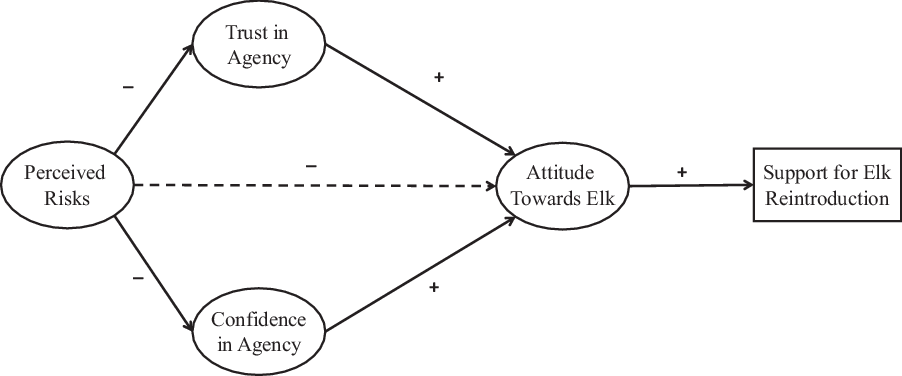
A structural equation model of support for elk reintroduction that integrates aspects drawn from the DMMC and the CHM is used to test several hypotheses. The model asserts that, by themselves, risk perceptions should have a direct and negative impact on support for elk reintroduction. However, when the aspects of the DMMC related to trust and confidence in the wildlife agency are added to the model, then that relationship is expected to become positive. This model predicts the mediation effect of trust and confidence on the relationship between risk perceptions and attitudes towards reintroduced elk and, ultimately, support for reintroduction. Generally, as risk perceptions towards elk increase, attitudes towards elk become more negative and support for elk reintroduction decreases. However, the model proposes that as trust in wildlife agency personnel and confidence in the agency to manage elk increase, the negative effect of risk perceptions on attitudes will diminish. Furthermore, as risk perceptions decrease because of this interaction, support for elk reintroduction will increase. Since the DMMC assumes that individuals place varying degrees of influence on the two components of social trust, the model also asserts that confidence plays a larger role than trust in influencing support for management. Overall, it is hypothesized that increasing levels of trust in wildlife agencies has a positive relationship with attitudes towards elk and reintroduction support (Fig. 1).
Structural equation model of support for elk reintroduction.

Methods
Study area and research design
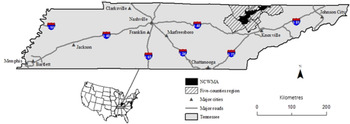
This survey-based study was conducted in the five-county area (including Anderson, Claiborne, Campbell, Morgan and Scott counties) surrounding the elk restoration zone in East Tennessee (Fig. 2), which is centred on the North Cumberland Wildlife Management Area (NCWMA) consisting of several smaller, linked wildlife management areas. The Tennessee Wildlife Resources Agency (TWRA) released 201 elk into the zone between 2000 and 2008, and these were estimated to be c. 350 in number by 2016 (Tennessee Wildlife Resources Agency 2018). A lottery-based hunting programme has since been established to manage the elk population in the region (Chapagain & Poudyal Reference Chapagain and Poudyal2020).
Study area of the five-county region located around the North Cumberland Wildlife Management Area (NCWMA) in East Tennessee, USA.

Data collection involved a mail survey of 5000 residents who were selected via stratified random sampling to ensure representation of residents living both inside and outside the zone. Addresses were selected so that 60% were located within the elk zone and 40% were located within the surrounding area to ensure adequate responses from those with greater chances of having experiences with elk in this area. The sample was obtained from Survey Sampling, Inc., a commercial vendor used in previous studies using households as a sampling frame (Poudyal et al. Reference Poudyal, Bowker and Moore2016, Watkins et al. Reference Watkins, Caplenor, Poudyal, Muller and Yoest2019). Survey administration followed a modified tailored design method (Dillman Reference Dillman, Smyth and Christian2014), which involved an initial mailing of the survey along with a cover letter and return envelope, followed by a reminder postcard, a subsequent mailing of the survey packet to those who had not responded and a final reminder letter. These mailings were sent out over 4 weeks in January and February 2018.
Out of 5000 contacts, 18 were returned because the person was deceased or had moved. A total of 1005 surveys were returned, yielding an adjusted response rate of 20.2%. This rate is similar to other recent mail surveys that utilized randomly sampled local residents on their views towards wildlife management planning (e.g., Caplenor et al. Reference Caplenor, Poudyal, Muller and Yoest2017, Grady et al. Reference Grady, Harper, Carlisle, Ernst and Schwiff2019). The sample of 1005 respondents drawn from the targeted population within the five-county restoration zone is estimated to have a 95% confidence interval and a ±5% margin of error (Vaske Reference Vaske2008).
Model scales and variables
The latent constructs included in the model (i.e., trust, confidence, risk perceptions and attitudes) were defined using multiple item indicators adapted from the literature (see Siegrist et al. Reference Siegrist, Gutscher and Earle2005, Sponarski et al. Reference Sponarski, Vaske, Bath and Musiani2014, Harper et al. Reference Harper, Miller and Vaske2015). To measure risk perceptions, a nine-item Likert response scale was created, and each item asked respondents to rate their level of concern regarding problems associated with elk such as ‘elk/vehicle accidents’, ‘damage to fences’ and ‘spreading disease to cattle/pets’. Items were derived from previous studies on risks pertaining to elk in various locations in the USA (Lee & Miller Reference Lee and Miller2003, Crank et al. Reference Crank, Hygenstrom, Groepper and Hams2010). Level of concern for each item was measured on a five-point Likert scale (‘Not at all concerned’ = 1, ‘Very concerned’ = 5). A factor analysis was used to remove redundancies within the nine items, and the resulting five items were summed into a perceived risk scale, with higher scores reflecting greater perceived risks associated with elk.
Levels of trust and confidence in the managing wildlife agency were assessed via a three-item and four-item scale with statements such as ‘I am confident in the wildlife agency’s capacity to manage elk in the region’ to measure confidence and ‘Wildlife agency professionals share similar goals as me’ to measure trust. Items were derived from the literature on the DMMC and previous work in wildlife management (Siegrist et al. Reference Siegrist, Earle and Gutscher2003, Needham & Vaske Reference Needham and Vaske2008, Harper et al. Reference Harper, Miller and Vaske2015). Level of agreement with each statement was gauged on a five-point Likert scale (‘Strongly disagree’ = 1, ‘Strongly agree’ = 5). Responses to the two scales were summed, with higher scores reflecting greater levels of confidence and trust.
Attitudes towards reintroduced elk were measured via a five-item scale that asked respondents to rate their level of agreement (‘Strongly disagree’ = 1 to ‘Strongly agree’ = 5) with statements about elk in Tennessee such as ‘Elk are a valuable part of nature’ and ‘Future generations should be able to see elk in Tennessee’. Items were derived from previous work on wildlife attitudes (Crank et al. Reference Crank, Hygenstrom, Groepper and Hams2010, Sponarski et al. Reference Sponarski, Vaske, Bath and Musiani2014, Harper et al. Reference Harper, Miller, Vaske, Mengak and Bruno2016). Local support for elk reintroduction was estimated by one survey item, which asked respondents to rate their level of agreement with the statement: ‘I support establishing a healthy population of elk in my region’. Support was rated on a five-point Likert scale that ranged from ‘Strongly disagree’ (1) to ‘Strongly agree’ (5), and higher numbers reflected great local support.
Several sociodemographic variables were used to describe the characteristics of the respondents. They included age, gender, educational attainment, income levels and whether or not the respondent was a hunter.
Data entry and analysis
Returned completed surveys were organized by unique ID numbers, coded and entered into a database. An exploratory factor analysis (EFA) was conducted on the construct of risk perceptions to find the minimum number of factors that account for covariation in the model. Confirmatory factor analyses (CFAs) were then performed on the multi-item trust scale to test the hypothesized DMMC, as well as on the attitudes towards elk scale. Following Vaske (Reference Vaske2008), stringent cut-offs were utilized in each analysis so that only variables having an item total correlation of at least 0.5 were considered for the analysis. Cronbach’s α was also used to test the internal consistency of the factors that emerged from performing the factor analyses.
Once the measurement models were validated, the structural equation model was developed to examine the correlation between the latent variables, which in this case are trust, confidence, risk perceptions, attitudes towards elk and support for reintroduction. Structural equation models constrain the covariance of constructs according to theory (Byrne Reference Byrne2016). The structured equation model (SEM) tool in the STATA 15 software package was used to fit the structural model. Goodness of fit was examined using the χ2 test, the confirmatory fit index (CFI; CFI >0.90 is acceptable), the Tucker–Lewis index (TLI; TLI >0.95 is acceptable) and the root mean square error of approximation (RMSEA; RMSEA between 0.5 and 0.8 is acceptable) (Cangur & Ercan Reference Cangur and Ercan2015, Byrne Reference Byrne2016). These tests were conducted to ensure that the manifest variables adequately measure the constructs, that the manifest variables measure the correct constructs and that there are no extraneous variables in the final model. Adjustments to the model, such as removing irrelevant variables or adjusting relationships, were made through post hoc analyses. Mediation in the SEM model was tested following the four-step process detailed in Baron and Kenny (Reference Baron and Kenny1986). The tests described in the following steps are simplified regression structural equation models showing the relationship between only two variables at a time. First, a test was conducted to show that the risk perception construct is correlated with attitudes towards reintroduced elk, which established that there is an effect that may be mediated. Second, tests were conducted to show that the risk perception construct is correlated with each mediator (trust and confidence). Third, tests were conducted to show that each mediator not only is correlated with, but also affects attitudes towards reintroduced elk. Lastly, to establish complete mediation, the effect of risk perception, controlling for trust and confidence, should be zero. If this path is only diminished and not completely removed with the addition of the mediator variables to the model, then partial mediation is indicated.
Results
A total of 1005 surveys were completed, resulting in a response rate consistent with several recent surveys that utilized randomized local residents as the sampling frame in a mail survey (e.g., Dalrymple et al. Reference Dalrymple, Peterson, Cobb, Sills, Bondell and Dalrymple2012: 21% in North Carolina; Poudyal et al. Reference Poudyal, Bowker and Moore2016: 15% in 18 eastern US states including Tennessee). Most (78%) respondents were 45–70 years of age, with an average age of 49 years. Almost two-thirds of them identified their gender as female (65%) and reported to be non-hunters (64%). A total of 10% had less than a high school diploma or GED, 34% had a diploma or General Education Development (GED) certification, 35% had some college or associated degree, 12% had a bachelor’s degree and the rest (8%) had a post-graduate degree. Of the 806 participants that responded to the income question, 55% indicated their annual household gross income was less than US$50 000, another 31% reported U$50 000–100 000, while the rest (14%) had incomes greater than US$100 000. Most (88%) respondents owned homes or property in the study area, while 9% lived in the region but did not own or rent property in the area.
The sample closely represents the age, income and educational characteristics of the targeted population. Females (65%), however, were overrepresented, and were subsequently underweighted in the analysis so that they would match the proportion of females in the targeted population (50%). No significant differences were found in our model variables between those living within the elk reintroduction zone and those living outside the zone. Furthermore, the first 10% and last 10% of the survey responses were compared as a proxy to check for potential non-response bias (Armstrong & Overton Reference Armstrong and Overton1977, p. 397). Statistical tests confirmed no statistically significant differences between these groups of responses in terms of age, education and income, which suggests that the non-response bias may not be an issue of significant concern.
Confirmatory factor analyses and scale reliabilities
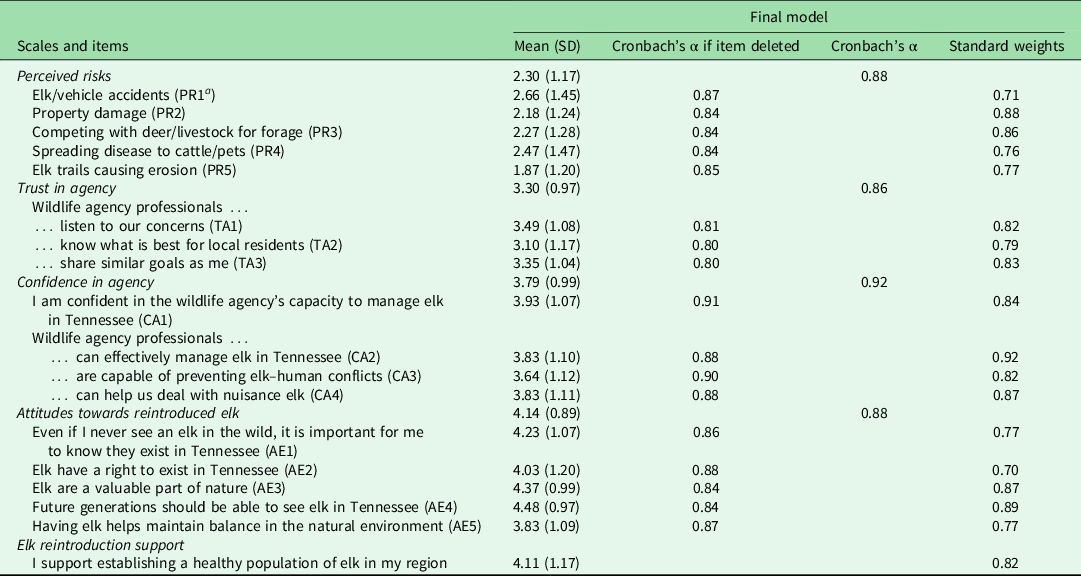
Results from the CFAs performed on the constructs in the Support for Elk Reintroduction Model along with results from the tests for internal consistency of the scales are presented in Table 1. The findings suggest perceived risks associated with elk were relatively low, with means ranging from 1.87 to 2.66 and a scale mean of 2.30 on a five-point scale. The average respondent did not have strong trust or mistrust in the agencies, as demonstrated by a mean of 3.30 and the means of the scale items ranging from 3.10 to 3.49. Items measuring confidence had comparatively higher means ranging from 3.64 to 3.93 and a scale mean of 3.79. Attitudes towards elk were relatively high, with a scale mean of 4.14 and items measuring attitudes ranging from 3.83 to 4.48. Support for elk reintroduction also rated highly with a score of 4.11 on a five-point scale. The Cronbach’s α test revealed very high scores for each of the four scales, suggesting high internal consistency and reliability.
Characteristics of measures of perceived risks, trust, confidence, attitudes and elk reintroduction support.

All standardized weights are significant (p < 0.001). Higher mean scores represent greater risk, greater trust and confidence, stronger positive attitudes and greater support based on scores from 1 to 5.
a Abbreviations for items as shown in Figure 3.
Structural equation model
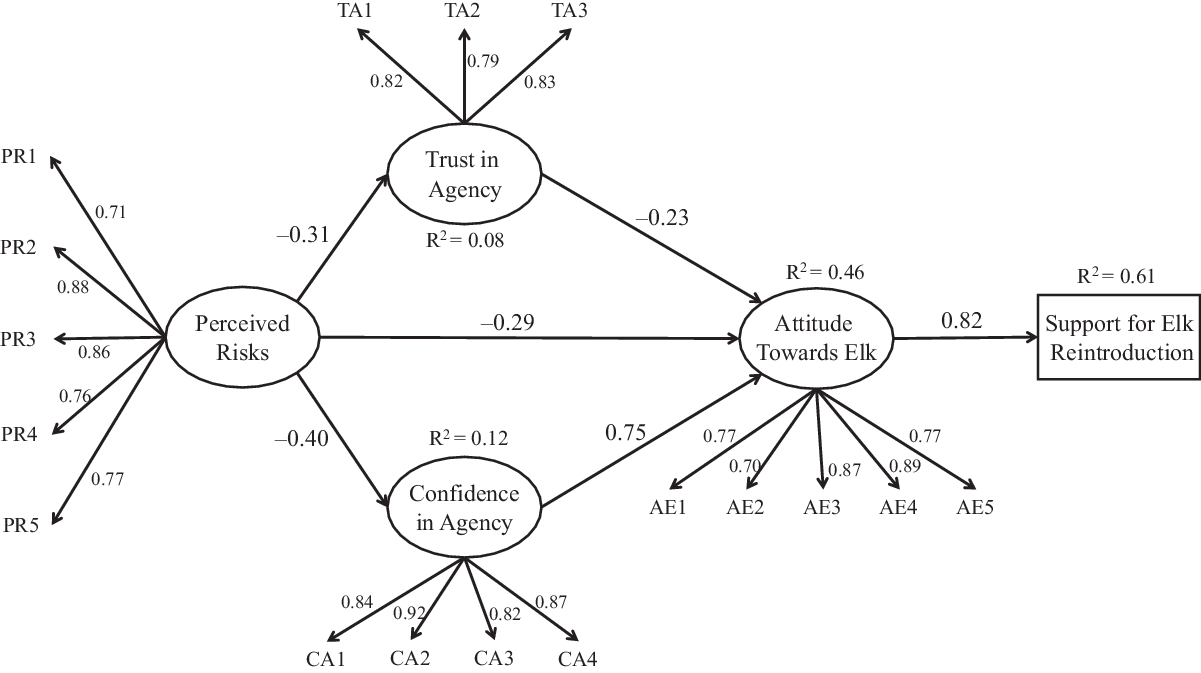
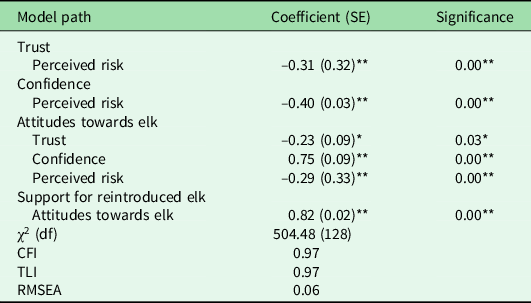
The path coefficients and goodness-of-fit tests indicate that the full structural equation model (Fig. 3) fits the data well (χ2 128 = 504.48, p < 0.001, CFI = 0.97, TLI = 0.97, RMSEA = 0.06) (Table 2). It also confirms significant links between risk, trust, confidence, attitudes and support; the variables together explain 61% of the variance in support for elk reintroduction. The other links between risk perceptions, trust and confidence also explain 46% of the variance in attitudes towards elk. Furthermore, the model demonstrates that perceived risk has a significant negative effect on attitudes towards reintroduced elk (β = –0.29, p < 0.01), on trust (β = –0.31, p < 0.01) and on confidence (β = –0.40, p < 0.01). In addition, the direct relationship between risk perceptions and attitudes towards elk is mediated by trust and confidence (Fig. 3). That is, as the path from perceived risk to elk attitudes goes through trust, the negative relationship is weakened (β = –0.23, p < 0.05). Additionally, as the path from perceived risk to elk attitudes goes through confidence, the negative relationship is transformed to positive and substantially strengthened (β = 0.75, p < 0.01). Lastly, the entire model has a positive and significant effect on support for elk restoration (β = 0.82, p < 0.01).
Full structural model showing the relationships between risk perceptions, agency trust, agency confidence, attitudes towards elk and support for elk reintroduction; all model parameters are significant at p < 0.05.

Structural equation model path results for the model of elk reintroduction support in Tennessee.

*p < 0.05, **p < 0.01.
CFI = confirmatory fit index; RMSEA = root mean square error of approximation; TLI = Tucker–Lewis index.
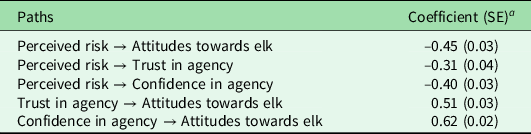
This model meets three of the four conditions of Baron and Kenny (Reference Baron and Kenny1986) in establishing mediation, suggesting partial mediation (Table 3). When tested alone, perceived risk is significantly related to attitudes towards reintroduced elk (β = –0.45, p < 0.01). Perceived risk is also significantly related to the mediator variables of trust (β = –0.31, p < 0.01) and confidence (β = –0.40, p < 0.01). To meet the third condition, trust is significantly related to attitudes towards elk (β = 0.51, p < 0.01), as is confidence to attitudes towards elk (β = 0.62, p < 0.01). In the full model (Fig. 3), the negative effect of perceived risk on elk reintroduction support is diminished (β = –0.29, p < 0.01) but not eliminated, suggesting a partial mediation. As the strength of the path between perceived risk and attitudes towards elk is weakened by the inclusion of trust and confidence, it can be concluded that these variables act as partial mediators in this relationship.
Partial mediation conditions for the model of elk reintroduction support in Tennessee.

a All coefficients are significant (p < 0.01).
Discussion
Residents in the five-county area surrounding the elk restoration zone in East Tennessee have moderate levels of trust and confidence in the managing wildlife agency and generally low perceptions of risk. More specifically, the results demonstrate that trust and confidence have unique significant partial mediation effects on the relationship between risk perceptions and attitudes towards reintroduced elk. The results suggest that trust and confidence in the managing agency can play key roles in reducing risk perceptions and garnering long-term support for wildlife reintroductions.
A major finding of the study confirms the influence of the DMMC posited by Siegrist et al. (Reference Siegrist, Gutscher and Earle2005), along with the differential impacts of trust and confidence on support for management. Both trust and confidence in the agency had positive and significant effects on attitudes towards reintroduced elk, which positively affected continued support for reintroduction. The results are similar to findings from a study in Canada suggesting that trust in the managing agency positively impacts attitudes towards wolves, which positively impacts behavioural support for wolf management (Sponarski et al. Reference Sponarski, Vaske, Bath and Musiani2014). By including the DMMC, this study expands upon previous work to better understand local support for wildlife reintroductions. By assessing confidence and trust as two distinct features of social trust, wildlife agencies can gain a more nuanced look at this important predictor of support.
The results also confirm the difference in magnitude of the partial mediation effect between the two mediation variables (trust and confidence). Trust in agency personnel simply minimized the negative effect of risk perceptions on support for reintroduction (from –0.45 to –0.29), while confidence in the agency’s management capability changed the relationship from negative to positive (from –0.45 to 0.75). These results are consistent with the findings in Siegrist et al. (Reference Siegrist, Gutscher and Earle2005) that confidence plays a larger role in predicting cooperation than trust. While both trust and confidence are important factors, confidence plays a larger role than trust as confidence changes the relationship between risk perceptions and support for reintroductions into a positive one, while trust simply reduces the magnitude of the negative relationship.
The findings additionally show that risk perceptions have a negative effect on attitudes towards reintroduced elk. These results are similar to other studies on wildlife reintroductions. For example, risk perceptions had a negative impact on attitudes towards panther recovery in Florida, cougar recovery in Montana and natural recolonization of grey wolves in Minnesota (Riley & Decker Reference Riley and Decker2000, Chavez et al. Reference Chavez, Gese and Krannich2005, Langin & Jacobson Reference Langin and Jacobson2012). While the results show that risk perceptions were generally low in this population (ranging from 1.87 to 2.66 on a five-point scale), they still had a negative impact on attitudes. This suggests that all levels of risk perceptions should be taken seriously by wildlife agencies and groups attempting reintroductions, as even small amounts of risk can lead to backlash and negative attitudes from the public.
The model presented in this paper revealed that trust and confidence were partial mediators of the relationship between risk perceptions and attitudes towards reintroduced elk. Risk perceptions were minimized but still remained after the introduction of trust and confidence into the model. While risk perceptions were low overall in this study, similar results were found in reintroduction studies involving species that are perceived as much higher risk. Sponarski et al. (Reference Sponarski, Vaske, Bath and Musiani2014) found that trust acts as a partial mediator in their model predicting attitudes and behavioural support for wolf management. Needham and Vaske (Reference Needham and Vaske2008) found similar results in that hunters who trusted the managing wildlife agency perceived less risk from CWD than those with less trust in the agency. They were also more likely to continue hunting deer and participate in management options for the disease, but they still perceived some level of risk (Needham & Vaske Reference Needham and Vaske2008). Depending on the amount of risk involved in a given wildlife management situation, risk perceptions may never completely disappear. However, these studies, along with our findings, suggest that regardless of the levels of risk involved, trust in the managing agencies can be beneficial for reducing some levels of risk and gaining public support.
The empirical evidence from this study establishes the interplay of relationships between risk perceptions, trust, confidence, attitudes towards reintroduced elk and support for continued restoration. In addition to confirming the role of the dual-mode model of trust and confidence in reducing risk perceptions, this study also established its role in the wildlife management context. As the model explained 61% of the variance in support for elk restoration, it can be concluded that risk perceptions, trust and confidence play large roles in attitudes towards reintroduced species and support for their restoration in the present case. Regardless of how small the risk of a wildlife management action or programme is to local residents, it can still receive opposition. Therefore, investing in building trust with residents and instilling confidence through consistent, competent management can be important factors in garnering support. The results also suggest that prioritizing confidence through capable management may be beneficial.
Conclusion
As losses in global biodiversity continue to mount, wildlife reintroductions will become more common practice, and the importance of trust in gaining local support will be critical for improving the long-term success rates of these restoration projects. In this context, this study helps to clarify the role of social trust, explained by the DMMC, in the success of wildlife reintroduction programmes. The present results may be more relevant for future reintroductions of game or other lower-risk species, but the implications from the study for the role of trust and confidence in mitigating risk perceptions and improving support cannot be downplayed. When the human-dimension aspects of reintroductions are overlooked or agencies fail to properly build trust with stakeholders, conflicts and public relations issues can abound. Additionally, as the population of reintroduced species (e.g., elk in the case of Tennessee) grows, it will become more important to track local residents’ attitudes towards the species, as larger numbers will increase the chances of human encounters and potentially elevate risk perceptions. It will also become more important for wildlife managers to effectively deal with nuisance elk, to show a willingness to cooperate with residents in order to minimize wildlife–human conflict and to continue gaining and keeping residents’ trust.
While building trust is critical for securing cooperation, it is fragile, and negative actions have greater impacts on it than positive actions (White & Eiser Reference White and Eiser2005, Davenport et al. Reference Davenport, Leahy, Anderson and Jakes2007). For this reason, it is important for wildlife management agencies attempting to build trust in order to boost support for management programmes to be consistent and patient in their efforts. Hunter trust in state wildlife agencies has been shown to increase when the agency demonstrates procedural fairness in decision-making and technical competency (Riley et al. 2018). As confidence in management capabilities plays a larger role than trust in agency personnel, and as confidence is built upon past experiences, consistency in technical competency could be critical. Procedural fairness is also achieved when stakeholders clearly understand the methods by which agencies make decisions, believe the process is fair and believe they have a voice in the decision-making process (Schroeder et al. 2017, Riley et al. 2018). Therefore, it will be important for agencies involved in wildlife reintroductions to establish a management plan with broad stakeholder engagement, including meetings, comment periods and surveys of attitudes and perceptions to ensure transparency and fairness in decision-making. Once a plan is established, it should then be consistently followed, especially when dealing with resident complaints or issues with nuisance wildlife.
Some limitations of the study should be noted. The results from the study revealed an overrepresentation of respondents who identified their gender as female. This was a household survey sent to residents living near the reintroduction zone. Therefore, it was not targeted at the typical groups of people represented in most wildlife research (i.e., visitors to recreation areas, hunters, anglers, etc.). As the other demographic variables closely reflected the study area and survey weights were used to address the overrepresentation of women, we believe that the results are reasonably representative and can inform management and policy.
It should also be noted that alternative models on trust and wildlife management have been developed. For example, studies on acceptance and tolerance for wildlife have used alternative models of trust whereby trust indirectly affects acceptance of wildlife via its influence on perceptions of risks and the benefits associated with the risk (Zajac et al. Reference Zajac, Bruskotter, Wilson and Prange2012, Bruskotter & Wilson Reference Bruskotter and Wilson2014). Risks and benefits have additionally been utilized to assess acceptable management actions for wildlife (Schroeder et al. Reference Schroeder, Fulton, Cornicelli and Bruskotter2018). Future studies could expand upon the model in this paper to include risk and benefit perceptions towards reintroduced wildlife in order to assess their additional impacts on trust, confidence and support for management.
Future studies could compare methods for gaining public support for wildlife reintroductions in order to find the most effective combination. The analytical model presented in this paper could also be improved in future studies by adding complexity to the model, such as testing antecedents of trust (e.g., value similarity, normative tolerance). By assessing the antecedents of trust and adding them to this model, a more complete picture of the influence of trust on attitudes towards reintroduced wildlife and willingness to support reintroductions may be achieved. The model could also be tested in reintroduction cases with species inducing higher levels of risk perceptions, such as predators and large carnivores. Results might differ for these types of reintroductions, where risks are higher and trust in agencies is lower.
Acknowledgements
The authors are thankful to Brad Miller and John Mike of the Tennessee Wildlife Resources Agency and Binod Chapagain of the University of Tennessee for their input at various stages of this study.
Financial support
Partial funding to complete this research was provided by the Tennessee Wildlife Resources Agency.
Conflict of interest
None.
Ethical standards
The final survey instrument and protocols were approved by the University of Tennessee’s Institutional Review Board (IRB Approval #UTK IRB-17-04149-XP).