INTRODUCTION
Rambutan (N. lappaceum) is a medium-sized tropical tree in the Sapindaceae family. The inflorescence of rambutan contains many flowers which are perfect in structure, but function as pistillate, staminate or hermaphrodite (Zee et al., Reference Zee, Chan, Yen, Shaw, Chen and Nagy1998). About 40–60% of any rambutan seedling population produce staminate (male) flowers only, but most of the clonal commercial cultivars are hermaphroditic (Tindall, Reference Tindall1994; Zee et al., Reference Zee, Chan, Yen, Shaw, Chen and Nagy1998). There is considerable genetic diversity in rambutan for many traits including aril colour, pest and disease resistance, brix and acidity, among others (Goenaga and Jenkins, Reference Goenaga and Jenkins2011; Tindall, Reference Tindall1994). The edible portion of the rambutan fruit is a fleshy, translucent white sarcotesta, which arises from an integument surrounding a single oblong seed (Tindall, Reference Tindall1994). There is a lack of information on best management practices and optimum growing conditions for rambutan. For example, little is known about the adaptability of rambutan to highly acidic soils. The mechanism by which soil acidity reduces the yield of many crops has been studied extensively (Foy, Reference Foy and Adams1984; Kochian et al., Reference Kochian, Pence, Letham, Pineros, Magalhaes, Hoekenga and Garvin2002). A high concentration of Al inhibits root cell elongation and division, causing a reduction in root growth, and therefore limiting exploitation of soil by roots for moisture and nutrients (Langer et al., Reference Langer, Cea, Curaqueo and Borie2009; Samac and Tesfaye, Reference Samac and Tesfaye2003). Soil Al as high as 15 cmol kg−1 can be found in tropical acid soils; in the tropical Americas, about 50% of the soils with potential for agricultural use have Al toxicity problems (National Research Council, 1993; Villagarcia et al., Reference Villagarcia, Carter, Rufty, Niewoehner, Jennette and Arellano2001). Plants growing in acid soils show deficiencies of nitrogen, phosphorous, potassium, calcium, and magnesium, and manganese toxicity (Samac and Tesfaye, Reference Samac and Tesfaye2003).
Plants have evolved two major mechanisms for Al tolerance: (1) internal tolerance and (2) Al exclusion from the root apex (Barceló and Poschenrieder, Reference Barceló and Poschenrieder2002; Kochian et al., Reference Kochian, Pineros and Hoekanga2005; Langer et al., Reference Langer, Cea, Curaqueo and Borie2009). Several studies suggest that Al-tolerant plants exclude Al from roots by exudation of organic acids to the rhizosphere or by creating Al-ligand complexes for translocation from roots to shoots, and subsequent accumulation in leaf vacuoles (Samac and Tesfaye, Reference Samac and Tesfaye2003; Watanabe and Osaki, Reference Watanabe and Osaki2002).
Previous research on the evaluation of promising rambutan germplasm for horticultural traits suggests that this crop adapts well to acid soils (Goenaga, Reference Goenaga2011). The objective of this study was to determine the mechanism conferring Al tolerance in rambutan. It is hypothesized that this tolerance is brought about organic acid exudation which may form an Al-ligand complex that makes Al non-toxic in the rhizosphere.
MATERIALS AND METHODS
Nutrient solution
Seed of rambutan cultivar ‘Jitlee’, a high-yielding clone (Goenaga and Jenkins, Reference Goenaga and Jenkins2011) adapted to tropical Ultisols (Goenaga, Reference Goenaga2011), were germinated on washed sand in a greenhouse and seedlings were allowed to grow for about four weeks. Seedlings at the six-leaf stage were transferred to 30 cm × 18.5 cm × 10.5 cm (l × w × d) plastic containers containing 3.6 litres of a modified Magnavaca's nutrient solution (Piñeros et al., Reference Piñeros, Shaff, Manslank, Carvallo Alves and Kochian2005) at pH 4.0. A rubber stopper with a 0.5 cm hole was slit to enclose the stem and provide seedling support. Aeration of the nutrient solution was provided by an aquarium pump. The nutrient solution contained the following macronutrients (mM): Ca, 3.53; K, 2.35; Mg, 0.85; NH4-N, 1.3; NO3-N, 10.86; P, 0.013; S, 0.20; and micronutrients (μM): B, 25; Cu, 0.63; Fe, 138; Mo, 0.83; Mn, 9.1; Zn, 2.3; and Na, 1.74. Iron was supplied as sprint 138.
The nutrient solution was renewed every seven days. Six Al treatments at a concentration of 0, 1.0, 2.3, 4.1, 6.7 and 10.2 mM and with activities of 0, 0.25, 0.50, 0.75, 1.00 and 1.25 mM, respectively, were added in the form of aluminium chloride (AlCl3). The desired Al+3 activities were estimated using GEOCHEM-EZ speciation software (Shaff et al., Reference Shaff, Schultz, Craft, Clark and Kochian2010). The pH was kept constant at 4.0 by addition of 0.1 M hydrochloric acid or 0.1 M potassium hydroxide (Langer et al., Reference Langer, Cea, Curaqueo and Borie2009). Treatments were arranged in a randomized complete block design with five replications. The experiment was replicated twice over time. Average solar radiation, maximum and minimum temperatures during the first trial were 5.04 MJ, 32.6°C, and 22.9°C, respectively, and 4.06 MJ, 33.1°C and 23.7°C in the second trial.
Organic acid determination
Collection of exudates for organic acid determination was performed according to Langer et al. (Reference Langer, Cea, Curaqueo and Borie2009) and Piñeros et al. (Reference Piñeros, Magalhaes, Carvalho Alves and Kochian2002). Fifteen days after transplanting, a seedling from each Al treatment and replication was carefully removed from the plastic container. The root system of this plant was immediately washed with distilled water and placed in a solution having the same Al concentration where the seedling was growing plus 4.39 mM CaCl2. This Ca concentration corresponded to the total divalent cation concentration in the nutrient solution, and maintained a relatively constant Al stress similar to that found in the nutrient solution by emulating any possible Al amelioration by divalent cations (Piñeros et al., Reference Piñeros, Magalhaes, Carvalho Alves and Kochian2002). After 24 hours, the plant was removed from the vial and the solution stored at −20°C for subsequent determination of organic acids.
Organic acids (citrate, succinate, malate and oxalate) were determined using high performance liquid chromatography (Agilent HP 1100, Santa Clara, CA) using a modification of Cawthray (Reference Cawthray2003) and Langer et al. (Reference Langer, Cea, Curaqueo and Borie2009). For this purpose, root exudates were lyophilized and the precipitate re-dissolved in 5 mL deionized water and filtered through a 45 μm filter (Whatman, Buckinghamshire, UK). To obtain optimum analytical conditions, peak separation was achieved using a two 150 × 4 mm reverse-phase column (Sigma–Aldrich Corp., Saint Louis, MO) in series at 25°C. Sample solutions (10 μL) were injected into the column, and a 1% ortho-phosphoric acid at pH 2.1 and methanol (9:1 ratio, respectively) were used for isocratic elution at a flow rate of 0.5 mL min−1 with UV detection at 210 nm.
Standard solutions of oxalic, citric, malic and succinic acids at concentrations of 0.50, 1.0, 2.0 3.0 and 4.0 μg g−1 each, were used to construct calibration curves. Preliminary studies with organic acid standards conducted prior to the study indicated a recovery of at least 95%.
Plant growth and nutrient composition
Plants were harvested 60 days after being transferred to nutrient solutions. At harvest, the number of leaves, leaf area, plant height and stem diameter were measured. Leaf area was measured using a LI-3100 area meter (LI-COR, Inc., Lincoln, NE), plant height with a ruler and, stem diameter with a digital caliper (Mitutoyo, Inc., Aurora, IL). Plants were then separated into roots, stems and leaves and dried to constant weight at 70°C for dry matter determination. In addition, leaves that had fallen from plants in each Al treatment during the 60-day experimental period were also collected for dry matter determination. A RTI was calculated by dividing root dry weight of plants grown with Al by the root dry weight of plants grown without Al. A high RTI presumes more tolerance of the root system to a given Al treatment (Taylor and Foy, Reference Taylor and Foy1985).
Plant parts were ground using a Wiley mill and analysed for P, K, Ca, Mg, Fe, Mn, Zn, Mo, B and Al concentration using recommended digestion procedures (Perkin-Elmer, 1994). For this purpose, tissue samples were incinerated in crucibles at 500°C for four hours, and allowed to cool overnight. The incinerated samples were digested with 20 mL 33% HCl until 10 mL of solution remained in the crucible. After digestion was completed, each sample was filtered through Whatman No. 541 filter paper into a 100 mL volumetric flask. The solution was used for nutrient determination using a PE 7300 DV inductively coupled plasma-optical emission spectrometer (Perkin-Elmer, Shelton, CT).
Total nitrogen was determined by a modification of the micro-Kjeldahl method (Foss, 2002). For this purpose, 0.2 g of tissue was weighed and transferred to a Kjeldahl tube. The following compounds were added to each tube: Hengar granules for smooth boiling; one catalysing tablet (1.5g K2SO4 + 0.15g CuSO4); 5 mL concentrated H2SO4 and 3 mL 30% H2O2. Samples were digested in a digestion block for 2 h at 380°C.
Analyses of variance and regression analyses were carried out using the GLM procedure of the SAS program package (SAS Institute, Cary, NC, USA). Only coefficients at p ≤ 0.05 were retained in the models.
RESULTS AND DISCUSSION
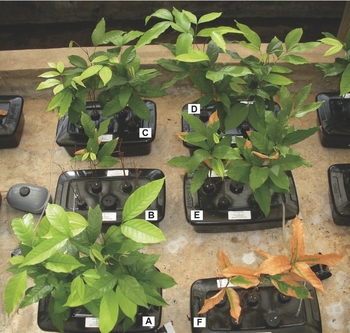
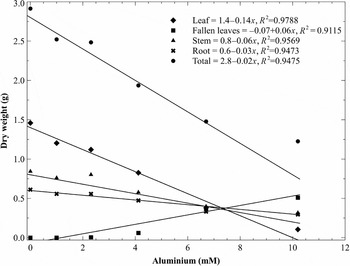
All treatments had a significant effect (p ≤ 0.01) on total, leaf, stem and root dry weights. Increasing the Al concentration from 0 to 10.2 mM resulted in a significant decrease in leaf, stem, root and total dry weight, but the highest Al concentration did not result in plant death. Leaf dry weight of the fallen leaves (i.e., leaves that abscised as a result of treatment effects) increased with increments in Al levels (Figures 1 and 2).
Sixty days old rambutan seedlings as affected by varying levels of aluminium. Clockwise from bottom left: (A) 1.0 mM Al; (B) 10.2 mM Al; (C) 2.3 mM Al; (D) 0.0 mM Al; (E) 4.1 mM Al; (F) 6.7 mM Al.

Dry weight of plant parts of rambutan at different aluminium concentrations.

Miyasaka et al. (Reference Miyasaka, Buta George, Howell and Foy1991) found that Al at a concentration of 0.15 mM significantly reduced shoot and root dry weights in the Al-sensitive snap bean cultivar ‘Romano’ and the Al-tolerant cultivar ‘Dade’. Matiello et al. (Reference Matiello, Pereira, Zonta, Mauri, Matiello, Meireles and da Silva2008) found a significant reduction in shoot and root dry weight in three different coffee cultivars at Al concentration ranging from 0.01 to 1.5 mM. In our study, a significant reduction in total dry matter occurred after a regression-predicted Al concentration of 3.5 mM was reached (Figure 2) suggesting that rambutan is tolerant to high Al concentrations in the rhizosphere.
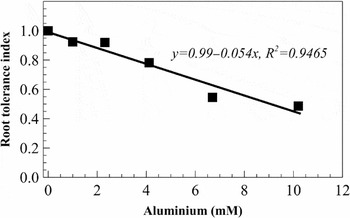
The RTI remained relatively constant (1.00–0.85) in Al treatments ranging from 0 to about 3.5 mM, but it declined significantly in Al treatments higher than 4.1 mM (Figure 3). Taylor and Foy (Reference Taylor and Foy1985) suggested that an RTI of 0.85 ± 0.03 or higher defines Al tolerance in wheat cultivars.
Root tolerance index of rambutan at different aluminium concentrations.

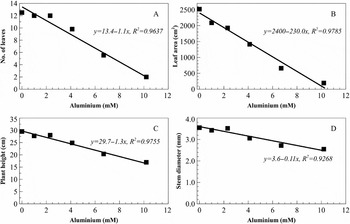
As with dry matter, leaf number, leaf area, plant height and stem diameter significantly decreased with increase in Al concentration (Figure 4A–D). These results agree with similar studies conducted with other crops. Langer et al. (Reference Langer, Cea, Curaqueo and Borie2009) studied four alfalfa cultivars and found that Al concentrations (0.050 and 0.10 mM) in the nutrient solution caused a significant reduction in shoot dry weight and reduced plant growth. The fact that in this study rambutan seedlings grew relatively well even at Al concentration of about 3.5 mM (Figure 4) demonstrates that this crop is highly tolerant to Al. Similar nutrient culture studies with other crops such as alfalfa (Langer et al., Reference Langer, Cea, Curaqueo and Borie2009), soybean (Liao et al., Reference Liao, Wan, Shaff, Wang, Yan and Kochian2006), barley (Tian-Rong et al., Reference Tian-Rong, Guo-Ping, Mei-Xue, Fei-Bo and Jin-Xin2007), coffee (Matiello et al., Reference Matiello, Pereira, Zonta, Mauri, Matiello, Meireles and da Silva2008) and wheat (Wang et al., Reference Wang, Raman, Zhang, Mendham and Zhou2006) showed significant reductions in dry matter production at much lower Al concentrations (0.05–1.48 mM) than those used in this study. Results from this work concur with those of Goenaga (Reference Goenaga2011) working with rambutan who found that dry matter production, stem diameter and plant height were unaffected until very high levels of soil Al were reached.
Plant growth parameters of rambutan at different aluminium concentrations.

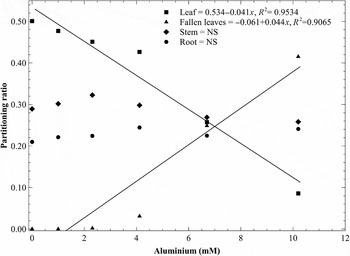
Ratios of dry matter partitioning to leaves, stems and roots as a fraction of total plant dry matter are presented in Figure 5. At Al concentrations ranging from 0 to 4.1 mM, plants allocated a greater percentage of their dry matter to leaves with this organ accounting for over 40% of the total dry matter in plants. At higher Al concentrations, the partitioning ratio decreased significantly for leaves. It is noteworthy that at an Al concentration higher than 4.1 mM, total dry matter of fallen leaves (i.e., abscised leaves) increased significantly, whereas the partitioning ratio of roots and stems was not significantly affected (Figure 5). This response may indicate a mechanism whereby plants reduced their leaf area as a way to minimize sink strength to favour survival of other plant organs (e.g. roots). That leaf abscission may have been the result of reduced water absorption due to Al-induced root injury is a possibility, but the partitioning of dry matter to roots did not change throughout the experimental period (Figure 5), and plants did not show signs of wilting.
Relationship between dry matter partitioning of rambutan plant organs at different aluminium concentrations. Absence of curve fitting denotes lack of significant response.

The Al-dependent efflux of organic acids into the rhizosphere has been widely described as an important mechanism in plant species to minimize the toxic effects of Al in acid soils (Barceló and Poschenrieder, Reference Barceló and Poschenrieder2002; Kochian et al., Reference Kochian, Hoekanga and Pineros2004; Langer et al., Reference Langer, Cea, Curaqueo and Borie2009). In this study, analyses of root exudates for the presence of organic acids showed no detectable amounts of citrate, succinate, malate and oxalate in solution (data not shown). Since non-sterile conditions were used in this study, there is the possibility that microorganisms in the nutrient solution may have rapidly decomposed organic acids in the rhizosphere (Jones, Reference Jones1998). However, the procedure used in this study to collect organic exudates have been used successfully by others (Piñeros et al., Reference Piñeros, Magalhaes, Carvalho Alves and Kochian2002; Reference Piñeros, Shaff, Manslank, Carvallo Alves and Kochian2005) thus suggesting another type of tolerance mechanism in rambutan. We suggest that rambutan tolerates high concentration of Al in the rhizosphere by producing an Al-ligand complex for translocation from roots to shoots, and subsequent accumulation in leaf vacuoles (Ma et al., Reference Ma, Ryan and Delhaize2001; Watanabe and Osaki, Reference Watanabe and Osaki2002) or by a tolerance mechanism in which Al remain in the plant cytoplasm where it permeates the plasmalemma and becomes sequestered or converted into an innocuous form (Wang et al. Reference Wang, Raman, Zhang, Mendham and Zhou2006). Famoso et al. (Reference Famoso, Clark, Shaff, Craft, McCouch and Kochian2010) demonstrated that in rice, there is no significant correlation between Al exclusion from the root apex (mediated by malate or phosphate) and root growth in the presence of Al. Therefore, roots of Al-tolerant rice varieties are able to grow even with significant Al accumulation in the root tip. The authors suggested that malate and/or phosphate may chelate Al within the apoplast of the root tip, rather than exclude Al from entering the root tip. Alternatively, they speculated that the root cell wall may play a role in rice Al-tolerance by modification of the cell walls. Since there was no organic acid exudation in this study, perhaps rambutan is using an alternative mechanism, similar to rice, to achieve high Al tolerance.
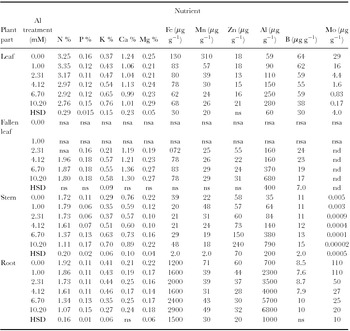
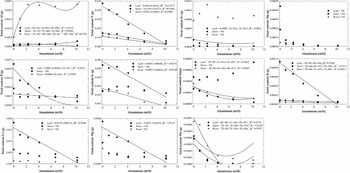
Figure 6 shows total content of nutrients in leaves, stems and roots collected at the end of the experimental period. As expected, increasing the concentration of Al in the nutrient solution resulted in significant reductions in total content of N, P, K, Ca, Mg, Fe, Zn, B and Mo, particularly in leaf tissue. This reduction in nutrient content is probably the result of the drastic decline in dry weight exhibited by plant organs (Figure 2). It is noteworthy that even though the content of P declined with increases in Al, the concentration of P in most tissues was generally significantly higher in high Al treatments (Table 1). A similar response was observed for K and Ca in stem tissue. Santana et al. (Reference Santana, Yamada and Santana1985) found only small reductions in P concentration of cacao roots exposed to high Al. Al treatments did not have a significant effect on root Ca concentration or content (Figure 6; Table 1) even though Al is known to inhibit Ca uptake by blocking Ca channels in the plasma membrane (Huang et al., Reference Huang, Shaff, Grunes and Kochian1992). The ability of Al to reduce Ca uptake and translocation is well documented (Delhaize and Ryan, Reference Delhaize and Ryan1995; Lazarević et al. Reference Lazarević, Poljak and Horvat2012; Oleksyn et al., Reference Oleksyn, Karolewski, Giertych, Werner, Tjoelker and Reich1996; Rengel, Reference Rengel1992). Goenaga and Smith (Reference Goenaga and Smith2002) found that adaptation of beans to acid soils may require efficient uptake and utilization of these nutrients, particularly calcium. Wang et al. (Reference Wang, Raman, Zhang, Mendham and Zhou2006) working with barley found that high soil Al causes deficiencies of essential nutrients like calcium, magnesium, iron and molybdenum and decreased availability of phosphorous resulted in overall stunting, late maturity, purpling of stems, leaf yellowing and thickened and distorted root systems. In this study some of these symptoms were only visible when Al treatment concentrations exceeded 4.1 mM, a very high Al concentration when compared to that used in similar studies with other crops (Matiello et al. Reference Matiello, Pereira, Zonta, Mauri, Matiello, Meireles and da Silva2008; Miyasaka et al. Reference Miyasaka, Buta George, Howell and Foy1991; Tian-Rong et al. Reference Tian-Rong, Guo-Ping, Mei-Xue, Fei-Bo and Jin-Xin2007; Zheng et al. Reference Zheng, Yang, He, Yu, Zhang, You, Shen and Matsumoto2005);
Nutrient concentration in various plant parts of rambutan grown at different aluminium concentrations.

HSD is the minimum significant difference according to Tukey's studentized range test; ns is not significant at p ≤ 0.05; nsa refers to no sample available due to lack of treatment effect; nd is not detectable by instrument.
Total nutrient content in various plant parts of rambutan as influenced by soil aluminium. Absence of curve fitting denotes lack of a significant response.

The concentration of leaf Al significantly increased with increases in Al in the nutrient solution (Table 1). These results agree with those of Goenaga and Smith (Reference Goenaga and Smith2002) and Duncan et al. (Reference Duncan, Dobson and Fisher1980) who found that the concentration of leaf Al in dry bean and sorghum, respectively, increased significantly with increases in soil Al. Studies with other crops (Wang et al., Reference Wang, Raman, Zhang, Mendham and Zhou2006) showed that Al accumulation in the root system of wheat increased significantly with increases in Al concentration in the rhizosphere. Piñeros et al. (Reference Piñeros, Magalhaes, Carvalho Alves and Kochian2002) found that in an Al-tolerant maize line, the Al concentration in root tips increased with increments in the Al concentration of the nutrient solution. At 0.22 mM Al, the Al concentration in the maize root tip reached 2,951 μg g−1. Exposure of this Al-tolerant line to this Al concentration in the nutrient solution resulted in only a 20% reduction in root growth as compared to 45–70% in moderately tolerant and sensitive lines (Piñeros et al., Reference Piñeros, Shaff, Manslank, Carvallo Alves and Kochian2005). Matiello et al. (Reference Matiello, Pereira, Zonta, Mauri, Matiello, Meireles and da Silva2008) found that the Al concentration was higher in coffee roots than in leaves with root Al concentrations higher than 8,200 μg g−1 in high Al treatments, suggesting an internal tolerance mechanism to withstand this high Al concentration. In our study, the concentration of Al in stems and roots was 790 μg g−1 and 6,800 μg g−1, respectively in the 10.2 mM Al treatment, demonstrating that rambutan can also tolerate high concentration of Al in tissues (Table 1). Future studies are needed to assess formation of Al-ligand complexes that may be loaded to xylem vessels of rambutan roots and translocated to shoots where they may be compartmentalized into vacuoles (Samac and Tesfaye, Reference Samac and Tesfaye2003; Watanabe and Osaki, Reference Watanabe and Osaki2002).
Some highly Al-tolerant plant species can accumulate high concentrations of Al in above-ground plant parts without showing symptoms of Al toxicity presumably by detoxifying or compartmentalizing endogenous Al (Ma et al., Reference Ma, Ryan and Delhaize2001). Al-tolerant species known to possess internal tolerance mechanisms to withstand high Al include Hydrangea and buckwheat which detoxify accumulated Al by creating ligands with organic acids. This mechanism allows these plant species to accumulate Al in their leaves to high levels in Hydrangea (3000 μg g−1) and moderately high levels in buckwheat (450 μg g−1) as compared to other plant species like wheat, which employ Al exclusion mechanisms in roots and accumulate less than 50 μg g−1 Al in their leaves (Kochian et al., Reference Kochian, Pence, Letham, Pineros, Magalhaes, Hoekenga and Garvin2002). None of these plant species are fruit crops. In this study, the concentration of Al in rambutan leaves reached 680 μg g−1 when exposed to 10.2 mM Al after just two months of growth (Table 1). Watanabe and Osaki (Reference Watanabe and Osaki2002) considered an Al accumulator plants that exceed a concentration of 1,000 μg g−1 in their leaves.
CONCLUSIONS
The results of this study confirms that rambutan is highly tolerant to Al in the rhizosphere as evidenced by: (1) a RTI of 0.85 when plant roots were exposed to an Al concentration in the rhizosphere as high as 3.5 mM; (2) plants surviving with Al concentration in the roots as high as 6800 μg g−1; (3) number of leaves, plant height and stem diameter little affected when plants were grown at an Al concentration in the nutrient solution as high as 3.5 mM; (4) although plants exhibited leaf abscission, they were able to tolerate Al concentrations in the nutrient solution as high as 10.2 mM during the experimental period. Accumulation of Al in leaves, stems and roots suggest the existence of an Al-sequestration mechanism in rambutan which may involve an Al-ligand complex which translocates from roots to shoots, where it may accumulate in leaf vacuoles. The hypothesis that rambutan tolerates high concentration of Al by exudation of organic acids (Al exclusion mechanism) is not supported by results in this study. Future studies should be directed toward finding the ligand and mechanism responsible for conferring high Al tolerance in rambutan.
Disclaimer
Mention of trade names or commercial products in this paper is solely for the purpose of providing specific information and does not imply recommendation or endorsement of the US Department of Agriculture.
Acknowledgements
We are grateful to Angel Marrero, José Luis Rodríguez, Pablo Ríos, Tomás Miranda, Carlos Ríos and Josué Arocho for assistance. UPR- Mayaguez professors Dr. Nairmen Mina, Dr. Carmen Vega, Prof. Maritza de Jesús and Dr. Samuel Hernández. Graduate students Dr. Leonardo Pacheco, Mr. José Luis Ruiz and Mr. José Carmona. Dr. Leon Kochian, USDA-ARS, Ithaca, New York and Dr. Jon Shaff, Cornell University, Ithaca, New York for scientific advice.