


On 9 December 1941, Shanghai woke up to the sound of boots and rumbling engines on the pavement. The Japanese army had just taken over the International Settlement by force. In the French Concession, it was a shattering moment, eliciting a mixture of feelings ranging from consternation, to relief and to anxiety. In the months that followed, the Japanese military imposed a series of measures that, for the first time, challenged the sanctity of the foreign settlements and the privileges and protection that foreigners had enjoyed under the treaties since the nineteenth century. The French Concession preserved its autonomy, but its authorities planned for the worse, such as evacuating French nationals. In this article, we rely on a rare document – a listing of all French residents in 1942 – to conduct a quantitative micro-history of the French community in the wake of the Japanese invasion in the decisive year of 1942. On the basis of this snapshot, we examine this group from the perspective of historical demography combined with a spatial approach drawing on the geospatial resources built over a decade in Shanghai.
The history of foreign communities in China constitutes a strand of research that few scholars have explored. With the exception of Robert Bickers’ extensive work on the British community in China, most works have focused on a specific national group in a specific locality. Moreover, aside from Ristaino's work on the Russian/Jewish community,Footnote 1 Takatsuna's monograph on the Japanese communityFootnote 2 and Krantzler's and Gao Bei's studies of the Jewish refugees,Footnote 3 all of them in the city of Shanghai, and Bickers and Henriot's edited volume on foreign communities in East Asia,Footnote 4 all other existing works are made up of unpublished doctoral theses.Footnote 5 Few academic papers have addressed the nature, status and activities of foreign communities as groups (vs. studies of individuals) in Shanghai or elsewhere.Footnote 6 It can be argued that this is due to the overwhelming China-centred approach in western studies of modern China. In China proper, however, there is a similar concentration of works on three foreign communities: the Japanese in Shanghai,Footnote 7 and the Russians and the Jews, in Harbin and Shanghai, with a certain amount of overlap due to the presence of Russian Jews in the first waves of migration to China after the early 1920s.Footnote 8
Yet, paradoxically, despite its relative importance as an urban entity or as a foreign community, and the abundant documentation available, little is known of the people who formed the French community. In this article, we first want to contribute to filling in a historiographical gap about the French presence in China with a focus on the French Concession in Shanghai, their major foothold in the country. Second, we argue that the study of the French population is an important story in its own right as this enriches our knowledge of foreign communities in treaty-port China. Previous studies – unpublished theses – have addressed various topics in social and legal history in ShanghaiFootnote 9 or issues of institutional and political management in other French-ruled territories in Hankou, Tianjin or Guangzhouwan.Footnote 10 Although some individual portraits appear in these works, they never include any examination of the French community as a group. Yet, this is not just about enriching our knowledge of the French community and more broadly of foreign communities in treaty-port China. We argue that the French formed a distinct group due to the system of power that gave them fuller control over their territory than the British and Americans in the neighbouring International Settlement. This configuration in turn gave them far more leeway and influence than their sheer size warranted. The central source document on which we rely also highlights precisely the mechanisms of French municipal management and its firm grip on power in and beyond its territory in Shanghai. Although there were discontinuities in space and organization, the French presence in China formed a particular configuration that still awaits its Robert Bickers.Footnote 11
The French did not represent, by far, the largest foreign community in Shanghai, and yet their presence had an impact that went far beyond their modest size. This was due to the large and central territory that they administered within the city, their capacity to infuse it with norms, regulations and cultural practices from the homeland and a deliberate and sustained effort to support ‘Frenchness’ in the French Concession and even Shanghai.Footnote 12 This political and cultural stance resulted from the system of power that the French authorities – the consul general – instituted to make up for the numerical inferiority of the French community in its own territory. While the French formally emulated the form of municipal administration established in the International Settlement, with a fully elected ratepayers assembly and a municipal administration – Shanghai Municipal Council (SMC) – under its control, power in the French Concession came to be concentrated in the hands of the consul general.Footnote 13 The French Municipal Council (FMC), dissolved arbitrarily several times by the consul, became a rubber-stamp assembly and all major decisions were taken through ordonnances consulaires. Although a full municipal administration eventually emerged, the consul general retained the ultimate power of vetoing any decision and of governing by administrative fiat. This unusual power configuration gave the French authorities – consul general and municipal administration – greater latitude to define policies that promoted French interests, to interact selectively with Chinese elites and to stand up to the SMC in an uneasy, but constant collaboration over local affairs and regulations.
The presence of a French population in Shanghai, as shown in the exhaustive 1942 census, was largely the result of the mechanism of power instituted in the settlement, which made it a territory offering a wealth of jobs directly (municipal administration) or indirectly (electricity and streetcar companies) linked to the deliberate intention to build, develop and defend a specifically French space, politically and culturally, as a counter-weight to the International Settlement and in defiance of the Chinese authorities. The system of power instituted in the French Concession, by creating a French cultural space (with French as the working language) and by giving privileges to French nationals for jobs in the municipal institutions, worked as a magnet for people in search of opportunities, who found in Shanghai a comfortable labour niche, better living conditions, a higher social status and a bit of exoticism. This system of power, however, by creating an artificially protected economic and political sphere, funnelled the in-coming French migrants into a narrow range of activities over which the municipality had direct (municipal services) or indirect (tramway and electricity) control. Eventually, with a general policy that favoured residential spaces and sidelined industries, the French Concession attracted a diversified population, as in the neighbouring settlement, but in socio-economic terms this population did not exhibit the same extensive range of activities.Footnote 14
1942: a year of high significance
The year 1942 represents a watershed in the history of wartime Shanghai. Due to especially harsh climatic conditions and the impact of the embargo imposed by the Allies after the attack on Pearl Harbor, it was the deadliest year of the war period for the civilian population since 1938, the fateful year after the Sino-Japanese conflict broke out in Shanghai.Footnote 15 Locally, the Japanese army followed up on the assault on the US naval base by invading and taking over the International Settlement. Although the Japanese maintained for a while the existing foreign body of administrators, workers and policemen under the SMC as an expedient to preserve public order, they became the sole source of power and decision. Soon they started to curtail the social and economic position of enemy nationals (British, American, Dutch, etc.) by restricting their access to money, taking control of companies, and finally rounding them for detention in internment camps after November 1942.Footnote 16 As a result of these increasingly restrictive measures, in Shanghai the French Concession became de facto the last ‘Lone Island’ in a sea of occupied territories all around (Figure 1).Footnote 17
The regime of occupation in Shanghai in December 1941

Yet, even if the French Concession was spared outright occupation due to the mutual recognition between the Japanese and Vichy governments as friendly nations, the long arm of the Japanese army reached into the French-administered area. Aside from collaboration on the repression of acts of resistance and arrests of Chinese and enemy nationals, the Japanese army imposed its agenda, especially the decision to establish a system of population registration geared toward the forced evacuation of population and food rationing. In view of the reduced supply of food and sharp drop of economic activity after the beginning of the embargo, not to mention the presence of the large Chinese population that had sought refuge in the foreign settlements after the beginning of the war, the Japanese were eager to reduce the population deemed as unnecessary and to contain food consumption.Footnote 18 The system of food rationing also provided considerable leverage to keep the population quiet and subservient.
A unique and rare document
The original source on which this article is based was discovered in the private papers of Robert Jobez (1898–1980), former deputy director of the Service politique (Special branch) of the police in the French Concession after 1933.Footnote 19 The document lists all the French citizens registered at the consulate general in Shanghai who lived in the city proper and adjacent areas. It presents a detailed portrait of the entire French community at a critical juncture in wartime Shanghai.Footnote 20 Its uniqueness lies in the fact that in the context of Shanghai (and even China) it presents a nominal roll of French residents throughout Shanghai, with a range of attributes that did not appear in the regular census documents (Figure 2). To the best of our knowledge, no such document has ever been found for the population at any time in the International Settlement or the Chinese municipality. This survey also attests to the care of the French authorities not just about counting their own, but registering and knowing their whereabouts in the city. Such documents are extremely rare and, apart from much earlier nominal lists in the 1840s, no such systematic listing has come to light, not just for the French residents, but for any foreign community in the city. While both the French Municipal Administration and the SMC conducted regular surveys of their populations, with a special interest in foreign residents, they published only the compiled statistical results. The original census forms filled out by the population have been lost, destroyed or remain locked up in some unknown archive. No such archives have emerged despite a four-year-long foray in the historical sources at the Shanghai Municipal Archives.Footnote 21
Page from the original census survey

The survey of the French population in Shanghai was part of the registration of the whole population in the French Concession to make sure that each and every French citizen was accounted for, within and beyond the limits of the settlement. Even if the Japanese army did not challenge the authority of the French consul and his administration, the French authorities were aware of the risk of a confrontation with the Japanese in case the latter decided that their safety required full control of the settlement. The consular services produced this survey in May 1942 in the wake of the population count completed three months earlier under Japanese fiat. The list was updated as of 18 July 1942. The various elements of information, including the professional categories, were collected from the original declarations by the registered French residents.
The document lists by name all the registered French residents, either as single individuals (both male and female heads of families), or as spouses of non-French residents. In the case of heads of families, the survey provides data on the spouse and the number of children, but not their age or sex (for children). To our knowledge, this is the most complete sociographic survey of the French community as, for each individual, it indicates the home address, occupation, marital status and age. Other elements of information can be inferred from the data such as sex, marriage to a non-French resident and nature of housing. There is also partial information on the workplace. While the survey listed 1,281 individual names, the total recorded population amounted to 2,419 people. Although the registration must have missed a few individuals who were reluctant or oblivious to consular registration, the document reflects very closely the actual French population in Shanghai (2,497 in the French Concession and 173 in the International Settlement).Footnote 22 In the sections that follow, we examine this population from various angles to highlight its nature and specific features.
The French population in the longue durée
The 1942 survey fits in a long history of population census and registration. The first complete survey of the population was conducted in 1865. In the following decades, the slow evolution and even decrease of the general population failed to motivate the municipal authorities to monitor demographic trends very closely. The next surveys took place in 1878 and 1879, then in 1890. The survey in 1890 marked the beginning of a regular five-year census, in parallel with the same practice in the International Settlement, until 1930. Thereafter, the French authorities decided to carry out a population count on a yearly basis, although these counts failed to meet the standards of the five-year census. The last full census before the war took place in 1935. In the summer of 1937, refugees arrived by hundreds of thousands in the settlement and the municipal administration gave up counting the population in its territory. Its police produced only careful but unverified assessments on the total population before the February 1942 quasi-census, with 824,613 Chinese and 29,767 foreigners.Footnote 23
From the very beginning when the French consul established the first settlement in 1849, French residents were a minority community, not just vis-à-vis the Chinese population, but also among larger numbers of other nationalities. The early foreign resident population in the French Concession included 243 men (85 per cent), 40 women (12 per cent) and 8 children (3 per cent). It comprised a majority of non-French male residents. With 104 residents, the French represented 43 per cent of the total male population, followed by the Germans (18 per cent), the Italians (13 per cent) and finally the British (9 per cent) among the major groups.Footnote 24 Three decades later, the French community still counted 104 residents and its social structure remained basically the same.Footnote 25 It represented 32 per cent of the foreign population.Footnote 26 In the following decades, the inflow of French citizens failed to keep pace with the sustained growth of other foreign residents.
Between 1895 and 1935, a total of 48,139 foreigners moved into the French Concession. Although they hailed from all over the planet, except Africa, most came from the major nations that had signed treaties with China in the nineteenth century. The French Concession served as a place of abode and a platform for a wide range of foreign nationals beyond France proper: 22,874 Europeans, 14,317 Russians, 5,243 Americans and 4,901 Asians. Among the Europeans, 41.4 per cent came from Great Britain, 25.3 per cent from France and less than 10 per cent each from Germany, Portugal, Denmark, Poland or Italy. Russians, also part of Europe, are counted here separately due the sheer size of their community. Only very small groups of migrants originated from South America, India and the Middle East. There was a sharp increase of Europeans after 1920, then again after 1930. An important factor in the migration mix was the influx of Russian refugees from Russia after the 1917 Revolution. Migrants from North America represented a tenuous flow until 1915, while those from Asia came steadily, but in limited numbers. The French Concession was never home to migrants from Japan, unlike in the International Settlement. There were never more than a few hundred Japanese residents. The largest segment of the Asian population was made up of the Vietnamese soldiers (‘Tonkinese’) that the French Municipality maintained as a security force within its police.
Apart from French citizens, who quite naturally preferred to settle in an area where French culture and language were the norm, at least among foreigners, the French Concession attracted certain foreign populations for different reasons. Because of its residential nature, with broad avenues and a lot of green space, Americans and some British were drawn to the French Concession for reasons of comfort and lifestyle. Cultural closeness factored heavily in the choice of residence among the Spanish, Portuguese and Greek communities. This was also true of the French-speaking or francophile Russians – White Russian émigrés for the most part – who were heavily concentrated in the French Concession. The last major factor in the case of the Vietnamese was simply being colonial subjects that the French brought in to secure their control in case of a crisis.Footnote 27
During the same period, the French population increased by a factor of 10 until 1934 (from 143 to 1,430) (Figure 3). There was a continuous growth with a sharp increase in the immediate pre-war years (2,342 in 1936). Thereafter, the French community gained only an average of 31 individuals per year until 1942. In proportion to the total foreign population, however, the French population experienced a continuous decline (from 39 per cent in 1895 to 15 per cent in 1935 and less than 10 per cent after 1930). The year 1915 was a turning point. The sharp drop was due to the movement of repatriation of French residents to take part in World War I (-17 per cent) at a time when the foreign population doubled, especially the British (from 314 to 681), Americans (from 44 to 141), Germans (from 148 to 270) and Japanese (105 to 218). In the inter-war period, the French population failed to fill the gap. In February 1942, before enemy nationals were interned, the French residents amounted to just 8 per cent of the whole foreign population (27,327). The war changed the composition of the foreign community. The gradual decrease of the British (-558) and Americans (-1,133) was counterbalanced by an influx of Germans (1,451), Japanese (665), Portuguese (600) and Vietnamese (1,228).
The French and foreign population in the French Concession (1895–1942)
Source: Based on Henriot, Shi and Aubrun (eds.), The Population of Shanghai, 50–2.

The minority status of the French population in its own territory during the entire period 1849–1942 goes a long way to explain the central role and extensive power of the French consul general and the decision to adopt a system of municipal administration that preserved a majority for the French residents. Moreover, the system of the municipal council was abandoned as early as 1865 to make way for a committee of municipal administration (Commission d'administration municipale) appointed by the consul. The temporary setup that emerged in the wake of a conflict between the municipal councillors and the consul actually became a permanent institutional fixture.Footnote 28 The rule of the consul general was uncontested and amounted to a local version of authoritarian consular regime.Footnote 29 In contrast to the SMC, the assembly of ratepayers and even the municipal administration were continuously relegated to a secondary role.Footnote 30 When the war broke out in the city in 1937, the Japanese found a system of power that facilitated greatly their interaction with the French Concession. They only had to negotiate with the general consul to obtain full compliance with their demands from the French municipality. The consul general himself, Roland de Margerie, was an ardent supporter of the Vichy government who offered no resistance to the conditions imposed by the Japanese army.Footnote 31
French Concession or Frenchtown?
The North China Daily News often referred to the French-administered territory as ‘Frenchtown’ to mock the perceived exclusivity and provincial nature of the French community in Shanghai. The census recorded a total number of 2,420 of French residents in Shanghai with 901 men, 870 women and 649 children. The category of children referred to individuals under the age of 16 and whose sex was not recorded. Based on a categorization in six age groups, the French population in Shanghai appeared to be relatively young.Footnote 32 Residents under 55 years represented 74 per cent while the middle-age group (36–45) represented close to one third of the total population. We assume that spouses fitted into the same age structure, probably with a lower median age, while the inclusion of children would definitely have pulled down the average age of the French population. These figures suggest that most of the French residents who lived and worked in Shanghai probably left the city once they retired from active life, either returning to France or moving to the neighbouring French colonies (particularly Vietnam) where they could maintain their way of living. Since the total population remained stable and even increased during the war, this age structure points to a regular turn-over and a relatively high degree of renewal within the French population.
The sex ratio was clearly unbalanced in favour of men. The census recorded 374 (adult) women as individuals and 496 women as spouses of French residents. Among the 374 women who were not married to a French national, 46 were single (5.3 per cent of all women) and 114 were nuns (13 per cent). Moreover, 200 women (23 per cent) were married to non-French nationals. Because these individual women were listed as ‘Mrs.’, we consider that they were or had been married. Unmarried women were listed systematically under ‘Miss’. Since the census did not link these married women to a French national, we can infer that very likely they were or had been married to a foreign national. This represented a strikingly high ratio of inter-marriage among foreigners. Unfortunately, the census did not provide any information on the spouses of these women, which leaves much room for conjecture. As noted above on the age structure, the very low number of recorded widows (3) suggests that most widows probably left Shanghai after losing their spouses. Finally, there were 14 women whose status was unclear.
Single women – women who never married – present an intriguing case that deserves closer attention. In the original document, unmarried women were noted systematically as ‘Miss’. Among these single women (excluding Catholic nuns), 40 per cent were above 35 years and very unlikely to get married, even in a market with more men than women. Close to one quarter were under 25 years. How did these women manage to make a living in Shanghai? In terms of occupation, single women occupied mostly low-level jobs, with the largest number working as stenotypists (37 per cent), employees (9 per cent), domestic servants (5 per cent). Only 12 per cent can be classified as professionals (5) and 7 per cent as students (3). One quarter was unemployed, which raises the question of how they were able to support themselves. The dry content of the census does not provide any clear answer. We are left again with conjecture. Living in Shanghai, especially in the French Concession, was not cheap. The pressure on rents was particularly high after 1937 with the influx of hundreds of thousands of Chinese residents. To meet this challenge required a stable income. Altogether, the occupation of single women shows the real job opportunities that the existence of French administrations and companies provided.
Since the census recorded three times more men than women, it is certainly delicate to attempt to analyse the structure of occupation along gender lines. Within these parameters, what was the gendered structure of occupation within the French population in Shanghai? The religious sector was the only activity where there was an equal representation between men and women (115 women vs. 152 men). Unsurprisingly, women were under-represented in almost all the other categories, especially professionals or executives (3 women for 116 men), business owners (19/124), middle-managers (25/214) and even employees (47/197). As noted above, unemployed women were comparatively over-represented (156 women vs. 60 men). Moreover, we do not know whether the recorded spouses or married women had an occupation or not, which may alter our view of French women's employment. Overall, this is a structure in line with that of the foreign population in the International Settlement with a rate of only 16 per cent.Footnote 33
Beyond women, what was the global structure of occupation of the French in Shanghai in 1942? It is tempting to compare the French population with the British or the American communities in the International Settlement. Unfortunately, although we have a detailed census of the foreign population by occupation for 1885–1935, even for 1935 we do not have any breakdown by nationality. Since the foreign population in the settlement included a part of the French population (a small share) and of the Japanese population (a significant share), the structure of occupation is actually seriously biased by the strong Japanese component of the population (see infra). In the early days of the French Concession, the structure of occupation in the French community resembled very much that of the International Settlement. Yet the evolution over time followed a markedly different path. In 1849, the French community was made up of common people, mostly involved in small trade and local services to the foreign population (50 per cent of hotel-keepers, barbers, bakers, butchers, pharmacists, bookstores). Others made a living as employees (9, 12 per cent), large wholesale traders (négociants) (8, 10 per cent) or missionaries (4, 5 per cent). There were no workers and no intermediate professions.Footnote 34 This was far from the conventional vision of privileged upper-class expatriates. Except for missionaries who came with a specific purpose, most French were simply migrants who took their chance to seek a job in a newly open, but uncertain, harbour in China. In the late 1870s, the French community started to show the early signs of the rise of public employment. Although trade (22 per cent) and services (51 per cent) represented the bulk of jobs, people employed in public administration represented 21 per cent of the workforce.Footnote 35
By contrast, in 1942, business owners represented only 11 per cent (143) while missionaries represented 21 per cent (267). The major change was the rise of professionals and middle managers. In sum, there was a complexification of French society with services becoming the prevailing sector of activity. In fact, production-oriented activities, such as industry (0.4 per cent) or handicraft (0.5 per cent), were hardly represented. Trade was the next most important sector after public employment with 15 per cent of the labour force. Most of the service sectors amounted to 3 or 4 per cent each, like transportation (4.6 per cent), education services (4.7 per cent), professionals (4.1 per cent), finance and insurance (3.4 per cent) and entertainment (0.4 per cent). Quite clearly, the municipal administration was the main employer in the French Concession with more than one quarter of all French residents (28.4 per cent), including both municipal services (administration, police) and schools. Yet, if we included family members, 37 per cent of the French population depended on the municipal council for their living. Religious orders represented the next most important sector with close to one fifth (21 per cent) of all residents, even if this did not represent their actual occupation. Many served as teachers in public and private schools or served in charity institutions.
To examine the social and economic status of French residents, we defined seven socio-professional categories: religious personnel, middle managers, employees, business (trade and industrial) owners, professionals and executives, workers (skilled or unskilled) and finally unemployed or undefined occupations.Footnote 36 The dominant category in our population was the religious personnel (21 per cent, 267 individuals), followed by middle managers (20 per cent, 258), employees (18 per cent, 224), business (trade and industrial) owners (11 per cent, 143), professionals and executives (9 per cent, 119) and workers (skilled or unskilled) (3 per cent, 36). Unemployed or undefined occupations amounted to 18 per cent (234). Middle managers represented mostly teachers, police sergeants or inspectors. Most of these 181 individuals (18 per cent) were employed by the French municipality or in public utilities companies: 131 worked directly for the municipal administration and 25 for the Compagnie Française de Tramway et d’Électricité (CFTE). Business owners ranked third (11 per cent, 143) in terms of importance, most of them running small shops and only a few ran more important companies. Professionals and executives (9 per cent) were principally engineers, directors or physicians. Workers represented only 3 per cent of the total population (36 individuals), most of whom actually worked for the municipality, one half in municipal services and one quarter for the municipality-sponsored radio station (TSF). The ‘undefined’ category (18 per cent) included 372 unemployed and 15 individuals involved in other occupations: 7 artists, 6 students and 2 small rentiers.
To a certain degree, the sociological profile of the French community had many parallels with the Japanese community in Shanghai. Public services, for example, represented a substantial share (20.5 per cent) of the workforce among the Japanese. Compared to the French, however, the Japanese residents were far more involved in trade (33.3 per cent of the workforce), industry (27 per cent) and transportation (14.2 per cent). Although the structure of occupation as defined in the source did not match exactly that of the French population, it revealed a similar pattern with a low percentage of managers (10.2 per cent) and professionals (including civil servants) (8.6 per cent), but a large contingent of employees (47.4 per cent). A distinguishing feature of the Japanese population was the higher number of skilled workers and craftsmen (25.6 per cent) and technicians (5.9 per cent). The range of professions was much larger than in the French population, due notably to the share of industry and transportation (shipping) in the economic structure of Japanese interests. Yet the most important factor was the sheer size of the Japanese community. The tremendous expansion of the Japanese community had transformed it from a small Japanese enclave to a full-blown Japanese city in the heart of Shanghai with a multitude of jobs that tended to the needs of the Japanese residents themselves The French population never reached this level.
What lessons can we draw from this socio-economic portrait of the French community in Shanghai? The most obvious observation is that over the entire period of French presence, the majority of French residents were just common people, with the bulk fitting within the spectrum of the middle classes. In terms of social status, the French community comprised mostly middle managers, employees and shop owners. The share and even absolute size of the upper echelons were quite modest. Another characteristic of the French population was its skewed socio-professional profile with the growing role and eventually the over-representation of municipal employees and Catholic personnel. For the latter, this highlights the active role that France decided to assume in the protection of Catholic interests in China, with Shanghai as the main basis. On the former, this points to a form of exclusivity directly related to the specific power configuration that prevailed in the French Concession, which also found its translation in spatial terms as discussed in the next section.
The French community: a self-contained space
The study of the French population in spatial terms provides another valuable angle for an understanding of its social dynamics. In this section, we adopt a multiscalar approach to establish that the French population in Shanghai was a largely self-contained community at every scale of observation – from the settlement as a whole to the micro-level of residence. For this particular approach, we relied on Geographical Information System tools and the geospatial database of the Virtual Shanghai Project to process our census data.Footnote 37 Whenever relevant, we combined this data with additional layers from other sources (apartments, zones) in order to make sense of the socio-spatial patterns we identified.
What were the spatial patterns of the French residence in 1942? At first glance, French residents actually met the image of a self-contained group. Altogether, the census registered 2,420 French nationals in Shanghai and the vast majority living within the confines of the French Concession (Figure 4). Only 10 per cent lived in the International Settlement. All those who lived in the Chinese Municipality belonged to religious orders, with the highest concentration (77 per cent) in the Jesuit Zikawei (Xujiahui) complex. Most of those who elected to live in the International Settlement were business owners whose activities probably placed them in regular contact with other foreign nationals, especially their British and American counterparts. Moreover, they may have sought greater proximity with the business centre in the central district, and some probably lived in the premises of their company. The remaining residents were employees working for British or American companies.
Distribution of the French population in Shanghai
Source: ‘Liste des Français immatriculés au consulat général de France, 1942’.
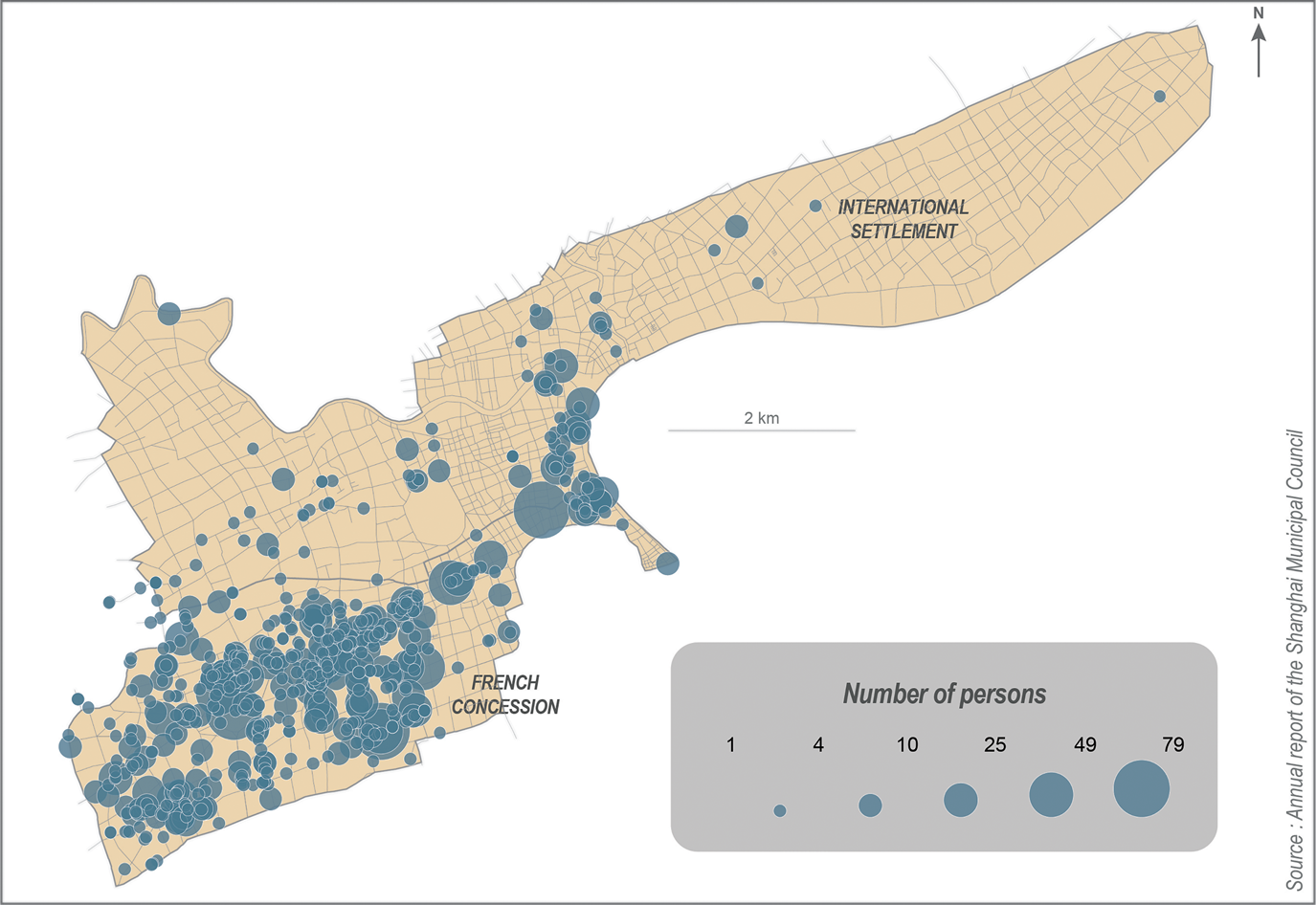
Within the French Concession itself, the French residents were more likely to live in the least Chinese-populated districts of the French Concession (less than 2,000 Chinese residents per census district), where there was a higher percentage of foreign residents. It is also obvious that they shunned altogether the densely populated area in the eastern districts with their smaller street blocks lined with Chinese-style shops and lilong housing.Footnote 38 By contrast, the western districts with their broad avenues lined with trees, western-style buildings, garden lilong and villas offered a living environment that appealed especially to the taste of French residents (as well as Chinese, British and American elites). Overall, we observe a neat east/west divide and a gradient that reflects the socio-professional status of residents (Figure 5). While employees and workers lived in the eastern sections, business owners and executives tended to concentrate in the western districts, particularly along Avenue Petain and the western section of Avenue Joffre, which belonged to the so-called ‘residential zone’ (zone de résidence). The more upscale apartments built from the 1930s onwards were concentrated in this residential zone, which the French authorities formally designated only in 1938 (Figure 6). Only those who could afford to purchase villas lived in the less crowded and less commercialized areas.
The distribution pattern of the French population
Source: ‘Liste des Français immatriculés au consulat général de France, 1942’.

The French population and the residential zone (1940)
Source: Ordonnance consulaire No. 490, 29 Dec. 1938 (art. 4), SMA, U38-1-2807.

At the micro-level of residence, the tendency for exclusivity and self-containment was even more significant. The 1942 survey identified 42 apartment buildings, of which 41 were located in the French Concession (Figure 7). This list represented about one half of the actual number of apartment buildings in the settlement, but the survey revealed the most important ones (36 with a proper name and only 5 unnamed ‘apartments’).Footnote 39 In 1939, the total population living in these buildings amounted to 4,816 persons, including the Chinese who in many cases formed the majority of the residents. In February 1942, the French residents in apartment buildings represented 171 families with 409 persons. Since the 1942 survey missed about one half of the existing buildings, it is difficult to ascertain the share of the French in the resident population. It represented approximately 8.5 per cent (1939 figure) to 15 per cent if we discount the missing buildings. While this percentage may seem low, this matched the actual ratio (8.5 per cent) of French residents among the total population in February 1942.
The population of apartment buildings
Source: ‘Liste des Français immatriculés au consulat général de France, 1942’.
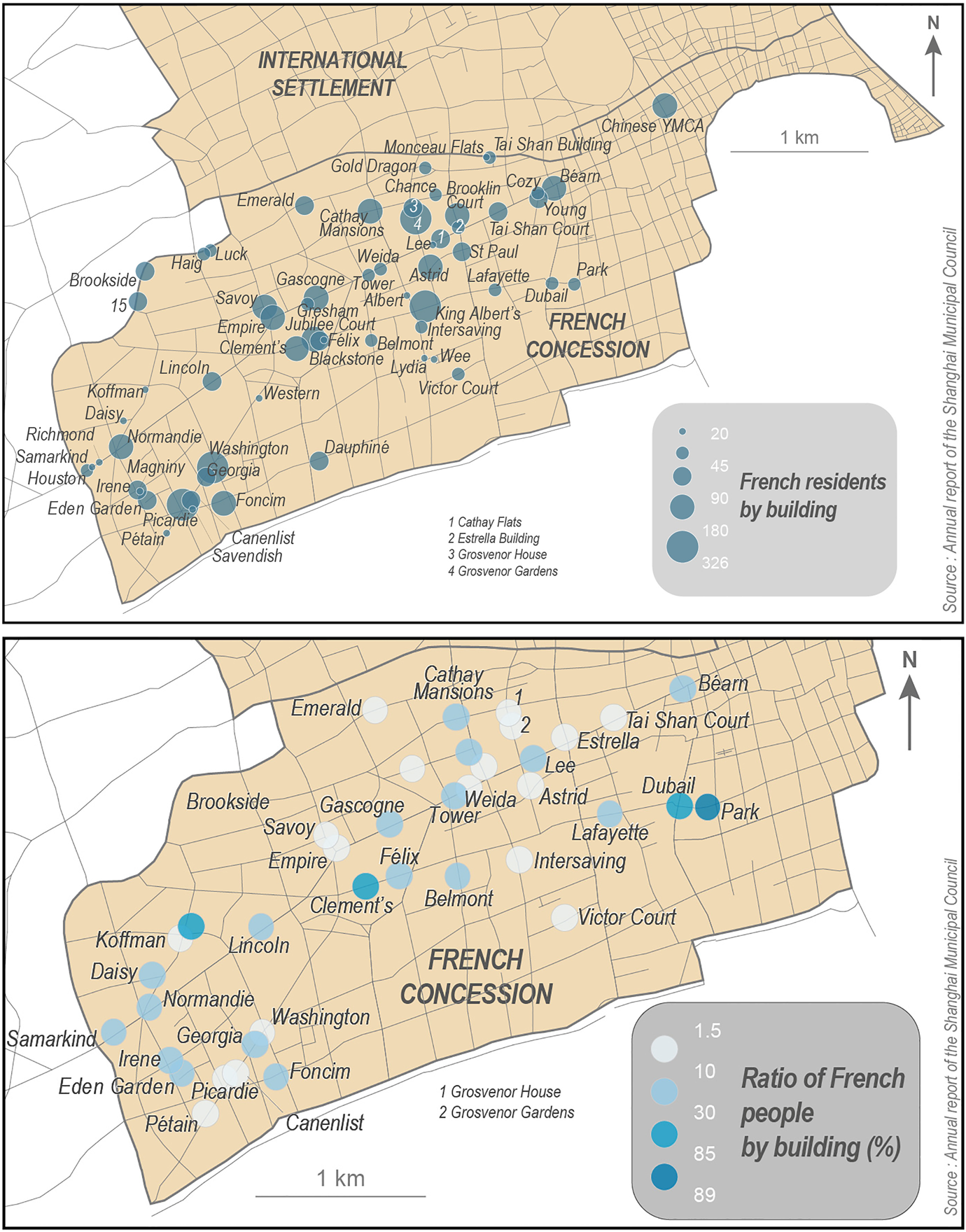
The number of French residents living in apartment buildings was more significant when compared to the whole French population. Altogether, 17 per cent of French residents lived in apartment buildings, which denoted a preference for this type of housing, a tendency to ‘cluster’, and a certain economic well-being. In six buildings, French residents represented more than half of the resident population. In one case, they even represented 100 per cent, but this was a building leased by the French municipality to house its policemen. In five other buildings, the French represented between 25 per cent and 40 per cent of all residents. Altogether, 56 per cent of the French who lived in apartment buildings lived in these 11 buildings. Modern apartment buildings represented an alternative, and an intermediate level, between the regular lilong type of housing and the individual villas that only the wealthiest could afford. The cost of purchasing or renting an apartment in most of these buildings required substantial revenues. Except for the building devoted to the police and three other nondescript buildings, these apartment buildings were modern constructions geared toward the middle and upper middle classes.
Of the 201 heads of families who lived in apartment buildings and whose occupation is known, 44 were employees (22 per cent), 48 were middle managers (24 per cent), 30 were professionals or senior executives (15 per cent), 26 were trade and industry business owners (13 per cent) and 7 were skilled workers (3 per cent). If we examine for whom these residents worked (116), an overwhelming majority (61.2 per cent) was employed by the French municipality (71), of which 61 directly by the municipal administration (this includes the 29 policemen). Although these residents were distributed among various buildings, the high number of residents employed by the FMC tends to reinforce the argument of both social and professional homogeneity.
Conclusion
While 1942 marked a turning point in the western presence and power in the city, it had little impact on the composition and the life of the French residents. If anything, it singled them out as the sole privileged western group in Shanghai that enjoyed not just political protection – this also applied to the nationals that hailed from neutral countries or countries allied with Japan such as Germany – but life in a territory that remained free of Japanese occupation and interventions. The broader wartime context, however, and the unchallenged military and political power of the Japanese increasingly undermined this unique position. Quite interestingly, for the first time since the establishment of the French Concession, a significant group of Japanese elected to settle in the French-administered territory, along with a large contingent of nationals from Japan allied countries.Footnote 40
We have argued that the French community in Shanghai showed many traits of a self-contained community. The astounding majority that lived within the limits of the settlements reveals a pattern not to be found among the British or the Americans. Only the Japanese, although they had no settlement of their own, had the same degree of spatial concentration. This spatial distribution, however, may not just reflect a form of parochialism. The structure of power in the French Concession shaped the structural traits of the French population. It created a politically, culturally and linguistically defined space where French nationals were presented with opportunities and even privileges. A major factor of this equation was undoubtedly the sheer weight of the municipal administration and CFTE – a private company with vested interests in the French Concession – in employment opportunities. It created de facto a situation where the employees made the rational choice to live in the same space as their workplace. And those in search of jobs would definitely settle where they had a better chance to get hired.
The biased social structure of the French population – a majority of municipal and tramway employees and missionaries – also played a role in the housing pattern we have detected. If we exclude the missionaries, the bulk of the French residents belonged to the middle and upper middle classes. Compared to the majority of the Chinese population, this placed them in a much more favourable position in terms of revenue and lifestyle. Those who could afford it quite clearly manifested a preference for the more modern and comfortable apartment buildings where they were more likely to rub shoulders with other French and westerners. Social and economic status would thus explain the tendency to congregate in a small number of apartment buildings, even more so as the better ones were in small number in the settlement.
The source we used has its inherent limitations as the population census established an x-ray of the French community, with only the bones, but not the flesh and blood of the actual social and economic relations of its members, in their environment with the other local groups, both foreigners and Chinese. Neither are we in a position to assess the degree to which the French circulated beyond the limits of their settlement in their everyday life, for entertainment, shopping and even work. Yet we managed to draw more than one can expect from such an apparently terse document through a spatial approach and the connection with external data. The history of the French community in Shanghai is a history that remains to be written beyond the crude demographic figures.



