INTRODUCTION
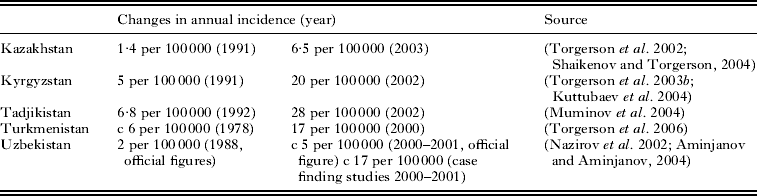
The collapse of the Soviet Union in 1991 was followed by severe economic hardship and was associated with increases in mortality and decreases in life expectancy across the region (Becker and Hemley, Reference Becker and Hemley1998; Becker and Urzhumova, Reference Becker and Urzhumova2005; Stillman, Reference Stillman2006). At the end of last decade of the 20th century it became apparent that there was evidence of increased numbers of human cystic echinococcosis (CE) in the former Soviet Republics of central Asia (Table 1). Official government statistics in Kazakhstan document an increase in cases of CE from about 200 cases per year until 1994, rising rapidly to approximately 1000 cases per year by the beginning of the 21st century (Torgerson et al. Reference Torgerson, Shaikenov, Baitursinov and Abdybekova2002). This epidemic emerged at a time of rapid economic decline and decreases in medical services, and hence was unlikely to be an artefact caused by improved diagnosis. Likewise there was strong evidence from neighbouring Kyrgyzstan that a similar phenomenon was present (Torgerson et al. Reference Torgerson, Burtisurnov, Shaikenov, Rysmukhambetova, Abdybekova and Ussenbayev2003b). In Tajikistan, it was reported that the number of cases increased from 374 cases in 1992 to 1875 cases in 2002 (Muminov et al. Reference Muminov, Mahmadov, Shodmonov, Torgerson and Shaikenov2004). Subsequently data became available confirming that similar epidemics were occurring in Uzbekistan and Turkmenistan (Torgerson et al. Reference Torgerson, Oguljahan, Muminov, Karaeva, Kuttubaev, Aminjanov and Shaikenov2006). Furthermore in Uzbekistan there is very strong evidence that officially reported cases are a substantial underestimate of the numbers of cases being treated. A detailed case-finding study of all hospitals in Uzbekistan uncovered approximately four times the number of cases of CE than were being reported in Government statistics (Nazirov et al. Reference Nazirov, Ilkhamov and Ambekov2002). Unpublished figures suggest that the numbers of cases of CE, at least in Kazakhstan and Kyrgyzstan, have stabilized since about 2003. However, there are now increasing numbers of human cases of alveolar echinoccocsis (AE) being reported in Kyrygzstan (Usubalieva et al. Reference Usubalieva, Minbaeva, Ziadinov, Deplazes and Torgerson2013).
Changes in the annual reported incidence of echinococcosis in central Asia following the collapse of the Soviet Union

EPIDEMIOLOGY OF ECHINOCOCCUS GRANULOSUS
Human studies
Information regarding the epidemiology of the disease in humans has been obtained from hospital records, official data of reported cases or from a limited number of community ultrasound surveillance studies. Official data and hospital records indicate that there are many cases in children under 14 years of age – possibly up to one third (Torgerson et al. Reference Torgerson, Shaikenov, Baitursinov and Abdybekova2002, Reference Torgerson, Karaeva, Corkeri, Abdyjaparov, Kuttubaev and Shaikenov2003a). However, although the mean age of cases from a detailed hospital survey in Kyrgyzstan is very young – approximately 24 years (Torgerson et al. Reference Torgerson, Karaeva, Corkeri, Abdyjaparov, Kuttubaev and Shaikenov2003a) this is not dissimilar to the median age of the population (see data in US Census Bureau, 2012) and the proportion of the Kyrgyz population that is under 14 years is approximately 35%. Thus, at least in Kyrgyzstan, an important factor is the very young age pyramid of the population. However, in the hospital study, the proportion of paediatric cases was somewhat higher after 1997 compared to prior to 1997. This indicates an increasing proportion of children and is consistent with the origins of the epidemic being recent. Other than the young age of cases, there is also an association with unemployment amongst adults – the proportion of adults diagnosed with CE who were unemployed was double that of the general unemployment rate in the country. A further interesting observation was that those individuals with hepatic cysts tended to be younger than those with pulmonary cysts.
In Kazakhstan, the origin of human cases is closely associated with the major sheep-rearing areas of the country (Torgerson et al. Reference Torgerson, Shaikenov, Baitursinov and Abdybekova2002). In Tajikistan, there seems to be a lower proportion of paediatric cases with 7·8% of cases being less than 14 years of age and 58·7% being between 18 and 48 years, and the average age of hospital treated patients being 36 years of age (Muminov et al. Reference Muminov, Mahmadov, Shodmonov, Torgerson and Shaikenov2004). Most cases (89%) originated from rural areas. Women were over-represented (60·3%). In addition, the incidence varies in different regions. The northern part of the country has the highest incidence being more than twice that of central areas. The southern districts seem to be intermediate in incidence. In Uzbekistan, approximately 14·3% of cases treated between 1999 and 2001 were in children less than 14 years of age, although the proportion of paediatric cases was increasing. Of the adults, 54% of cases were in women, 46% men (Nazirov et al. Reference Nazirov, Ilkhamov and Ambekov2002).
Community studies using ultrasound surveillance have also given further clues to the epidemiology of CE in this region. In Kyrgyzstan, a cross-sectional ultrasound survey of 1486 subjects in the Kochkor district revealed 20 with abdominal cysts. This gives an estimated prevalence of 1·35%. However, because of bias in the population surveyed and potential missing data, the true prevalence of CE might be as high as 3·4% (Torgerson et al. Reference Torgerson, Karaeva, Corkeri, Abdyjaparov, Kuttubaev and Shaikenov2003a). Both these estimates were significantly higher than a survey undertaken in the same area some 10 years previously. Logistic regression revealed that there was an association with infection and the provision of a poor water supply. In a rural community in the east of Kazakhstan, 47 cases, either ultrasound-positive or recently treated, out of a population of 3126 were revealed to have CE (Torgerson et al. Reference Torgerson, Rosenheim, Tanner, Ziadinov, Grimm, Brunner, Shaiken, Shaikenov, Rysmukhambetova and Deplazes2009a). The estimated incidence in this population was 50 cases per 100 000 per year between 2000 and 2005. Large households and/or poor living standards were significantly associated with a diagnosis of CE. Subjects diagnosed with CE also were unable to work for longer periods of time.
There is one study that has demonstrated widespread environmental contamination of the surroundings of rural homes with E. granulosus eggs (Shaikenov et al. Reference Shaikenov, Rysmukhambetova, Massenov, Deplazes, Mathis and Torgerson2004). Five of 120 soil samples taken from 30 gardens of rural homesteads were positive for the G1 strain of E. granulosus demonstrating the potential for indirect transmission of E. granulosus to humans from such sources.
Livestock studies
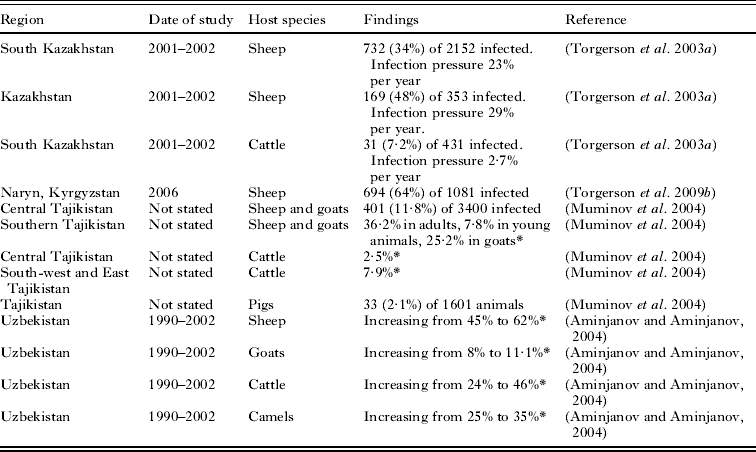
There have been several studies investigating the increasing prevalence of CE in livestock which has paralleled the increase in human disease incidence. In Uzbekistan, the prevalence of echinococcosis in sheep for example has increased from 45 to 62% between 1990 and 2002 (Aminjanov and Aminjanov, Reference Aminjanov, Aminjanov, Torgerson and Shaikenov2004). In Kazakhstan, prevalences in sheep have also increased. Prevalences in the 1980s of approximately 14% were reported in southern Kazakhstan but by 2000 this had increased to 37% in the same area (Torgerson et al. Reference Torgerson, Shaikenov, Baitursinov and Abdybekova2002). In the Naryn region of central Kyrgyzstan, a prevalence of 64% in sheep was reported in 2006 (Torgerson et al. Reference Torgerson, Ziadinov, Aknazarov, Nurgaziev and Deplazes2009b). In Tajikistan, prevalence varies with region. In high endemic areas in the north, over 50% of sheep are infected, in central and southern districts sheep generally have approximately a 20% prevalence and areas around the Chinese border just 7%. Infection varies with age in all regions with young animals having often less than a 10% prevalence, but the oldest animals approaching 80% (Muminov et al. Reference Muminov, Mahmadov, Shodmonov, Torgerson and Shaikenov2004). There is also some limited data on prevalences in pigs, camels and goats in Uzbekistan and Tadjikistan (see Table 2).
Summary of livestock prevalences and transmission dynamics reported from central Asia
* Sample sizes not stated in original references.
Echinococcus in definitive hosts in central Asia
There is also information regarding transmission dynamics in livestock. In southern districts of Kazakhstan, the prevalence in sheep has been reported at between 34 and 48% and cattle at approximately 7% (Torgerson et al. Reference Torgerson, Burtisurnov, Shaikenov, Rysmukhambetova, Abdybekova and Ussenbayev2003b). In sheep, there was a mean abundance of 2·54 cysts per sheep from South Kazakhstan and Jambyl Oblasts rising to 4·7 cysts per sheep for other regions. There is increasing abundance and prevalence with age in both populations with sheep acquiring 1·2 and 2·0 cysts per year. Cattle had a much lower infection pressure only acquiring 0·15 cysts per year. The reasons for apparent lower infection pressure in cattle compared to sheep is not known, but it could be due to variation in infection pressure through different grazing patterns, variations in parasite genotype between the two species or the circulating genotype being less infectious to cattle compared to sheep. In the Naryn district of Kyrgyzstan, the infection pressure in sheep has been estimated at 1·3 cysts per year – comparable to that seen in neighbouring Kazakhstan (Torgerson et al. Reference Torgerson, Ziadinov, Aknazarov, Nurgaziev and Deplazes2009b). More detailed analysis was undertaken of the data from Kyrgyzstan with an analysis of the infectious biomass in sheep in terms of the number of infectious protoscoleces. It was demonstrated that 80% of the infective biomass was in sheep aged 4 years or older, but this represented just 28% of sheep presented for slaughter.
Studies in definitive hosts
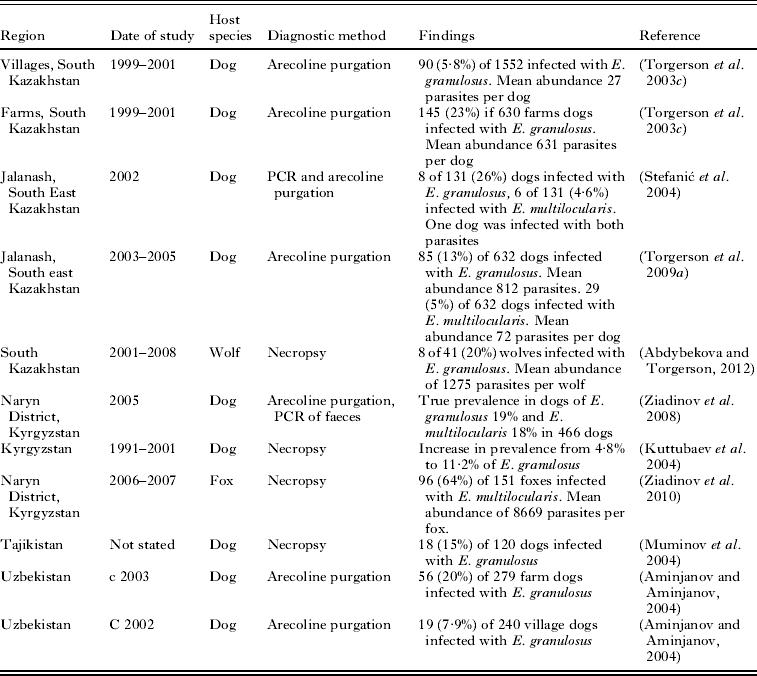
Dogs play an essential role in the transmission cycle of E. granulosus and transmission to man. There have been a number of studies investigating the prevalence and transmission dynamics of E. granulosus in dogs across this region (Table 3). In Tajikistan, one study of 120 dogs reported a prevalence of 15·2% (Muminov et al. Reference Muminov, Mahmadov, Shodmonov, Torgerson and Shaikenov2004). In Uzbekistan, 531 dogs were investigated using arecoline purgation. Of these, 279 were farm dogs of which 56 were infected (20·1%). Of the remaining 240 village dogs, 19 were infected (7·9%). The differences between the prevalence of the two populations is significant (P<0·001, Fisher test) (Aminjanov and Aminjanov, Reference Aminjanov, Aminjanov, Torgerson and Shaikenov2004). In Kazakhstan, there were similar differences between farm dogs and village dogs. A study in southern Kazakhstan indicated that farm dogs had a prevalence of 23% and an abundance of 631 parasites per dog, whilst village dogs had a much lower prevalence of just 5·8% with an abundance of 27 parasites per dog (Torgerson et al. Reference Torgerson, Shaikenov, Rysmukhambetova, Ussenbayev, Abdybekova and Burtisurnov2003c). The differences in prevalence between these groups of dogs were hypothesized to be due to availability of sources of offal. Farm dogs are used largely for shepherding and presumably have greater access to animal casualties. Village dogs, in contrast, tend to be kept more as domestic pets. A separate study in Jalanash in eastern Kazakhstan revealed a prevalence of 13% in a population of 632 dogs with a mean abundance of 812 parasites per dog (Torgerson et al. Reference Torgerson, Rosenheim, Tanner, Ziadinov, Grimm, Brunner, Shaiken, Shaikenov, Rysmukhambetova and Deplazes2009a). In Kyrgyzstan in Naryn province, approximately 19% of dogs were infected with E. granulosus (Ziadinov et al. Reference Ziadinov, Mathis, Trachsel, Rysmukhambetova, Abdyjaparov, Kuttubaev, Deplazes and Torgerson2008). Limited information is available on genotypes of E. granulosus and all information is from samples recovered from dogs. Genotypes G1 (E. granulosus sensu stricto), G4 (Echinococcus equinus) and G6/7 (Echinococcus canadensis) have all been recovered from dogs in either Kazakhstan and/or Kyrgyzstan (Stefanić et al. Reference Stefanić, Shaikenov, Deplazes, Dinkel, Torgerson and Mathis2004; Ziadinov et al. Reference Ziadinov, Mathis, Trachsel, Rysmukhambetova, Abdyjaparov, Kuttubaev, Deplazes and Torgerson2008)
In Kazakhstan, a small study of 41 wolves found 8 infected with E. granulosus (19·5%) (Abdybekova and Torgerson, Reference Abdybekova and Torgerson2012). No information is available on whether wolves are infected through a wild life cycle or through scavenging on sheep.
EPIDEMIOLOGY OF ECHINOCOCCUS MULTILOCULARIS
Human studies
Human AE has been diagnosed in central Asia in both Kazakhstan and Kyrgyzstan for many years. The first report in Kyrgyzstan was in 1948 from archival material dating from as early as 1935. Further cases were reported in the Soviet Literature between 1960 and 1988 (reviewed by Abdyjaparov and Kuttubaev, (Reference Abdyjaparov, Kuttubaev, Torgerson and Shaikenov2004). In Kazakhstan, 19 of 1435 cases of echinococcosis reported in Almaty hospitals between 1989 and 2003 were possible AE cases, whilst 4 out of 205 cases of echinococcosis treated at the Institute of Experimental Surgery in Almaty were confirmed as AE (Shaikenov and Torgerson, Reference Abdyjaparov, Kuttubaev, Torgerson and Shaikenov2004).
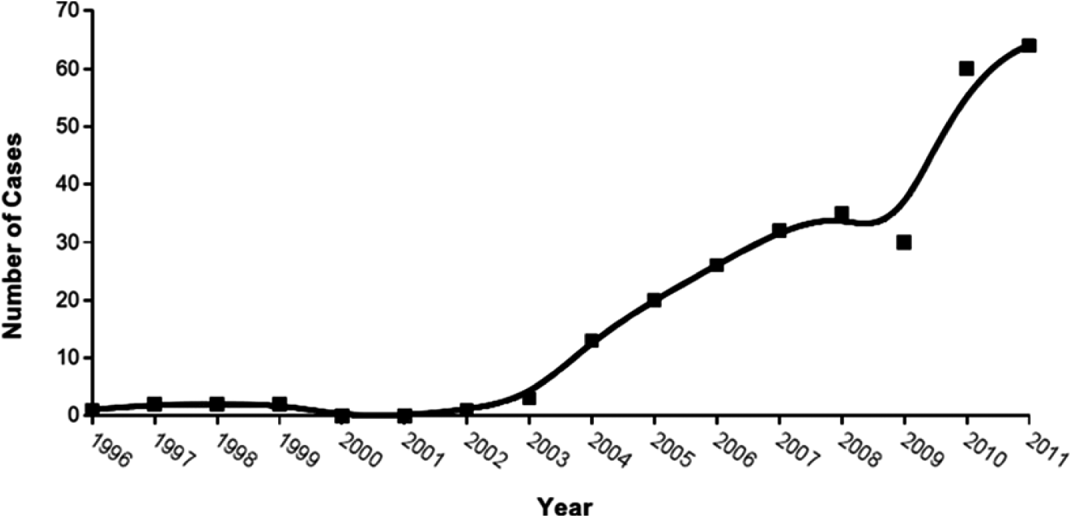
Recently, strong evidence that human AE is an emergent diseases has been reported, at least in Kyrgyzstan. Up until 2003, only sporadic cases were reported, typified by the summaries given above. But since then, from just 0–3 cases per year, the numbers of AE cases now being reported is over 60 cases per year (Usubalieva et al. Reference Usubalieva, Minbaeva, Ziadinov, Deplazes and Torgerson2013) (Fig. 1). The cases have all been confirmed histologically and the evidence appears to point to a newly emerging epidemic rather than improved diagnosis. Naryn district has by far the highest incidence with over 7 cases per 100 000 per year for 2010–2011. However, cases are being seen in every district of Kyrgyzstan. Approximately 64% cases are in females and the mean age of diagnosis is much younger than in Europe at just 33·4 years of age compared to 54 years in Switzerland for example. It is likely that the relative youth of cases of human AE is a reflection of the population structure of the country as the median age of the Kyrgyz population is just 24 years.
Changes in the numbers of reported cases of human AE in Kyrgyzstan, 1996–2011 (data from Usubalieva et al. Reference Usubalieva, Minbaeva, Ziadinov, Deplazes and Torgerson2013).
Although it is likely that E. multilocularis is endemic in the other three republics of central Asia, at the time of writing it was not possible to access any data or reports other than those described above for Kazakhstan and Kyrgyzstan.
Intermediate hosts
This parasite has long been known to be endemic in central Asia with extensive studies being undertaken by Shaikenov in intermediate hosts both before and after the dissolution of the Soviet Union. Much of the data from these studies is reviewed in Shaikenov (Reference Shaikenov, Torgerson and Shaikenov2004a, Reference Shaikenov, Torgerson and Shaikenovb, Reference Shaikenov2006). From data collected over several decades it was shown that E. multilocularis has a very patchy distribution in Kazakhstan. In arid regions infections of small mammals are usually only found in areas where there is moisture or higher levels of humidity such as in desert oases or river and stream valleys. In the mountains in the south of Kazakhstan or the forest steppe in the north, infections of small mammal hosts appear to be more extensive. In Kyrgyzstan, there have been studies on rodents of mountainous pastures (Abdyjaparov and Kuttubaev, Reference Abdyjaparov, Kuttubaev, Torgerson and Shaikenov2004). Prevalences of up to 4% were seen in species such as the grey marmot (Marmota baibacina) and Gopher (Citellus relictus), with a number of other species also being infected.
Definitive hosts
A recent study of red foxes (Vulpes vulpes) in Naryn region indicated a high prevalence of approximately 65% (Ziadinov et al. Reference Ziadinov, Deplazes, Mathis, Mutunova, Abdykerimov, Nurgaziev and Torgerson2010). Infection of domestic dogs has been recorded in the mountainous region of south east Kazakhstan. This was first detected in a study in 2002. Of 131 dogs, 6 were infected with E. multilocularis (Stefanić et al. Reference Stefanić, Shaikenov, Deplazes, Dinkel, Torgerson and Mathis2004). One of these dogs was infected with both E. granulosus and E. multilocularis. This is one of the first reports of a naturally occurring dual infection with both parasites in a single dog. Subsequent studies in the same district between 2003 and 2005 indicated a prevalence of 5% (29 of 632 dogs) using arecoline purgation (Torgerson et al. Reference Torgerson, Rosenheim, Tanner, Ziadinov, Grimm, Brunner, Shaiken, Shaikenov, Rysmukhambetova and Deplazes2009a). However, because of the poor sensitivity of arecoline purgation the true prevalence is likely to be higher. In Naryn province, Kyrgyzstan, a prevalence of 18% was estimated in dogs using a combination of arecoline purgation and PCR methods, and estimating the true prevalence using latent class methods (Ziadinov et al. Reference Ziadinov, Mathis, Trachsel, Rysmukhambetova, Abdyjaparov, Kuttubaev, Deplazes and Torgerson2008) (Table 2). Dogs that were not tied and hence had greater opportunities to roam, hunt and scavenge had substantial higher prevalences (26%) than dogs that were tied up for most of the time (11%).
Hypothesis for human AE emergence in Kyrgyzstan
The emergence of AE in Kyrgyzstan could be linked to the socio-economic changes that have occurred following the dissolution of the Soviet Union. There was certainly increased transmission of CE to humans as outlined above. Thus it can be hypothesized that, with increased numbers of dogs and widespread rural poverty, E. multilocularis colonized dogs which were forced to hunt or forage for food, as suggested by the higher relative risk of infection in free-roaming dogs (Ziadinov et al. Reference Ziadinov, Mathis, Trachsel, Rysmukhambetova, Abdyjaparov, Kuttubaev, Deplazes and Torgerson2008). So it is possible that following colonization of dogs, the increase in AE is a result of increased dog-human contact. Such increased dog-human contact is proven by the increasing incidence of human CE since dogs are the obligatory definitive host of E. granulosus. In addition, the increase in the numbers of AE cases appeared approximately 15 years after the dissolution of the Soviet Union, which is the same as the estimated latent period of AE in humans. Further investigations are being undertaken and unpublished evidence suggests that in some communities the ultrasound prevalence of AE may be as high as 7%.
CONCLUSIONS
It is clear that there has been a substantial increase in the numbers of cases of human echinococcosis being diagnosed since the collapse of the Soviet Union. Likewise there appear to be increases in the prevalences of E. granulosus in livestock and in dogs. Both these phenomena are likely caused by the reorganization of livestock farming with the privatization of large collectivized livestock units. This has also led to the closure of large meat processing units and reduced supervision of meat processing by the veterinary public health services. Dog populations have increased and there was a requirement of larger numbers of dogs for shepherding the increased numbers of small livestock units. This has provided the opportunity for increased transmission of E. granulosus (Shaikenov et al. Reference Shaikenov, Torgerson, Usenbayev, Baitursynov, Rysmukhambetova, Abdybekova and Karamendin2003). Increases in free-roaming dog populations scavenging for food may have provided an opportunity for E. multilocularis to colonize dogs and the close contact of dogs with humans has allowed transmission of E. multilocularis from dogs to humans. These may be the reasons that there are now increasing numbers of human AE cases being reported in Kyrgyzstan (Usubalieva et al. Reference Usubalieva, Minbaeva, Ziadinov, Deplazes and Torgerson2013).
FINANCIAL SUPPORT
Much of the works reviewed in this article was supported by INTAS, Swiss National Funds (SCOPES programme), the NIH and the Welcome Trust.