On the morning of October 4, 1934, readers of the leading Madrid newspaper A.B.C. unwittingly bore witness to a watershed moment in Spain’s history. Hours later, a miners’ strike would begin in the northern province of Asturias, sparking a series of clashes between the Spanish political right and left that would lead the nation to a bloody three-year civil war (1936–1939) and the establishment of Generalissimo Francisco Franco’s brutal dictatorship (1939–1975).Footnote 1 But that had not occurred yet—it was still morning, and as they paged through the paper, A.B.C. subscribers encountered not reports of worker armies in the industrial north, but something seemingly ordinary: an interview with an as-yet little-known businessman, coincidentally also from Asturias, named José “Pepín” Fernández Rodríguez.
In this interview, Pepín—or as his employees knew him, “Don José”—announced the launch of his new department store, Sederías Carretas, just steps from Madrid’s city center. As the month advanced, more interviews, as well as store ads, appeared in A.B.C., always stressing that this was a new kind of store—that its arrival was anything but commonplace. Pepín promised madrileños “the store they had been waiting for,” a cathedral of consumption that embodied cutting-edge American commercial methods imported from Havana’s El Encanto department store, where the Asturian had learned his trade three decades earlier as a young expatriate. Sederías Carretas, he declared, would treat commerce as something noble, the fulfillment of “a social function and a public service.” Curious crowds had flocked to the store’s grand opening on October 2; emboldened by this early success, Pepín proclaimed the founding an event nothing short of “transcendent.”Footnote 2
Buying into Change reveals how, between the 1940s and the 1980s, this store and other enterprises like it broadly shaped Spanish society and politics in ways that indeed transcended the world of business—how in a moment of remarkable coincidence, October 4, 1934 witnessed not just a pivotal moment in the coming of the Franco dictatorship, but also the first steps toward an equally dramatic mass consumer revolution that eventually undermined that same regime. More specifically, this dissertation examines how department stores like Sederías Carretas (soon to expand into Spain’s premier national chain, Galerías Preciados), a burgeoning consumer press, new supermarkets, and a rapidly professionalizing Spanish advertising industry all contributed to the development of an internationally oriented mass consumer society in Franco’s Spain. It traces how that this new mass consumption quickly became a sociopolitical space that both the regime and its opponents sought to claim, and shows that this ultimately opened new avenues for at times subversive, often foreign-influenced expression at a time when the Franco regime had foreclosed such opportunities for public life.
During the 1940s and 1950s, department stores and magazines reproduced Francoist mechanisms of social control, even as they also stoked Spanish interest in consumer products and practices then spreading in Western Europe, such as American appliance culture, which began to make inroads in Spain after the normalization of relations with the United States in 1953.Footnote 3 This international influence only intensified during the Spanish economic boom of 1959–1973, during which Spain possessed one of the fastest growing economies in the world.Footnote 4 In these years, Spain’s first supermarkets, many of them affiliates of the Dutch chain SPAR, exposed ordinary Spaniards to foreign food ways and, alongside department stores like Galerías Preciados, transformed the urban landscape with sleek glassed-in storefronts that spoke of an incipient Spanish rise to a Northern European- and American-coded modernity. Galerías and its competitors sent employees on foreign exchanges, which only deepened these cross-cultural contacts. Later in the 1960s and into the 1970s, a newly arrived foreign department store joined in: the iconic American chain Sears Roebuck and Company, which came to Spain in 1964. The result, I argue, was a network of consumption-mediated relationships that tied Spain to, and domestically highlighted its commonalities with, Western Europe and the United States. This drove a shift in public discourse on Spanish national identity toward an emphasis on Spain’s European character, undercutting the Franco regime’s foundational discourse, which stressed Spanish national difference. And these ties, I further show, also served as pathways for the entry of foreign ideas on specific issues like gender equality that ran counter to Francoist patriarchal orthodoxy.Footnote 5
At the same time, Buying into Change cautions that this was not a one-sided process. Writing of a rise in foreign tourism to Spain during the boom era, scholars Sasha Pack and Justin Crumbaugh have respectively suggested that this shift in consumption patterns either stoked a popular Spanish desire to emulate Western European through democratization, or conversely served as a spectacle of prosperity behind which the regime could hide its continued brutality.Footnote 6 This dissertation instead seeks a third approach to Francoism’s relationship to consumption, arguing that mass consumption in Franco’s Spain was neither a priori liberalizing nor unproblematically co-opted by the regime, but instead constituted sociopolitically contested terrain. On the one hand, regime officials and supporters throughout Franco’s tenure sought to harness Spain’s nascent consumer society for their own political purposes—for instance, working to burnish the regime’s image abroad through displays of a consumption-driven Spanish national rise to modernity. Indeed, it was largely this aim that led Franco’s Ministry of Commerce to spearhead the introduction of the supermarket to Spain in the late 1950s. And although such imports could produce social changes—the supermarket’s power to rationalize family budgets and nutrition granted Spanish homemakers new social importanceFootnote 7—the real impact of these shifts should not be simply assumed. Though now more prestigious, housewives’ duties as family caregivers remained otherwise much the same.
Nevertheless, many of the foreign products and practices that consequently crossed the Pyrenees did carry with them notions that subverted the Franco regime’s sociopolitical project. In the late 1960s, for instance, youth departments in Spanish department stores provided teenagers with opportunities to fraternize in ways considered unacceptable under Francoism’s preferred brand of conservative Catholic morality. In the end, this dissertation argues, Franco’s supporters failed more than they succeeded in co-opting Spain’s mid-century consumer revolution. Conversely, the merchants and media-makers who championed this new consumer society played a significant role in driving forward changes in Spanish society that prepared the ground for the nation’s remarkably rapid transition to democracy in the late 1970s, following Franco’s death in November 1975.
The speed and (deceptive) ease with which this democratic transition unfolded almost immediately became and has since remained a focal point of scholarly debate. Accounts have ranged from early, primarily political narrativesFootnote 8 to sociocultural analyses rooted in Victor Pérez Díaz’s thesis that the transition era’s liberalizing political culture emerged from a prior resurgence of Spanish civil engagement in the 1960s.Footnote 9 Most recently, scholars have turned to a multicausal approach that seeks to weave together multiple political, social, and cultural narratives.Footnote 10 However, the key role that retailing and mass consumption played in preparing the way for democratization has remained mostly absent from this model, as has work on the ways that these forces conversely served the regime in its lifetime and preserved Francoist power structures amid and beyond the transition.Footnote 11
It is just such a consumption-centered analysis that Buying into Change aims to contribute to current transition scholarship. This dissertation begins by examining the unlikely origins of Franco-era Spain’s initial development of a mass consumer sphere in the 1940s, thereby revising the current periodization of Spain’s consumer revolution, which focuses on the 1950s and 1960s, and cautioning against scholarly overdetermination of this consumerism’s emergence and politically liberalizing character.Footnote 12
Amid the social and economic ruins of the Spanish Civil War, there was indeed little to hint at the advent of a Spanish mass consumer society. These were the so-called Hunger Years, marked by disease, shortages, diplomatic isolation after the defeat of the Axis powers—among the early Franco regime’s few friends—in 1945, and, of course, repression, as the regime banned all political parties save the fascist Falange and imposed a sixteenth-century patriotic brand of religion known as National-Catholicism.Footnote 13
However, it was precisely amid this hardship that Spanish mass commerce first took form, with the spread of Spain’s first modern department stores. By the mid-1950s, Sederías Carretas and Salamanca-based Almacenes Siro Gay had both grown into national store chains (the former now rechristened Galerías Preciados), and supplied by its own in-house manufacturing division, whereas primary competitor El Corte Inglés repeatedly expanded its flagship store and developed its own manufacturing wing.Footnote 14 Organizational complexity grew apace: Galerías, Siro Gay, and Asturias-based Almacenes Botas introduced employee handbooks, social clubs, and bulletins that layered the workplace experience and colonized employees’ leisure time—a form of welfare work that drove forward the professionalization of Spanish retailing.Footnote 15 Meanwhile, the Spanish consumer press expanded even more rapidly, as the number of magazines launched quadrupled during the 1940s.Footnote 16
This burgeoning consumer sector also seemed to pose little threat to Francoist hegemony. To the contrary, Francoist officials and supporters instrumentalized an initially socially conservative Spanish mass consumerism to further the regime’s sociopolitical project. New women’s magazines promoted National-Catholicism’s domestic, submissive, and devout feminine ideal through religious poetry, patriotic reports on Spanish fashion designers’ latest, appropriately modest, clothing lines, and content that stressed the official feminine values of submission to patriarchal authority, self-sacrifice, and other-centered consumption.Footnote 17 Thus, in 1946 the fashion journal Alta Costura offered the example of Louis XVI’s daughter, who begged her uncle to act as her father upon release from a French prison, and a 1954 ad in another magazine encouraged readers to use Komol-brand hair dye for their husbands’ sake—not their own.Footnote 18
Department stores served the regime still more directly. Sociologist Juan Linz has argued that the early Franco regime quickly transitioned from totalitarianism to a “stabilized authoritarian[ism]” after 1945;Footnote 19 the case of stores like Galerías Preciados instead suggests that the regime’s designs were never so straightforwardly dichotomous. Like the better-known example of the Spanish Catholic Church, stores such as Galerías Preciados could function as proxies by which the Franco regime was able to exercise indirect control over Spaniards’ private behavior.Footnote 20 Managers at Galerías colonized worker’s lives via the store’s new rigid, all-encompassing code of conduct or Normas, as well as through Galerías’ social clubs. Via the latter, they they sought to monopolize workers’ free time; in similarly totalizing fashion, management used the Normas to claim broad authority over employees’ private morality and insert the store into every aspect of these workers’ lives, seeking to shape them into employee-citizens wholly defined by their relationship to the store. The handbook’s tenets reproduced National-Catholic moral strictures, policing employees’ choice of literature, friends, and pastimes, always backed with a thinly-veiled threat: “How many have lost their jobs … having given in to such stimulations!”Footnote 21 Its policy on “Treason against the Store,” a fundamental store principle that forbade employees from buying anything at a competitor that Galerías itself sold, epitomized this will to control, as the store’s comprehensive inventory meant that this policy claimed a virtual store monopoly on employees’ lives as consumers.Footnote 22 By this time, citizen-consumers’ freely exercised choice had become a cornerstone of liberal-democratic society in America;Footnote 23 by contrast, this policy amounted to a blanket disenfranchisement, all the more striking given Galerías Preciados’ historical embrace of American commercial methods.
As Buying into Change shows, Galerías Preciados, along with many other Spanish retailers, existed within a dense network of transnational relationships that connected them to counterparts and consumers in Northern Europe, Latin America, and the United States, ties that intensified and undermined the regime during Spain’s late 1950s and 1960s boom. Galerías Preciados and El Corte Inglés both bore early links to Cuban commerce through their El Encanto-trained founders, who adopted the Havana retailer’s internal hierarchy. Galerías, moreover, made this pedigree a cornerstone of its corporate identity, and inherited a paternalism that contributed significantly to the Normas’ intrusiveness.Footnote 24 Ties to the United States and Europe were more extensive still: Galerías launched its employee bulletin in 1948, after Pepín Fernández’s son José Manuel returned from a stint at Macy’s inspired by that store’s journal, and in 1964, Federated Department Stores—the parent company of Macy’s—purchased a 10 percent share in Galerías.Footnote 25 Following the arrival of American servicemen in Spain after 1953, the store began to promote itself as a world-class establishment tied to America and Europe by its international clientele, which it did by publishing testimonials from visiting American customers in its bulletin and maintaining a much-publicized corps of interpreters that included both Spaniards and foreigners like Dutch exchange student Jetty Kentie, who worked at Galerías in 1960.Footnote 26
It was such quotidian encounters, Buying into Change argues, that drove Francoist Spain’s integration into a larger Western commercial community. At Galerías—a national store chain by the early 1960s—foreign employees like Kentie interacted with Spanish customers, while Spanish workers left on exchanges to sister stores abroad like London’s Selfridges, in both instances exposing Spaniards to foreign lifestyles and eroding early Francoist perceptions of Spanish national difference. In 1961 and 1964, for instance, exchange workers Ramón Hernández and Paquita Almazán reported that they found the weather alien in Stockholm and London, respectively, but not so the residents.Footnote 27
This phenomenon peaked after the 1964 arrival of the American department store Sears Roebuck and Company, which, as Sears de España, would operate out of Barcelona and Madrid until 1982. Sears was a multinational corporation with branches throughout the Americas, but also with a policy of hiring locally; indeed, Sears’ inaugural Barcelona branch launched in 1967 with a markedly international managerial corps, including locals like Personnel head Alfonso Buisán and Sears veterans like Cuban-born Ramiro Fernández.Footnote 28 Sears-Spain employees subsequently moved frequently between international divisions, tracing out the global Sears network into which Spain now fit. Barcelona native Alfonso Buisán, for example, joined Sears in mid-1966 and subsequently trained in Chicago, Mexico City, and Puerto Rico, where he encountered both novel American business practices and the international character of Sears’ ranks as he met new colleagues like Cuban Gustavo Fernández of Sears-San Juan, formerly of El Corte Inglés.Footnote 29 Similarly, Sears de España President John H. Gardner, his successor John Riney, and Ramiro Fernández all arrived after working for the chain in places such as Brazil and Peru, as well as the United States—and their experiences were far from unique.Footnote 30
The effect of these frequent border crossings, I argue, was to deemphasize their significance, a lesson only further emphasized by company policies that fostered international corporate unity. Sears’ operating procedures were so standardized that foreigners could begin working before mastering the local language. Meanwhile, the Sears Extension Institute, a professional development correspondence course program for employees, staged contests between Sears’ national divisions, sales contests pitted individual departments worldwide against each other, and when the parent company enjoyed success, as when the Sears Tower opened in 1973, Sears de España celebrated these achievements as their own. Together, these programs worked discursively to build the global Sears network into a single international, commercially mediated imagined community, and to people it with employees shaped into “Sears citizens,” as Alfonso Buisán once phrased it in 1968.Footnote 31
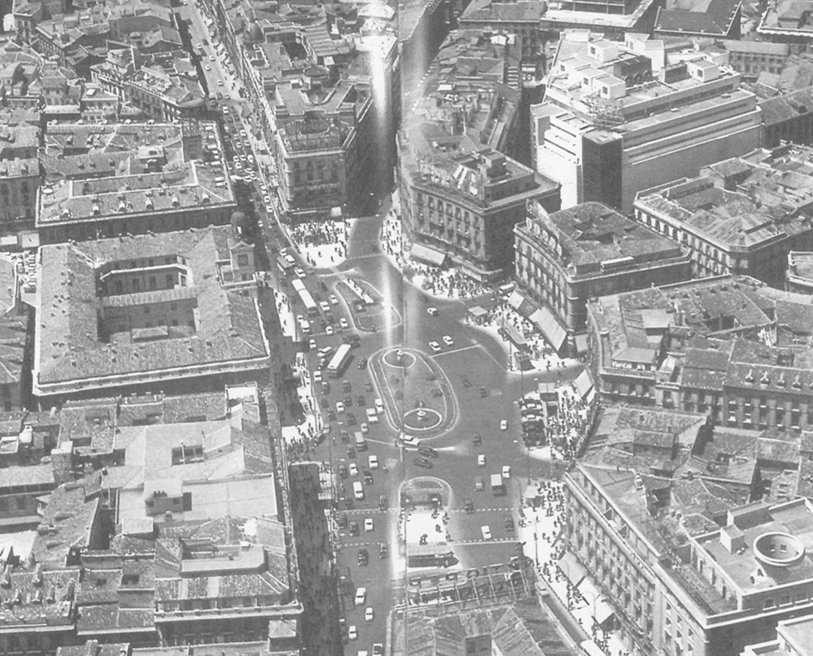
This transnationality also manifested spatially. Department store shop floors in the 1960s and early 1970s periodically became international zones, hosting visiting delegations as well as special exhibitions of foreign products like 1962’s “Paris at Galerías” and the opening in 1970 of a special “English Men’s Shop” inside El Corte Inglés’ Bilbao branch, a boutique-like space for Anglophile shoppers complete with columns carved into Big Ben’s likeness and staff in special English-style livery.Footnote 32 New, sleek, modern storefronts, meanwhile, transformed the urban landscape along foreign lines: In 1966, Galerías Preciados replaced Madrid’s historic Hotel Florida with the concrete face of a new model store titled Nuevas Galerías; a year later, Sears-Barcelona’s own new concrete-and-glass storefront transformed the surrounding residential Calvo Sotelo Plaza; and by the early 1970s, the white bulk of El Corte Inglés’ flagship store towered over the traditional buildings in Madrid’s city center (see Figure 1).Footnote 33 The former two stores also featured something familiar to Americans, but new to Spain: massive parking garages for hundreds of vehicles, which at Sears followed the chain’s typical—but, in Spain, unusual—choice of location in an outlying suburban area.Footnote 34 All these changes arrived laden with expectations of a Spanish national rise to modernity and membership in the European “club” of prosperous nations, voiced openly in ads for the 1970 launch of Spain’s first shopping center in Bilbao, which heralded the city’s entry into Europe’s “Shopping Center Common Market.”Footnote 35
El Corte Inglés, Madrid’s Puerta del Sol Plaza, 1971. Source: Roger Freeman and Paquita Freeman, A Visitor’s Guide to Madrid (León: Editorial Everest, 1971).

These same hopes surrounded the arrival of another commercial revolution—the supermarket. Supermarkets first began their spread through Spain in 1956, when Spanish diplomatic attaché José Ruiz Morales requested information on them from the U.S. Department of Commerce.Footnote 36 They then spread quickly, from a test store opened in Madrid in late 1957 under the auspices of the Commissary for Supply and Transport (CAT), an agency within the Ministry of Commerce, which led in 1958 to an ambitious plan for a national network of 496 state-run supermarkets that foundered only after the Spanish national grocers’ guild protested, fearing the end of private enterprise in their trade.Footnote 37 Private chains immediately took over, most especially the Dutch chains SPAR and VéGé, which by the early 1960s were Spain’s largest grocers—between 1961 and mid-1963, SPAR grew from 100 locations to 810.Footnote 38
Expectations of a coming modernity pervaded coverage of these new stores. To promote the supermarket’s alien-seeming self-service model and the off-putting frozen products involved, CAT launched a women’s magazine in 1960, Ama (“Housewife”), which featured articles aimed at familiarizing housewives with supermarkets,as well as content aimed at professionalizing homemakers. Such columns sought to rationalize meal planning, budgeting, and shopping, or used cartoons and stories to impart basic economic principles, all with the goal of raising Spanish nutritional levels, and thereby the Franco regime’s prestige abroad.Footnote 39 It was in this hope that Spanish SPAR President Álvaro Ortíz de Zárate prophesied in 1961 that Spanish food commerce would “advance more in the [coming] DECADE than in the whole past CENTURY” [emphasis in original], and trade journal CONAUTA later boasted in 1964 that “Spain’s self-service grocers are up at the level of foreign ones.”Footnote 40
Once again, with this an influx of foreign consumer ways came moments of cultural encounter. Customers who came to a SPAR affiliate and the grocers who had chosen to join SPAR and embrace the self-service vending model found themselves confronted with foreign, thoroughly modern experiences. As at Spain’s department stores, the changes began even before entering, as dark entrances gave way to sleek, glassed-in storefronts that gave even smaller Spanish towns a foreign feel.Footnote 41 Inside, shoppers were met with carefully curated lighting, music, and display choices; professional point-of-sale advertising; a near-total absence of shop counters (often just one supporting the register); prepackaged and frozen rather than bulk goods; and the replacement of time-honored brands with a single, rationalized SPAR label, all of which added to the impression that Spain was joining the Europe of prosperity.Footnote 42 Grocery trade professionals grew so invested in the notion that a change in dietary habits was necessary for Spain to properly become part of Western Europe that in 1963 SPAR’s Spanish division proposed the adoption of the supposedly more nutritious meat-centered English diet, and in 1966 VéGé-Spain called on Spaniards to switch to instant coffee.Footnote 43
The upshot of these changes was a shift in circulating discourse concerning Spanish national identity. The early Franco regime’s narrative of national exceptionalism contrasted Spain as beacon of Christian civilization with Western Europe and America’s decadent parliamentary–liberal democracies; increasingly, Spaniards inverted this relationship, as Spanish retailers and shoppers became convinced that they should look to Europe for guidance, and not vice versa. This in itself challenged the Franco regime, as Spain’s consumption-driven social convergence with Europe left Francoism’s brutal political exceptionality in ever-harsher relief.Footnote 44 However, this new mass consumption also offered more direct challenges to Francoist hegemony.
With the arrival of foreign consumer ways in the 1960s also came new products and associated meanings, some of them subversive to Francoist social doctrine, particularly regarding the National-Catholic gendered order. Spain’s shift to consumerism eroded the kind of loyalty Galerías Preciados had sought to build, damaging its effective ability to enforce its will (and Francoist social control) on its by-now thousands-strong workforce. By 1971, for instance, readership of the store bulletin was so low that the normally sanitized journal noted it bitterly—a problem shared by Almacenes Botas’s employee bulletin, which was forced to delay publication in 1969 for lack of content, which employee-readers traditionally contributed.Footnote 45
Meanwhile, Spanish commerce as a whole sought to adapt to the changing times by importing and reporting on the latest fashion trends arriving from abroad, increasingly aimed at the young—Spain’s fastest-growing demographic, with more than half of the population under 30 by 1971.Footnote 46 Magazines began to publish articles encouraging greater diversity and innovation in fashion, particularly menswear, and, over the course of the 1960s, they introduced unisex fashion to Spain.Footnote 47 By 1967, a fashion oriented around the values of self-expression, iconoclasm, and, most especially, youth had taken hold, such that textiles manufacturer PK launched a clothing line in answer—Terlenka YOUNG—and emphasized unisex lines in many of its products.Footnote 48 In this same period, most of Spain’s major department store chains created “youth” departments in which both sexes could shop for these items.Footnote 49
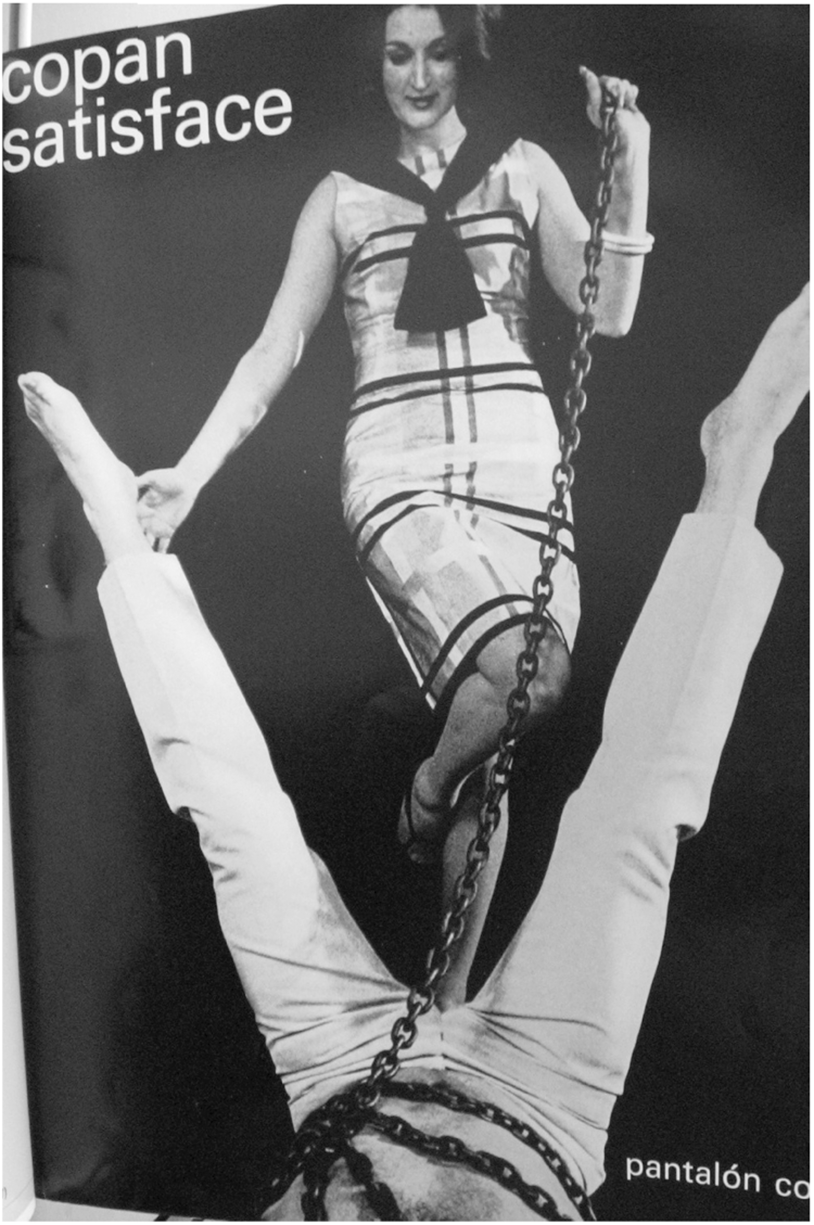
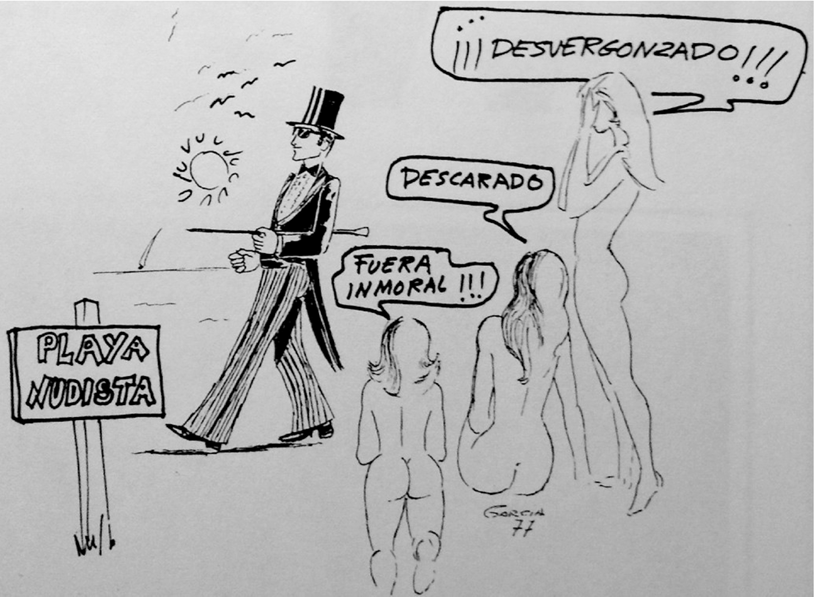
All this had consequences. Boys and girls, once able to interact only while chaperoned, could now mingle freely over clothes that at least partially erased gender differences.Footnote 50 Magazines like the avant-garde men’s journal DON (founded in 1963) welcomed changes in menswear as a step toward gender equality, arguing that now neither sex had a monopoly on innovation.Footnote 51 Indeed, as previously feminized and stigmatized sartorial dynamism won male acceptance, it lost its effectiveness as a category of gender difference, becoming decoupled from narratives of feminine capriciousness and social instability that had helped support Francoist patriarchy.Footnote 52DON itself pushed the envelope still further, challenging the regime’s prudish and notoriously repressive press censors with a series of daring ads, including a 1967 ad for Copan-brand pants that featured a woman, dominatrix-like, holding a phallically positioned chain wrapped sadomasochistically around a supine half-naked man, along with the suggestive caption, “Copan Satisfies” (see Figure 2). Some ads even challenged the regime politically. In 1968, for instance, PK ran an ad in the women’s magazine TELVA in which the firm identified itself with, and voiced support for, socially conscious students of the kind then protesting in Madrid and Barcelona against Francoism’s stifling of political life.Footnote 53 These criticisms even made their way into the otherwise apolitical Sears’ employee bulletin. Therein, cartoonist José García published strips from 1976 through 1978 that criticized Spanish authorities during the democratic transition for their continued use of violence against peaceful protesters or dealt in a raunchy humor used at the time to perform new sexually liberated democratic identities, as in one strip in which beach-going nudists were shocked by a “shameless” tuxedo-clad passerby (see Figure 3).Footnote 54
“Copan Satisfies”. Source: Don, No. 7 (1967).
“Nudist Beach”. Source: Noti-Sears, No. 37, Year VI (March–April 1977).
Beginning soon after the regime had installed itself, Buying into Change argues, a new Spanish mass consumer society spearheaded by Spain’s department stores, supermarkets, and consumer press gradually drove the nation’s integration into a larger Western commercial community, a process of Americanization and Europeanization that altered Spanish social mores and shook the earth beneath Generalissimo Franco’s repressive political system. Francoism, though known for its ability to superficially change to suit the political times, had long clung to notions of an essentialized Spanish national difference, a notion first mobilized in opposition to Western parliamentary liberalism. Although the regime sought to use Spain’s consumer revolution to popularly legitimize itself, retailers such as Galerías Preciados, Sears, and SPAR ultimately eroded this myth of difference. Shuttling employees, products, and ideas across national borders, they created opportunities for quotidian cultural encounters. These, in turn, increasingly convinced Spaniards that, just as at Sears there was but a single, international Sears network of which Spain and the United States were both members in good standing, Spain’s future lay not in pretensions to national exceptionalism, but full integration into Western Europe and the rise to modernity, national prosperity, and also the democratization that entailed.