Anthracycline chemotherapy has been shown to improve the outcome in bone and soft tissue sarcomas and is considered the standard of care in first-line treatment of osteosarcoma, Ewing sarcoma, and most cases of soft tissue sarcoma; 1 – Reference Gaspar, Hawkins and Dirksen 3 however, anthracycline administration may be associated with severe, and even fatal, cardiotoxicity, which can occur many years after therapy completion.Reference Oeffinger, Mertens and Sklar 4 , Reference Mulrooney, Yeazel and Kawashima 5
The incidence of anthracycline-related cardiotoxicity in childhood cancer survivors varies from 5 to 20% according to the literature,Reference Mulrooney, Armstrong and Huang 6 but few studies report specifically on cardiac toxicity in children with bone sarcoma and soft tissue sarcoma.Reference Brown, Vijarnsorn, Potts, Milner, Sandor and Fryer 7 , Reference Longhi, Ferrari and Tamburini 8
This study focusses on cardiotoxicity incidence in a population of children diagnosed with bone sarcoma and soft tissue sarcoma treated with anthracycline chemotherapy at a single Italian institution, utilising the Common Terminology Criteria for Adverse Events version 4.0 for grading and defining cardiotoxicity.
Materials and methods
Study population
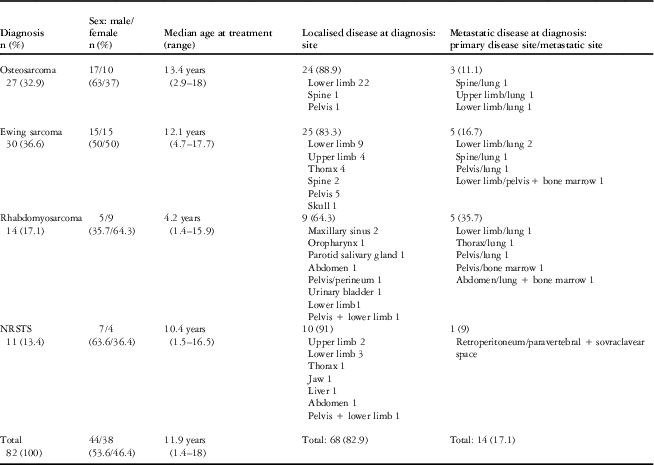
The cohort included all patients with newly diagnosed bone sarcoma or soft tissue sarcoma during 1995–2011, treated with anthracycline chemotherapy at Regina Margherita Children’s Hospital. Patients were considered eligible provided they had undergone a baseline echocardiography and had attended cardiological and clinical follow-up examinations for at least 3 years from the completion of any cardiotoxic therapy. We excluded patients who received no anthracyclines, had no documented baseline echocardiogram, or those who had insufficient data regarding cardiological follow-up analysis (Table 1).
Population description.

NRSTS=non-rhabdomyosarcoma soft tissue sarcoma
Clinical data collection
Cases were identified from the 1.01 Model Registry, which registers all cases of cancer diagnosed and treated in Associazione Italiana Ematologia e Oncologia Pediatrica centres; data were collected from this Registry and from patients’ medical records. The collected data included sex, age at treatment, histological diagnosis, site of primary lesion, and extent of metastases. Cumulative anthracycline dose, treatment protocol, method and duration of anthracycline administration, start and end dates of chemotherapy administration, radiation dose, and radiation field involving the heart were documented. Autologous and allogeneic hematopoietic stem cell transplantation dates as well as conditioning regimen, date and site of relapse, treatment at relapse, date of last follow-up examination, date and cause of death, and date and site of second malignant neoplasm were noted. Data on thyroid function, body mass index, pre-existing cardiac abnormalities, and familial cardiovascular history were also collected.
Cardiac assessments
Echocardiography and electrocardiography were performed before treatment, during treatment as per protocol, on therapy completion, and subsequently during surveillance; systolic and diastolic function parameters and cardiac dimensions were evaluated; the electrocardiography parameters focussed on QTc interval.
During the surveillance period, the frequency for carrying out echocardiography and electrocardiography was decided by the oncologist until 2003, when Children’s Oncology Group Long-Term Follow-Up Guidelines for Survivors of Childhood, Adolescent, and Young Adult Cancers 9 were first published and then applied in our Centre. Data were reviewed by the study’s paediatric cardiologist.
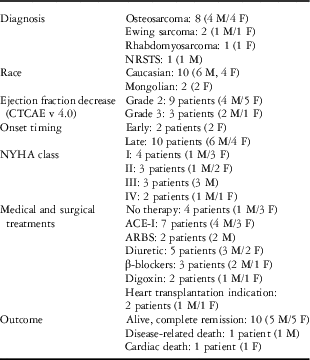
For patients who developed cardiotoxicity, medical treatment, indication for heart transplantation, time from cardiotoxic treatment completion to toxicity development, and time from cardiotoxicity diagnosis to last follow-up were collected (Table 2).
Characteristics of patients who developed cardiotoxicity.

ACE-I=angiotensin-converting enzyme inhibitors; ARBS=angiotensin receptor blockers; CTCAE=Common Terminology Criteria for Adverse Events; F=female; M=male; NRSTS=non-rhabdomyosarcoma soft tissue sarcoma
Heart failure was evaluated according to American College of Cardiology/American Heart Association classification, NYHA Functional classification, and Common Terminology Criteria for Adverse Events version 4.0.
Definitions
We defined cardiotoxicity as a grade ⩾2 ejection fraction reduction according to Common Terminology Criteria for Adverse Events version 4.0. The percentage decline from baseline ejection fraction was calculated during treatment, at the end of therapy, and during the follow-up period.
Cardiotoxic treatments include anthracycline or alkylating agent chemotherapy and radiotherapy involving the heart in radiation fields. 9 , Reference Armenian, Hudson and Mulder 10 In order to calculate the cumulative anthracycline dose, we calculated doxorubicin isotoxic equivalents according to Children’s Oncology Group guidelines. 9 All patients were >10 kg at diagnosis; no dose adjustment for small weight was necessary, even for younger patients.
Early toxicity was defined as toxicity that occurred within 1 year after first-line anthracycline-based chemotherapy; late cardiotoxicity was defined as cardiopathy that occurred a year or more after therapy.Reference Lipshultz, Franco, Miller, Colan and Sallan 11
The median time to cardiotoxicity was calculated from the time of completion of first-line anthracycline-based chemotherapy to the time of finding the first clinical or echocardiographic evidence of toxicity.
Demographics
A total of 82 patients met the inclusion criteria. The cohort included 44 male and 38 female patients, with a median age of 11.9 years (range 1.44–18 years) at treatment. In all, 57 patients were affected by bone sarcoma: 27 by osteosarcoma, 30 by Ewing sarcoma; 14 patients were diagnosed with rhabdomyosarcoma; and 11 patients were diagnosed with non-rhabdomyosarcoma soft tissue sarcoma. The population included 74 white non-Hispanic patients, four patients of Mongolian ethnicity, and four North African patients. No patients had pre-existing cardiac abnormalities or a family history of cardiovascular disease; no patients were affected by Down’s syndrome.
Of the cases, 82.9% had localised disease at diagnosis and 12 out of 14 patients with metastatic disease had pulmonary metastases.
Chemotherapy
All patients received anthracyclines during first-line treatment; most patients received first-line therapy according to different Associazione Italiana Ematologia e Oncologia Pediatrica, Italian Sarcoma Group, European paediatric Soft Tissue Sarcoma Study Group, and International Society of Paediatric Oncology trials over time; modification from the standardised protocol have been made according to the patient’s clinical history or toxicity. Anthracyclines were administered to a minor portion of the patients according to a personalised protocol. Among 82 patients on first-line therapy, 74 were treated with doxorubicin, three with epirubicin, and three with both doxorubicin and epirubicin; one patient was treated with doxorubicin and liposomial doxorubicin; and another patient was treated with epirubicin and daunorubicin. The majority of patients received alkylating agents; only one patient was treated with a potentially cardiotoxic tyrosine kinase inhibitor, namely pazopanib, which was used as a second-line therapy for synovial sarcoma.
In the overall study population, the median cumulative anthracycline dose was 390.75 mg/m2 (range 80–580 mg/m2). Sub-group analysis showed different median values for the cumulative anthracycline dose: 420 mg/m2 (range 300–450 mg/m2) in the osteosarcoma cohort, 400 mg/m2 (range 320–580 mg/m2) in the Ewing sarcoma group, 210 mg/m2 (range 80–421.5 mg/m2) for patients diagnosed with rhabdomyosarcoma, and 225 mg/m2 (range 120–381.5 mg/m2) in the non-rhabdomyosarcoma soft tissue sarcoma cohort.
Anthracyclines were administered as a 1-hour IV infusion for three patients; a 4-hour minimum-dose anthracycline IV infusion was administered for the other patients. Among 79 patients treated with doxorubicin, only three patients received dexrazoxane; among these three patients, two received a 24-hour doxorubicin infusion, whereas the other patient received a 4-hour doxorubicin infusion, according to treatment protocols.
Stem cell transplantation
A total of 30 patients underwent autologous hematopoietic stem cell transplantation; six patients received high-dose cyclophosphamide (4–8 g/m2) during mobilising chemotherapy. One patient diagnosed with rhabdomyosarcoma underwent allogeneic hematopoietic stem cell transplantation at first complete remission, and a patient with Ewing sarcoma treated with autologous hematopoietic stem cell transplantation during first-line treatment received allogeneic hematopoietic stem cell transplantation as a part of second-line therapy. Conditioning regimens were mainly melphalan-, thiotepa-, carboplatin-, and etoposide-based.
Radiotherapy
In all, 17 patients received radiation involving the heart: 10 with Ewing sarcoma, four with rhabdomyosarcoma, and three with non-rhabdomyosarcoma soft tissue sarcoma; the radiation dose was ⩾30 Gy in 12 cases. None of these 17 patients developed cardiotoxicity. No patients received total body irradiation.
Survival outcome
The median time of follow-up was 10.2 years (range 4.2–20.7) for the entire population. Overall survival was 97.9% (±2%) at 10 years and 83% (±11.6%) at 20 years. Relapse occurred in 20 patients. Of the patients, five developed a second malignant neoplasm: two cases of papillary thyroid cancer, one case of medullary thyroid cancer, one case of peripheral primitive neuroectodermal tumour, and one case of hemangioendothelioma of the testis. A total of three deaths were observed: two patients died because of progressive disease–one patient was affected by Ewing sarcoma and another patient died because of a secondary peripheral primitive neuroectodermal tumour–and one patient died because of cardiac toxicity. The median time from the first diagnosis of cancer to death was 11.9 years (range 8.9–18.5).
Statistical analyses
χ2 analysis and Fisher’s exact probability test were used to assess categorical variables. A non-parametric t-test was performed to evaluate independent samples. Multivariate analysis only included parameters with a p value ⩽0.1 on univariate analysis. Odds ratios were calculated with 95% confidence limits. Overall survival was estimated using the Kaplan–Meier methodology. Statistical analyses were performed using SPSS (IBM Corp 2012, Armonk, New York, United States of America) and NCSS (Hintze, 2001; NCSS PASS, Number Crunched Statistical System, Kaysville, Utah, United States of America) softwares.
Results
Of the 82 patients, 12 (14.6%) developed cardiotoxicity. In this group, the median age at treatment was 8.9 years (range 1.5–16.9) and the median cumulative anthracycline dose was 420 mg/m2 (range 330–421.5). The median time for grade-2–4 toxicity was 4.2 years (range 0.05–9.6). The median period of surveillance after first evidence of toxicity was 2.6 years (range 0–17).
A total of two female patients developed early toxicity, whereas late-onset cardiotoxicity was observed in 10 patients.
In all, nine patients – four male and five female – presented a grade-2 ejection fraction decrease and three patients – two male and one female – presented grade-3 toxicity, according to Common Terminology Criteria for Adverse Events version 4.0.
Of these cases, four patients, of whom two were Caucasian and two were Mongolian, were asymptomatic and did not need medical treatment. Among the other eight patients, angiotensin-converting enzyme inhibitors, β-blockers, and diuretics were the most used drugs. A total of two patients, aged <2 years at treatment, developed a dilatative cardiomyopathy refractory to medical treatments and were amenable for a heart transplantation procedure: a female patient died because of heart failure before transplantation could be performed, 18 years after rhabdomyosarcoma diagnosis and 17 years after the first evidence of cardiotoxicity; a male patient underwent heart transplantation 15 years after non-rhabdomyosarcoma soft tissue sarcoma diagnosis and 11 years after developing cardiotoxicity, and 4 years after transplantation he did not need any medical treatment.
We also observed subclinical and transient grade <2 ejection fraction decrease in four patients at first-line chemotherapy completion; echocardiographic alterations were not detected during subsequent control observations.
No relevant electrocardiographical alterations were observed.
Risk factors associated with cardiotoxicity
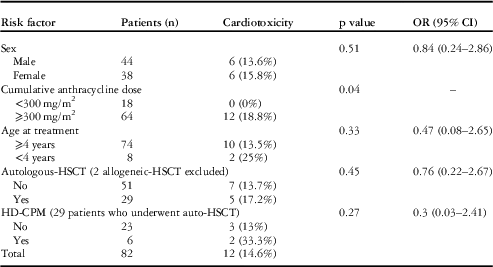
In our population, on univariate and multivariate analysis, a cumulative anthracycline dose ⩾300 mg/m2 was the only factor associated with an increased risk for cardiotoxicity. Age at treatment <4 years, female sex, autologous hematopoietic stem cell transplantation, high-dose cyclophosphamide, thyroid dysfunction, and excess weight did not contribute significantly to toxicity, but the small sample size and wide confidence intervals make it difficult to rely on these results (Table 3).
Risk factors for cardiotoxicity.

CI=confidence interval; HD-CPM=high-dose cyclophosphamide; HSCT=hematopoietic stem cell transplantation; OR=odds ratio
Discussion
Anthracycline-related cardiotoxicity and its associated risk factors in paediatric cancer survivors are clearly described in the literature.Reference Lipshultz, Franco, Miller, Colan and Sallan 11 – Reference Ehrhardt, Fulbright and Armenian 13 The leading non-cancer-related cause of morbidity and mortality in long-term survivors is cardiovascular disease.Reference Lipshultz, Franco, Miller, Colan and Sallan 11 Among paediatric cancer survivors aged ⩾35 years, the risk for congestive heart failure is higher in patients with bone sarcoma and soft tissue sarcoma than in those with leukaemia, but is similar to that in patients with lymphoma.Reference Armstrong, Kawashima and Leisenring 14
Few studies report the incidence of cardiotoxicity specifically in survivors of paediatric bone sarcoma and soft tissue sarcoma. The Italian Sarcoma Group described a 2 and a 1.3% cardiotoxicity – defined as having an ejection fraction <50%–incidence among 883 osteosarcoma and 543 Ewing sarcoma survivors treated during 1983–2006; the age at diagnosis was ⩽40 years and the cumulative anthracycline dose was 480 and 400 mg/m2, respectively; authors observed a greater toxicity incidence among younger patients and in those on the earlier protocol (IOR-2) in which patients received the highest dose of doxorubicin (480 mg/m2).Reference Longhi, Ferrari and Tamburini 8 In a paediatric population – that is, in those aged <17 years, with a median age at diagnosis 11.1 years–of patients with Ewing sarcoma who received a median cumulative dose of anthracycline of 365 mg/m2 and were treated during 1978–2006,Reference Brown, Vijarnsorn, Potts, Milner, Sandor and Fryer 7 a 29.6% cardiotoxicity–defined as grade-2 ejection fraction decrease according to Common Terminology Criteria for Adverse Events version 4.0–incidence was described.
In our study, cardiotoxicity incidence was 14.6%. Patients who developed toxicity received a cumulative anthracycline dose >300 mg/m2; therefore, they were classified as high-risk patients, 9 , Reference Armenian, Hudson and Mulder 10 and were not treated with chest radiation or high-dose cyclophosphamide. It was not possible to define female sex and age at treatment <4 years as risk factors for cardiotoxicity because of the sample size. Nevertheless, among patients younger than 4 years at treatment, a greater toxicity incidence was observed: two out of eight patients of this cohort developed refractory heart failure requiring heart transplantation; thus, younger age seems associated with a poorer cardiac outcome in our study.
The majority of patients in our study population were Caucasian; the minority comprised North African and Mongolian patients. No toxicity was observed among North African patients, whereas two out of four Mongolian patients developed asymptomatic cardiotoxicity. Further follow-up studies and a larger sample population are required to define cardiac toxicity risk among patients of this uncommonly represented ethnicity.
Detection of subclinical cardiac toxicity improved after 2003, when Children’s Oncology Group Long-Term Follow-Up Guidelines for Survivors of Childhood, Adolescent, and Young Adult Cancers Guidelines were first published; therefore, it is possible that we underestimated toxicity incidence in patients who attended the surveillance programme before 2003. On the other hand, prolonged follow-up investigation allowed the detection of late-onset cardiotoxicity and the selection of cases amenable for medical treatment.
Cardiac toxicity incidence did not vary significantly over the study period. Patients were treated according to different protocols with different cumulative anthracycline doses and different intravenous administrations over time. None among the three patients who received doxorubicin as a 1-hour infusion developed cardiotoxicity; it was not possible to evaluate the role of continuous intravenous anthracycline infusion versus shorter infusion time because of the study population size; moreover, continuous intravenous anthracycline infusion did not demonstrate the provision of long-term cardioprotection in children, was associated with longer hospital stays and cost, as well as with an increased risk for thromboembolic events and mucositis;Reference Lipshultz, Franco, Miller, Colan and Sallan 11 , Reference Lipshultz, Miller and Lipsitz 15 , Reference Lipshultz, Giantris and Lipsitz 16 hence, some authors advise against the continuous use of an intravenous infusion.Reference Lipshultz, Franco, Miller, Colan and Sallan 11 , Reference Lipshultz, Giantris and Lipsitz 16
Despite initial conflicting data,Reference Lipshultz, Lipsitz and Orav 17 , Reference Hellmann 18 which have not been substantiated with longer follow-up studies,Reference Lipshultz, Franco, Miller, Colan and Sallan 11 several trials have found no association between dexrazoxane and an increased risk for secondary malignanciesReference Asselin, Devidas and Zhou 19 – Reference Barry, Vrooman and Dahlberg 22 or decreased oncological efficacy.Reference Lipshultz, Scully and Lipsitz 23 , Reference Lipshultz, Franco and Sallan 24 Dexrazoxane has been demonstrated to be cardioprotective in children treated with doxorubicin for T-cell acute lymphoblastic leukaemia and lymphoma,Reference Asselin, Devidas and Zhou 19 in children with osteosarcoma whose treatment also included trastuzumab,Reference Ebb, Meyers and Grier 25 and in children with osteosarcoma treated with doxorubicin at dose escalations up to a cumulative dose of 600 mg/m2.Reference Kopp, Bernstein and Schwartz 26 In 2014, it was designated as an orphan drug for “prevention of cardiomyopathy for children and adolescents 0 through 16 years of age treated with anthracyclin” by the Food and Drug AdministrationReference Lipshultz, Franco, Miller, Colan and Sallan 11 , 27 and, in Italy, its use is contraindicated in children since 2011. 28 Only three patients in our study population received dexrazoxane; hence, we could not evaluate its protective effect.
Liposomal anthracycline analogues are correlated with lower symptomatic and subclinical cardiotoxicity risk than free doxorubicin, with an equivalent efficacy.Reference Smith, Cornelius and Plummer 29 At present, they are not routinely used as the first-line treatment for sarcomas in adult patients, but are mainly used in clinical trials.Reference De Sanctis, Bertuzzi and Basso 30 , Reference Judson, Radford and Harris 31 Very little information is available on the comparative cardiotoxic effects of anthracycline analogues in children Reference van Dalen, Michiels, Caron and Kremer 32 – 36 and longer follow-up analysis is needed.
New mechanistic explanations of anthracycline cardiotoxicity are emerging, primarily relying on the ability of this class of drugs to interfere with complex signalling networks related to cardiomyocyte survival, including DNA damage response, energetic stress, and gene expression modulation networks.Reference Ghigo, Li and Hirsch 37 Future research efforts should be directed towards evaluating whether targeting these recently identified factors that interact with drugs and play a role in anthracycline cardiotoxicity may provide the opportunity to reduce the cardiovascular burden of anti-cancer therapies and even allow the administration of high-dose anthracycline chemotherapy.
There are no guidelines for the cardiotoxicity treatment for childhood cancer survivorsReference Armenian, Hudson and Mulder 10 at present. Angiotensin-converting enzyme inhibitors demonstrated neither the ability to reduce congestive heart failure incidence and mortality rates nor the potential to improve overall survival,Reference Silber, Cnaan and Clark 38 but they can delay cardiomyopathy progression.Reference Lipshultz, Lipsitz and Sallan 39
Currently, the absence of longitudinal follow-up studies in survivors of childhood cancer precludes the routine use of newer imaging approaches, such as three-dimensional echocardiography, tissue Doppler imaging, cardiac MRI, and speckle tracking, for primary cardiomyopathy surveillance; nevertheless, major evidence is needed to evaluate the prognostic role of increase in levels of cardiac troponins and natriuretic peptides during follow-up analyses.Reference Armenian, Hudson and Mulder 10
Prevalence of cardiovascular diseases increases with age among childhood cancer survivors,Reference Mulrooney, Armstrong and Huang 6 , Reference Kremer, van Dalen, Offringa, Ottenkamp and Voûte 40 similarly as traditional cardiovascular risk factors.Reference Armenian, Hudson and Mulder 10 , Reference Ehrhardt, Fulbright and Armenian 13 In our study, we observed the development of cardiac toxicity up to over 9 years after anthracycline therapy completion, and subclinical toxicity occurred even 7 years after the end of treatment.
A long-term follow-up cardiological investigation is mandatory in childhood cancer survivors who received cardiotoxic treatments; it should be continued throughout the lifetime, and not only when the patients are at a high risk.Reference Armenian, Hudson and Mulder 10
To date, risk-stratification approaches to screening and subsequent intervention have largely been driven by demographic and treatment-related exposures; 9 , Reference Armenian, Hudson and Mulder 10 incorporating data that demonstrate associations between cardiomyopathy and a number of genetic and acquired risk factors might allow to define more personalised surveillance and intervention approaches.Reference Armenian, Hudson and Mulder 10 , Reference Ehrhardt, Fulbright and Armenian 13
Our study confirms the importance of a lifelong cardiac toxicity surveillance programme for survivors of childhood cancer and underlines the need for primary prevention, utilising lower cumulative doses of anthracyclines and less cardiotoxic anthracycline analogues, as well as for developing new strategies for cardioprotection. The identification of therapeutic strategies limiting anthracycline cardiotoxicity with preserved antitumour efficacy represents the current challenge for cardio-oncologists, paediatric oncologists, and medical oncologists.
Acknowledgements
None.
Financial Support
This research received no specific grant from any funding agency, commercial, or not-for-profit sectors.
Conflicts of Interest
None.
Ethical Standards
The authors assert that all procedures contributing to this work comply with the ethical standards of the Helsinki Declaration of 1975, as revised in 2008. Ethical approval was obtained from the institutional committee to undertake a retrospective chart review of all patients treated at our Institution.