
Introduction
Dielectric elastomers (DEs) can respond to electrical stimuli by changing their shapes and belong to the family of smart materials.[ Reference Pelrine, Kornbluh, Pei and Joseph 1 – Reference Giousouf and Kovacs 3 ] Generally, DEs can induce several levels of strains (from 10% to 300%), but they require large electric fields (usually about 100 V/μm) to achieve large actuated strains.[ Reference Romasanta, Lopez-Manchado and Verdejo 4 ] It has been reported that the operating electric field of DEs could be decreased for these materials by increasing the DEs' dielectric constants and also through lowering Young's modulus.[ Reference Pelrine, Kornbluh and Kofod 5 ] A soft silicone rubber (SR)-based DE has the advantages of low Young's modulus combined with lower viscoelasticity and good thermal stability.[ Reference Shankar, Ghosh and Spontak 6 ] However, its deformability under an electric field is limited with a low inherent dielectric constant (≈2.9).[ Reference Brochu and Pei 2 , Reference Shankar, Ghosh and Spontak 6 ] The most popular approach to increasing the dielectric constant is by incorporating nano/micron-sized high-dielectric filler particles into the DE matrix. Examples of fillers used are titanium dioxide (TiO2),[ Reference Liu, Zhang, Yang, Yu, Yao and Tian 7 – Reference Kontos, Kontos, Tsoukleris, Bernard, Spyrellis and Falaras 9 ] lead magnesium niobate–lead titanate (PMN–PT),[ Reference Gallone, Carpi, De Rossi, Levita and Marchetti 10 , Reference Yang, Zhang, Liu, Dong, Yu and Tian 11 ] barium titanate (BT)[ Reference Yang, Ge, Tian, Ning, Zhang, Zhao, Ito, Nishi, Wang and Luan 12 , Reference Kim, Jones, Hotchkiss, Haddock, Kippelen, Marder and Perry 13 ] and functionalized graphene sheet.[ Reference Romasanta, Hernández, López-Manchado and Verdejo 14 ] Ferroelectric oxides, which exhibit a spontaneous electric polarization can also be reoriented in an external field. In particular, these oxides possess a large dielectric constant. Perovskite BT is one example of such oxides and exists as a white powder. It has a high-dielectric constant of above 1200.[ Reference Yun, Urban, Gu and Park 15 ] Nevertheless, inorganic BT has poor compatibility with SR and this disadvantage prevents its further application in soft actuators. To negate this limitation, researchers focused on surface modification of BT.[ Reference Kim, Jones, Hotchkiss, Haddock, Kippelen, Marder and Perry 13 , Reference Luo, Wang, Wang and Li 16 ] Dopamine, which can interact strongly with metal oxides by forming hydrogen bonds,[ Reference Lin, Thakur, Tan and Lee 17 ] was considered an effective chemical with which to modify the surface of BT particles.[ Reference Luo, Wang, Wang and Li 16 , Reference Yang, Tian, Li, Wang, Ge and Zhang 18 ] Moreover, the aromatic group, the hydrogen-bonded hydroxyl-dopamine (DP) species and the bromide group are of high polorisability,[ Reference Ren, Wu and Ponder 19 – Reference Greff, Zubia, Genta-Jouve, Massi, Perez and Thomas 21 ] which is propitious to the enhancement of the dielectric constant. This research had the aim of enhancing the dielectric constant of SR-based DE composites by adding the DP–BT and a further increase in the dielectric constant was sought by grafting bromine (Br) onto the DP–BT surface.
Experimental
DP–BT and Br–DP–BT preparation
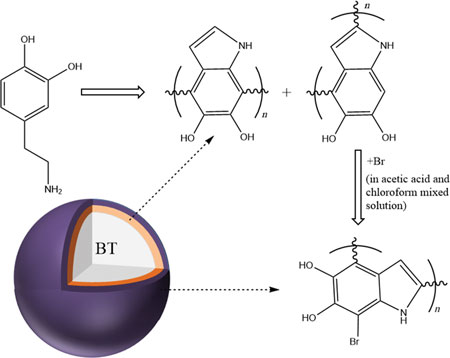
Figure 1 shows reactions for obtaining the DP–BT and Br–DP–BT. The coating research on DP–BT was reported previously.[ Reference Jiang, Betts, Kennedy and Jerrams 22 ] In this work, 10 g of BT was dispersed in 50 mL of ethnol–water mixture (with a mass ratio of 1:1) and stirred for 30 min. Thus, OH− functional groups were added to the particle surfaces. The mixture was then poured into 450 mL of deionized water with the addition of 1 g of DP hydrochloride. Thereafter, the suspension was stirred at 60 °C overnight prior to being subjected to ultrasonic shaking for 30 min. The DP–BT-coated particles were recovered by vacuum filtration. Subsequently, they were washed using deionized water and finally dried at 60 °C for 1 day in a vacuum to avoid oxidization of the DP.
Schematic diagrams of the fabrication of Br and DP-coated BT.

For deposition of Br on DP–BT particles, an approach of directly grafting the Br on DP was employed.[ Reference Shevchenko, Nagaev, Shevchenko, Chernysheva, Badun, Fedoseev and Myasoedov 23 ] The resulting DP–BT particles were initially ground up and dissolved in a mixture of 20 mL acetic acid and 60 mL chloroform. Subsequently, 1.25 mL concentrated Br liquid was added and reacted overnight with magnetic stirring. The solution was heated at 60 °C in order to remove the remnant Br, acetic acid, and chloroform. Finally, the powder was washed with deionized water and dried at 60 °C for 1 day.
DE films preparation
Initially, the two part of SR were mixed at a weight ratio of 1:1 and dissolved in heptane. Then, the particles (BT, DP–BT, and Br–DP–BT) with the required weight percentage of 10% were added to the mixture. To achieve uniform dispersion of the SR and fillers in heptane, the mixture was subjected to ultrasonic shaking for 20 min. To complete the process, the mixture was poured into a watch glass, subjected to ultrasonic shaking for 30 min, and heated for 3 h at 80 °C in a water bath with an ultrasonic cleaner, which performed the function of heating and shaking under aerated conditions.
Characterization
The morphological features of all particles in this work were observed using a scanning electron microscope (SEM) (Zeiss Supra). Elemental analysis of these particles was carried out using an energy-dispersive x-ray spectrometer (EDS) (Oxford Inca Xmax), which was coupled to the SEM. Fourier transform infrared spectroscopy (FTIR) spectra of the micro-particles were recorded in the 350–4000 cm−1 range with a Perkin Elmer 400 Series Spectrometer. Dielectric measurements of DE films were conducted on a Turnkey broadband dielectric spectrometer at 20 °C in the frequency range of 10 Hz–1 MHz.
Results and discussion
Figure 2 shows the SEM images of BT, DP–BT, and Br–DP–BT particles. As shown in Fig. 2(a) the BT particles were almost spherical with a diameter of about 500 nm. They formed clusters easily and the surfaces of these particles were relatively smooth. After coating with DP and Br, the treated particles increased in diameter by more than 200 nm [refer to Figs. 2(b) and 2(c)]. Additionally, the surfaces of the coated particles became rough as a result of being modified with DP and Br reagents.
SEM micrographs of particles used in the experiments: (a) BT; (b) DP–BT; (c) Br–DP–BT.

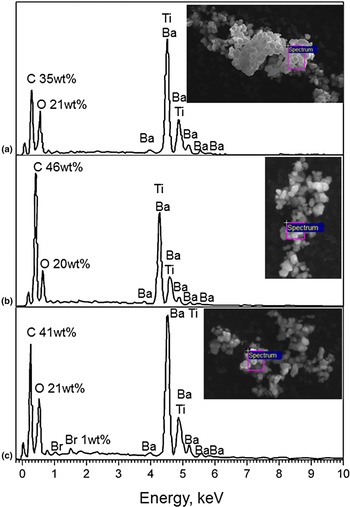
Figure 3 shows the EDS spectrum of DP–BT and Br–DP–BT. Element Ba along with elements Ti and O can be observed in Fig. 3(a) indicating the fundamental constituents of BT. Carbon (C) was also detected in each of the particles mainly due to residues present in various chamber surfaces such as vacuum pump and from sample surface migration and reaction with the electron beam forming a C-rich environment.[ Reference Rolland, Carlino and Vane 24 ] Moreover, the contents of C in DP–BT (46 wt%) and Br–DP–BT (44 wt%) are more than that in BT (35 wt%) indicating the deposition of DP on BT particles [refer to Figs. 3(b) and 3(c)]. However, the content of element O changed only slightly after modification with DP and Br with the O atomic mass fraction of DP nearly equal to that of BT (21 wt%). Figure 3(c) shows the Br peak on the spectra indicating the deposition of Br on DP–BT particles.
EDS spectra of DP–BT and Br–DP–BT.

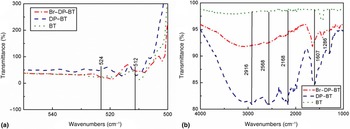
Figure 4(a) shows the FTIR spectra of DP–BT and Br–DP–BT over a range of 550–500 cm−1. The peaks at 512 and 524 corresponding to the C–Br stretch vibrations can be observed in the fingerprint region of the spectra. Figure 4(b) shows the FTIR spectra of DP-coated BaTiO3 (DP–BT) and Br-grafted DP–BT (Br–DP–BT) in the functional group region (4000–1000 cm−1). Due to the deposition of DP on BaTiO3, the C–H bond appeared at 2916 cm−1. The transmittance peaks located at 1607 and 1286 cm−1 corresponded to aromatic amine N–H bending vibrations and C–N stretching vibrations, respectively. In addition, the appearance of the peaks at 2568 and 2168 cm−1 was interpreted as indicating the presence of the Ba–OH and Ti–OH formation,[ Reference Racles, Cazacu, Fischer and Opris 25 ] which was probably due to the addition of ethanol during the fabrication of DP–BT.
FTIR spectra of DP–BT and Br–DP–BT in the frequency ranges of (a) 550–500 cm−1; (b) 4000–1000 cm−1.

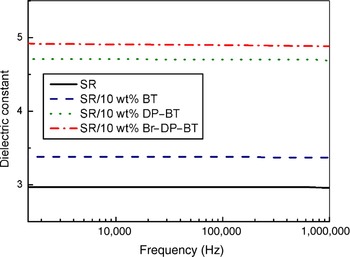
Figure 5 shows the spectra of dielectric constant related to the frequency for pure SR, SR/10 wt% BT composite, SR/10 wt% DP–BT composite, and SR/10 wt% Br–DP–BT composite. As can be observed from Fig. 5, pure SR displayed a dielectric constant of about 2.9 at 1 kHz. The dielectric constant increased over the entire frequency range with the addition of 10 wt% BT and to 3.4 at 1 kHz. After adding the DP–BT particles in the SR matrix, the dielectric constant rose at all testing frequencies, most significantly to 4.7 at 1 kHz. Moreover, the dielectric constant was further enhanced by about 0.2 when SR was filled with 10 wt% Br–DP–BT compared with that of SR/10 wt% DP–BT composite. However, the dielectric constant changed only slightly in the wide test frequency range for each SR composite, probably because of the amorphous structure presented in SR, which prevents the dielectric constant being influenced from the dipole orientation in the electric field.[ Reference Sharma, Madras and Bose 26 ]
Dependence of the dielectric constant on frequency.

Conclusions
This work illustrated an efficacious and relatively simple coating method for increasing the dielectric constants of SR/BT composites. SEM images showed the increases in diameter of the particles after they were coated with DP and Br. It was clearly shown from the EDS and the FTIR spectrum results that DP and Br were deposited on BT particles. The dielectric constant of SR composites was also increased by modifying BT particles, which was in consistency with others work.[ Reference Yang, Ruan, Huang, Wu, Li, Wang, Ao, Liang, Guo and Zhang 27 ] Moreover, a dielectric constant of 4.9 was obtained by SR with 10 wt% Br–DP–BT, which is numerically 2.5 higher than that of the SR/10 wt% BT composite. Even though the dielectric constant of the SR/BR–DP–BT composite only increased by a small amount (0.2), this could most probably be increased further through application of higher loadings.
Acknowledgment
The authors gratefully acknowledge the support provided by the DIT Fiosraigh Dean of Graduate Students Award.