


Introduction
Sepiolite, a naturally occurring fibrous magnesium silicate mineral, has emerged as an important rheological modifier in seawater-based drilling fluids because of its superior salt tolerance compared with conventional layered clay minerals (Ettehadi et al., Reference Ettehadi, Ülker and Altun2022; Lin et al., Reference Lin, Yang, Li, Jiang and Luo2023; Zhuang et al., Reference Zhuang, Zhang, Chen, Liu, Fan and Li2024a; Zhuang et al., Reference Zhuang, Zhang, Bergaya, Yuan, Zhuang and Yuan2024b). Its distinctive 2:1 layer-chain crystal structure features discontinuous octahedral sheets that produce an elongated fibrous morphology rather than planar sheets (Galán, Reference Galán1996; Guggenheim and Krekeler, Reference Guggenheim, Krekeler, Galàn and Singer2011; Suárez and García-Romero, Reference Suárez, García-Romero, Galàn and Singer2011). In aqueous dispersions, these high-aspect-ratio fibers readily entangle to form a three-dimensional ‘haystack’ network through physical interlocking and point contacts (Carmona et al., Reference Carmona, Ramírez, Trujillo-Cayado, Caro and Muñoz2018; Liu et al., Reference Liu, Du, Clode, Li, Liu and Leong2020; Castillo et al., Reference Castillo, Lescano, Marfil and Barbosa2022; Zhuang et al., Reference Zhuang, Liu, Xiao, Xie, Fan, Fan, Yuan and Liu2025). This unique architecture gives sepiolite strong viscosity-building and suspension-stabilizing capabilities, making it useful in drilling fluids (Al-Malki et al., Reference Al-Malki, Pourafshary, Al-Hadrami and Abdo2016; Abdo and Haneef, Reference Abdo and Haneef2022; Abdo and Haneef, Reference Abdo and Haneef2024; Xu et al., Reference Xu, Huang, Liu and Tian2026), industrial suspensions (Fuente et al., Reference Fuente, Jarabo, Moral, Blanco, Izquierdo and Negro2010; Aydin et al., Reference Aydin, Kara, Bundur, Ozyurt, Bebek and Ali Gulgun2022; Wang et al., Reference Wang, Du, Ge and Fu2024), and composite materials (Kara et al., Reference Kara, Tekin, Alan and Şafaklı2016; Shi et al., Reference Shi, Li, Zhang, Ma, Duan and Zhou2017; Li et al., Reference Li, Gómez-Avilés, Sellaoui, Bedia, Bonilla-Petriciolet and Belver2019).
A particularly attractive attribute of sepiolite is its ability to maintain rheological performance under high-salinity conditions where montmorillonite-based systems may fail severely (Álvarez et al., Reference Álvarez, Santarén, Esteban-Cubillo, Aparicio, Galàn and Singer2011; Altun and Osgouei, Reference Altun and Osgouei2014; Zhang et al., Reference Zhang, Xu, Christidis and Zhou2020). In montmorillonite dispersions, elevated electrolyte concentrations compress the electrical double layer (EDL) and promote face-to-face aggregation, leading to rapid viscosity loss and sedimentation (Luckham and Rossi, Reference Luckham and Rossi1999; Tombácz and Szekeres, Reference Tombácz and Szekeres2004; Wu and Adachi, Reference Wu and Adachi2016; Ren et al., Reference Ren, Deshun and Zhai2021). By contrast, the fibrous morphology of sepiolite allows the entangled network to retain hydrodynamic volume and structural support even at high ionic strength, preserving acceptable rheological performance. This characteristic renders sepiolite particularly suitable for seawater-based drilling operations and other high-electrolyte applications (Abdo et al., Reference Abdo, AL-Sharji and Hassan2016; Ettehadi and Altun, Reference Ettehadi and Altun2017; Zhao et al., Reference Zhao, Qiu, Huang and Wang2017).
However, this ‘salt resistance’ should not be equated with complete insensitivity to electrolyte effects. Although the entangled fiber network maintains macroscopic colloidal stability over broad salinity ranges, electrolytes can still modify sepiolite behavior through EDL compression, ion association with surface sites, and surface-charge modification (Leroy and Revil, Reference Leroy and Revil2004; Leong, Reference Leong2024). Ions with high charge density or strong surface affinity may induce fiber aggregation, localized network densification, or altered inter-fiber contact modes, ultimately compromising rheological performance (Alkan et al., Reference Alkan, Demirbaş and Doğan2005; Sabah et al., Reference Sabah, Mart, Çınar and Çelik2007; Liu et al., Reference Liu, Du, Clode, Li, Liu and Leong2020; Zhuang et al., Reference Zhuang, Liu, Xiao, Xie, Fan, Fan, Yuan and Liu2025). Despite this recognized sensitivity, important questions remain unresolved: which ionic species in seawater primarily drive sepiolite performance degradation, through what mechanisms do different ions restructure the fiber network, and can rheological behavior be linked to seawater ionic composition?
Previous investigations have established that sepiolite–electrolyte interactions involve two major contributions: EDL compression and ion-specific surface association (Sabah et al., Reference Sabah, Mart, Çınar and Çelik2007; Dikmen et al., Reference Dikmen, Yilmaz, Yorukogullari and Korkmaz2012; Liu et al., Reference Liu, Du, Clode, Li, Liu and Leong2020; Zhuang et al., Reference Zhuang, Liu, Xiao, Xie, Fan, Fan, Yuan and Liu2025). Monovalent cations typically compress the diffuse layer and reduce electrostatic repulsion between fiber surfaces. Multivalent cations may exert stronger effects through preferential association with surface sites, which can lead to charge neutralization or even charge reversal. Although Derjaguin–Landau–Verwey–Overbeek (DLVO) theory provides a useful framework for understanding electrostatic repulsion and van der Waals attraction, it cannot fully account for ion-specific effects among ions of the same valence. Such deviations are commonly associated with differences in hydration, polarizability, and specific surface affinity (Feng et al., Reference Feng, Liu, Li, Liu, Tian, Li and Li2020; Kang et al., Reference Kang, Tang, Zhao and Song2020).
For fibrous clay minerals such as sepiolite, this knowledge gap is particularly important. Their macroscopic rheology depends critically on three-dimensional networks formed by fiber entanglement and point contacts. Different ions may induce distinct microscale fiber aggregation patterns, including localized bundling, network densification, and altered connection modes. How these structural variations translate into rheological responses remains insufficiently understood. Most critically, in complex multicomponent electrolytes such as seawater, it remains difficult to identify which ion species dominate network restructuring and performance degradation.
Seawater presents an ideal but challenging system for addressing this issue. It contains multiple electrolyte species at different concentrations, making it difficult to isolate individual ion contributions. Sodium chloride dominates by mass, whereas divalent cations such as Mg2+ and Ca2+, despite lower concentrations, possess greater charge densities and may exert disproportionately strong effects through surface association. Sulfate, SO42−, as a divalent anion, may also participate in interfacial processes distinct from those involving monovalent chloride. Without a systematic investigation of individual components at seawater-relevant concentrations, the key controlling ions and their mechanisms remain unclear. This limitation hinders mechanistic understanding of sepiolite salt tolerance and complicates formulation optimization for seawater environments.
To address these knowledge gaps, the present study adopted a component-resolved approach based on simplified seawater chemistry. Five primary salts: NaCl, KCl, MgCl2, CaCl2, and Na2SO4, were selected to represent the dominant ionic species in seawater, including monovalent cations (Na+ and K+), divalent cations (Mg2+ and Ca2+), and the major anions (Cl− and SO42−). Single-salt dispersions were prepared at concentrations corresponding to the simplified seawater formulation, enabling direct comparison of ion-specific effects under seawater-relevant conditions. By integrating colloidal stability assessment, zeta-potential analysis, pH measurements, cryogenic scanning electron microscopy (Cryo-SEM), and rheological measurements, this study established multiscale structure–property relationships linking ion–surface interactions, fiber network architecture, and macroscopic flow behavior. These insights provide a theoretical basis for rational formulation design of sepiolite-based drilling fluids and improve understanding of ion-specific effects in fibrous colloidal systems.
Materials and methods
Materials
The sepiolite sample, a purified grade, was supplied by TOLSA S.A. (Spain). Details of this sample can be found in a previous report (Zhuang et al., Reference Zhuang, Liu, Xiao, Xie, Fan, Fan, Yuan and Liu2025). The mineralogical composition of the sepiolite sample was determined by X-ray diffraction (XRD) using a semi-quantitative reference intensity ratio (RIR) method, giving ~95% sepiolite and 5% dolomite. The cation exchange capacity (CEC) was determined to be 13.7 cmol kg–1 using the ammonium acetate method.
Sodium chloride (NaCl, 99.5%), potassium chloride (KCl, 99.5%), calcium chloride (CaCl2, 97.0%), anhydrous sodium sulfate (Na2SO4, 99.0%), and magnesium chloride hexahydrate (MgCl2·6H2O, 98.0%) were purchased from Shanghai Aladdin Biochemical Technology Co., Ltd, China. The MgCl2 concentration reported in the seawater formulation is expressed as the anhydrous MgCl2 equivalent; MgCl2·6H2O was weighed accordingly during solution preparation. Deionized (DI) water with a resistivity of 18.2 MΩ cm was used in all experiments.
Preparation of seawater and salt solutions
The artificial seawater was prepared based on the American Society for Testing and Materials (ASTM) D1141 formulation, but only the five major salts, NaCl, Na2SO4, MgCl2, CaCl2, and KCl, were included in this study (Table 1). This simplified formulation was used to isolate the effects of the dominant seawater ions on sepiolite dispersion behavior. Minor components, such as NaHCO3, KBr, H3BO3, SrCl2, and NaF, were not included because they account for <1% of the total salt content in the formulation. To distinguish the contributions of different salts from the colloidal and rheological properties of sepiolite, the five single-salt solutions were formulated at concentrations identical to those specified for the corresponding salts in the simplified seawater composition.
Composition of the simplified artificial seawater and corresponding single-salt solutions

Table 1. Long description
The table consists of two rows and six columns.
Row 1 (Header): Salt, N a C l, N a sub 2 S O sub 4, M g C l sub 2, C a C l sub 2, K C l.
Row 2 (Concentration in g L super -1):
- N a C l: 24.534
- N a sub 2 S O sub 4: 4.094
- M g C l sub 2: 5.203
- C a C l sub 2: 1.158
- K C l: 0.695
A footnote specifies that the M g C l sub 2 concentration is expressed as the anhydrous M g C l sub 2 equivalent, though M g C l sub 2 dot 6 H sub 2 O was used during preparation.
The MgCl2 concentration is expressed as the anhydrous MgCl2 equivalent. MgCl2·6H2O was weighed accordingly during solution preparation.
Preparation of sepiolite dispersions
The 5 wt.% sepiolite dispersions were prepared as follows. Sepiolite powder (20 g) was added slowly to 400 mL of aqueous solution, including DI water, simplified seawater, or single-salt solutions. The mixture was dispersed at room temperature under high-speed stirring at 10,000 rpm for 20 min. The resulting dispersions were then sealed and allowed to equilibrate under static conditions for 24 h prior to characterization.
Characterization
Gel volume test
The macro-stability and sedimentation behavior of sepiolite in different electrolyte solutions were evaluated using a modified gel-volume/sedimentation test for clay dispersions, following procedures similar to those reported previously for fibrous clay gels (Liu et al., Reference Liu, Du, Clode, Li, Liu and Leong2020; Zhuang et al., Reference Zhuang, Liu, Xiao, Xie, Fan, Fan, Yuan and Liu2025). Exactly 100 mL of the prepared 5 wt.% sepiolite dispersion was transferred into a 100 mL graduated glass cylinder. The cylinders were sealed to prevent evaporation and kept undisturbed at room temperature (15–25°C) for 24 h. The volume of the sedimented or gel phase, V (mL), was then recorded. A larger gel volume indicates a more expansive three-dimensional network and better macroscopic stability of the sepiolite dispersion.
Zeta potential measurements
The zeta potential (ζ) of sepiolite particles was measured using an Anton Paar Litesizer DLS 500 analyzer. Because of the high concentration of the base dispersions, the samples were diluted to a sepiolite concentration of 0.1 g per 100 mL using the same solution to maintain the equilibrium electrolyte concentration. Each measurement was performed in triplicate at 25°C.
pH measurements
The pH values of the 5 wt.% sepiolite dispersions were measured after 24 h of static equilibration using a calibrated pH meter at room temperature. Before measurement, the pH meter was calibrated using standard buffer solutions. The reported values were used to assess whether pH variation or possible hydrolyzed Mg2+/Ca2+ species could contribute to the observed colloidal and rheological behavior.
Microstructure characterization
The microstructures of the dispersions were observed using a Hitachi Regulus 8100 field-emission cryogenic scanning electron microscope (Cryo-SEM) equipped with a Quorum PP3010T cryo-transfer/preparation system. Before sample loading, the cryo-preparation system was evacuated, cleaned by nitrogen gas purging, and pre-cooled to ~−175°C. A small amount of freshly prepared sepiolite dispersion was placed on the cryo-sample holder and plunged rapidly into supercooled/slush liquid nitrogen at ~−210°C for rapid freezing. The frozen sample was then transferred under cryogenic conditions to the cryo-preparation chamber. A pre-cooled knife was used to fracture the frozen specimen and expose a fresh internal surface. The fractured surface was sublimated at −90°C for 21 min to enhance topographical contrast, sputter-coated with platinum at 9 mA for 50 s, and then transferred to the SEM cryo-stage for imaging.
Note that plunge freezing followed by cryo-fracturing and sublimation was used rather than high-pressure freezing in the present study. Therefore, complete vitrification of the aqueous phase cannot be guaranteed, and cryo-preparation artifacts, including ice-crystal formation, fracture-induced changes, and sublimation-related changes, may influence the apparent pore geometry of the frozen gels. To minimize and account for these limitations, only small droplets were used, samples were frozen rapidly in supercooled/slush liquid nitrogen, transferred and processed under cryogenic conditions, and all dispersion systems were prepared and imaged using the same protocol. Consequently, the Cryo-SEM images were interpreted qualitatively to compare relative morphological differences among electrolyte systems, rather than to quantify the absolute native pore structure. The microstructural interpretation was further evaluated together with independent zeta-potential and rheological measurements.
Rheological properties
Rheological properties were measured using a Thermo Scientific HAAKE MARS iQ rotational rheometer equipped with a 60 mm parallel-plate geometry (C60/Ti) with a 1 mm gap. The temperature was maintained at 25.0±0.1°C using a Peltier temperature controller. To minimize shear-history effects, each sample was pre-sheared at a shear rate of 100 s−1 for 60 s, followed by a resting period of 300 s prior to testing. Flow curves were obtained by a shear-rate sweep: the shear rate was first increased from 0.1 s−1 to 1000 s−1, maintained at 1000 s−1 for 30 s, and then decreased back to 0.1 s−1.
For the parallel-plate geometry, the shear rate was evaluated at the rim. Because the sepiolite dispersions exhibited non-Newtonian shear-thinning behavior, the shear stress values exported by the rheometer software were corrected for the parallel-plate geometry using the measured torque–angular velocity relationship. The reported flow curves therefore correspond to corrected shear stress values.
Results and Discussion
Colloidal properties
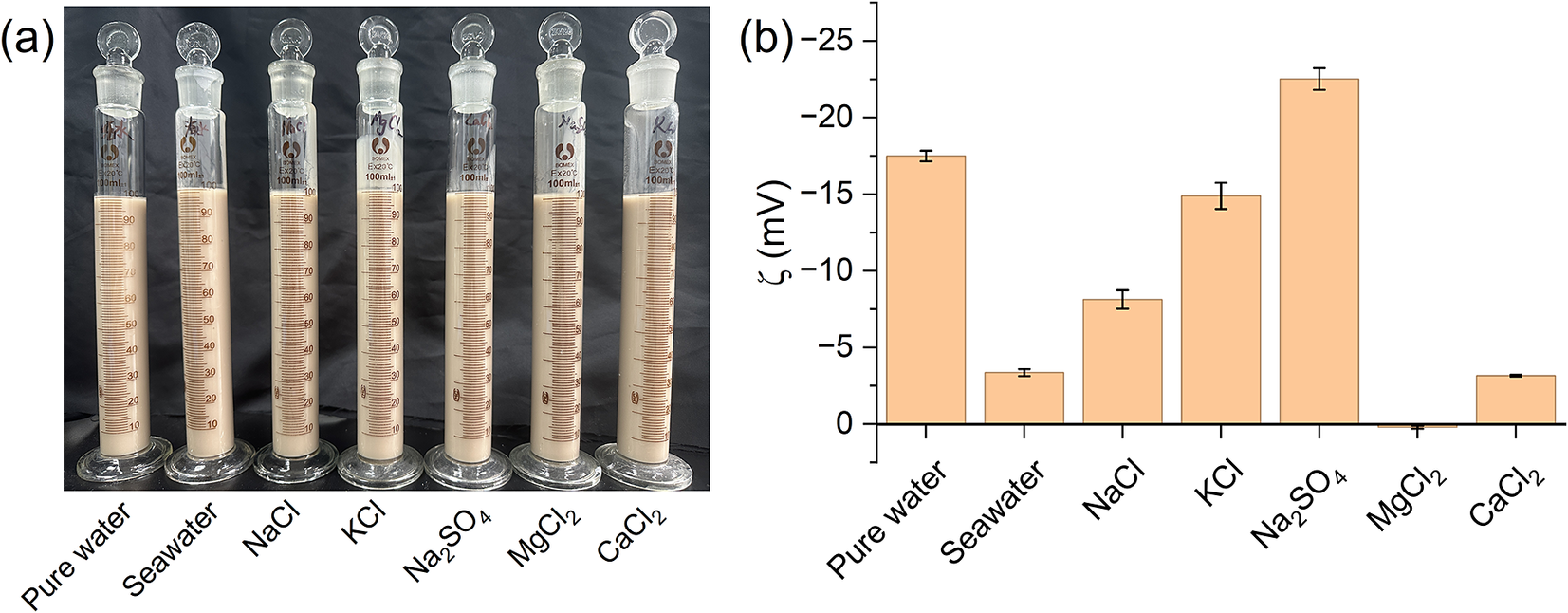
The colloidal stability of sepiolite dispersions in pure water, seawater, and five single-salt solutions was evaluated through gel-volume measurements, zeta-potential analysis, and pH measurements to elucidate ion-specific interfacial interactions governing fiber network formation and stability. After 24 h of standing, no significant sedimentation was observed in any dispersion examined (Fig. 1a). All systems maintained a gel volume of 100 mL without noticeable phase separation, regardless of electrolyte environment. This macroscopic stability is attributed primarily to the formation of a three-dimensional fibrous network at 5 wt.% sepiolite concentration (Shaikh et al., Reference Shaikh, Nasser, Hussein, Benamor, Onaizi and Qiblawey2017). The high-aspect-ratio fibers create a percolating network through physical interlocking, effectively preventing gravitational settling even under high-salinity conditions (Galán, Reference Galán1996; Ruiz-Hitzky et al., Reference Ruiz-Hitzky, Ruiz-García, Fernandes, Lo Dico, Lisuzzo, Prevot, Darder and Aranda2021). This observation indicates that sepiolite macroscopic stability is governed strongly by geometric confinement and mechanical interlocking, distinguishing it from conventional layered clays. Consequently, although gel-volume measurements confirm the absence of catastrophic sedimentation, they are insufficient to resolve ion-specific differences in fiber–fiber interactions and interfacial properties that ultimately determine rheological performance (Liu et al., Reference Liu, Du, Clode, Li, Liu and Leong2020; Zhuang et al., Reference Zhuang, Liu, Xiao, Xie, Fan, Fan, Yuan and Liu2025).
(a) Gel volumes and (b) zeta potentials of 5 wt.% sepiolite dispersions in various aqueous solutions after 24 h of equilibration. Error bars in (b) represent standard deviations from triplicate measurements.

Figure 1. Long description
Panel a is a photo of seven glass graduated cylinders containing tan-colored sepiolite dispersions. From left to right, the labels below the cylinders are Pure water, Seawater, N a C l, K C l, N a sub 2 S O sub 4, M g C l sub 2, and C a C l sub 2. The gel volumes appear relatively uniform across all cylinders, reaching approximately the 90 milliliter mark.
Panel b is a bar chart. The y-axis is zeta potential in millivolts, represented by the symbol zeta, with a scale from negative 25 to 0. The x-axis lists the same seven aqueous solutions from panel a. The bars show the following approximate zeta potential values:
- Pure water: negative 17.5
- Seawater: negative 3.5
- N a C l: negative 8
- K C l: negative 15
- N a sub 2 S O sub 4: negative 22.5
- M g C l sub 2: 0
- C a C l sub 2: negative 3.2
Error bars are present on each bar, indicating standard deviations.
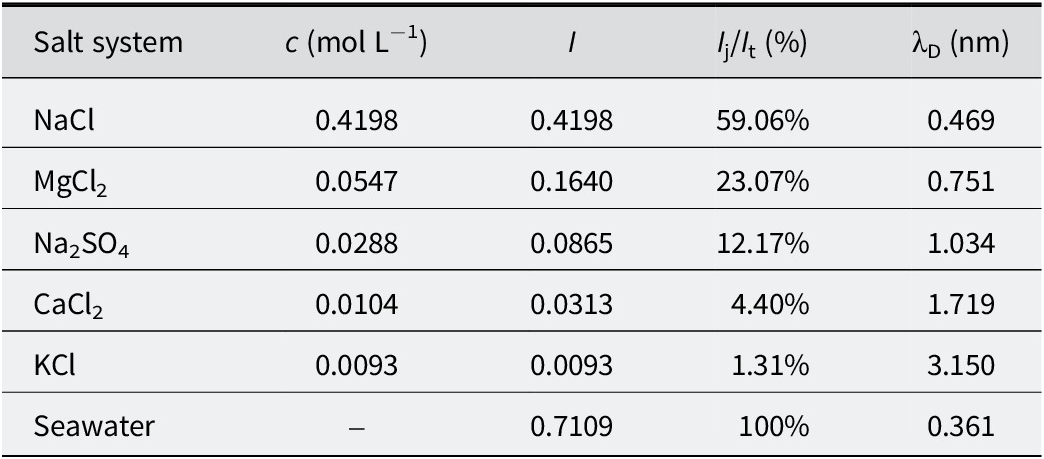
To probe these ion-specific interfacial interactions, zeta-potential measurements were used to characterize how different electrolyte ions modify the EDL structure and surface charge. The zeta-potential data (Fig. 1b) revealed pronounced variations reflecting ion-specific electrolyte–surface interactions. In pure water, sepiolite exhibited a zeta potential of −17.5 mV, consistent with negatively charged surface sites from isomorphic substitution and deprotonation of edge functional groups (Leroy and Revil, Reference Leroy and Revil2004; Carmona et al., Reference Carmona, Ramírez, Trujillo-Cayado, Caro and Muñoz2018). Upon dispersion in seawater, the zeta potential shifted to −3.37 mV, corresponding to a substantial reduction in surface negativity. The high ionic strength of the simplified seawater system, I=0.7109 mol L–1 (Table 2), compressed the EDL to a Debye length, λD, of 0.361 nm, the most compact among all systems examined (Al-Bazali, Reference Al-Bazali2022a; Al-Bazali, Reference Al-Bazali2022b). However, this pronounced charge reduction cannot be attributed solely to electrostatic screening and instead suggests combined contributions from EDL compression and ion-specific surface association (Wu, Reference Wu2022). By examining individual salt systems and their corresponding Debye lengths, systematic differences between monovalent and divalent ions became apparent.
Key parameters for various solutions

Table 2. Long description
The table consists of five columns: Salt system, c (mol L super -1), I, I sub j / I sub t (%), and lambda sub D (nm).
* N a C l: c is 0.4198, I is 0.4198, I sub j / I sub t is 59.06%, lambda sub D is 0.469.
* M g C l sub 2: c is 0.0547, I is 0.1640, I sub j / I sub t is 23.07%, lambda sub D is 0.751.
* N a sub 2 S O sub 4: c is 0.0288, I is 0.0865, I sub j / I sub t is 12.17%, lambda sub D is 1.034.
* C a C l sub 2: c is 0.0104, I is 0.0313, I sub j / I sub t is 4.40%, lambda sub D is 1.719.
* K C l: c is 0.0093, I is 0.0093, I sub j / I sub t is 1.31%, lambda sub D is 3.150.
* Seawater: c is not applicable, I is 0.7109, I sub j / I sub t is 100%, lambda sub D is 0.361.
Footnotes specify that c is molar concentration, I is ionic strength, I sub j / I sub t is the ionic-strength contribution, and lambda sub D is the Debye length at 25 degrees Celsius.
c = molar concentration of each salt; I = ionic strength; I j/I t indicates the ionic-strength contribution of each salt to the simplified seawater system; and λD represents the Debye length calculated at 25°C. For MgCl2, c is based on the anhydrous MgCl2 equivalent.
Among the chloride salt systems, NaCl, MgCl2, CaCl2, KCl, all exhibited reduced negative zeta potentials, but the magnitude varied dramatically with cation identity. The Debye length, representing EDL thickness and scaling as
$ {\lambda}_D\propto 1/\sqrt{I} $
 , provides a quantitative metric for expected electrostatic screening (Bharat and Sridharan, Reference Bharat and Sridharan2015; Srinivasan et al., Reference Srinivasan, Van den Akker and Shardt2023). Monovalent cation systems showed behavior broadly consistent with this classical prediction. NaCl, with c=0.4198 mol L–1 and contributing 59.06% of the ionic strength of the simplified seawater system, compressed the double layer to λD=0.469 nm and yielded ζ=−8.13 mV. KCl, with c=0.0093 mol L–1 and a 1.31% ionic-strength contribution, produced λD=3.150 nm and ζ=−14.90 mV, remaining close to the pure water system. This systematic trend indicates that classical electrostatic screening is the main contribution in monovalent cation systems (Leong, Reference Leong2024).
In contrast, divalent cations exhibited clear deviations from predictions based solely on Debye length. CaCl2, with c=0.0104 M and a 4.40% ionic-strength contribution, generated λD=1.719 nm, which is much larger than for NaCl. Classical screening alone would suggest a moderate reduction in zeta potential. However, the observed value was −3.17 mV, indicating a much stronger charge reduction. This discrepancy suggests that Ca2+ exerts ion-specific effects beyond classical screening, probably through specific cation association in the Stern layer and possible surface complexation with functional groups (Tertre et al., Reference Tertre, Castet, Berger, Loubet and Giffaut2006; Liu et al., Reference Liu, Lu, Sprik, Cheng, Meijer and Wang2013).
MgCl2 showed an even stronger effect. Despite its moderate ionic strength, I=0.1640 mol L−1, corresponding to 23.07% of the simplified seawater ionic strength, and an intermediate λD=0.751 nm, Mg2+ reduced the zeta potential to a near-neutral or slightly positive value, ζ=+0.20 mV. This behavior is consistent with strong Mg2+ association with sepiolite surfaces, probably involving specific adsorption in addition to diffuse-layer screening (Li and Schulthess, Reference Li and Schulthess2021; Orucoglu et al., Reference Orucoglu, Grangeon, Gloter, Robinet, Madé and Tournassat2022). The strong effect of Mg2+ may be related to its high charge density, arising from its divalent charge and small ionic radius. Although MgCl2 contributes less than one-quarter of the ionic strength of the simplified seawater system and has a Debye length larger than that of seawater, it modifies significantly interfacial charge characteristics. This comparison indicates that ion-specific surface chemistry is essential for understanding divalent cation systems.
Na2SO4, with c=0.0288 M, a 12.17% ionic-strength contribution, and λD=1.034 nm, showed an effect distinct from those of divalent cations. Despite its intermediate ionic strength, Na2SO4 increased the magnitude of the negative zeta potential beyond that in pure water. This behavior is consistent with a preferential association of SO42– with positively charged edge sites, which may partly offset Na+-induced diffuse-layer compression. Clay mineral edges have amphoteric surface sites, and positively charged domains may exist at fiber termini under near-neutral pH conditions. Preferential sulfate association with these sites may enhance the net negative charge and strengthen inter-fiber repulsion.
The seawater system provides a useful demonstration that interfacial behavior in multicomponent electrolyte systems cannot be predicted from ionic strength alone. The simplified seawater system, dominated by NaCl, compressed the double layer to λD=0.361 nm. If diffuse-layer compression alone controlled the zeta potential, seawater would be expected to behave similarly to or only slightly more strongly than NaCl. Instead, the observed zeta potential of seawater, −3.37 mV, was close to that of CaCl2 and much less negative than that of NaCl. This convergence indicates that divalent-cation surface association plays a disproportionately important role in determining the interfacial characteristics of the seawater system, whereas diffuse-layer compression by the dominant monovalent salts provides the background electrolyte effect.
These findings establish the basis for understanding microstructural evolution and rheological deterioration in seawater-dispersed sepiolite. The λD–ζ analysis reveals a clear distinction between monovalent and divalent cation systems. Monovalent systems are broadly consistent with diffuse-layer compression, whereas divalent cation systems show stronger charge neutralization than expected from Debye length alone. This behavior indicates that specific cation association and possible surface complexation contribute to the interfacial response of Mg2+ and Ca2+. These interfacial charge modifications can reduce electrostatic repulsion and favor altered fiber–fiber interactions, including lateral association and apparent bundling.
The pH values of all 5 wt.% sepiolite dispersions after 24 h equilibration were circumneutral to weakly alkaline, ranging from 7.2 to 8.0 (Table 3). This relatively narrow pH range indicates that the large differences in zeta potential and rheology cannot be attributed solely to bulk pH variation. Nevertheless, the possible role of pH-dependent divalent-cation chemistry should be acknowledged. At near-neutral pH, hydrolyzed Mg2+ and Ca2+ species may form to a limited extent and may contribute to additional attractive interactions or surface complexation with sepiolite. Therefore, the divalent-cation effect observed in this study is interpreted as arising from a combination of diffuse-layer compression, specific cation association, and possible contributions from hydrolyzed Mg/Ca species. The absence of similarly severe rheological degradation in the NaCl, KCl, and Na2SO4 systems, despite their comparable or slightly higher pH values, further indicates that pH alone does not control the observed behavior.
pH values of 5 wt.% sepiolite dispersions after 24 h of equilibration.

Table 3. Long description
The table consists of two rows and eight columns.
Row 1 (Headers): System, Pure water, Seawater, N a C l, K C l, N a sub 2 S O sub 4, M g C l sub 2, and C a C l sub 2.
Row 2 (p H values):
- Pure water: 7.8
- Seawater: 7.2
- N a C l: 7.9
- K C l: 8.0
- N a sub 2 S O sub 4: 8.0
- M g C l sub 2: 7.6
- C a C l sub 2: 7.3
These colloidal measurements establish the basis for interpreting microstructural evolution and rheological deterioration in seawater-dispersed sepiolite. The zeta-potential and Debye-length analysis reveals a clear distinction: monovalent systems largely follow diffuse-layer compression trends, whereas divalent cation systems deviate substantially because of strong surface association and charge neutralization. These interfacial charge modifications provide a chemical driving force for altered fiber–fiber interactions, including lateral association and apparent bundling.
Microstructure
Cryo-SEM was employed to visualize the frozen gel morphology of 5 wt.% sepiolite dispersions in pure water, seawater, and five single-salt systems. This technique minimizes drying-induced collapse compared with conventional SEM and allows qualitative comparison of fiber network architecture. However, because plunge freezing, cryo-fracturing, and sublimation were used, possible cryo-preparation artifacts, including ice-crystal formation, fracture-induced changes, and sublimation-related changes, cannot be completely excluded. All dispersions were prepared, frozen, fractured, sublimated, coated, and imaged using the same protocol. Therefore, the Cryo-SEM images are used mainly to compare relative morphological differences among electrolyte systems rather than to quantify the absolute native pore geometry. This limitation is considered in the interpretation below.
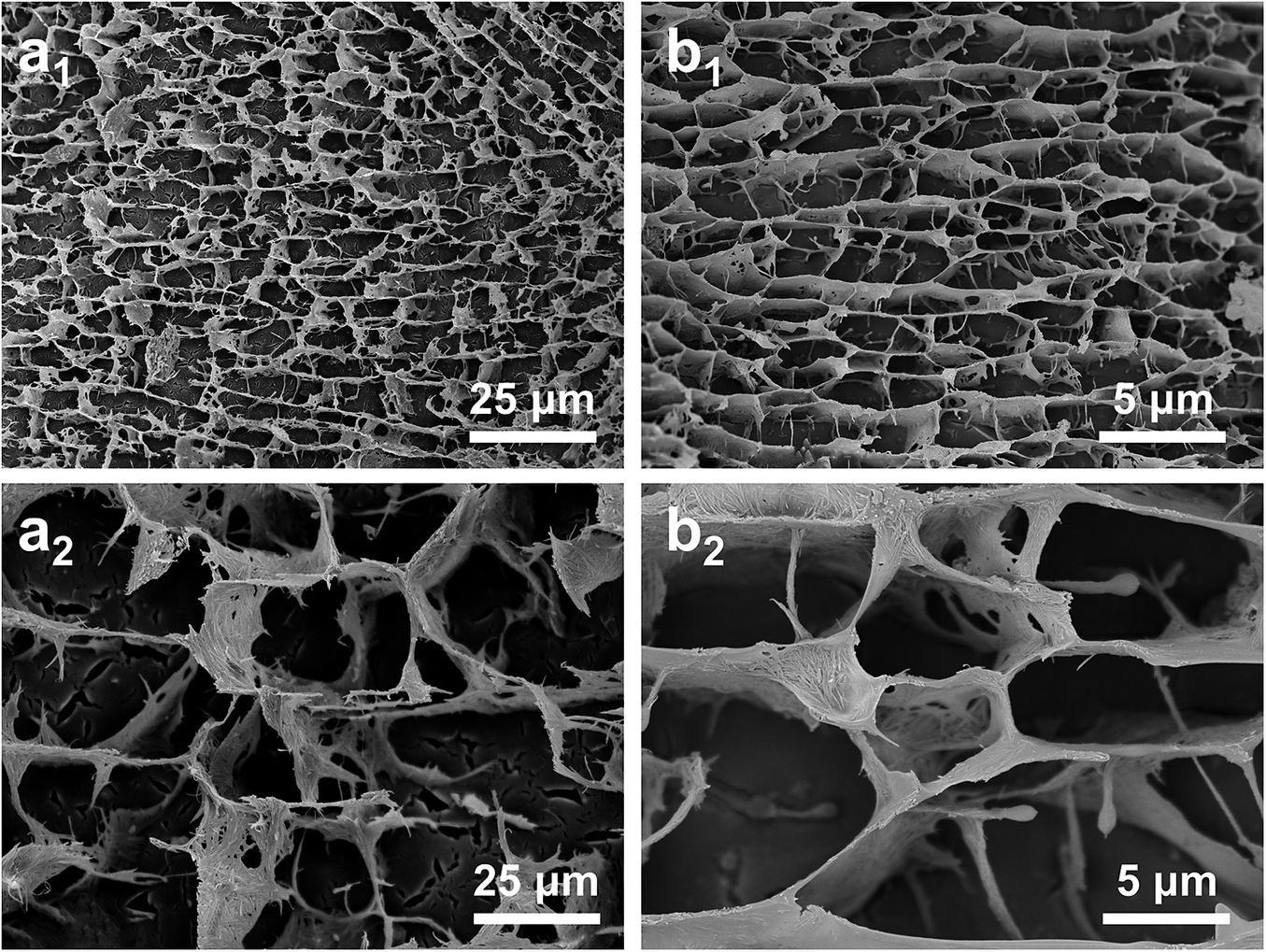
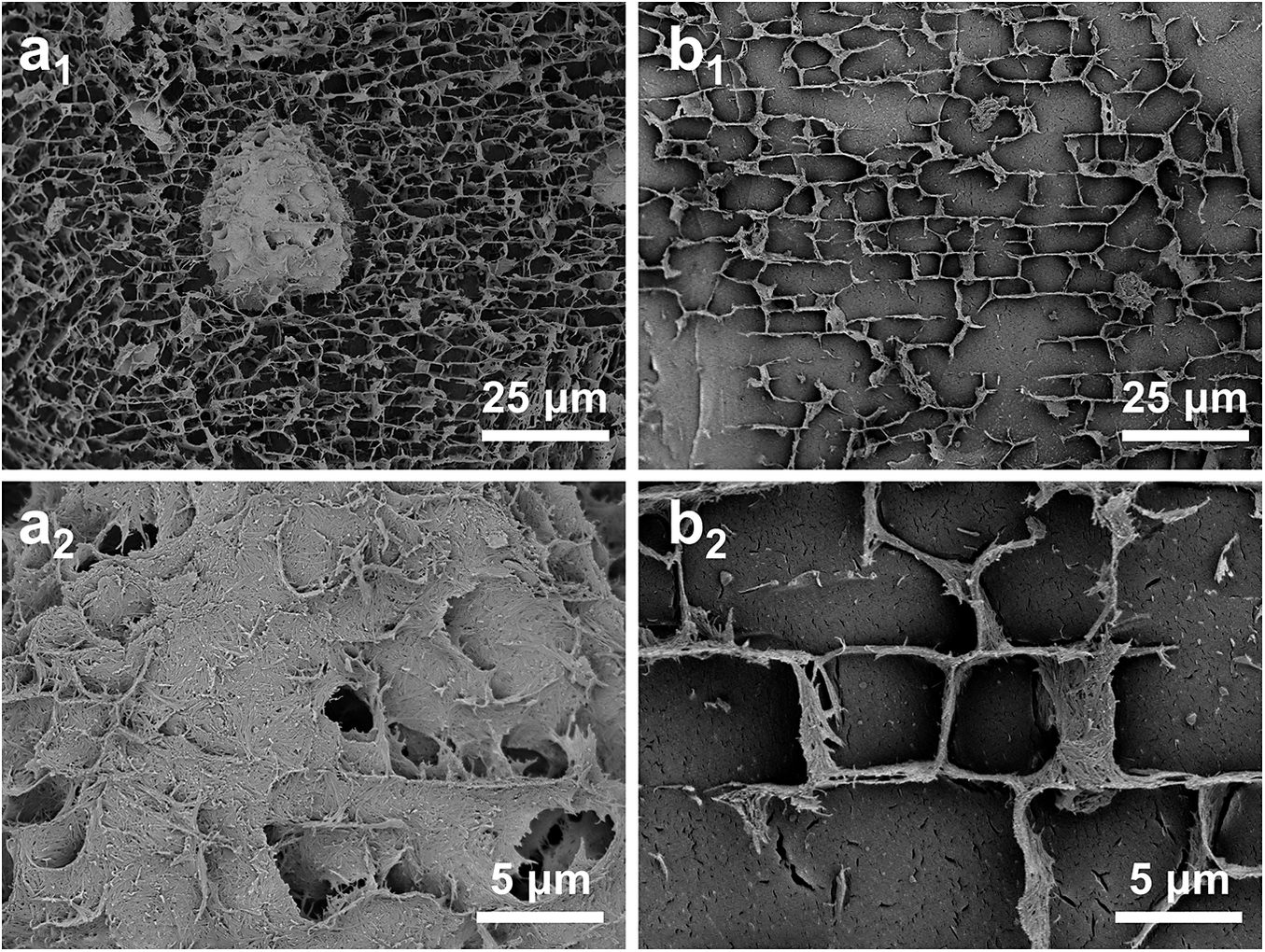
In pure water (Fig. 2a), the frozen gel morphology shows a relatively homogeneous fibrous network, with comparatively uniform pore-like features and abundant apparent contact points. The fibers exhibit mostly random spatial orientation with extensive physical entanglement, forming a voluminous ‘haystack’-like structure. This relatively homogeneous morphology is consistent with the low-ionic-strength environment, in which electrostatic repulsion from negatively charged fiber surfaces and surface hydration layers help maintain inter-fiber separation. Fiber–fiber interactions appear to occur mainly through weak, reversible point contacts and physical interlocking rather than extensive lateral association, preserving a large number of dispersed fiber units and load-bearing contact points throughout the network.
Cryogenic scanning electron microscopy (Cryo-SEM) images of 5 wt.% sepiolite dispersions in: (a1) pure water, 1000× ; (a2) pure water, 5000× ; (b1) seawater, 1000× ; (b2) seawater, 5000×.

Figure 2. Long description
A four-panel set of Cryo S E M micrographs.
Top-left panel a sub 1 shows a 5 weight percent sepiolite dispersion in pure water. It reveals a dense, interconnected network of thin, sheet-like walls forming irregular pores. A scale bar at the bottom-right indicates 25 micrometers.
Top-right panel b sub 1 shows the dispersion in seawater. The structure appears more organized with elongated, horizontally aligned pore channels separated by thin fibrous walls. A scale bar at the bottom-right indicates 5 micrometers.
Bottom-left panel a sub 2 provides a higher magnification view of the pure water dispersion. The walls of the pores show a rough, fibrous texture with many small protrusions. A scale bar at the bottom-right indicates 25 micrometers.
Bottom-right panel b sub 2 provides a higher magnification view of the seawater dispersion. The pore walls appear smoother and more distinct than in the pure water sample, with visible fibrous bundles forming the structural framework. A scale bar at the bottom-right indicates 5 micrometers.
Compared with pure water, the seawater system shows a more heterogeneous frozen morphology, with regions of relatively dispersed fibers co-existing with denser aggregated or bundled features (Fig. 2b) (Min Kim et al., Reference Min Kim, Eberle, Kate Gurnon, Porcar and Wagner2014; Mangal and Jamali, Reference Mangal and Jamali2024). This heterogeneity is consistent with the multicomponent nature of seawater, in which different ions compete for surface sites and modify the EDL structure to different extents. The zeta-potential change from −17.5 mV in pure water to −3.37 mV in seawater indicates strong charge neutralization. The resulting morphology appears less uniform than that in pure water, suggesting that some fibers remain individually dispersed while others undergo lateral association into denser features. This apparent shift from a relatively uniform fibrous network toward a more heterogeneous morphology is consistent with the reduced zeta potential and lower viscosity measured for the seawater system.
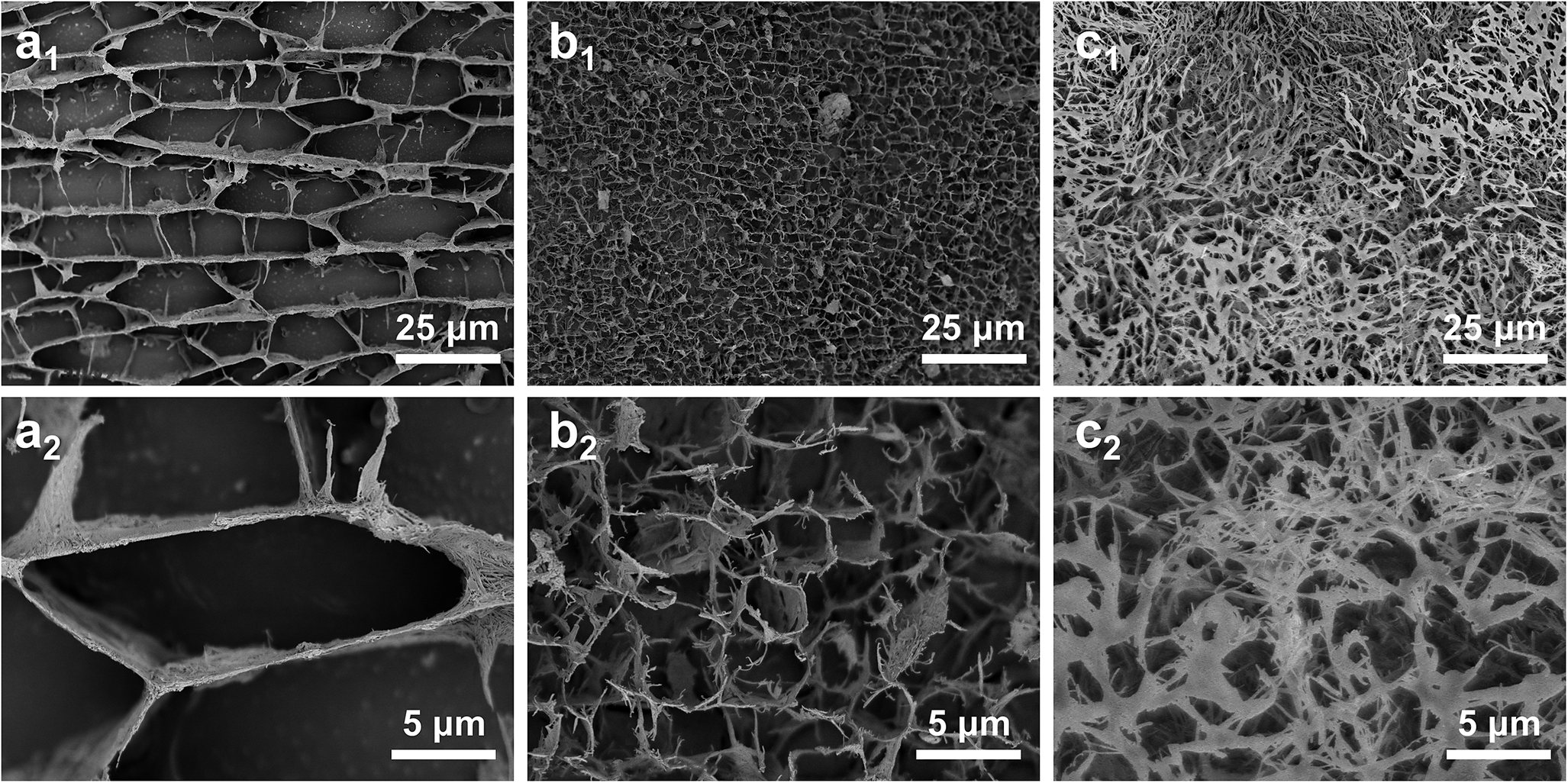
Qualitative comparison of the individual single-salt systems suggests that the heterogeneous morphology observed in seawater is related to distinct ion-specific effects. The monovalent cation systems, NaCl and KCl, and the divalent anion system, Na2SO4, generally preserve more voluminous network features dominated by entanglement and point contacts (Fig. 3). In the NaCl system (Fig. 3a), which contributes 59.06% of the simplified seawater ionic strength, the network retains considerable similarity to the pure-water baseline despite substantial EDL compression. Although Na⁺ reduces the zeta potential to −8.13 mV and decreases the estimated Debye length to 0.469 nm, the fibers remain largely individualized and network connectivity is maintained through distributed point contacts and entanglement junctions. The absence of obvious large fiber bundles in the NaCl system suggests that diffuse-layer compression alone did not cause extensive lateral aggregation under these conditions.
Cryogenic scanning electron microscopy (Cryo-SEM) images of 5 wt.% sepiolite dispersions in: (a1) NaCl, 1000×; (a2) NaCl, 5000×; (b1) KCl, 1000×; (b2) KCl, 5000× ; (c1) Na2SO4, 1000×; (c2) Na2SO4, 5000× solutions.

Figure 3. Long description
The figure is organized into three columns representing different salt solutions.
Column 1 (a sub 1 and a sub 2) shows sepiolite in N a C l. Panel a sub 1 reveals a highly ordered, honeycomb-like cellular structure with elongated, rectangular pores. Panel a sub 2 provides a close-up of a single pore, showing thin, smooth walls and a clear void space.
Column 2 (b sub 1 and b sub 2) shows sepiolite in K C l. Panel b sub 1 displays a much finer, more isotropic network with smaller, irregular pore sizes compared to the N a C l sample. Panel b sub 2 shows that the walls of this network are composed of interconnected fibrous bundles with a rougher texture.
Column 3 (c sub 1 and c sub 2) shows sepiolite in N a sub 2 S O sub 4. Panel c sub 1 exhibits a disordered, dense, and chaotic arrangement of fibrous clusters. Panel c sub 2 reveals a complex, three-dimensional web of thick, overlapping sepiolite fibers that lack the distinct cellular compartmentalization seen in the other two solutions.
Scale bars are located in the bottom right of each panel. Panels a sub 1, b sub 1, and c sub 1 have 25 micrometer scale bars. Panels a sub 2, b sub 2, and c sub 2 have 5 micrometer scale bars.
The KCl system (Fig. 3b) shows limited structural deviation from pure water, consistent with its low concentration and large Debye length. At this ionic strength, the EDL remains relatively extended and the zeta potential remains close to that in pure water. Therefore, K+ appears to play a relatively minor role in the frozen network morphology at seawater-relevant concentration.
Na2SO4 (Fig. 3c) provides an instructive case for anion-specific effects. Despite the presence of divalent SO42– and an intermediate ionic strength, this system produces a relatively fine fibrous network and a more negative zeta potential than pure water. This behavior is consistent with preferential association of SO42− with positively charged edge sites, which may partly offset Na⁺-induced diffuse-layer compression. Preferential sulfate association, possibly involving surface complexation at edge sites, may enhance the net negative charge, strengthen inter-fiber repulsion, and promote a refined network architecture. This finding indicates that divalent ions do not necessarily destabilize sepiolite dispersions; their effect depends heavily on whether they interact with negatively charged basal/fiber surfaces or positively charged edge sites.
Divalent cation systems, MgCl2 and CaCl2, show qualitatively different frozen morphologies (Fig. 4). The MgCl2 and CaCl2 systems display denser aggregated features and apparent side-by-side fiber association, suggesting the formation of fiber bundles. This transformation changes the network from distributed connectivity of many individual fibers toward fewer, larger aggregated units separated by larger void-like regions. In MgCl2 (Fig. 4a), dense aggregated domains and apparent bundles several times thicker than individual fibers are observed. The near-neutral or slightly positive zeta potential in the MgCl2 system, ζ=+0.20 mV, provides a plausible explanation for the enhanced tendency toward lateral fiber association. Strong charge neutralization would markedly reduce electrostatic repulsion and may allow attractive interactions between surface domains to promote fiber association.
Cryogenic scanning electron microscopy (Cryo-SEM) images of 5 wt.% sepiolite dispersions in: (a1) MgCl2, 1000×; (a2) MgCl2, 5000×; (b1) CaCl2, 1000×; (b2) CaCl2, 5000× solutions.

Figure 4. Long description
The figure consists of four panels arranged in a two-by-two grid.
* Top-left panel a sub 1: A C r y o S E M micrograph at a 25 micrometer scale showing a dense, interconnected network of fine sepiolite fibers. The structure appears as a porous, sponge-like matrix with a large, rounded aggregate visible in the upper-left quadrant.
* Top-right panel b sub 1: A C r y o S E M micrograph at a 25 micrometer scale showing a more open, cellular structure. The network is composed of larger, rectangular or polygonal voids separated by thin walls of sepiolite fibers, resembling a honeycomb or grid pattern.
* Bottom-left panel a sub 2: A higher magnification micrograph of the magnesium chloride sample at a 5 micrometer scale. It reveals the intricate, matted texture of the individual sepiolite fibers forming thick, irregular walls around smaller, deep pores.
* Bottom-right panel b sub 2: A higher magnification micrograph of the calcium chloride sample at a 5 micrometer scale. It shows the distinct, clean edges of the large polygonal cells. The walls are composed of densely packed fibers, and the interior surfaces of the cells appear relatively smooth compared to the magnesium chloride sample.
The CaCl2 system (Fig. 4b) produces similar, although somewhat less pronounced, aggregation features despite the absence of positive zeta potential. Ca2+ reduces the zeta potential to −3.17 mV and compresses the EDL, weakening electrostatic stabilization sufficiently to allow fibers to approach more closely. The presence of dense aggregated features and larger void-like regions suggests that reduced electrostatic repulsion and divalent-cation association can promote lateral aggregation even without complete charge neutralization. Thus, divalent-cation-induced bundling appears to be a threshold-like process: once the repulsive energy barrier is sufficiently reduced, lateral fiber association can proceed.
The critical distinction between monovalent and divalent cation systems lies in their different modes of charge modification and their structural consequences. In monovalent systems, compression occurs mainly through diffuse-layer counterion accumulation, reducing repulsive potential without strongly altering intrinsic surface charge. Fibers may approach more closely, but residual repulsion helps preserve dispersed configurations and reversible contacts. In divalent cation systems, both diffuse-layer compression and stronger cation association with surface sites contribute to charge neutralization. This surface association can modify interfacial charge more strongly than monovalent screening and create conditions favorable for lateral fiber association.
Note that Cryo-SEM provides qualitative morphological evidence rather than direct quantitative proof of the native aqueous structure. Ice-crystal formation, cryo-fracturing, and sublimation may influence the apparent pore geometry and local morphology. Nevertheless, because the same cryo-preparation and imaging protocol was applied to all samples, the relative differences among electrolyte systems remain informative. The stronger aggregation or bundling features observed in MgCl2 and CaCl2 are consistent with the independent zeta-potential and rheological results.
Rheological behavior
Comprehensive rheological characterization was performed to establish quantitative relationships between ion-specific interfacial modification, fiber network morphology, and macroscopic performance. Rheological measurements assess directly how EDL compression, specific cation association, and consequent network reorganization manifest in flow behavior under applied stress. Integration of flow curves with apparent-viscosity analysis enables correlation of molecular-scale surface interactions and microscale fiber arrangements with bulk transport properties relevant to practical performance.
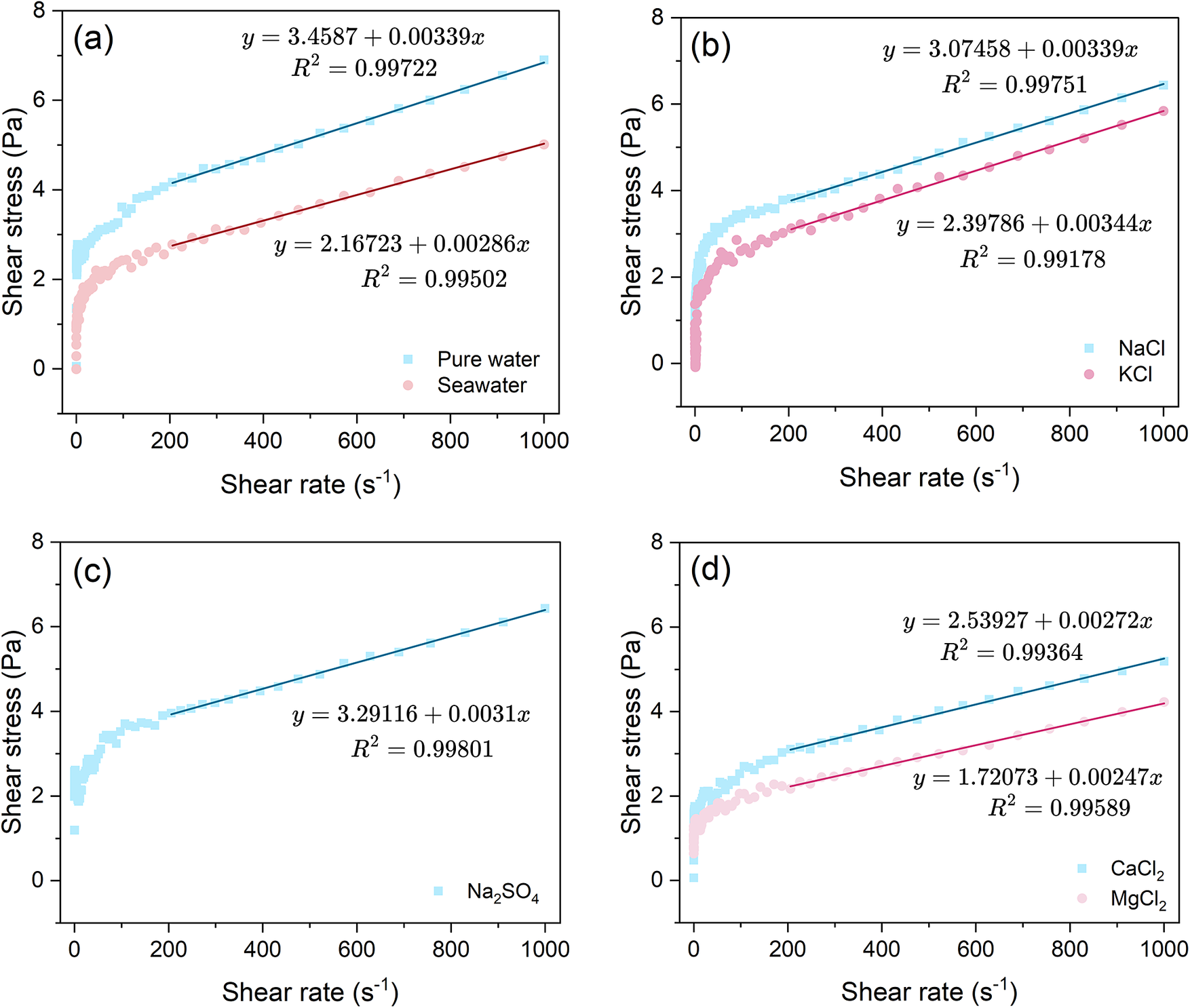
All sepiolite dispersions exhibited pronounced shear-thinning behavior across the examined shear-rate range of 0.1–1000 s–1 (Fig. 5). This behavior reflects the fundamental response of entangled fibrous networks. At low shear rates, the three-dimensional percolating structure maintains extensive inter-fiber contacts that provide substantial flow resistance, yielding high apparent viscosity (Tunc et al., Reference Tunc, Duman and Cetinkaya2011; Benli, Reference Benli2014; Ettehadi, Reference Ettehadi2020; Tonkur et al., Reference Tonkur, Can and Sabah2022). As shear rate increases, hydrodynamic forces overcome junction strength progressively, inducing network breakdown through disentanglement, fiber alignment along flow streamlines, and disruption of load-bearing contacts. The aligned configuration reduced hydrodynamic resistance and lowered the effective volume fraction, thereby decreasing apparent viscosity. Although all systems share this qualitative behavior, viscosity magnitude and shear-thinning intensity varied markedly with electrolyte composition, reflecting the ion-specific structural differences inferred from zeta-potential and Cryo-SEM data.
Flow curves of 5 wt.% sepiolite dispersions in (a) pure water and seawater; (b) Nacl and KCl; (c) Na2SO4; (d) CaCl2 and MgCl2 solutions. Continuous lines represent Bingham fitting of the high-shear-rate region.

Figure 5. Long description
A multi-panel figure consisting of four line graphs labeled a through d. All panels share the same axes: the x-axis represents Shear rate in s super -1 from 0 to 1000, and the y-axis represents Shear stress in P a from 0 to 8.
* Panel a: Compares Pure water (light blue squares) and Seawater (pink circles). Pure water sits higher on the y-axis with a fitting equation of y = 3.4587 + 0.00339x and R super 2 = 0.99722. Seawater follows below with y = 2.16723 + 0.00286x and R super 2 = 0.99502.
* Panel b: Compares N a C l (light blue squares) and K C l (pink circles). N a C l is the upper curve with y = 3.07458 + 0.00339x and R super 2 = 0.99751. K C l is the lower curve with y = 2.39786 + 0.00344x and R super 2 = 0.99178.
* Panel c: Shows a single data series for N a sub 2 S O sub 4 (light blue squares). The fitting equation is y = 3.29116 + 0.0031x and R super 2 = 0.99801.
* Panel d: Compares C a C l sub 2 (light blue squares) and M g C l sub 2 (pink circles). C a C l sub 2 is the upper curve with y = 2.53927 + 0.00272x and R super 2 = 0.99364. M g C l sub 2 is the lower curve with y = 1.72073 + 0.00247x and R super 2 = 0.99589.
In all panels, the data show a rapid non-linear increase in shear stress at very low shear rates (0 to 200 s super -1), followed by a linear Bingham plastic behavior at higher shear rates.
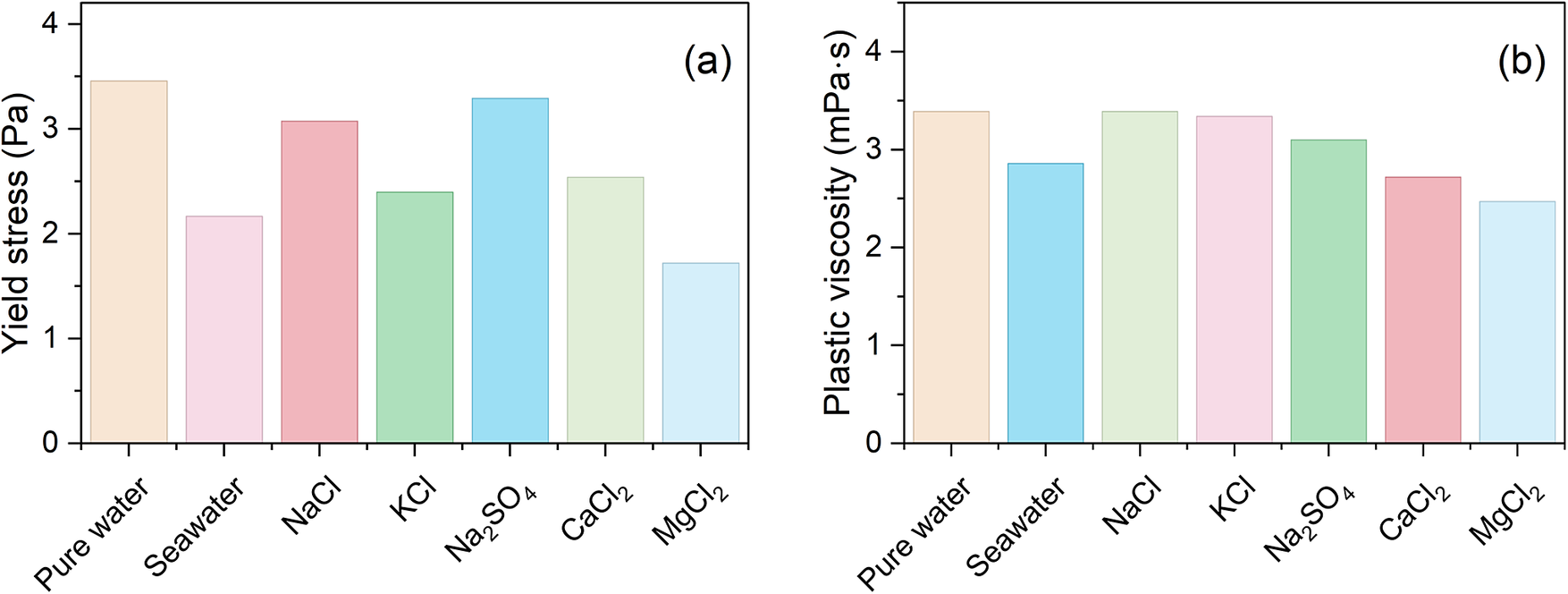
The flow curves exhibit two regimes. At low shear rates, below ~100 s–1, shear stress increased rapidly with increasing shear rate, characteristic of pseudoplastic behavior. At higher shear rates above ~100 s–1, the flow curves conform closely to the Bingham plastic model, with R2 values >0.99 (Tunc et al., Reference Tunc, Duman and Cetinkaya2011). The fitted line intercept represented the dynamic yield stress, which corresponded to the stress required to overcome the internal structure during flow. The slope represented plastic viscosity, reflecting viscous resistance during flow. To quantify electrolyte effects, dynamic yield stress and plastic viscosity were compiled from high-shear-rate fitting (Fig. 6), while apparent viscosity was determined at 1000 s–1 (Fig. 7).
(a) Dynamic yield stress and (b) plastic viscosity of 5 wt.% sepiolite dispersions derived from Bingham fitting of the high-shear-rate region.

Figure 6. Long description
A two-panel figure consisting of two bar charts labeled a and b.
Panel a is a bar chart titled Yield stress in P a on the y-axis, ranging from 0 to 4. The x-axis lists seven categories. From left to right, the yield stress values are approximately: Pure water at 3.5, Seawater at 2.2, N a C l at 3.1, K C l at 2.4, N a sub 2 S O sub 4 at 3.3, C a C l sub 2 at 2.5, and M g C l sub 2 at 1.7.
Panel b is a bar chart titled Plastic viscosity in m P a dot s on the y-axis, ranging from 0 to 4. The x-axis lists the same seven categories. From left to right, the plastic viscosity values are approximately: Pure water at 3.4, Seawater at 2.9, N a C l at 3.4, K C l at 3.3, N a sub 2 S O sub 4 at 3.1, C a C l sub 2 at 2.7, and M g C l sub 2 at 2.5.
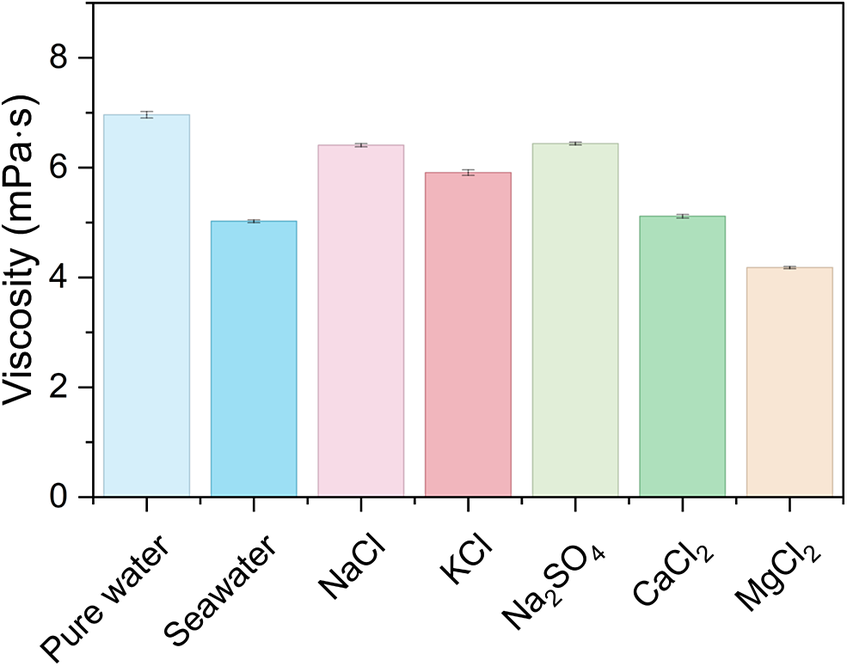
Apparent viscosity of 5 wt.% sepiolite dispersions at a shear rate of 1000 s–1 in pure water, seawater, and five single-salt solutions.

Figure 7. Long description
The figure is a bar chart showing Viscosity in m P a dot s on the y-axis ranging from 0 to 8. The x-axis lists the same seven media. From left to right, the viscosity values with small error bars are approximately: Pure water at 7.0, Seawater at 5.0, N a C l at 6.4, K C l at 5.9, N a sub 2 S O sub 4 at 6.5, C a C l sub 2 at 5.1, and M g C l sub 2 at 4.2.
In pure water, sepiolite exhibited the greatest dynamic yield stress, 3.5 Pa, plastic viscosity, 3.4 mPa·s, and apparent viscosity, 7.0 mPa·s. These relatively high values are consistent with the homogeneous, highly entangled network observed in Fig. 2a, where abundant reversible contacts throughout the three-dimensional framework maximized flow resistance. The strong negative zeta potential, ζ=−17.5 mV, and extended EDL help maintain inter-fiber separation, allowing individual fibers to participate in the load-bearing network rather than aggregating into less active bundles.
Monovalent cations induced measurable but modest rheological changes. In the NaCl system, which contributes 59.06% of the simplified seawater ionic strength, the apparent viscosity decreased to 6.4 mPa·s, corresponding to an 8% reduction relative to pure water. This result correlates with the subtle morphological modifications observed in Fig. 3a, where EDL compression and zeta-potential reduction allowed closer fiber approach but did not induce extensive bundling. Preservation of network continuity ensures that the system retained substantial viscosity and maintained shear-thinning behavior qualitatively similar to pure water.
The KCl system exhibited slightly lower apparent viscosity and yield stress than the pure-water and NaCl systems despite its small ionic-strength contribution, 1.31%. This behavior may reflect weak ion-specific effects of K+ rather than diffuse-layer compression alone. Compared with Na+, K+ is less strongly hydrated and may approach siloxane, silanol, or Mg–OH surface sites more closely, thereby partially weakening hydration-mediated repulsion or modifying local fiber–fiber contacts. However, because the KCl concentration is low and the zeta potential remains close to that in pure water, this interpretation should be regarded as tentative. The K+ effect is minor compared with the pronounced divalent-cation-induced aggregation observed for MgCl2 and CaCl2.
The Na2SO4 system presents a distinct case. Its apparent viscosity, 6.4 mPa·s, approaches that of the NaCl system despite an intermediate ionic strength. This behavior is consistent with the anion-specific effect identified through zeta-potential and microstructural observations. Preferential SO42– association with positively charged edge sites may enhance the net negative surface charge, strengthen electrostatic repulsion between fibers, and promote a refined network architecture. Although enhanced repulsion may help prevent fiber aggregation, it can also reduce the number or strength of fiber contacts, yielding slightly lower viscosity than pure water. This result further indicates that ionic strength alone cannot predict rheological performance in fibrous clay systems.
Divalent cation systems exhibited pronounced rheological degradation that cannot be explained by ionic strength alone. The MgCl2 system, contributing 23.07% of the simplified seawater ionic strength, reduced apparent viscosity by 40%, dynamic yield stress by ~51%, and plastic viscosity by ~26% compared with pure water. The CaCl2 system, despite contributing only 4.40% of the ionic strength, produced a 27% reduction in apparent viscosity. This disproportionate deterioration is consistent with the morphological transition shown in Fig. 4, where apparent side-by-side fiber aggregation and bundle formation reduced the number of independently dispersed structural units. Bundling also lowered the effective aspect ratio of the dispersed units. Because viscosity in fiber suspensions was highly sensitive to aspect ratio, bundling-induced reduction of effective aspect ratio can produce severe viscosity loss even when total fiber mass remains constant.
The divalent cation systems also imply altered shear-thinning mechanisms. In pure water and monovalent systems, shear-thinning probably arises from progressive fiber alignment and gradual disruption of reversible entanglement contacts. After shear removal, the randomly oriented entangled configurations in monovalent systems are expected to recover more readily because the fiber contacts are mainly reversible. In divalent-cation systems, the apparent bundles formed under quiescent conditions are expected to have stronger internal cohesion because of reduced electrostatic repulsion and enhanced cation-mediated attraction. The reduced surface charge and enhanced inter-fiber attraction in these systems are expected to favor more persistent bundled structures than the reversible contacts in monovalent systems. However, direct time-resolved recovery or thixotropy measurements would be required to quantify the stability and reversibility of these bundles. Consequently, the lower-viscosity state in divalent-cation systems may be associated with less efficient structural recovery, although this inference requires direct recovery measurements for confirmation.
The seawater system produced rheological behavior closer to that of the divalent-cation systems than to a simple average of all constituent single-salt systems. The apparent viscosity in seawater, 5.0 mPa·s, was close to those in MgCl2 and CaCl2 systems despite the fact that monovalent cations account for the majority of the ionic strength and individually produce only modest viscosity reductions. This convergence indicates that divalent cations exert a disproportionate influence on rheological deterioration in the simplified seawater environment. Although Na+ contributes the majority of ionic strength and provides substantial diffuse-layer compression, diffuse-layer compression alone did not induce the same degree of fiber bundling and network fragmentation. Instead, the strong association of Mg2+ and Ca2+ with sepiolite surfaces, reflected by the large reduction in zeta potential, probably promotes lateral fiber association and bundle formation. The resulting heterogeneous structure, characterized by co-existing dispersed and aggregated regions, leads to reduced flow resistance and lower apparent viscosity.
The present analysis focused on 5 wt.% sepiolite dispersions to isolate ion-specific effects under a fixed and practically relevant solid loading. Higher-concentration gels may show stronger physical crowding, larger yield stresses, and possible additional complications such as wall slip, loading heterogeneity, and less uniform pre-shear/recovery histories. Therefore, concentration-dependent rheology should be examined systematically in future work.
The rheological analysis establishes several important mechanistic insights. First, viscosity reduction cannot be predicted from ionic strength or Debye length alone; ion-specific surface-charge modification and resulting network architecture are critical. Second, monovalent and divalent cations exhibit distinct effects; monovalent systems preserve continuous networks with modest viscosity reduction, whereas divalent cation systems promote fiber association and more pronounced performance loss. Third, the dominant rheological influence of minority divalent cations in seawater indicates that formulation strategies should specifically target Mg2+ and Ca2+ rather than focusing solely on bulk salinity reduction. Finally, the Na2SO4 system suggests that some anions may preserve or even enhance dispersion stability through edge-site interactions, offering a possible pathway for rheological modifier design in high-salinity drilling fluids.
Conclusions
The present study demonstrated that the rheological behavior of sepiolite dispersions in seawater cannot be predicted from bulk ionic strength alone. Although all 5 wt.% sepiolite dispersions remained macroscopically stable without visible sedimentation, their interfacial properties, frozen gel morphologies, and rheological responses differed substantially among electrolyte systems.
Monovalent salts, especially NaCl and KCl, mainly caused diffuse-layer compression and preserved relatively voluminous fibrous networks, resulting in only modest reductions in apparent viscosity and yield stress. In contrast, MgCl2 and CaCl2 produced more significant charge neutralization and promoted apparent side-by-side fiber association. MgCl2 showed the strongest effect, reducing the zeta potential to a near-neutral or slightly positive value. The resulting fiber bundling reduced the number of effectively dispersed structural units and lowered the apparent aspect ratio of the network, leading to pronounced rheological degradation.
The simplified seawater system behaved more similarly to the divalent-cation systems than to the monovalent-salt systems, indicating that Mg2+ and Ca2+ exert a disproportionate influence on sepiolite rheology despite their lower abundance relative to NaCl. Therefore, optimization of sepiolite-based drilling fluids for seawater environments should focus not only on total salinity but also on mitigating divalent-cation effects. Potential strategies include selective chelation of Mg2+ and Ca2+, surface modification of sepiolite fibers, and the use of polymeric dispersants that provide steric stabilization.
Possible freezing artifacts in Cryo-SEM and the absence of direct time-resolved recovery measurements should be considered when interpreting the microstructural observations. Future work should examine concentration-dependent rheology, high-temperature behavior, quantitative bundle-size analysis, and molecular-scale adsorption mechanisms in true multicomponent seawater systems.
Data availability statement
Data will be made available on request.
Acknowledgments
None.
Author contributions
Conceptualization: G.Z.; Formal analysis: B.X., G.Z.; Funding acquisition: G.Z.; Investigation: B.X., Q.L., G.Z.; Supervision: G.Z.; Writing – original draft: B.X., G.Z.; Writing – review and editing: Q.L., G.Z., M.C., W.C., P.Y.
Financial support
This work was financially supported by the National Natural Science Foundation of China (42572035, 42502023), Guangdong Basic and Applied Basic Research Foundation (2023A1515110795), and Guangzhou Science and Technology Planning Project (SL2024A04J01144).
Competing interests
The authors declare none.