




No CrossRef data available.
Article contents
Away from ethnocentrism and anthropocentrism: Towards a scientific understanding of “what makes us human”
Published online by Cambridge University Press: 15 June 2010
Abstract
The quest to understand “what makes us human” has been heading towards an impasse, when comparative psychology compares primarily individuals that are not representative of their species. Captives experience such divergent socioecological niches that they cannot stand for their wild counterparts. Only after removing ethnocentrism and anthropocentrism will we be able to progress in our understanding of “what makes us human.”
Information
- Type
- Open Peer Commentary
- Information
- Copyright
- Copyright © Cambridge University Press 2010
References
Boesch, C. (2007) What makes us human (Homo sapiens)? The challenge of cognitive cross-species comparison. Journal of Comparative Psychology
121(3):227–40.Google Scholar
Boesch, C. (2008) Taking development and ecology seriously when comparing cognition. Journal of Comparative Psychology
122(4):453–55.Google Scholar
Boesch, C. (2009) The real chimpanzee: Sex strategies in the forest. Cambridge University Press.Google Scholar
Boesch, C. & Boesch, H. (1984) Mental map in wild chimpanzees: An analysis of hammer transports for nut cracking. Primates
25:160–70.Google Scholar
Boesch, C. & Boesch, H. (1989) Hunting behavior of wild chimpanzees in the Taï National Park. American Journal of Physical Anthropology
78:547–73.Google Scholar
Boesch, C., Crockford, C., Herbinger, I., Wittig, R., Moebius, Y. & Normand, E. (2008) Intergroup conflicts among chimpanzees in Taï National Park: Lethal violence and the female perspective. American Journal of Primatology
70:1–14.Google Scholar
Boesch, C., Eckhard, N., Bolé, C. & Boesch, H. (2010) Altruism in forest chimpanzees: The case of adoption. PLoS One
5(1):e8901.Google Scholar
Boesch, C., Head, J. & Robbins, M. (2009) Complex tool sets for honey extraction among chimpanzees in Loango National Park, Gabon. Journal of Human Evolution
56:560–69.Google Scholar
Carpendale, J. & Lewis, C. (2004) Constructing an understanding of mind: The development of children's social understanding within social interaction. Behavioral and Brain Sciences
27:79–151.Google Scholar
de Waal, F. B. M. (2001) The ape and the sushi master: Cultural reflections of a primatologist. Basic Books.Google Scholar
Goodall, J. (1986) The chimpanzees of Gombe: Patterns of behavior. The Belknap Press of Harvard University Press.Google Scholar
Henrich, J., McElreath, R., Ensminger, J., Barr, A., Barrett, C., Bolyanatz, A., Cardenas, J. C., Gurven, M., Gwako, E., Henrich, N., Lesorogol, C., Marlowe, F., Tracer, D. & Ziker, J. (2006) Costly punishment across human societies. Science
312(5868):1767–70.Google Scholar
Herrmann, E., Call, J., Lloreda, M., Hare, B. & Tomasello, M. (2007) Humans have evolved specialized skills of social cognition: The cultural intelligence hypothesis. Science
317:1360–66.Google Scholar
Mitani, J. & Watts, D. (2001) Why do chimpanzees hunt and share meat?
Animal Behaviour
61:1–10.CrossRefGoogle Scholar
Mitani, J. & Watts, D. (2005) Correlates of territorial boundary patrol behaviour in wild chimpanzees. Animal Behaviour
70:1079–86.Google Scholar
Mitani, J., Watts, D. & Muller, M. (2002) Recent development in the study of wild chimpanzee behaviour. Evolutionary Anthropology
11(1):9–25.Google Scholar
Nelson, C., Zeanah, C., Fox, N., Marshall, P., Smyke, A. & Guthrie, D. (2007) Cognitive recovery in socially deprived young children: The Bucharest early intervention project. Science
318:1937–40.Google Scholar
Povinelli, D. J. (2000) Folk physics for apes: The chimpanzee's theory of how the world works. Oxford University Press.Google Scholar
Povinelli, D. J. & Vonk, J. (2003) Chimpanzee minds: Suspiciously human?
Trends in Cognitive Sciences
7(4):157–60.CrossRefGoogle ScholarPubMed
Sanz, C., Morgan, D. & Gulick, S. (2004) New insights into chimpanzees, tools, and termites from the Congo Basin. American Naturalist
164(5):567–81.Google Scholar
Silk, J. B., Brosnan, S. F., Vonk, J., Henrich, J., Povinelli, D. J., Richardson, A. S., Lambeth, S. P., Mascaro, J. & Shapiro, S. J. (2005) Chimpanzees are indifferent to the welfare of unrelated group members. Nature
437:1357–59.Google Scholar
Tomasello, M., Carpenter, M., Call, J., Behne, T. & Moll, H. (2005) Understanding and sharing intentions: The origins of cultural cognition. Behavioral and Brain Sciences
28:675–91.Google Scholar
Vonk, J., Brosnan, S., Silk, J., Henrich, J., Richardson, A., Lambeth, S., Schapiro, S. & Povinelli, D. (2008) Chimpanzees do not take advantage of very low cost opportunities to deliver food to unrelated group members. Animal Behaviour
75(5):1757–70.CrossRefGoogle Scholar
Warneken, F. & Tomasello, M. (2006) Altruistic helping in human infants and young chimpanzees. Science
311:1301–03.Google Scholar
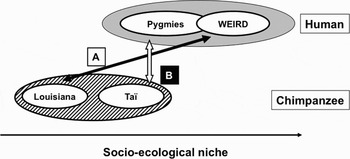
Figure 1. Schematic representation of the cognitive landscape in humans and chimpanzees as a function of the different socioecological niches that each species encounters. For each species, the possible range of cognitive performance is illustrated by an ellipse including all the individual population performances. Two types of cross-species comparisons are illustrated: The first one, the classical comparative psychology approach, compares two outlier populations for their species (black arrow A compares captive chimpanzees with WEIRD humans); and the second one compares populations of two species facing similar socio-ecological niches (white arrow B).
 You have
Access
- 7
- Cited by
Henrich et al.'s review of cognitive differences among human cultures is very timely in reminding us that different living conditions have consequences for cognitive development. Not all humans are Westerners, and this is true also for their cognition. Here, I want to address how this affects our understanding of cognitive differences between humans and chimpanzees, and requires reconsideration of many claims about “what makes us human” (Boesch Reference Boesch2007; Reference Boesch2008). To become a science, comparative psychology will have to include population differences in its theoretical thinking and empirical approaches.
Comparative psychology suffers from the same weaknesses as noted by Henrich et al. for psychology. Bold claims about “human uniqueness” are made based on the assumption that WEIRD (Western, Educated, Industrialized, Rich, and Democratic) societies' humans (I referred to them as WMC, or Western middle class, humans; Boesch Reference Boesch2007) and captive chimpanzee populations are representative of each of the two species (Boesch Reference Boesch2007; de Waal Reference de Waal2001). Comparative psychology predominantly compared captive chimpanzees with free Western humans (see black arrow A in my Figure 1). The overwhelming conclusion of these studies was that humans clearly outperform chimpanzees in such different cognitive domains as folk physics, altruism, cooperation, theory of mind, and gaze following (e.g., Hermann et al. Reference Herrmann, Call, Lloreda, Hare and Tomasello2007; Povinelli Reference Povinelli2000; Povinelli & Vonk Reference Povinelli and Vonk2003; Silk et al. Reference Silk, Brosnan, Vonk, Henrich, Povinelli, Richardson, Lambeth, Mascaro and Shapiro2005; Tomasello et al. Reference Tomasello, Carpenter, Call, Behne and Moll2005).
Schematic representation of the cognitive landscape in humans and chimpanzees as a function of the different socioecological niches that each species encounters. For each species, the possible range of cognitive performance is illustrated by an ellipse including all the individual population performances. Two types of cross-species comparisons are illustrated: The first one, the classical comparative psychology approach, compares two outlier populations for their species (black arrow A compares captive chimpanzees with WEIRD humans); and the second one compares populations of two species facing similar socio-ecological niches (white arrow B).
However, three essential points that invalidate their conclusions have been too often forgotten in the interpretation of such studies. First, the characteristics of the animal populations included in these studies are typically not representative of their species. The Louisiana captive chimpanzee group that has been used extensively in a variety of widely cited cognitive studies (e.g., Povinelli Reference Povinelli2000; Povinelli & Vonk Reference Povinelli and Vonk2003; Silk et al. Reference Silk, Brosnan, Vonk, Henrich, Povinelli, Richardson, Lambeth, Mascaro and Shapiro2005; Vonk et al. Reference Vonk, Brosnan, Silk, Henrich, Richardson, Lambeth, Schapiro and Povinelli2008) nicely illustrates this point (see Fig. 1). This group was created by putting together seven 2- to 3-year-old chimpanzees that were kept in isolation as a same-aged peers group all their lives, in a small, stable, and restricted man-made environment (see Povinelli Reference Povinelli2000). Such a history cannot be more different from the one of young chimpanzees in the wild. Wild individuals live in large, flexible, fission-fusion groups, with 30 to 100 individuals of different ages, in kilometer-wide ranges where food has to be located and extracted, and where life-threatening neighbors and predators loom (e.g., Mitani et al. Reference Mitani, Watts and Muller2002). True, captive conditions range from highly ecologically deprived environments, typical for the early 1950s, to much more enriched conditions, as seen in modern settings. Moreover, social conditions vary from complete isolation to more social groups. However, all captive conditions differ from wild ones in that captives are forced to live in much smaller, stable social groups, in very passive environments where food is provided and no competition with others exists. The fields of developmental and social psychology have shown that such differences have important effects on cognitive development in humans (Carpendale & Lewis Reference Carpendale and Lewis2004; Nelson et al. Reference Nelson, Zeanah, Fox, Marshall, Smyke and Guthrie2007).
No surprise that some captive chimpanzees have difficulties in understanding unseen relationships (Povinelli Reference Povinelli2000), whereas wild chimpanzees transport stone hammers to distant, out-of-sight nut-producing trees (Boesch & Boesch Reference Boesch and Boesch1984) and use tools to extract unseen underground resources (Boesch et al. Reference Boesch, Head and Robbins2009; Sanz et al. Reference Sanz, Morgan and Gulick2004). Similarly, some captives are unable to share food (Silk et al. Reference Silk, Brosnan, Vonk, Henrich, Povinelli, Richardson, Lambeth, Mascaro and Shapiro2005; Warneken & Tomasello Reference Warneken and Tomasello2006) or to work as a team with shared goals (Tomasello et al. Reference Tomasello, Carpenter, Call, Behne and Moll2005), whereas wild individuals share vast quantities of food with unrelated group members for extended periods of time and work as a close team when hunting prey, chasing leopards, or during risky intergroup encounters (e.g., Boesch & Boesch Reference Boesch and Boesch1989; Boesch et al. Reference Boesch, Crockford, Herbinger, Wittig, Moebius and Normand2008; Reference Boesch, Eckhard, Bolé and Boesch2010; Goodall Reference Goodall1986; Mitani & Watts Reference Mitani and Watts2005).
Second, comparative psychology has favored experimental studies using anthropocentric designs and assumptions. These might allow testing human abilities in other species, but are unlikely to uncover cognitive abilities of nonhuman animals. For example, to understand the altruistic abilities of chimpanzees, experiments have been designed on the ethnocentric assumption that sharing should be preferred over nonsharing when there is no cost to oneself (Silk et al. Reference Silk, Brosnan, Vonk, Henrich, Povinelli, Richardson, Lambeth, Mascaro and Shapiro2005). However, sharing implies a contractual obligation in some human populations (Henrich et al. Reference Henrich, McElreath, Ensminger, Barr, Barrett, Bolyanatz, Cardenas, Gurven, Gwako, Henrich, Lesorogol, Marlowe, Tracer and Ziker2006; and present study in the target article); and, therefore, this assumption does not even hold in all human populations. Similarly, numerous experiments with captive chimpanzees used a WEIRD notion of causality. In gaze-following experiments, tested animals needed to understand that a human gaze indicated an honest positive interest (Hermann et al. Reference Herrmann, Call, Lloreda, Hare and Tomasello2007; Tomasello et al. Reference Tomasello, Carpenter, Call, Behne and Moll2005). In helping experiments, tested individuals had to understand that experimenters pretending to not master a task needed to be helped (Warneken & Tomasello Reference Warneken and Tomasello2006). Less ethnocentric and anthropocentric experiments would bring us a long way to understand other species.
Third, by favoring experiments in captive settings, comparative psychology has opted for low ecological validity. For example, altruism in wild chimpanzees is expressed mainly in situations where a highly sought after food, meat, is shared with individuals that are socially important to the giver, either because they are hunting partners or social allies (Boesch Reference Boesch2009; Mitani & Watts Reference Mitani and Watts2001). Such a social dimension has rarely been considered in comparative experiments. Similarly, chimpanzees primarily cooperate during life-threatening situations, such as during intergroup fights or when predators are near, or to get meat (Boesch Reference Boesch2009; Goodall Reference Goodall1986). The difficulties with mimicking such situations in experiments have not prevented comparative psychologists from making strong claims about chimpanzees' limitations (Herrmann et al. Reference Herrmann, Call, Lloreda, Hare and Tomasello2007; Povinelli Reference Povinelli2000; Tomasello et al. Reference Tomasello, Carpenter, Call, Behne and Moll2005). Comparative psychologists' inability to mimic natural cooperative conditions is not proof that cooperative ability is absent in other animal species.
The quest to understand “what makes us human” has been heading towards an impasse. It will progress again once the socioecological diversity of humans and other species are considered. I am asking for greater care before making sweeping claims based on only a few captive individuals. Knowing that cognitive diversity is natural in species living in different socioecological conditions, we need to compare what is comparable (following white arrow B in Figure 1). Only when this condition is met will our quest to understand “what makes us human” progress.