Introduction
Survival rates for children with CHD have increased in recent decades, with approximately 81% of those born in the United States of America from 1980 to 1997 surviving to age 35 years, and similar to children without non-cardiac abnormalities and non-severe CHD. Reference Downing, Nembhard and Rose1 CHD mortality is decreasing globally, with net drift ranging from −2.41% in high socio-demographic index countries to −0.62% in low socio-demographic index countries. Reference Su, Zou and Hay2 Despite promising improvements in medical and surgical treatment for children with CHD, concerns remain regarding developmental and functional outcomes. Prevalence of developmental delay in children with CHD is high, estimated as high as 60–75%, with 42% of infants showing delays even preoperatively. Reference Billotte, Deken and Joriot3–Reference Khalil, Bennet, Thilaganathan, Paladini, Griffiths and Carvalho5 Developmental challenges for children with CHD extend beyond infancy and may continue to evolve and emerge throughout childhood and even into adulthood. Reference Verrall, Yang and Chen6–Reference Kharitonova, Marino, McCusker and Casey8 Children with CHD experience difficulties across numerous domains, including motor skills, memory, language, cognition, social communication, sensorimotor integration, attention, behavioural-emotional skills, and executive functioning. Reference Kharitonova, Marino, McCusker and Casey8,Reference Taylor, Quach and Bricker9 In infancy specifically, children with CHD have been shown to have high incidence of motor and cognitive delays, Reference Snookes, Gunn and Eldridge10 with language delays becoming apparent around 18 months of age. Reference Escapita, Gregg and Lambou11 Several non-modifiable risk factors are associated with developmental delays in children with CHD, including prematurity, structural brain abnormalities, seizures, altered fetal brain circulation, genetic syndromes, pre-operative intubation, need for mechanical circulatory support, higher number of cardiac surgeries, prolonged hospitalisation, decreased growth, and cyanosis. Reference Fuller, Nord and Gerdes12–Reference Sood, Newburger and Anixt15 Other risk factors, which may be difficult to modify, include socio-economic disadvantage and parental psychological distress. Reference Sood, Newburger and Anixt15 While not possible to definitively diagnose the cause of developmental delay in an individual child, it is important to understand the multifactorial origin of such delays.
Factors associated with developmental delays in children with CHD overlap with those that have been linked to lower school readiness. Reference Taylor, Quach and Bricker9 Prolonged hospitalisation, co-morbid genetic disorders, and longer periods of cardiopulmonary bypass have been associated with both increased risk of developmental delay and lower school readiness in children with CHD. Reference Taylor, Quach and Bricker9,Reference Fuller, Nord and Gerdes12,Reference Mussatto, Hoffmann and Hoffman13 Prolonged hospitalisation may disrupt parent–child bonding, with nearly half of parents of children awaiting CHD surgery at risk of depression due to parental role alteration and stress. Reference Lisanti, Demianczyk and Vaughan16 Preschool-aged children with complex CHD have been found to have poorer school readiness than children without CHD. Reference Taylor, Quach and Bricker9 At the time of school entry, children with CHD have increased prevalence of neurological abnormalities (28.4%), gross motor delays (49.4%), and fine motor delays (39%). Reference Majnemer, Limperopoulos, Shevell, Rosenblatt, Rohlicek and Tchervenkov17 In the long term, individuals with CHD experience lower academic achievement compared to heart-healthy peers and are less likely to complete secondary and postsecondary education. Reference Kharitonova, Marino, McCusker and Casey8,Reference Cocomello, Dimagli, Biglino, Cornish, Caputo and Lawlor18,Reference Pelosi, Kauling and Cuypers19 Despite these risk factors, difficulties in school for children with CHD are not universal, and many do not receive special services once enrolled, even in the face of identified needs. Reference Riehle-Colarusso, Autry and Razzaghi20
While children with CHD experience developmental and academic challenges, more research is needed to identify specific milestones in the domains of fine motor, personal social, communication, and problem-solving skills that are more likely to be delayed in children with CHD than their heart-healthy peers (see Figure 1). Targeted interventions delivered early during the developmental trajectory are associated with improved academic achievement, behaviour, and educational performance. Reference Karoly, Kilburn and Cannon21 Identifying specific skills that are likely to develop later in children with CHD may inform the provision of targeted interventions early in life by offering a better description of where supports should be focused. Further, there is a need to better understand the factors that contribute to the need for early intervention and special education services in this population. It has been shown that children are more likely to be enrolled in early intervention services with an increased risk of developmental delay than they are with a known, detected delay. Reference Twardzik, Cotto-Negrón and MacDonald22 Enrollment has also been shown to relate to funding, administrative policies, eligibility criteria, referral sources, and local availability of early intervention providers. Reference Twardzik, Cotto-Negrón and MacDonald22 In a study of children with CHD from one inpatient facility, only 53.1% had received early intervention services. Reference West, Yu, Lowery, Goldberg and Uzark23 Special education service receipt has been linked to a child’s functional limitations, diagnosed condition, ease of access, and usage of early intervention. Reference Lindly, Sinche and Zuckerman24 Children with disabilities under 3 years old may receive a family-based early intervention plan to address developmental impacts, while children whose disability affects their participation in school may be eligible for special education services under an individualised education plan. 25 It has been suggested that infancy is the most crucial period for developmental interventions for children with CHD. Reference Smith and Harrison26 Better understanding of specific milestone acquisition and predictors of early intervention and special education services may support early childhood providers in targeting developmental interventions specifically to children with CHD.
National Survey of Children’s Health items cross-referenced with Ages and Stages Questionnaire, 3rd Edition domains. Specific skills are marked with referenced age of attainment.

As such, the aims of this study are as follows:
-
1. To compare health status and developmental skill acquisition in the areas of fine motor, personal social, communication, and problem-solving skills of children aged 3–5 years with and without CHD; and
-
2. To identify factors that predict the need for special education or an early intervention plan in children with CHD aged 3–5 years.
Materials and methods
The National Survey of Children’s Health
This was a cross-sectional study from the 2022 National Survey of Children’s Health. The National Survey of Children’s Health has been widely used to study populations of children with CHD, including recent studies reporting associations between CHD and developmental disorders, Reference Liu, Wang, Pang, Huang, Yang and Zhao27 CHD and mental, behavioural, or developmental disorders, Reference Dorsey, Downing, Danielson, Kancherla, Oster and Farr28 as well as CHD and bullying and adverse childhood experiences. Reference Wright, Glidewell, Downing, Vagi, Fundora and Farr29 Although cross-sectional designs are unable to establish causality, they are useful to identify associations between variables and generate hypotheses for future research.
Data collection
Data for the 2022 National Survey of Children’s Health were collected in the United States of America between July 2022 and January 2023, using addresses from the United States Census Bureau’s Master Address file. 30 Surveys were completed online, on paper, or by phone, in English or Spanish, by parents or other adult caregivers of children. Respondents first completed a screener to determine if there were children in the home, their ages, and if there was a child with special healthcare needs. Households with multiple children had one child randomly selected about whom to collect in-depth information via a topical questionnaire. The topical questionnaire oversampled children with special healthcare needs and children aged 0–5 years because young children are often under-represented in surveys. 30 Further details on the National Survey of Children’s Health methodology are previously published. 30 Special healthcare needs designation requires a child to meet certain criteria, including: (1) the child has a specific consequence; (2) the consequence is attributed to a medical condition; and (3) that medical condition is expected to last at least 12 months. Qualifying consequences include need for a prescribed medication, above-average consumption of health or educational services, functional deficits compared to same-age peers, need for therapies (e.g., occupational or physical therapy); and need for treatment for emotional or developmental issues. 25 For this study, we used demographic data (age, sex, race, ethnicity, primary household language, insurance type, a measure of family resource availability, primary caregiver education level, family structure, and family income) as measures of social drivers of health and their known effects on child development. For health status, we used special healthcare needs status, caregiver report of the child’s overall health status, prematurity (defined in the National Survey of Children’s Health data as any birth more than 3 weeks early), previous healthcare provider diagnosis of anxiety or depression or developmental disorder, receiving special services such as physical or occupational therapy, whether the child was currently in school, and special education status. These variables were chosen because of their impact on overall health as well as development.
Data analysis
Stata 16.0 (STATACorp LLC, 2019) was used for data analyses. Data were analysed using procedures for complex survey data including sample weights and variance estimates. CHD was operationally defined as a “Yes” response to two questions: “1. Has a doctor or health care provider ever told you that this child has a heart condition?” and 2. “If yes, was this child born with the condition?” Although this operational definition includes children with CHD, it also likely includes children with a variety of other diagnoses, including benign conditions, arrhythmias, or cardiomyopathy. The National Survey of Children’s Health does not provide any medical history such as specific cardiac medications, hospitalisations, or procedures. Chi-square tests were used to compare children born with and without heart disease on early skill acquisition, health status, and demographic variables. Due to limitations of regression analyses in complex survey data, ordinal responses were separated into categorical groups. For example, a question with responses that included “always, usually, sometimes, rarely, or never” was dichotomised into “always, usually, sometimes” and “rarely or never.” Variables with a univariate significance <0.20 were added to the forward multivariate logistic regression model to identify factors that predict the need for special education or an early intervention plan. Significance level was set for α < 0.05.
The National Survey of Children’s Health includes many questions related to early skill acquisition for children between 3 and 5 years old. Items that had more than two response options for respondents were grouped into two categories representing higher and lower degrees of skill acquisition. The items selected for analysis in this study were mirrored by items listed on the Ages and Stages Questionnaire, 3rd Edition. The Ages and Stages Questionnaire, 3rd Edition is a widely used developmental screening tool used for children aged 1 month to 5.5 years. Parents or caregivers respond to specific skills their child consistently demonstrates, sometimes demonstrates, or does not yet demonstrate. It gathers information on five developmental domains: communication, gross motor, fine motor, personal-social, and problem-solving. Reference Squires and Bricker31 The psychometric properties of the Ages and Stages Questionnaire, 3rd Edition have been well studied and have demonstrated excellent test–retest reliability (0.91), inter-rater reliability (0.92), validity (0.82–0.88), sensitivity (0.86), and specificity (0.85). 32 For this analysis, items from the National Survey of Children’s Health were selected that directly matched items on the Ages and Stages Questionnaire, 3rd Edition related to communication (7 items), fine motor (4 items), personal-social (4 items), and problem-solving (4 items) skills. Figure 1 identifies these specific skills and normative age of skill acquisition. These specific developmental skills were assessed for all children aged 3 to 5 years in the 2022 National Survey of Children’s Health. Gross motor skills are also a component of the Ages and Stages Questionnaire, 3rd Edition, but none were able to be directly matched to National Survey of Children’s Health items.
Results
The 2022 National Survey of Children’s Health dataset included 54,124 responses from caregivers of children aged 0 through 17 years, and 11,097 of these responses were specific to children aged 3 to 5 years with complete data on included variables. This represents a weighted overall response rate of 39.1%. 33 There were 263 children whose parents/caregivers indicated they had CHD. Children aged 3–5 years with CHD were more likely than children without CHD to be of White race (76.8% versus 69.9%, p = 0.006), more likely to have English as the primary household language (91.5% versus 84.8%, p = 0.006), and more likely to have public only (33.2% versus 30.3%) or private plus public insurance (9.5% versus 4.9%, p < 0.001). Children with and without CHD did not differ significantly with regard to mean age, sex, household income, caregiver education, or family structure (see Table 1). Compared to heart-healthy peers, children aged 3–5 years with CHD were significantly more likely to have special healthcare needs designation (41.3% versus 14.1%, p < 0.001), have parent-rated health as fair or poor (4.53% versus 0.9%, p = 0.001), be born prematurely (28.8% versus 11.4%, p < 0.001), be diagnosed with anxiety or depression (8.7% versus 2.6%, p = 0.002), or be diagnosed with a developmental disorder (39.9% versus 16.2%, p < 0.001). Children aged 3–5 years with CHD were significantly more likely than heart-healthy peers to have received special services (36.7% versus 15.6%, p < 0.001) and to have received special education or an early intervention plan (28.6% versus 9.3%, p < 0.001) (see Table 1).
Demographic comparisons of children aged 3 to 5 years born or not born with a heart condition

Given are percent and 95% confidence interval for categorial variables, mean and standard deviation for continuous variables (age), and p-value represents Chi-square significance.
GED = General Education Development Test; VT = vocational technology programme; CI = confidence interval; FPL = federal poverty line; EIP = early intervention plan.
*Results that were below the significance level α < 0.05.
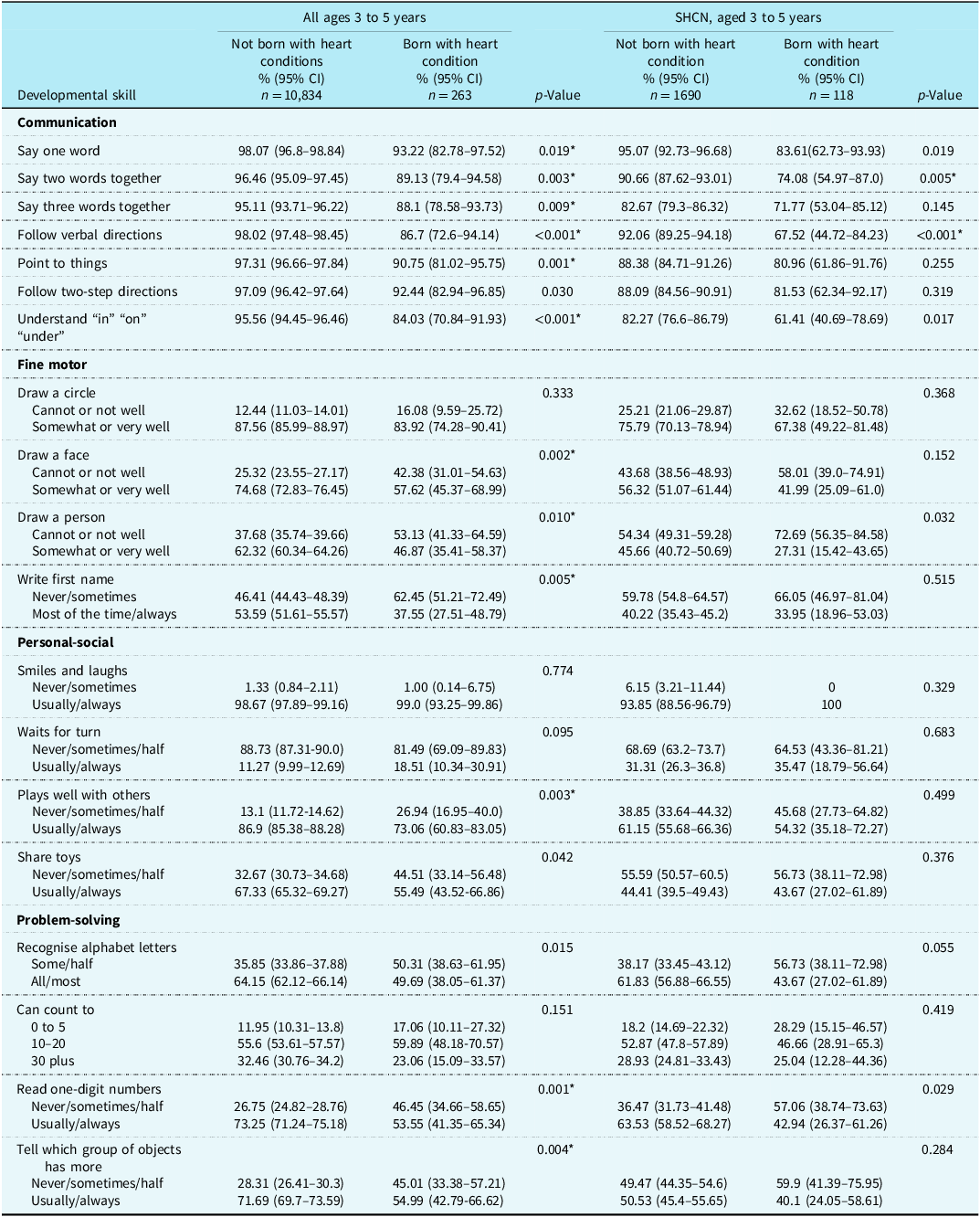
Despite there being no mean age difference between groups, children aged 3–5 years with CHD were significantly less likely than their heart-healthy peers to have achieved all examined communication skills, including saying one word (93.2% versus 98.1%, p = 0.019), two or three words together (89.1% versus 96.5%, p = 0.003 and 88.1% versus 95.1%, p = 0.009, respectively), following verbal directions (86.7% versus 98%, p < 0.001), pointing to objects (90.1% versus 97.3%, p = 0.001), following two-step directions (92.4% versus 97.1%, p = 0.030), and understanding “in” “on” and “under” (84% versus 95.5%, p < 0.001). Children with CHD were less likely to “somewhat well or very well” perform fine motor skills including drawing a face (57.6% versus 74.7%, p = 0.002), drawing a person (46.9% versus 62.3%, p = 0.010), and writing first name (37.5% versus 53.6%, p = 0.005). In personal-social skills, children with CHD were less likely to “usually or always” play well with others (73.4% versus 86.9%, p = 0.001) and share toys (55.5% versus 67.3%, p = 0.042). In problem-solving skills, children with CHD were less likely to recognise most or all alphabet letters (49.7% versus 64.1%, p = 0.015), usually or always read one-digit numbers (53.5% versus 73.2%, p = 0.001), and usually or always tell which group of objects has more (55% versus 71.7%, p = 0.004) (see Table 2).
Developmental skill acquisition between children aged 3 to 5 years born or not born with a heart condition and by special healthcare need status

Given are percent and 95% confidence interval, and p-value represents Chi-square significance.
SHCN = special healthcare needs.
*Results that were below the significance level corrected using Bonferroni correction p < 0.0125 for 2 x 2 comparisons and p < 0.008 for 3 x 2 comparison.
When developmental skill acquisition was limited to 3–5-year-old children who met the definition as having special healthcare needs, children with CHD and special healthcare needs were less likely than children with special healthcare needs and without CHD to say two words together (74.1% versus 90.7%, p = 0.005), follow verbal directions (67.5% versus 92.1%, p < 0.001), understand “in” “on” or “under” (61.4% versus 82.3%, p = 0.017), draw a person somewhat well or very well (27.3% versus 45.7%, p = 0.032), and usually or always read one-digit numbers (42.9% versus 63.5%, p = 0.029) (See Table 2).
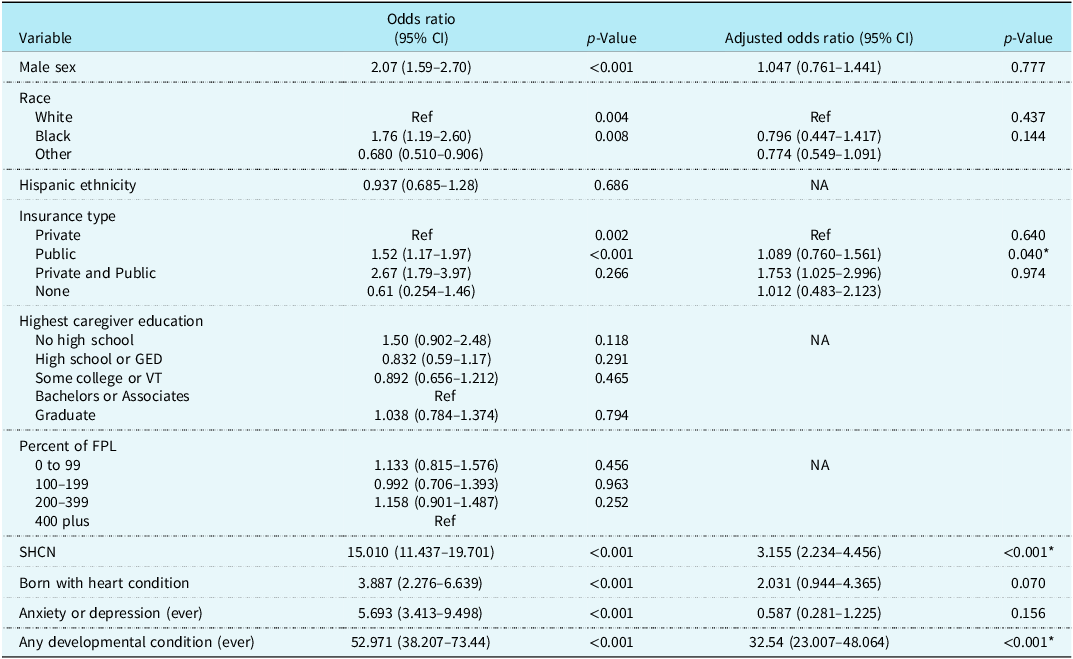
Univariate logistic regression identified male sex, Black or Other race, public or public plus private insurance, having special healthcare needs, CHD, previous diagnosis of anxiety or depression, and previous diagnosis of a developmental condition as predictors of need for special education or educational intervention plan. Multivariate logistic regression analysis identified predictors for children aged 3–5 years to receive special education or an early intervention plan. These included public plus private insurance (aOR 1.75, 95% CI 1.02–2.99, p = 0.040), classified as child with special healthcare needs (aOR 3.15, 95% CI 2.23–4.46, p < 0.001), and any developmental disorder (aOR 32.5, 95% CI 23.0–48.1, p < 0.001). After controlling for demographic (sex, race, and insurance) and health-related variables (special healthcare needs, anxiety or depression diagnosis, and developmental condition diagnosis), CHD was not a significant predictor for children to receive special education or an early intervention plan (aOR 2.03, 95% CI 0.94–4.36, p = 0.07) (see Table 3).
Univariate and multivariate predictors of need for special education or an EIP in children aged 3–5 years, n = 11,097

Given are odds ratio, adjusted odds ratio, 95% confidence interval, and p-value for univariate and multivariate logistic regression. Variables with a univariate significance <0.20 overall were included in the multivariate model.
GED = General Education Development Test; VT = vocational technology programme; SHCN = special healthcare needs; CI = confidence interval; Ref = reference group; NA = not included in multivariate model.
*Results that were below the significance level α < 0.05.
Discussion
This study identified that children aged 3–5 years born with CHD were less likely than their heart-healthy peers to have obtained skills in the areas of communication, fine motor, personal-social, and problem-solving skills. Although differences were noted across all four of these developmental domains between children with and without CHD, more differences were noted in the domain of communication, as 100% of skills in this area reached significance. This demonstrates more pervasive differences between children aged 3–5 years with CHD and heart-healthy peers in communication as compared with problem-solving (significant differences in 75% of skills), fine motor (significant differences in 75% of skills), and personal-social skills (significant differences in 50% of skills). These skills are crucial components of school readiness, and these skill domains have been shown to relate to long-term academic performance, including student retention, suspension, grade point average, and standardised test scores. Reference Ricciardi, Manfra, Hartman, Bleiker, Dineheart and Winsler34 As such, young children with CHD who do not develop these important prerequisite skills may be at an increased risk of later academic challenges. Even after stratifying our analysis to children aged 3 to 5 years with special healthcare needs, children with CHD continued to demonstrate less developmental skill acquisition in communication, fine motor skills, and problem-solving.
In addition to differences in developmental skill acquisition, children aged 3–5 years with and without CHD differed significantly on numerous health- and education-related variables. Multivariate predictors of needing special education services or an early intervention plan for young children with CHD included having public plus private insurance, special healthcare needs designation, and diagnosis of a developmental condition. Clearly, meeting criteria for special healthcare needs designation is an important predictor of developmental challenges and receiving special education or an early intervention plan. Children with CHD were more likely to have special healthcare needs, similar to findings from Chen and colleagues. Reference Chen, Riehle-Colarusso, Yeung, Smith and Farr35 Of note, having CHD itself was not a significant predictor for children to need special education services or an early intervention plan in our study. This finding highlights the nuance and variability of developmental profiles for young children with CHD and how the interplay of many variables beyond solely a diagnosis of CHD impacts skill acquisition. Other possible reasons for this finding may be provider or even parent bias leading to under-identification of developmental needs or reduced access to screening and referral due to insurance limitations or availability of services. Monteiro and colleagues identified that travel distance was an important predictor of non-attendance at cardiac neurodevelopmental follow-up Reference Monteiro, Serrano and Guffey36 ; this highlights the negative effects of social drivers of health such as access to transportation, ability to leave work for appointments, and arranging childcare for siblings. Other studies have identified increasing child age and lower CHD complexity as predictors of decreased cardiac neurodevelopmental follow-up attendance, in addition to increased travel distance and lower socio-economic status. Reference Dagur, Kleinmahon, Gurvitz, Acosta and Bora37 At the age of 3 to 5 years, many children with CHD have previously undergone intervention and the intensity of their cardiology follow-up care has lessened, perhaps reducing parent or provider perception of need for ongoing neurodevelopmental follow-up. Social drivers of health, including caregiver education and living in poverty, along with parental psychological distress are known to adversely affect developmental skill acquisition in communication, fine motor skills, and problem-solving from infancy throughout childhood. Reference Bucholz, Sleeper and Sananes38,Reference Davey, Sinha, Lee, Gauthier and Flores39 In addition to adverse effects on developmental skill acquisition, these same social drivers of health adversely affect access to developmental surveillance, referral, and services. Finally, the nature of our operational definition of CHD may have led to inclusion of other less severe forms of heart disease and therefore diluted the effects of CHD on the need for special education or early intervention.
This study affirms findings in existing literature that highlight the health and developmental differences between children with CHD and their heart-healthy peers. For example, past literature has demonstrated that children with CHD show cognitive and motor delays early in infancy after undergoing cardiac surgery. Reference Snookes, Gunn and Eldridge10 Children with single-ventricle CHD have demonstrated the highest risk of developmental delays, while children with two-ventricle CHD have been shown to catch up developmentally to heart-healthy peers over time. Reference Huisenga, La Bastide-Van Gemert, Van Bergen, Sweeney and Hadders-Algra40 Similarly, Sprong et al. Reference Sprong, Broeders and van der Net41 found that the prevalence of motor delays in children with critical CHD decreased from children aged 0–12 months, to 12–24 months, to 24–36 months. Additionally, it has been identified that toddlers with CHD show moderate delays in expressive language and motor skills and significant deficits in cognition compared to heart-healthy peers. Reference Kharitonova, Marino, McCusker and Casey8 Furthermore, past research has also found a high prevalence of emotional, social, and behavioural challenges in young children with CHD. Reference Clancy, Jordan, de Weerth and Muscara42 This echoes findings in this study that children with CHD were less likely to have acquired some personal-social skills and more likely to have been diagnosed with anxiety or depression.
These results also align with previous findings that suggest that children with CHD are more likely to require supplemental services in school. Riehle-Colarusso et al. Reference Riehle-Colarusso, Autry and Razzaghi20 identified children with CHD as being 50% more likely to receive special education services in school compared with their peers without congenital defects. Although the present study identified that young children with CHD were more likely than their peers to receive special education services or an early intervention plan, the actual difference may be even greater than what has been demonstrated by this dataset. This is because although the prevalence of developmental delays is high in young children with CHD, early intervention service receipt is low. Reference West, Yu, Lowery, Goldberg and Uzark23,Reference Mussatto, Hollenbeck-Pringle and Trachtenberg43 As such, there may have been children with CHD in this sample who may have needed special education services or an early intervention plan but never received either.
Children aged 3–5 years with CHD demonstrated significant differences from heart-healthy peers in skill acquisition in four out of five domains of the Ages and Stages Questionnaire, 3rd Edition. Unfortunately, differences could not be examined in gross motor skills because of a lack of congruity between the National Survey of Children’s Health and Ages and Stages Questionnaire, 3rd Edition items. The Ages and Stages Questionnaire, 3rd Edition is commonly used to examine school readiness in young children, Reference Squires and Bricker31 and developmental delays before the age of 3 years and at the age of 5 years have both been associated with lower academic performance at the age of 10 years. Reference Jeon, Wall, Peterson, Luze and Swanson44 As such, these results may suggest reduced school readiness in children with CHD compared to their heart-healthy peers. Further research is needed to compare school readiness between children with and without CHD and factors that may predict school readiness in young children with CHD.
Limitations
This research has limitations. One major limitation is that the National Survey of Children’s Health does not collect information about specific diagnoses, CHD severity, current or past medical or surgical interventions, or longitudinal data on hospitalisations. Previous research has demonstrated higher incidence of developmental delay in children with complex CHD compared to simple CHD; however, it is unknown what proportion of children in this dataset had complex CHD. 45 Additionally, the nature of the National Survey of Children’s Health has inherent limitations in that it relies upon parent/caregiver report, possibly introducing bias related to social desirability or misinterpretation of questions; however, the National Survey of Children’s Health uses a rigorous survey methodology, and parent report is a widely accepted and accurate method of collecting data about children’s health and development. The cross-sectional design of the National Survey of Children’s Health limits any conclusions about causality. Although the nature of the National Survey of Children’s Health data precluded comparisons between children based on CHD complexity or co-morbidities, we were able to compare children with special healthcare needs, with and without CHD. Because special healthcare needs were more rigorously defined in this dataset, this analysis better captures the developmental challenges in children with medically complex conditions. Our operational definition of CHD could have also included some other neonatal cardiac diagnoses, such as arrhythmias or cardiomyopathy. Making multiple comparisons between groups on developmental skill acquisition may increase the rate of false positives, but correction for multiple comparisons was not applied due to the exploratory nature of this analysis. Finally, we did not analyse gross motor milestone acquisition because of incongruence between gross motor milestone items on the National Survey of Children’s Health and the Ages and Stages Questionnaire, 3rd Edition.
Clinical implications and conclusion
This research can be used by health and educational professionals working in developmental programmes to support the early skill acquisition of young children with CHD. In hospital settings where children with CHD receive developmental support, intervention is often provided by occupational therapists, physical therapists, and speech language pathologists. Previous guidelines have recommended that hospitalised children with CHD receive developmental surveillance upon admission, with significant clinical changes, upon discharge, and during community-based follow-up care. Reference Lisanti, Vittner and Peterson46 Further, three risk stratification categories have been developed for children with CHD to guide decisions about developmental monitoring. Reference Sood, Newburger and Anixt15 Developmental professionals completing recommended developmental surveillance activities should ensure that they evaluate the skill areas where young children with CHD are likely to experience delayed skill acquisition. For example, speech language pathologists in inpatient paediatric cardiac settings often focus their intervention on feeding skill development; however, this study demonstrates a need to support early language milestone acquisition as well. Furthermore, young children with CHD should be screened in inpatient and clinic settings for factors known to predict the need for special education or an early intervention plan. Given known risks of developmental delays for young children with CHD, there is a strong argument for automatic referral and eligibility of children with CHD to receive early intervention services, especially those with identified special healthcare needs. Early identification and referral is important not only to support developmental achievement but also to improve functional outcomes and caregiver–child interactions and to reduce caregiver stress. Developmental surveillance plans should be integrated into routine paediatric primary and specialty care, including surgical aftercare as activity precautions are eased. Current recommendations for developmental screening, testing, and referral for services of children with CHD throughout infancy and childhood are available Reference Sood, Newburger and Anixt15,Reference Ware, Butcher and Latal47 ; however, clinicians should ensure that families can follow through with recommendations, facilitating access if necessary. Ideally, children with CHD receive surveillance, testing, and referral in multidisciplinary cardiac neurodevelopmental follow-up clinics, but lack of access to these centres may necessitate that screening be completed in primary or cardiology care clinics, with clinician referrals for further testing and services as indicated. Reference Duncan, Davey and Flyer48 Care coordination through a medical home is crucial to ensure communication and to reduce loss to follow-up. Developmental follow-up care for children with CHD should begin during infancy and continue through adolescence as developmental risks have been shown to vary throughout the trajectory of life; developmental difficulties may emerge or evolve throughout childhood, and challenges such as emotional regulation, working memory, and peer relationships may not be apparent until adolescence or adulthood. Reference Mussatto, Hoffmann and Hoffman4,Reference Huisenga, La Bastide-Van Gemert, Van Bergen, Sweeney and Hadders-Algra40,Reference Sprong, Broeders and van der Net41,Reference Tan, Semmel, Rodrigues, Bishop and Ilardi49,Reference Abda, Bolduc, Tsimicalis, Rennick, Vatcher and Brossard-Racine50 Future research is recommended to identify factors that predict school readiness, success, and engagement in young children with CHD to give further targeted direction to developmental service provision. In addition, research and quality improvement should focus on methods to improve access to developmental care across childhood for children with heart disease.
Acknowledgements
The authors thank Child and Adolescent Health Measurement Initiative (CAHMI) (2024), 2022 National Survey of Children’s Health: STATA dataset, and Data Resource Center for Child and Adolescent Health supported by Cooperative Agreement U59MC27866 from the US Department of Health and Human Services, Health Resources and Services Administration (HRSA), Maternal and Child Health Bureau (MCHB). The data were retrieved on 10/02/23 from childhealthdata.org.
Financial support
This research received no specific grant from any funding agency, commercial or not-for-profit sectors.
Competing interests
The findings and conclusions in this report are those of the authors and do not necessarily represent the official position of the Centers for Disease Control and Prevention.