During recent field research in San Cristóbal de Las Casas, a city in southern Mexico with a large tourist economy, I encountered a number of musicians who were concerned with the effects of gentrification on their creative practice. One, a reggae soundsystem artist, compared the economic trajectory of San Cristóbal with those of Brooklyn and Berlin, in which public spaces had become ‘whitewashed’ and local musics sidelined.Footnote 1 Another, who had been performing in the street in the city for several years, associated the emergence of ‘increasingly fancy restaurants’ in the centre with greater restrictions on street performance.Footnote 2 Finally, another street musician believed that the ‘capitalist system’ had ‘placed music in an overly narrow structure, in which commercial music predominates’, disenfranchising ‘the music of the world’:
Inside [restaurants and bars], you have to play commercial music which 90 percent [of musicians] don't like to play, and they play it just for the money. Outside in the street, you play from the heart, for enjoyment, and because there exists a real interaction among the people that like what you're doing. (Joel, 7 August 2015)
To spend time with these musicians, then, was to begin to engage with ongoing debates about culture, capital and diversity.
Acute anxieties around the cultural impact of gentrification have, in recent years, made their way into mainstream discourse. The term ‘gentrification’ is linguistically rooted in a particular class of people (the well-mannered ‘gentry’), and often implies cultural ‘cleansing’ of space (hence, for example, the ironic anti-gentrification slogan ‘keep Hackney crap!’, appropriated from a dismissive statement uttered by a London politician).Footnote 3 In recent years, gentrification has attracted a great deal of media attention, and become the focus of much political mobilization. Geographers have argued that gentrification consists of a process of capital expansion into urban areas, closing ‘rent gaps’ (differences between the value of current and potential rent) by facilitating property development geared towards the middle and upper classes, leading to price rises which displace these areas’ poorer former inhabitants (Smith Reference Smith1979, pp. 541–7; Lees et al., Reference Lees, Slater and Wyly2008, p. 9). This basic formulation has been expanded upon in various ways in the scholarly literature; gentrification has been linked to ‘the rise of hotel and convention complexes and central-city office developments, as well as the emergence of modern “trendy” retail and restaurant districts’ (Smith and Williams Reference Smith, Williams, Smith and Williams2013, p. 3). It often has a racial dimension, tending to displace ethnic minorities (Atkinson and Bridge Reference Atkinson, Bridge and Brown-Saracino2013), and it is also associated with the increased regulation of space by the police, deployed to proactively support property prices in gentrifying areas, with police ‘ceaselessly observing and investigating nuisances until perpetrators are so bothered that they stop’ (Pattillo Reference Pattillo and Brown-Saracino2013, p. 332).
Crucially, many anti-gentrification campaigners understand gentrification as a threat to ‘cultural, social, and economic diversity’ in their communities.Footnote 4 For instance, writing in The Telegraph in January 2014, London-based businessman Alex Proud condemned the ‘Shoreditchification’ of London, through which so-called ‘hipsters’ (the contemporary gentrifying classes) gain increasing prominence despite being ‘all cool by numbers. The people dress the same, they eat the same and the conversations sound the same.’Footnote 5 In this sense, then, the gentrification debates rehearse familiar anxieties in which the processual spatial expansion of capital is directly pitted against the heterogeneity of human creativity and identity. Yet, while scholars have engaged with questions to do with capital, music and space (Sterne Reference Sterne1997; DeNora Reference DeNora2000), little research has been carried out into the ways that gentrification relates to musical production and performance.
‘Gentrification’ may be understood as among the most recent in a long list of terms with which anxieties around capitalism and culture have been expressed. Phrases such as ‘globalization’, ‘cultural imperialism’, the notion of the ‘World System’ (Wallerstein Reference Wallerstein and King1991) and so-called ‘McDonaldization’ (Ritzer Reference Ritzer1983) have all been linked to debates about the relationship between capitalism and cultural diversity. In the study of music, ambivalences have emerged regarding the impact of capital on human creative agency; thus Feld (Reference Feld2000, p. 146) states that ‘[m]usical globalization is experienced and narrated as equally celebratory and contentious because everyone can hear equally omnipresent signs of augmented and diminished musical diversity’. Taylor (Reference Taylor2012) has examined the changing uses of music within the advertising industry in the USA since the 1920s up until the present, when this industry ‘increasingly drives popular music production’ (pp. 216–17). This situation, Taylor argues, has both created significant constraints on many musicians’ creative labour and threatened musical diversity, forcing compositions into ever-narrower formats (Taylor Reference Taylor2012, pp. 207–9). Taylor closes his book with the image of a Weberian bureaucracy within the advertising industry struggling to impose the ‘iron cage of rationalization’ upon musicians seeking to preserve an ‘ineffable, mystical, enchanted’ form of creativity (pp. 245–6). In a similar manner to my consultant Joel, then, Taylor's concerns occupy two broad categories: the effect of capitalist relations on musical style, and the ways that capitalist expansion may promote an instrumental role for music within a system prioritizing financial surplus.
The relationship between musical creativity and commerce has been a particular concern for scholars of popular music. In particular, many of these scholars, often responding to the intellectual legacy of Theodor Adorno, have rejected the notion that capitalism has caused homogenization within the music industries. Thus, Negus (Reference Negus1995, pp. 330–1) provides an overview of popular music scholarship which aligns, in this regard, with the theories of Adorno, yet himself draws upon ethnographic research to argue that record company executives are often at the forefront of stylistic change. Krims (Reference Krims and Moore2003, pp. 136–9), meanwhile, uses the example of the ‘proliferation of new styles and generic hybrids’ in 1990s US rap to suggest that, in fact, commercial music in the late 20th century saw a diversification of musical styles as record label ownership consolidated. Building on this argument, he calls for scholars to move beyond ‘monolithic and inflexible models of capitalism’ (p. 157). Most recently, Morcom (Reference Morcom2015, p. 292) has applied Braudel's ‘world systems’ theory to the example of Tibetan exile pop – a genre which is monetised, but which makes no profit – in order to bring out ‘capitalism's inherent unevenness or porosity’. While these scholars are concerned with very different contexts for musical creativity, then, each seeks to counter Adornian notions of the progressive commercial standardisation of music.
It is important, therefore, to engage critically with the debates around gentrification from the perspective of music, while attempting to develop nuanced approaches to the relationship between musical production and capital. This endeavour presents us with the challenge of understanding music's relation to capitalism in light of the fact that ‘music does not sit around exuding commodity status; it has to be commodified, and in ways that are different than other commodities’ (Taylor Reference Taylor1997, p. 283). In turn, considering commodities as a process means that the ‘intimacy […] of observational scale’ made possible by ethnography may be highly valuable for the study of music and capitalism (Herzfeld Reference Herzfeld2001, p. 19). Indeed, it is arguable that the most insightful recent studies on value and exchange have been carried out by economic anthropologists, who treat money as one of a plethora of items used in exchange (Graeber Reference Graeber2001; Wilk and Cliggett Reference Wilk and Cliggett2007). Methodologically, it may be argued, context-specific ethnography constitutes one of the only reliable means through which the challenge laid out above by Krims may be addressed.
One approach which may help to ground debate about value, exchange and culture in heterospecific, everyday experience may be found in the work of anthropologist Anna Tsing. Using the example of the conversion of matsutake mushrooms into commodities, Tsing (Reference Tsing2013, p. 39) foregrounds ‘the open-ended processes in which historical contingencies are awkwardly woven into capitalism’: sorting, classification and spatial separation temporarily convert gifts into commodities for the production of capitalist value. Tsing questions theories that define capitalism as a coherent whole, and positions analysis of the ‘rough edges’ of capitalism – points at which the awkwardness of these processes of conversion becomes apparent – as a crucial task for ‘ethnographers – observers willing to be surprised by details’ (Tsing Reference Tsing2013, pp. 38–9). This anthropologist highlights how capitalism is often rooted in what she terms economic ‘salvage’, oriented around the exploitation of ‘value produced without capitalist control’ (Tsing Reference Tsing2015, p. 63). This process is dependent on ‘translation’ between different regimes of value – creating important roles for well-connected individuals with detailed local knowledge – and is oriented around ‘pericapitalist’ spaces, grey areas at the edge of capitalism (Tsing Reference Tsing2015, p. 62). If we wish to understand the operation of capitalist supply chains, she argues, we ought to pay attention to the complex interaction between multiple regimes of value, of which only one is oriented around monetary exchange. Distancing capitalist exchange from production may help us to move beyond monolithic, predictable visions of capitalism as an economic system.
In this article, I explore these themes in relation to nine months of field research in San Cristóbal de Las Casas.Footnote 6 Following Tsing, I argue that this city may be understood as a musical ‘salvage economy’ in which commercial spaces often appropriated, in a temporary and incomplete fashion, musical genres and styles originating in sites with a more distant relationship to capital exchange (Tsing Reference Tsing2015, p. 63). Here, the rapid development of the city centre, the accompanying rise in rents and the impact of commerce on musical expression were concerns for many musicians. Equally, many visitors were attracted by this city's association with revolution, as a key site of pilgrimage for the anti-capitalist, pro-indigenous rights Zapatista Army of National Liberation. Exploring the case of Hernán, a musician performing pro-Zapatista songs in a restaurant in San Cristóbal, I draw out the constraints and possibilities for musical creative agency that emerged in a rapidly gentrifying city in which commercial activity was driven by the accumulation of rent. A process of gentrification could be perceived as influencing music-making in this setting in two key ways, which were highlighted by my consultants: by exerting limits over musical expression in public spaces, and by influencing musical expression within commercial spaces, as musical performance became subordinated to a variety of strategies of accumulation. Nonetheless, I also argue that the complexities inherent to commercial spaces’ appropriation of musical traditions rooted in anti-capitalist social movements are key to understanding the creative agency exercised by this article's protagonist.
Gentrification and urban development in San Cristóbal de Las Casas
San Cristóbal de Las Casas is a city located in the Highlands of Chiapas, Mexico's southernmost and poorest state. San Cristóbal has been defined as a ‘dual city’: during the colonial era, the city's population was dominated by criollos (people of Spanish descent) who inhabited the centre while comparatively small numbers of indígenas (indigenous people) occupied the peripheries (Aubry Reference Aubry2008, pp. 31–5). While a small settlement for most of its history, the city underwent significant demographic change in the second half of the 20th century. Religious conflicts in the 1970s and 1980s led to a mass exodus of Protestant indígenas from the Chiapas countryside, forming a ‘belt of misery’ of 20,000 inhabitants in poor neighbourhoods around San Cristóbal (París Pombo Reference París Pombo2000, p. 91). Equally, San Cristóbal became a tourist destination when the construction of the Pan-American Highway in the 1950s connected it to the rest of Mexico. Correspondingly, many outsiders from other states in Mexico moved to the city to set up businesses in the 1980s and 1990s. As a result of these developments, the city's population expanded from 17,500 inhabitants in 1950 to almost 90,000 in the early 1990s (Berghe Reference Berghe1994, pp. 76–7, 93). City inhabitants of Spanish or mixed-race descent with family from San Cristóbal, however – who are typically called coletos, and many of whom trace ancestry back to colonial-era families from the city (cf. Rocío Bermúdez Reference Rocío Bermúdez2011) – have often expressed ambivalence about these demographic changes, and at worst have perceived such migration as a threat to their urban ‘territory’ (París Pombo Reference París Pombo2000, pp. 92–4).
Equally, San Cristóbal's recent history has been strongly marked by one event: the Zapatista rebellion. On 1 January 1994, the Zapatista Army of National Liberation (EZLN) launched an uprising across eastern Chiapas. The EZLN was led by a small handful of urbanite guerrillas from large cities, while it was populated mostly by indigenous people from rural Chiapas whose first languages were variously Tzeltal, Tzotzil, Tojolabal, Zoque, Mam and Ch'ol (Barmeyer Reference Barmeyer2009). Briefly occupying several cities in the state, including San Cristóbal – and accompanied by eye-catching media presentation and critiques of capitalism and neoliberalism – the uprising captured the imagination of leftists across the world (Bob Reference Bob2005, pp. 128–9). After agreeing a ceasefire with the government, the EZLN sought to cultivate a civil movement in Chiapas that would operate without government support, creating a series of organizations of governance to administrate in newly won Zapatista territory.
The Zapatista uprising precipitated an immediate fall in tourism to the city. In response, the Chiapas state government sought to revive the area's tourist sector by pushing for subsidies for tourism in Chiapas and launching marketing campaigns intending to portray Chiapas as a ‘peaceful and enticing’ place (Pitts Reference Pitts, Pizam and Mansfeld1996, p. 226). This move to attract tourism was followed by later policies encouraging concentrated urban development. In the early 2000s three roads in the centre of the city were pedestrianised, making them particularly attractive hubs for tourist activity (Garza Tovar and Sánchez Crispin Reference Garza Tovar and Sánchez Crispín2015, pp. 197–8). These policies were designed to attract both consumers and producers of gentrifying space, and correlated with increased tourism in San Cristóbal. Between 1991 and 2005, the number of visitors to the city increased by 12%, the second highest increase of any Mexican tourist destination for this period (Propin Frejomil and Sánchez Crespin Reference Propin Frejomil and Sánchez Crispin2007, p. 154). My consultants who had spent longest living in San Cristóbal complained that this upsurge had coincided with dramatic increases in rents, especially in the pedestrianised city centre.Footnote 7
The government's reaction to the Zapatista uprising reinforced in economic terms the spatial marginality indígenas had suffered in previous eras: growing tourism was concentrated in the centre while the mostly indigenous peripheries continued to suffer deep poverty (Garza Tovar and Sánchez Crispin Reference Garza Tovar and Sánchez Crispín2015, pp. 205–6). In turn, poor indigenous families were often driven to beg in commercial spaces in the city centre (pp. 203–5), something to which some businesses responded by repeatedly refusing entry to people in indigenous dress,Footnote 8 implicitly resurrecting colonial patterns of discrimination. The process of gentrification occurring in this city, then, did not simply involve increasing rents, but was also associated with the creation of a normative image of the middle-class, cosmopolitan, light-skinned consumer.Footnote 9 Meanwhile, many shops and restaurants in the city centre (which were often run by people from outside Chiapas, typically in commercial properties owned by a small handful of local landowning coletos) produced a commercialised, generic image of indigeneity in order to appeal to tourists. For instance, a local commercial space called Mexica Tours had an image of the sun on its logo, indexing a generic ‘indigenous cosmology’ oriented around the sun, stars and moon, despite the fact that most of the indigenous languages spoken in the surrounding state were Mayan rather than Mexica.Footnote 10 In the city's square, dancers dressed in feathered costumes presented an exotic vision of pre-Hispanic indigenous identity, before posing for pictures with paying tourists. Here, as in many other contexts, gentrification involved the re-packaging of cultural traditions for wealthy consumers. Indeed, when San Cristóbal was declared a pueblo mágico (‘magic town’) in 2003, this decision was intended to reflect the cultural richness of the surrounding area, and the concomitant possibilities in the city for developing tourism (Trujillo Correa and López Lecona Reference Trujillo Correa, López Lecona, González and Romero2016).
At the same time, the continued presence of Zapatista communities in Chiapas has constituted an inspiring symbol for leftists, anarchists and Zapatista sympathisers worldwide, many of whom have travelled to Mexico to visit EZLN territory. Indeed, reflecting on the transnational nature of pro-EZLN solidarity, Rao (Reference Rao2010, p. 154) argues that the Zapatista movement is highly cosmopolitan. Related to the emergence of this movement, besides coletos and indígenas, in the 1990s and 2000s a new social class of people were attracted to San Cristóbal who were born outside Chiapas, many of whom ran businesses and were sympathetic to the Zapatistas. At the time of my research, although it was common to see restaurants and bars displaying Zapatista-themed posters, only a small handful of commercial spaces in the city made an explicit connection to the Zapatista movement, including the shop Nemi Zapata, the bars Café Bar Revolución and El Paliacate, and the restaurant Tierradentro. The influence of the city's new class of cultural cosmopolitans (Turino Reference Turino2000, pp. 10–12) could be heard every night in commercial spaces in the city centre, where transnationally popular genres of music such as ska, rock, pop, salsa, jazz and cumbia crowded out genres more popular among Mexican audiences, such as boleros and corridos.Footnote 11, Footnote 12
In this setting, commerce was spatially organised according to rent; shops in the best locations on the city's pedestrianised streets could pay several times the rent of an equivalent space located just 10 or 15 metres from these streets.Footnote 13 This reflected the ways that gentrified space in San Cristóbal was both consumed and produced (Lees et al. Reference Lees, Slater and Wyly2008, p. 190). Tourists tended to visit the most visible spaces, especially in the pedestrianised centre, while businesses further from the centre found it difficult to attract custom.Footnote 14 El Paliacate, for instance, was a bar and ‘cultural space’ hosting an eclectic mixture of music, theatre and other forms of entertainment; it constituted an important locus for the city's small pro-Zapatista activist subculture. Although the owners of this business paid little in rent, their low income made it difficult to pay performers. The cultural vibrancy of the venue was, therefore, largely a product of the community of mobile and economically independent activists that frequented it, which included many musicians, such as myself, who were able to perform for free. Local professional musicians, meanwhile, were often unhappy to have amateur performers undercut their income, something which had motivated a recent unsuccessful attempt to agree a city-wide musicians’ minimum wage.Footnote 15
In San Cristóbal, therefore, a number of tendencies worked in conjunction as the centre was gentrified. Rents had been increasing in property for both domestic and commercial use. This was driven simultaneously by a demand for gentrified space among tourists to the city and a push on the part of local government to produce it, manifesting itself in the pedestrianization of the city's centre.
Music, revolution and protest
Political protest occurred infrequently in public spaces in San Cristóbal's gentrifying historic centre during my research. Many among San Cristóbal's pro-Zapatista activist community felt publicly expressing one's political views to be a dangerous activity, since there was a history of government spying on Zapatista supporters in the city (Barmeyer Reference Barmeyer2009, pp. i–xvii). Public security, meanwhile, had high visibility in the centre, where police officers wore a casual-looking uniform with a t-shirt and baseball cap and tended not to carry firearms, and a comparatively high number were female. In a dynamic common to gentrifying spaces, they therefore both exerted control within public space and conveyed an image of safety for visitors.Footnote 16
This regulation of public space also extended to music. Vargas Cetina (Reference Vargas Cetina2000, p. 74) describes how, in the late 1990s, groups would often ‘sing Zapatista corridos with their guitars in the central park’, implying a level of tolerance for the public expression of revolutionary sentiment through music.Footnote 17 Yet, by the time of my research, the context for musical expression had changed considerably. Those wishing to perform music in public spaces were now required to gain a permit from the local government in advance, which carried information about their musical style alongside the time and location in which they were permitted to perform. Adherence to the permit was enforced by the local government's inspectors and an extensive police presence in the centre. Songs with political themes were noticeably absent in San Cristóbal's central streets, and there was a perception among some activists that it was not permitted to perform them in this context. One consultant told me that music with political themes was ‘prohibited by the government, they don't allow, for example, people to be singing the music of the Zapatistas in the street … There can even be violence, they can jail them’.Footnote 18 Another, who ran a local bar, stated more generally that often, if musicians set up to play in the street,
they get rid of you. It's about keeping the image clean … I think it has to do with the tourist's appreciation rather than making sure that those public spaces are public spaces for the people that live here. (Interview, Chui, 16 October 2013)
This consultant, then, linked present-day patterns of repression in San Cristóbal to the ‘cleansing’ of the city's profile as a tourist destination. While musicians told me stories about police censorship of public performances of political song in the city centre,Footnote 19 I saw no attempts at street performance of such music during my research – perhaps demonstrating that the perception that this might happen had, at least, a chilling effect among some local musicians.
Yet there were more complex reasons that Zapatista song was heard little in San Cristóbal. Around the turn of the millennium a series of projects were organised in Zapatista communities aimed at creating products for sale to sympathetic outsiders, including coffee (which one can buy in cities across North America and Europe) and CDs of Zapatista bands. Producciones Radioinsurgente, a Zapatista label with the slogan ‘The Official Voice of the EZLN’, was created in 2002 to record Zapatista songs – many of which are versions of the corrido genre of song performed by ensembles built around the guitar, vihuela and guitarrón Footnote 20 – in order to disseminate them to the outside world. At present, although Producciones Radioinsurgente has ceased to operate, one can purchase copies of these CDs for about 15 pesos each (about US$1) from a small handful of commercial spaces in San Cristóbal.
Nonetheless, by the time of my research, although San Cristóbal was a hub of pro-Zapatista activity, few pro-Zapatista activists listened to the music produced in Zapatista communities, such as that released on the Producciones Radioinsurgente label. This music was also absent from most of the commercial spaces in the city that promulgated a Zapatista image. Among the Zapatista sympathisers in the city, the albums produced by this label seemed to have limited appeal. At one point, a Spanish activist I got to know bought a CD of this music out of curiosity, but reacted negatively when he heard it for the first time, and switched it off almost immediately. Other activists I spoke to appeared to agree that this music was not made for their consumption; one told me that ‘it doesn't go with the typical urban taste’, while another suggested that urbanite activists and indigenous Zapatistas ‘live in different aesthetic worlds’.Footnote 21 This intriguing comment pointed towards the fact that, while the pro-Zapatista activist community local to the city was highly mobile, comparatively wealthy, and cosmopolitan (cf. Rao, Reference Rao2010), the songs written and recorded by Zapatista bands tended to break with the expectations of the typical cosmopolitan listener. Typically sung with nasal vocal production and little dynamic variation, they frequently deployed uneven metrical patterns and used varied rhythmic structures that created ambiguities regarding the relationship between the melody and rhythmic accompaniment. Of the four people I spoke to who did own collections of Zapatista songs, all but one worked for independent media organizations, where they would use these songs in their radio programmes: as an aural signature, as a means to ‘create atmosphere’, to accompany particular narratives, or as a means of calling the attention of a particular audience.Footnote 22 These uses diverged from the explicit aim of many Zapatista bands to spread political messages, narratives and information about the Zapatista movement in their music.
Since this city's ‘historic centre’ had undergone a process of gentrification which involved increasing control over public spaces, using music to spread political messages in this setting often required engagement with capitalist arrangements. However, although Zapatista communities themselves ran small-scale commercial projects (cf. Juris and Khasnabish Reference Juris, Khasnabish, Juris and Khasnabish2013, pp. 1–2), the Zapatista movement also had a long history of opposing capitalism that could create tensions for pro-Zapatista activists perceived to be complicit in this mode of social organization. This history went back to EZLN figurehead Subcomandante Marcos's communiqué ‘The Southeast in Two Winds’, which was written in 1992 and made public shortly after the 1994 uprising (Subcomandante Marcos 1995, pp. 31–51),Footnote 23 but the Zapatistas had also critiqued capitalism in the Sixth Declaration of the Lacandón Jungle, positioning it as a system based on ‘exploitation of the workers’ and ‘plunder’ of natural resources which ‘imprisons and kills those who rebel against injustice’ and ‘makes commodities of people, of nature, of culture, of history, of conscience’ (EZLN 2005). More recently, in an address given in 2008, Marcos denounced individuals seeking material gain from pro-Zapatista activism, singling out ‘politicians, intellectuals, artists and people from social movements’ who ‘present themselves as emissaries of the EZLN’ and from that gain ‘political capital’ (EZLN 2008). As he paid critical attention to the EZLN's supporters, Marcos created possibilities for internal suspicion to emerge among them, particularly concerning the commercial exploitation of Zapatismo.Footnote 24 This was especially evident in San Cristóbal, where the spaces available to pro-Zapatista activists were commercial, rather than public, in nature.
Music, message and commerce
In San Cristóbal, I conducted in-depth ethnographic research with one singer, called Hernán, playing concerts of Zapatista songs and political song from elsewhere in Latin America in local commercial spaces. Hernán was in his early thirties and came from a Tojolabal-speaking family living close to Comitán, a city in south-east Chiapas. Since he himself did not speak Tojolabal, Hernán defined himself as campesino (‘peasant’) rather than indigenous. At the time of writing, he lived on the outskirts of San Cristóbal, where he had lived since arriving in the mid-1990s to study at a preparatory school. In the city, Hernán had briefly found work at a museum, as well as studying law at a local university in the city in the early 2000s. This diversity of experience was reflected in the genres of music he had grown accustomed to throughout his life. While he had been raised in the countryside listening to norteña and ranchera music, as well as boleros and corridos – that is, songs ‘to drink to, about women, about love and heartbreak’, which the singer called ‘Mexican songs’Footnote 25 – Hernán became familiar with genres of music with more middle-class connotations in San Cristóbal. In this urban setting, he had been introduced to the work of nueva trova singers such as Pablo Milanés and Silvio Rodríguez, and nueva canción artists such as Alí Primera by a fellow worker at Na Bolom, who also taught him basic guitar-playing technique; he categorised these genres of song as ‘Latin American music’.Footnote 26 The singer described how he had become familiar with nueva trova as part of a wider process of political education (he mentioned reading Eduardo Galeano's book Las venas abiertas de América Latina, 1971), and encountered the music of singers from Central and South America before that of nueva trova singers from Mexico such as Oscar Chávez (indeed, Hernán had become a supporter of the Zapatista movement after listening to Chávez's 1999 album Chiapas). Thus, although Hernán had an indigenous background, many of his most important musical influences were transnational and cosmopolitan. At the time of research, as well as making money by performing music in several local restaurants Hernán gave classes in law at a local university, and was a well-respected figure within San Cristóbal's activist community. While he was a solo artist Hernán often performed with accompaniment, and when I arrived in San Cristóbal in May 2013 he had been playing for three months with Rigo, a teenage Tzeltal-speaking guitarist from a small town in rural Chiapas named Taniperla, who had recently migrated to San Cristóbal.Footnote 27
Although he claimed never to have had singing lessons, Hernán's vocal production was from the diaphragm and his tenor voice full of vibrato, with a large dynamic range. His vocal style, then, recalled singers of nueva canción and nueva trova, while his guitar playing was elaborate, incorporating techniques imported from flamenco such as rasgueando and tremolo playing. Hernán's live performances mostly featured two categories of song. The first were popular songs of love and heartbreak in the bolero or ranchero style. The second was a series of nueva canción and nueva trova songs that altogether formed a narrative of popular struggle across Latin America (Fairley Reference Fairley1984). For example, Hernán often sang Violeta Parra's ‘Gracias a la vida’, José de Molina's ‘Ya comenzó’ and Alí Primera's ‘No basta rezar’, as well as Oscar Chavéz's ‘Se vende mi país’ (‘My Country is Being Sold’). Occasionally, he altered lyrics to these songs in order to link them to the local political context. For example, the singer regularly played Carlos Puebla's ‘Hasta siempre Comandante’, an ode to Ché Guevara often sung in pro-Zapatista activist circles which generally concludes: ‘Y con Fidel te decimos/Hasta siempre, Comandante’ (‘And with Fidel we say/Until forever, Commander’). Hernán, however, would often replace the word ‘Fidel’ with figures or locations related to the Zapatista uprising, such as ‘Chiapas’ or (Subcomandante) ‘Marcos’. As well as nueva canción, the singer sang corridos about Emiliano Zapata, the rebel leader from the Mexican Revolution that the term ‘Zapatista’ refers to, thus linking present-day struggles across Latin America to one of the past. ‘Corrido de la muerte de Zapata’ and ‘Mi general Zapata’ eulogise Zapata, a ‘blessed son of the people’ who died ‘for land and liberty’.
Equally, several of the songs that Hernán regularly performed had direct thematic links to the Chiapas conflict, such as ‘Himno Zapatista’ (Zapatista Hymn) – a corrido based on a song about the Mexican Revolution (1910–20) which has come to constitute the main anthem of contemporary Zapatismo – which Hernán played at almost every concert he gave, and often dedicated ‘to the Zapatista caracoles [cultural centres]’ or ‘to the Zapatista women’.Footnote 28 Others included Oscar Chavez's ‘Siempre me alcanza la danza’ (‘The dance always gets to me’) and ‘Cuando pienso en Chiapas’ (‘When I think of Chiapas’), songs that contradict the sanitised image of Chiapas promoted by the government after 1994, describing the state as a place where people ‘die of hunger in the streets’, while ‘the coletos spend their time protecting their wealth’. In addition, Hernán often performed ‘Ya comenzó’ (‘This already began’), an upbeat song written by José de Molina in response to the Chiapas conflict, whose lyrics praise the courage of the Zapatista fighters and signal the inevitability and righteousness of the revolution:
El Zapatismo, señores Zapatismo, gentlemen
A la larga ha de triunfar Eventually will triumph
Porque es una lucha justa Because it is a just struggle
De liberación nacional For national liberation
Porque esto ya comenzó Because this already began
Y nadie lo va a parar And no-one's going to stop it
(José de Molina, ‘Ya comenzó’)
For Hernán, much of the value of ‘Ya comenzó’ was communicative; it told of ‘what's happening’, inviting a broad audience of Mexican society to stand in solidarity with Zapatismo: ‘labourers, […] the proletarian man, the students, full-time employees, unsalaried women’.Footnote 29
Hernán emphasised the importance of ‘disseminating’ (difundiendo) Zapatismo, thus contributing to what he perceived as one of the most important tasks ‘that the compas [Zapatistas] are carrying out right now’.Footnote 30 In particular, he sought to ‘carry a message to the people’ which could, in turn, play a role in ‘awakening’:
It's the political message that awakens me … I want to be a participant in that awakening of everyone else. In other words, I don't want to see them live asleep, and die without understanding what had happened. (Hernán, 9 July 2013)
For the singer, ‘awakening hearts’ through transmitting messages in songs constituted ‘a form of doing politics from below’.Footnote 31
Hernán frequently acted strategically in order to achieve his goal of message ‘transmission’ to as broad an audience as possible, and often performed at rallies and political events across Chiapas, as well as commercial spaces in San Cristóbal. Soon after I first got to know him, Hernán invited me to accompany him and Rigo to a primary school located about an hour's drive from San Cristóbal at which the pair had been invited to perform at a celebration of Día de las Madres (‘Mother's Day’). The pair arrived and sang the ‘Mañanitas’, a song performed in Mexico on the occasion of a birthday, after which they received a warm round of applause. Then, after a series of numbers by other contributors, Hernán and Rigo returned to sing a few more songs. Notably, the first was ‘Corrido de la muerte de Zapata’ (‘Corrido of the Death of Zapata’), a song recounting the betrayal and assassination of the revolutionary leader. Although Hernán dedicated the song to his maternal grandmother, introducing it as ‘a sad song, but one of history […] about the heroes of our Fatherland [Patria]’, this corrido was out of place in Hernán and Rigo's set, which was dominated by boleros containing themes of love and heartbreak. During our journey back to San Cristóbal, I asked Hernán about his decision to sing ‘Corrido de la muerte de Zapata’. In response, he commented abstrusely that he had used ‘a small dose, an exact dose’ (una dosis pequeña, una dosis exacta), deploying a medical metaphor that simultaneously painted himself as knowing doctor doing what was best for his audience and suggested a strategy of compromise, in which the singer communicated political messages in small, innocuous measures while otherwise fulfilling audience expectations.
Hernán's performances, at this time, strongly reflected the thematic and commercial priorities of the venue in which he performed most often. Tierradentro was an upmarket restaurant and ‘cultural space’ located in the centre of San Cristóbal which had opened in 2006. Its menu catered to an international palate and its spacious interior was decorated with plants, wicker lampshades and a few scattered red stars hanging from the high ceiling. Visitors to Tierradentro could have little doubt about where it situated itself politically. Its walls were covered with Zapatista-themed art, and posters with pro-Zapatista slogans adorned the walls, demanding ‘no more hostilities against Zapatista communities!’ and declaring solidarity with the Zapatistas ‘yesterday, today and forever’. Indeed, Tierradentro provided spaces for Zapatista women's co-operatives to sell wares produced in Zapatista communities, including hand-woven clothes, hand-crafted footwear and accessories such as books, mugs, aprons, t-shirts, laptop covers and stickers. It also sponsored Rompevientos, an online independent media project providing a voice for social movements and leftist political struggles. The majority of the waiting staff were migrants from rural Chiapas who spoke indigenous languages as well as Spanish, and they often wore Zapatista-themed t-shirts at work. Nonetheless, the restaurant attracted few coletos or indígenas, being frequented instead by a mixture of tourists, NGO workers and academics of leftist political sympathies, who were typically from outside Chiapas and middle-aged or older.
This restaurant, therefore, was an exemplary ‘rough edge’ of transition and ambivalence within capitalism (Tsing Reference Tsing2013, p. 39). Different economies were at play in this space, rentier and profit-making arrangements co-existing with alternative projects geared towards benefiting communities self-declared as ‘anti-capitalist’. It was also, however, framed as a revolutionary participant in an economy of attention (Crogan & Kinsley Reference Crogan and Kinsley2012), acting through the infiltration of commercial space with radical political messages. When I started research, Hernán had already been performing in Tierradentro three or four nights a week for several years, and the manner in which he had come to be hired by this venue illustrated well the ambivalence and ‘roughness’ pertaining to it. In addition to invitations to sing at protests and in Zapatista communities, Hernán had started to play palomazos [‘jams’] – informal, spontaneous performances – in commercial spaces in San Cristóbal in the mid-2000s. The singer would often perform ‘Himno Zapatista’ at such informal concerts, and claimed to have gained a reputation in the city as ‘the only person who dared to sing’ this song in public. In an interview he recounted how, on one occasion, he arrived at Tierradentro to play a palomazo; after singing ‘Himno Zapatista’, he was approached by a member of staff, who invited him to perform concerts in the space featuring this song.Footnote 32 Tierradentro paid Hernán 300 pesos per concert, and the singer was also paid to perform in other spaces, where his performances tended to contain less explicitly political material.
It is worth outlining, in more detail, the typical dynamics of this form of palomazo: a type of concert which here constituted, I suggest, the most important point of contact between commercial and non-commercial spaces. Used in this context, the word palomazo referred to an informal concert in a commercial space which, while framed as a gift, carries the expectation of financial remuneration. A musician would enter a restaurant or bar, ask the staff for permission to play a few songs (the staff, upon agreeing to the request, would switch off any incidental music), perform and pass through the audience with a hat asking for donations. In San Cristóbal, palomazos were especially popular among street musicians for several reasons: they allowed musicians to avoid engaging with the police and local government, whose regime of permits in practice gave them few rights; they allowed audiences to be directly and personally targeted; and singing outside could be exhausting. However, palomazos could also be interpreted as moments of ‘sorting’; they allowed local restaurants to categorise musical performances into styles which could or could not contribute to their commercial identity and strategies (cf. Tsing Reference Tsing2013, p. 39).
In Hernán's case, playing a palomazo allowed a process of sorting to occur after which his performances – the result of a complex process of social interaction and acculturation at the intersection of rural and urban life – could contribute to the commercial strategy pursued in Tierradentro. Equally, this venue also had a political purpose – to ‘express the struggle’, as one worker put itFootnote 33 – within which Hernán's performances were overtly contextualised. One senior staff member told me that they allowed Hernán to perform there so that he could ‘communicate his protest through music’, and claimed that as a result of this activity ‘various people have awakened’.Footnote 34 Another told me that ‘the fact that Hernán sings Zapatista music gives us strength […] that's what we like a lot about him. Because none of the other places allow you to sing revolutionary Zapatista music’.Footnote 35
Nonetheless, the revolutionary identity of this venue was contested. Tierradentro declared its support for Zapatismo most unequivocally in its menu, which stated that since the venue's coffee was ‘sown, cultivated and harvested by Zapatistas’, consuming it
allows indigenous peoples to drive forward their own projects in matters of health, education, shelter, justice, democracy, among others, as part of their own autonomy and free self-determination as indigenous peoples.
Yet many in San Cristóbal were sceptical about the restaurant's intentions. For instance, a French musician who had lived in the city for several years referred to a perception that Tierradentro wanted to ‘sell the image’ of Zapatismo.Footnote 36 Even the restaurant's book of customer feedback revealed a clientele preoccupied by the material links between this business and the Zapatista communities. In this book, as well as remarks about the food, atmosphere and service, many people included comments supporting the EZLN (such as ‘long live the EZLN!’ and ‘long live the liberty of the people!’) that implicitly recognised Tierradentro as its legitimate representative. A few comments, however, contested the restaurant's radical political self-positioning. One read ‘Long live the fresapatistas!’, satirizing the space's well-off clientele with a pun combining the word zapatista with the word fresa, a Mexican slang term for ‘posh’. Another commenter stated that the restaurant's food ‘would taste better if some of these profits went to the Zapatista communities’, concluding that ‘it's not enough to just open the space for them, it would be good if you could support them with something’. Beneath these comments were indignant responses, apparently written by staff, which indicated the high stakes of this debate for a restaurant whose credibility depended upon being seen to actively support Zapatista communities and organizations: objecting, they asked ‘who says that all we do is open up the space for them, who?’ and ‘what do you mean, there's no profit given to the [Zapatista] communities?’Footnote 37
Indeed, Hernán's own views about Tierradentro were similarly ambivalent. When, in September 2013, the electricity commission cut off the venue's supply over alleged unpaid bills, Hernán suspected foul play, suggesting that the restaurant had been singled out ‘because of what gets disseminated here’.Footnote 38 Nonetheless, in interviews, the singer often distanced himself from Tierradentro, suggesting that it merely provided a useful ‘forum’ for him to communicate his messages. He could also be highly critical of the venue, telling me that ‘business is business, no? And it has an economic purpose […] I don't know if they're just using the [Zapatista] image or if there's any direct contact with the movement’.Footnote 39 The singer, therefore, harboured criticisms of the venue which reflected both discourses prevalent throughout the local activist community and the uncertainties associated with a commercial context in which important financial transactions were largely hidden from view.
Revolution and rhythm: listening to stylistic change
Stylistically, the music performed by Hernán and Rigo was very different from that of the Zapatista bands whose songs they adapted. As mentioned, these bands often deployed asymmetrical rhythmic structures and an insistently uneven meter; they tended to use a nasal vocal technique, with little dynamic variation. The recordings of these songs made by Zapatista label Producciones Radioinsurgente were almost all performed as live in a studio without a click track, and were often structured in unpredictable ways. Little emphasis was placed on the first beat of a bar, and anacruses were rarely used; correspondingly, lines often varied in length within the same song, meaning that if a verse began on the first beat of a bar, its second line might slip back in the bar, beginning on the second or third beat. In contrast, when I began my research, Hernán's renditions of Zapatista songs followed classical Western rhythmic structure in which segments of a given line were incorporated into anacruses, so as to fit each line into four bars and emphasise the first beat of each. At a more detailed level, he played rhythm in an expressive, non-danceable tempo rubato fashion which helped him to perform seriousness and drama in his lyrical delivery, pausing on certain words and accelerating through others.
In turn, this non-danceable style was well suited to the atmosphere encouraged within Tierradentro. Like the use of music in shopping centres studied by DeNora (Reference DeNora2000, pp. 138–46), one could understand Hernán and Rigo's music to drive consumption through affecting the body in certain ways. Senior staff at Tierradentro told me that the restaurant was ‘for people that want to come to work, come to talk … this is a peaceful space’.Footnote 40 Customers valued Tierradentro's tranquillity and spaciousness, and would go there to study and work, as well as socialise.Footnote 41 It was important that both live and background music be appropriate to the space's desired atmosphere. Staff would not allow performers of ‘noisy’ genres of music – such as rock, for instance – to play in the venue.Footnote 42 Meanwhile, much of the background music played in the restaurant was nueva canción, and the venue's playlist also included artists with even more international reach, such as the Beatles and Manu Chao. Although such music contributed to the intended tranquil ambience, it also appealed to a well-travelled, capital-rich audience of middle- and upper-class ‘cosmopolitans’. Finally, live music also encouraged consumption: during performances, Hernán frequently raised his glass (usually of complementary mezcal) to the audience, said ‘cheers’ in an impressive number of global languages and drank.
Performances of Zapatista songs in Tierradentro, then, could be seen to correspond to commercial strategies within this space: creating a profitable atmosphere, attracting a moneyed clientele and encouraging them to stay in the venue, socialise and consume. Through the majority of my research, the singer's music suited the value of ‘tranquillity’, to which staff expected music played in the space to conform: by performing with rubato rhythm, Hernán was producing un-danceable music, which affected the atmosphere more than it provoked physical responses in the hearer; further, the echo resulting from the restaurant's ample interior produced of the singer's music a nebulous sound that occupied space while presenting few unnecessary distractions – thus resembling what Sterne (Reference Sterne1997, pp. 22–3) labels acoustic ‘architecture’. As such, the singer's performances allowed audiences freedom to respond to his music as they wished.
In these circumstances, then, a disconnection could arise between Hernán's goal of ‘awakening’ audiences with political messages and the sober reality of audience responses to his music. In a few instances, his solo sets were attended by small groups of politically minded enthusiasts who paid him their full attention, applauded loudly and requested encores. Nonetheless, on most occasions those present were focused on other things, while enjoying the atmosphere to which the singer's music was contributing. Indeed, after finishing songs Hernán frequently had to pause and say ‘thank you’ in a pointed manner in order to receive applause. During the singer's performances in Tierradentro, audiences tended to talk amongst themselves, and after concerts he often complained that those present had paid him little attention. Part of the problem, he said, was that most of the audience was used to ‘reggaetón, salsa, rumba […] pop’, and unfamiliar with music addressing serious themes, such as deprivation and injustice, which ‘bores them […] it doesn't excite them, because they're used to noise, they're not used to the message’.Footnote 43 In fact, these audiences were difficult to anticipate. I encountered a variety of opinions during conversations with customers in Tierradentro, of whom some valued Hernán's music for the messages it contained, and others felt that it was inappropriate to perform Zapatista songs in this setting. Yet others with whom I attended his performances simply understood little of what he was singing, and blamed a lack of clarity caused by the strong reverberation of sound in Tierradentro's spacious interior.Footnote 44
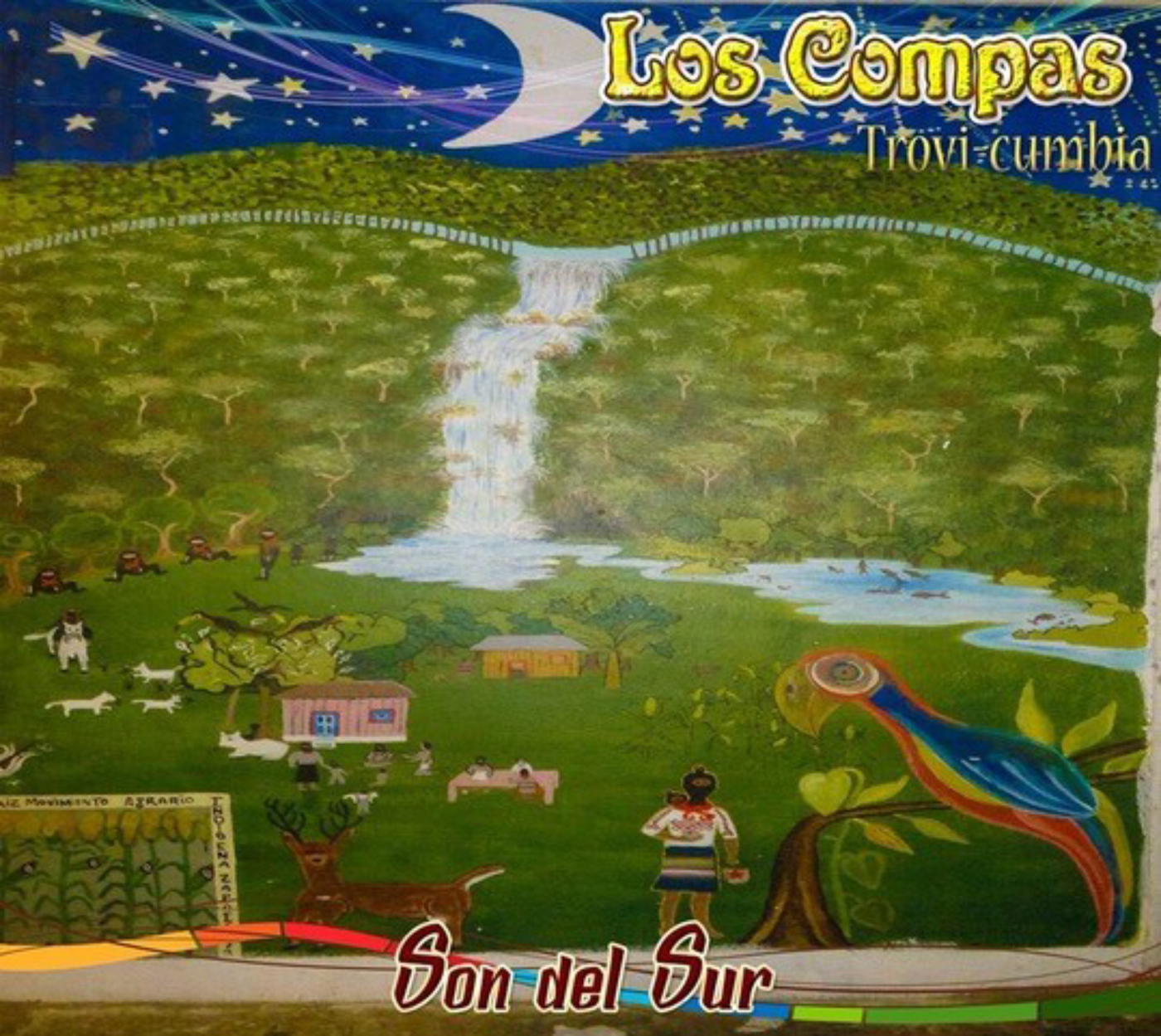
At this time, however, the singer discussed the possibility of a change in style with me; concerned that his concerts were being ignored by audiences, he expressed an interest in trying a ‘more energetic [movida]’ performance approach.Footnote 45 By the summers of 2015 and 2016, Hernán had acted on this goal; he was now leading a larger group of seven musicians, including acoustic and electric guitars, bass and percussion, with a new style in which his repertoire was now supported by shuffling, asymmetrical cumbia rhythms. A hybrid between a ‘text-centered’ genre of music (trova) and ‘body-centered’ one (cumbia) (Baker Reference Baker2011, p. 114), Hernán labelled this style trovicumbia. He called the band Los Compas de Chiapas, and later simply Los Compas – both names which index Zapatismo.Footnote 46 Equally, this band's identity remained strongly tied to Tierradentro; in 2016 Los Compas released an album entitled Son del sur (‘Sound of the South’) which featured images of murals within the restaurant on the front and back covers (see figure 1).
Used with permission of the artist.

The new musical direction this band took was hardly tranquil: their concerts demanded attention and got it, frequently motivating members of the audience in the restaurant to stand up and dance to insistent, uneven cumbia rhythms. Performances such as these transformed the space of the restaurant, creating a more fun, celebratory experience. This stylistic change was accompanied by a shift in the rhetoric connecting music to revolution. In addition to awareness-raising messages, members of Los Compas emphasised the political importance of rhythm. The back cover of Son del sur states that ‘the urgent revolution of today must begin with rhythm to remain in the hearts which dance the sounds of an abysmal reality’. During live performances in Tierradentro, Hernán had begun to give short talks emphasizing the importance of rhythm for achieving political change through music:
After ten years of playing trova […] that political message […] didn't come with rhythm, it was a political message that was occasionally tiresome. So we started to mix in the rhythms of cumbia […] and now we sing trovicumbia, living political message through rhythm. (Statement during a performance in August 2016)
Another member of Los Compas de Chiapas characterised their goal as raising ‘awareness, rhythm and joy’.Footnote 47 Suddenly, the affective power of music was recognised alongside the serious ‘message’ that Hernán had previously privileged.
The process by which this band had emerged was highly revealing. This new ensemble had been built up slowly over several years, and now included one of Hernán's university colleagues as well as another migrant from Taniperla. Those running the restaurant had become unhappy with Hernán's tendency to invite new musicians to perform without consulting them first – not least because this obliged them to pay more money for live music. Equally, their dissatisfaction had also extended to musical style. One waiter told me that the staff at Tierradentro had initially disliked the band's new sound, feeling that it clashed with the aesthetic priorities of the space. Nonetheless, upon seeing the larger, more enthusiastic audiences Los Compas tended to attract, they had grudgingly accepted that this change was good for business.Footnote 48 Of course, the fact that this creative decision was perceived, among those running the restaurant, as an ongoing act of defiance highlighted a presupposition concerning music's subordination to commercial strategy. In going against the wishes of the restaurant, Hernán exploited his status as the ‘only person who dared to sing’ ‘Himno Zapatista’ in the city, something which afforded him particular agency in a restaurant whose commercial identity was constructed around Zapatismo.
Final remarks: On musical salvage
The challenge that this narrative presents, I suggest, is that of contextualizing the creative agency exercised by the protagonists of this article in relation to a complex set of capitalist relations in a setting marked by gentrification. I began by highlighting the value of the recent work of Anna Tsing in finding pockets of diversity and unpredictability within settings dominated by capital exchange. This work, I suggest here, can be usefully deployed to understand this musical scene, and understand music's relation to the broader economic processes occurring in San Cristóbal.
Hernán's performances in Tierradentro may be understood as acts of musical ‘salvage’. That is, he took songs originating outside of capitalism and appropriated them for a commercial space participating, in however ambivalent a manner, in a process of gentrification. For instance, ‘Himno Zapatista’, which was core to the singer's repertoire in Tierradentro, was written at a Zapatista military training camp in the 1980s, and based on a corrido about the Mexican Revolution of 1910–1920. By the time of my research, this song had become a key part of Zapatista ritual life, often featuring at encounters and protests. Hernán and his musical collaborators were often invited to perform at such protests and encounters. ‘Himno Zapatista’ had accumulated meaning, then, through being performed at events with a distant relation to capitalism, many of which took place in Zapatista autonomous communities. In turn, protests were open events at which music was performed as a gift within a shared ritual life; they occurred in spaces in which, since no rents were charged, there was less imperative to accumulate capital. Spaces for protest could be understood as ‘pericapitalist’ sites which were ‘simultaneously inside and outside capitalism’ (Tsing Reference Tsing2015, p. 63); they were often the sites of deep hostility to capitalist economic processes, yet they produced, and attached richness of meaning to, cultural materials which could be adapted for gentrifying spaces.
Hernán thus worked as a ‘translator’, able to adapt performances of these songs to different contexts. Of course, the singer openly identified as a translator in one way – as an activist communicator of revolutionary messages through music to those unfamiliar with Zapatismo (cf. Tsing Reference Tsing2005, p. 18). Nonetheless, this article has argued that such an endeavour also implied translating revolutionary songs to suit the specific exigencies, such as ‘tranquillity’, of the gentrifying space in which the singer worked. As Tsing argues, ‘[t]ranslations across sites of difference are capitalism’ (Reference Tsing2015, p. 62). In the context studied here, translation facilitated accumulation even when capitalism had little hand in the initial composition of music. Further, on some levels Hernán's labour of translation implied simplification and the creation of musical uniformity – for instance, maintaining lines of equal length. Indeed, gentrification in this city could be seen as a series of simplifying translations, such as the dancers performing indigeneity in the central square, or the shops whose titles conflated Mayan and Mexica ethnic groups.
Yet, as indicated by Hernán's open defiance of the wishes of the space, the complexities of being a translator afforded the singer a great deal of creative agency. He was able to develop Los Compas within Tierradentro – despite this band's style being ill-suited to the pre-existing commercial strategy of this venue – because of the highly specific nature of his position as a musical mediator between Zapatismo and capitalism. He dared to sing ‘Himno Zapatista’ when others would not; he performed at protests and in Zapatista communities, developing individual credibility as an activist; he was an accomplished performer and his singing voice, full of vibrato, held particular appeal for cosmopolitan audiences. This position was characterised by ambivalences – especially among activists anxious about anyone who could be perceived to be profiting from a Zapatista image – but by the same token it presented plenty of creative possibilities.
It was therefore possible, in this setting, to root agency in acts of musical ‘salvage’. The salvaging of revolutionary songs for a commercial context exemplified the ways that ‘capitalist commodity value is everywhere created through tapping and transforming non-capitalist social relations’ (Tsing Reference Tsing2013, p. 21). Yet this case study also suggests that the peculiar qualities of positions of translation may make them privileged sites for unpredictable musical change. We may understand most about the relationship between gentrification and musical change by paying close attention to the specific social and musical interactions through which such positions are constituted. Such contingency is the terrain of intimate and open-ended practices of listening.
Acknowledgements
The author would like to thank Shzree Tan, Anna Morcom, Simran Singh, Henry Stobart and the two anonymous reviewers for their helpful comments on earlier versions of this article, as well as Hernán and all those who participated in this study. This research was funded by the Arts and Humanities Research Council.