You will find out soon or later,
That, good or bad, All men are mad;
All they say or do is theatre.
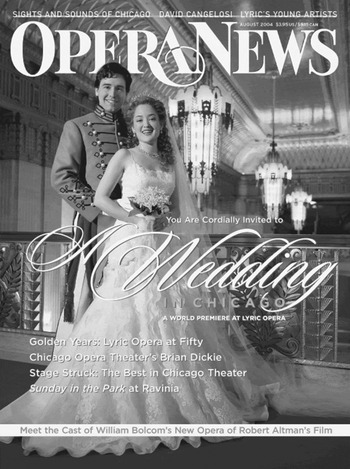
—Baba the Turk in The Rake's Progress Footnote 1In 2004, the Lyric Opera of Chicago celebrated two milestones: its fiftieth anniversary and the premiere of A Wedding. With music and libretto by Pulitzer Prize–winning composer William Bolcom, film director Robert Altman, and Arnold Weinstein, the opera received intense international coverage. Prepremiere articles, major features, interviews, and reviews appeared in Opera Now, Opernwelt, Opera, and Opera Quarterly. The Lyric's A Wedding dominated the August issue of Opera News, occupying the cover and several features, complete with glossy photos of the photogenic young leads dressed in luxurious wedding attire (see Figure 1).
Cover of Opera News, August 2004. Courtesy of Opera News.

Yet perhaps more surprising is the extent of coverage in national, regional, and even local newspapers in the United States. While reviews in the New York Times and the New Yorker may have been expected, the Milwaukee Sentinel and the Arlington Daily Herald (Illinois) highlighted the new opera in features and full-length reviews. Most impressive was the coverage by Chicago-area papers, for which Altman had become something of a local favorite. His last work before A Wedding, The Company (2003), had featured the city's Joffrey Ballet Company, and regional papers documented the fund-raising, preproduction, filming, and premiere of his new production with unusual attention. Journalists had rare access to the 79-year-old Altman, who not only collaborated on the libretto of A Wedding but also directed the original production.
For the creative team, the Lyric's administrators, and opera enthusiasts alike, the high profile of A Wedding must have seemed an ideal opportunity for public outreach and education. Altman had reached a zenith in his long career as a film director, writer, and producer. Alternatively acclaimed and disdained in the decade after his hit M*A*S*H (1970), Altman retrenched during the 1980s before making a much-publicized comeback with The Player (1992). By the time A Wedding premiered in 2004, Altman's reputation as an iconoclastic auteur was secure and his artistic integrity confirmed by more than two decades of work in opera.
In fact, Altman's association with opera occupies more than half of his mature career.Footnote 2 It began with his direction of Stravinsky's The Rake's Progress at the University of Michigan, Ann Arbor, in 1982. Four years later, the production was restaged (again under Altman's direction) at Opéra du Nord in Lille, France. Later, he collaborated with Bolcom and Weinstein on two full-scale operas for the Chicago Lyric: McTeague (1992) and A Wedding (2004), based on his 1978 film of the same name. Less well known are his cinematic and television projects that incorporate opera: a segment of Rameau's Les Boréades for the collaborative film Aria (1987), a planned film biography of Rossini that was to include numerous original operatic performances, and a television special for PBS, The Real McTeague (1993), that merged filmed excerpts from the opera with silent film and spoken commentary by Studs Terkel.
Altman's opera-themed output bears closer examination in light of new institutional initiatives to promote contemporary opera in the United States by exploiting synergies between film and opera. Indeed, Altman's activities encapsulate many aspects of the long and complex relationship between film and American opera that scholar Elise Kirk dates back to silent film.Footnote 3 A study of Altman's operatic work using previously unavailable primary sources, production documentation such as film and audio recordings and scores, and analysis of critical reception uncovers larger synergies among diverse media. These developments involve changing audiences and patronage systems, the relationship between elitism and the economics of producing operas, and the unique challenges to creativity in film, theatre, and music—separately and in concert. This case study of Altman's underexamined yet quite extensive work in opera suggests early models for crossovers between film directors and opera productions, both onstage and in film. Such crossovers raise questions of commercialism and artistic values when placed within the larger cultural, economic, and creative context of opera institutions and the film industry during an especially volatile period.
Altman, Music, and Theatre
Altman once spoke of his seeming disadvantages for a career in theatrical and filmed opera:
I don't consider myself an opera director. I consider myself a theatre director. To me, it's theatre. I can't read music—I'm really inept in those areas. I don't have anything to offer the singers, who already know those operas when they come in—they have to. I can't help them musically. I don't feel I have any purpose there, so I've avoided it.Footnote 4
Despite these protestations, Altman was, in fact, well versed in the relationship among drama, lyrics, and performance as demonstrated in his creative work, even if he lacked a precise knowledge of score reading and other rudiments.Footnote 5
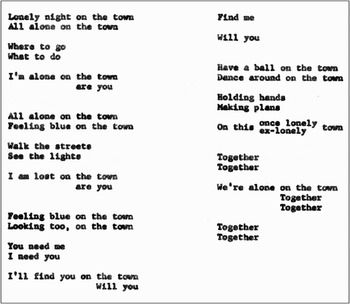
Especially relevant are Altman's creative efforts in musical theatre. In the late 1940s, after his discharge from the air force, Altman wrote the lyrics for at least two musicals. The most extensive consists of around a dozen songs written with composer Bob Ecton for a backstage portrait of life in Hollywood entitled Rumors Are Flying.Footnote 6 Although the show was never produced, the songs reflect a gift for clever imagery, double entendres, and unexpected turns of phrase. Moreover, typed lyrics from the same group of songs (Figure 2) demonstrate an early, specifically musical model for what would become one of Altman's signature devices: overlapping dialogue. In Altman's later films he would more fully exploit verbal and linguistic play with increasing dramatic and technical sophistication. And in his theatrical works including opera staging Altman would apply this musical-dramatic device most effectively, as will be shown.
Typed lyrics by Robert Altman, ca. 1947–8. From an original held in the Robert Altman Archives at the University of Michigan. Used by permission of the Estate of Robert Altman. All rights reserved.

Other aspects of Altman's career suggest a continuing creative engagement with music. He contributed lyrics to songs featured in his films, including “The Day I Looked Jesus in the Eye” for Nashville (1975) and “The Way It's Meant to Be” for Gosford Park (2001), and one of the Altman–Ecton songs, “Let's Begin Again,” was recycled for the film HealtH (1980).Footnote 7 In the early 1980s, Altman cowrote a country-and-western song entitled “Black Sheep” that would later become a hit record for artist John Anderson.Footnote 8 And, as film scholar Rick Altman notes, the director “is something of a hero, an intellectual explorer opening up new territory for the artists of tomorrow” for his approach to sound recording, mixing, and editing, including the use of radio microphones and multitrack sound manipulation:
Altman not only chose to use traditional technology in a new manner, but he also developed a new sound technology, specifically dedicated to a non-hierarchical multi-channel soundscape. The characteristic Altman approach to sound may thus be read as an overt attempt to break out of cinema's heretofore literary model, to fight the tendency to reduce sound to its meaning, to replace the single-channel linearity of written discourse by a three-dimensional multiplicity calling for a radically different level and type of spectator—and especially auditor—activity.Footnote 9
In addition to creating carefully composed soundscapes, Altman's films reveal his acumen for lyrics and musical accompaniment within dramatic scenarios; he coordinated these elements with the visual content of his films in great detail. As film scholars have discussed, McCabe and Mrs. Miller (1971), Nashville, Short Cuts (1993), Kansas City (1996), and Gosford Park employ unexpected musical repertoires to literally and figuratively underscore films whose genre is complex. From Leonard Cohen to country-and-western songs, vocal or instrumental jazz, and British music-hall hits, Altman had a knack for using musical performances—often diegetic and recorded live—to amplify, extend, and even undermine a film's essential narrative.Footnote 10 Although he was new to opera, then, Altman brought to his work in opera a heightened musical and aural sensitivity as well as the sophisticated and fine-tuned sense of musical, verbal, cinematic, and dramatic interplay that was evident in his films.
As a film director, Altman could rely on increasingly sophisticated sound design to draw the audience's attention to specific aural moments. Such precisely controlled audio design cannot directly transfer to live theatre on the same scale or with the same results. Yet Altman brought his distinct musical sensibility to his work directing opera, in realizations that have proven influential in a number of ways. First, he incorporated more cinematic techniques onstage, especially flashbacks used in unexpected contexts. Second, he placed more emphasis on acting by the opera's principal and supporting singers. Third, he employed more nonsingers (i.e., actors and dancers) to create spectacle and visual complexity onstage. Fourth, he promoted opera as antielitist and distinctively American, an emphasis the sponsoring institutions amplified through aggressive marketing and promotion. And last, he exploited intertextuality in his filmed operas and stage works as part of a larger dialogue concerning cinema, spectatorship, and memory. Thus, Altman's crossovers from Hollywood to opera stage and back again reflect a unique synthesis of theatre, music, and cinema.
1982: The Rake's Progress
In fact, Altman's initial involvement in opera originated in his musical work—albeit from a negative standpoint. In late December of 1980, the large-scale musical Popeye premiered during the busy holiday season. Although many critical reviews were quite positive, it is remembered as a critical and commercial failure.Footnote 11 The film failed to yield the substantial profits expected in the industry, and within a year Altman found himself unable to obtain financing and distribution from the major Hollywood studios. Although the veteran director tried to put on a brave face, a 1981 article in the New York Times concerning the sale of his production company noted his changed relationship to Hollywood:
“Suddenly, no one answered my phone calls,” Mr. Altman said in a telephone interview… . “I had no place to turn.” The maverick director whose greatest commercial success was M*A*S*H, 11 years ago, put his company on the block last winter in the wake of financial claims and counterclaims with Paramount Pictures over the budget of Popeye and the collapse of his next project, Lone Star, at United Artists… . “I feel my time has run out,” he said today. “Every studio wants Raider[s] of the Lost Ark. The movies I want to make are movies the studios don't want. What they want to make, I don't.” For the moment, Mr. Altman has turned to directing on the stage.Footnote 12
Indeed, the 1980s would prove difficult for several veterans of the so-called New Hollywood, specifically those identified as American art-cinema directors. As Thomas Schatz notes, the significance of such “Lucas and Spielberg super-blockbusters can hardly be overstated, considering their impact on theatrical and video markets in the U.S., which along with the rapidly expanding global entertainment market went into overdrive in the 1980s.”Footnote 13 Although Altman remained productive, his obscure, minimal-budget films aired primarily on cable television (including the HBO series Tanner '88 and the BBC miniseries Vincent and Theo). His films had almost no large-scale theatrical releases and virtually no major studio sponsorship through the late 1980s.
In the face of the limited opportunities Altman had to produce feature films distributed by mainstream Hollywood, he turned to the stage, a medium with which he had little experience beyond his lyric writing and a brief stint in a Kansas City community-theatre organization decades earlier.Footnote 14 He directed two short plays under the title Two by South, which was mounted by the Los Angeles Actors' Theatre in June 1981 and then as an Off-Broadway production that fall: both were well received. The following spring, Altman directed the play Come Back to the 5 & Dime, Jimmy Dean, Jimmy Dean starring Cher, Sandy Dennis, and Karen Black. Its run on Broadway was brief; the production was panned by critics as “dreadful.”Footnote 15 One critic wrote that such a weak play would not have been produced without celebrity headliners.Footnote 16 Although some of the criticism aimed squarely at the play's perceived shortcomings, respected critic Frank Rich specifically faulted Altman's direction, saying that he had staged the production “at the pace of a dripping faucet.”Footnote 17
The play, however, offered Altman an opportunity to experiment with adapting for stage the cinematic technique of flashbacks—a technique that he had avoided in films to this time. The stage incorporated two identical sets of a Woolworth's diner: one from the near-present (1975) and one from the past (1955). Rich described the flashbacks thus:
Mr. Altman rarely even bothers to separate the flashback scenes from the present-day ones. The characters don't change in age or appearance as they go back and forth between 1955 and 1975. Paul Gallo's lighting at first tries to indicate the time shifts, but finally lapses into incoherence when mere darkness would do.Footnote 18
Yet flashbacks, which would prove critical for Altman's later operatic realizations, offer more than temporal ruptures. They present an alternative view of each character's story, eventually undoing the present via the past. In that context, Gallo's lighting design makes dramatic and theatrical sense. Moreover, film scholar Maureen Turim points out that flashbacks “merge dream and memory imagery” to “explore the surreal aspects of memory and investigate intra-subjectivity.”Footnote 19
The play's flashbacks work in conjunction with the use of a mirrored wall to interrogate the reality of the central characters and their attempts to define, reflect, and apparently fictionalize their present lives in relation to the past. In an interview with Richard Combs, Altman stated that “the play was never meant to be realistic[;] there was a strong suggestion that this place wasn't even there, that it existed only in their minds and in our minds.”Footnote 20 Scholar Robert Self wrote that the use of mirrors in the film version of Come Back to the 5 & Dime symbolizes “the impact of the entertainment media upon the lives of the producers, the stars, and their audiences.”Footnote 21 In other words, through mirrors, the characters become “both observer and observed, the subject and the object.”Footnote 22 In the same way, the play's flashbacks and mirrored images interrogate spectatorship, temporality, and existence. In his future operatic work, Altman would extend his use of flashbacks as a key cinetheatrical device.
When other film projects failed to materialize, Altman accepted the position of Howard R. Marsh Visiting Professor of Journalism at the University of Michigan, Ann Arbor, from 15 September to 31 October 1982. Altman taught a film seminar on his own work,Footnote 23 and the arrangement was so successful that he returned the following year to direct theatrical and cinematic versions of Secret Honor, a one-man show fictionalizing Richard Nixon's post-Watergate life, using University of Michigan locales and unpaid student interns to augment his professional film crew.Footnote 24 Because of his clear musical bent and his recent experience in theatrical production, the university offered Altman a unique opportunity to synthesize these seemingly disparate elements in a new media: opera.
In addition to his teaching duties, Altman was approached by the dean of the School of Music, Paul Boylan, to direct a production of Stravinsky's opera The Rake's Progress (1951). The timing of Altman's appointment was auspicious: the opera was scheduled to run during Stravinsky's centenary year and to overlap with the national meeting of the American Musicological Society in Ann Arbor in the first week of November. Inspired in part by the eighteenth-century drawings of William Hogarth, the neoclassical opera follows the downfall of Tom Rakewell through the manipulation of Nick Shadow (the devil), including Tom's abandonment of his fiancée Anne Trulove, his debasement in the brothels of London, and his confinement to an insane asylum at the end of the work.
While Altman was not the first film director to work in opera, he was perhaps the most famous. Ingmar Bergman had created an acclaimed production of The Rake's Progress for the Royal Swedish Opera in 1961,Footnote 25 with which the composer was apparently pleased,Footnote 26 and he later directed a classic film adaptation of Mozart's Die Zauberflöte (1975). Joseph Losey's Don Giovanni (1979) is still one of the most innovative and studied film adaptations of opera.Footnote 27 Franco Zeffirelli crossed back and forth between theatrical and cinematic opera and released his film version of Verdi's La traviata (1982), which premiered in Italy a month after the debut of Altman's version of The Rake's Progress. But unlike Bergman, Losey, and Zeffirelli, whose films played primarily on college campuses and at independent art theatres, Hollywood studios had until recently distributed Altman's films. Not only were Altman's films available at the local drive-in or suburban multiplex but his hit film M*A*S*H had spawned the major weekly television series of the same name, which was still running at the time of the Michigan production.
The only other relevant precedent for Altman's work in opera may be the work of Francis Ford Coppola. In 1972, Coppola had directed a production in Los Angeles of Gottfried von Einem's The Visit of the Old Lady that had inspired mixed reactions. Although a reviewer in the London Times praised the production, the experience was described as an unhappy fit between filmmaker and media, possibly a result of the fact that Coppola had minimal experience working in live theatre and specifically in opera. As Coppola's biographer Michael Schumacher describes, the director seriously underestimated the time needed to mount the little-known opera from scratch in less than a month:
Coppola, who likened the frenetic preparation of the opera to “running in front of a locomotive,” struggled with his on-the-job training, which showed him the wide gulf between directing a motion picture and directing an opera… . “I'll never work on this kind of crazy schedule again,” he stated. “Opera people work harder than anybody else I've ever seen.”Footnote 28
Despite Coppola's use of opera in later films such as The Godfather III, he never returned to the opera stage. As a later critic noted, “Coppola washed his hands of crossing over” from film to opera after this “unhappy stint.”Footnote 29
Altman was initially unsure about taking on The Rake's Progress but changed his mind after he came up with the central concept for the production.Footnote 30 As he reminisced,
I remember I was asleep. They woke me up on a weekend morning… . I said, “I don't know anything about opera. Thanks for thinking of me, but I'm just not right.” I hung up the phone and in my sleepy condition I had this idea, this visual idea of what to do with the stage. I called him back and said, “I thought through this for 20 minutes. I'll do it.”Footnote 31
The central concept that had occurred to Altman involved placing the entire work, rather than just the final scenes, within an insane asylum. Thus, the opera unfolded as one long flashback told by an unreliable narrator; it was a refinement and an extension of the theatrical technique he had used in Come Back to the 5 & Dime, Jimmy Dean, Jimmy Dean. Altman's production reframed the relationship of observer and observed, since through flashbacks and other staging the main characters joined the audience in viewing the past onstage. As described by one reviewer, Baba the Turk unveiled her beard simultaneously “to the audience and the raucously appreciative inmates of Bedlam. Audience and cast, at that moment, cleverly merged.”Footnote 32 Both the temporal ruptures of the flashback and the dissolving line between audience and performer may have been inspired by one line in the opera: “You will find out soon or later, / That, good or bad, All men are mad; / All they say or do is theatre.”Footnote 33 Not only does this line encapsulate the self-reflexivity evident in virtually all of Altman's films, but the most inclusive interpretation of “all men are mad” also implicates the opera's spectators, who have been drawn into the spectacle.
The Christian Science Monitor review noted what would become an integral part of the reception of Altman's opera work: the fact that his artistic impulses could shine in the opera house, unimpeded by the crass commercialism of the film industry.Footnote 34 Implicit in this commentary is the comparison between true “art” and the debased commercialism of the blockbuster and sequel-fueled Hollywood film industry of the 1980s. Paradoxically, it was Altman's involvement with the commercial film industry that fueled international coverage of his work in opera. As a marquee film director, Altman brought Michigan's The Rake's Progress to a public prominence that was unprecedented for a university offering or even an American opera production in general. The production was reviewed both in the popular media and in scholarly periodicals.Footnote 35
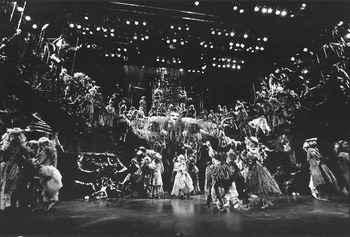
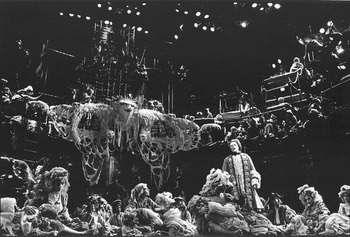
Photos, reviews, and other reports indicate that Altman emphasized acting and staging on a new scale (see Figures 3 and 4) in The Rake's Progress. The Christian Science Monitor reviewer described the “scenes in which nearly 150 people swarm around the setting at once” as “dazzling”:
Physically, the undertaking must rank with the grandest “grand opera” in recent memory. The stage creaked under a huge metallic cobweb of platforms and scaffolds. On it were draped scores of bizarrely costumed figures representing both the sublime and (more often) the phantasmagoric aspects of the story… . Inanimate objects took on unexpected life, as when a clock chimed in Stravinsky's score, and suddenly its dial was spectrally embodied by a huge ring of performers. It was part circus, part reverie, part nightmare, part sleight-of-hand, and part sheer fun—all managing to serve the libretto (by W. H. Auden and Chester Kallman) rather than merely distracting attention.Footnote 36
Production photo with guillotine for A Rake's Progress, by Igor Stravinsky, libretto by W. H. Auden and Chester Kallman. Directed by Robert Altman at the University of Michigan, Ann Arbor, November 1982. © 1982 Darryl Pitt.

Production photo of staging and multilayered set for Altman's production of A Rake's Progress. © 1982 Darryl Pitt.

The greatly expanded cast included a large number of nonsinging actors and thirty-six dancers. Although it was not a new idea, integrating nonsingers into opera had not been attempted before on this scale. It was possible only because of the institutional patronage of the university and the use of a large number of unpaid students to expand the cast of paid professional performers. A reviewer for the journal Opera wrote that, despite the seeming mayhem, Altman expertly tied together theatre and music, noting that he “moved his principals with as great a clarity and psychological exactness as we have come to expect of theatrical events… . All the principals gave splendid performances, alive with nuance, moving with grace.”Footnote 37 Altman's approach thus emphasized theatrical and visual aspects without sacrificing musical quality.Footnote 38
Throughout the next two decades, Altman's crossover work would be used in promotional materials to appeal to audiences in both theatre and opera—a trend that prefigured later efforts by film directors working in opera. This synthesis of art and commerce created a feedback loop in which Altman's credentials as an independent filmmaker validated his work in opera and his efforts on behalf of the art of opera enhanced his profile as an innovative auteur.
1987: Aria
After his two appointments at the University of Michigan, Altman relocated to Paris. During his European exile, the Opéra du Nord in Lille (in northern France) produced a slightly revised version of the Michigan production of The Rake's Progress in 1986. Here again, Altman told the entire opera as a flashback with the aid of twenty extra choristers and sets and costumes, all contributed by the University of Michigan. One reviewer remarked of the supplemental American performers that their “acting was sensational; rarely have I seen madness so frighteningly portrayed.”Footnote 39 As it happened, the timing for the Lille production was disastrous. The company had received notice of its closing due to an enormous deficit, and Altman's The Rake's Progress was the troupe's final exhibition.Footnote 40
Parts of the Lille production of The Rake's Progress are preserved in another medium, since dozens of its performers appear in a filmed sequence for the feature Aria (1987). As the premise for the film, ten famous directors, including Altman, Jean-Luc Godard, Ken Russell, and Derek Jarman, were given free rein to choose an operatic excerpt and make an accompanying short film of around ten minutes. For his segment, Altman chose an extended excerpt from Rameau's five-act tragédie en musique, Les Boréades (ca. 1763), to which the inmates of an eighteenth-century insane asylum—Tom Rakewell's colleagues from The Rake's Progress—react in sometimes amusing, often puzzling, ways.
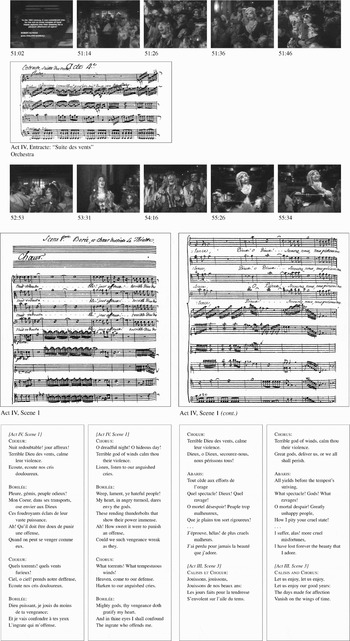
Rameau's work remained unperformed in the composer's lifetime and did not premiere until two centuries later, in 1964. The excerpt in Aria seems extremely esoteric when compared to the soundtracks of the other shorts, which include opera chestnuts from Rigoletto, Turandot, and Tristan und Isolde. In adapting Rameau's score, Altman chose to scramble the work's original sequence, placing a large section of act 4's music before a central dramatic moment in act 3 (summarized in Figure 5).
Visual and aural map of Altman's segment, “Les Boréades,” for Aria (1987). Screen captures from Robert Altman et al., Aria, DVD Release, Image Entertainment, Chatsworth, CA, 1999. Score excerpts: “Nuit redoubtable,” mm. 1–7 and “Terrible Dieu des vents,” mm. 6–12; from the facsimile of the full score: Jean-Philippe Rameau and Louis de Cahusac, Les Boréades: Tragédie lyrique (1764) (Paris: Stil, 1982). French text per Rameau in the facsimile score; translation by the author.

For the rare viewers who are familiar with the score of Les Boréades, and the even smaller demographic who would have recognized the cast of The Rake's Progress, the effect is not unlike a musical flashback. Indeed, as will become clear, the segment can be seen and heard as embodying several layers of flashbacks from Stravinsky's absent neoclassical score to the visual historicization of opera in this segment. The placement in the past begins (as shown in Figure 5, 51:02) with Altman's statement that “In the 18th century, it was considered chic for the rich to invite inmates of local insane asylums into their theatres for a pleasant afternoon of opera.” For anyone who understands the French libretto, the story line emerges as disjointed and nonsensical, creating the sense of temporary and narrative displacement.
Indeed, Altman made many choices that effectively distance the viewer from the work. Throughout the seven-minute opera video, we hear Rameau's music but see only the insane audience (and their foils, a few sane but dull members of the aristocracy) occupying the seats, boxes, and balconies of an old theatre. By focusing on the inmates' extreme, irrational, raunchy, and absurd reactions to the sophisticated and refined operatic soundtrack, Altman invites viewers to experience Rameau through the lens of madness.
Yet on one level, the soundtrack and setting are entirely appropriate. Since Stravinsky's The Rake's Progress is a pastiche of eighteenth-century opera and the on-screen cast is drawn from that work, why not place Stravinsky's cast in dialogue with a real eighteenth-century opera? Rameau scholar Charles Dill sees the combination of eighteenth and twentieth-century opera in this minifilm as embodying a dialogue between past and present, including Altman's consideration of his own previous work in opera:
Much of a director's time is spent imagining what audiences will see. To create an effective film, a director takes control of his audience's visual and auditory experience… . Inevitably, however, some of a director's time will be spent in the more historical act of understanding the responses of past audiences. At this point, he or she becomes concerned with comprehending the earlier audiences' pleasures, devotions, quibbles, and rejections. The Les Boréades segment in Aria might thus be thought of more practically as Altman's critical reflection on past work, in this case The Rake's Progress.Footnote 41
Moreover, Altman's realization of Les Boréades in dialogue with The Rake's Progress presents the only actual operatic performers seen in the entire film of Aria. The inmates mockingly mouth individual words (see Figure 5, 52:53 and 53:31, for example), evoking what often occurs in filmed adaptations of opera: mimed singing that uses “the naturalistic conventions of cinema … to translate a most unrealistic staged art form,” as Linda Hutcheon notes.Footnote 42 And by cinematizing an authentic theatrical production rife with allusions and quotations from both works, Altman's adaptation of Rameau and Stravinsky functions on some level as “(meta)commentary,” to use Thomas Leitch's concept.Footnote 43 In so doing, Altman makes use of multiple intertextual strategies, perhaps as a means of interrogating the relationships not only between observer and observed but between stage and screen, history and memory, sanity and madness, reality and illusion.
Part of this interrogation involves the location for the filming, a famous historic Parisian movie theatre, although the location is not included in the film's credits. The Théâtre le Ranelagh (also known as the Théâtre du Ranelagh) was originally built in 1755 and served as home to some of Rameau's performances. It was destroyed in the French Revolution but was later restored. The rebuilt Ranelagh functioned as a concert hall and theatre before being converted to a public moviehouse in 1931, in the early sound era. It continues to host a variety of art-film, theatrical, and musical productions.Footnote 44 Thus, music, theatre, film, and sound history intersect in Altman's “Les Boréades” segment to challenge the boundaries of spectatorship. The external audience watches a film showing an internal audience, who watch an unseen opera or, more likely, a film by staring back through the screen, suggesting a reversal of reality. Indeed, the inmates are running the asylum.
With so many layers of meaning and little (or no) opportunity for viewers to grasp these complex visual, aural, historical, and intertextual dimensions, it is no wonder that Altman's segment was one of least popular with reviewers, especially when compared with the erotic vignettes featuring starlets Bridget Fonda and Elizabeth Hurley and younger, edgier directors such as Jarman.
Yet Aria as a whole reflects the burgeoning field of independent film in the late 1980s, including the increased visible and aural presence of opera within more commercially viable films aimed at niche audiences. Even as the Hollywood industry continued to produced blockbusters and their sequels, three independent film companies—Miramax, Fine Line, and the Samuel Goldwyn Company—saw a substantial increase in box office in the so-called art market in the United States.Footnote 45 Miramax, the largest of the three and the distributor of Aria, would be particularly successful in creating new and more commercially successful independent films by distributing, in Alisa Perren's words, “art house-oriented films … that could be promoted as quality pictures—films that aspired to the status of ‘art’ in terms of style and narrative construction” but that also appealed “to multiple niches … using sex, violence, and controversy as sales strategies.”Footnote 46 Opera excerpts accompanied these films and supplied an undeniably highbrow soundtrack, from the Puccini arias of A Room with a View (1985) to the electronically produced castrato voice of Farinelli (1994).
1992: McTeague
By the time Aria reached theatres in the United States, Altman had begun work on three other opera-related projects. The first was a biopic to be filmed in Italy entitled Rossini! Rossini!, which was in the mold of previous composer biographies such as Amadeus, the successful Peter Schaffer play that found a mainstream audience in the 1984 Miloš Forman film. The planned Rossini project portrayed the famous composer with ample excerpts from his best-known operas, including Il barbiere di Siviglia (The Barber of Seville) and Guillaume Tell (William Tell). Script drafts and production notes indicate a smattering of characters already familiar to American audiences—Salieri, who is a main character in Amadeus; Beethoven; and Wagner—as well as an “Old Rossini” and a “Young Rossini,” following the frame of Amadeus. As Altman's notes describe the work, the director planned to use live-filmed, diegetic opera performances to underscore key moments in Rossini's life.Footnote 47 Although Altman was fired from the project before its completion, his notes indicate how thoroughly he had imagined a marriage of opera and film, one in line with the new Euro-American, high-culture, independent film movement that was already proving successful stateside.
The other projects were more successful: the opera McTeague (1992), with music by William Bolcom, libretto by Altman and Arnold Weinstein, and a first production directed by Altman; and a documentary that Altman co-wrote and directed for PBS entitled The Real McTeague (1993) that used filmed excerpts from the opera. The opera telescoped several sources from diverse media. It was based on the 1899 novel McTeague by Frank Norris (a native of Chicago), who fictionalized a newspaper account of a husband's murder of his wife. Another source was the legendary silent-film version Greed (1923–4) by Erich von Stroheim, originally an epic lasting at least nine hours that Leitch described as using one of the strictest forms of cinematic adaptation: that of “replication of every possible element of the original text—structure, action, character, setting, dialogue, theme, tone, and so on.”Footnote 48 Bolcom had viewed Greed's only surviving version as a student in 1962, one that had been edited to a fraction of the total running time without the director's consent. Expanding these original sources with the new opera, the PBS documentary The Real McTeague was a one-hour multimedia special that aired in May 1993 as part of the Great Performances series. It blended excerpts from the Lyric Opera of Chicago's production of McTeague and Stroheim's Greed and was hosted by Studs Terkel, who contributed commentary and read passages from the novel.
Both McTeague and The Real McTeague sprang from an initiative the Lyric Opera had announced in 1989 called Toward the 21st Century. This ambitious program commissioned three new American operas and seven new productions of contemporary operas written by composers from the United States. The nationalist overtones are obvious—in the words of the Lyric's general director Ardis Krainik, the program was “the first long-term commitment to American opera to be announced by any major opera company.”Footnote 49 The goal was “to further vitalize American opera” in Chicago and throughout the country by taking “a leadership role in promoting American opera and American-produced opera.”Footnote 50
McTeague stood as a signal moment in opera history as the first new commission in the Lyric's series. Bolcom had wanted to work with Altman on an opera project since viewing The Rake's Progress at the University of Michigan (where he taught composition) in 1982. Bolcom composed the music, Altman produced an initial scenario and conferred on issues such as plot points and characters, and Weinstein wrote most of the libretto.Footnote 51
The Lyric's publicity materials leading up to the work's premiere in October 1992 emphasized Altman's association with the project. The 1989 press release described Altman as “the famed film director.”Footnote 52 A mailed brochure publicizing the 1992–3 season, which would have been prepared late in 1991 or early 1992, described Altman as “our Academy Award–winning director”—an inaccurate statement, since Altman himself had never won an Oscar.Footnote 53 A foreword in the advertising booklet for McTeague by the Lyric's top administrator, Krainik, listed two of Altman's critically acclaimed films from the early 1970s: “Our director is the movies' famous Robert Altman (remember M*A*S*H and McCabe and Mrs. Miller?).”Footnote 54 While these early sources noted Altman's important role, the references were to his film career in general and to works that were two decades old.
In later advertising, however, the narrative changed substantially. In the late spring and summer of 1992, Altman's “comeback” film The Player emerged as a critical and box office success.Footnote 55 Altman won the Cannes Film Festival prize for Best Director in May, and in July he won the Rudolph Valentino Award for filmmaking. Later publicity materials from the Lyric mentioned The Player and Altman's recent awards at every turn. For example, the press release of 23 October 1992 touted “The Player, M*A*S*H, McCabe and Mrs. Miller” as well as a number of recent but little-known works from the 1980s, including Aria.Footnote 56 To publicize Altman's presence further, the Lyric arranged an all-day symposium on the day of the premiere, and the mailer advertising the event included photos that stressed Altman's participation in its production and his recent success in the mainstream film industry.Footnote 57
The publicity for McTeague emphasized the opera's cinematic and literary origins, even as the creative team expressed differing views on the film's influence on McTeague. Bolcom acknowledged a long-standing desire to link the film to a new opera, originating in his experience improvising a piano score for a viewing of Greed while a student at Stanford in 1962.Footnote 58 In comparison, Altman downplayed the influence of the film and even his familiarity with it:
Robert Altman, however, seems oddly unaffected by Greed. “I've never been emotionally captivated by it,” he says. “I've watched it more than experienced it. I don't think I've ever stayed and watched it through in one sitting. I know a lot more about the book than I do about the film.”Footnote 59
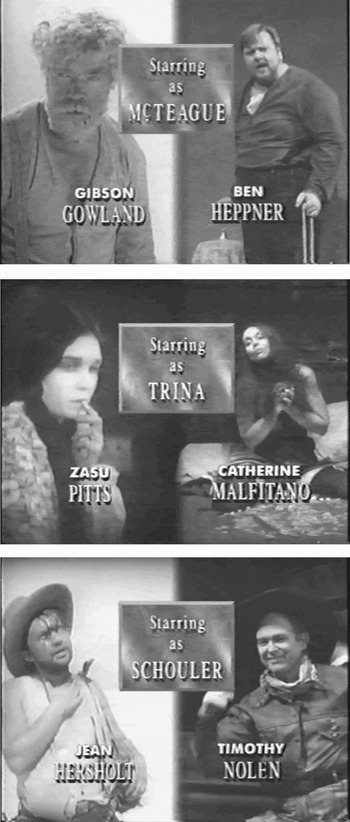
Yet Greed may have inspired the opera's production to a greater extent than Altman suggested. Both the opera and the extant silent film (in its edited form) removed many of the same minor characters and side stories. And scenic designer Yuri Kuper's set was “inspired by von Stroheim's Greed and [created] the subtle, monochrome look of a black-and-white silent film.”Footnote 60 The similarities in costume, appearances, and set between the opera production and the silent film are particularly obvious in the montage credits of The Real McTeague, which juxtapose equivalent characters and actors (summarized in Figure 6).
Opening credits of The Real McTeague comparing characters from Erich von Stroheim's film Greed and the opera McTeague by William Bolcom, libretto by Robert Altman and Arnold Weinstein. Screen captures from The Real McTeague: A Synthesis of Forms, episode of Great Performances, aired 26 May 1993 on WNET, New York.

As Kirk notes, the similarities between McTeague and Greed are “revealing—and startling— … from details of facial expression and gesture to overall dramaturgy and action.” He concludes that “whether conscious or deliberate, the links illustrate further the strong interplay within American theatre arts.”Footnote 61
Another reviewer suggested that such similarities were intentional, pointing out that The Real McTeague offers “a look at how closely Altman drew on von Stroheim's film in staging Bolcom's opera.”
Still, the program consists primarily of shifting between film and opera, using the opera's music as soundtrack for both. Placing scenes from both side by side clearly shows unusually strong visual and textual parallels between them.Footnote 62
A sung sequence in which McTeague recalls his childhood working in the mines musically recalls the opening sequence of Greed, while Trina's bandaged hands—unexplained in the opera but bitten off by McTeague in the novel and the film—replicate quite specifically the similar image in the film. Although it is not critical to understanding the opera, a visual memory of the film greatly enhances the theatre work in this passage and elsewhere. Altman's references to the film and the visual and theatrical manipulation of memory suggest a complex interweaving of the internal past of the opera and the cinematic past represented by Stroheim. The Lyric counted on this intertextuality: the symposium preceding the premiere included a showing of Greed.
McTeague the opera depends extensively on flashbacks to tell the story—a film device that Stroheim had not used but one that was firmly entrenched in Altman's theatrical tool kit by the early 1990s. Extending the technique from earlier productions, Altman and his production team effectively convey temporal and geographical distance by alternating scenes of McTeague's last moments in Death Valley with the trajectory of the story, including his marriage to Trina, her obsession with money after winning the lottery, the breakdown of their marriage, her murder at his hands, and his flight into the desert.
For Altman, however, the flashback is not simply a cinetheatrical device but is a metaphor for interacting with the past, sometimes intertextually. Indeed, Altman's description of McTeague echoes the animating tensions of the Aria segment that combines Rameau and Stravinsky, theatre and film, and distant and near past with the present:
McTeague doesn't apply to contemporary time; it's a fable which takes place in the past. The story is based on a real murder. … But we are seeing it through layers of memory—Norris', Bolcom's, mine, the designers, the actors, the people in the audience after they've seen it.Footnote 63
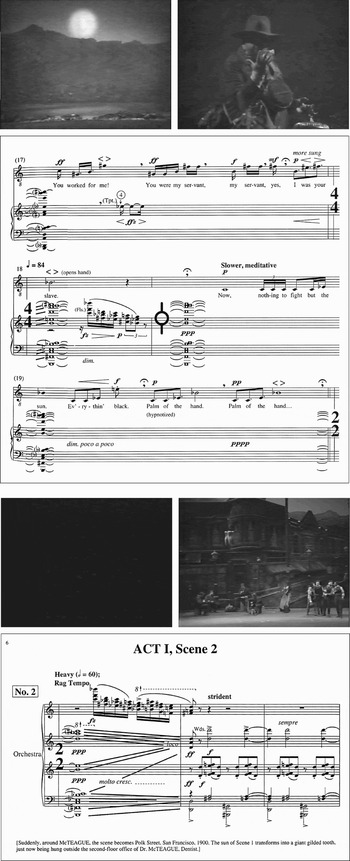
His theatrical production complemented Bolcom's music, which is also based on exploiting musical memory and association. Bolcom's allusions to cakewalks, ragtime, and waltzes, for example, are intended to be recognizable even though he presented them in a late twentieth-century style. And Bolcom's score juxtaposes diverse musical styles at the point of each flashback, which are reinforced by changes in lighting, costume, and scenery in Altman's production (see Figure 7). At the transition to act 1, scene 2, where the story moves back in time from McTeague's journey in the desert to happier days, Bolcom's score shifts from a posttonal recitative to a parody of ragtime. The temporal movement is here underscored—literally—by a shift from a clear late twentieth-century style to one tied to a style popular in the early decades of the century. The production—as summarized in Figure 7 through video captures from an archival video of the opera—clearly moves through a cinematic blackout even as the musical cue indicates a progression backward through time and memory.
Visual and aural map of the opening flashback of William Bolcom's McTeague from the end of act 1, scene 1 (mm. 17–19) to the beginning of act 1, scene 2 (mm. 1–3). Screen captures from an archival video of the premiere production, private copy provided by William Bolcom. Score excerpts from the piano–vocal reduction of William Bolcom, Arnold Weinstein, Robert Altman, and Frank Norris, McTeague: An Opera in Two Acts (Milwaukee: E. B. Marks, 1995).

In addition to flashbacks, Altman approached the principal singers as actors, encouraging them to develop their own movement. While Altman's technique was standard when he worked with professional actors in his films, it was comparatively new to the field of opera. Bolcom praised Altman's incorporation of improvisation as a liberation of opera “from the wooden kind of direction” that results in “pageant” rather than “theatre in the classic sense”:
What was special about Bob was how he made people move so naturally in his work. He was able to allow our opera characters to generate their own movement, but with his supervision. I remember the first day that Bob was there at McTeague rehearsals, and in comes Ben [Heppner, who played McTeague]. Bob says, “Show me what you're going to do for blocking, and we'll talk about it.” A light went on in Ben's head. Normally in opera you do what the director says: Stand over here for bar 47! Stand over here for bar 78! Move forward, move back! Ben would come in early every day to the set and experiment—try out and improvise. “Hey, I can do my own blocking!” he finally said.Footnote 64
While this sense of freedom may have been unprecedented in the opera world, it represented a more restrained approach compared to Altman's filmmaking process.
Altman's direction earned lukewarm reviews in the media coverage of the premiere. One recurring theme addressed the work's appeal to a mainstream audience, which was illustrated by Bolcom's use of popular music idioms and enhanced by the presence of film director Altman. As Edward Rothstein wrote in the New York Times,
In the expanse between the individualistic and the populist—a distinctively American polarity—Mr. Bolcom definitely leans toward the populist side. He has rejected the notion of an elite operatic art and declared that music must be entertaining as well as serious… . Robert Altman, the movie director who staged the Lyric's production and worked on the libretto with Arnold Weinstein, had similar ideas. He put in some crude simulated sex, structured the work around an awkward flashback and generally went for the attention-grabbing moment.Footnote 65
Rothstein seems at least moderately in favor of making opera musically more accessible through Bolcom's score, even as Altman's production—that is, the visual representation of what Rothstein deems “populist” elements—received harsher criticism. Another commentator claimed that McTeague exemplified the emergence of “popera,” in which film directors, popular artists such as Bobby McFerrin and Carly Simon, and country-and-western songwriters had “infiltrated opera.”Footnote 66
Perhaps most surprisingly, Altman himself connected his involvement with the opera to the Lyric's desire for publicity. A multipage prepremiere feature in the New York Times Magazine, which included several photos of the director on the opera set, reads as follows:
Altman discusses McTeague with a kind of weary pragmatism. “The reason they want me to direct opera is because I'm going to get more publicity for them,” he says matter-of-factly. “They're going to get more attention. People are going to say, ‘Hey, let's go see what this jerk does.’ But if it's not a success, they'll say, ‘Well, that was a bad idea; let's not do that again,’ and I'm sure they won't be calling Jonathan Demme up to direct an opera right away.”Footnote 67
Altman's estimation may have been correct, since the Lyric did receive a fair amount of extra publicity for the production. But despite Altman's prediction, McTeague prefigured a wave of opera productions by film directors for American and international companies. In his survey of film directors working in opera, Eric Myers lists a number who followed Altman into the opera arena after 1982, especially in the United States, including John Schlesinger, Herbert Ross, Bruce Beresford, Werner Herzog, Coline Serreau, William Friedkin, Andrei Konchalovsky, Maximilian Schell, Baz Luhrmann, and Patrice Chéreau.Footnote 68
In addition to its influence on later crossovers, McTeague inspired The Real McTeague. The participation of Studs Terkel, a native-born Chicagoan, enhanced the work's Chicago-centricity; he reminisced about viewing the original film of Greed in a Chicago movie theatre in 1926. The program's many reviews and features in mainstream media emphasized the opera's accessibility, in part a result of its careful pairing of the opera's more musically approachable and dramatically exciting moments with complementary filmed and spoken passages. One reviewer noted that “Mr. Altman not only picked appropriate moments from the opera to parallel the film excerpts, but he also chose the most significant musical moments in Mr. Bolcom's inviting though uneven score.”Footnote 69
Altman and Bolcom's decision to enhance opera through visual and literary comparisons made this contemporary American composition more intelligible for the television audience. William Glackin of the Sacramento Bee was enthusiastic about Altman's choices:
One reason the story works despite all the switching back and forth is … that the scenes from the opera performance (live) are cued to the film with startling accuracy, and in some cases the opera libretto seems to be using actual lines from the movie (or subtitles) and from the book.Footnote 70
In essence, The Real McTeague builds on the model Altman used in Aria of combining cinema and filmed theatre to create another intermedia interrogation of history and perspective, in this case using the original newspaper story, Norris's novel, Stroheim's film, and Altman, Weinstein, and Bolcom's opera.
The success of Altman's The Player marked more than just the director's Hollywood comeback. What had previously been a growing niche market for the new art film—independently produced, low-budget, high-culture films such as Aria—exploded in the early 1990s, much to Altman's benefit. Through the 1990s, “major independent” companies such as New Line and Miramax successfully marketed accessible art-house films to mainstream audiences, with the help of distribution deals with the major studios (Disney and Paramount, for example). The major independents combined studio backing, Cineplex venues, and high-profile supporting institutions such as the Sundance Film Festival as well. As Justin Wyatt notes, New Line and Miramax developed “diverse distribution, marketing and advertising methods” that enabled them to “develop respectable market shares and some commercially impressive cross-over films,” including Altman's The Player and Short Cuts.Footnote 71 Altman was both a beneficiary and an instigator of the so-called Indiewood boom, along with directors as diverse as the veteran James Ivory and newcomers Quentin Tarantino and Paul Thomas Anderson.Footnote 72 Working in an industry climate that was more welcoming of his work during the final stage of his career, Altman was heralded as “the most American of directors,” a “fanatically independent” auteur, and an “improvisatory maverick”—a reputation burnished by his long association with the high art of opera.Footnote 73
2004: A Wedding
In the 1990s and early 2000s, the boom years of Indiewood, Altman produced a string of films that straddled the commercial–art divide. Some were critical successes and performed decently at the box office, such as Short Cuts, Cookie's Fortune (1999), and Gosford Park, for which Altman received an Oscar nomination for best director. A few garnered mixed reviews (Kansas City, The Gingerbread Man [1998], The Company), whereas others flopped entirely (Ready to Wear [1994], Dr. T & the Women [2000]). Even negative reviews, however, acknowledged Altman's tenacity, longevity, and legendary status. The events surrounding the highly publicized premiere of Altman's Cookie's Fortune at the 1999 Sundance Festival illustrated the contradiction of an established iconoclast being celebrated at an Indiewood event by the very industry he was seen as opposing. Cookie's Fortune was distributed by October Films, a former independent that Universal had bought in 1997 as its in-house “mini-major,” a specialized wing of a major Hollywood studio that cultivated seemingly independent film with broad crossover appeal.Footnote 74
In the twilight of his career, Altman returned to opera for a final collaboration with Bolcom and Weinstein in the final commission in the Lyric Opera's Toward the 21st Century program. Even more so than McTeague had, A Wedding (2004) claimed a direct cinematic lineage in its adaptation of Altman's own 1978 film of the same title. And like the McTeague productions, the opera incorporated a focus on Chicago: the plot portrays a humorously catastrophic wedding between the son of an upper-class family from Lake Forest (a wealthy suburb of Chicago) and the daughter of a working-class Louisville clan turned nouveau riche.
Many of the alterations in staging the work were specific to the transition from film to theatre. The cast was reduced by over half, and the story line was streamlined in the opera version. In addition, the transition to opera softened some of the class dynamics of the story. Linda Hutcheon has noted that “the realistic film's sharp class satire, the vulgarity of the nouveau riche, the snobbery and hypocrisy of the blue-bloods, the pieties of both regarding marriage, is attenuated in the more artificial sung and staged version, perhaps because of the conventions of operatic comedy.”Footnote 75 Perhaps Altman was taking into consideration the class base of the Lyric's typical audience when he crafted what Hutcheon called the “gentler and more sympathetic portrayal” of the characters than the film version had presented. It would not do to pillory a “blue-blood” family to the upper-class audience that provided the Lyric's bread and butter.
Reaching a larger audience was a specific goal in this work, which the Lyric sought to do through its marketing of the opera's many connections to film. The music, the libretto, and the premiere production of A Wedding reflect a value system remarkably similar to that of mature Indiewood films—indeed, one that had already been apparent in Altman's 1978 film. Both used marquee names that were accessible to mainstream audiences through popular culture: in the film, television star Carol Burnett, aging movie legend Lillian Gish, and starlet Mia Farrow; for the opera, Altman himself. The contentious dialogue between “high” and “low” culture that was inherent in the tensions between the families was mirrored in a self-conscious blending of commercial and art styles in both productions.
In the opera, the Italian heritage of the wealthy Sloan family embodies the European “art” lineage of opera, while the crude Brenners personify the mainstream culture of American movies, television, and popular music. The class dichotomy is heard throughout the opera's score as Bolcom juxtaposes reworkings of a broad range of midcentury American popular musical styles with parodies of and allusions to European operatic conventions. For example, the groom's wealthy father and uncle celebrate Italian culture with a Verdi-inspired double tenor aria to sausage (“Prosciutto, mortadella”). By contrast, Snooks Brenner, the father of the bride, explains his moment of religious conversion through an Elvis-style rockabilly performance (“There was a time I was a drinker and a smoker”). While the separation between the older generation into “high” and “low” culture seems clear, the younger characters move more freely between worlds, as in the groom's slow-rock Platters-style drunken tribute to marriage (“Desire is the last thing I need”) and the bride's lush, contemporary aria recalling their first meeting (“Blue-green beautiful chlorine”). As Kirk mentions, opera in the early twenty-first century still implies elitism for many, and the score of A Wedding seems to be asking the central question of “whether opera is destined to be not only about art and quality but also about class.”Footnote 76 The uniquely American “wedding” between such different worlds must by necessity be difficult to achieve, even as the merger is played out dramatically onstage and through the score in the orchestra pit.
Altman focused on the acting of both nonsinging actors and the leads. In his “Director's Note” to the original production, Altman mentioned the new focus on acting by opera performers since the production of McTeague twelve years earlier:
We have a lot of actors in the opera who don't sing, and there is a lot of secondary and tertiary stuff going on. It's quite busy… . The difference in working with singing actors vs. speaking actors is in the actors themselves…. It's my assessment that it was a little more difficult working with opera singers 12–15 years ago than today, with more acting having become a more integrated part of the fabric. The concept regarding acting in opera has changed—you're no longer there simply to see the notes sung in costume.Footnote 77
While Altman did not use flashbacks in A Wedding, he did use another characteristic film device, one recognized as central to his cinematic language. The opera creates a sense of overlapping dialogue—sung instead of spoken—by using several layers onstage and having separate but interlocking action occurring in each.Footnote 78 Although hardly unknown in opera, a dramatic and musical genre celebrated for its polyphonic, multitextual ensembles, the dramatic, spatial, visual, and musical simultaneity of A Wedding merges this centuries-old tradition with more recent American media. Perhaps fittingly, Altman's final operatic realization evokes the celebrated heteroglossia of his films while recalling one of his earliest musical efforts: the overlapping, simultaneous lyrics of his songwriting days more than a half-century earlier.
Bolcom, Weinstein, and Altman all emphasized the work's accessibility, both musically and theatrically. Bolcom specifically compared the work to Mozart's Le nozze di Figaro in its musical style, while Bolcom and others have suggested that the work is closer stylistically to musical theatre, Broadway, and cabaret than to opera. Altman's own views about opera were antielitist; he saw A Wedding as a production that would have been at home on Broadway:
I don't know much about opera. I don't particularly like opera—at least I'm not an aficionado. I certainly can't tell if the performers are singing on key or off-key and whether they've missed a note. I'm much more interested in the stagecraft. To me this is theater; and theater is the same as film. It's putting on a show. This production is less opera than musical comedy. This could easily play on Broadway.Footnote 79
One reviewer described the combination of intelligence and accessibility of opera as comparable to the same qualities in Altman's films:
[Bolcom] and Weinstein regard their new work as another step in developing an alternative form of musical theater, somewhere between opera and Broadway/cabaret, ideally an equivalent of what Altman is to film: sharp, accessible, popular and intelligent.Footnote 80
The Lyric's promotional materials also emphasized that opera was not just an elite entertainment. One newspaper advertisement celebrated A Wedding as “accessible,” a “striking production,” “great fun,” and a “World Premiere Comedy,” effectively obscuring the work's identification as a contemporary opera.Footnote 81 That the advertisement highlighted Altman's involvement by having his name in bold (rather than the name of the Pulitzer Prize–winning composer Bolcom) reinforces the marketing campaign's emphasis on the opera's cinematic rather than its musical connections. The opera proved an economic success for the Lyric, suggesting that the bid to attract crossover audiences by niche marketing to audiences of semi-independent films worked.
The opera's premiere received an unprecedented level of coverage in mainstream and local newspapers and in national and international journals, including an entire issue of Opera News, as mentioned earlier. Perhaps it is this combination of the high public profile of the premiere and the work's accessibility—musically, dramatically, stylistically—that has given A Wedding a life beyond the premiere. Unlike McTeague, A Wedding has been performed in multiple venues, including a production at the Bloomington campus of Indiana University in February 2008 and another at the Music Academy of the West in Santa Barbara in August 2008.Footnote 82 The audience-friendly format of A Wedding illustrates the marriage of mainstreamed independent film and American opera, a contemporary, cinematic opera befitting the Lyric's Toward the 21st Century initiative.
Conclusion
Since the early 1990s, more film directors have directed opera. Yet only rarely do directors continue Altman's legacy by producing their own creative works. David Cronenberg's operatic realization of his film The Fly (1986), which premiered first in Paris and later in Los Angeles in 2008, is an exception. In his comments, Cronenberg echoes Altman:
I'm not a huge opera buff, but my exposure to classic opera has suggested that the sensibility of that is quite different from what I'm doing… . I think there's a desire in the world of opera to modernize. There's such an appearance these days of modern operas done often by directors who are not versed in classic opera, often film directors. If the art form is to survive and to have new audiences, than [sic] there have to be new operas.Footnote 83
Cronenberg's work for the Los Angeles Opera typifies that organization's approach, exemplified by its conspicuous courting of filmmakers as opera directors since the late 1980s. Not surprisingly, the company has seen an increase in both box-office revenue and its subscriber base.Footnote 84 In this sense, Altman's operatic work is prescient in its cinetheatrical elements, particularly his adaptation of flashbacks and overlapping dialogue, his use of cinematic intertextuality, and his new emphasis on acting (including a measure of improvisation) by the singers. Combined with the potential for marketing a feature film director to audiences otherwise distanced from an elitist art, Altman's engagement in opera embodied the potential for a revitalization of a peculiarly American genre. And the economic success of Altman's theatrical work in opera emerges as especially important in the context of an increasingly dire financial climate.
It is worth noting that the recent migration of independent film directors to opera corresponds with significant shifts in the relationship between (semi)independent film and the major studios. These trends include the absorption of Miramax and Fine Line into the Hollywood majors Disney and Paramount in the late 1990s. To some extent these major independents have made it more difficult for truly independent films (that is, films not distributed by the mainstream industry) to gain access to art houses and niche audiences. Chuck Kleinhans notes that once independent filmmakers identify niche markets, “Hollywood then steps in with its own vehicle.” In effect, independent filmmakers end up doing the legwork for the mainstream industry. Despite their best efforts to work outside the system, their work carves out new turf for the majors, who then become their competitors.Footnote 85
Since 2000, a number of the smaller production units that were most responsible for Indiewood have closed or merged with larger studios.Footnote 86 (This situation is in some ways parallel to the state of the film industry in the 1980s that led Altman into work in opera—the industry's move into blockbuster production.) The world of opera is in flux as well. Although opera companies continue to woo film viewers to the opera house—for example, by broadcasting productions by La Scala and the Met in local cinemas—companies continue to struggle financially, and some have declared bankruptcy or canceled seasons outright. In this light, Altman's work to connect opera and mainstream independent film over more than twenty years reflects the unique pressures on both industries as well as the artistic and commercial benefits of such synergies.
Shortly before his death in November 2006, Altman thanked Paul C. Boylan for inviting him to direct The Rake's Progress in Michigan twenty-four years earlier, because as Boylan summarized, the opera “pointed [Altman's] life in a totally new direction.”Footnote 87 Perhaps today's less hospitable environment in Hollywood will inspire new directions for independent filmmakers working in the field of opera—directions that will depend on the resourcefulness and prescience of directors, composers, actors, singers, theatrical administrators, and audiences alike.