Introduction
Many developed countries now have a greater population of older adults than ever before in their histories, and this demographic shift is placing significant pressure on health-care systems. For instance, Canada, whose aged population is reaching its peak earlier than the United States of America but later than many of the world's more developed nations, saw a steady increase in the level of care required for those admitted to residential long-term care (LTC) over the past decades (Canadian Institute for Health Information 2011a ), with nearly 90 per cent of residents experiencing cognitive impairment (Canadian Study of Health and Aging Working Group 1994; Graham et al. Reference Graham, Rockwood, Beattie, Eastwood, Gauthier, Tuokko and McDowell1997) and more than 80 per cent having severe disability (Bravo et al. Reference Bravo, Dubois, Demers, Dubuc, Blanchette, Painter, Lestage and Corbin2014). There has been no increase in availability of LTC beds since 2004, despite increasing numbers of older adults (Canadian Institute for Health Information 2011b ; Jansen Reference Jansen2010) and efforts to scale funding to acuity of care have been insufficient (Bravo et al. Reference Bravo, Dubois, Demers, Dubuc, Blanchette, Painter, Lestage and Corbin2014; Jansen Reference Jansen2010). LTC residences in Canada and elsewhere continue to face high staff turnover (Cohen-Mansfield Reference Cohen-Mansfield1997; Decker et al. Reference Decker, Gruhn, Matthews-Martin, Dollard, Tucker and Bizette2003) and understaffing (e.g. Beattie Reference Beattie1998; Jansen Reference Jansen2010; Kayser-Jones Reference Kayser-Jones2003), and these factors are known to decrease care quality (Bowers, Esmond and Jacobson Reference Bowers, Esmond and Jacobson2000; Castle and Engberg Reference Castle and Engberg2005; Institute of Medicine 1986).
At the same time as these structural problems were acknowledged, there was a concerted renewal of effort, globally, to improve the experience of older adults who live in residential LTC (e.g. Aylward et al. Reference Aylward, Stolee, Keat and Johncox2003; Hadjistavropoulos et al. Reference Hadjistavropoulos, Marchildon, Fine, Herr, Palley, Kaasalainen and Beland2009). Among these were a number of innovations to promote humanistic change in residential LTC practice (for reviews, see Edvardsson, Winblad and Sandman Reference Edvardsson, Winblad and Sandman2008; McCormack et al. Reference McCormack, Roberts, Meyer, Morgan and Boscart2012; O'Connor et al. Reference O'Connor, Phinney, Smith, Purves, Perry, Drance, Donnelly, Chaudhury and Beattie2007), including several models of effective dementia care practice (e.g. Authentic Consciousness Framework, McCormack Reference McCormack2001; Burford Model, Johns Reference Johns1994; Positive Person Work, Kitwood Reference Kitwood1997a , Reference Kitwood, Kitwood and Benson1997b ; Senses Framework, Nolan, Davies and Grant Reference Nolan, Davies and Grant2001; VIPS Framework,Footnote 1 Brooker Reference Brooker2007). These models, primarily from the United Kingdom, have been characterised as person-centred, and, while controversy exists about the meaning of this term, McCormack (Reference McCormack2004) has emphasised that models of person-centred dementia care draw attention to four general domains of the patient's experience: relationships, social being, environment, and personal identity or selfhood.
Literature discussion of person-centred practice innovations also proliferated in North America, where interventions tended to fall within three categories: those that promoted environmental or ‘culture’ change (e.g. Eden Alternative™, Thomas Reference Thomas1994), those that emphasised change in employee knowledge (e.g. Gentle Persuasive Approaches, Schindel-Martin and Dupuis Reference Schindel-Martin and Dupuis2005; P.I.E.C.E.S., Ontario Ministry of Health and Long-term Care 1999; restraint-free care, Fisher et al. Reference Fisher, Drossel, Yury, Cherup and Sturmey2007), and those that called for change to specific practices (e.g. the person-centred approach to bathing residents described by Sloane et al. Reference Sloane, Hoeffer, Mitchell, McKenzie, Barrick, Rader, Stewart, Amann Talerico, Rasin, Zinc and Koch2004).
Of all of these innovations to promote person-centred care, interventions designed to increase knowledge are perhaps especially likely to be adopted by North American LTC homes because they require short-term, predictable investments of time and money and do not necessitate potentially costly organisational changes. Compared to programmes focused on revising specific care practices, there might be a larger perceived return on investment because, although the time and costs involved are similar, there is better potential to address more than a single topic through employee education.
Programmes designed to improve employee knowledge of person-centred dementia care typically emphasise ways to understand and intervene when a resident with dementia displays a behaviour that conveys distress or is not received well by others in their residence (e.g. Fisher et al. Reference Fisher, Drossel, Yury, Cherup and Sturmey2007; Ghandehari et al. Reference Ghandehari, Hadjistavropoulos, Williams, Thorpe, Alfano, Dal Bello-Haas, Malloy, Martin, Rahaman, Zwakhalen, Carleton, Hunter and Lix2013; Ontario Ministry of Health and Long-term Care 1999; Schindel-Martin and Dupuis Reference Schindel-Martin and Dupuis2005). These programmes often foster other complementary goals; for instance, the restraint-free care programme described by Fisher et al. (Reference Fisher, Drossel, Yury, Cherup and Sturmey2007) explicitly emphasises reduction of mechanical and chemical forms of restraint. Sometimes, the programmes emphasise specific organisational priorities, as in the prominence of occupational safety in the Gentle Persuasive Approaches programme (Schindel-Martin and Dupuis Reference Schindel-Martin and Dupuis2005). Commonly, didactic learning is emphasised and skill building in actual practice is either not included or limited in scope because of the workshop style of seminars. Maintenance of knowledge is cultivated through annual booster sessions or made the responsibility of practice leaders or managers. Generally speaking, changes in knowledge are expected to translate fairly immediately and permanently to changes in practice.
Despite employee interest in continuing education (Kaasalainen et al. Reference Kaasalainen, Williams, Hadjistavropoulos, Thorpe, Whiting, Neville and Tremeer2010), during a review of literature on the effectiveness of continuing education programmes in residential LTC, Aylward et al. (Reference Aylward, Stolee, Keat and Johncox2003) found minimal evidence that training programmes contribute to long-term maintenance of knowledge. Indeed, evidence documenting the persistence of clinical problems in many of the areas explicitly addressed by programmes designed to promote person-centred care continues to be published. A report by Wang et al. (Reference Wang, Schneeweiss, Avorn, Fischer, Mogun, Solomon and Brookhart2005) indicates that approximately two-thirds of patients with dementia who live in American nursing homes are prescribed psychotropic medications despite the understanding that this strategy is too often used as an alternate form of restraint (Garrard et al. Reference Garrard, Makris, Dunham, Heston, Cooper, Ratner, Zelterman and Kane1991; Kane et al. Reference Kane, Williams, Williams and Kane1993). Ayalon et al. (Reference Ayalon, Arean, Bornfeld and Beard2009) suggested that many health-care providers still do not have adequate knowledge of best practices for the management of agitation among LTC residents with dementia. Moreover, health providers pathologise the behaviour of LTC residents with dementia, leading them to respond with solutions that do not properly address the cause of the behaviour (Dupuis, Wiersma and Loiselle Reference Dupuis, Wiersma and Loiselle2012; Hunter et al. Reference Hunter, Hadjistavropoulos, Smythe, Malloy, Kaasalainen and Williams2013). Finally, media reports continue to document cases of resident abuse and, in Canada, this has prompted some provinces to create special task forces to address the problem (see e.g. Long-term Care Task Force 2013). Aylward et al. (Reference Aylward, Stolee, Keat and Johncox2003) concluded that in situations where lasting changes in practice are desired, continuing education may not be sufficient to reach that goal, noting that most such programmes devote very little attention to organisational and system factors during planning and implementation.
Some of the social-structural and organisational factors that limit application of best practice knowledge are by now well documented. For instance, Mallidou et al. (Reference Mallidou, Cummings, Schalm and Estabrooks2013) documented the time Canadian nursing assistants (NAs) devoted to a number of different work tasks in an LTC setting. They observed that NAs were involved in a steady stream of brief work activities, with a large proportion of these activities lasting from one to three minutes and interruptions common, all suggesting a rushed and busy style of work. They also observed that personal, social and networking time was very constricted. Lopez (Reference Lopez2006: 56), after several weeks documenting experiences as a participant-observer and NA in an American facility respected for its high staffing levels and good quality care, arrived at a point in which he was willing to compromise best practices to ensure efficiency, stating that lifting a patient himself, without the assistance of a mechanical lift and another NA, ‘is the only way to get everyone ready for breakfast on time’. Bowers, Esmond and Jacobson (Reference Bowers, Esmond and Jacobson2000) documented that NAs tailor compromises in care to their knowledge of each resident to reduce the likelihood that cutting corners, which is perceived as necessary, will result in problems. Morgan et al. (Reference Morgan, Crossley, Stewart, D'Arcy, Forbes, Normand and Cammer2008) found that NAs were often blamed for incidents in which residents with dementia were aggressive, and their employers often failed to address risk factors including a rushed pace of care and access to behavioural specialists.
Overall, although efforts to promote person-centred values in dementia care through education programmes are being scaled up, there are significant questions about the potential for such programmes. Thus far, debate has been focused on whether changes in knowledge translate to changes in practice, particularly in a context in which organisational pressures restrict flexibility to implement called-for changes in practice.
We approach the debate from a slightly different vantage point. Interventions to promote person-centred approaches to residential LTC are usually aimed at staff from diverse occupations; nevertheless, it can be argued that the ultimate target group is NAs, who represent the majority of the workforce and are most involved in direct care. Education is assumed to be an effective strategy to improve NAs' care practices because NAs often have little training related to their work (Beck et al. Reference Beck, Ortigara, Mercer and Shue1999; Waxman, Carmen and Berkenstock Reference Waxman, Carmen and Berkenstock1984) and thus represent an untapped audience. Nonetheless, valuable knowledge is gained through clinical experience and information sharing (e.g. Eraut Reference Eraut2007; Rycroft-Malone et al. Reference Rycroft-Malone, Kitson, Harvey, McCormack, Seers, Titchen and Estabrooks2002). We were, therefore, interested in exploring the quality of person-centred dementia care practice among NAs by: identifying strategies that NAs (with no prior training in person-centred care) considered to be associated with high-quality dementia care, examining how closely these related to values or strategies recommended in frameworks for person-centred care, and considering whether organisational factors influence the implementation of these strategies. We chose this approach to allow us to: (a) contribute to improvements in educational programming by identifying potential gaps in person-centred practice of NAs and (b) contribute to debate about the potential of employee education by evaluating whether gaps in best practice dementia care represent a problem in knowledge.
Methods
We completed our research in the context of a larger mixed-methods study about the influence of beliefs about personhood on health providers' intended behaviours (Hunter et al. Reference Hunter, Hadjistavropoulos, Smythe, Malloy, Kaasalainen and Williams2013). The previous study included analysis of nurse and NA interview data containing direct statements about the self or personhood of residents with dementia (a very small proportion of the total interview data). In the current study, we analysed the full set of interview data previously collected from NAs, as well as a new group interview completed to increase sample size and representativeness. After analysing the interview data, we created a matrix of concepts mentioned in five frameworks for humanistic dementia care, and examined the extent to which the categories generated in our initial analysis completed the matrix. The result is a hybrid form of analysis with both inductive and deductive goals (for an alternative approach to hybrid analysis, see Fereday and Muir-Cochrane Reference Fereday and Muir-Cochrane2006).
Setting and sample
Our research was completed in two health regions within a western Canadian province. In Canada, health care is a social benefit co-ordinated by provincial governments, and funding is generated from both federal and provincial taxes. Still, residents of LTC homes are expected to pay an income-based co-payment that represents an average of 20 per cent of the total cost of LTC services. Some LTC homes are owned and operated by provincial health regions and others are owned and operated by corporations (for-profit affiliates) or religious and other non-profit organisations (non-profit affiliates). Homes typically range in size from approximately 25 residents to 350 residents, and a typical home provides care for 50–100 residents. NAs represent the majority of LTC staff, and are supervised by registered nurses. According to current guidelines issued by the province's Ministry of Health, each home must employ at least one registered nurse and ensure the availability of nursing care on a 24-hour basis. Beyond this, individual health regions or homes determine the ideal staffing mix for effective and safe care. Homes usually employ one registered nurse per unit on any given shift, depending on the number of residents per unit. Availability of services other than nursing care (e.g. physiotherapy, occupational therapy, psychology) is very limited.
During the period of data collection, many of the province's health regions were introducing a training programme about person-centred care in LTC. We chose not to include LTC homes that had already introduced the programme, since we wanted to explore knowledge acquired though practice. We employed purposive sampling to recruit NAs from seven other homes in two health regions, with a focus on representing NAs' typical experiences (Teddlie and Yu Reference Teddlie and Yu2007). Of the participating homes, one was located in a rural centre, two in small urban centres and four in larger urban centres; one was a for-profit affiliate, five were not-for-profit affiliates, and one was fully owned and operated by the health region; and size varied from 30 to 390 residents. This sample reasonably approximates the mix of LTC home characteristics seen in the province.
Recruitment procedures
Facility managers were asked to invite participation from NAs who had at least one year of experience working with residents who have dementia, and who were diverse in terms of their approach to their work. Participants were given a study information form to review and asked to reply to the manager the next day if interested. An interview was then scheduled. Given the involvement of managers in recruitment, those who expressed interest were given the opportunity to ask questions or opt out of the study before the interview began (no one opted out). Four group interviews and three individual interviews were scheduled, with 28 NAs taking part. All interviews were located in the LTC home where the participants worked, and group members were all acquainted with one another. Most interviews were completed in 2009; however, to increase representation from rural homes, we completed one group interview in 2013. We were unable to identify additional interviewees given the rapid dissemination of education programmes promoting person-centred care between 2009 and 2013.
Data collection
Participants met the interviewer, P.H., for the first time at the interview, which, for convenience, was held in a private meeting room in the workplace. The interviews began with an introduction to the research, information about the nature of the interview and the final disposition of the results, and recommendations about maintaining confidentiality outside the group. Written consent was then obtained from prospective participants, and the interview proceeded. No one except the interviewer and the interviewees was present.
Data analysis
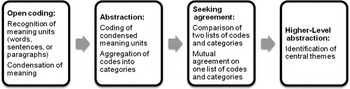
To analyse the interview transcripts, we employed qualitative content analysis, in which a fragment of an interview transcript that conveys meaning is condensed, interpreted (i.e. coded), and then abstracted into sub-categories and over-arching categories that stay as close as possible to the meanings conveyed in the text being analysed (Graneheim and Lundman Reference Graneheim and Lundman2004; see Figure 1). This approach to analysis is characterised by a focus on the subject and context (in this case, the subject of quality dementia care in the context of LTC homes) and allows for the expression of latent content, or the underlying meaning of text. Thus, it was well matched to our inductive goal of description with limited interpretation. After generating themes using this approach, we compared these themes to the content of five frameworks of humanistic dementia care, in order to identify those that surfaced most and least frequently.
Qualitative content analysis.

Given that our interview questions were designed to broadly survey experiences in residential LTC, we restricted analysis to the following questions, explicitly related to dementia care strategies: (a) What does it mean to provide good quality dementia care? (b) What things make it easier for you to work with someone who has advanced dementia? and (c) What things make it difficult for you to work with someone who has advanced dementia? Responses to other interview questions (e.g. about rewards and challenges of work) were included in our analysis only when the content directly related to providing care for residents with dementia.
Interviews were transcribed and analysed using NVivo 8.0 software. To increase reliability, P.H. completed open coding of all transcripts and S.K. completed open coding of three transcripts. In an initial comparison of results, P.H. tended to use terms derived from her discipline (psychology) whereas S.K. relied on terminology used more frequently in nursing theory and research. Given that the research involved NAs and took place in a health-care setting, we decided to adopt S.K.'s approach. P.H. recoded the affected interviews and we compared results again. At this point, discrepancies arose primarily from differences in phrasing despite agreement on a similar main concept. Very occasionally, discrepancies arose from themes that were present in the larger set of interviews coded by P.H. but not the smaller subset coded by S.K. All differences were resolved through discussion, interviews were recoded by P.H., and a revised list of codes and categories was developed. S.K. reviewed these results a third time for agreement, and no discrepancies were identified at this stage.
A member check was completed following the original set of interviews, but was not repeated after adding one additional group interview to the sample in 2013. In this member check, a summary of themes generated from the interviews was presented to participants, followed by the question: ‘To the best of your knowledge, is this summary consistent with the spirit of the views of LTC staff in your facility?’ Participants were asked to respond anonymously on a Likert scale ranging from 0 (not consistent at all) to 6 (very consistent). Twenty-six participants responded. The modal agreement rating was 5, and the mean rating was 4.9, demonstrating strong agreement with results.
Results
Sample characteristics
We did not ask participants to disclose their age or the number of years they had worked in residential LTC; however, one of the focus groups was made up primarily of young adults who had been working in LTC for less than five years, one was a mixed group of younger and middle-aged NAs, and the others were primarily made up of middle-aged NAs who had worked in LTC for several years. The three individual NA interviewees had multiple years of experience in LTC. All interviewees were female, reflecting the disproportionate number of females who enter this occupation in Canada.
Results of inductive analysis
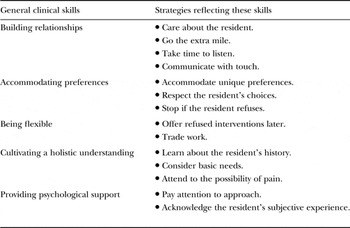
During the interviews, NAs discussed five general strategies for high-quality dementia care: (a) building relationships, (b) accommodating preferences, (c) being flexible, (d) cultivating a holistic understanding, and (e) providing psychological support (corresponding codes are summarised in Table 1).
Summary of clinical skills generated by nursing assistant participants

Building relationships
NA participants reported that building a good interpersonal relationship with each resident was central to high-quality dementia care and gave several examples of the actions involved in building relationships with residents. These ranged from recognising the emotional needs of the residents (‘they need to feel loved’) to ‘going the extra mile’ to arrange and attend special events (e.g. teas) not required as a condition of employment. Between these two extremes, NAs regularly spoke of taking time to listen to residents and mentioned the use of facial expression, touch, greetings and small gestures to build relationships when time was limited or when the resident had a limited ability to communicate. Taking time to build good relationships with residents was perceived as central to effective care, and was perceived as valuable to both the resident and the employee. For instance, NAs frequently mentioned that their workplace was the resident's home and several mentioned feeling as if they were like family to the residents or as if the residents were part of their family. Many NAs, including a group of younger NAs, stated that the quality of their relationships with residents was the primary reason they continued to work as NAs.
Nonetheless, participants also expressed dissatisfaction with their efforts to build relationships with residents and nearly unanimously expressed concern about lack of time, overwork, the pace of work or routinisation of tasks as impediments to relationships, as in the following example:
The girls have another routine and they can't change their routine just because of one specific client or one patient, you know, and that's not enough time. We don't have time to do certain things that people need. And this is every day. Don't even think about when we're short. Those days, it's another issue. And that's not fair … I do feel good when I go home at night and I have done something good for my people, or we make like a tea afternoon with cookies. Like it happens once in a while. I feel good with things like that. But how often can we do that? (Group Interviewee 7)
Although lack of time was cited as the major impediment to building relationships, other factors, such as social customs and relationships with co-workers, were also occasionally mentioned. For example, participants noted that many interactions with a resident involve two or more NAs (e.g. during the course of personal care or transfers). One NA mentioned that this did not allow sufficient privacy for the resident and NA to converse in a natural way, and others intimated that an interpersonal mismatch between two NAs working with the same resident could contribute to difficulties building a relationship with the resident. In addition, although most participants discussed efforts to build relationships with residents who have cognitive impairment and gave examples of how this might be done, some participants acknowledged that they spent less time building relationships with residents who had a limited ability to communicate (relating this to time pressures), and others observed that some NA co-workers did not try to cultivate relationships with residents who were cognitively impaired. For instance, the comment, ‘but there are people that just go in there and wash and dress and throw them in the chair’ (Group Interviewee 2) generated several expressions of agreement in a group interview.
Accommodating preferences
In expressing their views about high-quality dementia care practices, NAs often offered examples of ways in which they tried to ensure that residents' expressed preferences were respected (e.g. ‘if they don't want to get them up, we leave them in bed’; Individual Interviewee 3). These examples tended to be stereotyped, with sleep/wake times and the option to skip breakfast most likely to be mentioned. Other preferences (e.g. preferred activities, clothing or appearance) were less frequently mentioned. NAs indicated that time pressure and the resulting routinisation of care practices (particularly but not exclusively on days the unit is short-staffed) reduced their capacity to support residents' preferences. For instance, Group Interviewee 3 described a situation in which a resident asked to be shaved, and stated, ‘things like that you like to do right away but you can't because there is no time’. Although NA participants clearly felt that accommodating the residents' preferences was important, there were indications of variability in practice. Once again, these indications came from participants’ reports of other NAs' behaviour, as in this example from Group Interviewee 6, who said that some co-workers repeatedly ignored the request of a woman who wanted to telephone her daughter:
I mean, if she wants to phone why wouldn't you answer her? Please! And I have to go sometimes in there you know, so please, before this lady she gets like that, please just call the daughter please! And I don't know, but sometimes there is like a reaction, like [they] don't want to do it, so I say please give me the damn telephone and I will do it!
Despite general acknowledgement of the importance of respecting the wishes of residents with dementia when possible, there was also evidence that in certain contexts, particularly those involving bathing, health and safety, this aspiration might not be appropriate. For instance, Group Interviewee 20 offered the following example related to restraint use:
There's this one resident that has a restraint and every day he asks the same question – why do I have to wear this belt? And you have to explain to him every day the same thing – it's for your safety because when we tell you to ring when you need help, you still stand up and you fall and you're going to hurt yourself.
Such instances seemed to be experienced as dilemmas by NA participants, who discussed competing obligations to respect the preferences of the resident and to ensure that their actions were in the resident's best interests.
Being flexible
NAs suggested that accommodating the preferences of residents with dementia while maintaining high standards of care involves a high level of flexibility. Examples of flexibility commonly involved problem solving around a resident's refusal of an intervention perceived by NA as important to quality health care, such as attention to personal hygiene or bathing. In these situations, NAs agreed that it was important not to persist with plans for care because of the likelihood of escalating conflict (‘You can't push them, because they'll just come right back and they won't do anything’; Individual Interviewee 2). Instead, NAs described having learned to implement solutions that could both accommodate the resident's preferences and allow for the delivery of important interventions. For example, NAs occasionally described trading assigned work so that the resident could be more at ease with the person delivering the intervention. In addition, several NAs offered a strategy of accepting the resident's choice to decline care, but planning to offer the intervention again later. Nonetheless, NAs' descriptions of their co-workers’ behaviour suggested variability in practice, as in this example:
I find a lot of workers, they don't just leave them be and walk away. Some of them just keep going and it just makes [the resident] more agitated. The other [NA] is saying, ‘Let's just leave them’ [but the reply is] nope, nope, let's go, let's do it, let's get our work done. (Group Interviewee 20)
In addition to providing examples of flexibility in interactions with residents, NAs also found it necessary to flexibly accommodate circumstances that involve additional and unexpected commitments of time (e.g. working on a day the unit could not be fully staffed; working to complete tasks that were not completed by the last shift). In addition, some participants gave examples of completing extra work to benefit others when they had extra time, as a way to ensure help when others had extra time. In these cases, flexibility was more directly associated with management of time pressures at work than with the quality of interactions with residents. Nonetheless, participants indicated that these strategies were employed to preserve quality of care when under unusual levels of time pressure.
Cultivating a holistic understanding
The cognitive losses experienced by many residents with dementia and the effects of these losses on communication resulted in the need for significant effort to cultivate a holistic understanding of the resident. Two main strategies were mentioned in the interviews: (a) looking to the resident's history to better understand his or her likely preferences and (b) reflecting on the status of the resident's most basic needs, including the possibility of poorly controlled pain. Although these strategies were mentioned in all of the interviews, a group of NAs with fewer years of experience gave less evidence of efforts to cultivate a holistic understanding than the other groups and individuals in the sample.
NAs indicated that understanding the resident's history was personally valuable, and helped them to feel connected to residents. They also emphasised that understanding the resident's history provided important insights into the significance of residents' behaviours. For instance, Group Interviewee 11 described a resident who went to other residents' rooms at night, intending to check on each of them. Knowing that this resident had been a registered nurse allowed NAs to respond sensitively, by suggesting a break and offering to finish rounds. Although there was relative consensus about the importance of understanding residents' histories, some interviewees commented on the difficulty of finding time to develop this understanding. Others noted that in the past, their facility had provided brief resident biographies in each resident's bedroom, but concerns about resident privacy, following the implementation of privacy legislation, had led to the abandonment of this approach.
Numerous times throughout the interviews, and especially in responses to queries about high-quality dementia care, NAs expressed the importance of attending to basic needs and comforts such as ensuring that incontinence products were changed regularly. Attending to comfort and other basic needs was communicated variously as an empathic moral response (i.e. an observation of ‘the golden rule’), a way to reduce agitated behaviour and a way to rule out a change in health status. Attending to such needs involved the cultivation of empathy, or realising that failing to meet basic needs would decrease the resident's comfort and psychological wellbeing. Many of the examples NAs provided conveyed the impression that there is significant variability in practice and that such needs are not always met immediately by NAs, as in this example:
I make sure they're shaved, they're toileted, they're not laying in a mess … I make sure and if I have to spend extra time fitting a battery in a hearing aid because I know it's dead, I could just pop that hearing aid in, the woman doesn't know the difference at the time, but it's whistling, you know, I take the time to go and get the battery and put it in there so she can hear, and she's like, ‘oh, well that is better’. (Individual Interviewee 3)
Pain control was mentioned in most, though not all, of the interviews, suggesting that interviewees were keenly aware of pain as a potential contributor to agitation or behaviour change. NAs observed that effective pain management reduced aggressive behaviour during personal care and reduced agitation in general, and were thus very concerned about managing pain. Some interviewees suggested that pain medication be increased or given prophylactically given the prevalence of pain among the residents they worked with. Interview responses related to under-use of pain medication often had a tone of bewilderment or frustration, but in this example the tone is distress:
She just let out this scream! I thought somebody must have hit the floor and then they said, ‘oh it was Helen – she's trying to sit up’. And I thought, ‘oh my God, give her something, like they've got Tylenol for arthritis!’ (Group Interviewee 13)
Although many NAs generated specific examples of the under-treatment of pain, very few mentioned having discussed their concerns with nurses.
Providing psychological support
The last major theme in the NA interviews was the importance of providing psychological support to residents with dementia. In describing the importance of offering psychological support, participants emphasised the particular difficulties of persons with dementia, including memory loss and changes in information processing, and described ways that they had adapted their approach to care to acknowledge these difficulties. Some NAs gave examples approaching the resident in a kind and friendly manner rather than in an authoritative or ‘bossy’ manner. Others emphasised ‘talking the resident through’ the tasks involved in his or her care and in so doing, offering reminders about who they were, what they were doing, and why. Still others offered reminders that adopting a pace appropriate to the resident's abilities was important, and often involved patience. Finally, some NAs noted that it was important to avoid surprising the resident (e.g. as might occur if the resident were approached from behind without warning).
Participants also frequently mentioned that as memory loss progressed, some residents began to confabulate, appearing to believe that they were currently living out an event related to a previous life experience (e.g. needing to pay a farm bill), or otherwise demonstrated confusion about their current experiences. Several interviewees discussed the importance of acknowledging the subjective experience of residents. Nonetheless, participants mentioned a range of approaches to confabulation. Most NAs went along with the story, either by omitting pertinent information or by responding in a way that aligned with the resident's subjective experience, as in this example from Group Interviewee 13: ‘Like with Agatha,Footnote 2 she'll ask where Henry is, and I say oh, he's not here today, but I never tell her that he has died because she won't remember and she'll just be so upset.’ In this case, the NA's response protects the resident from repeated episodes of psychological distress. The following example illustrates the use of this technique to protect the resident's safety while at the same time preserving her sense of autonomy:
I have one lady that always wants to pack up the truck and is like, ‘Take me out with you, I need to hop on the bus’ and you've got to be like, ‘Grandma, the bus has broken down, there's been a snowstorm.’ (Group Interviewee 22)
In both cases, this choice of intervention seems to have validated the resident's lived experience and circumvented experiences of confusion, conflict and grief, thus providing additional psychological support. Although most interviewees agreed that they used similar approaches, a few participants stated that they avoided any use of deception, and preferred a sensitive but direct approach. A very small minority gave evidence of the planned or regular use of deception to facilitate care. For instance, one interviewee described pretending to be a physician to facilitate hygienic care with a very modest resident.
Results of deductive analysis
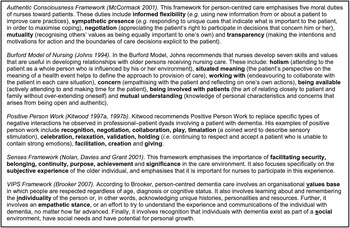
After identifying these five themes reflected in NAs' on-the-job learning about effective dementia care, we compared the themes to several models, frameworks and philosophies of person-centred care. For this analysis, we selected five frameworks which have been reviewed elsewhere (Dewing Reference Dewing2004; McCormack Reference McCormack2004). We then excluded one that proved too unwieldy for the present analysis (the Skilled Companionship model contains 27 strategies to facilitate a number of processes that arise in three domains; Titchen Reference Titchen, Higgs and Titchen2001) and substituted another more recently published framework, the VIPS Framework (Brooker Reference Brooker2007). The following five frameworks were included, and are further described in Figure 2: Authentic Consciousness Framework (McCormack Reference McCormack2001), Burford Model (Johns Reference Johns1994), Positive Person Work (Kitwood Reference Kitwood1997a , Reference Kitwood, Kitwood and Benson1997b ), Senses Framework (Nolan, Davies and Grant Reference Nolan, Davies and Grant2001)Footnote 3 and VIPS Framework (Brooker Reference Brooker2007). Each of these frameworks includes a significant focus on individual staff members' approaches to dementia care. We chose not to include approaches that have a greater emphasis on institutional culture change (e.g. Eden Philosophy of Care, Thomas Reference Thomas1994), and we also excluded proprietary programmes (e.g. Gentle Persuasive Approaches, Schindel-Martin and Dupuis Reference Schindel-Martin and Dupuis2005; Ontario Ministry of Health and Long-term Care 1999). To compare our themes to the frameworks we chose, we created a matrix in which the skills generated by our participants were compared to the skills recommended in documents presenting approaches to person-centred dementia care.
Summary of person-centred care frameworks.

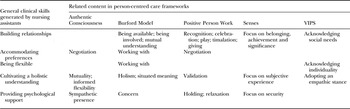
In the left-hand column of Table 2, we list the five general clinical skills that NAs generated during our study. In the other columns of Table 2, we list comparable concepts from five approaches to person-centred dementia care. The table shows considerable overlap among the general clinical skills our participants generated and those emphasised in the five approaches to person-centred care. Each of the five general clinical skills generated in this study overlap concepts from at least two frameworks. One concept, cultivating holistic knowledge, overlaps all of the frameworks and models. Nonetheless, some concepts were mentioned in person-centred care frameworks but under-emphasised or neglected by our study participants. For the sake of brevity, we list only areas in which we perceived significant differences. There are many nuances that we are unable to address:
-
1. The Valuing element of the VIPS Framework (Brooker Reference Brooker2007) speaks to workplace culture and management support for person-centred care, such as in mission statements, training, affirmation, empowerment and quality assurance practices. Although workplace factors surfaced consistently in NAs' comments, these comments suggested that NAs felt that organisational support for the kinds of person-centred care strategies they wished to implement was inadequate. The nature of their comments suggests that staffing levels were the most important concern.
-
2. The Transparency theme of the Authentic Consciousness Framework (McCormack Reference McCormack2001), which emphasises making the intentions and motivations for action, and the boundaries of care decisions, explicit to the patient, did not surface as a significant theme in our data. Elements of this theme were conveyed in our participants' discussion of the importance of paying attention to one's approach to the resident, which might involve re-introducing themselves to the resident and explaining what type of care they were offering. However, lack of transparency was very common in the context of responding to confusion and confabulation.
-
3. The focus of the Senses Framework (Nolan, Davies and Grant Reference Nolan, Davies and Grant2001) on facilitating a sense of belonging, achievement and significance overlaps our participants' sense that it is important to undertake active efforts to build relationships, but also goes beyond this to convey that the resident must feel prized in the community in which he or she is now living. Our participants gave the sense that this is an unrealised goal.
-
4. Kitwood's (Reference Kitwood1997a , Reference Kitwood, Kitwood and Benson1997b ) Positive Person Work emphasises a collection of behaviours that facilitate person-centred dementia care. Although our participants discussed several of these behaviours, they neglected the following: creation (facilitating valued contributions from the resident with dementia), collaboration (working together with the resident on tasks including personal care), facilitation (enabling the resident to do what he or she otherwise could not) and timalation (providing sensory stimulation). In addition, while several participants gave examples of the importance of play (participating in activities with residents for the sake of enjoyment) and celebration (facilitating the experience of joy), they indicated that they rarely did these things because of time pressure.
Comparison of study results to content of person-centred care frameworks

Discussion
Relying on their clinical experience, the NAs who participated in this study collectively generated five general strategies to enhance dementia care: building relationships, providing choice, being flexible, cultivating holistic knowledge and providing psychological support. These strategies provided a reasonable approximation to clinical skill sets discussed in frameworks of person-centred care (see Table 2), suggesting that a foundation of practice-based knowledge about person-centred care already exists among experienced NAs working in residential LTC. Although other research on the development of NAs' job-related knowledge is scarce, the development of job-related knowledge among nurses has received some attention. Nurses report that a great deal of the knowledge they employ in practice is acquired through work-related experience, including interactions with clients and colleagues (Eraut Reference Eraut2000, Reference Eraut2004, Reference Eraut2007; Ozsoy and Ardahan Reference Ozsoy and Ardahan2008), and that knowledge acquired in relationships is privileged over science-based formats such as books, articles and workshops (e.g. Ehrenberg and Estabrooks Reference Ehrenberg and Estabrooks2004; Estabrooks Reference Estabrooks1998; Estabrooks et al. Reference Estabrooks, Rutakumwa, O'Leary, Profetto-McGrath, Milner, Levers and Scott-Findlay2005; Ozsoy and Ardahan Reference Ozsoy and Ardahan2008). Indeed, knowledge acquired from clinical experience and patients' expressions of their preferences is increasingly perceived as a form of evidence that has the potential to inform nursing practice validly (Rycroft-Malone et al. Reference Rycroft-Malone, Kitson, Harvey, McCormack, Seers, Titchen and Estabrooks2002). To the extent that other research substantiates our finding that care aides also generate valuable knowledge through their work experiences, it will be important to continue to identify what is learned best through work experience and, for content that requires additional training, the conditions under which NA-oriented education is most effective, including considerations such as target audiences (e.g. new NAs or experienced NAs), programme content (e.g. content that assumes but expands on an existing knowledge base) and encouraging the application of knowledge (for examples, see Burgio et al. Reference Burgio, Allen-Burge, Roth, Bourgeois, Dijkstra, Gerstle, Jackson and Bankester2001; Smyer, Brannon and Cohn Reference Smyer, Brannon and Cohn1992).
Several first-person disclosures of dissatisfaction with one's own approach to dementia care arose during our interviews, and these were almost entirely in the context of discussing pressures for efficiency in a demanding work environment, a topic that arose universally in our interviews. Structural factors including less than optimal staffing ratios have been acknowledged across North America for some time now (Beattie Reference Beattie1998; Cohen-Mansfield Reference Cohen-Mansfield1997; Decker et al. Reference Decker, Gruhn, Matthews-Martin, Dollard, Tucker and Bizette2003; Jansen Reference Jansen2010) and are known to influence care quality in LTC environments (Bowers, Esmond and Jacobson Reference Bowers, Esmond and Jacobson2000; Bravo et al. 2014; Castle and Engberg Reference Castle and Engberg2005; IOM 1986). The influence of these factors on NA practice is documented in a number of recent reports that illustrate, in correspondence with our results, that NAs have a rushed pace of work and little time to build relationships (e.g. Bowers, Esmond and Jacobson Reference Bowers, Esmond and Jacobson2000; Lopez Reference Lopez2006; Mallidou et al. Reference Mallidou, Cummings, Schalm and Estabrooks2013).
In addition to expressing frustration at structural barriers to person-centred care, our participants regularly contributed observations to suggest significant variability in the employment of person-centred strategies by their NA co-workers. Although subject–observer biases (Jones and Nisbett Reference Jones and Nisbett1971) are known to operate in such situations, causing observers to attribute others' behaviour to internal causes (e.g. work ethic and values) and their own behaviour to situational causes (e.g. staffing levels; having a bad day), it remains plausible that some of the variability in person-centred dementia care practice is related to individual rather than situational factors. Our own prior work supports this idea (Hunter et al. Reference Hunter, Hadjistavropoulos, Smythe, Malloy, Kaasalainen and Williams2013), as does the fieldwork of Foner (Reference Foner1994). It will be important to continue to identify individual factors that influence person-centred approaches to dementia care among NAs, and also to determine which of these are malleable and under what conditions. If individual factors do not account for more than a trivial amount of the variability in person-centred practice or are not malleable, the value of programmes that emphasise changing the knowledge and attitudes of individual NAs might be inconsequential in comparison to the value of programmes that emphasise behaviour change or organisational change.
Despite their ability to articulate several strategies that overlapped the content of models of person-centred dementia care, NAs' strategies did not completely correspond to these models. Some major themes that were mentioned in the models but not voiced consistently by our participants were those of transparency, timalation (sensory stimulation), play, celebration, creation, collaboration and facilitation.
With respect to transparency (Authentic Consciousness Framework, McCormack Reference McCormack2001), NAs in our sample raised the possibility that dilemmas encountered in resident care (e.g. how to respond to a resident who repeatedly asks for his or her deceased spouse) are sometimes best resolved through a lack of transparency, including omission of information, white lies or play-acting. This phenomenon has been documented in other studies, both quantitative and qualitative (e.g. Day et al. Reference Day, James, Meyer and Lee2011; Tuckett Reference Tuckett2004, Reference Tuckett2007), with one study indicating that deception is employed almost universally in dementia care (James et al. Reference James, Wood-Mitchell, Waterworth, Mackenzie and Cunningham2006). Health-care workers believe that deception is sometimes necessary to promote the best interests of the person, including emotional comfort and physical safety (see the review by Tuckett Reference Tuckett2004). Interviews with people with dementia suggest that deception is considered acceptable as a means to promote their best interests, but that the circumstances under which it is employed, including the level of disease advancement, warrant careful consideration (Culley et al. Reference Culley, Barber, Hope and James2013). James et al. (Reference James, Wood-Mitchell, Waterworth, Mackenzie and Cunningham2006) had dementia care providers suggest guidelines for the use of deception in their practice, and these guidelines also emphasise careful consideration, and include the delivery of education programmes to help staff recognise potential problems associated with deception, and to provide them with alternatives. The near-universal acceptance of limited use of deception to promote wellbeing in dementia care may have implications for future development of the Authentic Consciousness Framework. Still, the range of deceptive practices we learned of and the span of NA opinions about the use of deception suggest that NAs would benefit from additional guidance in this ethically sensitive area of practice.
Outside the context of transparency, two additional dilemmas were raised by NAs. The first was that, although they strive to recognise residents' autonomy and affirm their choices when possible, the resident might not have the capacity to make some care decisions (a further dilemma arises in proceeding without the resident's assent because of the potential to induce distress or conflict). The second dilemma was that NAs seemed reluctant to express concerns related to the inadequacy of pain management for specific residents despite being well positioned, by their close work with residents, to support and inform pain management. Although we did not further explore NAs' apparent reluctance to express these concerns, we suspect this is related to a respect for the scope of practice and expertise of nurses, and represents a communication gap involving frontline workers. Similar issues have been noted in several previous reports (e.g. Anderson et al. Reference Anderson, Ammarell, Bailey, Colón-Emeric, Corazzini, Lillie, Scotton Piven, Utley-Smith and McDaniel2005; Colón-Emeric et al. Reference Colón-Emeric, Ammarell, Bailey, Corazzini, Lekan-Rutledge, Piven, Utley-Smith, Ammarell, Bailey, Corazzini, Piven and Anderson2006; Parker et al. Reference Parker, Kirchner, Bonner, Fickel, Ritchie, Simons and Yano2009). Overall, there is a low volume of published literature discussing the kinds of ethical and practical dilemmas encountered by NAs. Further attention to the resolution of such dilemmas, and to the role of communication in resolving them, might help to enrich employee education programmes tailored to NA audiences.
NAs in our sample discussed a number of skills identified in the Senses Framework (Nolan, Davies and Grant Reference Nolan, Davies and Grant2001) and the Positive Person Work model (Kitwood Reference Kitwood1997a , Reference Kitwood, Kitwood and Benson1997b ), but omitted some, and identified difficulties in implementing still others. The omitted skills included creation, collaboration and facilitation (Kitwood Reference Kitwood1997a , Reference Kitwood, Kitwood and Benson1997b ), skills that involve spending time supporting a resident in completing tasks and activities that he or she is able to do. Such approaches are known to sustain involvement in personally meaningful activities and prevent excess disability (e.g. Yury and Fisher Reference Yury and Fisher2007), and thus represent excellent examples of best practice dementia care. Given the commitment of time necessary for such activities, our participants' frequent references to time pressure and task routinisation provides the most likely explanation for the absence of these practices in their descriptions of quality dementia care. NA concerns about time pressure and task routinisation are not unique to our sample. For instance, Ward et al. (Reference Ward, Vass, Aggarwal, Garfield and Cybyk2008) describe that the majority of care provider interactions with residents are task-based and very brief, sometimes lasting as little as five seconds. Relatively few interactions involve a two-way verbal exchange. Luff et al. (Reference Luff, Ellmers, Eyers, Young and Arber2011) argue that lower staffing ratios over 12-hour night shifts result in early bedtimes shaped by pressures to do the work of moving and lifting residents while more staff are available to assist. Residents frequently expressed a desire to stay up later or to get up earlier but, rather than staff facilitating residents' participation in personally meaningful evening or morning activities, many residents said they facilitated carers' work by complying when asked to go to bed, avoiding use of the call bell and patiently waiting their turn to get up.
Our participants gave occasional examples of what Kitwood (Reference Kitwood1997a , Reference Kitwood, Kitwood and Benson1997b ) describes as timalation (sensory stimulation), play (participating in an activity for the sake of enjoyment) and celebration (facilitating the experience of joy), and what the Senses Framework (Nolan, Davies and Grant Reference Nolan, Davies and Grant2001) describes as a focus on belonging, achievement and significance. Although it was clear that those who offered these examples saw them as essential to building relationships with residents and, ultimately, offering quality dementia care, they also conveyed the perception that it was virtually impossible to include these highly relational approaches in their care with any regularity because of pressures for efficiency. An increase in the use of person-centred practices advised by the Positive Person Work model and the Senses Framework is likely to be better addressed in the scope of facility-wide culture change efforts and wider policy changes rather than one-time education sessions, given repeated indications that organisational and health-care system factors constrain relational aspects of person-centred practice (Aylward et al. Reference Aylward, Stolee, Keat and Johncox2003; Caspar and O'Rourke Reference Caspar and O'Rourke2008; Lopez Reference Lopez2006).
Conclusion
Understanding the knowledge that NAs acquire through their work has the potential to inform design and planning of interventions (whether educational or otherwise) to improve person-centred dementia care. Interviews conducted with NAs who had not received any training about person-centred dementia care suggested that NAs acquire significant knowledge about person-centred care during the course of their work. Interview results also pointed to variability in practice, and to ways that NA education might be enhanced to better acknowledge the complexity of the issues they encounter in their work as health-care providers. Valuable elements of NA training to improve person-centred care might be: acknowledgement of person-centred care strategies that many NAs cultivate through work experience (e.g. attention to flexibility, rapport, empathy, psychological support and the resident's rights), discussing approaches to commonly experienced ethical dilemmas (e.g. conflict between the resident's autonomy and the approved care plan or between the resident's psychological wellbeing and the health provider's interest in being transparent), and recognising that some changes are best addressed by paving the way towards institutional practices or policy changes that make possible collaborative, facilitative and relational forms of care. Since we only examined NA perspectives during this study, further work addressing the congruence of NA perspectives with those of residents, family members, staff and managers will be informative. Overall, our work suggests that while many forms of person-centred care can be integrated into NAs' day-to-day work, others might be very difficult to develop outside the context of organisational change. Attention to organisational factors must continue to be a focus in efforts to enhance person-centred dementia care.
Acknowledgements
The authors thank Ms Farah Goubran and Mr Thomas Qiao for assistance in formatting the document. This research was supported by a Canadian Institutes of Health Research Doctoral Research Award to Paulette V. Hunter. The Saskatchewan Health Research Foundation and St Thomas More College provided additional support for the study. Paulette V. Hunter designed and completed the study in the context of a dissertation project, under the supervision of Thomas Hadjistavropoulos. Sharon Kaasalainen provided consultative supervision for qualitative analysis, served as a second coder for three transcripts and assisted in the process of finalising results. This project was reviewed and approved by the University of Regina Research Ethics Board (#75R1213), the University of Saskatchewan Research Ethics Board (13–26), the Regina Qu'Appelle Health Region Research Ethics Committee and the Sun Country Health Region Ethics Committee. The authors have no conflict of interest.