Introduction
The genus Bulbothrix Hale (Hale Reference Hale1974) was based on the Series Bicornutae (Lynge) Hale & Kurok. of the genus Parmelia Ach. The species can readily be identified by the small, deeply laciniate thalli with marginal bulbate cilia (the main characteristic), cortical atranorin (which differentiates Bulbothrix from the genus Relicina), hyaline, unicellular, ellipsoid or bicornute ascospores and bacilliform to bifusiform conidia. The medullary chemistry is variable, containing several chemosyndromes and some unknown substances. Hale assembled all of the then available taxonomic information in a monograph of the genus (Hale Reference Hale1976). Subsequently several additional species have been described, mainly from the Neotropics (e.g., Sérusiaux Reference Sérusiaux1984; Hale Reference Hale1986; Sipman & Aubel Reference Sipman and Aubel1992; Elix Reference Elix1993, Reference Elix1995; Krog Reference Krog1993; Marcelli Reference Marcelli1993; Morales-Méndez et al. Reference Morales-Méndez, Marcano, Galiz, Mohali, Palacios-Prü, Daniëls, Schulz and Peine1995; Aptroot & Aubel Reference Aptroot and Aubel1999; Marcelli & Ribeiro Reference Marcelli and Ribeiro2002; Jungbluth et al. Reference Jungbluth, Marcelli and Elix2008; Spielmann & Marcelli Reference Spielmann and Marcelli2008), and it seemed an opportune time to revise the genus. During this work (Benatti Reference Benatti2010), many type specimens were examined and this resulted in the reinterpretation of some species previously treated as synonyms (Hale Reference Hale1976).
Prior to his discovery and combination of B. goebelii (Hale Reference Hale1976), Hale accepted three isidiate species that he subsequently synonymized with this species: B. papyrina, B. scortella and B. subdissecta (Hale & Kurokawa Reference Hale and Kurokawa1964; Hale Reference Hale1974). However, he did not discuss the difficulties in interpreting the relationships within this broader concept of B. goebelii, nor the uncertainties involved (Hale Reference Hale1976). More recent studies (Benatti Reference Benatti2010) have shown that these species have different characteristics from each other. The type material of B. goebelii was shown to be a mixture of species and the fragment that is most consistent with the protologue is actually non-isidiate and contains only medullary lobaric acid (Benatti Reference Benatti2010).
Materials and Methods
The morphological and anatomical characters of the specimens were analyzed using standard stereoscopic and compound microscopes. Anatomical sections, including those of apothecia and pycnidia when present, were cut by hand with a razor blade. The chemical constituents were checked by spot tests with potassium hydroxide (K, 10% and 30%), sodium hypochlorite (C) and para-phenylenediamine (P), and also examined under UV light (360 nm). Chemical constituents of all specimens were identified by thin-layer chromatography (TLC) using solvent C (Bungartz Reference Bungartz2001), and selected specimens including all types were analyzed by HPLC.
Types and additional specimens of all species cited were studied and compared (43 specimens). The morphological terminology for lobe development follows that of recent publications (listed in the Introduction), with two exceptions. Lacinules are adventitious, ribbon-like secondary outgrowths from the primary lobe margins or sometimes from the upper surface. Lobules are similar, but short and rounded (Marcelli et al. Reference Marcelli, Canêz, Benatti, Spielmann, Jungbluth and Elix2011).
At least 16 ascospores (the usual content of two full asci) were measured per apothecium, but average size ranges were obtained from 32 ascospores. This was for all specimens examined that contained apothecia, including all types of accepted names and their synonyms. A few mature apothecia were cut for each specimen.
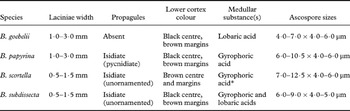
A key for the nine currently known isidiate species containing C+ and KC+ substances (gyrophoric, lecanoric and lobaric acids) is presented. Other species are currently under study and this list will certainly grow. Table 1 compares the characteristics of the four species discussed in this paper.
Comparative diagnostic characteristics of Bulbothrix goebelii, B. papyrina, B. scortella and B. subdissecta. The data refer to the most typical range found.

* At the present, it is uncertain if other substances are, or are not, in fact, produced by B. scortella, how much variability there is, or if contaminants are possibly involved.
Key to the isidiate species of Bulbothrix containing medullary gyrophoric, lecanoric and lobaric acids
1 Thallus containing only medullary lobaric acid (C−, KC+ rose, UV+ bluish) ... 2
Thallus containing mainly medullary gyrophoric or lecanoric acids, some species containing lobaric as an accessory substance ... 3
2(1) Isidia eciliate; lower cortex black, brown margins of varying widths ... B. apophysata
Isidia ciliate; lower cortex entirely pale brown to tan ... B. thomasiana
3(1) Medulla C+ and KC+ red, containing lecanoric acid ... B. laevigatula
Medulla C+ and KC+ rose, containing gyrophoric acid, with/without accessory lobaric acid ... 4
4(3) Laciniae narrow, 0·1–0·7 mm wide; isidia ciliate ... 5
Laciniae broad, 0·5–3·0 mm wide; isidia eciliate ... 7
5(4) Laciniae 0·1–0·3 mm wide; lower cortex mottled black and brown, ascospores bicornute, with pointed tips, 12–18×3–4 µm ... B. sipmanii
Laciniae 0·2–0·7 mm wide; lower cortex black with distinct brown margins; ascospores ellipsoid, with rounded tips, 4–10×4–6 µm ... 6
6(5) Cilia and rhizines simple to partially furcate; apothecia coronate; ascospores ellipsoid, usually 8·0–10·0×4·5–6·0 µm ... B. fungicola
Cilia and rhizines densely dichotomously branched; apothecia eciliate; rounded ascospores almost spherical, usually 4·0–6·0×4·0–5·0 µm ... B. pseudofungicola
7(4) Laciniae 1·0–3·0 mm wide; upper cortex emaculate; isidia becoming tortuous and often pycnidiate when mature; amphithecium often pycnidiate when mature; medulla containing only gyrophoric acid ... B. papyrina
Laciniae 0·5–1·0 mm wide; upper cortex maculate; isidia usually more or less straight and never developing pycnidia regardless of stage; medulla containing gyrophoric and lobaric acids (see comments under B. scortella) ... 8
8(7) Lower cortex brown, with darker or paler margins; ascospores (6·0–)7·0–11·0(–12·5) ×4·0–6·0 µm; usually only medullary gyrophoric acid ... B. scortella
Lower cortex black, with brown margins, occasionally with very dark brown small spots; ascospores (5·0–)6·0–8·0(–9·0)×4·0–5·0 µm; usually gyrophoric acid combined with lobaric acid ... B. subdissecta
The Species
Bulbothrix goebelii (Zenker) Hale
MycoBank No: MB 341599
Smith. Contr. Bot. 32: 14 (Reference Hale1976).
Basionym: Parmelia goebelii Zenker, Pharm. Waarenk. 1: 134 (1827); type: “Auf officinellen Rinden” in Goebel “Auf Stücken der Loxachina.”, América do Sul, collector unknown [lectotype (here designated)—M!].
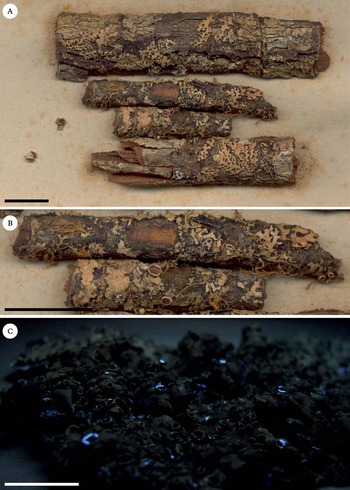
(Fig. 1)
Bulbothrix goebelii. A, type collection; B, lectotype; C, detail of a Bulbothrix goebelii thallus showing the apothecia under UV light (Spielmann et al. 2573, SP). Scales: A–C=1 cm. Incolour online.

Thallus with sublinear to subirregular laciniae, up to 8·7 cm wide (type composed of small fragments about 1 cm wide), coriaceous to subcoriaceous, corticolous or saxicolous, greenish grey becoming dusky grey or dusky green in the herbarium; upper cortex 12·5–42·5 µm thick, algal layer 15·0–55·0 µm thick, medulla 15·0–130·0 µm thick; lower cortex 12·5–32·5 µm thick. Laciniae anisotomic to isotomic dichotomously or sometimes irregularly branched, 0·3–1·9(–3·1) mm wide, contiguous to slightly imbricate or occasionally crowded, very adnate, strongly attached; apices plane to involute, truncate to subtruncate; margin sinuous to crenate or subirregular, flat, entire to sometimes slightly incised, not or scarcely sublacinulate, ciliate, axils oval to irregular. Upper surface continuous, smooth, with occasional transvere cracks in older parts, laminal ciliary bulbs absent; maculae absent. Adventitious lacinules absent to scarce on older parts, very short, simple, flat, 0·2–1·2×0·1–0·5 mm, truncate or acute, underside concolorous with the lower margin. Cilia black to brown, initially simple soon becoming furcate and then dichotomous or irregularly ramified, 0·05–0·40(–0·55)×c. 0·03 mm, with semi-immersed to emergent basal bulbs c. 0·05–0·15 mm wide, abundant along the margins, separate (0·05–0·10 mm) from one another to contiguous mainly in the axils, absent or scarce at the apices. Medulla white. Soredia, pustules and isidia absent. Lower surface black with small dark brown to brown occasional spots, slightly shiny to opaque, smooth to subrugose, moderately to densely rhizinate; marginal zone black, indistinct from the centre to dark or light brown, attenuated, c. 0·5–2·0 mm wide, shiny to opaque, smooth, weakly papillate, rhizinate; rhizines brown to light brown or whitish, usually paler than the cortex, initially simple or furcate at the margin soon becoming repeatedly dichotomously or irregularly branched, with basal or displaced blackened bulbs, 0·10–0·50(–0·60)×c. 0·03 mm, abundant, often intertwined and agglutinated, evenly distributed, almost appearing as a tomentum.
Apothecia laminal or submarginal, common, subplane to concave, 0·3–3·1 mm diam., adnate to substipitate, margins smooth to subcrenate, amphithecia smooth, without ornamentation or occasionally unevenly pycnidiate, ecoronate; disc brown, epruinose, imperforate, epithecium 7·5–15·0 µm; hymenium 35·0–55·0 µm, subhymenium 15·0–30·0 µm; ascospores rounded to subspherical, 4·0–6·5(–7·0)×4·0–6·0 µm, epispore c. 0·5 µm thick.
Pycnidia laminal to submarginal, scarce to common, immersed, with black ostioles; conidia bacilliform to weakly bifusiform, 5·0–7·5×c. 0·75 µm.
Chemistry. Colour reactions: upper cortex K+ yellow, UV−; medulla K−, C−, KC−, P−, UV− (KC+ rose and UV+ light blue under the hymenial discs and amphithecia). TLC/HPLC: cortical atranorin and chloroatranorin; medullary lobaric, oxolobaric and colensoic acids, concentrated in the apothecia.
Distribution. The distribution cited by Hale (Reference Hale1976) includes several different species previously synonymized under B. goebelli. The currently confirmed distribution, based on samples we have examined, includes South America (from unknown localities, including the type collection), Peru and Brazil (states of Goiás and Minas Gerais).
Comments. Hale (Reference Hale1976) faced difficult problems regarding this species complex which he resolved by including eight names as synonyms of B. goebelii. Following careful examination of the type collection, checking Hale's previous notes together with accompanying chemical data, we were finally able to understand the source of the confusion.
The type collection of B. goebelii is a mixture of small fragments of four different species of Bulbothrix. A significant portion comprises fragments of a fertile species which lacks isidia and contains lobaric, oxolobaric and colensoic acids (HPLC and TLC in solvent C). This specimen best fits the protologue of Zenker (Reference Zenker, Goebel and Kunze1827), and has been chosen as the lectotype of B. goebelii. As such, B. goebelii could well be the primary, non-isidiate counterpart of B. apophysata (Hale & Kurok.) Hale (US! holotype, TNS! isotype). It appears that the lobaric acid is concentrated in the apothecia given that the medullary spot tests on the laciniae are negative.
The second most prominent component of the mixture is a sterile, isidiate species, with a black to dark brown lower cortex, brown margins and black rhizines which contain medullary gyrophoric, lecanoric and lobaric acids. This fragment is entirely consistent with B. subdissecta (Nyl.) Hale and its latter synonym B. lobarica Jungbluth et al. (Jungbluth et al. Reference Jungbluth, Marcelli and Elix2008). The mixture of these two species probably caused Hale (Reference Hale1976) to interpret B. goebelii as an isidiate species containing gyrophoric acid, which was subsequently followed by other authors.
The third species present in the mixture consists of a fragment with rounded lobes, dense maculae, unbranched cilia and rhizines, a brown lower cortex and medulla with a K+ yellow→red reaction (salazinic acid), and is probably identical with B. hypocraea (Vain.) Hale. Another very small isidiate fragment on a sliver of bark above the previous species, has a brown lower cortex (a different shade of brown from the major isidiate thallus), contains gyrophoric acid, and is most likely a fragment of B. scortella (Nyl.) Hale.
The apothecia represent the most striking feature of B. goebelii: they concentrate lobaric acid which reacts KC+ (violet) pink and emits a strong blue fluorescence under UV light. These reactions were not observed in any other part of the thalli, which were negative to all colour tests.
The ascospores of the lectotype and the other specimens of B. goebelii studied are smaller and more rounded than those described by Hale (Reference Hale1976) [4·0–6·5(–7·0)×4·0–6·0 µm vs. 8·0–10·0×4·0–6·0 µm] and are among the smallest found in the genus.
Since Hale's concept of B. goebelii (1976) comprised multiple morphologically and chemically similar species, it was necessary to restudy and compare the synonyms and related specimens to determine whether or not they represent B. goebelii s. str. or other species (Benatti Reference Benatti2010).
Other species similar to B. goebelii containing medullary gyrophoric acid include B. atrichella (Nyl.) Hale (H-NYL 35233! lectotype, duplicates at FH-Tuck! and M!), a species which differs from B. goebelii by being distinctly maculate, in having black rhizines without bulbs and somewhat larger ellipsoid ascospores (c. 6·0–8·0×4·0–5·0 µm). Bulbothrix semilunata (Lynge) Hale (S! holotype) differs in having narrower laciniae (c. 0·2–0·5 mm wide), coronate apothecia and larger bicornute, crescent-shaped ascospores c. 12·0–23·0 µm long. Bulbothrix coronata (Fée) Hale (G! lectotype) can be distinguished from B. goebelii by the coronate apothecia and the larger ellipsoid ascospores 6·0–10·0×4·0–6·0 µm.
Additional specimens examined. South America, unknown collector, fragment numbers 5 and 6 (G, together with the type material of B. coronata). Peru:Dept. San Martin: Prov. San Martin, Tarapoto, NE of Hotel de Turistas, c. 6°30′S, c. 76°20′W, alt. 350 m, 12 iii 1981, R. Santesson & G. Thor P71:24 (S).—Brazil:Goiás: Água Fria Municipality, Repeater Station of Telebrasília de Roncador, alt. 1200m, 1992, G. Hatschbach, M. Hatschbach & E. Barbosa 58330 (C); ibid, Serra Dourada Municipality, 120 km NW of Goiânia, 50°10′W, 16°04′S, c. 850 m alt., 1990, T. H. Nash 29337 (CANB); ibid.,, Alto Paraíso de Goiás Municipality, Chapada dos Veadeiros, 1991, M. P. Marcelli & O. Yano 11126 (SP). Minas Gerais: Catas Altas Municipality, Parque Natural do Caraça, 1265 m alt., 20°06′06″S, 43°29′12·9″W, 2006, A. A. Spielmann, L. S. Canêz & M. P. Marcelli 2260, 2261 (SP); ibid., 1260 m alt., 20°06′01·3″S, 43°29′09·0″W, 2006, A. A. Spielmann, L. S. Canêz & M. P. Marcelli 2573 (SP).
Bulbothrix papyrina (Fée) Hale
MycoBank No: MB 341606
Phytologia 28(5): 480 (Reference Hale1974).
Basionym: Parmelia papyrina Fée, Essai sur les crypt. des écorces exot. offic. suppl.: 121 (1837); type: South America, on bark of Cinchona sp., locality and collector unknown (G!—holotype).
Synonyms: Parmelia granatensis Nyl. Flora 68: 613 (Reference Nylander1885); type: Colombia, Nova Granata, Socorro, alt. 1200 m, 1863, A. Lindig s.n. (H-NYL 35170!—lectotype, as in Hale Reference Hale1976).
Parmelia addenda Vain. Hedwigia 46: 169 (Reference Vainio (Wainio)1907); type: Thailand, Sinus Bengalensis, ad corticem Arecae catechu prope Lem Dan, in insula Koh Chang, 1900, J. Schmidt X, (C!—lectotype; TUR-V!—duplicate as in Hale Reference Hale1976).
Parmelia acariospora Zahlbr. Denks. der Akad. der Wiss. in Wie, Math.-Naturwiss Klasse 83: 169 (1909); type: Brazil, Prov. São Paulo, in itiniere S. Amaro-Barra Mansa in districtu urbis Itapecerica, 800–900 m, June 1901, Schiffner s. n., (W!—lectotype; W!, US!—duplicates as in Hale Reference Hale1976).
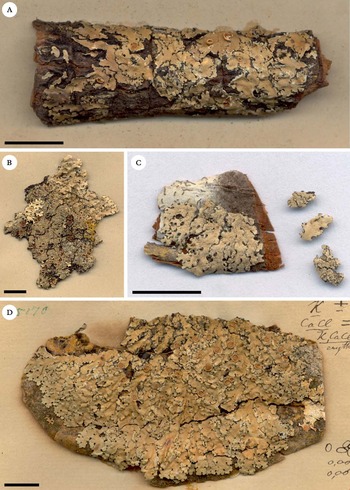
(Fig. 2)
Bulbothrix papyrina (holotype); B, Parmelia acariospora (lectotype); C, Parmelia addenda, (lectotype); Parmelia granatensis (lectotype). Scales: A–D=1 cm. In colour online.

Thallus sublinear laciniate, pale dusky brown in the herbarium, up to 9·7 cm diam., submembranaceous to subcoriaceous, corticolous; upper cortex 15·0–22·5 µm thick, algal layer 25·0–37·5 µm thick, medulla 65·0–87·5 µm thick, lower cortex 10·0–17·5 µm thick. Laciniae anisotomic, dichotomously or trichotomously to irregularly branched, (0·3–)1·0–2·4 (–3·1) mm wide, contiguous to slightly imbricate, adnate and adpressed to occasionally undulate on older parts, apices plane, truncate to subtruncate, margin smooth and slightly sinuous to subcrenate or irregular, flat to slightly involute, entire to slightly incised, rarely sublacinulate, axils oval to irregular. Upper surface continuous, smooth to subrugose, with occasional fissures, laminal ciliar bulbs absent. Maculae absent, only scars left by eroded isidia. Adventitious marginal lacinules absent to scarce or scattered in older parts, short, simple to furcate or irregularly branched, flat, 0·2–1·7×0·1–0·6 mm, truncate or acute, underside concolorous with the lower margin. Cilia black, apices initially simple or furcate and soon becoming subdichotomously or irregularly ramified at the axils (very brittle and absent in part), 0·05–0·25(–0·40)×c. 0·03 mm, with semi-immersed to immersed bulbate bases c. 0·05–0·10 mm wide, frequent throughout the margins, spaced 0·05–0·10 mm from each other to abundant and contiguous at the axils and some random parts, becoming sparse at the apices of the laciniae. Medulla white. Soredia and pustules absent. Isidia scarce to frequent or abundant in older parts, laminal to occasionally submarginal, granular to mostly smooth cylindrical, straight when young to tortuous when mature, 0·05–0·70×c. 0·05–0·10 mm, simple to sparsely branched, erect to partially procumbent, firm to caducous, concolorous or with brownish apices, eciliate, often partially pycnidiate when mature. Lower surface black, shiny, smooth to subrugose, ± papillate, densely rhizinate. Marginal zone brown to light brown, becoming darker towards the centre, attenuated, c. 0·5–4·0 mm wide, shiny, smooth to subrugose, ± papillate, becoming partially rhizinate nearer to the centre. Rhizines black to partially brown or with whitish apices, initially simple or furcate but soon becoming richly dichotomously or irregularly branched, often with subtle, basal blackish bulbs, 0·05–0·50×c. 0·03–0·05 mm, frequent to abundant, partially intertwined and agglutinated at some parts, evenly distributed.
Apothecia laminal or submarginal, common, subconcave to subplane or plane, 0·3–3·2 mm diam., sessile to adnate or substipitate, margins smooth to occasionally subcrenate, amphithecia smooth, without ornamentations or occasionally subrugose and unevenly pycnidiate, ecoronate. Disc light brown, epruinose, imperforate, epithecium 5·0–12·5 µm; hymenium 30·0–45·0 µm, subhymenium 10·0–30·0 µm. Ascospores subrounded to ellipsoid or oval, (5·0–)6·0–10·5×4·0–6·0(–8·5) µm, epispore c. 0·75 µm.
Pycnidia submarginal or on the isidia, very scarce to common, immersed, with black ostioles. Conidia bacilliform, 4·0–6·0×c. 0·5 µm.
Chemistry. Colour reactions: upper cortex K+ yellow, UV−; medulla K−, C+ rose to reddish rose, KC+ rose to reddish rose, P−, UV− or + weakly pale bluish. TLC: cortical atranorin; medullary gyrophoric acid (also mentioned by Hale as he erroneously interpreted it as a synonym of B. goebelii, see Hale Reference Hale1976).
Distribution. The names Parmelia addenda, P granatensis and P. acariospora were all cited for the following locations: Asia (Thailand), Carribean (Guadalupe, Martinique), and South America (Brazil, Colombia) (Fée Reference Fée1837; Nylander Reference Nylander1885; Vainio Reference Vainio (Wainio)1907, Reference Vainio (Wainio)1915; Zahlbruckner Reference Zahlbruckner1909; Lynge Reference Lynge1914). Based on type specimens and additional materials, the species is confirmed for Asia (Thailand) and South America (Colombia and Brazil, Mato Grosso and São Paulo states).
Comments. The type material is a small but entire thallus which has been significantly damaged and has few isidia. Few pycnidia were seen in this specimen and they are particularly rare on the isidia; conidia were not observed. The apothecia are well developed and contain mature ascospores. Occasionally, the pycnidia may also occur, scattered on the amphithecia. The pycnidiate isidia are a common, but variable feature in this species and may be dependent upon the stage of isidial development. The upper surface is more densely isidiate than those of other species of this group.
For comparisons with B. scortella and B. subdissecta, see below.
Additional specimens examined. Brazil:Mato Grosso: Santa Anna da Chapada, in margine silvae minus densa, 9 iii 1894, G. O. Malme s. n. (UPS); Santa Anna da Chapada, 1894, G. O. Malme 2435 (LD); Santa Anna da Chapada, 625–1100 m alt., 1894, G. O. Malme 2509b (US); ibid., between Jaciara and São Vicente, km 313 da BR-364, c. 100 km ESE de Cuiabá, 750 m alt., 1980, M. P. Marcelli 9148 (SP).
Bulbothrix scortella (Nyl.) Hale
MycoBank No: MB 341610
Phytologia 28(5): 480 (Reference Hale1974).
Basionym: Parmelia scortella Nyl. Flora 68: 615 (Reference Nylander1885); type: [United States of America], America Septentrionalis, Texas, 1850, C. Wright [FH-Tuck!—lectotype (Hale Reference Hale1976); H-NYL!—duplicate].
Synonyms: Parmelia njalensis Dodge, Ann. Miss. Bot. Gard. 46: 65 (1959); type: Sierra Leone, Kori, Njala, on bark of Funtumia africana, Deighton M5642 (BM!—holotype).—Parmelia marginalis Lynge. Ark. för Bot. 13(13): 112 (Reference Lynge1914); type: Brazil, Mato Grosso, 1914, Brasiliae civit. Matto Grosso, Santa Anna da Chapada, in margine silvae, ad corticem, 21-II-1894, Malme 2393 (S!—holotype).
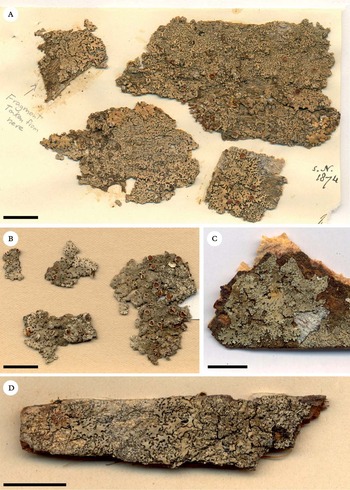
A, Bulbothrix scortella (lectotype); B, Parmelia marginalis (holotype); C, Parmelia njalensis (holotype); D, Bulbothrix subdissecta (lectotype). Scales: A–D=1 cm. In colour online.

Thallus sublinear to linear laciniate, pale dusky, greenish or olivaceous grey in the herbarium, up to 6·5 cm diam., subcoriaceous to submembranaceous and fragile, corticolous; upper cortex 12·5–15·0 µm thick, algal layer 20·0–27·5 µm thick, medulla 37·5–50·0 µm thick; lower cortex 12·5–20·0 µm thick. Laciniae isotomic to anisotomic dichotomously, trichotomously or irregularly branched, 0·3–1·2(–1·6) mm wide, contiguous to slightly imbricate or rarely crowded in the centre, very adnate and appressed, apices plane, truncate to subtruncate; margin smooth and sinuous to subcrenate or subirregular, flat, entire to incised, partially sublacinulate, axils oval to irregular. Upper surface continuous and smooth, with occasional irregular fissures in older parts, laminal ciliar bulbs absent. Maculae weak, punctiform, laminal, sparse to ± frequent, amidst scars left by eroded isidia. Adventitious marginal or laminal lacinules sparse to frequent, especially on older parts, sometimes growing amidst the isidia, short, simple to furcate or irregularly branched, flat, 0·3–2·0×0·1–0·3(–0·5) mm, truncate or acute, underside concolorous with the lower margin. Cilia black to brown or occasionally whitish, apices initially simple soon becoming furcate and then subdichotomously branched, 0·05–0·15(–0·25)×c. 0·03 mm, with semi-immersed to immersed bulbate bases c. 0·05–0·10(–0·15) mm wide, frequent to abundant along the margins, spaced 0·05–0·10 mm from each other to contiguous in the axils, becoming sparse or absent at the apices or random parts of the laciniae. Medulla white. Soredia and pustules absent. Isidia sparse to frequent, laminal, granular to smooth cylindrical, straight to slightly tortuous, 0·05–0·35(–0·50)×c. 0·05 mm, simple to sparsely branched, erect to procumbent in part, firm to caducous, concolorous or with pale brownish apices, eciliate. Lower surface brown to dark brown, occasionally almost blackish in random spots, shiny to opaque, smooth to subrugose, densely rhizinate. Marginal zone brown to dark brown and indistinct or somewhat darker than the centre and attenuated, c. 0·5–1·5 mm wide, shiny, smooth, partially papillate, weakly to densely rhizinate. Rhizines cream to light or dark brown, occasionally blackish or with whitish apices, usually paler than the lower cortex, initially simple or furcate soon becoming richly dichotomously branched, usually with subtle basal or displaced blackish bulbs, 0·10–0·60×c. 0·03–0·05 mm, abundant and tomentum-like, evenly distributed.
Apothecia laminal or submarginal, common, subconcave to plane, 0·2–2·6 mm diam., adnate to sessile, margins smooth to partially subcrenate, amphithecia smooth, occasionally with sparse isidia, ecoronate. Disc light brown, epruinose, imperforate; epithecium 7·5–10·0 µm, hymenium 35·0–45·0 µm, subhymenium 35·0–50·0 µm.
Ascospores subglobose to ellipsoid or oval, sometimes with weakly acuminate apices, (5·5–)7·0–11·0(–12·5)×4·0–5·0(–6·0) µm, epispore 0·5–1·0 µm.
Pycnidia submarginal, sparse, immersed, with black ostioles. Conidia bacilliform to weakly bifusiform, some appearing weakly sublageniform, (4·0–)5·0–7·0×c. 0·75 µm.
Chemistry. Colour reactions: upper cortex K+ yellow, UV−; medulla K−, C+ rose to reddish rose, KC+ rose to reddish rose, P−, UV−. TLC/HPLC: cortical atranorin; medullary gyrophoric acid [also mentioned by Hale (Reference Hale1976) as he erroneously interpreted it as a synonym of B. goebelii]. The lectotype also contains traces of medullary lecanoric, lobaric and oxolobaric acids, possibly contaminants.
Distribution. The names Parmelia scortella, P. njalensis and P. marginalis were cited for the following localities: Asia (Japan), Africa (Sierra Leone), USA, South America (Venezuela and Brazil) (Nylander Reference Nylander1885, Reference Nylander1890; Lynge Reference Lynge1914; Vainio Reference Vainio (Wainio)1915; Dodge Reference Dodge1959; McCullough Reference McCullough1964; Moore Reference Moore1968). Here the species is confirmed for Asia (Malaysia), Africa (South Africa), USA (states of Florida, Georgia and North Carolina), Caribbean (Cuba, Hispaniola) and South America (Brazil, states of Mato Grosso, Minas Gerais and São Paulo).
Comments. The lectotype of Parmelia scortella (Fig. 8) consists of four fragments from 2·5 to 6·5 cm in diam., the largest of the fragments almost comprising an entire thallus. Small pieces of a Punctelia species are intermixed with these fragments.
Bulbothrix scortella is distinguished from B. goebelii by the presence of sparse to frequent isidia, medullary gyrophoric acid and the brown colour of the lower cortex. It is the only species of this group that has a brown lower cortex with tan margins, rather than black with brown margins (Moore Reference Moore1968), although most specimens examined here often have darker brown margins.
By contrast, both B. papyrina and B. subdissecta have a black lower cortex and brown margins, further differentiated by the width of the laciniae (in the case of B. papyrina), the presence/absence of cortical maculae, the size and shape of the isidia and the medullary chemistry (all B. papyrina specimens examined contain only gyrophoric acid as a medullary substance). No intermediate specimens with variable lower surface colour were found, as was observed in specimens of B. ventricosa (Hale & Kurok.) Hale or B. viatica Spielmann & Marcelli (Benatti Reference Benatti2012).
For comparisons with B. subdissecta, see below and Table 1.
Additional specimens examined. Malaysia:Sabah: Sungei Bating road, about 15 mi NW of Sandakan, c. 10 m alt., 1965, M. E. Hale 30598, 30599, 30600 (US).—South Africa:Cape Prov.: District Knysna, 6 mi N of town, 1953, O. Almborn 2664 (LD); ibid., Wynberg District, Kirstenbosch, 1953, O. Almborn 1381 (US).—USA:Florida: Lake County, Leesburg, 1967, B. J. Moore 4104 (DUKE). North Carolina: Brunswick County, Smith Island, Bald Head, 1959, W. L. Culberson 8064 (DUKE). Georgia: Hancock County, Piedmont, 33o50′N, 83o48′W, 1992, F. H. M. Crew s. n. (DUKE).—Cuba: about halfway up Loma Del Gato, Sierra Maestra, Oriente, 1959, H. A. Imshaug 24952 (US).—Dominican Republic:Province La Vega: vicinity of Piedra Blanca, near Goodrich rubber grove, 200–500 m, 1947, H. A. Allard 16829 (US).—Brazil:Mato Grosso: km 313 of BR-364 highway, between Jaciara and São Vicente, c. 100 km ESSE of Cuiabá, 750 m alt., 1980, M. P. Marcelli 8441, 9131, (SP). Minas Gerais: Tiradentes Municipality, base of the São José Mountain Range, 1993, M. P. Marcelli, T. Ahti & O. Yano 25677 (SP). São Paulo: Santa Rita do Passa Quatro Municipality, fazenda Vassununga, km 259 of the Anhanguera Highway, 760 m alt., 1978 , M. P. Marcelli & B. L. Morretes 15629 (SP).
Bulbothrix subdissecta (Nyl.) Hale
MycoBank No: MB 341615
Phytologia 28(5): 481 (Reference Hale1974).
Basionym: Parmelia subdissecta Nyl, Jour. Linnean Soc., London 20: 51 (Reference Nylander and Crombier1884); type: Malaysia, Malacca, Tanjong, on cocoa-palms, 9 November 1866, A. C. Maingay 2865 (H-NYL!—holotype; BM!—isotype).
Synonym: Bulbothrix lobarica Jungbluth, Marcelli & Elix, Mycotaxon 104: 57 (Reference Jungbluth, Marcelli and Elix2008); type: Brazil, São Paulo, Itirapina Municipality, Estação Experimental do Instituto Florestal, 22°15′S 47°49′W, 770 m alt., along the trail inside cerradão next to Pedregulho, on a tree trunk, 24 March 2004, L. S. Canêz, P. Jungbluth & A. A. Spielmann 1174 (SP!—holotype).
(Fig. 3D)
Thallus sublinear laciniate, pale dusky green to grey in the herbarium, fragments up to 4·8 cm diam., subcoriaceous to submembranaceous and fragile, corticolous; upper cortex 10·0–17·5 µm thick, algal layer 15·0–25·0 µm thick, medulla 20·0–52·5 µm thick, lower cortex 7·5–25·0 µm thick. Laciniae anisotomic dichotomously or trichotomously to irregularly branched, (0·3–)0·4–1·2 mm wide, contiguous to slightly imbricate, very adnate and adpressed, apices plane, truncate to subtruncate, margin smooth and sinuous to subcrenate or subirregular, flat, entire to incised, partially sublacinulate, axils oval to irregular. Upper surface continuous and smooth, with occasional irregular or transverse fissures in older parts, laminal ciliar bulbs absent. Maculae weak to distinct, punctiform, laminal, intermixed with scars left by eroded isidia. Adventitious marginal or rarely laminal lacinules frequent to absent, often present on older parts, sometimes intermixed with the isidia, short, simple to furcate, dichotomous or irregularly branched, flat, 0·3–2·4×0·1–0·3 mm, truncate or acute, underside concolorous with the lower margin. Cilia black to occasionally brown or whitish, apices initially simple but soon becoming furcate, trifurcate and then dichotomous or irregularly branched, 0·05–0·20(–0·25)×0·02–0·03 mm, with semi-immersed to immersed bulbate bases c. 0·05(–0·10) mm wide, abundant along the margins, separate (0·05 mm) from one another to contiguous, becoming sparse or absent at the apices of the laciniae. Medulla white. Soredia and pustules absent. Isidia frequent, laminal to rarely marginal, granular to smooth cylindrical, straight to slightly twisted 0·05–0·25(–0·35)×c. 0·05 mm, simple to rarely sparsely branched, erect to partially procumbent, firm to caducous, with concolorous or brownish apices, eciliate. Lower surface black, occasionally with dark brown spots, shiny, smooth to subrugose, weakly papillate, densely rhizinate. Marginal zone brown to light brown, attenuated, c. 0·2–1·5 mm wide, shiny, smooth, weakly papillate, partially rhizinate. Rhizines black to brown or light brown especially close to the margins, occasionally with whitish apices, initially simple soon becoming furcate and then dichotomously or irregularly branched, with subtle basal or displaced blackish bulbs in part, 0·10–0·30(–0·40)×0·03–0·05 mm, abundant almost forming a tomentum, often intertwined with one another and the cilia, evenly distributed.
Apothecia (very sparse and juvenile in the holotype) laminal or submarginal, sparse to common, ± plane, 0·3–1·4 mm diam., adnate, margins smooth, amphithecia smooth, without ornamentation, ecoronate. Disc dark brown, epruinose, imperforate; epithecium 10·0–15·0 µm, hymenium 30·0–35·0 µm, subhymenium 20·0–25·0 µm. Ascospores ellipsoid to oval, 5·0–8·0(–9·0)×4·0–5·0 µm, epispore c. 1.0 µm.
Pycnidia laminal to submarginal, sparse, immersed, with black ostioles. Conidia bacilliform to weakly or evidently bifusiform, (4·0–)5·0–6·0×0·5–1·0 µm.
Chemistry. Colour reactions: upper cortex K+ yellow, UV−; medulla K−, C+ rose to reddish rose, KC+ rose to reddish rose, P−, UV+ faint bluish (sometimes weak, almost UV−). TLC/HPLC: cortical atranorin; medullary gyrophoric, lecanoric, lobaric, oxolobaric, ±hiascic (trace) acids (see also Hale Reference Hale1976).
Distribution. The names Parmelia subdissecta and Bulbothrix lobarica were all cited for the following locations: Asia (Philippines, Malaysia), Caribbean (Hispaniola), Central America (Panama) and South America (French Guiana, Brazil) (Nylander & Crombie Reference Nylander and Crombier1884; Vainio Reference Vainio (Wainio)1909; Jungbluth Reference Jungbluth2006; Jungbluth et al. Reference Jungbluth, Marcelli and Elix2008). Based on type specimens and additional materials, the species is confirmed for Asia (Philippines), Central America (Dominican Republic and Panama) and South America (Peru and Brazil, Goiás, Mato Grosso, and São Paulo states).
Comments. The holotype is a small thallus on tree bark and is in good condition. There are very few apothecia which do not exceed 0·3 mm in width, all with poorly developed hymenia, as well as a few pycnidia. The duplicate is similar but has better developed apothecia containing ascospores.
The upper surface of most specimens of B. subdissecta is maculate, and even when there are scars left by eroded isidia, they are often incorporated within the maculae. In addition, this species often develops marginal and laminal adventitious lacinules amidst the isidia, similar to those of B. scortella. Cilia vary from being simple to dichotomously branched. While in some thalli dichotomous cilia are best developed in the axils, in others the cilia are more densely branched all along the margins apart from the apices of laciniae. Although there is considerable variation, the rhizines in B. subdissecta are usually paler than the lower cortex, except for the type and several other specimens where black rhizines predominate. As mentioned by Hale (Reference Hale1976), the Asian populations tend to have a black lower surface with black, more sparsely branched rhizines compared to specimens from the Americas.
Bulbothrix scortella differs from B. subdissecta in having a predominantly brown lower cortex and larger ascospores (8·0–12·0×4·0–6·0 µm versus 5·0–8·0×4·0–5·0 µm). Other characters mostly overlap, and molecular studies are probably needed to confirm the integrity of these two species.
Bulbothrix apophysata is morphologically very similar to B. subdissecta and differs mainly in containing medullary lobaric acid rather than gyrophoric acid. Bulbothrix fungicola (Lynge) Hale (S!, lectotype) differs in having narrower laciniae, small ciliate isidia with tiny bulbs, simple to partially furcate cilia and rhizines, coronate apothecia and larger ascospores (8·0–10·0×4·0–6·0 µm) and by the presence of only gyrophoric acid in the medulla.
Bulbothrix laevigatula (Nyl.) Hale (H-NYL 35653! holotype, PC! isotype) is quite similar to B. subdissecta, but differs in containing medullary lecanoric acid. Like Hale (Reference Hale1976), we could not find other clearly distinct morphological differences between the species.
Additional specimens examined. Philippines:Quezon Prov.: Luzon, c. 300 m alt., Chuan logging area, Sierra Madre, about 15 km east of Pagbilao, 1964, M. E. Hale & J. Banaag 26915 (LD).—Dominican Republic: in ravine in Sabana de la Rosa near km 28 on Duarte Highway, 1947, H. A. Allard 15955 (US).—Panama: Canal Zone, F. Drayton Trail, Barro Colorado Island, 50–150 m, 1977, M. E. Hale 47710 (US).—South America: “Auf officinellen Rinden”, unknown collector (mixed part of the type collection of Bulbothrix goebelii, M!).—Peru: Dept. San Martín: Tingo María, 625–1100 m alt., 1949/ 1950, H. A. Allard 22581a (US).—Brazil:Mato Grosso: Buriti, Chapada dos Guimarães, near the MT-305 Highway, 1980, 600 m alt., M. P. Marcelli 8356 (SP). Goiás: Rio Verde, between Jataí and Rio Verde, BR-060, 48·5 km before Rio Verde, 780 m alt., 1980, M. P. Marcelli 8028, 8041 (SP); ibid., Alto Paraíso de Goiás, Chapada dos Veadeiros, near the GO-118 (BR-010) Highway, 1250 m alt., 1991, M. P. Marcelli & O. Yano 11106 (SP); ibid., Fazenda Palmital, beside the GO-118 (BR-010) Highway, c. 10 km from Alto Paraíso beside the Highway, 1560 m alt., 1991 M. P. Marcelli & O. Yano 11109A (SP).
The authors wish to thank the curators of BM (Scott LaGreca), C (Eric Hansen), CANB (Brendan Lepschi), DUKE (Kathleen Pryer), FH (Donald Pfister), G (Philippe Clerc), H (Leena Myllys), L (Erik Smets), LD (Arne Thell), LWG (Tariq Husain), M (Andreas Beck), PC (Bruno Dennètiere), S (Anders Tehler), TNS (Yoshihito Ohmura), TUR (Seppo Huhtinen), US (Rusty Russell), UPS (Anders Nordin) and W (Uwe Passauer) for the loans of the type specimens and additional material, and Richard Harris and an anonymous reviewer for critical revision of the manuscript.