Introduction
Historically declines in mortality, first in high- and then in low- and middle-income countries, have been driven by a large range of factors including improved nutrition, public health interventions in sanitation, vaccination and primary health care, and improved medical technologies and interventions (Cutler et al., Reference Cutler, Deaton and Lleras-Muney2006). For European nations, which experienced these falls in mortality earlier, life expectancy in general increased in tandem with rises in national income. However, in low- and middle-income countries in the last half-century imported medical technologies and new global development funding has led to lower mortality without or ahead of increases in national income or Gross Domestic Product (Soares, Reference Soares2007).
Also important in lowering mortality has been changes in health behaviours and attitudes towards health. These health behaviour changes have been partly associated with improvements in education, particularly for women, leading to greater health literacy, changed childcare patterns and more openness to modern medicine. Women’s education has been associated particularly with falls in infant and child mortality. However, more highly educated population groups have also been associated with lower rates of smoking, healthier diet patterns and higher levels of exercise. Higher education also leads to more health-care-seeking behaviour. The relationship between higher education and lower mortality has been shown to exist regardless of individual or national income levels and is a stronger predictor of health than income (Kc & Lentzner, Reference Kc and Lentzner2010; Baker et al., Reference Baker, Leon, Smith Greenaway, Collins and Movit2011).
These changes in attitude towards health, assisted by the improved availability of health care and education, have been described as a ‘Health Transition’ (Caldwell, Reference Caldwell1986, Reference Caldwell2001). This can be distinguished from the associated epidemiological transition in causes of death in populations over time, by also adding consideration of the organized social response to changing health conditions and their drivers (Frenk et al., Reference Frenk, Bobadilla, Stern, Frejka and Lozano1991). A health transition approach can then encompass determinants of changing mortality at the individual, institutional, societal and systemic levels, including consideration of the effect of education, a publically conferred good, on individual-level health behaviour and utilization of modern health care. Caldwell observed, for example, in the 1970s and 1980s that certain countries were able to achieve exceptional declines in mortality beyond that predicted by their GDP level. He observed that countries or regions that invested in universal secular education and also universal primary health care, including Sri Lanka, Costa Rica and Kerala, achieved very low mortality levels, particularly for infants and children (Caldwell, Reference Caldwell1986, Reference Caldwell2001).
Thailand is one such country, having achieved great improvements in mortality since the end of World War II. Thailand’s proactive approach to health improvements saw the kingdom, by the 1960s, have the highest life expectancy in South East Asia, apart from Singapore and Brunei (Carmichael, Reference Carmichael2011). Mortality decline continued and was particularly prominent in infants, with the Infant Mortality Ratio declining from 102 per 1000 live births in 1960 to 7 in 2014. Overall crude mortality rates have declined from 13 per 1000 population to 7 in the same time period (World Bank, 2016). In the post-World War II period Thailand invested extensively in improved primary health care, and also in nutrition supplementation and vaccination campaigns. These programmes, along with substantial investment in sanitation infrastructure (access to clean water increased from 8% of the population to 98% from 1960 to 2000) and health facilities, particularly rural health centres, were major contributors to the mortality decline experienced in Thailand (Carmichael, Reference Carmichael2011). More recently the introduction of universal health care in Thailand since 2001 has further improved access to health care with the potential to also reduce health inequities (Yiengprugsawan et al., Reference Yiengprugsawan, Carmichael, Lim, Seubsman and Sleigh2010; Aungkulanon et al., Reference Aungkulanon, Tangcharoensathien, Shibuya, Bundhamcharoen and Chongsuvivatwong2016).
As well as these direct health inputs, also noteworthy is the prioritization in Thailand in the same period (from the 1960s) of implementation of universal free education. Universal schooling was declared a legal requirement in Thailand in 1921, but the 1960s saw a proliferation of school building across the kingdom. By the 1970s most children in Thailand were receiving at least 4 years of schooling. These educational trends were leading most other nations in South East Asia (Keyes, Reference Keyes1991).
Thailand then has already made considerable advances in its demographic and health transitions and has already achieved low mortality. Behind that transition though remain substantial differentials in health risks and outcomes. For health policies to address variations in mortality rates across population sub-groups it is important to understand the dynamics and patterns of such variation. Societal groups that experience lower mortality need to be identified, not only for their differential demand for health services, but also to assess the drivers of such difference and how these could be achieved by the rest of that population. To help inform such approaches a unique group of modern Thais has been studied for the last 10 years. This paper presents a review of the ongoing mortality transition as it affects this group of citizens aspiring to improve their lives by academic study at Thailand’s leading Open University – Sukhothai Thammathirat (STOU). The differential mortality benefit enjoyed by STOU students is demonstrated and the mortality effects of higher education, and in particular the aspiration required to pursue an Open University education while working and living in the community, is assessed.
Methods
Study population and data sources
The study population for this paper were members of the Thai Cohort Study (TCS). The TCS members were recruited from among adult distance-learning students at Sukhothai Thammathirat Open University (STOU). In 2005 a 20-page baseline questionnaire was sent out to all 200,000 students enrolled at STOU; 87,151 responded and these formed the group of cohort participants. The baseline questionnaire collected data on a wide range of socio-demographic, social and environmental factors as well as on health risks and outcomes. Further details of cohort recruitment and characteristics have been published elsewhere (Sleigh et al., Reference Sleigh, Seubsman and Bain2008).
In this baseline survey participants also provided their 13-digit citizen identification number, a unique ID used in Thailand for connecting to many government services. These TCS identification numbers were then linked to civil registration records collected by the Ministry of Interior to identify mortality amongst cohort members. Between April 2005 and December 2013, 935 TCS member deaths were recorded.
The analyses presented here assessed the socio-demographic characteristics of TCS members based on questions asked in the baseline survey, including sex, income and urban/ rural residence. Health risk factors were also assessed, including BMI (calculated from questions on self-reported height and weight), alcohol consumption (based on the question ‘Have you ever drunk alcohol?’ with the responses: occasional social drinker, no, current regular drinker, and used to drink but have now stopped), smoking status (assessed based on responses to two questions: ‘Have you ever smoked?’ followed by ‘Have you currently quit smoking?’). Lastly pre-existing health conditions were assessed through the question: ‘Have you ever been told by a doctor that you have this condition?’ followed by a list of 26 diseases and health conditions.
Comparisons with the Thai national population data utilized a variety of data sources. For all-cause mortality official Thai national data archived in the World Health Organization (WHO) Mortality Database was accessed (WHO, 2017). Risk factor prevalences in the national population were also sourced from official figures. National BMI data were derived from the WHO global BMI database (WHO, 2016), smoking levels from another WHO report (WHO Country Office for Thailand, 2007) and alcohol consumption from analyses of a 2007 National Household Survey (Assanangkornchai et al., Reference Assanangkornchai, Sam-Angsri, Rerngpongpan and Lertnakorn2010). Education levels in the national population were derived from an OECD report on world education indicators (OECD & UNESCO Institute for Statistics, 2005) and income from the 2007 National Household Survey (National Statistics Office Thailand, 2007).
Analyses
The first analysis step compared the prevalence of selected socio-demographic variables and risk factors for mortality in the TCS and the general Thai population. Associations between risk factors and all-cause mortality were then assessed using logistic regression models. Adjusted odds ratios for all-cause mortality over the eight years of cohort follow-up were calculated adjusting for sex, age, education, BMI category, smoking status, self-rated health, injury history, drinking status, income and chronic disease history (diabetes, heart disease, high cholesterol, stroke and high blood pressure). These variables were all shown to be significantly associated with differential mortality risk.
Next, age- and sex-specific mortality rates for males and females in 10-year age groups for the TCS group and the Thai national population were calculated. Age groups started with 15–24 years (the youngest members of the cohort at baseline) and ended with an open age group of 65 years and over. There were very few female TCS members (and very few deaths) in the final age group so females were omitted from that part of the analysis. From these age- and sex-specific mortality rates Relative Risks (RRs) for mortality were calculated with the national population as the reference group.
Ethical approval
Informed written consent was obtained from all participants. All students were advised that they could withdraw, or not participate, without any effect on their academic progress. The questionnaires never sought sensitive personal information and no biological samples were taken. Ethics approval was obtained from Sukhothai Thammathirat Open University Research and Development Institute (protocol 0522/ 10) and the Australian National University Human Research Ethics Committee (protocols 2004/344 and 2009/570).
Results
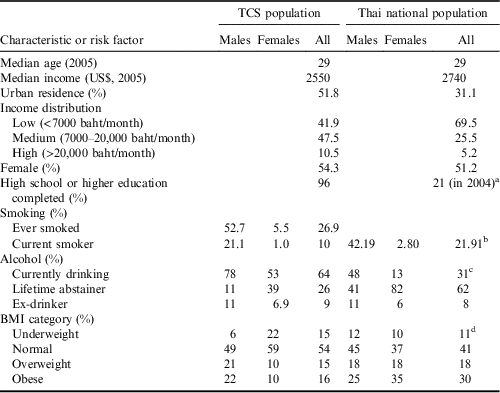
The initial analysis compared Thai Cohort Study (TCS) members with the general Thai population, in terms of socio-demographic factors as well as risk factors for health (see Table 1). For socio-demographic variables the TCS group was similar to the national population for average income levels, median age and proportions of females. Although similar for median income the income distribution within the TCS group varied from that of the national population, with a much larger proportion of TCS members lying in the ‘middle’ income category (47.5 vs 25.5%). The TCS population was more urban but half of participants still lived in rural areas. The most substantial difference between the two populations was that the TCS members were more highly educated with almost all having completed at least high school, and only 21% of the general Thai population having reached this stage of education. There were also some variations in risk factor prevalence among the two populations. The TCS members were twice as likely to be current drinkers, while they were half as likely to be current smokers. For excess BMI, there was little difference between TCS and Thai males. However, for females there was a substantial difference with only 20% of TCS females being overweight or obese while 53% of Thai women overall were in these categories. Also, women in the Thai national population had higher obesity rates than men, while in the TCS group this relationship was reversed.
Socio-demographic characteristics and risk factor prevalence in the Thai Cohort Study (TCS) versus the Thai national population, 2005

Empty cells indicate where data were not available.
Sources of non-TCS data: aOECD World Education indicators 2005 (OECD & UNESCO Institute for Statistics, 2005); bWHO tobacco use prevalence database (WHO Country Office for Thailand, 2007); cFrom national Thai health survey data (Assanangkornchai et al., Reference Assanangkornchai, Sam-Angsri, Rerngpongpan and Lertnakorn2010); dWHO Global BMI database (WHO, 2016).
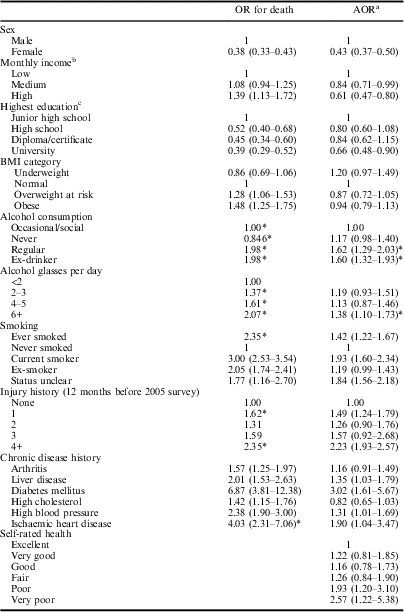
Table 2 shows the associations between risk factors measured at baseline in the TCS group in 2005 and mortality in the subsequent 8 years. By far the strongest relationships observed were for sex differences in mortality risk with women being less than half as likely to die in the 8 years of follow-up as men. In socio-demographic terms the effects of higher education and income were both significant, with the university graduates and high-income groups having adjusted odds ratios of 0.66 and 0.61 respectively. The next strongest relationship was found for smoking, with current smokers having nearly twice the odds of mortality. Current alcohol consumption was also associated with elevated mortality risk with adjusted odds ratios of 1.62. The high rates of drinking observed in Table 1, combined with the strong relationships revealed in the table, mean that alcohol is a serious issue for TCS members. Although BMI was not found to be associated with mortality risk in the adjusted models other analyses have found that the relationship is significant amongst older age groups within the TCS members (Yiengprugsawan et al., Reference Yiengprugsawan, Banwell, Zhao, Seubsman and Sleigh2014). A history of injury in the year proceeding the baseline survey was also associated with all-cause mortality. This risk increased with the number of previous injuries. Those who had experienced four or more injuries in the year proceeding baseline had 2.23 times the odds of mortality. Lastly, previous diagnosis with a variety of chronic diseases, with the association being strongest for diabetes (AOR 3.02), and poor self-rated health, were also predictors of subsequent mortality.
Odds ratios (OR) linking 2005 baseline data to 935 deaths among Thai Cohort Study participants before December 2013

a Adjusted for sex, age, education, BMI category, smoking status, self-rated health, injury history, drinking status, income and chronic disease history (diabetes, heart disease, high cholesterol, stroke, high blood pressure).
b Low income <7000 baht (US$280), medium income 7000–20,000 baht (US$ 280–800) and high >20,000 baht (>US$800) per month.
c Highest education level reached prior to enrolment at STOU.
*Indicates ORs with statistical significance (p<0.05).
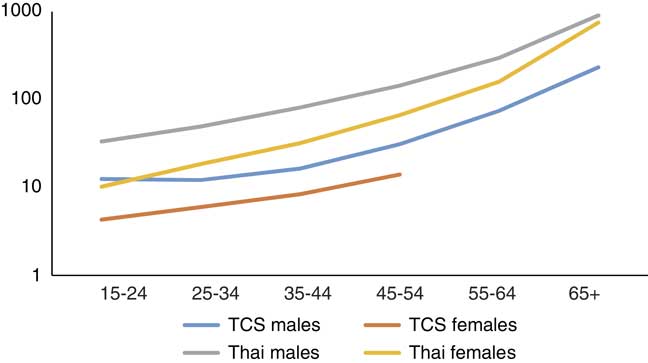
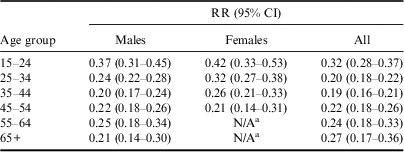
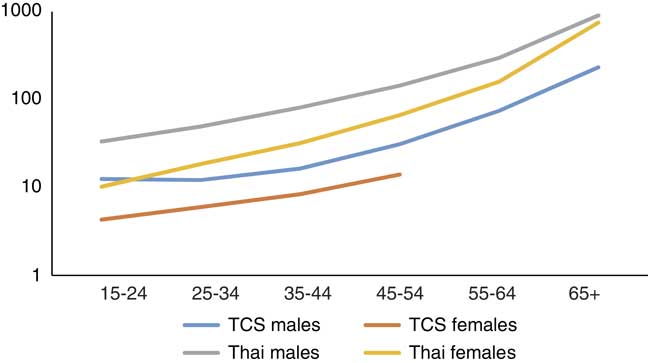
Further analysis then assessed differences in all-cause mortality rates between the TCS members and the general Thai population. Figure 1 plots age- and sex-specific mortality rates for the two populations. The TCS members had a consistent pattern of lower mortality rates across all age and sex groups. For males and females the gap between TCS and national population deaths was narrowest in the youngest age groups and widened as age increased. This relationship can also be observed in Table 3. The RRs for mortality ranged from 0.20 to 0.37 for males and from 0.21 to 0.42 for females. The highest RRs for both males and females in the TCS group were in the lower age group. The lowest RRs for males were in the 35–44 year age group, while for females the lowest risks were found among 45- to 54-year-olds.
Eight-year age-specific mortality rates for Thai Cohort Study (TCS) participants and the Thai national population (2005–2013). Note that the y-axis represents a logarithmic scale.
Relative Risk (RR) of mortality by age group for TCS members vs Thai national population

a There were very few female deaths among TCS females aged over 55 so these figures are not included.
Discussion
This analysis of mortality in Thailand has identified Thai Cohort Study participants as a group with significantly lower mortality than the general population. Across all age and sex groups TCS mortality was around one-third of that in the national population. This low mortality cohort population differs in one key way from other Thais: their aspiration and motivation to pursue higher education while still being embedded and employed in their communities.
Other studies of the effect of education on all-cause mortality in the region have also found inverse relationships. In particular, a meta-analysis of pooled data from 29 cohort studies in ten Asian countries found low education to be associated with a RR of mortality of 1.40 (Vathesatogkit et al., Reference Vathesatogkit, Batty and Woodward2014) and the Asia Pacific Cohort Studies collaboration found those with primary education versus higher education had a hazard ratio for all-cause mortality of 1.81 (Woodward et al., Reference Woodward, Peters, Batty, Ueshima, Woo and Giles2015). Other studies assessing the relative effects of income and education on mortality have found that education is powerful in reducing mortality risk, even when taking into account occupation and income differentials. In Korea those with only primary education had five times the risk of mortality compared with those with university education and similar results were found in Chile (Son et al., Reference Son, Armstrong, Choi and Yoon2002; Koch et al., Reference Koch, Romero, Romero, Aguilera, Paredes, Vargas and Ahumada2010). These results support the data from this study, where income and education both had independent and powerful effects on mortality risk.
One noteworthy factor in the analyses presented here is that the gap in mortality rates between TCS members and the general Thai population was smallest for the youngest age groups and peaked among 40- to 50-year-olds. The mortality benefit enjoyed by TCS members is probably driven by behavioural characteristics associated with higher education levels. So, the mortality benefit being received by the cohort participants relates more to reduced risk factors for chronic conditions that manifest in older age groups than to the injury risk concentrated in the young. The main cause of mortality in the younger age group in the TCS and in the general population was injury; the TCS and the general population mortality gap was therefore smallest in this age group. This age-related variation in mortality gap between the TCS and the national population agreed with other reports, which have found that the educational gradient for mortality is greatest for causes of death where medical progress has been greatest and where individual lifestyle factors can be applied to reducing risk of death. Proposed pathways between education and mortality in other settings have included greater health literacy, greater likelihood of health-care-seeking behaviour and better health behaviours. The implication then is that increased education levels in societies, accompanied by diffusion of new medical technologies, can increase mortality variation in societies, in line with the findings of this study (Soares, Reference Soares2007), while a less protective effect is felt for injury mortality.
The other analyses in this paper revealed some of the potential mechanisms mediating the mortality reduction. The markedly lower smoking rates for TCS men and women, and excess BMI rates for TCS women, were significant and probably explain part of the mortality variation. This relationship between education and lower smoking rates, but higher alcohol consumption, has been observed in other Thai studies (Aekplakorn et al., Reference Aekplakorn, Hogan, Tiptaradol, Wibulpolprasert, Punyaratabandhu and Lim2008). These variables can only explain part of the extensive variation in mortality between the two groups. The largely unmeasurable effect of aspiration and motivation for life improvement – life with a goal – is important and deserves more study. Those who have embarked on higher education while employed and raising families are possibly more likely to take greater care of their health than those without that aspiration.
One limitation in this study is the difficulty of making direct risk factor comparisons among the two populations. One of the strengths of the TCS is the collection of extensive data on risk factors at baseline and the ability to measure associations between these risk factors and mortality. For many of these risk factors comparable measurements were not available for the Thai population. This was particularly the case, for example, for environmental risks for which the TCS had data at the individual level, which cannot be easily compared with population-level data.
One of the biggest challenges in conducting long-term cohort studies in low- and middle-income countries like the one described here is maintaining contact with study participants and continuing to collect data on life events over the long term. Thailand is one of the only countries in the South East Asian region where mortality data collected through a nationwide civil registration system is complete for the whole population. This system, combined with the use of the unique citizen identification number system, has enabled the TCS to collect data on deaths among participants into the future without the need to do further surveys or collect information from family members. The strength of Thailand’s civil registration system is that it allows powerful analyses of life course risk factors for mortality not possible elsewhere in the region. This potential emphasizes the importance of strengthening civil registration in other low- and middle-income countries in Asia to improve understanding of patterns of mortality and their risk factors.
The effect of education and aspiration on mortality is particularly important in a setting such as Thailand where demographic and health transitions are still ongoing. In such a setting it is necessary to consider not only falls in infant and child mortality but the remaining variations in adult mortality and the potential need for policy approaches to be responsive to this mortality variation. The fact that only 21% of current Thai adults have graduated from high school, and the near universal high school enrolment now, suggest a great potential for future reductions in mortality. In terms of health policy utilization of the results presented here it is useful to consider this upwards trajectory in education levels in Thailand. The STOU itself has over 200,000 students nationwide enrolled at any one time, and there are other Open Universities in the country. This growing group of educated, aspirational, but not elite Thais may well represent future trends in Thai mortality.
Acknowledgments
The authors thank the staff at Sukhothai Thammathirat Open University (STOU) who assisted with student contact, and the STOU students who participating in the cohort study. They also thank the Thai Ministry of Interior and Ministry of Public Health for mortality investigation and cause of death data linkage. The study was supported by the International Collaborative Research Grants Scheme with joint grants from the Wellcome Trust UK (GR071587MA) and the Australian National Health and Medical Research Council (268055), and by a global health grant from the NHMRC (585426).