An atrioventricular valve whose chordal apparatus originates from both sides of the ventricular septum is known as a straddling atrioventricular valve. Reference Milo, Ho and Macartney1 Biventricular repair is challenging in cardiac disease patients with straddling of the atrioventricular valves. Straddling atrioventricular valves may accompany ventricular septal defects, tetralogy of Fallot, double outlet right ventricle, transposition of the great arteries, and other rare intracardiac diseases. Reference Milo, Ho and Macartney1,Reference Wenink and Gittenberger-de Groot2 The morphology of the atrioventricular valves can complicate the associated lesions and their surgical management. For this reason, a single ventricular route may be required in many patients. Here, we report the case of an infant with successful biventricular repair and transposition of the great arteries with a straddling tricuspid valve.
Case report
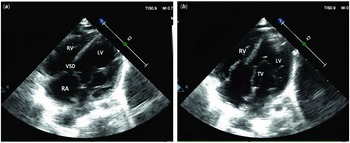
A 16-day-old male weighing 3.7 kg was admitted to our institute because of moderate cyanosis and signs of congestive heart failure. Chest X-ray indicated increased pulmonary blood flow and mild cardiomegaly. An electrocardiogram showed right axis deviation, and q waves present in the right precordial leads. Echocardiography revealed D-transposition of the great arteries, a large (12 mm) inlet ventricular septal defect, a small patent ductus arteriosus, and a small secundum-type atrial septal defect with a left-to-right shunt, pulmonary arterial hypertension, an overriding tricuspid valve, Type C straddling and anomalous origin of the coronary arteries (the left anterior descending artery originated from sinus 1, and the right coronary artery and circumflex artery originated from sinus 2. The right coronary artery and circumflex artery had separate ostiums). The tricuspid valve annulus was 13 mm (z score: −0.25), and the mitral valve annulus was 9 mm (z score: −2.21). The right and left ventricular diameters were normal (the left ventricular end-diastolic diameter was 22 mm, z score: +1.13; the left ventricular end-systolic diameter was 11 mm, z score: −0.79) (Fig 1). One week later, the patient underwent ligation of the patent ductus arteriosus and pulmonary banding. During follow-up, when the patient was two months old, balloon atrial septostomy was performed due to low saturation and the development of atrial septal defect restriction. After balloon atrial septostomy and pulmonary artery banding, the signs of heart failure regressed, and the patient was discharged from the hospital with a saturation level of 80–85%. When the patient was 5 months old, he underwent an arterial switch procedure. Technically, the patient’s anatomy was suitable for biventricular repair, but his body size was too small for total correction. Additionally, the coronary artery anomaly made single-step biventricular repair more complicated. It was determined that pulmonary artery banding for palliation would be performed first, and biventricular repair would be performed after the patient had grown, which was more convenient for our institution.
The septal leaflet of the tricuspid valve overrides the apex of the ventricular septum (a). The chordae from the anteroseptal side of the tricuspid valve attach to a papillary muscle in the posterior wall of the left ventricle (b) .

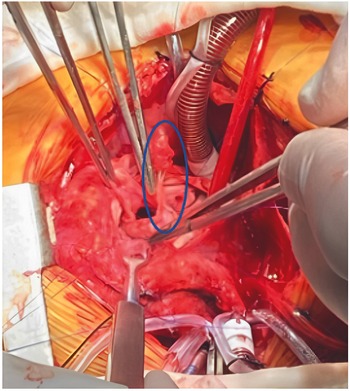
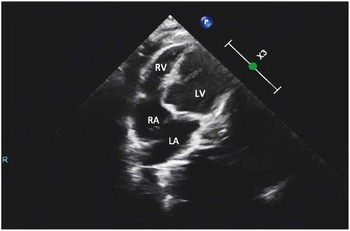
At surgery, the chordae from the anteroseptal side of the tricuspid valve were found to adhere to a papillary muscle in the posterior wall of the left ventricle, and the septal leaflet of the tricuspid valve was found to override the crest of the ventricular septum. During the procedure, an arterial switch was performed, and the inlet ventricular septal defect was closed from the right ventricular side with a pericardial patch through a right atriotomy. The chordae leading to the anteroseptal side of the tricuspid valve were divided, and they were translocated to the right side of the ventricular septum (Fig 2). The pericardium was stitched to the edge of the ventricular septal defect patch with a 6-0 prolene suture with pledgets. Pulmonary debanding and pulmonary artery reconstruction were performed, and primary atrial septal defect closure was performed, leaving a 2 mm defect. Complete atrioventricular block developed post-operatively, and the patient underwent dual chamber pacemaker implantation on post-operative Day 7. The patient, who had no additional complications during follow-up, was discharged on post-operative Day 20. Recent echocardiography performed as a follow-up revealed normal biventricular function, mild mitral regurgitation, and mild tricuspid regurgitation without stenosis. Using the tricuspid valve regurgitation jet velocity of 2.2 m/s as a basis, it was determined that the right ventricular pressure was normal (Fig 3).
Transection of the chordae from the anteroseptal side of the tricuspid valve.

View of the post-operative four-chamber echocardiogram.

Discussion
Straddling and overriding of the atrioventricular valves may be associated with an additional anomaly in approximately 3% of patients with CHD, excluding those with double-inlet ventricle and atrioventricular canal type defects. Reference Kirklin and Barratt-Boyes3 Morphological tricuspid valve straddling is more common than morphological mitral valve straddling. Reference Rice, Seward and Edwards4 Tricuspid valve straddling with transposed great arteries is often associated with underdeveloped right ventricular inflow and the presence of a large inlet ventricular septal defect. The type of defect associated with a straddling tricuspid valve is an inlet septal defect. This defect is typically not seen underneath the crux of the heart; nonetheless, it may extend anteriorly towards the bulboventricular septum and the infundibular septum. An inlet septal defect is distinct from an atrioventricular septal defect, which also affects the inlet septum in terms of size and location and is present in patients with an atrioventricular canal malformation. Reference Wenink and Gittenberger-de Groot2
Corrective surgery for a straddling atrioventricular valve was first reported in 1979. Reference Pacifico, Soto and Bargeron5 Complex intracardiac defects, hypoplasia of one of the ventricles, and excessive atrioventricular valve straddling and overriding necessitate the selection of the Fontan procedure in these patients. In the presence of Type A and B straddling, it was previously suggested by Pacifico et al. Reference Pacifico, Soto and Bargeron5 that the abnormal chordae or papillary muscle be transected, the ventricular septal defect be closed, and the separated chordae be sutured to the septum patch. This technique was not recommended for Type C straddling. Although biventricular repair is very challenging for patients with this type of extreme intracardiac disease, Prabhu et al. Reference Prabhu, Zhu, Turek and Andersen6 reported successful biventricular repair in a five-year-old patient with an inlet ventricular septal defect, subpulmonic stenosis, a hypoplastic right ventricle and a straddling tricuspid valve. Similar to this, our patient had a large inlet ventricular septal defect as well as tricuspid valve straddling and overriding. In addition, transposition of the great arteries could be accompanied by intracardiac defects. Despite all these overlapping complexities, we were able to execute biventricular repair by performing arterial switching, inlet ventricular septal defect closure and reconstruction of the tricuspid valve. The tricuspid valve was repaired by transecting all the straddling cords and reattaching them onto the right side of the patch used to close the ventricular septal defect. This technique has many advantages over other intracardiac patching techniques. The risk of developing subaortic stenosis after chordal translocation is lower than that with other biventricular repair options. Additionally, the release of the papillary muscles allows chordal mobility and results in better valve function. Reference Serraf, Nakamura and Lacour-Gayet7
It has been reported that complete heart block is more common after cardiac repair. In addition, transposition of the great arteries is accompanied by intracardiac defects with concordant atrioventricular connections and atrioventricular valve straddling with large septal defects. Reference Kirklin and Barratt-Boyes3 Pacifico et al. Reference Pacifico, Soto and Bargeron5 reported a 30% incidence of complete heart block in patients with this anatomical complex. In another study, three of five patients who had biventricular repair with straddling of the tricuspid valve required a permanent pacemaker. Reference Reddy, Liddicoat, McElhinney, Brook, van Son and Hanley8 In a series of 30 patients with atrioventricular valve straddling who underwent biventricular repair, the incidence of post-operative complete heart block was reported to be 3.8% by Serraf et al. Reference Serraf, Nakamura and Lacour-Gayet7 Among reported studies, a low incidence of heart block is attributed to suturing the patch to the left side of the septum, further away from the septal crest. Because of the high risk of complete heart block, a comparison of potential morbidities should be made between biventricular repair and the Fontan procedure. In our case, a post-operative complete heart block developed, requiring permanent pacemaker implantation. Regarding the long-term morbidities of the Fontan circulation, we considered biventricular repair in our patient, despite the risk of complete heart block. However, the distribution of the conduction bundle and the nature of the atrioventricular connection were carefully considered due to the intracardiac defect to minimise the risk of post-operative complete heart block. In the presence of such atrioventricular septal malalignment, the ventricular conduction bundle takes its origin from an anomalous atrioventricular node, formed at the point where the malaligned muscular ventricular septum meets the atrioventricular junction. Reference Spicer, Anderson and Backer9,Reference Lopez, Houyel and Colan10
The functions of the tricuspid valve should also be carefully studied when transecting the straddling cords and reattaching them on the right ventricular side. Intraoperative transoesophageal echocardiography is extremely important in the evaluation of the tricuspid valve. When significant residual regurgitation is detected, repair may need to be reconsidered. In the close follow-up of our patient, echocardiographic evaluation showed that his tricuspid valve function was good.
In conclusion, chordal translocation and reattachment can be performed for successful biventricular repair in patients with a straddling tricuspid valve and two adequately sized ventricles. Considering the morbidities of the Fontan circulation, it seems more appropriate to prioritise the biventricular repair option in such patients.
Acknowledgements
None.
Financial support
This research received no specific grant from any funding agency in the commercial or not-for-profit sectors.
Conflicts of interest
None.
Ethical standards
Patient data have been anonymised.