Introduction
Bipolar disorder (BD) is the fourth leading cause of disability worldwide among young people. Cognitive deficits are one of the main causes of disability even in euthymic phases, varying between 30% and 62% among euthymic subjects with BD (Martino et al., Reference Martino, Strejilevich, Scápola, Igoa, Marengo, Ais and Perinot2008; Reichenberg et al., Reference Reichenberg, Harvey, Bowie, Mojtabai, Rabinowitz, Heaton and Bromet2009). Toward that, a meta-analysis evidenced individuals with BD show dysfunctions in a wide range of cognitive domains, and it cannot be entirely related to acute phases (Torres, Boudreau, & Yatham, Reference Torres, Boudreau and Yatham2007). Cognitive deficits are more persistent than the mania or depressive phases, impacting functional outcome and recovery, but those deficits are not present in all individuals with BD (Burdick et al., Reference Burdick, Millett, del Mar Bonnín, Bowie, Carvalho, Eyler and Young2019). There is a part of subjects who have a similar cognitive performance to unaffected individuals, while others exhibit severe cognitive impairment in many cognitive domains (Green, Girshkin, Kremerskothen, Watkeys, & Quidé, Reference Green, Girshkin, Kremerskothen, Watkeys and Quidé2019).
Individuals with BD are classified as having impaired or preserved cognitive function using arbitrary cutoff scores. The limitation of this approach is that it does not accurately represent the underpinnings of these deficits present within samples of subjects with BD. For this reason, data-driven approaches, such as cluster analysis, are methods more suited to provide relevant, monolithic cognitive phenotypes. A recent meta-analysis with 24 studies about cognitive clusters have found distinct neuropsychological subgroups within BD patients: a first group with cognitive functioning similar to unaffected individuals (32–48% of individuals with BD); a second one presenting cognitive impairment in only specific cognitive domains, such as processing speed and attention (29–40% of individuals with BD); and a third one with severe cognitive impairment in several domains (12–40% of individuals with BD) (Green et al., Reference Green, Girshkin, Kremerskothen, Watkeys and Quidé2019). These clusters showed similar intensity of mood symptoms but presented different levels of psychosocial functioning, stress, and quality of life (Jensen, Knorr, Vinberg, Kessing, & Miskowiak, Reference Jensen, Knorr, Vinberg, Kessing and Miskowiak2016; Solé et al., Reference Solé, Jiménez, Torrent, del Mar Bonnin, Torres, Reinares and Martínez-Arán2016).
The differences in the cognitive profiles of BD subjects may be due to heterogeneous disorder trajectories, with particular relevance for the influence of premorbid factors. Cross-sectional studies showed that patients with high cognitive reserve (CR), for example, displayed better cognitive performance than patients with low CR (Anaya et al., Reference Anaya, Torrent, Caballero, Vieta, Bonnin, Ayuso-Mateos and Vega2016; Forcada et al., Reference Forcada, Mur, Mora, Vieta, Bartrés-Faz and Portella2015). Furthermore, the number of hospitalizations, number of mood episodes, and early onset of disease are also related to worse clinical, functional, and cognitive outcomes (Cardoso, Bauer, Meyer, Kapczinski, & Soares, Reference Cardoso, Bauer, Meyer, Kapczinski and Soares2015; Geoffroy et al., Reference Geoffroy, Etain, Scott, Henry, Jamain, Leboyer and Bellivier2013). Although there seems to be a subset of patients with a progressive cognitive decline throughout the disease (Passos, Mwangi, Vieta, Berk, & Kapczinski, Reference Passos, Mwangi, Vieta, Berk and Kapczinski2016), not all subjects with BD will lead to unfavorable clinical outcomes. It is hypothesized that more severe cognitive impairment represents a marker of severe disease phenotype, since patients cognitively impaired with multiple episodes present the onset of symptoms 2–5 years earlier than patients with a single episode of mood (López-Jaramillo et al., Reference López-Jaramillo, Lopera-Vásquez, Gallo, Ospina-Duque, Bell, Torrent and Vieta2010; Van Rheenen et al., Reference Van Rheenen, Lewandowski, Bauer, Kapczinski, Miskowiak, Burdick and Balanzá-Martínez2020).
Moreover, little is known about predictors of cognitive profiles in BD, knowing which individuals are at risk of unfavorable cognitive outcomes, early detection of these deficits may enable more timely and effective strategies to avoid pernicious course. Clinically, early detection of neuropsychological subgroups is a significant challenge in the management of BD. Therefore, we aim to identify demographic and clinical factors associated with cognitive heterogeneity in individuals with BD through an innovative machine-learning method.
Methods
Participants
We recruited 267 individuals with BD and unaffected subjects from outpatient clinics in Brazil and Spain. The BD diagnosis was determined by experienced psychiatrists using the Structured Clinical Interview for DSM-IV Axis 1 Disorders (SCID-I). To be included in the study, patients should be between 18 and 65 years of age, and be euthymic for at least 1 month before the assessment, as confirmed by the Hamilton Depression Rating Scale (HAM-D-17) and Young Mania Rating Scale (YMRS) ≤ 7. Exclusion criteria were: diagnosis of intellectual disability according to Wechsler Adult Intelligence Scale (WAIS-III), significant neurologic or clinical comorbidity, being treated with electroconvulsive therapy within the past year, and substance abuse or dependence in the last year. Unaffected individuals included were between 18 and 65 years, were not using any psychiatric medication, and had no first-degree family history of a severe mental disorder, dementia, or intellectual disability. All participants provided written informed consent. The local ethical committees from both Brazil and Spain approved all procedures.
Assessments
All participants completed a structural interview with experienced clinicians that included sociodemographic information and clinical assessments. After that, a neuropsychological battery was administered by experienced clinical psychologists. The cognitive domains assessed were: inhibitory control (Stroop Color and Word Test) (Scarpina & Tagini, Reference Scarpina and Tagini2017); processing speed (Trail Making Test A); cognitive flexibility (Trail Making Test B) (Tombaugh, Reference Tombaugh2004); verbal fluency (Verbal Fluency Test with letters F-A-S) (Tombaugh, Kozak, & Rees, Reference Tombaugh, Kozak and Rees1999); working memory (Letter-Number Sequencing from WAIS-III) (Yates et al., Reference Yates, Trentini, Tosi, Corrêa, Poggere and Valli2006); short-term verbal memory [Hopkins Verbal Learning Test-Revised (HVLT-R) trials 1–3 or California Verbal Learning Test-II (CVLT-II) trials 1–5]; and long-term verbal memory (HVLT-R delayed recall trial or CVLT-II delayed recall trial) (Baños & Martin, Reference Baños and Martin2002; Benedict, Schretlen, Groninger, & Brandt, Reference Benedict, Schretlen, Groninger and Brandt1998).
Analysis
We performed analyses in R (version 3.6.1), RStudio (version 3.5.3), and Weka software (http://www.cs.waikato.ac.nz/ml/index.html).
Data transformation
Trail Making Test A (TMT-A) and Trail Making Test B (TMT-B) were subtracted by 300 (maximum score) to be compatible with the direction of the other cognitive tests, which indicate – unlike the TMT – that the higher the score, the better the performance. We transformed the cognitive variables to z-scores based on the mean and standard deviation of unaffected subjects (Field, Reference Field2013). We truncated extremely low z-scores (<−4.0) to z = −4.0 to allow that extreme value could be included in the analysis, since z-score <−4.0 already mean severe cognitive impairment (Jensen et al., Reference Jensen, Knorr, Vinberg, Kessing and Miskowiak2016). All cognitive tests were the same for both samples except for verbal memory tests. The Brazilian sample used the Hopkins Verbal Learning Test-Revised (HVLT-R), while the Spanish sample used the California Verbal Learning Test-II (CVLT-II). In order to include a memory domain in our analysis, we converted scores of HVLT-R trials 1–3 and the delayed recall trial into z-scores based on the mean and standard deviation of the Brazilian sample of unaffected individuals. We performed the same procedure with CVLT-II trials 1–5 and the delayed recall trial based on the Spanish sample of unaffected subjects. After that, we gathered the z-scores of HVLT-R trials 1–3 and CVLT-II trials 1–5 as a short-term verbal memory domain and delayed recall of HVLT-R and CVLT-II as a long-term verbal memory domain.
Cognitive subgroups
We performed hypothesis testing in three steps. First, we used hierarchical cluster analysis (HCA) to investigate the presence of cognitive subgroups in the BD sample using Ward's method and squared Euclidean distance using R package ‘cluster’ (version 2.1.0) (Hermens et al., Reference Hermens, Redoblado Hodge, Naismith, Kaur, Scott and Hickie2011, Reference Hermens, Naismith, Chitty, Lee, Tickell, Duffy and Lagopoulos2015). We computed the average silhouette width to determine optimal numbers of clusters with package ‘factoextra’ (version 1.0.5) (Tomasini, Borges, Machado, & Emmendorfer, Reference Tomasini, Borges, Machado and Emmendorfer2017). We performed a Discriminant function analysis (DFA) using package ‘MASS’ (version 7.3-51.4) to confirm the clusters retained and to investigate the predictive power of the clustering of each participant's cognitive domain to the cognitive subgroup (Jensen et al., Reference Jensen, Knorr, Vinberg, Kessing and Miskowiak2016).
Second, we checked the variables for outliers and normal distribution using the Kolmogorov–Smirnov test. All variables in common with both groups were normally distributed. We performed Student's t and χ2 tests when appropriated to compare the groups. We tested for cluster effects on neuropsychological characteristics through multivariate analysis of variance (MANOVA) with post-hoc Tukey's HSD test for multiple comparisons. Statistical significance was p < 0.05 (two-tailed) for all tests.
Classification and regression tree model
Finally, we used a classification and regression tree (CART) model to identify the clinical features of our data-driven cognitive subgroups in subjects with BD. The CART algorithm is a non-parametric model with high-order interactions that predicts outcomes based on the average value of observations (Dykxhoorn, Hatcher, Roy-Gagnon, & Colman, Reference Dykxhoorn, Hatcher, Roy-Gagnon and Colman2017; Nathan & Scobell, Reference Nathan and Scobell2012). CART is a machine-learning method widely used for diagnosis and classification of high-risk behaviors (Dennison, Wu, & Ickes, Reference Dennison, Wu and Ickes2014; Dykxhoorn et al., Reference Dykxhoorn, Hatcher, Roy-Gagnon and Colman2017; Takeuchi et al., Reference Takeuchi, Takeuchi, Kawakubo, Booka, Mayanagi, Fukuda and Kitagawa2018; Tyrovolas, Tountas, Polychronopoulos, & Panagiotakos, Reference Tyrovolas, Tountas, Polychronopoulos and Panagiotakos2012). This technique can identify complex nonlinear relations with interactive models (Ghatak, Reference Ghatak2017; Hayes, Usami, Jacobucci, & McArdle, Reference Hayes, Usami, Jacobucci and McArdle2015). The CART algorithm has some advantages: (1) produces a tree output simple to understand; (2) is a white-box model, i.e. it is easier to interpret than black-box; (3) has a good performance with both small and large datasets; (4) is robust against collinearity; (5) handles both categorical and continuous variables; and (6) automatically selects relevant features and determines cut-points according to characteristics of data. These cut-points may be clinically relevant, indicating distinct clinical courses and helping clinical decision-making. This algorithm uses an automatic feature selection in each leaf. The linear regression method shows some limitations compared to CART: (1) does not handle categorical and continuous factors simultaneously; (2) is not able to identify different predictors into the same group; and (3) estimates only linear relationship between variables. Outcomes were the cognitive subgroups (intact, selectively impaired, or severe) previously defined. Variables included in the CART analysis were: years of education, age, number of hospitalizations due to mood episodes, years of disease, age of onset, first-episode types (depressive or manic episode), first-episode psychosis (dichotomous variable: yes or not), family history of mood disorders (dichotomous variable: yes or not), and type of BD (type I or II). We split our dataset into training (70% of the whole sample) and test dataset (30%) randomly. In the next step, we used a standard machine-learning protocol with leave-one-outcross-validation to evaluate the model's performance (Dwyer, Falkai, & Koutsouleris, Reference Dwyer, Falkai and Koutsouleris2018). We used the default pruning parameter to avoid overfitting (complexity parameter = 0.01). Afterward, we tested the trained model in the testing ‘unseen’ datasets. Individual-level predicted probabilities of cognitive heterogeneity were calculated based on balanced accuracy, sensitivity, specificity, the positive predictive value, the negative predictive value, and the area under the ROC curve (AUC).
Results
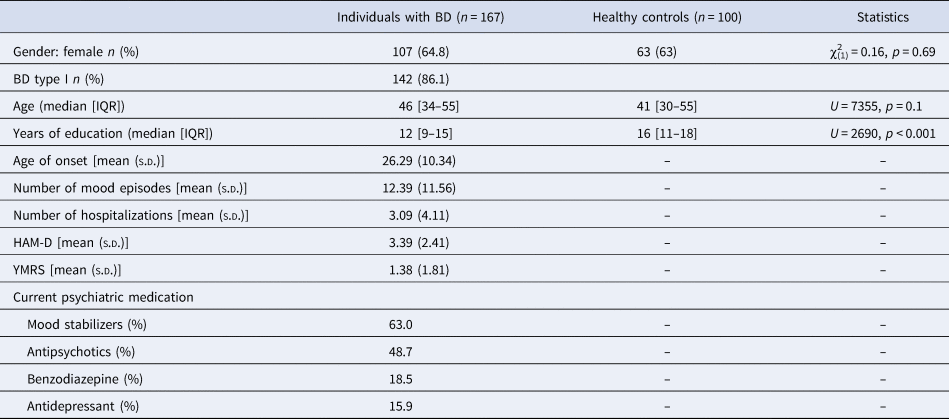
The demographic and clinical variables of the sample are presented in Table 1. A total of 167 individuals with BD and 100 healthy controls. Participants were 59 healthy volunteers and 97 outpatients from the Bipolar Disorder Program at Hospital de Clinicas de Porto Alegre (HCPA) – Brazil, and 41 unaffected individuals and 70 outpatients from the Barcelona Bipolar Disorder Program at Hospital Clinic – Spain. The groups (BD and unaffected individuals) had a similar gender distribution. Individuals with BD were older compared to unaffected subjects.
Sociodemographic and clinical characteristics of individuals with BD and unaffected subjects

IRQ, interquartile range; s.d., standard deviation; HAM-D, Hamilton Depression Rating Scale; YMRS, Young Mania Rating Scale.
Cognitive subgroups of BD patients
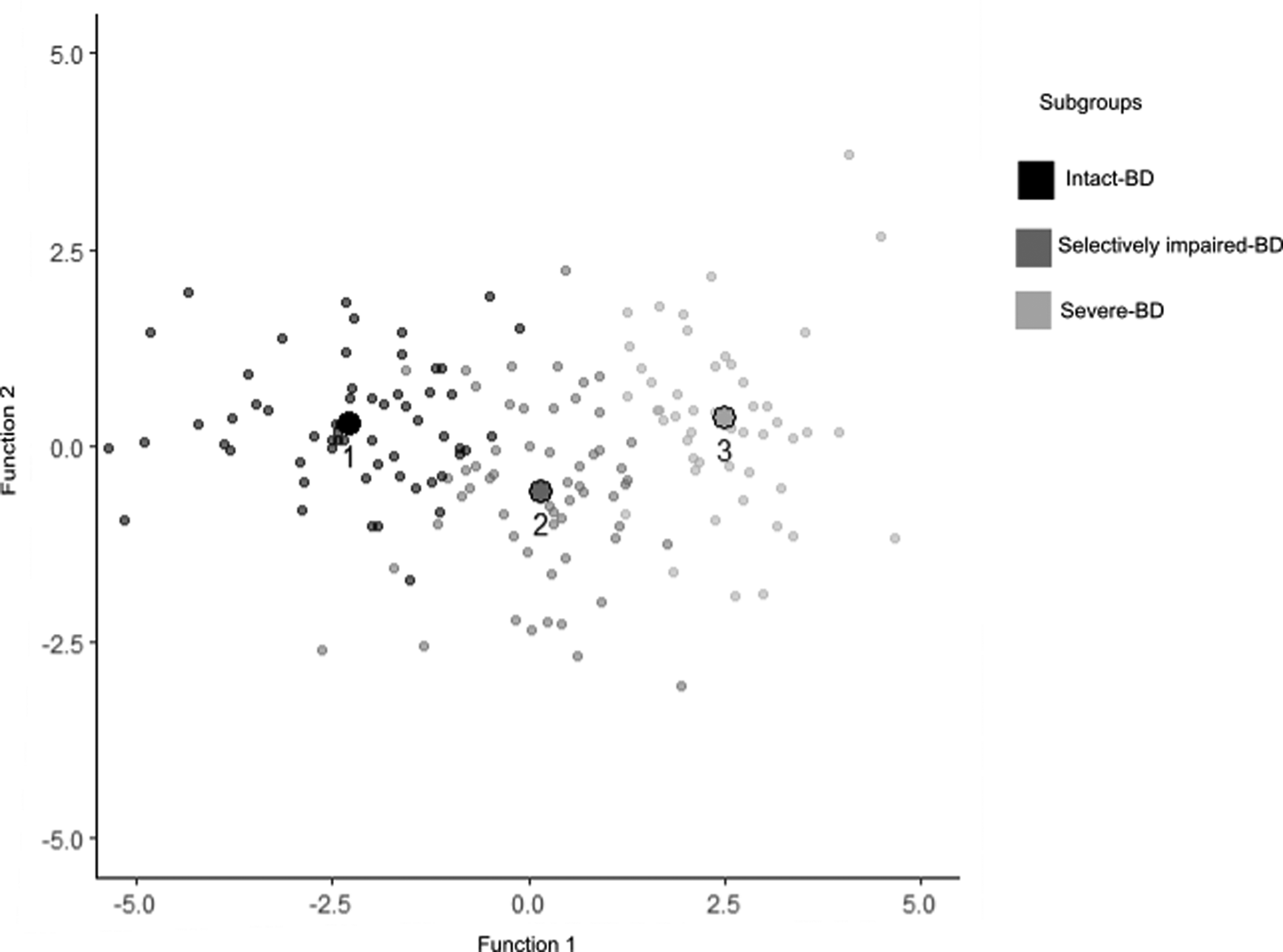
The HCA, through the average silhouette width, demonstrated the presence of three cognitive clusters (online Supplementary Fig. S1), comprised of 35.3% of patients with intact cognition (n = 59), 34.7% with selective impairments (n = 58), and 29.9% with severe impairments (n = 50). The DFA showed the presence of two discriminant functions, which explained 95.5% and 4.05% of the variance, respectively (Wilks' λ = 0.17, χ2 = 279.91, p < 0.001; Wilks' λ = 0.84, χ2 = 27.9, p < 0.001). The patients were correctly classified by DFA into 93% of the cases, evidencing the validity of the three cognitive clusters. Cognitive flexibility and verbal fluency were domains that better classified BD patients into cognitive clusters employing correlations between discriminating variables and discriminant functions (Function 1: r = 0.78 and r = 0.45; Function 2: r = 0.24 and r = −0.33, respectively). The cognitive subgroups are shown in Fig. 1.
Agglomeration of subjects with BD produced by DFA based on cognitive performance in three groups. The higher symbols are the centroids for each cluster. Intact-BD, cognitively intact cluster of subjects with BD; selectively impaired-BD, selectively impaired cluster of subjects with BD; severe-BD, severely impaired cluster of subjects with BD.

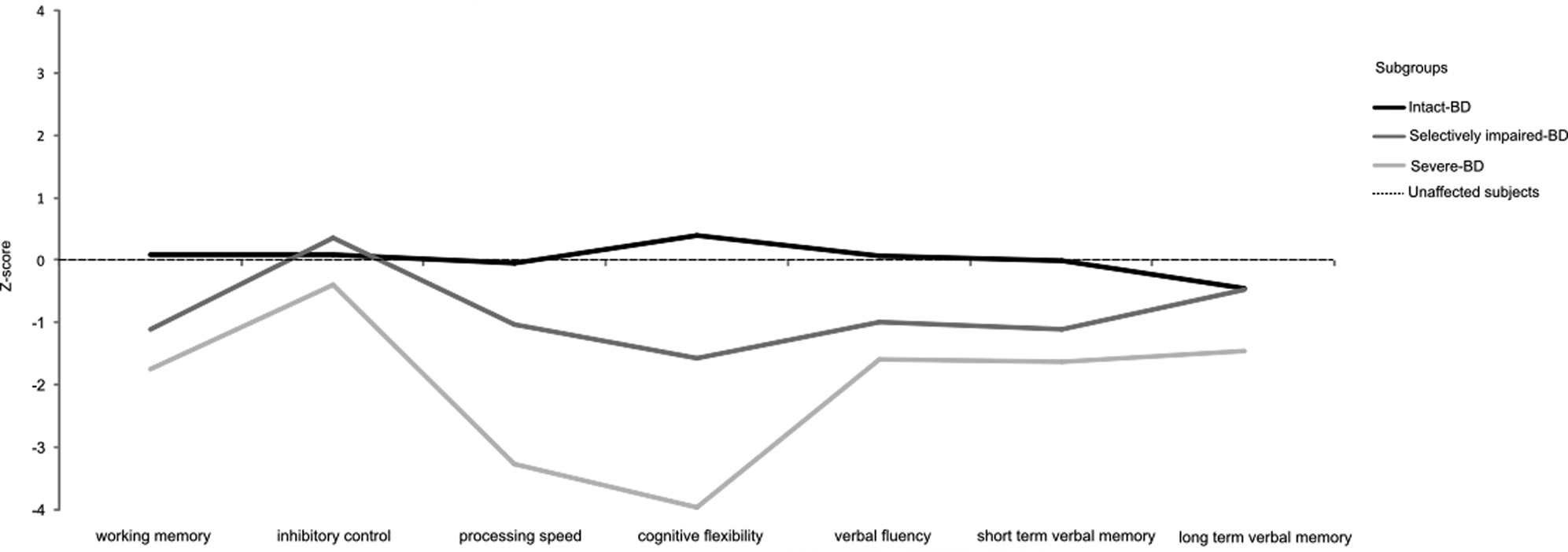
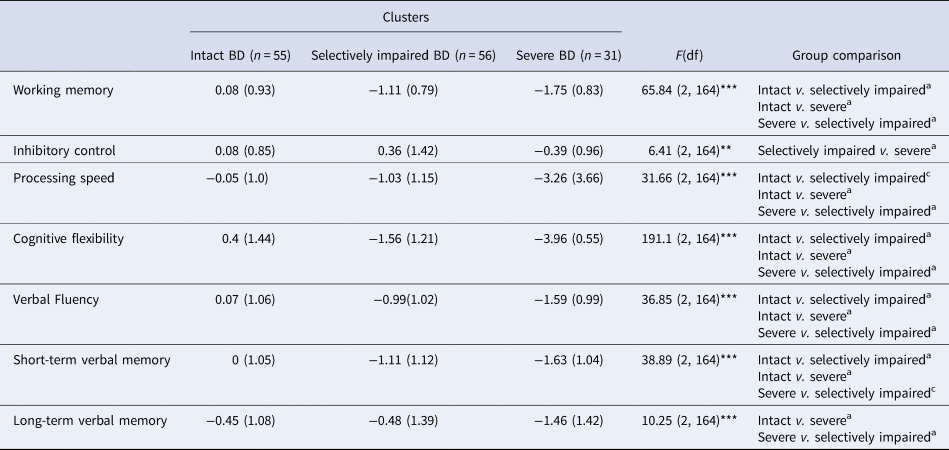
The multivariate analysis of variance displayed a significant effect of group comparing the cognitive clusters across neuropsychological variables (F (2,164) = 156.8, p < 0.001). The post-hoc test revealed that all cognitive groups were different (Table 2). The intact cognition group had better performance than the other two cognitive clusters. The selectively impaired group also had better performance compared to the severe impairment group, except for inhibitory control. This group exhibited an intermediate performance between the intact cognition and the severe impairment groups. The severely impaired group had worse performance than the other two cognitive groups. The mean z-scores across domains between the three clusters of BD patients are displayed in Fig. 2.
Mean of neuropsychological performance between three clusters of individuals with BD and unaffected subjects. The X-axis is the domains cognitive and Y-axis is the value of z-score based on mean and standard deviation of unaffected subjects in cognitive tests. Statistical tests among groups are shown in Table 2. Intact-BD, cognitively intact cluster of subjects with BD; selectively impaired-BD, selectively impaired cluster of subjects with BD; severe-BD, (severely impaired cluster of subjects with BD.

Comparison of z scores between neurocognitive clusters of BD across cognitive domains
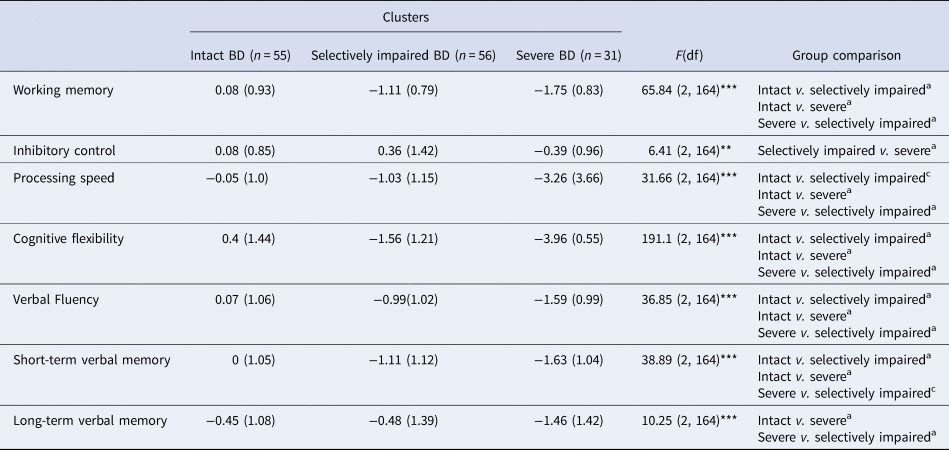
MANOVA with post-hoc Tukey's HSD test for multiple comparisons. Data showed as mean (standard deviation) of z-scores.
***p < 0.001.
ap < 0.001; bp < 0.01; cp < 0.05; p values are adjusted for multiple comparisons with post-hoc Tukey's HSD test.
Classification and regression tree (CART) model
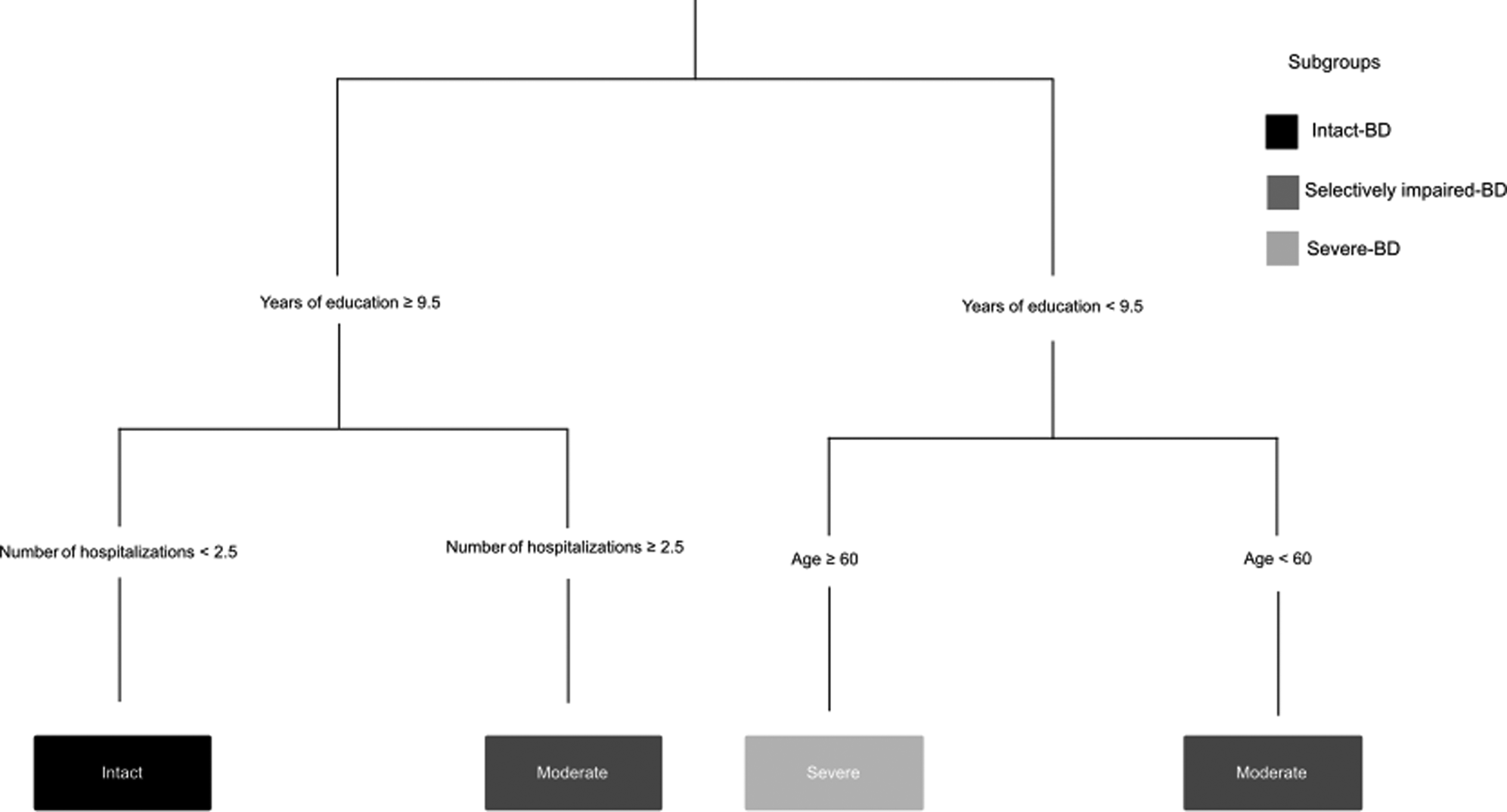
The tree-based CART model is shown in Fig. 3. The model to classify cognitive subgroups showed sensitivity 45.8%, specificity 78.4%, balanced accuracy 62.1%, and the AUC was 0.61 (online Supplementary Fig. S2). There were four leaf nodes, which are results of ‘if–then’ conditions. Of the 10 variables included in the model, only three were able to separate cognitive clusters in BD individuals. The split criterion is indicated in each decision node. The most important criterion was years of education, which split the root node into two branches (⩾9.5 years of education and <9.5 years of education).
CART model using clinical markers of severity among cognitive clusters in BD. Each node shows the predicted class (intact cognition, selective cognitive impairment, or severe cognitive deficits).

Additionally, the CART showed the following clinical features of cognitive clusters: the number of hospitalizations (First split: ⩾2.5 and <2.5), and age (<60.5 and ⩾60.5). Years of disease, age of onset, first-episode types (depressive or manic episode), first-episode psychosis (dichotomous variable: yes or not), family history of mood disorders (dichotomous variable: yes or not), and type of BD (type I or II) were not selected by the model.
Subjects with severely impaired cognition showed fewer years of education (<9.5) and older age (⩾60). A portion of individuals with selectively impaired cognition exhibited fewer years of education (<9.5) and younger age (<60). Another fraction of the same group displayed more years of education (⩾9.5) and a higher number of hospitalizations (⩾2.5). The intact group had more years of education (⩾9.5) and a lower number of hospitalizations (<2.5).
Discussion
This is the first study to use innovative machine-learning techniques to identify clinical markers of severity among cognitive subgroups of individuals with BD in order to bring useful markers for clinicians working with this population. Our study identified three cognitive subgroups of euthymic patients with BD, which is consistent with the existing literature. Interestingly, we found that – among the possible clinical and demographic variables – years of education, the number of hospitalizations, and age were predictors selected by the machine-learning algorithm in the subgroups of cognitive performance mentioned above, highlighting critical characteristics of individuals within these clusters.
The cognitive clusters in our Brazilian and Spanish sample included 39% of patients with intact cognition, 39% with selectively impaired cognition, and 22% with severely impaired cognition. The percentage of subjects in each cluster was similar to a previous systematic review, indicating that only a small portion of BD subjects actually exhibited severe cognitive impairment (Green et al., Reference Green, Girshkin, Kremerskothen, Watkeys and Quidé2019). When we looked at the differences between subgroups regarding the performance of each domain, we found that they were all different, suggesting important distinctions among groups. Some authors report that a cognitive deficit might be considered when the standard deviation is 1 score below the mean of an unaffected subject sample (Iverson, Brooks, Langenecker, & Young, Reference Iverson, Brooks, Langenecker and Young2011; Jensen et al., Reference Jensen, Støttrup, Nayberg, Knorr, Ullum, Purdon and Miskowiak2015; Martino et al., Reference Martino, Strejilevich, Marengo, Ibañez, Scápola and Igoa2014). The severe group displayed cognitive deficits in all domains except for inhibitory control, e.g. the cognitive functions working memory, processing speed, verbal fluency, short-term, and long-term verbal memory were below −1.5 standard deviation. The selectively impaired group showed a moderate performance between 0 and −1 standard deviation in inhibitory control, processing speed, verbal fluency consistent with previous studies (Bora et al., Reference Bora, Hıdıroğlu, Özerdem, Kaçar, Sarısoy, Civil Arslan and Tümkaya2016; Burdick et al., Reference Burdick, Russo, Frangou, Mahon, Braga, Shanahan and Malhotra2014; Green et al., Reference Green, Girshkin, Kremerskothen, Watkeys and Quidé2019; Jensen et al., Reference Jensen, Knorr, Vinberg, Kessing and Miskowiak2016; Russo et al., Reference Russo, Van Rheenen, Shanahan, Mahon, Perez-Rodriguez, Cuesta-Diaz and Burdick2017). However, the selectively impaired cluster had cognitive deficits in cognitive flexibility, working memory, short-term, and long-term verbal memory below −1 standard deviation. The intact cluster performed similarly to the unaffected individuals. These findings indicate that the cognitive heterogeneity present in these subjects cannot be ignored or considered without specificities, once they might be related to different cognitive trajectories. Current evidence on cognitive courses points in two directions: some patients experience a cognitive decline over time, but other individuals with BD exhibit low premorbid cognitive functioning (Van Rheenen et al., Reference Van Rheenen, Lewandowski, Bauer, Kapczinski, Miskowiak, Burdick and Balanzá-Martínez2020).
Interestingly, the main criterion to predict the neuropsychological subgroups was years of education, subdividing the cognitive clusters into subgroups with more years of education (intact and selectively impaired) and fewer years of education (selectively impaired and severe). As we know, this variable is an essential proxy of CR, e.g. the brain's capacity to resist damage due to specific life experiences such as the level of education. The severe group had fewer years of education (<9.5) and older age, while a portion of the selectively impaired cluster had the same years of education and <60 years old. In BD, patients with low CR show worse cognitive performance in several domains, suggesting that CR may play a critical function in the course of BD (Anaya et al., Reference Anaya, Torrent, Caballero, Vieta, Bonnin, Ayuso-Mateos and Vega2016). Thus, this evidence suggests that these patients may show lower CR and may be more susceptible to impacts on cognitive function over time. However, it is relevant to highlight the complex nature between education and cognitive performance since premorbid symptoms may also impact academic achievement. A cross-sectional study with 156 euthymic subjects with BD and 416 healthy individuals has shown that cognitive alterations lead to a lower level of education, because while only 10% of healthy controls completed the basic education and had severe cognitive impairment, more than half of the individuals with BD completed the basic education and had severe cognitive impairment (Bora et al., Reference Bora, Hıdıroğlu, Özerdem, Kaçar, Sarısoy, Civil Arslan and Tümkaya2016). As far as we know, all studies investigating the interplay between these factors have cross-sectional designs, which is a significant limitation, since it is not possible to establish a causal relationship between cognition and scholar achievement.
Age had played important role in differentiating the selectively impaired and severe deficits clusters, indicating additional impacts of aging in the trajectory of some individuals with BD. It is widely described that aging implicates in cognitive declines. The rate of people with dementia increases from 1.6% between 60 and 64 years of age, to 4.3% between 70 and 74 years, and above 90 years, the prevalence is 43.1% (Prince et al., Reference Prince, Bryce, Albanese, Wimo, Ribeiro and Ferri2013). A longitudinal study of a 3-year follow-up period showed that older patients with BD exhibited more severe deficits and faster cognitive decline than unaffected subjects (Gildengers et al., Reference Gildengers, Mulsant, Begley, Mazumdar, Hyams, Reynolds and Butters2009). This evidence corroborates our findings, which showed that the severe cluster had two important factors associated with cognitive impairment: CR and age (Lewandowski, Sperry, Malloy, & Forester, Reference Lewandowski, Sperry, Malloy and Forester2014).
The number of hospitalizations was another predictor of cognitive clusters in our study. This variable differentiated the intact cluster with a lower number of hospitalizations (<2.5) from the selectively impaired cluster with a higher number of hospitalizations (⩾2.5). As showed by our data, the intact group had a lower number of hospitalizations (<2.5) than the selectively impaired group (⩾2.5). Recent reports indicate that patients with more hospitalizations exhibit cognitive deficits in several domains, whereas patients with few hospitalizations show better cognitive performance (Czepielewski et al., Reference Czepielewski, Massuda, Goi, Sulzbach-Vianna, Reckziegel, Costanzi and Gama2015; Robinson & Ferrier, Reference Robinson and Ferrier2006; Vieta et al., Reference Vieta, Popovic, Rosa, Solé, Grande, Frey and Kapczinski2013). Furthermore, there is evidence that the length of hospital stay is negatively associated with neuropsychological performance at discharge from inpatient care (Levy et al., Reference Levy, Stephansky, Dobie, Monzani, Medina and Weiss2009). The number of hospitalizations is a harder endpoint with minimum recall bias that is probably strongly related to BD's acute mood episodes. Moreover, rates of hospitalizations are a crucial marker of illness severity associated with worse clinical outcomes (da Costa, Passos, Lowri, Soares, & Kapczinski, Reference da Costa, Passos, Lowri, Soares and Kapczinski2016). Our intact group has fewer hospitalizations for possibly having a less severe phenotype of the disease, requiring fewer psychiatric hospitalizations, while individuals with cognitive impairment and more hospitalizations may represent a marker of disease severity (Bora & Özerdem, Reference Bora and Özerdem2017). Patients with more severe cognitive impairment have other markers of severity such as psychotic episodes and longer disease duration (Van Rheenen et al., Reference Van Rheenen, Lewandowski, Bauer, Kapczinski, Miskowiak, Burdick and Balanzá-Martínez2020).
Thus, the intact group has more years of education and fewer hospitalizations. In contrast, the selectively impaired and severe groups have a different clinical course with the additional impact of aging for the severe group, reinforcing the idea of distinct disease courses. Besides, the interaction between neurodevelopmental and progressive aspects requires that the clinicians should have a longitudinal view of patients. Our findings may be relevant to help clinicians in decision-making as applying therapeutics focused on early interventions, relapse prevention, and cognitive remediation to the groups of individuals with BD that indeed will benefit from it. Furthermore, identifying cognitive subgroups and their respective clinical markers of disease severity may help to establish target therapies. For example, it may be useful to indicate relapse prevention strategies for a part of the selectively impaired cluster, while another may benefit from cognitive or functional remediation. Thus, clinical judgment could be assisted by machine-learning techniques (Jiang et al., Reference Jiang, Jiang, Zhi, Dong, Li, Ma and Wang2017).
Our study has some limitations. First, this study had a cross-sectional design, and it is strongly recommended a longitudinal study to assess the disorder's cognitive course. Assessing the cognitive development through a high-risk sample for BD or birth cohorts would be the most suitable, since those study designs can identify premorbid and morbid variables over time with almost no recall bias, unlike cross-sectional designs. Additionally, the longitudinal studies are important to investigate the stability of cognitive subgroups. Second, we did not measure intellectual performance and other premorbid variables, such as childhood trauma, drug use, and prodromal symptoms, which may explain better the cognitive heterogeneity than the variables used in our study. Third, we had a small sample size into each cluster, which interferes with a better predictive model. Thus, we suggest future replications with larger sample sizes, because our machine-learning model did not achieve great performance measures, insomuch our findings should be interpreted with caution. Fourth, subjects with at least 1 month of euthymia may have residual symptoms that might impact cognitive performance. Fifth, our study did not show any biological markers such as metabolomics or genetic, which may provide relevant insight into BD's cognitive heterogeneity.
Nonetheless, the strength of our work was a transcultural study and the use of a new method analysis, not previously used in neuropsychology of BD. In this model, the cutoffs displayed are data-driven rather than being stratified based on arbitrary criteria. Data-driven methods allow the development of personalized interventions with early detection and prognosis evaluation. Future research should assess functional impairment, neuroimaging, and other biological measures in different clusters on longitudinal designs, verifying if clusters change over time.
In conclusion, individuals with BD could have three cognitive profiles: similar performance to healthy controls, moderate impairments in some cognitive functions, and severe impairments across all domains. These results corroborate recent findings of neuropsychological heterogeneity in BD. The most important variables of these cognitive subgroups of BD patients was years of education, followed by the number of hospitalizations due to a mood episode, and age, respectively, suggesting an overlapping between premorbid and morbid factors. Our results may help clinical decision-making and develop early interventions that prevent cognitive decline in subjects with BD.
Supplementary material
The supplementary material for this article can be found at https://doi.org/10.1017/S0033291720003499.
Acknowledgements
We thank all the participants of the study.
Financial support
Part of this study was supported by FIPE/HCPA (15-0298) and the Brazilian National Council for Scientific and Technological Development (CNPq – 423969/2018-8).
Conflict of interest
The authors declare that the research was conducted in the absence of any commercial or financial relationships that could be construed as a potential conflict of interest.
Ethical standards
The authors assert that all procedures contributing to this work comply with the ethical standards of the relevant national and institutional committees on human experimentation and with the Helsinki Declaration of 1975, as revised in 2008.