Introduction
The concept of high-entropy alloys (HEAs) was initially proposed independently by YehReference Yeh, Chen, Lin, Gan, Chin, Shun, Tsau and Chang1 and Cantor,Reference Cantor, Chang, Knight and Vincent2 abandoning traditional single-principal-element alloy systems and adopting a multicomponent design strategy with chemical element concentration for each element ranging between 5 and 35 at.%. In the early stages of developing HEAs, it was widely accepted that the formation of a simple solid-solution phase is preferred rather than complex intermetallic compounds, owing to the increased configurational entropy with the increased number of chemical components. For example, the prototypical equiatomic CoCrFeMnNi “Cantor alloy”Reference Cantor, Chang, Knight and Vincent2 is a face-centered-cubic (fcc) solid-solution phase, which exhibits excellent ductility, but limited strength.Reference Otto, Dlouhý, Somsen, Bei, Eggeler and George3,Reference Wu, Liu, Wang, Ma, Stoica, Nieh, He and Lu4
Second-phase strengthening, as a traditional approach for strength enhancement, is widely used among Ni-based superalloys,Reference Zhang, Wang, Harada and Koizumi5 Al alloys,Reference Seidman, Marquis and Dunand6 Mg alloys,Reference Nie and Muddle7 and high-performance steels.Reference Jiao, Luan, Miller and Liu8 Precipitation strengthening is also effective for HEAs.Reference Yang, Zhao, Tong, Jiao, Wei, Cai, Han, Chen, Hu, Kai, Lu, Liu and Liu9–Reference Li18 Though the formation of a second phase deviates from the original intention to retain a single solid-solution phase in HEAs, second-phase strengthening leads to unambiguous properties enhancement, which has become a research hotspot at the present time.
Various precipitate phases have been explored and studied so far, such as the L12-type phase (γ′),Reference Yang, Zhao, Tong, Jiao, Wei, Cai, Han, Chen, Hu, Kai, Lu, Liu and Liu9–Reference Yang, Zhao, Luan, Han, Wei, Kai and Liu11 σ and μ phases,Reference Liu, Lu, He, Luan, Wang, Liu, Liu, Chen and Liu13,Reference Ming, Bi and Wang14 Laves phase,Reference Liu, He, Huang, Wang, Lu and Liu15 B2 phase,Reference Wang, Ma, Jiang, Li, Shi, Dong and Liaw16,Reference Gwalani, Soni, Choudhuri, Lee, Hwang, Nam, Ryu, Hong and Banerjee17 and carbides.Reference Li18 Ni-based superalloys made use of the L12-type Ni3(Al,Ti) phase, which provides high-temperature strength due to its stability at high temperatures.Reference Sims, Stoloff and Hagel19 Molybdenum contributed to the formation of topologically close-packed (TCP) phases (σ and μ phases), whose hardnesses are extremely high, up to 15 GPa.Reference Liu, Lu, He, Luan, Wang, Liu, Liu, Chen and Liu13 Niobium addition into CoCrFeNi, as an example, induced the formation of a Nb-rich Laves phase, resulting in an increase in yield strength from 147 MPa for CoCrFeNi to 637 MPa for CoCrFeNiNb0.412.Reference Liu, He, Huang, Wang, Lu and Liu15 In Al0.7CoCrFeNi HEA, a high ultimate tensile strength of 1223 MPa can be attributed to the CsCl-type B2 precipitates embedded in the disordered body-centered-cubic (bcc) matrix.Reference Wang, Ma, Jiang, Li, Shi, Dong and Liaw16 It should also be noted that the carbide volume fraction increased as the carbon content increased, leading to a significant strength enhancement.Reference Li18 The L12-type precipitation-hardened HEAs (PH-HEAs), in particular, exhibit a promising outlook for high-temperature applications. The addition of Al and Ti atoms into single-phase NiCoFeCr HEA can induce the formation of coherent L12 precipitation with a dramatic strength enhancement.Reference He, Wang, Huang, Xu, Chen, Wu, Liu, Nieh, An and Lu10 The crystal structure of the precipitates in L12-type PH-HEAs is analogous to Ni3Al-type precipitates in Ni-based superalloys.Reference Sims, Stoloff and Hagel19 Dual-high-entropy nanostructures,Reference Yang, Zhao, Tong, Jiao, Wei, Cai, Han, Chen, Hu, Kai, Lu, Liu and Liu9,Reference Yang, Zhao, Luan, Han, Wei, Kai and Liu11 consisting of high-entropy precipitates in a high-entropy matrix, are unique to PH-HEAs. The compatibility between the high-entropy matrix (γ phase) and high-entropy precipitates (γ′ phase) in terms of similar lattice constants enables excellent thermal stability of precipitation as well as low interfacial energy between the matrix and the precipitate. γ matrix is a solid-solution fcc phase with lattice constant close in value to that of the γ′ phase, allowing a coherent interface between the matrix and precipitates. An incoherent interface between the precipitate and matrix, such as that of σ and μ phases, usually acts as a source for crack initiation and propagation, leading to a severe brittle fracture during deformation.Reference Rae and Reed20 In contrast, a coherent L12-type high-entropy precipitate embedded in the high-entropy matrix leads to significant strength improvement without sacrificing ductility.Reference Yang, Zhao, Tong, Jiao, Wei, Cai, Han, Chen, Hu, Kai, Lu, Liu and Liu9,Reference Zhao, Yang, Tong, Wang, Luan, Jiao, Chen, Yang, Hu and Liu21 Severe lattice distortion in the interiors of the high-entropy matrix and the high-entropy precipitates also contributes to the strength enhancement by impeding dislocation motion.Reference Lu, Wang, Chen, Baker, Yeh, Liu and Nieh22
Due to the high-entropy effect, dual-high-entropy nanostructures can yield HEAs with superior phase stability at high temperatures, when compared to conventional superalloys. In some NiFe-based superalloys, γ″ (Ni3Nb) is the principal strengthener with a crystal structure of body-centered tetragonal. Commercial Inconel 718 superalloy is known to soften quickly above 650°C due to the transformation from γ″ phase to δ.Reference Manriquez, Bretz, Rabenberg, Tien, Antolovich, Stusrud, MacKay, Anton, Khan, Kissinger and Klarstrom23 On the other hand, Ni2CoCrFeNiNb0.15 (atomic molar ratio) HEAs retained the γ″ precipitate even after annealing at 650°C for 80 h without further phase transformation.Reference He, Chen, Han, Wu, Wang, Wei, Wei, Wang, Liu and Kai12 In addition, a stable γ/γ′ microstructure was retained even after aging at 1100°C for 500 h in the case of Ni40.7Co20.6Fe11.5Cr12.2Al7.8Ti7.2 (at.%) and Ni48.6Co17.0Fe9.0Cr7.5Al10.3Ti5.8Ta0.6Mo0.8W0.4 (at.%) HEAs.Reference Tsao, Yeh, Kuo and Murakami24
Sluggish diffusion effects can also provide extra benefits for properties of HEAs at high temperatures by enhancing high-temperature resistance, as compared with conventional superalloys. First, creep resistance is controlled by the diffusion rate through dislocation climb and cross-slip;Reference Caron and Khan25 smaller diffusion rates suggest potential superb creep properties in HEAs. Second, the temporal evolution of precipitation in PH-HEAs affects their performance during the precipitation coarsening stage under long-time thermal exposure. It was recently reported that excellent thermal stabilityReference Zhao, Chen, Lu and Nieh26,Reference Zhao, Yang, Han, Luan, Chen, Kai, Liu and Kai27 can be ascribed to the sluggish diffusion in HEAs.
PH-HEAs thus have demonstrated the promise to serve as new structural materials at elevated temperatures, implying that they have the potential to replace conventional Ni-based superalloys and become next-generation high-temperature structural materials. In this article, we highlight recent developments in PH-HEAs, focusing on their microstructural evolution. The opportunities and challenges faced by PH-HEAs for high-temperature applications are also discussed.
Dual-phase γ + γ′ microstructure
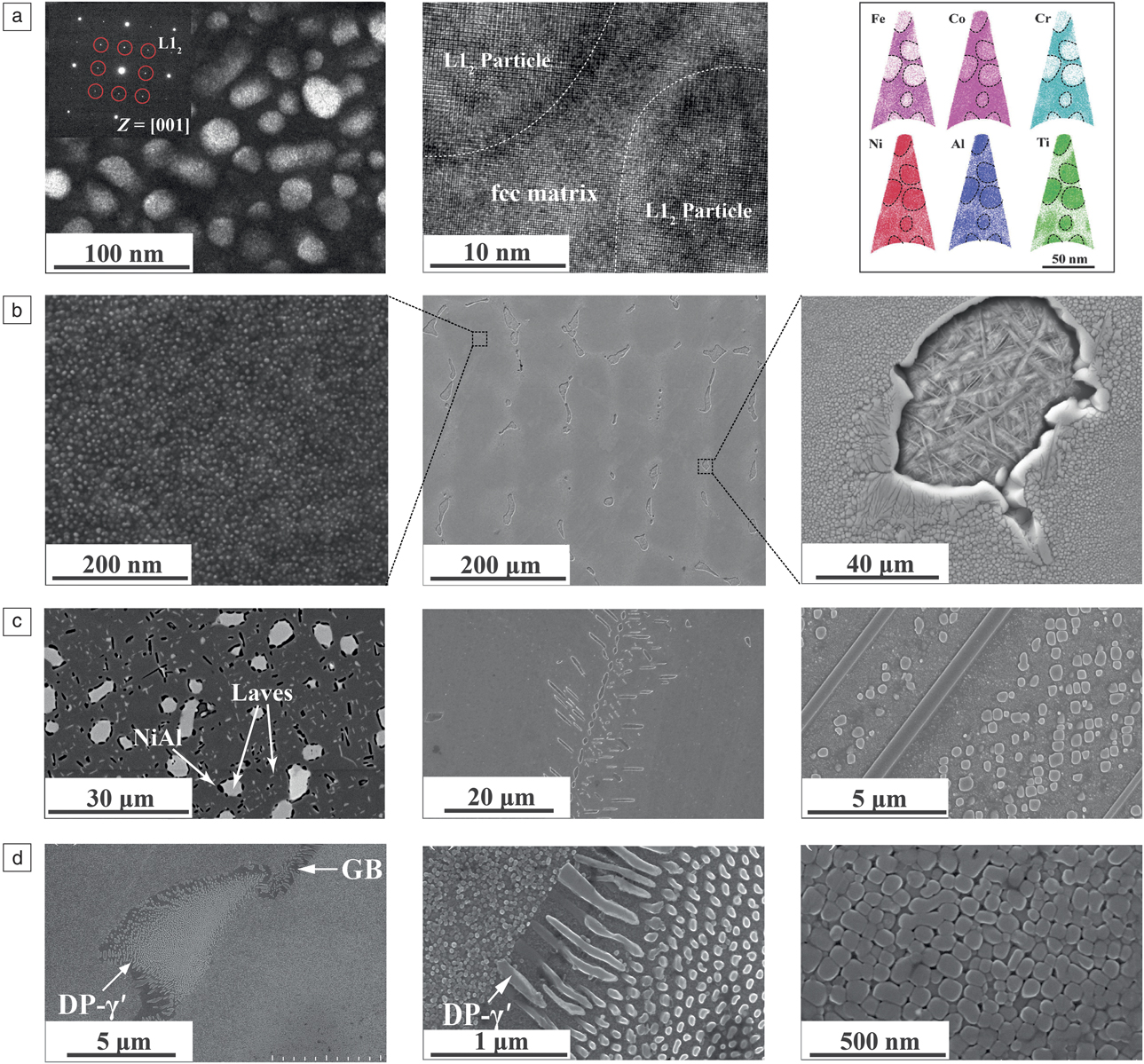
Ni-based superalloys, as classical materials designed for the high-temperature environment, have been under development for decades since the emergence of rotating engines.Reference Sims, Stoloff and Hagel19 There are several reasons for the application of superalloys for industrial applications and especially aircraft applications, including high-temperature strength, creep resistance, and oxidation resistance.Reference Sims, Stoloff and Hagel19 The microstructures of some PH-HEAsReference Yang, Zhao, Tong, Jiao, Wei, Cai, Han, Chen, Hu, Kai, Lu, Liu and Liu9,Reference Zhao, Yang, Tong, Wang, Luan, Jiao, Chen, Yang, Hu and Liu21,Reference Gwalani, Choudhuri, Soni, Ren, Styles, Hwang, Nam, Ryu, Hong and Banerjee28–Reference Xu, Liu, Guo, Hirata, Fujita, Nieh, Liu and Chen31 are analogous to those of superalloys, with γ′ precipitates embedded in a γ matrix, (Figure 1a, left and middle), but with high-entropy characteristics both in the matrix and precipitates. Typically, γ′ is a Cu3Au-type high-entropy intermetallic compound with Ni and Co atoms mainly substituting for the center sites on the cubic faces, and with Al and Ti atoms mainly substituting for the corner sites of the unit cell. Fe and Cr atoms evidently partition into the γ matrix and are depleted in the γ′ precipitation, as shown in Figure 1a, right (black circles represent the precipitates).Reference Yang, Zhao, Luan, Han, Wei, Kai and Liu11 Cu has been proven to promote the nucleation of the γ′ phase by providing heterogeneous nucleation sites in the form of Cu clusters,Reference Gwalani, Choudhuri, Soni, Ren, Styles, Hwang, Nam, Ryu, Hong and Banerjee28 resulting in a conjoint γ′ phase/Cu-rich cluster within the fcc matrix.
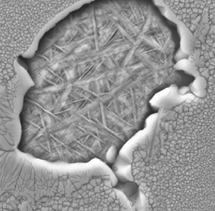
Nanostructures and microstructures of precipitation-hardened high-entropy alloys (PH-HEAs). (a) (Left) Transmission electron microscope (TEM) image showing the morphology of the L12 precipitate. (Inset) Selected-area diffraction patterns taken from zone axis Z = [001]. Red circles show the superlattice diffraction spots of the L12-type precipitates, (middle) high-resolution TEM image showing the coherent interface between an L12 precipitate and the face-centered-cubic (fcc) matrix, and (right) elemental distribution map obtained by atom probe tomography.Reference Yang, Zhao, Luan, Han, Wei, Kai and Liu11 (b) Microstructure of Ni36Co25Fe15Cr8Al10Ti6 (at.%) PH-HEAs: (left) high magnification of γ′ precipitation, (middle) dendritic and interdendritic area, and (right) high magnification of needle-like NiAl precipitates (the β phase).Reference Daoud, Manzoni, Wanderka and Glatzel32 (c) Detrimental phases: (left) NiAl phase at γ/Laves interfaces during aging in Ni22Co30Fe18Cr18Al8Nb4 PH-HEA,Reference Antonov, Detrois and Tin34 (middle) needle-like η phase in Ni1.5Co1.5FeCrAl0.1Ti0.4 PH-HEA, and (right) β phase in Ni1.5Co1.5FeCrAl0.5 PH-HEA.Reference Chang and Yeh35 (d) Microstructure of Ni1.5Co1.5FeCrAl0.2Ti0.3 PH-HEA. (Left) Grain boundary, (middle) magnification of cellular γ′ precipitation along a grain boundary, and (right) well-developed spherical γ′ precipitates within the grain interior.Reference Kuo and Tsai37 Note: DP, discontinuous precipitation (cellular γ′ phase); GB, grain boundary.

Detrimental phases
On the path toward optimizing the microstructures of PH-HEAs, the most urgent task is to achieve a pristine γ/γ′ structure without the formation of other undesirable brittle intermetallic phases, especially the TCP phases. Daoud et al.Reference Daoud, Manzoni, Wanderka and Glatzel32 and Manzoni et al.Reference Manzoni, Singh, Daoud, Popp, Völkl, Glatzel and Wanderka33 observed the formation of a needle-shaped NiAl phase (β phase in Figure 1b, right) and Cr-Fe-rich platelets in Ni36Co25Fe15Cr8Al10Ti6 (at.%) and Ni16Co15Fe15Cr23Cu8Al23 (at.%) PH-HEAs, respectively. Niobium contributed to the formation of the Nb-rich Laves phase during homogenization, while the B2-type NiAl phase was observed at the γ/Laves interfaces during aging in the Ni22Co30Fe18Cr18Al8Nb4 (at.%) alloy (Figure 1c, left).Reference Antonov, Detrois and Tin34
Chang et al.Reference Chang and Yeh35 found that the needle-like Ni3Ti phase (the η phase) formed in the Ni1.5Co1.5FeCrAl0.1Ti0.4 PH-HEA after aging at 1000°C (Figure 1c, middle), while the NiAl phase (the β phase) was observed in the Ni1.5Co1.5FeCrAl0.5 PH-HEA after aging at 900°C (Figure 1c, right). Furthermore, the formation of the η phase was found to be suppressed by replacing Ti with Al addition, but excessive Al will induce the formation of the β phase.Reference Chang and Yeh35 The L21-type Heusler phase was found in the Ni36Co25Fe15Cr8Al10Ti6 (at.%) PH-HEA, which remained even after a long-time annealing at 900°C.Reference Haas, Manzoni, Krieg and Glatzel29 The Heusler phase is a Ni2TiAl-type precipitate with a large unit cell that comprises eight small bcc NiAl-type unit cells. For each small bcc, nickel atoms occupy the corner sites and aluminum or titanium alternatively occupy the body-center site. These undesirable phases are generally hard and brittle, and thus they would act as possible sources for crack initiation and propagation. On the other hand, they consume valuable Al and Ti content, which could be used for elevating the γ′ phase volume fraction and providing alloys with higher strengths at high temperatures.
Cellular precipitation at grain boundaries
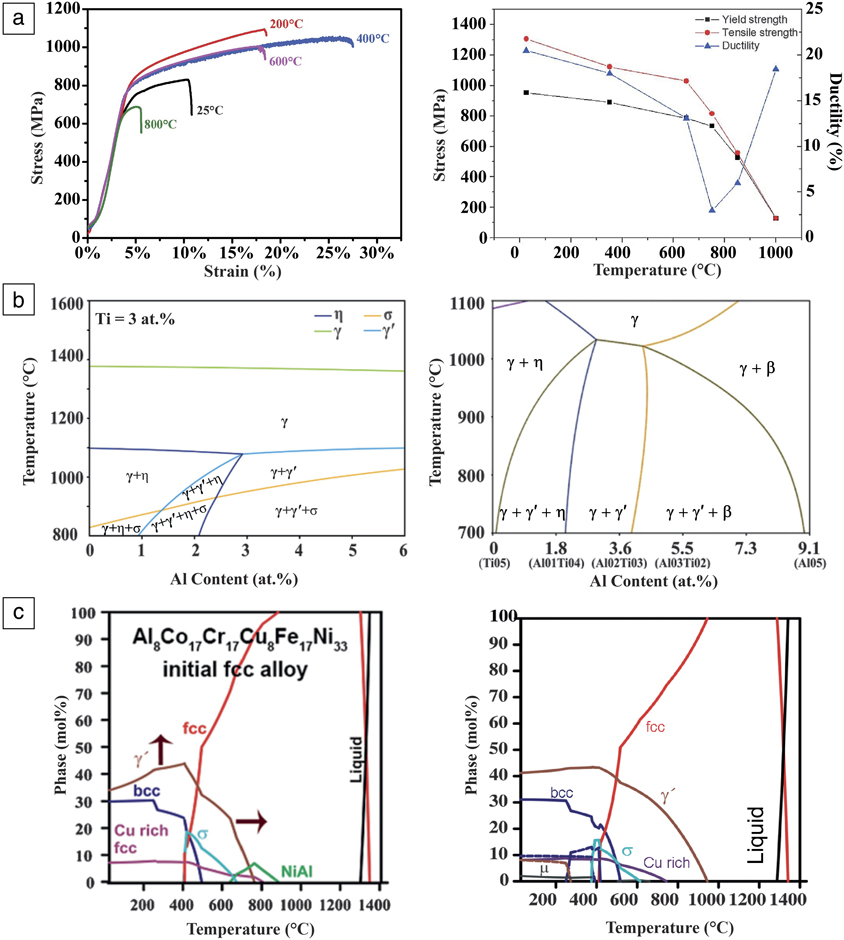
Another key issue is the heterogeneous precipitation of cellular γ′ precipitates along grain boundaries,Reference Chang and Yeh36,Reference Kuo and Tsai37 which is also observed in traditional alloys, such as Al alloys,Reference Williams and Edington38 Cu alloys,Reference Zhao and Notis39 and Ni-based superalloys.Reference Nystrom, Pollock, Murphy and Garg40 Such discontinuous precipitation behaviorReference Kuo and Tsai37 is generally ascribed to the chemical supersaturation in the γ matrix and grain-boundary migration (Figure 1d). It should be noted that tuning the chemical compositions and heat-treatment procedures can avoid such precipitation. Cellular precipitation can possibly be eliminated by changing the quenching method from water quenching to furnace cooling or substituting Co content with Ni. The slower cooling rate is expected to provide more time for γ′ to precipitate at grain boundaries, thus impeding the grain-boundary migration and preventing cellular precipitation. Substituting Co by Ni increases the γ′ solvus temperature, which allows more γ′ to precipitate during the cooling process. The supersaturation degree in the matrix is reduced, resulting in the disappearance of cellular γ′ precipitation. Yeh et al. Reference Chang and Yeh36 and Tsai et al.Reference Kuo and Tsai37 proposed that such cellular γ′ precipitates at the grain boundaries have little influence on room-temperature tensile properties, but they cause rapid ductility loss at intermediate temperatures (roughly from 600°C to 800°C), as shown in Figure 2a, which was associated with intergranular fracture.Reference Chang and Yeh36,Reference Jensen and Tien41
Intermediate temperature embrittlement of precipitation-hardened high-entropy alloys (PH-HEAs) and computational-aided alloy design. (a) (Left) Ductility loss at 800°C in Ni1.5Co1.5FeCrAl0.2Ti0.3 PH-HEAs.Reference Kuo and Tsai37 (Right) Strength and ductility of Ni27.27Co27.27Fe18.18Cr18.18Al3.31Ti5.78 (at.%) PH-HEAs at different temperatures; cellular precipitation caused sharp ductility loss at around 750°C.Reference Chang and Yeh36 (b) CALculation of PHase Diagrams (CALPHAD) results of (left) (NiCoCr)97–xAlxTi3 (at.%) PH-HEAsReference Zhao, Yang, Tong, Wang, Luan, Jiao, Chen, Yang, Hu and Liu21 and (right) Ni1.5Co1.5FeCrAlxTiy (x + y = 0.5) PH-HEAs.Reference Chang and Yeh35 (c) Phase diagram predictions of (left) Ni33Co17Fe17Cr17Cu8Al8 PH-HEA and (right) Ni34.8Co17Fe17Cr14Cu8Al8Ti1Mo0.1W0.1 (at.%) PH-HEA.Reference Manzoni, Daoud, Voelkl, Glatzel and Wanderka50 Arrows in the left panel indicate the expansion of γ′ phase region through small alloy additions of Ti, Mo, and W.

Similarly, the precipitation of brittle grain-boundary oxides and carbides also caused ductility loss with increased temperatures above 600°C in Inconel 718, but ductility at ambient temperatures remained unaffected.Reference Rao, Srinivas and Sarma42 Apart from the effects of grain-boundary precipitates,Reference Yeh, Chen, Lin, Gan, Chin, Shun, Tsau and Chang1,Reference Cantor, Chang, Knight and Vincent2 there are several other possible interpretations for the embrittlement, such as interstitial impurities segregation,Reference Heatherly and George43 environment-induced embrittlement,Reference Bricknell and Woodford44 and intrinsic grain-boundary weakness.Reference Takasugi, George, Pope and Izumi45 Impurity (such as Bi and S) levels as low as tens of ppmReference Zheng, Chellali, Schlesiger, Baither and Schmitz46,Reference Kraai and Floreen47 are sufficient to induce embrittlement. In one study, pure nickel samples were exposed at 1000°C in air and vacuum before tensile testing in an argon atmosphere. The samples after exposure to air exhibited a higher level of ductility loss than those under vacuum.Reference Bricknell and Woodford44 Apart from oxygen, water vapor in air is also thought to dissociate into atomic H on Ni3Al surfaces, resulting in embrittlement.Reference George, Liu and Pope48 Heterogeneous bonding at the grain-boundary area, which causes intrinsic grain-boundary weakness, was considered to be the reason for the fracture surface consisting of the presence of a completely intergranular fracture surface.Reference Takasugi, George, Pope and Izumi45
A fundamental understanding is still lacking at the present time, and more systematic work is required to elucidate the intrinsic mechanisms of the intermediate temperature embrittlement phenomenon.
Computation-aided alloy design
The CALculation of PHase Diagrams (CALPHAD) method, which is based on thermodynamic calculations, offers reliable guidance for alloy design in terms of chemical compositions and heat-treatment conditions. Different from previous trial-and-error routes for alloy design, the CALPHAD method accelerates the search for a target microstructure and composition by computational approaches, which greatly reduces the experiments needed.
It was found that a stable γ + γ′ dual phase can be maintained by adjusting the compositions and heat-treatment temperature to avoid the formation of η and σ phases (Figure 2b, left).Reference Zhao, Yang, Tong, Wang, Luan, Jiao, Chen, Yang, Hu and Liu21 He et al. found that the results of the formation of the minor detrimental Heusler phase in (NiCoFeCr)100–x–yAlxTiy PH-HEAs, apart from the γ matrix and γ′ precipitation, were in good agreement with experimental observations.Reference He, Wang, Wu, Liu, Mao, Nieh and Lu49 For the Ni1.5Co1.5FeCrAlxTiy (x + y = 0.5) PH-HEAs, Chang and YehReference Chang and Yeh35 successfully predicted the microstructural evolution of (γ + η) in Ti0.5 to (γ + η + γ′) in Al0.1Ti0.4, to (γ + γ′) in Al0.2Ti0.3, to (γ + β + γ′) in Al0.3Ti0.2 and to (γ + β) in Al0.5 PH-HEAs (Figure 2b, right). Through a comparison of the phase diagrams of Ni33Co17Fe17Cr17Cu8Al8 (at.%) and Ni34.8Co17Fe17Cr14Cu8Al8Ti1Mo0.1W0.1 (at.%) (Figure 2c), it was found that the curve for the γ′ phase was shifted upward, which implied a higher γ′ volume fraction in the Ni34.8Co17Fe17Cr14Cu8Al8Ti1Mo0.1W0.1 (at.%) PH-HEA than the Ni33Co17Fe17Cr17Cu8Al8 (at.%) PH-HEA.Reference Manzoni, Daoud, Voelkl, Glatzel and Wanderka50 It is of interest to point out that small additions of refractory elements Mo, W, and Ti can raise the volume fraction of the γ′ phase considerably, resulting in the suppression of the NiAl.Reference Manzoni, Daoud, Voelkl, Glatzel and Wanderka50
However, some discrepancies still exist between the experimental results and the CALPHAD predictionsReference Liu, Lu, He, Luan, Wang, Liu, Liu, Chen and Liu13,Reference Tsao, Yeh, Kuo and Murakami51 in terms of detrimental phases, volume fractions of γ′, and γ′ solvus temperatures. It appears that more thermodynamic data for CALPHAD calculations are needed for PH-HEAs design.
Summary
The microstructural evolution of PH-HEAs has been reviewed in this article. A dual high-entropy nanostructure consisting of high-entropy γ′ precipitates and a high-entropy γ matrix is analogous to that of conventional superalloys. Due to severe lattice distortion, sluggish diffusion, and the high-entropy effect, PH-HEAs have the potential to replace conventional Ni-based superalloys and to be used in high-temperature environments. Some critical issues remain, suggesting future directions for research:
1. Phase control should be given higher priority. Hard and brittle deleterious phases need to be eliminated by carefully tuning chemical compositions and heat treatments. The CALPHAD method makes it easier to obtain a target microstructure without time-consuming experiments. Retaining a stable γ′/γ dual-phase structure at higher temperatures is a presumption for the design of high-temperature structural materials. Phase stability evaluation is an important consideration in selecting structural materials under elevated-temperature environments. Besides, a high-volume fraction of the γ′ strengthener is preferred in order to develop high-performance structural materials. The preferential size, morphological shape, and composition of the precipitates, as well as lattice misfit between the matrix and the precipitates in PH-HEAs for high-temperature applications, remain open questions for researchers.
2. The high-temperature strength of PH-HEAs decreased rapidly when the temperature approached 1000°C because of the rapid dissolution of hardening precipitates. The yield strength of the Ni36Co25Fe15Cr8Al10Ti6 PH-HEA remained at 672 MPa at 800°C, but dropped to just 148 MPa at 1000°C.Reference Daoud, Manzoni, Wanderka and Glatzel32 Similarly, the hardnesses of Ni40.7Co20.6Fe11.5Cr12.2Al7.8Ti7.2 (at.%) and Ni48.6Co17.0Fe9.0Cr7.5Al10.3Ti5.8Ta0.6Mo0.8W0.4 (at.%) PH-HEAs were superior to that of Ni-based superalloy CM247LC (Ni-10Co-8.4Cr-5.5Al-1.0Ti-3.0Ta-0.7Mo-10.0W-0.15C-0.015B-0.05Zr-1.5Hf wt%) at room temperature, but softened quickly when the temperature increased above 600°C.Reference Tsao, Yeh, Kuo and Murakami24 The stabilization of the L12 precipitate at high temperatures is a key issue for alloy design.
3. There is limited data on creep resistanceReference Tsao, Yeh, Kuo, Kakehi, Murakami, Yeh and Jian30 and thermal fatigue behavior of PH-HEAs at the present time. Also, the mechanical performance of directionally solidified (DS) and single-crystal (SC) PH-HEAs have been scarcely reported.Reference Tsao, Yeh, Kuo, Kakehi, Murakami, Yeh and Jian30,Reference Manzoni, Haas, Daoud, Glatzel, Förster and Wanderka52 There are three main reasons for the enhancement of elevated-temperature properties in DS- and SC PH-HEAs. The elimination of grain boundaries normal to the stress axis improves creep resistance and high-temperature ductility because of the lack of failure initiation sites. The second is that a preferred low-modulus [001] orientation in the solidification direction improves thermal fatigue resistance. Third, due to the removal of grain boundaries along the stress axis in the DS PH-HEAs and the complete removal of grain boundaries in the SC PH-HEAs, incipient melting temperatures for such PH-HEAs are higher than their polycrystal counterparts, implying a better high-temperature performance. More importantly, we need to compare the high-temperature strength and creep resistance of DS- and SC PH-HEAs with that of Ni-based superalloys.
4. High-temperature oxidation resistance is another key issue to be characterized. Hot corrosion, as a form of degradation, should also be considered. PH-HEAs mainly count on Al and Cr content to form alumina and chromia, respectively, for surface protection and oxidation resistance. As a result, the alloying additions of Al and Cr should be quantitively studied in order to improve the PH-HEA oxidation and corrosion resistance.
Acknowledgment
The research is supported by the Hong Kong Government GRF (Grant No. CityU 11202718).

Boxuan Cao is a doctoral candidate in the Department of Materials Science and Engineering at the City University of Hong Kong, Hong Kong. He obtained his bachelor’s degree in 2018 from Shandong University, China. His current research focuses on the applications of high-entropy alloys in elevated temperature environments. Cao can be reached by email at bocao4-c@my.cityu.edu.hk.

Tao Yang is a postdoctoral fellow at the City University of Hong Kong, China. He received his master’s degree in materials science and engineering from Xiamen University, Hong Kong, in 2014, and his PhD degree in mechanical engineering from the City University of Hong Kong in 2018. He has published more than 10 peer-reviewed articles on innovative design and microstructural characterization of advanced structural materials, including high-entropy alloys, superalloys, steels, and titanium alloys. Yang can be reached by email at taoyang6-c@my.cityu.edu.hk.

Wei-hong Liu is an associate professor at the Harbin Institute of Technology (Shenzhen), China. She obtained her PhD degree from the City University of Hong Kong, Hong Kong, in 2016. Her research focuses on the development and mechanical behavior of advanced materials, including high-entropy alloys and metallic glasses. She has more than 10 papers published, and two of them were rated as highly cited papers by the Clarivate Web of Science. Liu can be reached by email at weihonliu2@gmail.com.

C.T. Liu is a university distinguished professor at the City University of Hong Kong, Hong Kong. He received his PhD degree in materials science and engineering at Brown University in 1967. He was previously at Oak Ridge National Laboratory as group leader of the Alloying Behavior and Design Group, and The University of Tennessee as a distinguished research professor. He was also a distinguished professor at Auburn University, and a chair professor at The Hong Kong Polytechnic University. His research interests include physical metallurgy and mechanical behavior of alloys, nanostructured materials, intermetallic compounds and bulk amorphous alloys, microstructure and phase transformation, alloy design of high-temperature structural materials, precious metals, Ti-based alloys, metal-matrix composites, and innovative materials processing. Liu can be reached by email at chainliu@cityu.edu.hk.