1. Introduction
In our multilingual world, foreign-accented speech is ubiquitous. This is not surprising considering the sheer complexity involved in acquiring a second-language sound system: learners not only need to know what the contrastive segment categories of the L2 are, but they also have to acquire the specific phonetic targets for their realization in production, and become responsive to the relevant cues for their identification in perception. Furthermore, learners need to realize where these sounds occur in syllables and lexical items, and acquire suprasegmental properties, such as rhythm and intonation. Accordingly, empirical studies have shown that L2 learners struggle with virtually any aspect of L2 pronunciation, including consonants (e.g., Flege, Reference Flege1991; Flege, Munro and MacKay, Reference Flege, Munro and MacKay1995; Aoyama, Flege, Guion, Akahane-Yamada and Yamada, Reference Aoyama, Flege, Guion, Akahane-Yamada and Yamada2004), vowels (e.g., Bohn and Flege, Reference Bohn and Flege1990, Reference Bohn and Flege1992, Reference Bohn, Flege, James and Leather1997; Ingram and Park, Reference Ingram and Park1997; Morrison, Reference Morrison2008, Reference Morrison2009), and suprasegmentals (e.g., Broselow and Park, Reference Broselow, Park and Archibald1995; Gottfried and Suiter, Reference Gottfried and Suiter1997; Leather, Reference Leather, James and Leather1997; Davidson, Reference Davidson2006; Jilka, Reference Jilka, Trouvain and Gut2007; Francis, Giocca, Ma and Fenn, Reference Francis, Giocca, Ma and Fenn2008).
At the same time, however, not all learners find L2 pronunciation equally difficult. For example, Bongaerts and his associates (e.g., Bongaerts, Van Summeren, Planken and Schils, Reference Bongaerts, Van Summeren, Planken and Schils1997; Bongaerts, Reference Bongaerts and Birdsong1999; Bongaerts, Mennen and Van der Slik, Reference Bongaerts, Mennen and Van der Slik2000) showed that native Dutch learners’ pronunciation in English was judged as indistinguishable from native controls, even though they had only started L2 learning in adulthood. Similar results are also reported in Birdsong (Reference Birdsong1992, Reference Birdsong2003) for English learners of French. While such instances of native-like acquisition may be rare, their existence underscores the fact that learners’ performance is highly variable.
Many studies have attempted to explain individual differences across learners. Indeed, a large body of research has been dedicated to identifying factors affecting degree of foreign accent. Their results have revealed that age of onset of acquisition and length of residence are particularly important (e.g., Flege, Birdsong, Bialystok, Mack, Sung and Tsukada, Reference Flege, Birdsong, Bialystok, Mack, Sung and Tsukada2006; MacKay, Flege and Imai, Reference MacKay, Flege and Imai2006; see also Piske, MacKay and Flege, Reference Piske, MacKay and Flege2001, for a review of earlier studies), but other factors, such as language use, motivation, and various psychosocial factors also contribute to the degree of perceived foreign accent to some extent (e.g., Flege, Yeni-Komshian and Liu, Reference Flege, Yeni-Komshian and Liu1999; Moyer, Reference Moyer1999, Reference Moyer2004; Cebrian, Reference Cebrian2006).
What these studies have in common is that they show how dependent linguistic variables correlate with independent non-linguistic ones. However, individual variation can also be understood differently, that is, in terms of individual learners’ distinct learning paths. Thus viewed, individual variation refers to the idea that there may be several different routes to successful acquisition. The literature on this type of variation is sparse, though. Escudero (Reference Escudero, Do, Dominguez and Johansen2001) and Escudero and Boersma (Reference Escudero and Boersma2004) found that learners exhibited different developmental paths in the acquisition of the English /i-ɪ/ contrast, depending on the English dialect they were exposed to, i.e., Scottish versus Southern British English. Additionally, Morrison (Reference Morrison2009) found that L1 Spanish listeners exposed to the same English dialect, i.e., Canadian English, follow two distinct developmental paths when learning the English /iː-ɪ/ contrast.
What is more, there is no established theoretical account that makes explicit reference to the possibility that learning paths may not be uniform. Hence, there is a need not only for empirical but also for theoretical work on individual variation in L2 development. The present study seeks to contribute to both by explaining individual L1 English learners’ perception of L2 German vowels on the basis of Escudero's (Reference Escudero2005) Second Language Linguistic Perception (L2LP) model. In what follows, this and other explanatory frameworks will be reviewed, and it will be shown why the L2LP model is particularly amenable to an analysis of individual variation. Subsequently, the design and hypotheses of the present study will be presented.
Explanatory frameworks
Many explanations have been offered for learners’ difficulties with L2 speech. According to some, certain sounds are inherently more difficult than others as a result of universal constraints (Eckman, Reference Eckman1977, Reference Eckman, Ioup and Weinberger1987, Reference Eckman1991; Carlisle, Reference Carlisle and Yavas1994, Reference Carlisle1998, Reference Carlisle1999; Broselow, Chen and Wang, Reference Broselow, Chen and Wang1998). Natural Phonology (Stampe, Reference Stampe1969, Reference Stampe1979), for example, claims that the human articulatory and perceptual systems endow us with preferences for particular forms. Accordingly, if sounds occur rarely in the world's languages, this is an indication that the human articulatory and perceptual systems do not favour them, and that learning these forms involves overcoming an articulatory or perceptual difficulty. In terms of Markedness Theory, such sounds are marked, while commonly occurring ones are unmarked. However, defining L2 difficulty in terms of universal constraints and markedness has run into problems. Thus, patterns that contradict markedness relations have commonly been observed (e.g., Battistella, Reference Battistella1990; Rice, Reference Rice2000), and no generally accepted definition of markedness has been found (cf. Hume, Reference Hume2004).
Alternatively, learners’ difficulties with L2 sounds may be the result of prior language learning in the native language, i.e., native-language transfer. Indeed, most current theoretical accounts assume that the phonological system of the learners’ native language, rather than universal constraints, constitutes the starting point of L2 learning, and that difficulties arise due to the relative similarity/dissimilarity of specific L1–L2 constellations.Footnote 1
According to the Contrastive Analysis Hypothesis, or CAH, (e.g., Lado, Reference Lado1957), for instance, difficulties will arise where the L2 is most dissimilar to the L1, while phenomena that are similar across the two languages will not pose problems for the learners. All that is required to predict areas of difficulty, then, is a systematic comparison of the L1 and the L2 sound systems. As with Markedness Theory, the empirical results did not always match the predictions (e.g., Zobl, Reference Zobl1980). However, it is noteworthy that the predictions were typically made on the basis of a phonemic comparison rather than detailed phonetic analyses.
More recently, the Speech Learning Model (SLM), described in Flege (Reference Flege and Strange1995, Reference Flege, Burmeister, Piske and Rohde2002, Reference Flege, Meyer and Schiller2003) and Flege and MacKay (Reference Flege and MacKay2004), was proposed. Compared with the CAH, this model predicts the exact opposite: L2 sounds which are similar to L1 categories will pose greater difficulties than dissimilar L2 sounds. The rationale for this assumption is that humans will assimilate physically similar sounds to the same abstract category. Thus, where an L2 sound is phonetically similar but not identical with an L1 category, the former will be perceptually assimilated to the L1 category, a phenomenon termed equivalence classification. If, however, an L2 sound is sufficiently dissimilar to any L1 category, it will evade assimilation to native categories. In this case, learners will be posited to have created a new category for this dissimilar L2 sound, provided they have received sufficient amounts of target-language input.
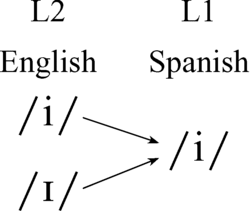
While the SLM assesses difficulty in terms of an L1–L2 token-by-token comparative approach, the Perceptual Assimilation Model, or PAM (Best, Reference Best, Goodman and Nusbaum1994, Reference Best and Strange1995; Best and Tyler, Reference Best, Tyler, Bohn and Munro2007), predicts difficulty on the basis of the assimilability of non-native contrasts to native categories. More specifically, the model posits that a non-native contrast which is perceptually assimilated to two separate L1 categories will be easy to discriminate (Two-Category (TC) Assimilation Type), while a non-native contrast which is assimilated to a single L1 category will be more difficult to discriminate (Single-Category (SC) Assimilation Type, as shown in Figure 1).Footnote 2 Note that the PAM and the SLM are convergent so that Best's notion of assimilation to native categories resembles Flege's notion of equivalence classification.
Example of the single-category (SC) assimilation type, taken from Escudero and Boersma (Reference Escudero, Boersma, Skarabela, Fish and Do2002).

Neither model fully accounts for L2 perceptual development, however. In its current version, the SLM merely describes ultimate attainment, and would need to be extended considerably to accommodate earlier acquisitional stages, as Guion, Flege, Akahane-Yamada, and Pruitt (Reference Guion, Flege, Akahane-Yamada and Pruitt2000) state. The PAM, on the other hand, while applicable to beginners, does not account for later stages of L2 learning. Note that this model was originally conceived to explain cross-language perception, not L2 perception. More recently, it was, however, extended to account for L2 perception, as well (Best and Tyler, Reference Best, Tyler, Bohn and Munro2007). Thus, in Best and Tyler (Reference Best, Tyler, Bohn and Munro2007) the likelihood that learners will be able to distinguish L2 contrasts is predicted on the basis of a comparison between the articulatory settings of L1 and L2 sounds. This account thus differs from the acoustic and auditory-based ones of the SLM and the L2LP model.
Drawing on elements from both the SLM and the PAM, Escudero (Reference Escudero2005) recently proposed the Second Language Linguistic Perception (L2LP) model, which attempts to capture the entire developmental process of L2 speech perception. According to this model, L2 learners will initially perceive target language sounds in the same way as they perceive L1 sounds. In other words, the initial stage of L2 perception is equivalent to cross-language perception. Following from this, the model proposes the Full Copying Hypothesis,Footnote 3 which stipulates that on first encounter with an L2, learners create a duplicate of their L1 system, and handle L2 sounds via this newly formed system. Subsequent L2 perceptual development then leaves the original L1 system unaffected. This means that transfer is posited to occur only once, that is, at the onset of L2 learning. Empirical evidence for full copying has been found in a variety of studies, most notably in Escudero and Boersma (Reference Escudero and Boersma2004) on the English /iː-ɪ/ contrast for Spanish learners, and in Escudero and Boersma (Reference Escudero, Boersma, Skarabela, Fish and Do2002) on the Spanish /i-e/ contrast for Dutch learners.
With respect to the source of L2 perception, the model posits that initially, sound perception is shaped by the particular acoustic properties of Learners’ L1 Accent, including regional, social and idiosyncratic features. Thus, unlike previous models which treat the learners’ L1 as a homogeneous entity, the L2LP model claims that even individuals with the same native language are differently equipped for the L2 learning task. This aspect makes the L2LP model particularly suited for an assessment of individual variation. Evidence in support of the claim that L1 accentual features affect non-native perception comes from studies on accent normalization (e.g., Evans and Iverson, Reference Evans and Iverson2004, Reference Evans and Iverson2007). For instance, Evans and Iverson (Reference Evans and Iverson2004) showed that speakers from northern England with little experience with southern English accents categorized synthesized vowels in a “northern way”, irrespective of whether they were embedded in a northern or southern English accent.
As beginning L2 learners differ from each other in the way they map L2 categories onto L1 ones,Footnote 4 they are also faced with different problems that need to be overcome, and thus different learning tasks which, in turn, lead to different learning paths. L2 development is therefore contingent on learners’ ability to overcome their particular problems. Failure to do so will lead to fossilization. To exemplify the variability in cross-language mapping patterns, let us assume that a given learner initially perceives the two sounds of a non-native contrast in terms of a single native category, i.e., SC assimilation in Best's (1995) terms. This learner will then face different learning tasks compared with a learner who, in response to the particular properties of his or her L1 accent, assigns the same L2 sounds to two separate native categories, i.e., TC assimilation.
In the case of the initial SC assimilation pattern, or new scenario, as it is referred to in the L2LP model, the learners’ task is either to create a new L2 category or to split the single category that handles both elements of the non-native contrast. In the case of a TC assimilation pattern, on the other hand, or similar scenario in the L2LP terminology, in which learners assign each element of a non-native contrast to a separate L1 category, there is no need to create new categories. Instead, all they need to do is reuse their existing L1 categories and shift their L1 perceptual boundary to match that of the L2. Accordingly, this is a much easier task to perform than category splits and category creations. Instances of L2 category boundary shifts have been demonstrated, for instance, in Escudero and Boersma (Reference Escudero, Boersma, Skarabela, Fish and Do2002) for Dutch learners of Spanish and in Escudero (Reference Escudero2005, Reference Escudero, Boersma and Hamann2009) for Canadian English learners of Canadian French.
Thus, the L2LP model sets out to account for L2 perceptual development in its entirety. As with the PAM, it makes predictions on the basis of a comparison of L1 and L2 sound contrasts, rather than tokens, as the SLM does. However, in conformity with the SLM, it includes a developmental dimension and its predictions are based on detailed acoustic analyses. Hence, the L2LP model constitutes a meaningful synthesis of the two established explanatory frameworks. Furthermore, with respect to individual variation, it argues that the learners’ individual L1 accentual features determine the way they categorize L2 speech sounds, and that this, in turn, determines their patterns of further L2 development. It is this aspect that makes the model directly applicable to the study of individual learning paths in L2 learners.
The present study
The present study seeks to explain individual variation in the development of L2 vowel perception in native English learners of German. Before discussing the specific design of the study, we will briefly describe the phonetic properties of German and English vowels.
Standard German comprises a set of eight tense monophthongs, i.e., [iː,eː,ɛː,ɑː,oː,uː,ʸː,øː] and seven lax ones, i.e., [ɪ,ɛ,a,ɔ,ʊ,ʏ,œ], as well as [ə] and [ɐ], which only occur in unstressed syllables. The tense monophthongs are generally longer and more peripheral in the vowel space than their lax counterparts, although [ɑː] and [a] only differ in terms of duration (Jørgensen, Reference Jørgensen1969; Antoniadis and Strube, Reference Antoniadis and Strube1984; Bohn and Flege, Reference Bohn and Flege1990, Reference Bohn and Flege1992). In spectral terms, German distinguishes the five front unrounded vowels [iː,eː,ɪ,ɛː,ɛ], the four back rounded vowels [uː,ʊ,oː,ɔ], the four front rounded vowels [ʸː,ʏ,øː,œ], the two central vowels [ə,ɐ], and the two open vowels [ɑː,a]. The present study is only concerned with a subset of these, namely the rounded vowels [uː,ʊ,ʸː,ʏ,øː,œ].
Standard Southern British English has a set of eleven monophthongs, i.e., [iː,ɪ,ɛ,æ,ʌ,ɑː,uː,ʊ,ɔː,ɒ,ɜː] (e.g., Deterding, Reference Deterding1997; Hawkins and Midgley, Reference Hawkins and Midgley2005). Like German, English distinguishes tense–lax pairs, but in a less systematic way. Although both languages have large vowel inventories, acoustic comparisons (e.g., Strange, Bohn, Trent and Nishi, 2004a; Mayr, Reference Mayr2005) suggest that English and German vowels are largely distinct from each other spectrally. Note that both English and German also have various closing and centring diphthong categories. This is only relevant for the present study in so far as English native speakers have been shown to map some of the German monophthongs to English diphthongal categories. In Strange et al. (Reference Strange, Bohn, Trent and Nishi2004a), for instance, German [oː] was identified with English [əʊ], and German [eː] with English [eɪ]. With respect to vowel duration, the tense–lax difference is larger in German than in English. Whitworth (Reference Whitworth2003), for instance, reports that in German, lax vowels are approximately half as long as tense ones, while the tense–lax ratio for English is 0.70 (see also House (Reference House1961) for English, and Antoniadis and Strube (Reference Antoniadis and Strube1984) for German).
Several previous studies have been concerned with German and English vowels. Most of these have investigated the acquisition of English vowels by native speakers of German (e.g., Bohn and Flege, Reference Bohn and Flege1990, Reference Bohn and Flege1992, Reference Bohn, Flege, James and Leather1997; Flege, Bohn and Jang, Reference Flege, Bohn and Jang1997). Studies on the acquisition of German vowels by native speakers of English, on the other hand, are rare. A notable exception is Jacewicz (Reference Jacewicz2002) who investigated the perception and production of the four lax L2 German vowels [ɪ,ʏ,ʊ,ɛ] by native English beginning learners of German. This study includes an identification experiment, in which eight orthographic German symbols functioned as response categories (“i”, “e”, “a”, “o”, “u”, “ü”, “ö”, “ä”). The results revealed that the learners could readily distinguish between rounded and unrounded vowels, and never misidentified rounded vowels as unrounded ones. Identification for the two unrounded vowels was generally good, while that for the two rounded vowels was poor.
This suggests that rounded German vowels pose particular perceptual challenges for native English speakers. Furthermore, studies on the perception of German vowels by monolingual native speakers of English (Polka, Reference Polka1995; Polka and Bohn, Reference Polka and Bohn1996; Strange, Bohn, Trent, McNair and Bielec, Reference Strange, Bohn, Trent, McNair and Bielec1996; Bohn and Polka, Reference Bohn and Polka2001; Kingston, Reference Kingston2003; Strange, Bohn, Trent and Nishi, Reference Strange, Bohn, Trent and Nishi2004a; Strange, Levy and Lehnholf, Reference Strange, Levy and Lehnholf2004b; Strange, Bohn, Nishi and Trent, Reference Strange, Bohn, Nishi and Trent2005) indicate that rounded vowels, perhaps with the exception of [oː] and [ɔ], may have more complex cross-language mapping patterns, including single-category and multiple-category assimilations (cf. Escudero and Boersma, Reference Escudero, Boersma, Skarabela, Fish and Do2002) than other types of vowels. It is for this reason that the present study focuses on the rounded German vowels [ʸː,uː,øː,œ,ʊ,ʏ].
In this study, the perception of these six vowels by native English speakers is assessed in two experiments. Experiment 1 investigates the learners’ categorization of German vowels in terms of English categories in a cross-language perceptual assimilation task, while Experiment 2 assesses the learners’ ability to identify L2 German vowels in a forced-choice identification task. Together, they aim to determine (1) whether the learners’ progress in L2 perception follows a single, uniform learning path or several different ones, and (2) whether the empirical data support specific aspects of the L2LP model. With respect to the latter, three hypotheses were tested:
(H1) Learners with the same L1 vary systematically in their cross-language perception patterns
(H2) Cross-language perception patterns determine L2 development
(H3) Similar L2 contrasts are easier to acquire than new L2 contrasts
As Experiment 1 assesses the way in which the learners assimilate the German vowels to native categories, this experiment is in a position to test (H1). It is predicted that, as with previous studies (e.g., Strange et al., Reference Strange, Bohn, Trent, McNair and Bielec1996, Reference Strange, Bohn, Trent and Nishi2004a, Reference Strange, Levy and Lehnholf2004b), learners’ patterns will be systematic, albeit diverse.Footnote 5
With respect to (H2), the L2LP model argues that cross-language perception tasks capture the initial stage of L2 learning, as we have seen. Thus, on the basis of the learners’ cross-language patterns (Experiment 1), predictions can be made about their L2 development. The accuracy of these predictions can then be determined on the basis of individual learners’ performance in the L2 identification task (Experiment 2).
Finally, (H3) predicts that performance in Experiment 2 will be better for L2 contrasts which the learners had assimilated to more than one similar L1 category in Experiment 1 than for L2 sounds which had been assimilated to the same L1 category. This is because the L2LP model argues that the perception of cross-linguistically similar L2 contrasts is easier to acquire than that of contrasts which do not exist in the L1, i.e., new contrasts, as a result of the learning tasks involved, which are category boundary shifts versus category splits/ creations, respectively. To test (H3), the L2 identification data of sounds that were assimilated to several different L1 categories in the perceptual assimilation experiment will be compared with those that were assimilated to the same L1 category.
2. Experiment 1
A perceptual assimilation task examined how native English learners of German categorized auditory input tokens of German vowels in terms of English categories. The L2LP model assumes that in cross-language perception tasks of this kind, learners may only draw on their L1 perception system without thereby activating the L2. This hypothesis is based on research which shows that learners utilize language-specific perception modes. Escudero and Boersma (Reference Escudero, Boersma, Skarabela, Fish and Do2002), for instance, found that Dutch learners of Spanish who listened to L2 Spanish vowels embedded in a Dutch carrier phrase perceived the vowel tokens in a Dutch way regardless of their level of proficiency with the Spanish language.
Specifically, the authors showed that the Dutch learners assigned tokens of the Spanish vowels /i/ and /e/ to the three native vowel categories /i/, /ɪ/ and /ɛ/. Crucially, when the learners were presented with the same vowel tokens but embedded in a Spanish carrier sentence, they reduced their use of the Dutch category /ɪ/. Interestingly, this reduction in the use of Dutch /ɪ/ was highly correlated with their level of proficiency in the Spanish language, with only intermediate and advanced but not beginning learners exhibiting this pattern. The authors inferred from this that L2 learners listen to L1 and L2 sounds with two separate perception modes, and that learners are even capable of listening to L2 sounds in an L1-specific way without activating their L2. However, this is dependent on strict control of the factors that have been shown to influence language activation, such as the language of instruction in an experiment (cf. Grosjean, Reference Grosjean1989, Reference Grosjean, de Groot and Kroll1997, Reference Grosjean and Nicol2001).
Further corroboration of this hypothesis comes from studies which examine L2 and bilingual sound perception and production. For instance, Escudero (Reference Escudero2005, Reference Escudero, Boersma and Hamann2009) reports that Canadian English (CE) learners of Canadian French (CF) perceived the same CF tokens differently depending on whether the tokens were embedded in an English or in a French carrier phrase. Specifically, the learners performed similarly to monolingual Canadian English listeners when classifying Canadian French vowels in terms of English response categories. In contrast, and depending on their proficiency in the French language, they performed similarly to CF monolinguals when classifying the CF vowel tokens by means of French response categories. Similar results are also reported for studies on speech production. In Khattab (Reference Khattab2002), for instance, Arabic–English bilingual children aged five, seven and ten years performed similarly to their monolingual English peers when their English /ˡ/ productions where recorded in an English setting in which only English was used. In contrast, when recorded within an Arabic setting, the bilingual children produced English /ˡ/ with similar Arabic features as those used by their parents, who are L2 speakers of English.
Studies on word naming also indicate that bilinguals do not always activate both their languages. Jared and Kroll (Reference Jared and Kroll2001), for instance, asked experienced and inexperienced English learners of L2 French to name English words containing the same spelling in both languages, but whose pronunciation differs. For example, the grapheme sequence <ai> in English, as in the word bait, is pronounced /eɪ/. However, in French the same set of graphemes is pronounced /ɛ/, as in fait (“fact”). In the first experiment, an English word naming task, it was predicted that the learners would take longer to name English words whose homographs are pronounced differently in French than those that are not, provided French was activated during this L1 task. Interestingly, however, no difference in reaction time was found across the two sets of words. On the other hand, when the experienced L2 learners performed the same task after having performed a French word naming task, they were slower at naming the English words with incongruent French counterparts. These results show that without a direct prompt to activate their L2, learners show no effect of their L2 phonology when performing an L1 task.
In the following, the methodology and results of a cross-language perceptual assimilation experiment will be presented. In this experiment, English listeners were asked to classify German vowels as if they were English because they performed the task in a fully English setting, where English was the sole language. To reinforce English language activation, tokens of English vowel productions were included alongside the German ones. It was expected that the learners’ performance would be similar to monolingual English listeners, and that their German proficiency would have a marginal effect on their perception, as was the case in the studies reviewed above.
Listeners
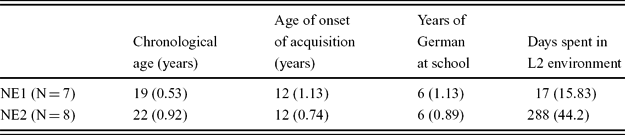
The listeners in this experiment comprised seven native English first-year undergraduate students of German (NE1) and eight native English fourth-year undergraduate students of German (NE2). All participants were female.
As Table 1 shows, the native English participants, with a mean onset age of twelve years, had all spent an average of six years studying German at a secondary school in the United Kingdom. They all reported having only rudimentary knowledge of foreign languages other than German and not having received any specialized phonetic training. They spent their formative years in England, though their dialect background reflects a certain degree of variability, including both northern and southeastern English accents.
Listeners in Experiment 1; standard deviations in parentheses.

The differences between the two groups of learners manifest themselves in terms of experience with German, both through naturalistic exposure and formal classroom tuition. Thus, the experienced learner group (NE2) spent two more years studying German in higher education than the inexperienced learner group (NE1). In addition, they had spent an entire academic year studying at a German university during their third year, as is required for most undergraduate language degrees in the United Kingdom. In contrast, the inexperienced learners had only spent an average of 17 days in a German-speaking environment at the time the study was conducted.
Stimuli
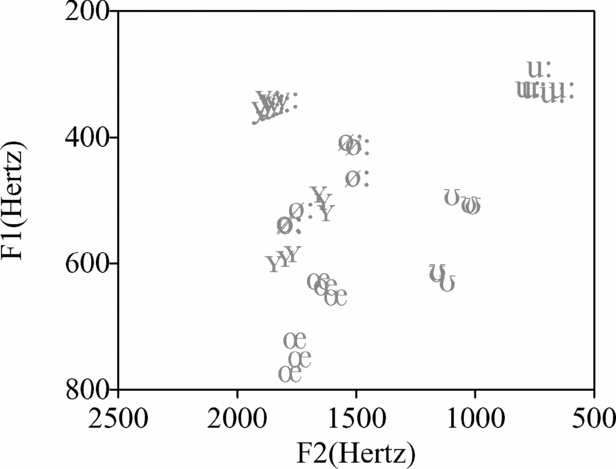
The listeners were exposed to eight auditory stimuli of each of the 14 German monophthongs [iː,eː,ɑː,oː,uː,ʸː,øː,ɪ,ɛ,a,ɔ,ʊ,ʏ,œ] in the context /bVt/. Note, however, that only six of the eight tokens from each category were physically different, while two tokens were identical. These had been randomly chosen from the six physically different productions to control for intra-rater reliability. In addition, two tokens from the 13 English vowel categories [iː,ɪ,ɛ,æ,uː,ʊ,ɔː,ɒ,ɜː,ʌ,ɑː,eɪ,əʊ], each produced in the context /bVt/ (cf. Table 2), were included as a control measure. Thus the learners were exposed to 8 × 14 German vowels + 2 × 13 English vowels for a total of 138 tokens. With respect to the German vowels, only the results for the six rounded vowels [uː,ʊ,ʸː,ʏ,øː,œ] will be discussed here.Footnote 6 Figure 2 displays the F1 and F2 distributions of the tokens for these vowels.
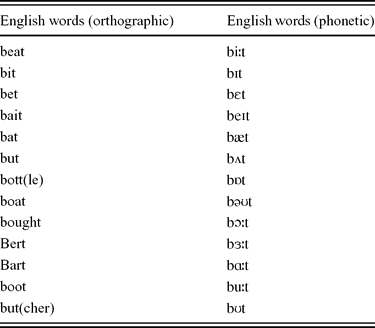
English /bVt/ response categories used in the perceptual assimilation task (Experiment 1).

F1 and F2 values of the tokens presented in the perceptual assimilation task (Experiment 1).

The German input tokens used in the experiment were produced by a set of five female native German speakers from North Rhine-Westfalia and Lower Saxony, who were all speakers of Standard German (Hochdeutsch). Note that this also constitutes the target variety for the learners. The English input tokens were produced by eight monolingual English speakers from southern England, who were all speakers of Standard Southern British English (SSBE). The recordings took place in individual sessions. With respect to the German productions, the speakers produced three instances of each of the 14 German /bVt/ words embedded in the context Ich habe . . . . gesagt “I have said”. The English productions, in turn, involved having the speakers produce three instances of the 13 English /bVt/ words in the context I say . . . again. The speakers were encouraged to produce the sentences at a ‘natural pace’. The speech materials were recorded using an ANDREA ANTI-NOISE NC 61 headset microphone, which was attached to a standard PC and digitized at a sampling rate of 22 kHz with 16-bit resolution. For the recordings, PRAAT software (Boersma and Weenink, Reference Boersma and Weenink2004) was used. Subsequently, a subsection of the tokens was randomly selected from the pool of productions. The target words in question were extracted from the carrier phrase, normalised for peak intensity, and fed into the computer programme used in the experiment.
Procedure
The listeners’ task was to classify auditory tokens of the German and English vowels in terms of 13 English response categories, which were represented orthographically, as shown in the left-hand column of Table 2.
As the table shows, all English words were actual words. These were used to enable listeners to make classifications on the basis of abstract phonological categories, and to minimize orthography-based problems. In the task, listeners were asked to concentrate only on the first syllable of each word. This made it possible to preserve a single phonetic context. Note, however, that this also meant matching German /bVt/ words to the first syllable of bottle and butcher, and to disregard the rest. On the screen, the second syllable of these words was displayed in parentheses, as in Table 2. The English categories were selected on the basis of findings from previous perceptual assimilation studies (e.g., Strange et al., Reference Strange, Bohn, Trent, McNair and Bielec1996, Reference Strange, Bohn, Trent and Nishi2004a).
During the experiment, the learners used a computer programme which displayed the 13 English response categories orthographically for each auditory input token. It was carried out in a quiet computer suite, where each of the learners sat in front of a standard PC and was exposed to the auditory input through standard headphones. The order of presentation of the stimuli was the same for all listeners. Identical types of vowels did not occur in immediate succession. Otherwise, the order of presentation was random. They could proceed at their own pace and listen to the input tokens as often as they wished. All instructions were in English. It took the listeners approximately 25 minutes to complete the experiment.
Results
An assessment of the English input tokens revealed that an average of 95 percent of them (SD: 4.65) were perceived in terms of the intended categories. This suggests that the learners were able to use the response categories correctly. With respect to the German tokens, Table 3 shows the most commonly selected English response categories across all learners in the assimilation of the six German vowels to native English categories. Note that only responses that account for at least 5 percent of the overall assimilation pattern of a given German vowel are shown here.
Mean percent assimilation of the six German vowels to the most commonly chosen English categories across all learners in Experiment 1.

The results indicate that both German [uː] and [ʸː] were predominantly assimilated to English [uː]. Likewise, the most common response category for German [øː] and [œ] was English [ɜː], and for German [ʊ] and [ʏ] English [ʊ]. Note, however, that the patterns are more varied on these latter two contrasts. These findings conform closely to previous studies on the cross-language perception of German vowels by monolingual English speakers (e.g., Polka, Reference Polka1995; Polka and Bohn, Reference Polka and Bohn1996; Strange et al., Reference Strange, Bohn, Trent, McNair and Bielec1996; Bohn and Polka, Reference Bohn and Polka2001; Strange et al., Reference Strange, Bohn, Trent and Nishi2004a, Reference Strange, Levy and Lehnholf2004b, Reference Strange, Bohn, Nishi and Trent2005).
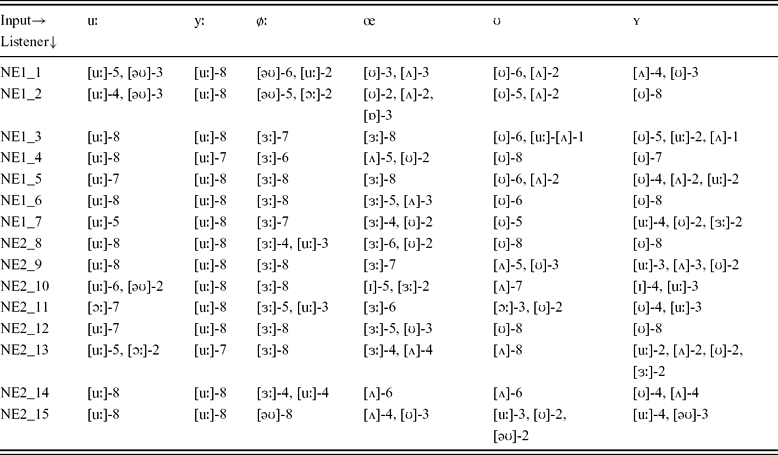
Individual learners’ patterns are displayed in Table 4 so as to assess variability in the cross-language assimilations. The rows represent the 15 learners and the columns the 6 German vowels. In the cells, the English vowel chosen for a specific number of German tokens (out of a maximum of eight per vowel) is followed by a hyphen and the number of tokens. Importantly, the table only displays English vowel categories that the learners used to classify more than one token of a given German vowel. Thus, the tokens in each cell do not always add up to eight. Note, however, that, exceptionally, singular tokens are displayed for one learner's categorization of German [ʊ] and [ʏ], i.e., NE1_3. This was done to illustrate that this learner completely neutralized the [ʊ-ʏ] contrast. Rows 1–7 depict the results of the less experienced English learners of German (NE1), while rows 8–15 depict those of the experienced learners (NE2).
Results per learner and vowel in the perceptual assimilation task (Experiment 1).

As Table 4 shows, only a subset of the 13 English vowels was selected to classify the six German vowels. More specifically, an inspection of the cross-linguistic categorization patterns shows that only eight English vowels were used to accommodate the 15 learners’ choices, i.e., [uː,əʊ,ɔː,ʊ,ʌ,ɒ,ɜː,ɪ], and that the majority of learners assimilated the six German vowels to no more than four English categories, i.e., [uː,ʊ,ʌ,ɜː], in some cases even to merely three. English [ɪ] and [ɒ] were only used by one learner each, while [uː] functioned as an attractor for all learners. The other most common attractors were [ʊ] (14 learners), [ɜː] (12 learners), and [ʌ] (11 learners). Note that in northern England [ʊ] and [ʌ] are commonly merged so that the number of English vowels to which the German ones were assimilated may be even lower than Table 4 would suggest. However, the phonetic properties of these two vowels vary considerably in northern English and many speakers from that area do make a distinction between them (cf. Wells, Reference Wells1982). It is also interesting to note that, with the exception of [ɜː] and [ɪ], the six rounded German vowels were only assimilated to rounded vowels in English.
As predicted, the results thus show that (1) the cross-language patterns involving the six rounded L2 German vowels are highly complex, (2) the learners differ from each other in the way they assimilated the L2 vowels to native categories, and (3) the observed variation is not random, but highly constrained and systematic. In fact, the individual learners’ patterns seem to be assignable to two basic types: (1) those which mainly feature single-category assimilations (Perceptual Assimilation Pattern 1, PAP1), and (2) those whose patterns are more varied and predominantly feature multiple-category assimilations (Perceptual Assimilation Pattern 2, PAP2). More specifically, participants were assigned to PAP1 if they showed a tendency to neutralize the contrasts [uː-ʸː], [øː-œ], and [ʊ-ʏ], even if neutralization was only partial, i.e. if not all tokens of a non-native contrast were assimilated to the same native category. Assignment to PAP2, in turn, involved more complex neutralization patterns, typically encompassing three-way neutralizations. Interestingly, these patterns cut across the two experience-based learner groups, i.e., NE1 and NE2. Both assimilation patterns will be discussed further below.
Perceptual Assimilation Pattern (PAP) 1
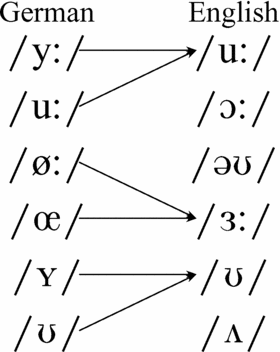
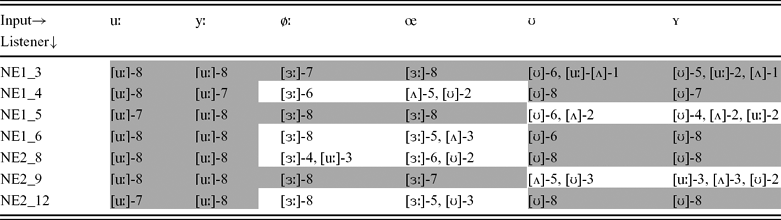
Seven listeners followed this pattern. Its common characteristic is that the German contrasts [uː-ʸː], [øː-œ] and [ʊ-ʏ] are each perceived in terms of a single native category. Note that Figure 3 constitutes an idealization of the pattern, i.e., three totally new contrasts. Only one learner (i.e., NE1_3) actually conformed to this pattern, while the others totally neutralized the German [uː-ʸː] contrast, but varied on the other two contrasts. Complete neutralization of a contrast is indicated by a grey background in Table 5.
Idealized cross-language mapping pattern for PAP1.

Perceptual Assimilation Pattern 1.

As Table 5 shows, [øː-œ] and [ʊ-ʏ] also constitute totally new contrasts. However, this only holds true for some of the learners. More specifically, two of the learners in PAP1 assimilated both [øː] and [œ] only to English [ɜː] while not assigning German [ʏ] and [ʊ] only to identical English categories (cf. NE1_5, NE2_9). The remaining four learners (NE1_4, NE1_6, NE2_8, NE2_12) exhibited the reverse pattern: they assimilated [ʏ] and [ʊ] only to English [ʊ], but did not assign [øː] and [œ] only to identical English categories. Note that NE1_4 differs slightly from the others as she did not neutralize the [øː-œ] contrast at all.
Perceptual Assimilation Pattern (PAP) 2
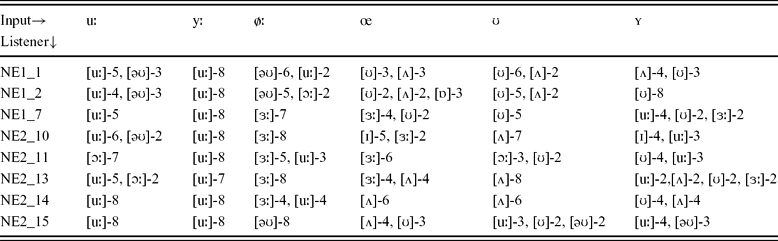
Eight listeners followed this pattern, which is characterized by multiple neutralizations. It constitutes a blend of single-category assimilations and a constellation that involves associating a single L2 category with more than one L1 category, referred to as multiple category assimilation patterns in Escudero and Boersma (Reference Escudero and Boersma2004).
Table 6 shows that listeners NE1_1, NE1_2, and NE2_14 neutralized the German three-way contrast between the lax vowels [œ,ʊ,ʏ] because they assigned virtually all tokens of these three vowels to the same two English categories, i.e., [ʊ] and [ʌ]. In addition, these listeners neutralized the three-way contrast between the tense vowels [øː,uː,ʸː]. However, they differed from each other in terms of the choice of English categories and the level of neutralization of the three German vowels. Thus, both NE1_1 and NE1_2 neutralized the contrasts [uː-ʸː] and [uː-øː] to some extent, but kept [ʸː-øː] relatively distinct. In contrast, NE2_14 completely neutralized [uː-ʸː] while only neutralizing [uː-øː] and [ʸː-øː] half of the time.
Perceptual Assimilation Pattern 2.

Listeners NE1_7, NE2_11, NE2_13, and NE2_15 neutralized the German tense–lax contrasts to some degree, although typically less so for [uː-ʊ] than for the other contrasts. Listener NE2_15 exhibited the largest amount of multiple neutralizations because she assigned German [uː,ʸː,ʊ,ʏ] to English [uː], and German [øː,ʊ,ʏ] to [əʊ]. Not only did this listener neutralize tense and lax vowels, but also German [ʊ-ʏ] since both were perceived as English [uː] and [əʊ]. German [œ], on the other hand, was mapped onto [ʊ] and [ʌ].
Finally, NE2_10 neutralized [uː-ʸː-ʏ], [œ-ʏ], and to a lesser extent, [øː-œ]. Interestingly, this learner was the only one to assimilate instances of the front rounded German vowels to English [ɪ]. The replacement of front rounded L2 vowels by unrounded front vowels is uncommon for native English speakers, as previous studies have shown (e.g., Flege, Reference Flege1987; Rochet, Reference Rochet and Strange1995; Strange et al., Reference Strange, Bohn, Trent, McNair and Bielec1996; Jacewicz, Reference Jacewicz2002; Strange et al., Reference Strange, Bohn, Trent and Nishi2004a). It appears that roundedness is a particularly salient perceptual cue for English speakers, while speakers of other languages, such as Portuguese, have been shown to rely more on frontness (cf. Rochet, Reference Rochet and Strange1995).
3. Predictions for L2 development
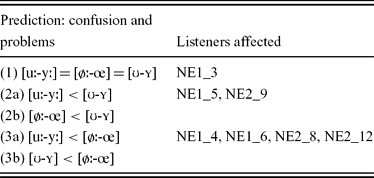
On the basis of the learners’ perceptual assimilation patterns, predictions were made for their development in L2 perception, as assessed in Experiment 2, a 14-type forced-choice identification task. With respect to PAP1, it was predicted that the seven listeners in this group would generally find it difficult to differentiate the contrasts [uː-ʸː], [ʊ-ʏ], and [øː-œ]. After all, as shown in Table 5, they predominantly perceived German [uː] and [ʸː] as English [uː], German [ʊ] and [ʏ] as English [ʊ], and German [øː] and [œ] as English [ɜː], as we have seen. More specifically, it was predicted that German [uː] and [ʸː] would be equally difficult to identify for all learners because total neutralizations of an L2 contrast have been shown to be particularly hard to resolve (see above). On the other hand, the learners were predicted to vary in their level of difficulty when classifying the other two contrasts (cf. (1), (2a), (3a) in Table 7). This is because partial neutralizations of a non-native contrast are more likely to result in the mapping of the elements of a contrast to two distinct L2 categories than total neutralizations. After all, according to the L2LP model, the learners would then not need to create new categories or to split existing ones, but merely to shift the boundaries between the categories to which the German contrasts were assimilated.
Predictions for L2 development: PAP1; ‘ = ’ indicates ‘equally difficult’, ‘<’ indicates that the first contrast is predicted to be more difficult to identify than the second one.

Specifically, then, it was predicted that the first subgroup of listeners (NE1_5, NE2_9) would have more difficulty classifying German [øː-œ], a contrast that constitutes a totally new scenario for them, than German [ʊ-ʏ], a contrast that constitutes a partial new scenario (cf. (2b) in Table 7). The reverse predictions hold for the second subgroup (cf. (3b) in Table 7). Within the latter, it was predicted that NE1_4 would be particularly successful with the [øː-œ] contrast as a result of her assigning all tokens of these sounds to two separate native categories. Finally, learner NE1_3 who fully neutralized all three contrasts, was predicted to have equal difficulty with each of them (cf. (1) in Table 7). Table 7 summarizes the predictions for PAP1.
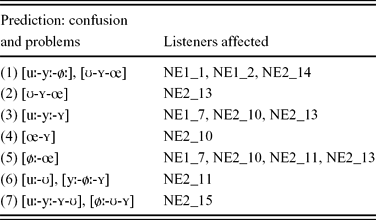
With respect to PAP2, the situation is more complex since the learners’ patterns are more diverse than in PAP1. Seven predictions were made, as outlined in Table 8. Note that due to the complexity of the learners’ cross-language mapping patterns, the number of predictions made here may not be exhaustive.
Predictions for L2 development: PAP2.

On the basis of the cross-language mapping patterns of the learners in PAP2 (cf. Table 6) it was predicted that three learners (i.e., NE1_1, NE1_2, NE2_14) would confuse the three tense vowels with each other and the three lax vowels with each other, but would not have major difficulties differentiating across tense and lax categories (cf. (1) in Table 8). NE2_13, on the other hand, was predicted to struggle only with the lax three-way contrast (cf. (2) in Table 8). It was also predicted that the latter learner as well as NE1_7 and NE2_10 would have difficulties differentiating the three-way contrast [uː-ʸː-ʏ] (cf. (3) in Table 8). Furthermore, [œ-ʏ] was expected to pose problems for NE2_10 who, alongside NE1_7, NE2_11 and NE2_13, was also predicted to struggle with the [øː-œ] contrast (cf., (4) and (5) in Table 8). NE2_11 was predicted not only to struggle on the latter contrast, but also on [ʸː-øː-ʏ] as well as [uː-ʊ] (cf. (6) in Table 8). Finally, NE2_15, who neutralized the largest amount of German categories in Experiment 1, was predicted to confuse [uː-ʸː-ʏ-ʊ] with each other as well as [øː-ʊ-ʏ] (cf. (7) in Table 8).
4. Experiment 2
To assess L2 perceptual development, a forced choice identification experiment was carried out. The methodology and results of the experiment are discussed below.
Listeners
The same 15 native English learners of German as in Experiment 1 also participated in Experiment 2. In addition, a control group (NC) of eight female native German speakers from Western Germany (North Rhine-Westfalia, Lower Saxony) was included. They were all speakers of Standard German.
Stimuli
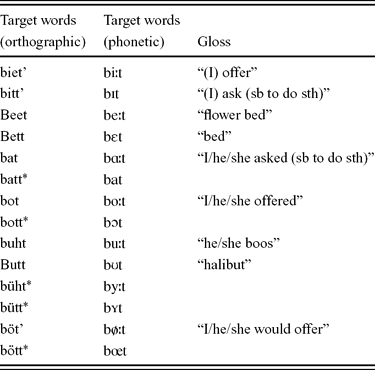
In this experiment, the listeners were tested on their ability to identify the 14 German monophthongs [iː,eː,ɑː,oː,uː,ʸː,øː,ɪ,ɛ,a,ɔ,ʊ,ʏ,œ] in the context /bVt/, as depicted in Table 9. Note that asterisks indicate non-words, although they all conform to German spelling conventions.
German /bVt/ words.

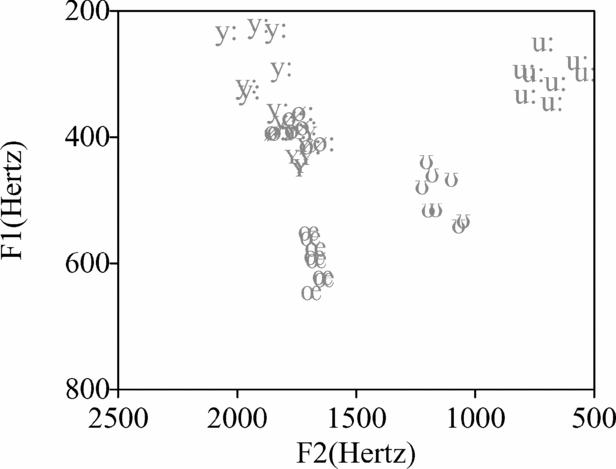
Eight tokens of each target word were randomly selected from the pool of native German speakers’ productions (cf. Experiment 1). Out of these, two tokens per vowel were randomly selected and played a second time during the experiment to control for intra-rater reliability. Thus the listeners were exposed to (8 + 2) × 14 for a total of 140 tokens. Figure 4 displays the F1 and F2 values of the eight physically different tokens of German [uː,ʸː,øː,œ,ʊ,ʏ]. Only these six vowels will be discussed here.Footnote 7
F1 and F2 values of the tokens presented in the L2 vowel identification task (Experiment 2).

Procedure
In this experiment, the listeners used a computer programme which displayed a list of the 14 target words, represented orthographically as in the left-hand column of Table 9, for each of the 140 auditory tokens. Their task was to identify which of the 14 possible options they had heard.
In order to minimize the possibility that learners might misidentify words due to orthographic problems, they were first presented with the target words alongside high-frequency German words that the learners had reported being familiar with. With respect to the target word batt, for instance, they were told that it contained ‘the same sound’ as in the familiar words hat “he/she has”, Mann “man” and das (definite article, neuter). Note, however, that the experimenter did not provide a modelled version of any of the vowels. The experiment only began when the participants indicated feeling comfortable with the target words.
During the experiment, the listeners were allowed to proceed at their own pace. They were encouraged to take a short break after each set of ten tokens in order to avoid fatigue effects. They were also allowed to listen several times to the auditory tokens before making their choices. All in all, it took the listeners approximately 35 minutes to complete the experiment.
Results
Table 10 displays the mean percent correct identification score for each group and vowel. In order to assess differences across groups and vowels, the mean percent correct identification data for each vowel and listener were submitted to a 3 (group) × 6 (vowel) mixed plot ANOVA (repeated measures). The results revealed a significant main effect of vowel (F(5,16) = 11.434, p<.001), a significant main effect of group (F(2,20) = 19.151, p<.001), and a significant vowel* group interaction (F(10,34) = 4.262, p = .006). A Games-Howell post-hoc test revealed that the NC group identified the vowels significantly more accurately than the listeners in NE1 (p = .001) and NE2 (p = .001). The difference between the latter two, on the other hand, was not significant (p = .514). These results are corroborated in a series of one-way ANOVAs, carried out separately for each of the six German vowels (see Appendix).
Percent correct identification for the inexperienced native English learners (NE1), the experienced native English learners (NE2), and the native German controls (NC) in the forced-choice identification task (Experiment 2); standard deviations in parentheses.

Both learner groups thus failed to reach native proficiency in L2 vowel perception. Moreover, although the overall mean for NE2 was higher than for NE1, additional experience with German did not significantly affect learners’ performance in the experiment. On the other hand, it is important to note that neither of the learner groups made random choices (chance level = 7% correct). This is evidence for learning effects on the part of both the experienced and the inexperienced learners.
As learners from NE1 and NE2 were assigned to both PAP1 and PAP2, it was examined whether the learners’ performance in the L2 identification experiment varies as a function of the type of assimilation pattern. Thus, the mean percent correct identification data from each learner, but not the German controls, were submitted to an independent samples t-test. The results revealed that the learners in PAP1 (mean: 59%; SD: 13%) and in PAP2 (mean: 51%, SD: 20%) did not differ significantly from each other (t(13) = .911, p = .379). This suggests that successful perception of the German vowels may not depend on the overall type of assimilation pattern followed by the learners, i.e., PAP1 or PAP2. On the other hand, these results are based on mean values across the six vowels. It is therefore possible that although the overall performance of those assigned to PAP1 and PAP2 does not differ, individual patterns of (mis)identification may show systematic differences. By exploring this eventuality, it will be possible to assess the accuracy of the predictions made on the basis of the learners’ cross-language mapping patterns.
5. Testing the predictions
The L2 identification patterns were considered consistent with the predictions if the elements of a non-native contrast that had been mapped onto the same L1 category in Experiment 1 were confused with each other in the L2 identification experiment. This was the case, for instance, if a learner had mapped all tokens of German [uː] and [ʸː] to English [uː] in Experiment 1 and then confused these two German categories with each other in Experiment 2.
Alternatively, consistency with the predictions was achieved if the learners showed evidence that they had successfully resolved their initial difficulty with a contrast, as a result of their development in L2 perception. This could be done in one of two ways: either the learners managed to identify the elements of the contrast accurately or they assigned them to distinct L2 categories. While this latter scenario does provide evidence for learners’ ability to maintain contrastivity between two German sounds, it is also indicative of problems assigning the correct labels to these and other L2 categories. In contrast, if the learners struggled with L2 sounds which on the basis of their cross-language mapping patterns should not pose problems, this would indicate inconsistency with the predictions.
Testing PAP1
In the cross-language assimilation task, the seven listeners in PAP1 tended to perceive German [uː] and [ʸː] as English [uː], German [ʊ] and [ʏ] as English [ʊ], and German [øː] and [œ] as English [ɜː], as we have seen (cf. Table 5). Consequently, it was predicted that they would have difficulty differentiating the contrasts [uː-ʸː], [ʊ-ʏ], and [øː-œ] in Experiment 2. Recall, however, that while [uː] and [ʸː] were assimilated to English [uː] across the board by all learners in PAP1, the other two contrasts were differentially neutralized by these learners.
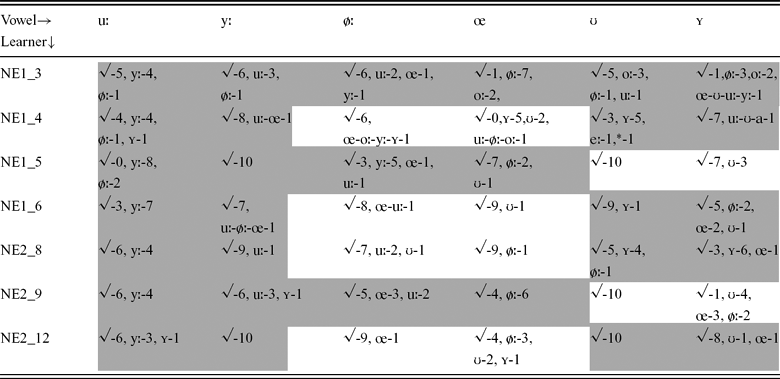
Table 11 shows the individual L2 identification results of the seven listeners in PAP1. The vowels in the cells represent the German classifications made by the learners. Note that for each of the six categories, ten tokens were presented, resulting in the figures in each cell adding up to ten. Correctly identified tokens are indicated by a tick (√) in the table and incorrectly identified ones are noted in terms of the L2 category that the learners perceived them as. The contrasts which were predicted to be most difficult are in grey and the ones which were predicted to cause less difficulty in white. Thus, if the L2LP predictions hold, the learners should have had fewer problems with the contrasts in white than those in grey.
L2 identification results for Perceptual Assimilation Pattern 1; * = missing token; √ = identification as the intended German vowel.

An inspection of the table suggests that NE1_3 struggled equally with the identification of the vowels involved in the three contrasts, as was predicted (cf. Prediction (1) in Table 7), since for each contrast, almost all tokens were mapped onto the same categories, providing evidence for a lack of differentiation. With respect to the remaining learners, the results suggest differences across the two subgroups. Thus, NE1_5 and NE2_9 had greater difficulty with [uː-ʸː] and [øː-œ] than with [ʊ-ʏ], as predicted (cf. Predictions (2a) and (2b) in Table 7). More specifically, NE1_5 appears to have been generally capable of differentiating [ʊ] and [ʏ] (17 out of 20 correct), but unable to differentiate all instances of [uː-ʸː] and half of [øː-œ]. Likewise, NE2_9 was more successful on [ʊ-ʏ] than the other two contrasts since she only struggled with the identification of one member of this contrast, i.e., [ʏ], but mutually misidentified both members of [uː-ʸː] and [øː-œ].
With respect to the second subgroup, i.e., NE1_4, NE1_6, NE2_8, and N2_12, it was predicted that the [øː-œ] contrast should be easier than the [ʊ-ʏ] and [uː-ʸː] contrasts (cf. Predictions (3a) and (3b) in Table 7). This was confirmed with respect to NE1_4 since for [uː-ʸː] she used the same categories in 17 out of 20 instances and for [ʊ-ʏ] in 16 out of 19 cases. On the other hand, she managed to keep [øː] and [œ] relatively distinct since only two of 20 tokens constitute mutual misidentifications. Although this suggests an ability to differentiate the two members of the contrast relatively well, this learner still has difficulties assigning the correct labels to these categories.
The same holds true for NE1_6 who used the same categories for [uː-ʸː] in 18 out of 20 instances, and for [ʊ-ʏ] in 16 out of 20 instances. Note, however, that she had made progress on the latter contrast, as indicated by the large number of correct identifications. Despite this, she was clearly superior on [øː] and [œ] which she kept almost completely separate. The predictions are also met for NE2_8 who used the same category for [uː-ʸː] in all instances, and for [ʊ-ʏ] in 18 instances, and yet managed to distinguish clearly between [øː] and [œ]. The only learner who is obviously at odds with the predictions is NE2_12. An inspection of her identification patterns suggests that she managed to overcome her problems with the [ʊ-ʏ] contrast and made progress on [uː-ʸː]. However, contrary to expectations, she struggled with [øː-œ].
Testing PAP2
The cross-language assimilation patterns of the eight listeners in PAP2 were more varied than those in PAP1 and involved a tendency towards multiple neutralizations. For example, NE1_1, NE1_2, and NE2_14 assigned tokens of [ʊ], [ʏ], and [œ] to the same native categories. A similar pattern was also found for the tense vowels. Based on these findings, it was predicted that the learners would have difficulties differentiating between the three tense vowels and the three lax ones in Experiment 2, but not across tense and lax categories. Similar predictions were made for the patterns of the other listeners in PAP2 (cf. Table 8).
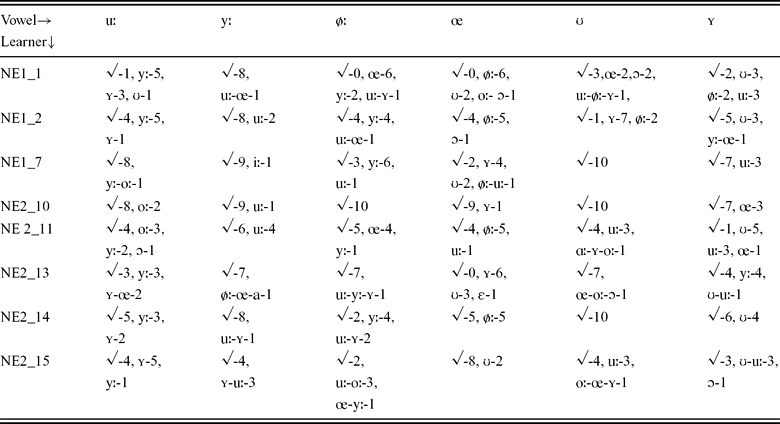
Table 12 shows the individual L2 identification results of the eight listeners in PAP2. An inspection of the table shows that Prediction (1) (cf. Table 8), i.e., the confusion of the three tense and lax vowels by NE1_1, NE1_2, and NE2_14, is largely confirmed in the L2 data. However, all three listeners also appear to have had problems with the [øː-œ] contrast, which had not been predicted. Also, in some cases, other tense and lax vowels were not kept entirely separate. Unpredicted perception patterns of this kind will be addressed in the discussion section.
L2 identification results for Perceptual Assimilation Pattern 2; √ = identification as the intended German vowel.

Prediction (2), i.e., the confusion of [œ-ʊ-ʏ] by NE2_13, is borne out by the identification data. Furthermore, this learner as well as NE1_7 struggled with [uː-ʸː-ʏ], as predicted in (3). In contrast, NE2_10 appears to have undergone successful L2 development. Nevertheless, remnants of her problems with the [œ-ʏ] contrast (Prediction 4) are still noticeable, thereby confirming the predicted pattern. With respect to [øː-œ] (Prediction 5), the L2 data are consistent with the predictions, as NE1_7, NE2_10, and NE2_13 managed to keep the two elements of the contrast largely distinct, thus overcoming their initial difficulties with it. NE2_11, on the other hand, confused [øː] and [œ] with each other. Moreover, the latter not only had problems with this contrast but also with [uː-ʊ] (Prediction 6), though not with [ʸː-øː-ʏ]. On the other hand, NE2_11 commonly confused [uː-ʸː] although this contrast had not been predicted to pose problems for her.
Finally, NE2_15, who had been predicted to confuse instances of [uː-ʸː-ʊ-ʏ] (Prediction 7), indeed found it difficult to keep these L2 categories distinct. In line with most other learners, [uː] and [ʸː] were found to be particularly hard to identify accurately. Furthermore, this learner failed to distinguish between German [øː], [ʏ] and [ʊ], as predicted, since tokens from each of these categories were erroneously identified as [uː].
6. Discussion and conclusion
This study sought to investigate whether native English learners of German follow different learning paths in their perceptual development, and whether the observed patterns are explicable on the basis of a relatively new theoretical framework, i.e., Escudero's (2005) L2LP model. To this end, two experiments were carried out. Experiment 1 assessed the way the learners assimilated L2 sounds to native categories, and Experiment 2 investigated their ability to identify L2 German vowels in a forced-choice identification task.
The results of Experiment 1 indicate that there is indeed a large degree of variation across learners. This is in line with previous studies on the cross-language perception of German vowels by English speakers (e.g., Polka, Reference Polka1995; Strange et al., Reference Strange, Bohn, Trent, McNair and Bielec1996, Reference Strange, Bohn, Trent and Nishi2004a, Reference Strange, Levy and Lehnholf2004b). Furthermore, the results also showed that the observed variability is highly constrained. Thus out of the 13 possible response categories, only a subset was used. More specifically, the six rounded German vowels were only mapped onto four English categories (i.e., [uː,ʊ,ɜː,ʌ]) by the majority of the learners. Although the learners’ patterns were varied, they were broadly characterized by either containing largely single-category assimilations (PAP1) or multiple neutralizations (PAP2). With respect to the L2LP model, this finding thus lends support to the hypothesis that learners vary systematically from each other in the way they map L2 sounds to native categories.
Two additional claims of the model were tested. First, we sought to determine if the difficulties that individual learners encounter in L2 perception are a result of the way they map L2 sounds onto native categories in the initial stages of L2 learning. Thus, based on the learners’ cross-language mapping patterns, predictions were made for L2 development, and these were then compared with the learners’ actual performance in the L2 identification experiment. The results with respect to both PAP1 and PAP2 suggest that, despite some inconsistencies, the individual performance of the majority of learners in the L2 identification experiment matched the predictions made on the basis of their cross-language mapping patterns. This lends tentative support to the L2LP model's proposal that cross-language perception patterns determine L2 development, although further studies are needed to corroborate this claim.
An interesting finding of the study was that the experienced and the inexperienced learners did not differ in their performance, and that their success in L2 vowel perception was not dependent on the general type of perceptual assimilation pattern that they followed, i.e., PAP1 or PAP2. This suggests that where learners successfully managed to overcome their perceptual difficulties, the speed at which this was accomplished may be related not so much to their linguistic experience with the L2 or to their specific learning path, but to other factors such as motivation (cf. Piske et al., Reference Piske, MacKay and Flege2001), learning context (Mora, Reference Mora, Perez-Vidal, Juan-Garan and Bel2008), or amount of L1 and L2 use (Cebrian, Reference Cebrian2006). These factors were not assessed formally in this study. However, it is worth mentioning that only NE2_12, who was an experienced learner, exhibited L2 perception patterns that appear to have developed away from her perceptual assimilation patterns and towards native-like performance. This suggests that there may be some relation between L2 experience and factors such as motivation and amount of L1 and L2 use.
Finally, we set out to test the L2LP model's hypothesis that L2 contrasts that are assimilated to different/distinct L1 categories will be easier to perceive than those assigned to a single L1 category. In this respect, the results of the individual analysis, especially for listeners in the PAP1 group, show that the more listeners assign a German contrast to two different L1 categories, the easier it is for them to achieve native-like performance in the L2 perception of such a contrast. In general, the results for the six rounded German vowels confirm the hypothesis that accurate identification of L2 sounds assigned to the same L1 category is hard.
What this study has shown, then, is that the six rounded German vowels are difficult, precisely because they are mapped in complex ways onto a small number of L1 English categories. On the other hand, previous research indicates that the mapping patterns of other German vowels, e.g. [iː,ɪ,eː,ɛ,ɑː,a,oː,ɔ], are much less complex and result in the preservation of non-native contrasts (e.g., Strange et al., Reference Strange, Bohn, Trent, McNair and Bielec1996, Mayr, Reference Mayr2005). For example, German [iː] was predominantly mapped onto English [iː], and German [ɪ] was predominantly mapped onto English [ɪ]. As these vowels were also identified much more accurately in the L2 identification experiment (cf. Mayr, Reference Mayr2005), this lends support to the hypothesis that L2 contrasts that are mapped onto L1 contrasts are relatively easy to acquire – a claim that conforms to Best's (1995) predictions for single-category versus two-category assimilations.
While this preliminary study largely upheld the L2LP model's claims, the L2 data from some individuals were inconsistent with the predictions. For instance, NE2_12 performed better on the [ʊ-ʏ] contrast than on the [øː-œ] contrast, despite the fact that the opposite had been predicted. It is possible that her difficulties with this contrast were a direct reflection of her development on the two other contrasts, although this cannot be readily ascertained. On the other hand, her misidentification patterns are consistent with her problems with the three contrasts involved in SCA patterns, i.e., [uː-ʸː], [ʊ-ʏ], and [øː-œ].
Some learners also exhibited problems with L2 sounds that were not predicted on the basis of their PA patterns. NE1_1, NE1_2, and NE2_14, for example, mutually misidentified instances of [øː] and [œ], although these two sounds had been mapped onto distinct native categories. A possible explanation is that this confusion may have arisen due to difficulties with L2 orthography. After all, the two target words representing these two vowels, i.e., böt and bött, do not differ in terms of the symbol used to represent the vowels. Orthographic problems could also explain why these learners often incorrectly classified other tense vowels as lax ones, and vice versa.
This is in line with other L2 perception studies which also reported the possible influence of orthography in their results, e.g., Escudero (Reference Escudero, Do, Dominguez and Johansen2001) and Escudero and Boersma (Reference Escudero and Boersma2004). However, few speech perception studies have actually controlled for L1-based orthographic effects in L2 perception because it is difficult to present a categorization task without using orthographic labels. Recent psycholinguistic research (cf. Escudero, Hayes-Harb and Mitterer, Reference Escudero, Hayes-Harb and Mitterer2008) which has directly tested the role of orthography in L2 word recognition and perception has demonstrated that L1 orthography indeed plays a large role in the development of these abilities.
One of the central aims of this study was to show that an analysis of individual learners’ performance can shed new light on L2 perceptual development. However, the approach taken in this study meant that traditional quantitative statistical methods were not appropriate. In this respect, the study has its limitations. Thus, despite clearly defined criteria, an interpretation of the learners’ individual patterns involved a certain degree of judgment on the part of the researchers. Nevertheless, this method has made it possible to show that the variability in the learners’ patterns is systematically constrained, and thus provides an explanation for their difficulties with the six rounded German vowels.
It is important to note, however, that these explanations are based on the L2LP model's claim that L2 learners utilize language-specific perception modes. While the latter have been confirmed in a variety of empirical studies (see above), future research is required to determine exactly how, when and to what extent languages are activated in L2 perceptual development, and what methodological factors need to be controlled for in this context. Future research is also needed to look into the complexities involved in the acquisition of rounded German vowels by English learners, and more generally into the perceptual development of learners whose L1 and L2 contains a large vowel inventory. Such research could, for example, directly assess how L1 accent influences learners’ cross-language mapping patterns, including a systematic investigation of the role of L1 dialectal variation. This would involve obtaining an acoustic record of individual learners’ L1, and then relating their L1 accentual properties to those of L2 sounds. Preliminary work that is currently underway on English learners of German has shown encouraging results (Mayr and Escudero, in preparation), but more work on individual learners’ L2 perceptual development is required, especially in the form of longitudinal studies. Such research may bring us a step closer to understanding the complexities involved in the acquisition of a second-language sound system.
Appendix
One-way ANOVAS and Games-Howell post-hoc tests for each vowel in the identification experiment (Experiment 2); asterisks indicate that the mean differences are significant at the .05 level