1 Introduction
Health technology assessment (HTA) – a multidisciplinary evaluation of health, economic, social and other aspects of health interventions (EUnetHTA, 2012; INAHTA, 2016) – seems firmly established in Europe today (Kristensen, Reference Kristensen2012; Sorenson and Chalkidou, Reference Sorenson and Chalkidou2012). There are compelling arguments for using HTA as an evidence-based analytical tool for informing decision-making on the pricing and reimbursement (P&R) of health interventions (Gibis et al., Reference Gibis, Artiles, Corabian, Meiesaar, Koppel, Jacobs, Serrano and Menon2001; Garrido et al., Reference Garrido, Kristensen, Nielsen and Busse2008; Hartz and John, Reference Hartz and John2009; Velasco Garrido et al., Reference Velasco Garrido, Gerhardus, Røttingen and Busse2010). As a result, many countries founded dedicated HTA institutions. Although they differ greatly in their institutional setup, competences and role in decision-making systems (Allen et al., Reference Allen, Pichler, Wang, Patel and Salek2013; Panteli et al., Reference Panteli, Eckhardt, Nolting, Busse and Kulig2015), they share a general commitment to informing decisions based on a rigorous, transparent and independent evaluation of evidence. The European Union (EU), with the HTA Network founded by Article 15 of Directive 2011/24/EU, supposes that all EU member states have ‘HTA bodies’ (European Commission 2013; Directive 2011/24/EU 2011). It would therefore seem that deciding whether to establish an HTA institution is a no-brainer, especially given that fashionable policies and institutions, as having an HTA body undoubtedly is (Shah et al., Reference Shah, Barron, Klinger and Wright2014), tend to diffuse internationally (Meseguer, Reference Meseguer2005; Weyland, Reference Weyland2005; Marsh and Sharman, Reference Marsh and Sharman2009).
A closer look, however, reveals that not all EU countries have specialized HTA bodies (Löblová, Reference Löblová2016). Some use HTA as an analytical tool to inform decision-making without dedicated institutions [e.g. Lithuania (Wild et al., Reference Wild, Patera, Stricka and Karnickas2015)], but most countries without specialized bodies have a limited use for HTA in decision-making, predominantly in Central and Eastern but also in Southern Europe (Panteli et al., Reference Panteli, Eckhardt, Nolting, Busse and Kulig2015; Kaló et al., Reference Kaló, Gheorghe, Huic, Csanádi and Kristensen2016). In short, there are blank spots on the map of European HTA.
Why is this? The implicit assumption of much of the practitioner as well as scholarly literature is that HTA analyses, usually performed by specialized HTA bodies, are an evolutionary necessity. By this logic, HTA will inevitably diffuse everywhere and laggards will eventually catch up with the good pupils (Moharra et al., Reference Moharra, Espallargues, Kubesch, Estrada, Parada, Vondeling, Scalzo, Cristofides, Turk and Raab2009; Moran and Fidler, Reference Moran and Fidler2010; Oortwijn et al., Reference Oortwijn, Mathijssen and Banta2010; Finta et al., Reference Finta, Kelemen and Ács2013; Lopert et al., Reference Lopert, Ruiz and Chalkidou2013). However, new HTA institutions have been rare in recent years: since 2007, only three EU countries established an HTA body (Löblová, Reference Löblová2016). This suggests their unfettered diffusion has encountered mediating factors (Benson and Jordan, Reference Benson and Jordan2011). These include resistance from key domestic actors (Bache and Taylor, Reference Bache and Taylor2003), which can be expected to be particularly influential in a low-salience policy area such as HTA (Lohmann, Reference Lohmann2003; Culpepper, Reference Culpepper2010). In fact, vested interests of powerful actors have been pointed out as one of the reasons for the non-existence of HTA in many countries (Kaló et al., Reference Kaló, Gheorghe, Huic, Csanádi and Kristensen2016).
This article therefore examines actors’ stances as mediators of the diffusion of HTA bodies. It asks what the interests and policy positions of key health policy actors are regarding the establishment of new HTA bodies, and how these positions are formed.
To answer these questions, this article analyzes the case of HTA in the Czech Republic. As of 2017, the country does not have a dedicated HTA body and is unlikely to establish one in the near future. However, HTA is a known term in the Czech Republic and the option of creating an HTA agency to inform P&R decisions was actively debated in 2011–2013. The project came to a halt in June 2013 following a sudden resignation by the government. This makes the Czech Republic a ‘near miss’ as opposed to an irrelevant case (Capoccia and Kelemen, Reference Capoccia and Kelemen2007), as it excludes the possibility that the policy idea has simply not reached the country. Because a debate took place, we can expect interests and positions to have been formed and formulated. The Czech case then helps uncover the patterns of interests and positions around HTA and its institutionalization in countries with no, or limited, HTA, and determine if interests can impede or encourage the diffusion of HTA institutions. Its findings can inform discussions on HTA institutionalization in similar cases, most directly in Central and Eastern European countries without HTA bodies.
The main argument of this article is that important domestic actors are well aware of arguments for establishing HTA institutions, but perceive the policy as ill-adapted to their needs. This challenges the common ‘laggard’ hypothesis by presenting evidence that policy-makers in countries with institutionalized HTA sometimes actively consider implementing the policy, but discard it, privileging instead other policy alternatives. Domestic and international efforts to institutionalize HTA, especially in countries with limited resources, should therefore take policy-makers’ needs into consideration.
2 Background and theoretical expectations
Establishing HTA bodies, even when inspired by a process of international policy diffusion, is an instance of authority delegation (Landwehr and Boehm, Reference Landwehr and Boehm2011; Shah et al., Reference Shah, Barron, Klinger and Wright2014). Domestic policy-makers face a double dilemma. First, do they want to establish a specialized body using HTA? Second, if yes, how much discretion should they give it? The answers depend on their motivations. Scholarly literature on delegation puts forward that policy-makers (principals) have an interest in creating specialized institutions (agents) in order to solve an information asymmetry problem and make use of the agents’ specialized knowledge in a highly complex policy area (Moe, Reference Moe1990; Bendor et al., Reference Bendor, Glazer and Hammond2001; Sweet and Thatcher, Reference Sweet and Thatcher2002). They award the agent more discretion [formal independence and decision-making powers (Thatcher and Sweet, Reference Thatcher and Sweet2002; Gilardi, Reference Gilardi2008)] when they are looking to (a) resolve problems of commitment credibility, (b) shield their policies from future reversals, or (c) avoid blame for unpopular decisions (Moe, Reference Moe1990; Bendor et al., Reference Bendor, Glazer and Hammond2001; Hood, Reference Hood2007; Gilardi, Reference Gilardi2008). Specialized independent HTA bodies with a say in P&R decisions can therefore be a means for policy-makers of ensuring consistent, evidence-based P&R, while deflecting blame for rationing care – a theme well-known in health policy (Ham and Coulter, Reference Ham and Coulter2001; Kang and Reich, Reference Kang and Reich2014), as well as in HTA (Ozieranski et al., Reference Ozieranski, McKee and King2012a, Reference Ozieranski, McKee and King2012b).
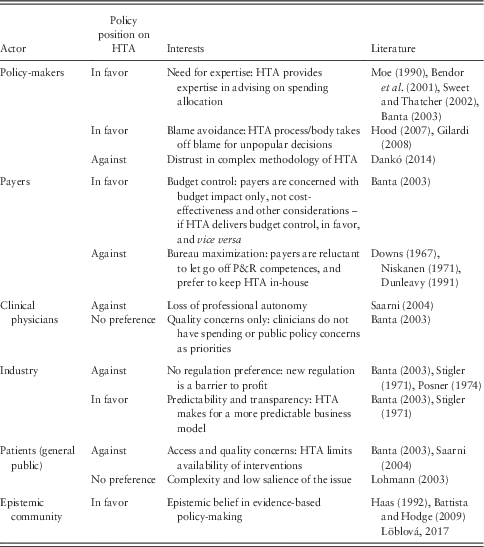
The delegation literature is generally not explicit on the interests and positions of actors other than the principals in this initial dilemma. But there are other actors than just policy-makers and (would-be) agents in the delegation relationship, most importantly those who the new institution intends to regulate (e.g. industry), but also others (Adolph, Reference Adolph2013). Banta’s (Reference Banta2003) review provides the clearest, if brief, reflection on interests and goals (though not concrete positions) of the most important actors (‘stakeholders’) regarding HTA (Banta, Reference Banta2003: 129). His notes allow us to formulate the following theory-informed expectations about actors’ interests and policy positions on HTA institutions, summarized in Table 1. They are further informed by literature tackling interests in priority-setting and evidence-based medicine (Mykhalovskiy and Weir, Reference Mykhalovskiy and Weir2004; Saarni, Reference Saarni2004; Goddard et al., Reference Goddard, Hauck and Smith2006), as well as by status quo ex ante in Czech P&R.
Theoretical expectations about interests and policy positions on introduction of health technology assessment (HTA)

Policy-makers are attracted to the ‘value for money’ promise of HTA (Banta, Reference Banta2003): a specialized body that would solve a functional need for expertise – much in line with the central delegation premise. In the post-communist Czech Republic, this need for expertise had been satisfied by advisory expert committees on drugs, medical devices and diagnostics (MD&D) and health care services, convened by the minister of health. In 2007, a Constitutional Court ruling effectively dismantled the drug and MD&D committees on the grounds of lack of transparency and accountability (lack of appeal) of their procedures. Subsequently, P&R competence for pharmaceuticals was given to the State Institute for Drug Control (Státní úřad pro kontrolu léčiv – SÚKL), illustrating a need for expertise (in pharmacology at least) in addition to the need for a clearer legal procedure triggered by the Constitutional Court ruling. The MD&D committee was not replaced, suggesting a puzzle for the delegation theory as well as Banta’s hypothesis – by this logic, Czech decision-makers can be expected to feel pressure for an HTA body to fill the void. They might, however, prefer less complex alternatives as they do not trust the complex statistical models of HTA outputs (Danko, Reference Danko2014).
Insurers (payers) are interested in budget containment (Banta, Reference Banta2003) – and would therefore be in favor of HTA to the extent that a new HTA body would help them with this goal. As any bureaucracy, payers should be interested in bureau or budget maximization (Downs, Reference Downs1967; Niskanen, Reference Niskanen1971; Dunleavy, Reference Dunleavy1991), and should therefore prefer in-house HTA to an external (independent) agency. The Czech Republic has a multiple-payer social health insurance system, with limited competition between insurance funds, characterized by a dominance of the largest, publicly owned insurance fund (Všeobecná zdravotní pojišťovna – VZP). VZP plays a key role in P&R setting for all health care interventions; smaller insurers, grouped in an association representing them in P&R procedures and broader policy questions, typically follow its lead. Together they have an unusually strong position in the country’s P&R governance: they essentially determine the acceptability of the P&R levels for medicines in SÚKL’s procedure, and unilaterally set reimbursement levels for both outpatient and inpatient MD&Ds based on their internal calculations (as part of, respectively, direct reimbursement or pseudo diagnosis-related group payment schemes). They are also represented on the ministerial expert committee for health care services (along with representatives of the ministry, clinicians and – at times – patients), and can negotiate different levels of reimbursement for services. Czech payers can therefore be expected to be reluctant to let go of their power, unless HTA helps them control budgets better than the status quo – concrete policy proposals, rather than a general commitment to the policy idea, are likely to shape the payers’ positions.
Clinical physicians have little interest in issues other than quality of care (Banta, Reference Banta2003), which HTA promises to improve overall through improved allocation of resources but at the expense of selected individual treatments, making for an unclear position. Others have pointed out that clinicians are interested in maintaining broad professional autonomy which is threatened by a regulatory body (Saarni, Reference Saarni2004). They should therefore be against HTA in general. There is no reason to expect Czech clinicians to have different priorities.
The pharmaceutical and medical device industry has an overriding interest in financial profit, which new regulation threatens; on the other hand, Banta suggests it is also increasingly aware of cost-effectiveness constraints through ever fiercer market competition for reimbursement (Banta, Reference Banta2003). Their preference for or against an HTA body depends on the extent predictability of reimbursement decisions introduced by new HTA regulation offsets costs of expanded regulation, in line with the capture theory of regulation (Stigler, Reference Stigler1971; Posner, Reference Posner1974). Policy preferences therefore depend on individual firms’ market position. The dividing lines in the Czech Republic can be expected between those parts of the industry that anticipate an HTA body to become a hurdle to market entry on top of existing regulation (Hutton et al., Reference Hutton, McGrath, Frybourg, Tremblay, Bramley-Harker and Henshall2006) (e.g. the pharmaceutical industry and the wholly unregulated expensive MD&Ds purchased by providers), and those who stand to benefit from increased predictability (e.g. producers of MD&Ds regulated single-handedly by payers). Like payers’, the industry’s position can therefore be heavily contingent on the concrete policy proposals regarding the amount of discretion of the new HTA body.
The general public has a predominant interest in maintaining (or gaining) access to care of acceptable quality (Banta, Reference Banta2003). Traditional political economy approaches would argue that the general public has no preference on such highly technical issues (Lohmann, Reference Lohmann2003). However, it is represented in health policy-making by patient organizations (Jones et al., Reference Jones, Baggott and Allsop2004), who should, following Banta’s logic, be against HTA if they expect it to lead to benefit exclusion, and in favor if they see HTA as an opportunity to add more care to the reimbursement list. Czech patient organizations, as well as the broad public, are unlikely to be exceptional in this respect.
Banta also mentions ‘epidemiologists and other researchers’ who have an interest in ‘in the poor state of research and how to improve it’ (Reference Banta2003: 129). This category is sometimes also described as ‘Champions’ of HTA (Battista and Hodge, Reference Battista and Hodge2009). Because of its knowledge-centered motivation, this group can be reconceptualized as an HTA epistemic community: a group whose members recruit from across other stakeholder affiliations but are held together by a shared set of normative and principled beliefs, causal beliefs and notions of validity of knowledge, which motivate a strong preference for HTA (Haas, Reference Haas1992). The epistemic community is a different kind of actor than traditionally considered by the special interests scholarship, but its aim to influence policy is clear and its need to co-exist, bargain and build alliances with other actors is well-established (Sebenius, Reference Sebenius1992; Dunlop, Reference Dunlop2000). As such they should not be left out of our analysis. The Czech HTA epistemic community was indeed influential in putting HTA on the agenda around 2011 and can be expected to pursue its preference for HTA with vigor (Löblová, Reference Löblová2017).
3 Materials and methods
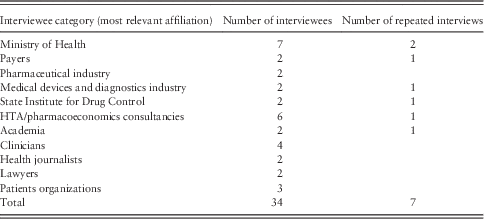
The findings in this article are based on a set of in-depth, semi-structured expert and elite interviews (Dexter, Reference Dexter2006; Littig, Reference Littig2009) with 34 actors knowledgeable about Czech HTA and reimbursement decision-making. All interviewees were promised anonymity and are identified here by randomly assigned interview numbers (e.g. ‘I-20’) and broad categories (see Table 2). Taking into account the sensitive nature of ongoing policy-making, this was a necessary tradeoff between transparency of the data and its quality (availability, trust and openness of interviewees).
Interviewee affiliations

Note: HTA=health technology assessment.
Ethical approval or consent forms were not required by the researchers’ institution for elite and expert interviews, who are typically assumed to be in a relative position of power to the interviewee (Morris, Reference Morris2009). Interviewees were explained the purpose of the research as a study focusing on the implementation of HTA in their country in the initial outreach email and at the beginning of the interview. They were given the choice of being recorded for the purposes of the study, as well as the option to stop the recorder any time.
All interviews were carried out in person by the author in Prague and Brno in three main rounds of fieldwork between May 2013 and December 2015; two were conducted over the phone. Three interviewees were interviewed twice; two were interviewed three or more times. The typical duration of an interview was 1 hour.
Interviewees were identified using purposive sampling (Tansey, Reference Tansey2007) in order to cover main actors involved in Czech HTA. Publicly available documents (conference reports, specialized press articles) were used to identify interviewees in the first round; snowball sampling (Tansey, Reference Tansey2007) was used later to identify additional important actors and to reach non-responsive interviewees. Given the relatively small size of the HTA policy community in the Czech Republic, most interviewees represented their respective stakeholder groups because of their institutional positions (e.g. directors of relevant units) or personal clout. Interviewees were mostly approached by their institutional email and phone. In two cases of snowball sampling, they were approached through a direct introduction by another interviewee. In total, 72 potential interviewees were identified between 2013 and 2015; 58 were prioritized and contacted; 10 (17%) refused (five of whom suggested alternative interlocutors) and eight (13%) did not respond despite repeated contact attempts (refusals and non-responses were spread evenly across interviewees’ institutional affiliations); two interviewees could not be located and two interviews were cancelled because of scheduling issues.
Semi-structured interviews are the most appropriate way of obtaining data for the object of our study – which is, a policy in the making, halted in the early days of the pre-legislative phase of the policy cycle. Few written traces exist and even fewer are publicly available. By definition, interviews with those in the know are in such cases, barring participation or observation (McNaughton Nicholls et al., Reference McNaughton Nicholls, Mills and Kotecha2014), the only way of gathering information for a researcher. To counter most potential risks of omission, misrepresentation or deception by the interviewees, information was systematically triangulated with data from other interviews and, where available, written documents (Berry, Reference Berry2002). For this reason, interviews were continued even beyond saturation [the point where additional interviews produce little new information or relevant themes (Guest et al., Reference Guest, Bunce and Johnson2006)] in an effort to reach as many relevant actors as possible. Data were analyzed using qualitative content analysis with the help of NVivo 10 software, based on deductive (theory-driven) and inductive (data-driven) codes (Schreier, Reference Schreier2014). The findings presented below are those where a reasonable level of confidence in their validity could be established through direct or indirect corroboration from available documents and other interviewees’ accounts (see Davies, Reference Davies2001).
4 Results
Czech policy-makers were divided on institutionalizing HTA, with one minister of health pro-HTA and another favoring an alternative policy option. Payers and the MD&D industry were against an HTA body, whereas patients, clinicians, and the pharmaceutical industry had no clear preferences. Only one group of actors was strongly in favor of institutionalizing HTA in the Czech Republic: the epistemic community of ‘aspiring agents’.
4.1 Policy-makers
Czech ministers of health were split on HTA: Leoš Heger (July 2010 to June 2013) initiated work on institutionalizing HTA midway through his mandate, whereas Svatopluk Němeček (January 2014 onward, following 6 months of caretaker government) promptly implemented an alternative to HTA.
Heger’s administration was favorable to HTA. The minister was originally unfamiliar with HTA but wished to solve a growing problem in his sector: unregulated entry of expensive diagnostics and devices on the market, later seeking reimbursement from public health insurance. He looked for ways to reinstall the old MD&D Committee, which had, until the Constitutional Court’s 2007 ruling, authorized their purchasing by providers. His advisors, members of the epistemic community, convinced him HTA would be an appropriate solution to the issue (I-40, I-96, I-37), overcoming the initial distrust expected by Danko (Reference Danko2014):
“The Minister wanted [his advisor] to reintroduce the old MD&D Committee. So [his advisor] explained to him the ministry no longer has the competence to centrally decide who can buy what. […] The minister complained that it’s too complicated […] but somehow he was eventually convinced [of the necessity of HTA], so he learned about it” (senior civil servant).
The central problem-pressure assumption of the delegation literature is here confirmed: the principal needs to create a new body to introduce regulation, and needs experts with specialized knowledge to determine the body’s output. Beyond this prima facie legitimizing function of experts, however, we find little trace of blame-avoidance motivation in interviews with policy-makers. Instead, the ministry aimed at starting public debate about the price of life and limits of health care free at the point of use, in order to manage public expectations (Alföldi Šperkerová, Reference Alföldi Šperkerová2014) – quite the opposite of blame-avoidance strategies of not attracting attention to potential rationing controversies.
As the principal, Heger’s ministry had a key say in formulating the details of the policy, which influenced the stances of other actors. The ministry had initially hoped for an independent agency but a new independent institution was deemed too expensive to get the approval of the ministry of finance (I-40, I-96): “It’s not so easy to create an independent public organization. […] No-one can afford another NICE [UK’s National Institute for Health and Care Excellence] here” (civil servant). The subsequent option included hosting an administrative bureau and an appraisal committee, composed of the ministry of health, two payer representatives, clinicians and the ombudsman (representing patients), within an upcoming ‘Health Insurance Bureau’ (eventually never created). Assessment of manufacturers’ HTA dossiers was to be outsourced to external experts (academia and consultancies), and decisions would be taken by the relevant decision-maker depending on the technology (SÚKL for drugs, ministry of health for services, etc.) (Vepřek, Reference Vepřek2011). Later formulations again mentioned a separate ‘Czech HTA Agency’ (Vepřek, Reference Vepřek2013a), followed eventually by an idea to add an HTA department to SÚKL (Vepřek, Reference Vepřek2013b), as SÚKL had the organizational and financial capacity to absorb new functions (iHETA, 2013: 3) (I-40).
This evolution seems to be motivated by emerging budgetary and practical constraints rather than a fundamental change in thinking. Some elements were constant, however: first, a strict separation between assessment and appraisal. Second, a focus on transparency: in all options detailed methodological guidelines as well as appraisal recommendations and reasonings were to be public. Third, the body was to have formal independence (even when joined up with SÚKL, itself an independent regulatory agency) but limited regulatory powers: its function was to be advisory. Finally, Heger’s administration was relatively agnostic as to the methodological details of HTA but had a clear position on the scope of its competences: all possible health technologies were to be mandatorily covered, not only pharmaceuticals but also MD&Ds and health care services (Vepřek, Reference Vepřek2011).
This changed with Němeček’s administration, and the debate around creating a specialized HTA body disappeared from the agenda. Problem-pressure persisted: Němeček still needed to control high-cost MD&D spending. Instead of establishing an HTA institution, the new administration tackled the issue by creating a new advisory committee within the ministry that would evaluate requests from individual providers (typically hospitals) for purchasing and geographical distribution of MD&Ds over 5,000,000 CZK (≈185,000 EUR). Payers committed to following the committee’s decisions through a voluntary memorandum of understanding – a very different kind of discretion than Heger’s HTA agency. The topic of HTA was to a certain degree absorbed by this policy solution: Němeček declared that ‘analyses based on HTA methodology should be one of the inputs for the committee’s decisions’ (zdravi.e15.cz, 2014). Several members of the committee describe the committee as an effort to ‘strive to introduce HTA’, speaking of ‘HTA-light-light’ (I-68, I-161). Others, however, doubt the committee’s methodological soundness (Čabanová, Reference Čabanová2014), given that individual reasonings and detailed methodology are confidential (Ministry of Health of the Czech Republic, 2015). This is also a departure from the ideal-typical HTA agency as advocated by Heger. In any case, a dedicated HTA institution was off the table.
The new MD&D committee is composed, among others, of representatives of clinical societies and some HTA experts (Ministerstvo zdravotnictví ČR, 2014). This suggests that Němeček perceived the need for expertise, and therefore delegation – but was able to satisfy it with less discretion, which in practical terms implied less time-consuming legislative, and budgetary, effort to set up a new institution. As one member of the new committee put it, “the [minister’s] assignment was to restore the [old] MD&D committee fast. [The team] had 2 weeks, maybe 2 months” (I-68, senior civil servant). This demonstrates how important the problem-pressure element in delegation dilemmas is: new principals may be convinced of the problem but choose a different solution than preferred by their predecessors, diminishing or dissipating the need for delegation or significant discretion.
4.2 Payers
Czech payers for the most part dismissed HTA and its various institutionalizations. On the one hand payers agreed on the usefulness of HTA as a tool to provide information whether a certain technology is worth funding, and agreed that the Czech health care system needed a similar decision-making tool (iHETA, 2013: 17–18) (I-105, I-65). They wanted a ‘basic consideration, with clear criteria’ of costs and benefits, defined broadly, of new health technologies (I-65, payer). To a certain extent they had been already performing this function in-house to inform internal decision-making for selected interventions (I-105, I-65, I-183). Their need for expertise was therefore low. The value added of an external HTA body for the payers would be a societal and political consensus on willingness-to-pay thresholds beyond which payers would be justified in refusing reimbursement:
“Let us take a technology which fails to convince us or other stakeholders that it is better for the patient, more efficient for the system and less costly for the insurer. [Having an HTA body] would […] make it easier for us to face the [public] pressure to fund it” (I-105, payer).
On the other hand, the promise of blame avoidance did not offset the payers’ ambition to keep control of reimbursement decision-making. They were apprehensive of a third-party regulator imposing reimbursement decisions (or even non-binding recommendations), which would be beyond their budgetary possibilities. As a result, they would face blame either from the patients and general public if they denied funding, or from politicians if they exceeded their budgets (I-65). All plausible institutional arrangements for HTA involved too much discretion for the payers to accept, as none would give a prominent enough role to budgetary concerns (I-65, I-105).
Banta’s hypothesis about budget impact being the primary interest of payers (rather than cost-effectiveness or patient quality of life, etc.) is in the Czech case confirmed. Policy solutions that do not address this concern directly are not attractive to Czech payers, including HTA:
“I don’t believe in ICERs [incremental cost-effectiveness ratios], numbers, models. I’ve seen how you can play around with those [to get the results you want]. […] The Hungarian way – risk-sharing – is the solution” (I-65, payer).
In contrast to alternative options, such as managed entry agreements (Kanavos and Ferrario, Reference Kanavos and Ferrario2013; Ferrario and Kanavos, Reference Ferrario and Kanavos2015; Ferrario et al., Reference Ferrario2017), HTA was identified by the payers as a policy that could, unless extremely sensitive to budget impact considerations, increase rather than maintain or reduce health care spending, and as such undesirable.
The payers’ reluctance to see a new body decide (or advise) on P&R would be readily explained by public choice theorists as a bureaucracy’s tendency to maximize its size, budget or competences (Downs, Reference Downs1967; Niskanen, Reference Niskanen1971; Dunleavy, Reference Dunleavy1991). Payers would be seen as incumbent agents defending themselves against bureaucratic competition. However, Czech payers should be, in matters of P&R, considered as near co-principals together with the ministry of health rather than agents. They have a de facto veto power in the drugs P&R procedure at SÚKL, a decision-making authority on MD&Ds and a seat at the table for health care services but are not subject, on P&R, to any extensive controlling mechanisms, usual in delegation arrangements, by the ministry. In addition, VZP has on many issues power almost equal to the ministry of health, stemming from its links to high politics: members of its board are nominated proportionately by parliamentary parties, leading to notorious clientelistic nexuses (Müller, Reference Müller2012; Nadační fond proti korupci and V97, 2012; Petrášová, Reference Petrášová2012; CTK, 2014; Nohl and Rodriguez, Reference Nohl and Rodriguez2015). Reconceptualizing Czech payers as co-principals explains their concerns for blame avoidance, not predicted by Banta or public choice bureaucratic theories. As principals, not only policy-makers, but also the payers needed to be convinced of the need for delegation in the first place. Solving a problem without delegation (such as in-house P&R decision-making) or with minimal discretion (such as signing a memorandum of understanding within a committee) may be more attractive.
4.3 Clinical physicians
Clinical physicians had no clear position on HTA and its institutionalization. The president of the umbrella association of Czech clinical societies summarized its members’ views in 2013: “Almost all representatives of clinical societies feel that HTA is something that does not, and will not, concern them” (iHETA, 2013: 19). In accordance with Banta’s hypothesis, clinicians’ priorities revolve around the quality and availability of care, including standard-setting and guideline writing, with a strict focus on their particular disease area (I-93, I-117, I-161). They are interested in those matters of P&R of health technologies that are of direct relevance to them, but their efforts are targeted at obtaining favorable reimbursement within the existing rules by finding alternative, often informal procedures, rather than investing time and resources into convincing policy-makers to change the rules of the game for all reimbursement decisions.
There is little direct opposition to HTA on the part of clinical physicians. If they have concerns, these are mostly about issues of transparency and inclusiveness of the future institution (iHETA, 2013):
“It would be good if some institution like NICE existed but not if it meant doing things the Czech way, all corrupt. It should be a transparent tool” (I-159, senior clinician).
Saarni’s hypothesis about clinicians’ resistance to HTA is refuted – lack of HTA under the status quo does not equal a lack of regulation of physicians’ freedom by other means. In public-payer universal health systems, clinicians are already restricted in their autonomy by extant rules and regulations, and even more so in the highly state-regulated systems of Central and Eastern Europe (Kaminska, Reference Kaminska2013; Wendt et al., Reference Kaminska2013). As assumed by the special interest literature (Lohmann, Reference Lohmann2003), concrete characteristics of new institutions are therefore of more concern but anticipating consequences on matters of principle (‘for or against HTA?’) is complex and costly, and therefore avoided.
4.4 Industry
Industry is in the Czech case divided into the pharmaceutical industry, and the MD&D industry, a large minority of which is united within the association CzechMed (most manufacturers of expensive devices and diagnostics are not members).
The pharmaceutical industry’s position on HTA was an uncomplicated endorsement in line with the general European response. Pharmaceuticals had been undergoing a relatively sophisticated P&R procedure within SÚKL since 2008, which has sometimes been described as ‘de facto HTA’ (iHETA, 2013: 18), even though SÚKL itself has been cautious of using the label and prefers to call its analysis ‘pharmacoeconomics’ instead (Löblová, Reference Löblová2017). The pharmaceutical industry therefore expected little tangible change to their business processes as a result of an HTA process or a new institution; at best, it would create a more level playing field where other interventions would be subject to similarly rigorous assessment as drugs (I-171, I-69).
The MD&D industry, on the other hand, had a more nuanced stance. Some companies were frustrated with the status quo where P&R of some MD&Ds were determined by a largely arbitrary power of VZP administration with little transparency (I-60), and would have welcomed the transparency and business environment predictability HTA promised. However, in general the industry feared any additional regulation as a hurdle to market access, especially if it would be as demanding as the drugs’ SÚKL procedure (iHETA, 2013: 20) (I-37, I-60):
“Our experience is that every change eventually means more work, delay etc., than benefits” (I-37, MD&D industry).
This is reflected in public comments of CzechMed’s president who had been an early proponent of HTA (Palát, Reference Palát2011) but later insisted on its limitations and pitfalls (Palát, Reference Palát2013). These included reservations about the scope and methodology of HTA analyses, which the MD&D industry deemed ill-adapted to their products (iHETA, 2013: 20). In consequence CzechMed later called for a ‘common sense’ evaluation instead of sophisticated health economic models (Palát, Reference Palát2013: 31). Discretion of the new body mattered; the main concerns of the MD&D industry were that HTA would target exclusively MD&Ds (as opposed to all health technologies), and that among MD&Ds, even low-cost devices would have to go through a cumbersome evaluation procedure. This threat was the clearest with a hosting option at SÚKL where organizational culture could be expected to replicate the pharmaceuticals’ procedure without many adjustments (I-60, I-37) but other policy formulation alternatives were also criticized (Palát, Reference Palát2013).
In contrast to expectations of the economic theory of regulation (Stigler, Reference Stigler1971), no part of the MD&D industry used HTA as an opportunity to improve or protect its market position. New regulation could have brought business predictability but compliance costs were deemed disproportionate, and less regulated status quo was preferred. Regardless of dividing lines, the Czech MD&D industry could easily voice its opposition to HTA as a whole.
4.5 Patients
Patient organizations did not see HTA as an issue high enough on the policy agenda and consequently worthy of their attention (I-35, I-17, I-81) (iHETA, 2013). Some even dismissed it as a policy whim that is unlikely to be implemented, and estimating its impact on patients’ lives as premature (iHETA, 2013: 17). Patient organizations explain this disinterest by their limited human resources:
“Finding information and data [including about ongoing policy projects] is investigative work even for [full time health policy professionals] that takes up most of their work hours. So you can imagine how difficult it is to access information for a patient organization that has 3-4 people who are doing all this as a hobby, after their day jobs” (I-81, patient representative).
As a result, they need to prioritize their lobbying efforts and HTA was not sufficiently advanced in the policy process to deserve detailed attention.
One exception were the rare disease patient groups, who clearly formulated their concern about HTA. They feared that any new HTA body would impose a uniform, rigid willingness-to-pay threshold using cost-effectiveness as the main criterion for reimbursement recommendations and disregard benefits of therapies outside of the health care system and require amounts and kinds of evidence unachievable for their disease areas (iHETA, 2013: 17) (I-81). These methodological concerns were more important than uncertain questions of institutional design. In line with the general interest group assumption that actors will not engage in lobbying if the costs of acquiring information on complex issues and acting on it are higher than potential benefits, even if the policy has direct consequences for them (Lohmann, Reference Lohmann2003), rare disease organizations, just as their non-rare counterparts, preferred to engage in monitoring of the policy development without action.
4.6 Epistemic community: ‘aspiring agents’
The epistemic community’s clear position in favor of HTA is in the Czech case confirmed: they were a group with a strong preference for an HTA institution. The delegation literature does not deal with positions and interests of future agents – the agent has no say in its own creation. The Czech case, however, implies that there are individuals who can reasonably expect to be later employed by, or otherwise involved with, the new body, and by virtue of their knowledge of the topic, members of the epistemic community are the most likely candidates. As such, they are ‘aspiring agents’, and have a clear interest in shaping the future institution to their liking.
Unlike interest groups, epistemic communities are not united by concurrent direct material (or other) interests but by their shared epistemic beliefs. Their members recruit from various institutions and organizations, and the Czech HTA epistemic community counted individuals whose primary work affiliations were as diverse as the ministry of health, SÚKL, MD&D industry, health care consultancies and academia. Each of them could, however, aspire to obtaining a high-level post in the future HTA institution – something regularly brought up by interviewees as a motivation for other members’ efforts:
“He was working on the concept for an HTA agency because he’d like the Czech Republic to have such an institution and he’d like to turn his [organization] into this agency” (I-161);
“He wanted the legislative draft to be good because his ambition was to continue working in the [future] HTA agency” (I-96).
Similarly, the community’s members often preferred such an institutional design that would prioritize (if not directly benefit) their original organization. In a classical example of ‘where you sit is where you stand’, members of the epistemic community who worked for consultancies and academia advocated for a ‘decentralized’ outsourcing system with a network of (public or private) suppliers of HTA analyses and a coordination role of a central agency (iHETA, 2013: 16) (I-161). Unlike the payers or the industry, their preference for an HTA body in general was not conditional on the kind of discretion it was to get. They were the one actor in Czech health policy who was in favor of HTA nearly irrespective of its details. The community, however, rapidly disintegrated following the unanticipated end of Heger’s mandate, which halted its access to decision-makers. They did not sustain their lobbying efforts during the caretaker minister’s term, and perceived advocating with minister Němeček as pointless (I-94, I-161, I-177).
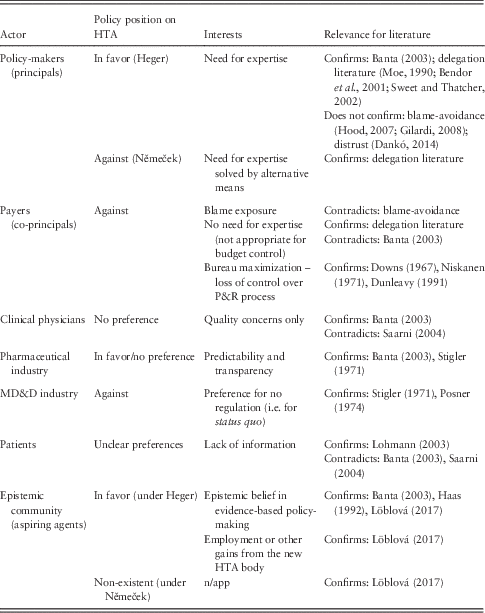
As a result, the composition of actors and their positions altered with a change of decision-makers: all actors who could potentially lobby decision-makers were either against an HTA body (payers, MD&D industry) or did not find the issue important (patients, clinicians, pharmaceutical industry). With the disappearance of the epistemic community as aspiring agents, there were no actors who would advocate in favor of institutionalizing HTA and push for it as a solution to minister Němeček’s MD&D problem (Löblová, Reference Löblová2017). These results are summarized in Table 3.
Findings: observed interests and policy positions of Czech health policy actors on health technology assessment (HTA)

Note: P&R=pricing and reimbursement.
5 Discussion and conclusions
This article sheds light on an understudied question of health policy: the dynamics of policy position formation and interests linked to emerging HTA policies. By focusing on what domestic actors think about institutionalizing HTA as a matter of authority delegation, we can observe how their interests and positions mediate the international diffusion of HTA institutions.
The present study is not without limitations. Studying actors’ positions is a delicate enterprise, which exacerbates pitfalls common to most qualitative political science research: reliability of the data is problematic, among others because of recall bias of interviewees and doubts about their trustworthiness. Its interpretation and presentation are not separable; moreover, there is a risk of presenting complex positions as caricatures. Finally, generalizability of findings from a single case study is a priori limited. Some of the dynamics observed in the Czech case (for instance, the relatively strong role of the Ministry of Health – as opposed for instance to the Ministry of Finance or international organizations) may only be relevant for other Central and Eastern European countries with long traditions of centralized authority in health care. Others, however, such as the hesitation of some policy-makers to implement a complex new decision-making structure and the relative lack of interest in HTA beyond the epistemic community, may be relevant for other countries with ‘non-core pharmaceutical markets’ (Danko, Reference Danko2014) around the world. Generalizability is even more limited in cases of non-events, such as here the non-adoption of HTA agencies. The government fall is one obvious idiosyncrasy of the Czech case; the strong role of the Czech VZP and other payers is another. Nevertheless, external shocks leading to a reorganization of the rapport de forces among key actors happen in most countries, and the presence of actors whose influence approaches the principals’ power could be a more universal pattern.
Findings from the Czech case notably challenge four implicit assumptions that underpin conventional discourse about countries without institutionalized HTA (typically low- and middle-income countries). First, diffusion of HTA agencies is not inevitable; it is mediated by domestic politics. The domestic context has been underlined to explain the varying institutional characteristics of HTA agencies worldwide (Banta, Reference Banta2003; Barron et al., Reference Barron, Klinger, Shah and Wright2015). Our findings suggest it also plays a role in the logically preceding question: does a country wish to establish an HTA agency in the first place? Too often, the answer tacitly follows the ‘laggard’ hypothesis: some countries have not ‘yet’ (Moharra et al., Reference Moharra, Espallargues, Kubesch, Estrada, Parada, Vondeling, Scalzo, Cristofides, Turk and Raab2009: 76) established HTA bodies because they have a low awareness of the topic, or a limited administrative, human resources, financial or other capacity. The near institutionalization of HTA in the Czech Republic demonstrates that, in some cases, awareness about HTA diffuses, and countries sometimes even take active steps toward creating HTA bodies. There are, however, a number of actors involved in the making of a new institution, all of whom have a stake in the outcome of the policy process: not only decision-makers, but also interest groups, existing bureaucracy and ‘aspiring agents’ – individuals or communities who expect to play key roles in the future institution. Important actors carefully evaluate HTA against the domestic context and their own interests and priorities, as they would do with any other policy, and aim at influencing decision-makers’ preferences. Sometimes, they have serious arguments against creating HTA bodies: HTA does not respond to their most urgent problems, which are either satisfactorily tackled by existing institutions and regulations, or by other policy alternatives. If they display distrust and criticism to the method, as some Czech payers and the MD&D industry do, it is informed, rather than intuitive as suggested by Danko (Reference Danko2014).
Second, countries without HTA institutions are not tabulae rasae. They have existing procedures and practices that regulate the entry of new interventions in the health system, even if these are not evidence-based, methodologically rigorous or particularly transparent (especially in democratic transition countries such as Central and Eastern Europe). For some actors, such as Czech patients and clinicians, little change can be expected from an HTA body as opposed to the status quo: it matters little if availability of treatments is determined by an HTA agency, or a ministerial committee or insurance fund bureaucrats. For others, however, such as the Czech MD&D industry or rare disease patients, the status quo can be more beneficial and HTA presents potential threats. The interests of actors as determined by the domestic context need to be taken into account, including their potential resistance (Kaló et al., Reference Kaló, Gheorghe, Huic, Csanádi and Kristensen2016) but also support or neutrality – it can be reasonably expected that, in other countries without HTA, clinicians and patients will not actively oppose the institutionalization of HTA unless they perceive it as a significant burden, in contrast to Banta’s (Reference Banta2003) and Saarni’s (Reference Saarni2004) arguments.
Third, alternatives to HTA are crucial for understanding why some actors do not choose HTA as their preferred policy. For delegation to an HTA body to happen, principals must perceive the need for the agent’s input (Moe, Reference Moe1990; Bendor et al., Reference Bendor, Glazer and Hammond2001; Sweet and Thatcher, Reference Sweet and Thatcher2002). This need may well be constructed or fostered by other actors – as when the Czech HTA epistemic community of aspiring agents persuaded minister Heger of the desirability of institutionalized HTA – but it may also be easily satisfied by other policy solutions, as when minister Němeček chose an advisory committee on costly MD&Ds over an HTA agency. If HTA does not respond to the principals’ most urgent problem, they are likely to choose a different option. Czech payers’ dismissal of HTA is illustrative of these dynamics: their most salient problem is not allocative inefficiency (which the laggard hypothesis presumes as a functional pressure common to most health systems), but budget containment. An HTA body would, according to their assessment, not provide as ready a solution to this problem as payer-controlled managed-entry agreements or ad-hoc reimbursement; at worst, it could lead to an increase in expenditure if the HTA institution privileged other criteria than budget impact. It may be easier for policy-makers in countries without HTA institutions to opt for parametric adjustments of existing policies, than to invest resources into building a new institution.
Finally, institutional arrangements of HTA matter. While warning against a simplistic emulation of the English NICE (Oortwijn et al., Reference Oortwijn, Mathijssen and Banta2010) is certainly reasonable advice, the opposing temptation is to avoid recommending any institutional setup altogether (VASPVT and LBI, 2015; Wild et al., Reference Wild, Patera, Stricka and Karnickas2015). HTA as a method of analysis becomes decoupled from its institutionalization, suggesting it is unimportant whether evidence is evaluated by an independent agency, a unit at the ministry of health, or an academic institute – as long as it respects general international HTA standards. The literature on HTA in Western Europe recognizes, however, that institutional details have far-reaching influence, from determining how HTA conclusions feed into decision-making and what kind of advice is produced (Shah et al., Reference Shah, Barron, Klinger and Wright2014) to what kind of technologies are funded (Böhm et al., Reference Böhm, Landwehr and Steiner2014). There is no reason to expect institutions to be neutral in non-Western European countries, but the plethora of possible institutional models makes anticipating their consequences difficult. Because of the uncertainty about institutional setups, some Czech actors focused more on the methodological details of HTA: rare disease patients, for instance, were more preoccupied with a potential binding cost-effectiveness threshold (as seen in Poland or Slovakia) than with institutions. However, for other actors (payers, MD&D industry) institutional details were crucial, and influenced heavily their stance on HTA. Although some institutional features were uncontroversial (notably transparency of the future body), others (such as the scope of its competences or its organizational structure) were the reason for opposition. The Czech Republic is not alone in this. A recent study of stakeholders’ views on HTA institutionalization in Chile identified a ‘broad consensus on the need for an independent and [transparent and participatory] publicly funded HTA body’; however, a closer look revealed disagreement on seemingly technical questions such as the body’s mandate and its place within the decision-making process (Lavín et al., Reference Lavín, Alaniz and Espinoza2017: 3) – points remarkably similar to the bones of contention in the Czech Republic. At the domestic level, then, the devil lies within the statutes of any HTA body – not only in the parameters of its economic models but also in its institutional design, and that these details matter also beyond Western Europe.
These four assumptions influence policy activities in many countries. The European Commission, for instance, recommends the use of HTA (European Commission Health and Consumers Directorate-General, 2013). The World Bank actively funds projects introducing HTA in individual countries, for instance, in Romania (Lopert et al., Reference Lopert, Ruiz and Chalkidou2013; Gulácsi et al., Reference Gulácsi, Rotar, Niewada, Löblová, Rencz, Petrova, Boncz and Klazinga2014). The most common argument of the ‘laggard’ literature is that HTA is even more important in lower income countries, as they have less resources to waste by allocative inefficiencies stemming from evidence-ignorant decisions (Moran and Fidler, Reference Moran and Fidler2010; Danko, Reference Danko2014). This is a theoretically sound claim. Nevertheless, the findings show that allocative inefficiency is, in some resource-tight contexts, not the main problem of policy-makers or other key actors; and if it is, other policy alternatives may be more attractive to them.
Naturally, ‘more attractive’ does not necessarily mean ‘right’, and resistance to change should not be taken as an excuse for avoiding reform. Still, HTA advocates, both international and domestic, should consider domestic actors’ concerns. They should give serious thought to the possibility that, in some cases, adapting existing institutions and procedures could present significant benefits (e.g. faster and cheaper implementation) for some countries, rather than creating new HTA bodies.
Acknowledgements
This paper was written at the School of Public Policy, Central European University, in Budapest. Research for this paper was partially supported by the International Visegrad Fund (grant numbers 51300464 and 51400781). The author wishes to thank Nikolai Sitter, Marie-Pierre Granger, Robin Bellers, Petra Baji, Katharina Böhm and Alexandru Moise.