Introduction
High atmospheric temperatures and drought have seriously impacted cotton crop growth and development and adversely affected cotton fibre quality and yield (Parida et al., Reference Parida, Dagaonkar, Phalak, Umalkar and Aurangabadkar2007; Lesk et al., Reference Lesk, Rowhani and Ramankutty2016; Ullah et al., Reference Ullah, Sun, Yang and Zhang2017; Ahmad et al., Reference Ahmad, Ilyas, Aslam, Roman, Ali, Naeem, Nazar and Rehman2020; Mahmood et al., Reference Mahmood, Khalid, Abdullah, Ahmed, Shah, Ghafoor and Du2020). Therefore, it is essential to identify and breed drought-tolerant cotton genotypes that can provide high yield and quality under water-limiting conditions.
Ninety percent of the water loss from the leaf epidermis occurs via the stomata which are the gas exchange portals of plant leaves (Buckley, Reference Buckley2005; Wan et al., Reference Wan, Griffiths, Ying, McCourt and Huang2009). In plants, the regulation of water loss influences drought stress tolerance by modulating stomatal density, closure and area to a certain degree (Hetherington and Woodward, Reference Hetherington and Woodward2003; Hejnák et al., Reference Hejnák, Tatar, Atasoy, Martinková, Çelen and Skalický2016). The phytohormone abscisic acid (ABA) regulates epidermal guard cell activity and participates in plant adaptation to drought (Danquah et al., Reference Danquah, de Zelicourt, Colcombet and Hirt2013; Kuromori et al., Reference Kuromori, Seo and Shinozaki2018). Thermal stress damages plant cell membranes which, in turn, results in electrolyte leakage (Demidchik et al., Reference Demidchik, Straltsova, Medvedev, Pozhvanov, Sokolik and Yurin2014). It is used to determine the number of plant cells dying as a consequence of biotic or abiotic stress (Hatsugai and Katagiri, Reference Hatsugai and Katagiri2018).
Plants have developed complex regulatory networks that respond to various environmental stresses (Lesk et al., Reference Lesk, Rowhani and Ramankutty2016). Certain proteins play important roles in the innate immunity and abiotic stress tolerance of higher plants (Xiong and Yang, Reference Xiong and Yang2003; Nakano et al., Reference Nakano, Yamada, Bednarek, Nishimura and Hara-Nishimura2014). The bZIP transcription factor, heat shock transcription factors (Hsfs) and heat shock protein (HSP) are key players in plant drought and heat response (Liu et al., Reference Liu, Liao and Charng2011; Srivastava et al., Reference Srivastava, Deng and Howell2014; Ohama et al., Reference Ohama, Kusakabe, Mizoi, Zhao, Kidokoro, Koizumi, Takahashi, Ishida, Yanagisawa, Shinozaki and Yamaguchi2016; Jacob et al., Reference Jacob, Hirt and Bendahmane2017). GhABF2 and ABP9 (bZIP) overexpression significantly improved multiple abiotic stress tolerances in Arabidopsis and cotton (Liang et al., Reference Liang, Meng, Meng, Malik, Yan, Lwin, Lin, Wang, Sun, Zhou, Zhu, Li, Jin, Guo and Zhang2016; Wang et al., Reference Wang, Lu, Hao, Guo, Guo, Zhao and Cheng2017). HSFA6b in Arabidopsis thaliana plays pivotal roles in ABA signalling and thermotolerance (Huang et al., Reference Huang, Niu, Yang and Jinn2016). HSFA1b (Triticum aestivum), ZmHSFA2 (Zea mays) and OsHsfA2a (Oryza sativa) also respond to various stressors (Gu et al., Reference Gu, Jiang, Zhang, Li, Wang, Zhang, Li, Dirk, Downie and Zhao2019; Malumpong et al., Reference Malumpong, Cheabu, Mongkolsiriwatana, Detpittayanan and Vanavichit2019; Tian et al., Reference Tian, Wang, Zhao, Lan, Yu, Zhang, Qin, Hu, Yao, Ni, Sun, Rossi, Peng and Xin2020). HSP70 is implicated in several different regulatory pathways and modulates proteins in distressed plants (Usman et al., Reference Usman, Rafii, Martini, Yusuff, Ismail and Miah2017). Cytosolic/nuclear HSC70 controls stomatal closure and regulates physiological ABA response and dependence in Arabidopsis (Clément et al., Reference Clément, Leonhardt, Droillard, Reiter, Montillet, Genty, Laurière, Nussaume and Noël2011). It also confers heat resistance to potato and contributes substantially to yield gains (Trapero et al., Reference Trapero, Morris, Ducreux, McLean, Stephens, Torrance, Bryan, Hancock and Taylor2018).
Here, we designed and conducted two experiments on the seedlings of 39 cotton genotypes (online Supplementary Table S1). In experiment 1, we evaluated stomatal density and area in the absence of exogenous ABA, stomatal aperture and relative GhHsfA, GhbZIP and GhHSP70 expression in the presence of exogenous ABA signals (3 and 6 h), and drought resistance in all of the aforementioned cotton genotypes. In experiment 2, we measured the relative changes in electrolyte leakage and the GhHsfA, GhbZIP and GhHSP70 expression levels in all 39 cotton genotypes subjected 40°C stress (4 and 8 h). The selection of drought-resistant and thermotolerant cotton cultivars can facilitate and ameliorate the breeding of varieties with high fibre yield and quality even under adverse climatic or environmental conditions.
Materials and methods
Plant material and growth conditions
Healthy cotton seeds were surface-sterilized with 70% (v/v) alcohol for 5 min, soaked in 15% (v/v) H2O2 for 4 h, rinsed 4–5× with sterile water, soaked with sterile water for 16 h and transferred to a square box lined with two filter papers. Healthy seedlings of the same size at the cotyledon stage were transplanted and spread out in a square basin and cultured under running water for 1 week. The water was then replaced with ½-strength Hoagland solution. The seedlings were grown in a greenhouse at 25°C/18°C day/night, 16-h photoperiod and 60% RH. The nutrient solution was replenished once weekly. The following experiments were conducted in triplicate on cotton seedlings at the four-true-leaf stage. Three strains per genotype were analysed.
Experimental design and treatments
The control cotton seedlings were left untreated in experiments 1 and 2. Three tissue samples were excised from the second true leaves. One sample was frozen in liquid nitrogen for RNA extraction, the second was used for stomatal morphology observation and photography and the third was used for electrolyte leakage measurements.
Experiment 1. ABA was added to ½-strength Hoagland solution until the final concentration was 100 μM. Two samples were excised after normal light exposure for 3 and 6 h. The sampling sites were the same as that for the control. One sample was frozen in liquid nitrogen for RNA extraction and the other was used for stomatal morphology observation and photography.
Experiment 2. Cotton seedlings were transferred to an artificial climate chamber. Illumination was set to 150 mol m2/s1, RH = 60% and temperature = 40°C. After 4 and 8 h culture, samples were excised. One was frozen in liquid nitrogen for RNA extraction and the other was used for conductivity measurements.
Stomatal traits
The abaxial epidermis in the middle of each leaf was peeled, glued to a glass slide and observed under an optical microscope fitted with a digital camera (Nikon DS-Ri2; Nikon Corp., Tokyo, Japan) and linked to a computer (Xu and Zhou, Reference Xu and Zhou2008). Three epidermal samples were observed per treatment and photographed at ×200 magnification. At least 25 stomatal apertures were examined per treatment and the experiment was conducted at least in triplicate. Stomatal area, width and length were measured with Nikon NIS Elements D software (Nikon Corp., Tokyo, Japan). The averages were calculated and divided by the image/field areas to obtain the average stomatal densities (/mm2). The stomatal aperture was equal to the stomatal width divided by the stomatal length. The stomatal densities were calculated by measuring the image/field areas and counting the stomata in them (Ryu et al., Reference Ryu, Cho and Kim2010).
Electrolyte leakage assay
For all replicates, leaves were rinsed twice with deionized water and dried with filter paper. Discs of 5 mm in diameter were punched from the leaves and placed in test tubes. Then 25 ml deionized water was added to each test tube and heated to 29°C on a 130-rpm shaker for 1 h. The initial conductivity was measured with a conductometer (Mettler Toledo FE30K; Columbus, OH, USA). The total conductivity was measured after the samples were boiled for 30 min in a water bath and cooled to room temperature. Cell membrane damage was calculated as relative conductivity, namely, initial conductivity/total conductivity × 100% (Campos et al., Reference Campos, Quartin, Ramalho and Nunes2003).
Relative gene expression level
GhbZIP, GhHsfA and GhHsp70 expression levels were measured using total RNA (Tiangen Biotech Co. Ltd., Beijing, China) isolated from the cotton seeding leaves in experiments 1 and 2. There are three independent biological replicates for each genotype. Total RNA was reverse-transcribed into cDNA using a Revert Aid First Strand cDNA Synthesis Kit (Thermo Fisher Scientific, Shanghai, China). The cDNA was used as a template for quantitative real-time polymerase chain reaction (qRT-PCR) to detect gene expression. The qRT-PCR reactions were analysed by using thermocycler (ABI 7500 Fast; Applied Biosystems, Foster City, CA, USA) and TransStart® TIP Green qPCR SuperMix (TransGen Biotech, Beijing, China). Cotton actin gene (GhUBQ7) was the reference standard. The target gene primers were designed with Primer Premier 5 (PREMIER Biosoft International, San Francisco, CA, USA) and are listed in online Supplementary Table S2. The fluorescent quantitative reaction mixture (20 μl) contained the following: 10 μl of TransStart Tip Green qPCR SuperMix (2×), 0.4 μl of Passive Reference Dye (50×), 0.4 μl each of forward and reverse primers (10 μm), 2 μl of cDNA (220 ng) and 6.8 μl of ddH2O. Thermal cycling conditions were as follows: thermal activation at 95°C for 1 min, denaturation at 95°C for 15 s and annealing at 60°C for 55 s for 40 cycles. The experiment had three repetitions for each sample. Relative expression levels were calculated using the 2−ΔΔCt method (Livak and Schmittgen, Reference Livak and Schmittgen2001).
Statistical analysis
Data were analysed with SPSS v. 19.0 for Windows (IBM Corp., Armonk, NY, USA). One-way analysis of variance followed by Duncan's multiple-range test detected significant differences among treatment means. Statistical significance was confirmed at P < 0.05. Figures were plotted with R Programming Language for Windows. Data are presented as means ± standard deviation of three replicates.
Results
Genotypic variation in stomatal traits
We investigated the stomatal traits on the abaxial leaf surfaces of 39 different cotton seedling genotypes. There were significant differences among them in terms of average stomatal density and stomatal area (Table 1). Kui85_174 had the lowest stomatal density (66 ± 16.5/mm2) while Zhongmian49 had the highest (182 ± 42.44/mm2). Ten genotypes had stomatal densities in the range of 66–100/mm2. Twenty genotypes had stomatal densities in the range of 100–150/mm2. Nine genotypes had stomatal densities in the range of 150–190/mm2. ZhongR2007 had the smallest stomatal area (663 ± 101.0 μm2) while Xinluzao26 had the largest (1305 ± 161.3 μm2). Twenty-four genotypes had stomatal areas in the range of 600–1000 μm2. Fifteen genotypes had stomatal areas in the range of 1000–1400 μm2.
Stomatal traits of 39 cotton genotypes in experiment 1

Stomatal density, stomatal area (control) and stomatal aperture (ABA) of 39 cotton genotypes. Data are means ± standard deviation for ⩾20 replications.
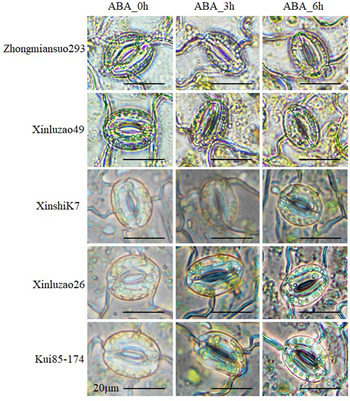
All 39 cotton genotype seedlings were soaked in 100 μM ABA plus nutrient solution for 3 and 6 h. Changes in their stomatal apertures were then observed (Table 1). Certain stomatal images are shown in Fig. 1. The stomatal apertures (width/length) ranged from 0.69 to 0.82 in the absence of exogenous ABA (ABA_0h), from 0.53 to 0.73 after 3 h exogenous ABA exposure (ABA_3h) and from 0.53 to 0.81 after 6 h exogenous ABA exposure (ABA_6h). The stomatal apertures of all genotypes had decreased in the range of −4.3 to −28.4% relative to the ABA_3h and ABA_0h treatments. The stomatal apertures of six genotypes (CQJ-5, Shinong98-7, Zhongmiansuo293, Shiyang1, Xinluzao49 and Jin34) had decreased by <20%. The stomatal apertures of two genotypes had increased by 5.2 and 6.9%, respectively. The stomatal apertures of the remaining 37 genotypes had decreased in the range of −2.5 to −31.2% compared with the ABA_6h and ABA_0h treatments. The stomatal apertures of seven genotypes (Xinluzao36, Keyang1, yu17-202, Xinluzao1, Xinluzao49, Shiyang1 and Shinong98-7) had decreased by <20%. Relative to ABA_6h and ABA_3h, the stomatal apertures of 21 genotypes had increased in the range of 2–26%, those of 16 genotypes had decreased in the range of 0–12% and those of Tashigan7 and yu17-202 had decreased by <10% (Table 1).
Photographs of foliar stomata of five cotton genotypes exposed to exogenous ABA. Bar = 20 μm. Second true abaxial cotton seedling leaf epidermis were peeled and observed under an inverted microscope fitted with a digital camera (Nikon Corp., Tokyo, Japan) at ×200 magnification.

Electrolyte leakage in different cotton genotypes
Electrolyte leakage was measured for 39 cotton genotype seedlings subjected to 40°C heat stress in artificial climate chambers for 4 and 8 h (Table 2). When the cotton seedlings were not heat-stressed (40°C_0h), the electrolyte leakage of all 39 genotypes was in the range of 8.34–16.93%. Compared with 40°C_0h, exposure to 40°C for 4 h (40°C_4h) increased electrolyte leakage in all samples by 0.2–167.1%. In seven genotypes (Zhongmiansuo293, Zhongmiansuo50, Xinnongmian3, Xinluzao42, TM-1, Tianhe995 and yu17-202), the electrolyte leakage had increased by <10%. In two other genotypes (XinshiK7 and KK1543), the electrolyte leakage had increased by >100%. Relative to 40°C_0h, exposure to 40°C for 8 h (40°C_8h) increased electrolyte leakage in 38 genotypes by 0.3–225.3%. In four genotypes (Xinluzao2, Yu17-202, Shiyang1 and CQJ-5), the electrolyte leakage had increased by 0–10%. In seven other genotypes (Xinluzao11, Xinluzao26, Xinhai20, ShiK8.Tm-1, kui85-174 and KK1543), the electrolyte leakage had increased by >100%. Compared with the 40°C_8h and 40°C_4h treatments, the growth rates showed a downward trend (−40 to 0%) for 10 genotypes. For Liao18, Xinpao1 and Shiyang1, the growth rates had decreased by <20%. For the remaining 29 genotypes, the growth rates had increased by 2–108%. The growth rates for six genotypes (Xinhai20, Zhongmiansuo50, Kui85-174, ShiK8, Xinluzao26 and TM-1) had increased by >50%.
Electrolyte leakage in 39 cotton genotypes subjected to 40°C thermal stress

Data are means ± standard deviation for ⩾3 replications.
Gene expression in 39 cotton genotypes under the ABA and 40°C treatments
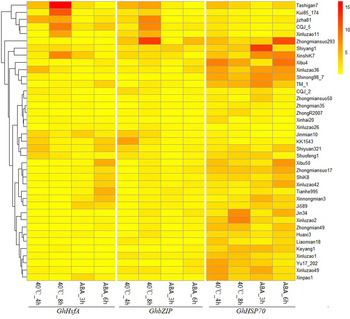
The relative expression levels of GhHsfA (KJ702452.1), GhbZIP (KP938299) and GhHSP70 (FJ415196.1) in response to heat and ABA exposure were measured for the 39 cotton genotypes (online Supplementary Table S3). After 40°C heat stress for 4 and 8 h and 100-μM ABA treatment for 3 and 6 h, all three genes were upregulated (Fig. 2).
GhHsfA, GhbZIP and GhHSP70 expression in 39 cotton genotypes at various stages under 40°C heat stress and exogenous ABA. The data represent fold-increases compared to enrichment of control sample and are the mean of three independent biological replicates and three technical replicates for each genotype.

Under the 40°C_4h and 40°C_8h treatments, GhHsfA was upregulated by 0.10–5.13× and 0.23–16.12×, respectively. For five genotypes (KK1543, Shiyuan321, Tanshigan7, Xinluzao36 and Jizha81) under the 40°C_4h treatment, GhHsfA was upregulated by >3×. For six genotypes (Xinluzao11, XinshiK7, CQJ-5, Kui85-174 and Tanshigan7) under the 40°C_8h treatment, GhHsfA was upregulated by >5×. After exogenous ABA treatment for 3 h (ABA_3h) and 6 h (ABA_6h), GhHsfA was upregulated by 0.11–3.38× and 0.11–5.31×, respectively. In Ji589, Jinmian10 and XinshiK7, the relative GhHsfA expression range had increased by >3× under the ABA_3h treatment. In Xibu50, the relative GhHsfA expression range had increased by >5× under the ABA_6h treatment. For most genotypes, the relative GhHsfA expression level was generally higher after the 40°C heat stress treatments than the exogenous ABA treatments (Fig. 2).
After the 40°C_4h and 40°C_8h treatments, the relative GhbZIP expression level had increased by 0.14–6.08× and 0.13–12.33×, respectively. For four genotypes (Jinmian10, Zhongmiansuo293, Tanshigan7 and KK1543), the relative GhbZIP expression had increased by >3× under 40°C_4h. For five genotypes (Xinluzao11, Tanshigan7, CQJ-5, Jizha81 and Zhongmiansuo293), the relative GhbZIP expression had increased by >5× under 40°C_8h. After the ABA_3h and ABA_6h treatments, the relative GhbZIP expression levels had increased by 0.12–3.20× and 0.16–4.44×, respectively. For Shiyang1 and Zhongmiansuo293, the relative GhbZIP expression levels had increased by 3×. For most genotypes, the relative GhbZIP expression levels were generally higher after the 40°C heat stress treatments than the exogenous ABA treatments (Fig. 2).
Under the 40°C_4h and 40°C_8h treatments, the relative GhHSP70 expression levels had increased by 0.39–7.96× and by 0.34–7.87×, respectively. Under 40°C_4h stress, shinong98-7, Xinpao1, yu17-202, Xinluzao49, Xinluzao36 and Xibu4 presented with >5× increases in relative GhHSP70 expression. Under 40°C_8h stress, the relative GhHSP70 expression levels were 5× higher in Xibu4, Jin34 and Xinluzao2. After the ABA_3h and ABA_6h treatments, GhHSP70 was upregulated by 0.08–12.55× and by 0.18–11.16×, respectively. Relative GhHSP70 expression had increased by >5× in Xinluzao49, Xinluzao36, Shinong98-7, XinshiK7, TM-1 and Shiyang1 after the ABA_3h treatment. Relative GhHSP70 expression had increased by >5× in Xinluzao42, Zhongmiansuo17, shinong98-7, Xinluzao36, Xibu50, XinshiK7, Xibu4 and Zhongmiansuo293 after the ABA_6h treatment (Fig. 2).
Correlations among stomatal traits and gene expression under ABA treatment
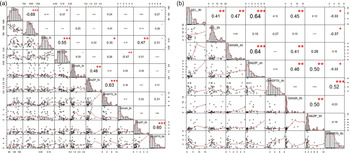
We evaluated the correlations among stomatal density, area, apertures and gene expression levels in the 39 cotton genotypes subjected to the ABA_3h and ABA_6h treatments (Fig. 3(a)). Stomatal density (SD) was significantly negatively correlated with stomatal area (SAr) (r = −0.69). Variations in stomatal aperture after the 3-h ABA (ΔSAp_3h) and the 6-h ABA (ΔSAp_6h) treatments were significantly positively correlated (r = 0.52). SD and ΔSAp_6h were significantly negatively correlated (r = −0.37). Relative GhHSP70 expression after the 3-h ABA treatment (GhHSP70_3h) and ΔSAp_3h were significantly positively correlated (r = 0.33). GhHSP70_3h and GhbZIP_3h and GhHSP70_6h and GhbZIP_6h were significantly positively correlated (r = 0.63 and r = 0.60, respectively). GhbZIP_3h and GhHsfA_3h were significantly positively correlated (r = 0.48). ΔSAp_6h and GhHsfA_6h were significantly negatively correlated (r = −0.47). GhHsfA was downregulated in response to the decrease in stomatal aperture under ABA_6h.
(a) Correlation coefficients of stomatal traits and gene expression levels in 39 cotton genotypes under exogenous ABA. SD: stomatal density; SAr: stomatal area; ΔSAp_3h and ΔSAp_6h: change in stomatal aperture under exogenous ABA for 3 h and 6 h, respectively; GhHsfA_3h and GhHsfA_6h, GhbZIP_3h and GhbZIP_6h, and GhHSP70_3h and GhHSP70_6h: relative GhHsfA, GhbZIP and GhHSP70 expression levels under 3 and 6 h exogenous ABA, respectively. (b) Correlation coefficients of electrolyte leakage and gene expression in 39 cotton genotypes under 40°C heat stress. ΔEL_4h and ΔEL_8h: change of electrolyte leakage under 4 and 8 h heat stress at 40°C. GhHsfA_4h and GhHsfA_8h, GhbZIP_4h and GhbZIP_8h, and GhHSP70_4h and GhHSP70_8h: relative GhHsfA, GhbZIP, and GhHSP70 expressions levels under 4 and 8 h heat stress at 40°C, respectively. ***Correlation significant at 0.001 level; **correlation significant at 0.01 level; *correlation significant at 0.05 level.

Correlations between electrolyte leakage and gene expression levels under 40°C stress
After the 40°C treatment, we evaluated the correlations among the changes in electrolyte leakage (ΔEL) and the relative GhHsfA, GhbZIP and GhHSP70 expression levels in the 39 cotton seedling genotypes (Fig. 3(b)). ΔEL_4h and GhHsfA_4h and ΔEL_4h and GhbZIP_4h were significantly positively correlated (r = 0.47 and r = 0.64, respectively). GhHsfA_4h and GhbZIP_4h were significantly positively correlated (r = 0.64) but GhHsfA_4h was not correlated with GhHSP70_4h. ΔEL_4h and GhHSP70_8h and ΔEL_8h and GhHSP70_8h were significantly negatively correlated (r = −0.33 and r = −0.37, respectively). GhHsfA_8h and GhbZIP_8h were significantly positively correlated (r = 0.50) and their response patterns were similar for all cotton genotypes. GhHsfA_4h and GhHsfA_8h, GhbZIP_4h and GhbZIP_8h, and GhHSP70_4h and GhHSP70_8h were significantly positively correlated with all three genes (r = 0.41; r = 0.50 and r = 0.52, respectively) under the 4-h and 8-h heat stress treatments at 40°C.
Cluster analysis of 39 cotton genotypes under ABA treatment
We conducted a cluster analysis on cotton leaf stomatal density and area, changes in stomatal apertures and relative GhHsfA, GhbZIP and GhHSP70 expression after 3-h and 6-h ABA stress. The horizontal Dim1 was 26.2%, the vertical Dim2 was 20.9%, and the 39 genotypes were classified into three categories (Fig. 4(a)). The green areas show nine drought-tolerant (T) genotypes (Zhongmiansuo293, Shiyang1, Shinong98-7, Xinluzao36, Xinluzao49, Xinluzao1, Keyang1, Yu17-202 and Jin34). The blue areas show 17 genotypes with moderate drought tolerance (MT) (XinshiK7, Xibu4, Xinluzao42, Xinluzao2, tm-1, Xinnongmian3, Xibu50, Yi589, Tianhe995, Zhongmian49, Xinpao1, Zhongmiansuo17, Zhongmian35, ShiK8, Shuofeng1, ZhongR2007 and Huaxi3). The red areas show 13 drought-sensitive genotypes (S) (Jinmian10, kui85-174, Xinluzao26, Xinhai20, Liao18, Xinluzao11, CQJ-2, Tashigan7, KK1543, Zhongmiansuo50, Jinzha81, CQJ-5 and Shiyuan321).
(a) Cluster analysis on drought tolerance in 39 cotton genotypes. Red region: ‘S’ = drought-sensitive genotypes; green region: ‘T’ = drought-tolerant genotypes; blue region: ‘MT’ = moderately drought-tolerant genotypes. (b) Cluster analysis on heat tolerance in 39 cotton genotypes. Red region: ‘MS’ = moderately heat-sensitive genotypes; light green region: ‘S’ = heat-sensitive genotypes; blue region: ‘T’ = heat-tolerant genotypes; purple region: ‘MT’ = moderately heat-tolerant genotypes.

Cluster analysis of 39 cotton genotypes under 40°C thermal stress
We conducted a cluster analysis on electrolyte leakage and relative GhHsfA, GhbZIP and GhHSP70 expression after 4 and 8 h heat stress at 40°C. The horizontal axis Dim1 was 39.2%, the vertical axis Dim2 was 19.9% and the 39 genotypes were classified into four categories (Fig. 4(b)). The blue areas show the heat-tolerant genotypes (T) (Xinluzao36, Shiyang1, Xinluzao49, Xinluzao1, Zhongmiansuo17, Xibu50, shinong98-7, TM-1, Keyangyang1, zhongmian49, Xinpao1, Jin34, yu17-202, Xinluzao2 and Xibu4). The purple areas show the moderately heat-tolerance genotypes (MT) (Tanshengan7, Zhongmiansuo293, Jizha81 and CQJ-5). The red areas show the moderately heat-sensitive genotypes (MS) (Shuofeng1, jinmian10, Liao18, Huaxi3, Xinluzao42, ZhongR2007, CQJ-2, Xinnongmian3, Yi589, Zhongmian35, ShiK8, Zhongmiansuo50, Tianhe995, Xinhai20 and Xinluzao26). The light green areas show the heat-sensitive genotypes (S) (XinshiK7, Shiyuan321, Xinluzao11, kui85-174 and KK1543).
Discussion
Numerous studies have proposed that the plant roots are the primary sites of synthesis of endogenous ABA, which is transported from the root via xylem to the leaf (Hartung and Heilmeier, Reference Hartung and Heilmeier1993; Seo and Koshiba, Reference Seo and Koshiba2002; Koiwai et al., Reference Koiwai, Nakaminami, Seo, Mitsuhashi, Toyomasu and Koshiba2004; Kuromori et al., Reference Kuromori, Miyaji, Yabuuchi, Shimizu, Sugimoto, Kamiya, Moriyama and Shinozaki2010). It was suggested that exogenous ABA is translocated from the epidermis to the xylem by foliar spray or from the xylem to the leaves by chemigation. It was also indicated that exogenous ABA participates in plant stress tolerance by foliar spray (Sripinyowanich et al., Reference Sripinyowanich, Klomsakul, Boonburapong, Bangyeekhun, Asami, Gu, Buaboocha and Chadchawan2013; Huang et al., Reference Huang, Chen, Yang, Li and Wu2015; Zhang et al., Reference Zhang, Zhang, Liu, Shao, Sun and Chen2016) or by chemigation (Du et al., Reference Du, Wang, Fan, Turner, He, Wang and Li2013; Wang et al., Reference Wang, Lu, Hao, Guo, Guo, Zhao and Cheng2017; He et al., Reference He, Jin, Palta, Liu, Chen and Li2019). During crop cultivation, the root is the first plant organ to perceive water shortage signals. Thus, we used the root leaching method to apply ABA and simulate the root signal. To determine relative drought and heat tolerances in 39 different cotton genotypes, we investigated the stomatal traits, changes in electrolyte leakage and expression levels of the stress-related genes GhHsfA, GhbZIP and GhHSP70 in cotton seedling leaves.
Stomatal closure is an important early-stage resistance response to mild drought. It conserves water and reduces evaporation (Bartlett et al., Reference Bartlett, Klein, Jansen, Choat and Sack2016; Usman et al., Reference Usman, Rafii, Martini, Yusuff, Ismail and Miah2017). Therefore, we screened drought-resistant cotton genotypes based on their stomatal traits and ABA signal sensitivities. There were significant differences among the 39 cotton genotypes in terms of average stomatal density and area. The stomatal density range was 66–182/mm2 and the stomatal area range was 663–1305 μm2 (Table 1). A drought tolerance cluster analysis disclosed that the stomatal densities of the nine drought-tolerant cotton genotypes were in the range of 95–147/mm2 and the stomatal areas were in the range of 824–1089 μm2 (Fig. 4(a)). Previous studies indicated that high stomatal density and low stomatal area are typical traits of drought-resistant plants (Hetherington and Woodward, Reference Hetherington and Woodward2003). The current study showed that moderate cotton leaf stomatal density and area were associated with strong drought resistance. Stomatal density (SD) was negatively correlated with stomatal area (SAr) (r = −0.69) (Fig. 3(a)). Thus, the total stomatal area per unit cotton leaf has remained within a certain consistent and stable range after long-term cultivation and domestication. In the long run, cotton leaf stomatal density increases with vapour pressure deficit (Devi and Reddy, Reference Devi and Reddy2018). However, this correlation is not characteristic of all crops.
The extent to which ABA maintains and regulates the degree and duration of stomatal closure varies among cotton genotypes (Table 1). The stomatal apertures (width/length) of the 39 cotton genotypes were in the ranges of 0.69–0.82 (0 h), 0.53–0.73 (3 h) and 0.53–0.81 (6 h) in response to exogenous ABA. After 3 h ABA, the stomata were closed in all cotton genotypes to different degrees. After the 6 h ABA treatment, the stomatal apertures of 21 genotypes had increased while those of the 16 other genotypes had decreased. The ABA treatments had reduced the stomatal apertures of shinong98-7, Shiyang1 and Xinluzao49 by >20% for. These three genotypes presented with moderate stomatal density and area and complete, long-term stomatal closure. SD and ΔSAp_6h were significantly negatively correlated (r = −0.37) (Fig. 3(a)). Thus, stomatal area and closure decrease with increasing stomatal density. Cotton genotypes with moderate stomatal density and area may be comparatively more sensitive to ABA signals.
Electrolyte leakage (EL) reflects cell membrane damage under thermal stress (Demidchik et al., Reference Demidchik, Straltsova, Medvedev, Pozhvanov, Sokolik and Yurin2014). The changes in the EL of 39 cotton genotypes significantly differed in response to heat stress (Table 2). The changes in EL were in the ranges of 8.34–16.93% for the 40°C_0h treatment, 9.72–24.58% for the 40°C_4h treatment and 10.52–28.91% for the 40°C_8h treatment. Relative to the 40°C_0h treatment, the EL of all genotypes had increased after the 40°C_4h treatment. After the 40°C_8h treatment, the relative EL of 29 genotypes increased while those of the remaining 10 genotypes decreased. Cotton thermotolerance varies with genotype. For most genotypes, the extent of cell membrane damage increases with heat stress exposure time. However, certain genotypes can attenuate heat-induced cell membrane damage possibly through immune-mediated repair mechanisms (Moreno et al., Reference Moreno, Mukhtar, Blanco, Boatwright, Moreno, Jordan, Chen, Brandizzi, Dong, Orellana and Pajerowska-Mukhtar2012; Nejat and Mantri, Reference Nejat and Mantri2017). ΔEL_4h and GhHsfA_4h and ΔEL_4h and GhbZIP_4h were significantly positively correlated (r = 0.47 and r = 0.64, respectively). However, ΔEL_4h was not correlated with GhHSP70_4h. Thus, GhHsfA and GhbZIP responded to heat stress well before GhHSP70. GhHSP70_8h and ΔEL_4h and GhHSP70_8h and ΔEL_8h were significantly negatively correlated (r = −0.33 and r = −0.37, respectively) (Fig. 3(b)). GhHSP70 upregulation could help mitigate cell membrane damage. HSP70 expression induced by a high temperature can help degrade H2O2, thus improving thermotolerance in plants (Li et al., Reference Li, Liu, Yi, Wang, Zhou, Xia, Shi, Zhou and Yu2014).
The relative GhHsfA and GhbZIP expression levels in all cotton genotypes were in the ranges of 0.10–16.12 and 0.14–12.33 (40°C) and 0.11–5.31 and 0.12–4.44 (ABA), respectively. Thus, GhHsfA and GhbZIP respond faster to heat stress than ABA signalling. A correlation analysis revealed that the GhHsfA and GhbZIP expression levels after both 3 and 6 h heat stress were significantly positively correlated (r = 0.64 and r = 0.50, respectively) (Fig. 3(b)). Therefore, GhHsfA and GhbZIP had similar heat stress response patterns. Relatively high expression levels of both genes were identified in Jizha81, Xinluzao11, CQJ-5 and Tanshigan7 (Fig. 2). The relative expression levels of GhHSP70 in all genotypes were 0.34–7.96× (40°C) and 0.08–12.55× (ABA). Thus, GhHSP70 was more responsive to ABA signals than heat stress. GhHSP70 upregulation in response to ABA signalling and heat stress was greater than those for GhHsfA and GhbZIP. Cotton genotypes with relatively higher GhHSP70 expression levels were Shinong98-7, Xinluzao49, Xinluzao36, Xibu4 and Jin34 (Fig. 2).
The GhHsfA and GhbZIP expression levels were significantly positively correlated (r = 0.48) under the ABA_3h treatment (Fig. 3(a)). Therefore, they had similar early responses to the ABA signals. ΔSAp_6h and GhHsfA_6h were significantly negatively correlated (r = −0.47) under the ABA_6h treatment (Fig. 3(a)). It is possible that after 6 h ABA signalling, GhHsfA expression became saturated and underwent negative regulatory feedback. Certain studies reported that HSP70 and bZIP regulate stomatal function (Clément et al., Reference Clément, Leonhardt, Droillard, Reiter, Montillet, Genty, Laurière, Nussaume and Noël2011; Kerr et al., Reference Kerr, Abdel-Mageed, Aleman, Lee, Payton, Cryer and Allen2018). The current study confirmed that ΔSAp_3h and GhHSP70_3h and ΔSAp_3h and GhbZIP_6h were significantly positively correlated (r = 0.44 and r = 0.33, respectively). GhHSP70_3h and GhbZIP_3h and GhHSP70_6h and GhbZIP_6h were also significantly positively correlated (r = 0.63 and r = 0.60, respectively) (Fig. 3(a)). Therefore, GhHSP70 may regulate stomatal closure and GhbZIP might positively regulate GhHSP70 expression and play an anti-stress role.
We tested the heat stress and ABA treatment responses of GhHsfA, GhbZIP and GhHSP70 in 39 cotton seeding genotypes. Based on relative expression levels of these genes, there were substantial differences among the genotypes (Fig. 2). In plants, various regulatory pathways collaborate and form a complex regulatory network. The observed variations in gene expression among the different genotypes could be explained by the inequalities in their alleles. In different potato genotypes, mutations in the upstream HSC70 promoter alter the expression of this gene (Trapero et al., Reference Trapero, Morris, Ducreux, McLean, Stephens, Torrance, Bryan, Hancock and Taylor2018). The yields may vary widely among cultivars subjected to various high-temperature conditions. Variations in the upstream ZmNAC and ZmVPP1 promoters of different maize genotypes have unequal degrees of drought resistance as the expression levels of the aforementioned genes differ among these varieties (Mao et al., Reference Mao, Wang, Liu, Li, Yang, Yan, Li, Tran and Qin2015; Wang et al., Reference Wang, Wang, Liu, Ferjani, Li, Yan, Yang and Qin2016). The expression levels of the three stress-response genes in the 39 cotton genotypes may serve as reference indices in rapid cotton stress tolerance identification and could help discover novel cultivars.
The current study revealed that for all cotton genotypes, stomatal area decreased with increasing stomatal density. Exogenous ABA increased stomatal density and decreased stomatal aperture. Thus, the stomatal density and area of cotton leaves are associated with, and influenced by, drought tolerance. The transcription factor GhbZIP may be upstream of GhHSP70 and might regulate stomatal closure under exogenous ABA signalling. The relative expression levels of GhHsfA and GhbZIP in various cotton genotypes corresponded to the degree of cell membrane damage caused by heat stress. These two genes reacted to thermal stress sooner than GhHSP70. However, the latter upregulation of GhHSP70 helped attenuate cell membrane damage. The relative expression levels of the aforementioned genes vary with exogenous ABA signal and heat stress exposure and with cotton genotype. Their expression levels in response to various stressors could serve as references for the rapid identification of stress-tolerant cotton varieties as well as the breeding of superior cultivars that produce high yields of high-quality fibre even under adverse climatic and environmental conditions. In the future, we intend to verify whether the three genes have excellent variation types in different cotton varieties and explore their regulatory mechanism.
Currently, China is the world's largest cotton producer, and Xinjiang's cotton output accounted for more than 80% of China's cotton production (http://www.cottonchina.org.cn/). Xinjiang is a semi-arid region with a typical temperate continental climate. The cotton-producing regions are arid throughout the year with minimal rain. In most cotton-producing regions in Xinjiang, the daily maximum temperature in July exceeds 37°C, average temperature of 5 consecutive days (http://www.cma.gov.cn/); this is the flowering period of cotton. Therefore, drought and high temperature in Xinjiang are the main factors that affect the long-term yield and quality of cotton. Our analysis of drought and heat resistance of 39 cotton materials provides basic data for the selection of local cotton breeding and cultivation materials.
The current study also demonstrated that there were substantial differences in the response patterns of the various cotton genotypes to exogenous ABA signalling and heat stress. Cluster analyses on the heat and drought tolerance indices of the 39 cotton genotypes identified the drought- and heat-resistant varieties. Zhongmiansuo293, Xinluzao36, Shiyang1 and Shinong98-7 were extremely resistant to both drought and heat. Heat- and drought-sensitive cultivars included Shiyuan321, Xinluzao11, Kui85-174 and Xinluzao26. The resistant genotypes could be applied towards abiotic stress resistance research and breeding in cotton. One limitation of this study is that stress tolerance in the various cotton genotypes was evaluated only for greenhouse-raised seedlings. Further screening and verification of stress tolerance, yield and fibre quality should be conducted in the aforementioned cotton varieties cultivated in the local outdoor field environment under natural climatic conditions.
Supplementary material
The supplementary material for this article can be found at https://doi.org/10.1017/S147926212000043X.
Acknowledgements
First of all, we thank the Key Research and Development Tasks of Xinjiang (2016b01001-1) and Graduate student scientific research innovation projects in Xinjiang province (XJ2019G136) for providing financial support for the Research. We thank the reviewers for their comments and suggestion. We thank Editage (www.editage.com) for English language editing.
Author contributions
Yp-G, Yy-Q and Qj-C conceived and designed the experiment. RF and Fl-S are responsible for greenhouse cotton culture and experimental processing and sampling. RF, KZ and QC performed gene expression analysis, whereas Yp-G analysed data and wrote manuscripts. All the authors reviewed the manuscript.
Conflict of interest
The authors declare no competing interests.