Disproportionate policy response – which is comprised of two core concepts, namely policy over- and underreaction (Maor Reference Maor2012, Reference Maor2014a) – is typically understood to be “a lack of ‘fit’ or balance between the costs of a public policy and the benefits that are derived from this policy, and/or between a policy’s ends and means” (Maor Reference Maor2017a, 384).Footnote 1 Policy scholars tend to view disproportionate policy as either unintentional or nonintentional responses. Unintentional disproportionate policy responses have been well captured by psychological and institutional explanations. Psychological accounts attribute all disproportionate policies to cognitive biases and constraints on information processing (e.g. Bar-Hillel Reference Bar-Hillel1973; Tversky and Kahneman Reference Tversky and Kahneman1974; Staw Reference Staw1981; Kahneman et al. Reference Kahneman, Slovic and Tversky1982; Jones and Baumgartner Reference Jones and Baumgartner2005; Kahneman Reference Kahneman2011; Meyer Reference Meyer2016) as well as sociopsychological dynamics in small decision-making groups (e.g. Janis Reference Janis1982; Mintz and Wayne Reference Mintz and Wayne2016). Institutional accounts ascribe all disproportionate policies to institutional values, procedures, myths and routines (e.g. Peters et al. Reference Peters, Jordan and Tosun2017). Both types of explanations share the view that disproportionate policies are unintentional errors of commission or omission (e.g. Walker and Malici Reference Walker and Malici2011).
In the middle ground between unintentional and intentional is the category of nonintentional disproportionate policy, which comprises studies of unintended policy consequences (e.g. Rhodes Reference Rhodes2000, Reference Rhodes2011; Hood and Peters Reference Hood and Peters2004; Margetts et al. Reference Margetts and Hood2010). These studies regard disproportionate policies as responses that political executives never intended to implement yet are not executed unknowingly, inadvertently or accidentally. Thus, political executives may select policies that sometimes, paradoxically, have the opposite policy effect, or create new problems in addition to the one they set out to correct. These consequences are unavoidable, and neither their incidence nor severity can be eliminated.
Against this background, the current article proposes a revolutionary idea: under certain circumstances, disproportionate policy responses may be intentionally designed, implemented as planned, and, at times, successful in delivering the political benefits sought by the political executives who initiate them and in achieving policy goals (e.g. Maor Reference Maor2017a, Reference Maor2017b, Reference Maor, Mintz and Terris2019a, Reference Maor2019b; Maor et al. Reference Maor, Tosun and Jordan2017).Footnote 2 This article highlights, therefore, a conceptual turn whereby the concepts of policy over- and underreaction are reentering the policy lexicon as types of intentional policy choices. At the heart of this conceptual turn are the claims that policy over- and underreactions are largely undertaken when political executives seeking reelection are vulnerable to voters, and that these policy modes are not opposites; each mode has a unique causal structure. Intentional overreactions derive from the desire of political executives to pander to voters’ opinions or signal extremity by overreacting to voters’ opinions (i.e. anti-pandering) in domains susceptible to manipulation for credit-claiming purposes. Intentional underreactions, by contrast, are motivated by political executives’ attempts to avoid blame – for example, by refraining from electorally risky reforms. These attempts may subsequently lead to deliberate overreaction.
An additional argument advanced here is that when uncertainty exists regarding the optimal policy choice, and consequently there are greater chances that political considerations will become interwoven with the definition of policy problems and goals, the window for deliberative disproportionate response widens. Thus, in contrast to the incremental approach, which would argue that uncertainty leads to incremental adjustments (e.g. Lindblom Reference Lindblom1959; Hirschman and Lindblom Reference Hirschman and Lindblom1962, 218) that very often amount to policy underreaction, this article provides a theoretical foundation for the argument that uncertainty may lead to deliberate policy overreaction, as political executives attempt to capture potential political benefits.
Bringing this conceptual turn to fruition is part of an attempt to understand what actual benefits political executives believe they are acquiring when they choose one disproportionate response over a proportionate one or over another disproportionate alternative. The conceptual arguments advanced herein should furthermore encourage scholars to recognise the political benefits that elected executives may reap from implementing disproportionate policies, and the effectiveness of such policies at times.
The ensuing sections address the following questions (in the same order): (i) What is disproportionate policy response, and what assumptions and parameters guide our understanding of its dynamics? (ii) Why do the intentions behind a disproportionate policy response matter? (iii) Under what conditions is deliberate policy overreaction most likely to occur? (iv) Under what conditions is deliberate policy underreaction most likely to occur? (v) How is disproportionate policy response implemented? and (vi) How can disproportionate policy response be measured? It concludes by identifying four areas that offer promising possibilities for future research with regard to deliberate disproportionate policy, namely definitional foundations, levels of analysis, temporality and dynamism, and process research.
What is disproportionate policy response, and what assumptions and parameters guide our understanding of its dynamics?
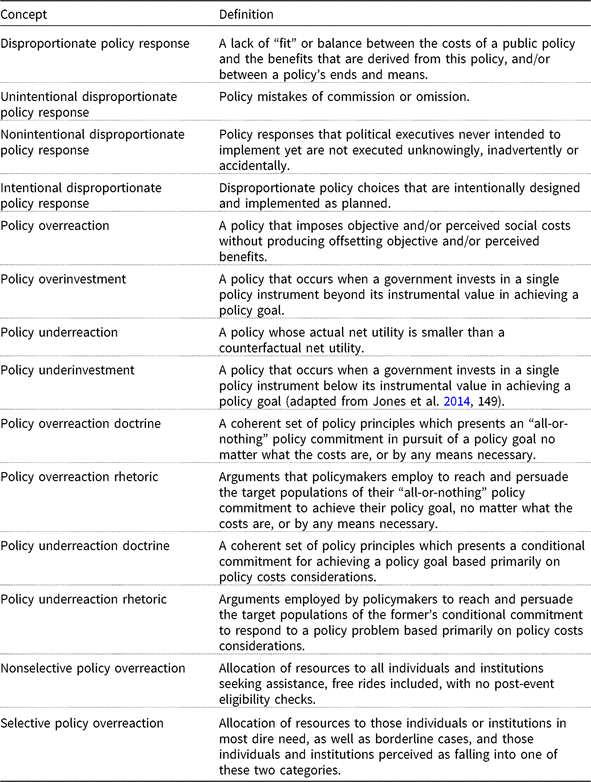
Disproportionate policy response is comprised of two core concepts: policy overreaction and policy underreaction. Policy overreaction is a policy that “impose[s] objective and/or perceived social costs without producing offsetting objective and/or perceived benefits” (Maor Reference Maor2012, 235). Policy underreaction is “a policy whose actual net utility […] is smaller than a counterfactual net utility […]” (Maor Reference Maor2014a, 428). Because policy problems and solutions are often loaded with ideational and symbolic elements (e.g. Conlan et al. Reference Conlan, Posner and Beam2014; Schneider et al. Reference Schneider, Ingram, de Leon, Sabatier and Weible2014), different individuals and groups may perceive disproportionate policy responses somewhat differently, and perceptions may change as the magnitude of a crisis or policy problem becomes more apparent. Both concepts are therefore objective facts and, at the same time, matters of interpretation. An objective manifestation of policy overreaction relevant here is the concept of policy overinvestment, which occurs when a government invests in a single policy instrument beyond its instrumental value in achieving a policy goal. An objective manifestation of policy underreaction is policy underinvestment, which occurs when a government invests in a single policy instrument below its instrumental value in achieving a policy goal (adapted from Jones et al. Reference Jones, Thomas and Wolfe2014, 149). Table 1 presents the aforementioned definitions, as well as other definitions of concepts developed throughout this article.
Disproportionate policy response: concepts and definitions

In order to understand the dynamics of disproportionate policy responses, a recent study formulated the disproportionate policy perspective (Maor Reference Maor2017a). This perspective suggests that, under certain conditions, policymakers may face incentives to design and implement disproportionate policy which, on occasion, may be successful in achieving policy and political goals. Among the fundamental strategies are the prioritisation of policy effectiveness over policy costs (or over other factors), leading to the formulation and implementation of policy overreaction options, and/or cost-consciousness (or other factors) over effectiveness, which results in the formulation and implementation of policy underreaction options. An example of the former is attaining a policy goal “at any costs” by opting for a highly detailed and complicated policy design that leaves little room for error. An example of the latter is saving design costs by opting for a policy design, that is, based on cost-free (read, relatively low-quality) data, or imposing the constraint that the policy must not exert an adverse (economic) impact on other policy sectors. The perspective also posits that policy overreaction will be pronounced if the emotional context of the policy (e.g. mass panic and public fears) is equally, if not more, important than the substantive nature of the problem at hand, and that disproportionate policy options may be planned as signalling devices or context-setters (e.g. resolving issues concerning the fragmentation of decisionmaking). The disproportionate policy perspective implies that a disproportionate response in the policy domain may at times be a politically well calibrated and highly effective strategy because of the damage it inflicts on political rivals and/or its success in shaping voters’ perceptions favourably.
Behind the idea that, on occasion, disproportionate policy response may be intentionally designed and, in some cases, successful in achieving political and policy goals is the view that decisionmakers are primarily autonomous actors. When they stand to benefit politically from policy over- or underreaction, their decisions may be carefully thought out and cautiously developed. Specifically, explanations of intentional disproportionate policy (henceforth, strategic explanations) view decisionmakers as boundedly rational individuals who, in some contexts, may produce substantially rational outcomes (Simon Reference Simon1985, 294). This may be the case, for example, when decisions involve high stakes and when decisionmakers are motivated to make the right choice (Chong Reference Chong, Huddy, Sears and Levy2013, 97). Strategic explanations thus highlight the assumptions underlying bounded rationality: the existence of variation amongst individuals and contexts in decision-making processes and outcomes (Simon Reference Simon1985, Reference Simon and Moser1995). Because individuals’ motivations differ, as do the opportunities available to them to process information carefully, and because contexts vary in terms of complexity, individuals are not necessarily consistent decisionmakers (Lodge and Taber Reference Lodge, Taber, Lupia, McCubbins and Popkin2000), as rational choice theory assumes (Simon Reference Simon and Moser1995). In policy contexts, this insight implies that decisionmakers do not need to place efficient goal attainment centre stage in every decision taken. Some individuals, operating within particular contexts, can therefore overcome (the “efficient goal attainment”) bias (Lau et al. Reference Lau, Anderson and Redlawsk2008) and make “rational” – read “reasonable” or “good enough” – disproportionate policy decisions (Maor Reference Maor2017a, Reference Maor2017b, Reference Maor, Mintz and Terris2019a; Maor et al. Reference Maor, Tosun and Jordan2017).
Why do the intentions behind a disproportionate policy response matter?
At the outset, intentions differ from desires by their settledness, that is, “to intend to do something is, in part, to be settled on doing it […]” (Mele Reference Mele, Beckermann, Brian and Walter2009, 693). Intentions are formed by decisions, and they should accord with one’s beliefs. Furthermore, two conditions make an action intentional. The first is that an agent, S, intentionally A-ed if and only if S A-ed the way S intended to A. The second is that S intentionally A-ed if and only if S A-ed for a reason (Mele Reference Mele, Beckermann, Brian and Walter2009, 694).
Why do the intentions behind policies matter? The answer lies in the wide variety of individuals’ intentions and the possibility that a political motivation may be embedded in policy intentions. Well-intended individuals are liable to select optimal policy strategies – ones that are likely to produce desired medium- or long-term outcomes – while maximising economic efficiency. Others are sometimes likely to select suboptimal and economically inefficient policy strategies for the purpose of political gain. For example, democratic elections provide incentives for political executives seeking reelection to engage in credit claiming (Mayhew Reference Mayhew1974; Grimmer et al. Reference Grimmer, Messing and Westwood2012). To do so, they may be willing to prioritise the visibility and popularity of policy instruments over their economic efficiency and/or effectiveness if this allows them to shape voters’ perceptions in a favourable way (e.g. Hodler et al. Reference Hodler, Loertscher and Rohner2010). In the area of counterterrorism, for example, scholars have shown that democratic governments undertake suboptimal policies, which involve observable displays of force and coercive actions, rather than secretive, more optimal activity because of electoral incentives to respond to public demands for more security in the aftermath of major terrorist attacks (e.g. Donohue Reference Donohue2008; Cronin Reference Cronin2009; Crenshaw Reference Crenshaw and Crenshaw2010; Dragu Reference Dragu2017; see also Bueno de Mesquita Reference Bueno de Mesquita2007). A counterfactual-based study of post-9/11 proactive measures in the US has furthermore found that the return to the War on Terror was pennies on the dollar (Sandler et al. Reference Sandler, Arce, Enders and Lomborg2009).
The argument that intentions matter implicitly assumes, however, that political executives and lay people share the same conception regarding intentional action. This assumption is important because political benefits may be gained only if the target audience would deem the policy selected by political executives intentional. The problem is that what lay persons and the wider community deem intentional or unintentional in particular cases may be biased by his, her or their interests, by conspiracy theories, and the like. Consequently, lay persons may not inevitably link a particular policy response to the political executive that initiated it, thereby inhibiting the flow of political benefits he or she expected to derive from this policy.
The ambiguity concerning the interaction between an agent’s intention and policy outcome is especially relevant in cases of deliberate policy underreaction because the outcome is open to framing manipulation, which is biased in favour of those who generate information, control access to policy arenas and synchronise or manipulate political timetables (Ackrill et al. Reference Ackrill, Kay and Zahariadis2013). Although these agents obviously include political executives, they may also comprise their rivals, thereby undermining the flow of political benefits received by the political executives who deliberately underreacted. By contrast, ambiguity very rarely exists in cases of policy overreaction because of the theatrical and spectacular nature of some policy overreactions, and/or because of the preference for a particular policy overreaction which exhibits a direct and immediate relation with the results, making it clear that the outcome was caused by the policy at hand and not by another factor or actor. President Trump’s policy proposals, for example, “are framed in terms of direct causation. Immigrants are flooding in from Mexico—build a wall to stop them” (Lakoff Reference Lakoff2016, 3). This, in turn, creates political incentives to overreact because at times it facilitates shared judgement as to the extraordinary nature of the policy response and its initiator, thereby guaranteeing a flow of political benefits originating from the executives’ traditional base, or “core”, and perhaps also from the wider electorate.
Yet why do we care about political executives’ intentions, considering that they sometimes make empty promises and even lie to get elected? According to Callander and Wilkie (Reference Callander and Wilkie2007), the effectiveness of lying is limited by the fact that voters do not want to elect people they suspect are untrustworthy and therefore try to get an idea of the politician’s character. Political executives may therefore be incentivised to overreact, for example, making some announcements that are discordant with what voters want, in order to signal honesty.Footnote 3
The discussion so far indicates that political executives’ policy intentions should be factored into analyses of deliberate disproportionate policies. This is because the political motivation embedded in their policy intentions at times influences the executives’ willingness to initiate, maintain and terminate disproportionate policies; guide such policies; help to coordinate such policies over time; and shape their interaction with other agents during various stages of such policy responses. Policy intentions of directors general in government ministries as well as agency heads should also be factored into analyses of deliberate disproportionate policies. This is because they may be judged, when encountering severe policy problems involving panic and fears amongst individuals (e.g. investors) and/or the general public, according to their ability to convince people that the policy system is viable and to “bring things back to normal” (Boin and ′t Hart Reference Boin and ′t Hart2003, 3).
Under what conditions is deliberate policy overreaction most likely to occur?
Policy overreactions in Western democracies are largely undertaken when political executives seeking reelection are vulnerable to voters.Footnote 4 Intentional policy overreactions primarily derive from political executives’ desire to increase their probability of reelection by pandering to voters’ opinions or their wish to signal extremity by overreacting to voters’ interests (i.e. anti-pandering) in domains that are susceptible to manipulation for credit-claiming purposes. Although vulnerability to voters varies widely (e.g. between election periods and nonelections), it still operates as an external constraint. This constraint is represented by a change in the public’s preferences towards supporting misguided policy goals (read, the stimulus) and the policy changes to which it leads. Alternatively, it is also represented by the response of public preferences to policy overreaction “thermostatically” – moving to the extreme right as policy moves to the extreme left and to the extreme left when it moves to the extreme right (Wlezien Reference Wlezien1995) – and the policy changes to which it leads.
Pandering to voters’ opinions may therefore incentivise political executives to implement populist or extreme policies, especially in policy domains wherein political executives are better informed than voters (e.g. Canes-Wrone et al. Reference Canes-Wrone, Herron and Shotts2001; Maskin and Tirole Reference Maskin and Tirole2004; Canes-Wrone and Shotts Reference Canes-Wrone and Shotts2007). An example is the influence of the public’s increasing punitiveness on mass incarceration in the United States (US) and the UK (Enns Reference Enns2016; Howard Reference Howard2017; Jennings et al. Reference Jennings, Farrall, Gray and Hay2017). Because the power to determine the election is not necessarily distributed equally among the electorate and advocacy organisations (e.g. Fenno Reference Fenno1978; Baumgartner et al. Reference Baumgartner, Berry, Hojnacki, Kimball and Leech2009; Schlozman et al. Reference Schlozman, Verba and Brady2012; Reference Schlozman, Brady and Verba2018), pandering to the interests of key populations (e.g. elderly; White), organisations, and politically valuable constituencies may incentivise political executives to implement many large policy changes in line with the friction model (Jones and Baumgartner Reference Jones and Baumgartner2005). A classic example occurs when presidents pursue policies across a range of issues that systematically target benefits to politically valuable constituencies (Kriner and Reeves Reference Kriner and Reeves2015). Surprisingly, voters may tend to respond positively to policy changes even when they are aware that politicians are manipulating policies to garner electoral support (Drazen and Eslava Reference Drazen and Eslava2010). Still, voters judge harshly politicians who seem to have direct control over outcomes that fail to meet the optimistic expectations they created. Consequently, when it comes to safeguarding reelection prospects, the optimal strategy may be for political executives to underpromise and overdeliver (Malhotra and Margalit Reference Malhotra and Margalit2014).
When political executives are vulnerable to voters, they may also be motivated to overreact to voters’ opinions in order to give the impression that they are well informed. Game theoretic models have shown that this anti-pandering strategy is often exacerbated by ideological polarisation between candidates (Bils Reference Bils2018). Given that voters tend to vote for parties which they deem competent at handling certain issues (e.g. van der Brug Reference van der Brug2004; Green and Hobolt Reference Green and Hobolt2008), political executives may be motivated to signal extremity in order to project an image of competency – thereby acquiring a short-term “issue lease” (Petrocik Reference Petrocik1996, 827) or, preferably, long-term issue ownership (Budge and Farlie Reference Budge and Farlie1983; Bellucci Reference Bellucci2006). When implemented “on the ground” rather than at the rhetorical level, this policy overreaction guarantees the delivery of outputs that meet the voters’ demands. Political executives may also devote attention to a given issue over a long period, for example, by applying aggressive language in order to achieve spontaneous association between the issue at hand and the party, that is, associative issue ownership (Walgrave et al. Reference Walgrave, Lefevere and Tresch2012).
In addition, given that voters are inclined to vote for parties and candidates which share their perspective on an issue and those which assume the most extreme positions (Rabinowitz and Macdonald Reference Rabinowitz and Macdonald1989), elected executives may be inclined to overreact in order to signal extremity. Policy overreaction may also be used to facilitate the politicisation of a particular issue (Carmines and Stimson Reference Carmines and Stimson1989; Rabinowitz and Macdonald Reference Rabinowitz and Macdonald1989), incentivising political executives to deviate from their ideological “comfort zone.” Political executives operating in multiparty systems may likewise be motivated to signal extremity when faced with internal and systemic constraints that limit their ability to carry out their proposals in full. This is because voters favour extreme parties, hoping that this will provide the extent of policy change they seek, for example, by taking a coalition government towards the preferred path (Iversen Reference Iversen1994; Merrill and Grofman Reference Merrill and Grofman1999; Kedar Reference Kedar2005). Another motivation for signalling extremity is related to ideological donors. Because individual donors prefer to support ideologically extreme candidates, political executives may be motivated to endorse ideologically extreme policies in pursuit of money (e.g. Barber Reference Barber2016).
A further stimulus for intentional policy overreaction, which operates as an expected external constraint, often triggers manipulative preemptive overreaction (Maor Reference Maor2012). This occurs when policymakers attempt to gain a strategic advantage when faced with an allegedly unavoidable swing of public mood. Elected executives may try to regain control of the public agenda by adopting highly visual and dramatic policy moves (Maor Reference Maor2012). By the same token, micro-events, such as a single dog bite, can swell into major political crises, leading to “forced choices” (Lodge and Hood Reference Lodge and Hood2002) of policy overreaction. Relatedly, in international politics and other areas that suffer from deficient verification and enforcement mechanisms, policymakers may be motivated to overreact in order to enable the other side to get an accurate read of their intentions, thereby strengthening coercive diplomacy and avoiding unnecessary wars (Jervis Reference Jervis2017). Keeping domestic and international opponents off balance may provide another stimulus for intentional policy overreaction. A recent departure from the aforementioned understanding of intentional action has been recorded by cognitive neuroscientists who consider such actions as movements that are not triggered by external stimuli but rather internally generated (Passingham et al. Reference Passingham, Bengtsson and Lau2010). An example of an intentional policy overreaction which may be relatively free of external constraints concerns policies aimed at securing a legacy by, for example, building monuments.
Under what conditions is deliberate policy underreaction most likely to occur?
The study of public policy over the past half-century has seen hundreds of studies describing and explaining incremental adjustments (e.g. Howlett and Migone Reference Howlett and Migone2011; Heyes Reference Heyes2017) that very often amount to policy underreaction. The phenomena of “non-decisions,” “non-issues” (Bachrach and Baratz Reference Bachrach and Baratz1970; Crenson Reference Crenson1971), as well as the importance of gatekeeping (Cobb and Elder Reference Cobb and Elder1972), “feel-good” political language (Edelman Reference Edelman1964, Reference Edelman1977), the power to frame the political discourse (Lukes Reference Lukes1975), “agenda denials” (Cobb and Ross Reference Cobb and Ross1997) and neglect in public policy (De Vries Reference De Vries2010) have together touched on aspects related to policies that are executed “too late” and/or provide “too little.” This is also true of studies regarding policy stasis and resistance to change, which have relied on the frameworks of path dependency (Pierson Reference Pierson2005), punctuated equilibrium theory (Baumgartner and Jones Reference Baumgartner and Jones2009) and the advocacy coalitions framework (Sabatier and Jenkins-Smith Reference Sabatier and Jenkins-Smith1993). Recently, a study of policy inaction has advanced the notion of calculated inaction (McConnell and ‘t Hart Reference McConnell and ′t Hart2014), which very often amounts to policy underreaction. However insightful these analyses are, deliberate policy underreaction per se has not been the analytical focus of any of these studies.
A key premise underlying the political logic that largely leads to deliberate policy underreaction is that some public policies are electorally dangerous because they entail difficult trade-offs involving the distribution of scarce public resources. In other words, political executives may be punished by voters shifting their support to viable alternatives (e.g. Lindblom Reference Lindbom, Kumlin and Stadelmann-Steffen2014) or by increasing levels of nonvoting (e.g. Karreth et al. Reference Karreth, Polk and Allen2013). This political risk has an objective manifestation, but perhaps more important are perceptions regarding the risk of being punished (e.g. Wenzelburger Reference Wenzelburger2011, Reference Wenzelburger2014). Consequently, when political executives are vulnerable to voters, the causal structure of deliberate policy underreaction is largely based on blame-avoidance decision-making behaviour. When political executives fear punishment at the hands of voters, they try to minimise electoral risks by avoiding blame (Weaver Reference Weaver1986; Hood Reference Hood2011; Hinterleitner and Sager Reference Hinterleitner and Sager2016; Hinterleitner Reference Hinterleitner2017; Leong and Howlett Reference Leong and Howlett2017), thus they try not to stray too far from public opinion and refrain from implementing electorally risky reforms. This political logic varies amongst political parties: some political parties are punished for implementing certain reforms while others are not (e.g. for retrenching social policies, see Giger and Nelson Reference Giger and Nelson2011, Reference Giger and Nelson2013).
Because the power to determine the election is not necessarily distributed equally among the electorate and advocacy organisations, political executives may be incentivised to selectively implement overly cautious solutions to policy problems. A classic example occurs when banking systems are made vulnerable by construction, as the result of political choices (Calomiris and Haber Reference Calomiris and Haber2014). Political executives may also refrain from implementing the solution to a policy problem if this will incur significant costs in the present but offer benefits only later, or if fixing a problem will incur costs at present, even though this will avoid a future cost, that is, uncertain but likely to be much higher (Bazerman and Watkins Reference Bazerman and Watkins2008). An example occurs when public funds for welfare, health and education all decline in states with larger Latino populations (Abrajano and Hajnal Reference Abrajano and Hajnal2015). Even welfare-enhancing policy solutions benefitting all societal groups may be stymied because of envy and other status motivations, that is, when “politicians perceive that citizens do not want policies that advantage others, even though they would benefit, too” (McClendon Reference McClendon2018, 8). The risk of electoral punishment for certain policies is likely to emerge only if these policies become politically salient (e.g. Armingeon and Giger Reference Armingeon and Giger2008; Vis Reference Vis2016). For example, political executives in societies characterised by strong ethnic boundaries and high saliency of race have responded far less aggressively to the HIV/AIDS epidemics and in ways that involve blame and shame avoidance (Lieberman Reference Lieberman2009). As long as the risk of electoral punishment following unpopular policies exists and is not minimised with a successful blame avoidance strategy, political executives are likely to intentionally underreact. This, in turn, increases the probability of deliberate policy overreaction following serious underreaction, when the policy problem at hand becomes salient and election day draws nearer.
In addition, political executives may deliberately underreact for a number of reasons: to buy time during which they can amass more information on the risks posed by the policy problem before formulating a response; in the hopes that the problem will disappear in the meantime; to prevent inflaming an already highly contentious issue; to pass the problem to the next administration; to avoid becoming embroiled in a major dispute; and to try to marginalise an item on the political agenda (McConnell and ‘t Hart Reference McConnell and ′t Hart2014) by, for example, managing blame strategically (Howlett and Kemmerling Reference Howlett and Kemmerling2017). Contextual factors that may intensify concerns of blame avoidance – and therefore intentional policy underreaction – include a lack of credible scapegoats towards whom blame could be directed or with whom it could be shared (e.g. foreign enemies or competitors, coalition partners, a second chamber and other levels of government), prevailing ideologies which advance small government narratives; coalitions’ “blocking” actions (e.g. when policy actors “dig in” along partisan lines); and a lack of viable solutions (McConnell and ‘t Hart Reference McConnell and ′t Hart2014).
Notwithstanding political executives’ power to under- or overreact, they often face constraints on doing so in those policy areas wherein a clear theory connects the policy problem with the policy solution. Specifically, when there exists certainty regarding the optimal policy choice to be pursued, and therefore near-perfect conditions for pursuing efficient goal attainment, it is reasonable to expect that political executives will use policy-relevant information in order to design a proportionate response. In this case, the severity of policy over- and underreaction, if it exists, can be gauged only with hindsight and in relation to the original policy goal.
However, when there exists uncertainty regarding the best policy choice to be pursued, and consequently there are higher chances that political considerations will become interwoven with the definition of policy problems and goals, the window for deliberative disproportionate response widens. This has two implications. First, political executives have a larger solution space within which inefficient and/or ineffective policies that are expected to yield political benefits may be prioritised over efficient and/or effective ones. Thus, for example, in contrast to the incremental approach, according to which relative uncertainty regarding the appropriate policy choice leads to incremental adjustments that very often amount to policy underreaction (Lindblom Reference Lindblom1959; Hirschman and Lindblom Reference Hirschman and Lindblom1962, 218), the conceptual turn advanced here provides the theoretical foundation for arguing that such a situation may lead to deliberate policy overreaction in an attempt to capture potential political benefits. Second, because policy is not evaluated in a vacuum but rather vis-à-vis an information set comprised of cost-benefit analyses, situation evaluations and risk assessments, it may be possible to identify disproportionate policy before the policy is implemented and in relation to what could happen, as well as with hindsight.
How is deliberate disproportionate policy implemented?
Key choices in the repertoire of deliberate policy overreaction are doctrine and rhetoric. A policy overreaction doctrine refers to “a coherent set of policy principles which presents an ‘all-or-nothing’ policy commitment in pursuit of a policy goal no matter what the costs are” (Maor Reference Maor2018, 52) or by any means necessary. These principles guide the government when using overwhelming force in order to achieve a decisive and quick policy outcome. Policy overreaction becomes a predictable event, for example, once a crisis occurs and a policy overreaction doctrine is in place (Maor Reference Maor, Howlett and Mukherjee2017c, Reference Maor2018). An example is the Cold War era’s Mutually Assured Destruction (MAD) – an all-or-nothing extreme of mutual destruction – that prevented the two sides from taking the conflict to the nuclear level.
Policy overreaction rhetoric, “a subset of policy overreaction doctrine, refers to arguments that policymakers employ to reach and persuade the target populations of their ‘all-or-nothing’ policy commitment to achieve their policy goal, no matter what the costs are” (Maor Reference Maor2018, 53) or by any means necessary. A classic example of policy overreaction rhetoric is Mario Draghi’s (Reference Draghi2012) statement, when the euro zone was in the throes of crisis, that “[w]ithin our mandate, the ECB is ready to do whatever it takes to preserve the euro. And believe me, it will be enough.” Furthermore, he reasserted this commitment in order to shield the Eurozone from the 2013 surge in the US Treasury yield (Draghi Reference Draghi2013). This is an example of a full-fledged policy instrument, termed forward guidance, which is used by central banks when communicating their future monetary policy. The decision here was to formulate a broad, qualitative and vague statement (Draghi Reference Draghi2017), which, at the same time, was overwhelming, unconditional and easily understood by both market participants and the general public. Assessing its success, Draghi (Reference Draghi2017) noted that: “The purpose of this forward guidance was protective, not proactive, and it succeeded. It succeeded contrary […] to everybody’s expectations and assessments at the time [….] We are simple folks, we stayed with simple formulas and it worked.” Another example of policy overreaction rhetoric is Boris Johnson’s “do or die” pledge to lead Britain out of the EU on 31 October 2019, which was delivered on the eve of his victory in the race to lead the Conservative Party.
Additional options in the repertoire of deliberate policy overreaction employed at times of crisis (Boin et al. Reference Boin, ′t Hart, Stern and Sundelius2005) are nonselective and selective overreaction. Nonselective overreaction allows governments to provide resources to all individuals and institutions seeking assistance, free riders included, with no postcrisis eligibility checks. This mode of policy overreaction is generally applied during natural disasters and other catastrophic events. Selective overreaction, such as stress tests for banks, singles out those individuals or institutions in most dire need, as well as borderline cases and those individuals and institutions that are perceived to fall into one of these two categories, thereby allowing policymakers to use overwhelming power selectively. Whereas the nonselective option intentionally disregards the heterogeneity of the target audience during a crisis, the selective one is often based on a mechanism with a relatively large safety margin, thus ensuring that all those in need, even borderline cases and those perceived as borderline cases, receive assistance. To increase the perceived credibility of selective mechanisms, the government will be disinclined to publicise the threshold or any information regarding it.
Analyses of policy systems in the throes of broad panic and public fears reveal that a government’s use of overwhelming power to quell panic may be necessary in order to reduce the uncertainty driving the panic decisively and speedily (e.g. Geithner Reference Geithner2014, 397). Overwhelming power is understood as credibly committing a large amount of available resources for use with discretion during a crisis (Gorton Reference Gorton2015). Thus, the state’s overwhelming power should be employed to overwhelm the target populations cognitively and emotionally, convincing them that government backing is unquestionably sufficient to solve the crisis. Recent research into the US Federal Reserve’s response to the 2007–2008 financial crisis focused on the decision to follow Bagehot’s (Reference Bagehot1873) rule: in a crisis, the central bank should lend freely (i.e. without limit), at a high rate, and on good collateral (Bernanke Reference Bernanke2014). The overreaction which occurred in this systemic crisis stemmed in part from ambiguity concerning when the crisis began, what constitutes “good collateral” and a “high rate” (Gorton Reference Gorton2012, 196), and the urgent need to convince people that government backing was indisputably sufficient to solve the crisis. The last was achieved when the US Congress committed $700 billion in the framework of the Troubled Asset Relief Program. This move succeeded in reducing the banking panic; subsequently, the Dodd–Frank Wall Street Reform and Consumer Protection Act reduced the amount available to address the crisis to $475 billion.
An examination of the repertoire of existing policy overreaction responses highlights the need to manage such responses. For example, if elected officials wish to quell hysteria among the general public by announcing the possible implementation of a mass vaccination campaign (read, there is enough stock to immunise the entire population), they may use a “put option” when buying the vaccinations. This enables them to make the announcement before justifying evidence for mass vaccination exists, thus reducing mass panic and buying time during which they can amass more information concerning the risks posed by the policy problem, while at the same time maintaining the right to return a specified amount of vaccinations to the manufacturers and receive reimbursement should the risk not materialise.
Regarding deliberate policy underreaction, we can infer such a response in a risky environment wherein policymakers accurately estimate increased risk but view the policy at hand as primarily subject to extra-organisational constraints, such as the expected response from other dominant players in the relevant system (Maor Reference Maor2014a). One example is the Israeli decision not to launch a preemptive attack before the 1973 Yom Kippur War – despite knowing that war was imminent 6 hours before the hostilities began (Bar-Joseph Reference Bar-Joseph2005). This resulted from fears of the US response to such a move, including the possible refusal to provide Israel with military and diplomatic support during the war. Thus, instead of launching a preemptive strike, the government called up the reserve forces. Prime Minister Golda Meir’s estimation of the US response in the case of a preemptive attack proved to be correct. Indeed, Henry Kissinger, then US Secretary of State, later stated that if Israel had initiated a preemptive attack it would not have received “so much as a nail” (Meir Reference Meir1975).Footnote 5 A related example is the inability of the UK government to respond to increasing concerns about immigration following the 2004 decision to open Britain’s borders to EU accession countries, because free movement between member states was and remains a fundamental EU principle (Evans and Mellon Reference Evans and Mellon2019).
We can also expect the occurrence of deliberate policy underreaction in a risky environment on the basis of the response time needed for a policy actor to adapt to an increase in risk. We can deduce this from a calculated decision not to act or, alternatively, to back a public policy with a relatively low amount of committed resources, when allocations in both cases can be modified within hours, days or a few months after the risk materialises with relatively minor or bearable ramifications, as perceived by policymakers. The methodology behind the five-year plan of the Israel Defence Forces (IDF), which encompasses all battle forces – air, sea and land – provides a classic example of this type of deliberate policy underreaction, and also brings to the fore the issue of balancing such a response with deliberate policy overreaction.
When building multiyear programmes in a context of deep uncertainty regarding future existential threats a state may face, organisations face the challenges of a rapidly changing strategic reality. However, they must simultaneously consider the long-term repercussions of certain development and purchasing decisions (decades down the line), the significant financial investment required, and the wide range of topics affected. According to Major General (ret.) Giora Eiland (Reference Eiland2018), former Head of the IDF’s Operations Division, Planning Division and the Israeli National Security Council during the period 1996–2006,
[…] if we […] want to maximize the operational effectiveness of a certain budget, we must divide [it][…] according to one parameter: the amount of time needed to introduce a change in the future. According to this criterion, we can split the budget into four parts: preparedness and the current security situation, readiness for war, size of the fighting force, and developing new means. Allocating resources to the first topic—preparedness and current security situation—can be altered within hours [….]. The time needed to increase readiness for war is measured in months. There is less flexibility on this topic, yet it is still relatively adaptable. We can take certain risks here and bolster the readiness only when facing a strategic alert [….]. The time necessary to increase the size of the operational forces is measured in years […] therefore here we cannot take many risks [….]. Regarding the investment in research and development of new means, […] it takes around ten years until a decision regarding the development of new technology matures into an operational capacity. Therefore, the flexibility in altering such decisions following a change in the strategic reality is highly limited. On this topic we are prepared from the outset to “waste” more resources because we cannot accurately anticipate what the top priorities will be in ten to twelve years’ time. The conclusion from this analysis is clear: the extent to which we can take risks, as well as save resources, decreases with each level. Such a budget allocation does not need to correspond with the optimal response to a certain scenario, but rather should follow different lines: we will intentionally provide a severely lacking response to the first topic, a partially lacking response to the second, a response to the third topic which lacks almost nothing, and a response which lacks nothing whatsoever to the fourth topic—building future capacities. (Eiland Reference Eiland2018, 302–204, my translation, my emphasis)
This justification implies that deliberate disproportionate policy response is not necessarily episodic in nature; although disproportionate policy response may intuitively entail a negative value-laden meaning, in certain cases it may be perfectly legitimate and justified. Furthermore, strategic considerations may enter into the very essence of disproportionate policy response.
Other choices in the repertoire of deliberate policy underreaction include doctrine and rhetoric. Policy underreaction doctrine refers to “a coherent set of policy principles which presents a conditional commitment for achieving a policy goal based primarily on policy costs considerations” (Maor Reference Maor2018, 52). An example in a context of increased risk (e.g. slow-moving crisis) is the “no regrets” doctrine, according to which measures ostensibly taken in response to uncertainty must realise other objectives. Indeed, in the context of climate change, the UK Department for Environment, Food and Rural Affairs notes that “most current adaptations are justified on co-benefits and/or are ‘no regret’ options” (DEFRA 2005, 8). Although these activities are framed by the government as proportionate (DEFRA 2005, 8), they are not designed to perform optimally in all scenarios of climate change. This is evident with regard to flood preparedness: “[u]nder-investment in these defenses is storing up costs and risks for the future” (Committee on Climate Change 2014, 8).Footnote 6
Policy underreaction rhetoric, “a subset of policy underreaction doctrine, refers to arguments employed by policymakers to reach and persuade the target populations of the former’s conditional commitment to respond to a policy problem based primarily on policy costs considerations” (Maor Reference Maor2018, 53). An example in a context of increased risk is the joint statement by Rose Kelly and John Kerin (Reference Kelly and Kerin1990), the Australian Minister for Arts, Sport, the Environment, Tourism, and Territories and the Minister for Primary Industries and Energy, respectively, that “[w]hile recognizing the need to restrict emissions and to aim for a 20% reduction, the Government will not proceed with measures which have net adverse economic impacts nationally or on Australia’s trade competitiveness in the absence of similar action by major greenhouse gas producing countries.”Footnote 7 Thus, policy instruments are not designed in a way that contributes to achieving policy effectiveness but rather in a way that avoids an adverse impact on other policy sectors. Another example is Australian climate change policy during 2013–2015, which was based on former Prime Minister Tony Abbott’s vision that “for the foreseeable future coal is the foundation of our prosperity. Coal is the foundation of the way we live because you can’t have a modern lifestyle without energy” (quoted in The Guardian 4 November 2014).
From the researcher’s perspective, identifying these cases is certainly no easy task. Indeed, political executives may tend to hide, or at least downplay, the fact that they intend to over- or underreact before policy is executed. To ensure that we do not identify and measure the wrong things, attention now turns to measurement issues.
How can disproportionate response be measured?
Given that policy over- and underreaction are objective facts and at the same time matters of interpretation, we have at our disposal two identification methods: one which is based on subjective evaluations, and the other objective. The former method is based on laypersons, bureaucrats and politicians’ perceptions of a given policy response, which can be gauged by surveys and interviews. Subjective evaluation of overreaction may furthermore be conveyed by the target audience’s surprise following an abrupt and unanticipated policy (Carpenter Reference Carpenter2010, 582). Scholars might arrive at assessments of (dis)proportionality for any given event at any given time by analysing data that encodes such surprises. Data may include opinion polls, which are conducted regularly in the relevant policy domain over decades, and/or perturbations to stock prices (e.g. in case of economic policy which has financial implications for the firms whose shares are traded). Although such analyses are restricted to publicly traded firms, they can be extended to the reactions of the bond, foreign exchange and crude oil markets, to macroeconomic policy announcements. Changes in stock prices capture the attributed value of unanticipated policy changes; can be linked directly to actual changes in economic policy; and can be compared across target audiences (e.g. firms).
Objective evaluations of disproportionate policy in a particular case may rely on (i) cost-benefits analysis, (ii) information based on policy-domain expertise gathered before policy implementation and (iii) broad-based agreement within relevant audiences. The former method relies on cost-benefits analysis preferably over two decades or more, the outcome of which allows assessments of the (dis)proportionality of the policy at hand according to the definitions of policy over- and underreaction outlined earlier. Scholars should take into account the fact that the effectiveness of a policy may fade over time when individuals or groups devise means to circumvent the policy instruments, such as terrorists’ use of massive truck bombs to penetrate embassy walls or flammable liquids to circumvent metal detectors (Enders et al. Reference Enders, Sandler and Cauley1990). Regarding the second method, we already noted that policy is not evaluated in a vacuum but rather vis-à-vis an information set comprised of cost-benefit analyses, situation evaluations and risk assessments. Therefore, access to this information in real-time may enable the identification of deliberate disproportionate policy before the policy is implemented and in relation to what could happen. Regarding the third method, scholars should treat a case as one of disproportionality when there is a broad-based agreement to this effect in the relevant policy sector as well as among a broad spectrum of observers and/or experts.
Additional methods for assessing disproportionality entail the use of benchmarks. One way of selecting a benchmark for assessing disproportionality is by looking at the historical performance of a policy over decades vis-à-vis the severity of the policy problem. Alternatively, scholars may use the legal doctrine of proportionality (e.g. Lodge and Hood Reference Lodge and Hood2002, 7), or opt for a comparative test. Regarding the latter, the extent of disproportionality can be measured by the distance of a given country’s set of policy responses to the average response of the countries under investigation, while accounting for domestic-level variation in the severity of the policy problem (e.g. De Francesco and Maggetti Reference De Francesco and Maggetti2018).
In order to explain why political executives act as they do, we need to understand what they think they are doing. Likewise, because the notion of intentional action is rather abstract, in addition to exploring their intentions, we must delve into their beliefs, decisions and thoughts about their actions, as well as the policy discussions that preceded the relevant policy decisions and the justifications provided in various arenas. Thus, we should combine elite interviews (especially using open questions) – by means of which we can comprehend the meanings, beliefs and preferences of the political executives involved (e.g. Rhodes Reference Rhodes2017), and thoughts about their actions – with content analysis of speeches, press releases, hearings and other documents. An analysis of broad categories deriving from prior theorising should be preceded by both an analysis of components not included in prior theories and an attempt to derive categories impartially from the actual responses given. Content analysis will thereafter allow us to identify the contextual and noncontextual factors driving the intentional actions at hand.
Because we do not possess a “logic” or “model” of explanation, scholars should pay attention to the context within which policymakers operate. This analysis should therefore be undertaken while carefully evaluating four components: (i) policy details and the behaviour of implementing agencies, (ii) context and circumstances, (iii) target audience (e.g. capacities, ethics, and so on) and (iv) policy results. If access to the policy process is gained, detailed behavioural analysis should aim to describe the process by which deliberative disproportionate policy response is debated, while gauging the sequence of arguments that lead to a decision to over- or underreact and the principles upon which such a decision is justified and defended. This ethnographic work, as well as the aforementioned methods, is not straightforwardly causal. However, analysing policy decisions by the same political executive over time may highlight systematic patterns or trends and provide confirmation or disconfirmation of hypotheses.
Future research
This article argues that the emerging area of disproportionate policy response is theoretically meaningful, contributing to our basic understanding of fundamental policy processes. Likewise, it is of practical importance because, under certain conditions, such a policy response may be effective and at the same time generate substantial political value for political executives. However, we still lack a thorough understanding of the processes by which this type of response occurs and is managed, and likewise we lack clarity regarding how that value is created. A few areas offer the most promising possibilities for future research in the subfield of deliberate disproportionate policy response: (1) definitional foundations; (2) levels of analysis other than the individual and governmental levels; (3) time and dynamism; and (4) process research.
Regarding definitional foundations, although some advances have been made in defining and dimensionalising policy over- and underreaction options, much work remains to be done. More dimensions should be identified, tested, refined and clarified in order to enhance measurement precision. Research addressing the boundary conditions of the definitional debate will continue to yield value (e.g. Maor Reference Maor, Howlett and Tosunforthcoming). Similarly, research exploring the relationships among disproportionate policy doctrines and rhetoric will also be of theoretical and practical value. One may gauge, for example, the conditions under which antagonistic policy overreaction doctrines include conciliatory rhetoric, and vice versa. A case in point is a situation in which the doctrine is formulated for foreign ears while the rhetoric is intended for domestic audiences. For this endeavour to be fruitful, more dimensions of policy doctrines and rhetoric must be identified and tested.
Regarding levels of analysis, given that deliberate disproportionate policy is both an individual (leader)-level construct and a government-level one, it is expected that most research will be undertaken at these levels. However, deliberate disproportionate policy can affect, and may be affected by, the institutional and contextual factors within which it is formulated. Research may therefore consider how inter-agency interaction or bureaucratic units within government departments influence and are influenced by deliberate disproportionate policy. Future research that develops and employs multilevel theorising and analytical techniques can enhance our understanding of the rich interplay between the policymakers and bureaucratic agencies involved in the formulation and calibration of disproportionate policy response across levels of analysis.
Regarding time and dynamism, future research should pay attention to issues of time, temporality and timescapes (e.g. Skowronek Reference Skowronek1993, Reference Skowronek2008; Howlett and Goetz Reference Howlett and Goetz2014). Considering that incentives, motivations, actors and contexts may vary over time, future theorising and empirical research must pay greater heed to the role of time in designing such policy response, considering how and why policymakers tend to formulate a disproportionate policy response in particular time periods; how and why incentives and motivations for formulating such policy response change and evolve over time; how the changes in the institutional forces of presidential and prime ministerial power (e.g. as leaders of their parties) and in the personalisation of politics affect their motivation to formulate such policy responses; and how different macro-social factors influence the formulation of such policies and their effects in different historical periods.
Future research should also pay attention to scope conditions and thresholds for people’s (mis)perceptions of policy overreaction as policy underreaction or a proportionate response and vice versa. In addition, future research should identify which party captures the benefits resulting from disproportionate policy response over time (e.g. Maor Reference Maor2014b, Reference Maor2016) and gauge the boundaries and interrelationships between the (objective) level of disproportionality of a policy response, people’s assessment of the visible face of the policy (i.e. the political executive in charge) and their (subjective) assessment of the extent to which a policy is disproportionate. The latter challenge may include attempts to identify the conditions under which these constructs tend to move in tandem, converging and co-evolving over time; the circumstances in which people’s assessments of the visible face of the policy guide them in predicting the disproportionality of this political executive’s policy response; and the situations which lead to a decoupling of the visible face of the policy from assessments regarding the disproportionality of an executive’s response (e.g. Maor and Gross Reference Maor and Gross2015; Maor Reference Maor2017d). Additional issues for future investigation include the potential for populist political executives to generate positive assessments of their disproportionate policy responses; the circumstances under which a subjective assessment of disproportionate policy response transcends policy domain boundaries; the conditions in which people’s assessment of disproportionate policy response derives from the emotional response to a policy, and from people’s identities, norms and social categories; and the implications of disproportionate policy response for legitimacy, accountability, governance and democracy at large.
Regarding process research, scholars should delve into processes through which deliberate disproportionate policy responses are built, maintained and calibrated. More work is required to fully understand how to manage such types of policy responses effectively, primarily through qualitative research that offers the benefits of thick descriptions and inductive theorising. The aforementioned avenues offer a broad agenda for research on disproportionate policy response. In my opinion, these are the most useful ways to proceed.
Acknowledgements
The author would like to thank the anonymous reviewers for their valuable comments, and to gratefully acknowledge financial support from the Israel Science Foundation under grant 616/17.
Data Availability Statement
This study does not employ statistical methods and no replication materials are available.