INTRODUCTION
Interest in screening for cancer-related distress is growing, spurred on by the recognition that distress is common and generally not well addressed (Fallowfield et al., Reference Fallowfield, Saul and Gilligan2001; Carlson et al., 2004; Adler & Page, Reference Adler and Page2008; Passik & Lowery, Reference Passik, Lowery, Kissane, Maj and Sartorius2011; Jacobsen & Wagner, Reference Jacobsen and Wagner2012; Linden et al., Reference Linden, Vodemarier and MacKenzie2012). In 2009, the Canadian Partnership Against Cancer (CPAC), Cancer Journey Portfolio launched a pan-Canadian initiative to support cancer agencies in implementing screening for distress. One aspect of that initiative included the development of a web-based education program. The program was designed to support healthcare professionals in developing knowledge and skill in screening and in the provision of initial supportive care. Here we report on the development and outcomes of that education program.
BACKGROUND
Incidence rates of psychosocial distress across the cancer continuum from diagnosis to survivorship or palliation, in North America range from 35 to 45% (Carlson et al., 2004; Wen & Gustafson, Reference Wen and Gustafson2004; Linden et al., Reference Linden, Vodemarier and MacKenzie2012), with similar rates found worldwide (Zabora et al., Reference Zabora, Blanchard and Smith1997; Mehnert, Reference Mehnert2004; Santos, Reference Santos2004). Healthcare professionals often either fail to recognize or underestimate distress (Fallowfield et al., Reference Fallowfield, Saul and Gilligan2001; Adler & Page, Reference Adler and Page2008; Passik & Lowery, Reference Passik, Lowery, Kissane, Maj and Sartorius2011). Even when distress is identified, however, too often healthcare professionals fail to adequately intervene, citing time restraints, lack of knowledge, skill, or confidence; and fear of probing into personal issues (Maguire & Pitceathly, Reference Maguire and Pitceathly2003; Kruijver et al., Reference Kruijver, Garssen and Visser2006). This failure to adequately address high levels of cancer-related distress contributes to physical and psychological morbidity and poor quality of life, and may lead to further disability (Sanson-Fisher et al., Reference Sanson-Fisher, Girgis and Boyes2000; Newell et al., Reference Newell, Sanson-Fisher and Savolainen2002; Wen & Gustafson, Reference Wen and Gustafson2004).
Distress has been endorsed as the sixth vital sign by numerous national and international associations and groups, many of whom have identified screening as an integral part of cancer care in guidelines and standards (Bultz & Carlson, Reference Bultz and Carlson2006; Canadian Association of Nurses in Oncology, 2006; Accreditation Canada, 2008; Howell et al., Reference Howell, Currie and Mayo2009; National Comprehensive Cancer Network, 2010; Holland et al., Reference Holland, Watson and Dunn2011). There is little disagreement that completion of a distress screening tool is an essential first step in improving early detection and providing an appropriate response to patient needs. However, screening initiatives often have failed because there has not been an adequate response to the distress that is identified through screening (Jacobsen, Reference Jacobsen2009). In order to change patient outcomes, screening must be followed by skilled communication in order to understand the meaning of the distress and adequate supportive care to address the source of the distress or the symptom (Bainbridge et al., Reference Bainbridge, Seow and Sussman2011; Dolbeault et al., Reference Dolbeault, Boistard and Meuric2011; Fillion et al., Reference Fillion, Cook and Blais2011; Fitch, Reference Fitch2011; Lynch et al., Reference Lynch, Goodhart and Saunders2011; Regan et al., Reference Regan, Ristevski and Jones2012).
Several clinical practice guidelines (Howell et al., Reference Howell, Currie and Mayo2009; Reference Howell, Keller-Olaman and Oliver2010; Reference Howell, Keller-Olaman and Oliver2011) identify that mild-to-moderate levels of distress are likely to be amenable to intervention at the level of the primary oncology team, and suggest that referral to psychosocial oncology specialists is necessary for more severe levels of distress. In clinical practice, however, patients often do not follow up on suggested referrals, preferring to receive care from familiar healthcare professionals whom they already know (Passik & Lowery, Reference Passik, Lowery, Kissane, Maj and Sartorius2011). A number of studies (see, e.g., Ell et al., Reference Ell, Xie and Quon2008; Strong et al., Reference Strong, Waters and Hibberd2008; Moorey et al., Reference Moorey, Cort and Kapari2009; Walker & Sharpe, Reference Walker and Sharpe2009) have identified that with adequate training and confidence, nurses can provide excellent firstline intervention for distress in ways that are more acceptable to patients than referral to specialists, and that are well within the scope of the specialized oncology nurse. More severe or complicated situations, or those that do not respond well to brief interventions, still benefit from specialist care, in which case the skill of the nurse or other frontline team member is key in helping patients to make a successful connection with another provider.
Barriers to the provision of psychosocial and supportive care, including screening for distress, are gaps in frontline professionals' knowledge, skills, and confidence with communication and supportive care (Botti et al., Reference Botti, Endacott and Watts2006; Neumann et al., Reference Neumann, Galushko and Karbach2010; Dolbeault et al., Reference Dolbeault, Boistard and Meuric2011; Fann et al., Reference Fann, Ell and Sharpe2012). Skilled communication has been shown to influence the rate of patient recovery, and contributes to effective pain control, adherence to treatment regimens, decreased psychological distress, and increased coping (Stewart et al., Reference Stewart, Belle Brown and Donner2000; Fallowfield & Jenkins, Reference Fallowfield and Jenkins2004; Reference Fallowfield and Jenkins2006; Fukui et al., Reference Fukui, Ogawa and Ohtsuka2008; Moorey et al., Reference Moorey, Cort and Kapari2009). Nurses in particular, as frontline staff members who most often are conducting screening for distress, are key to the success of screening initiatives (Fitch, Reference Fitch2011). Although screening, assessing, and intervening with distress is well within the scope of their practice, in some studies nurses have been found to avoid patients' expression of emotional distress and to use distancing techniques to avoid entering into emotionally difficult conversations (Wilkinson, Reference Wilkinson1991; Booth et al., Reference Booth, Maguire and Butterworth1996; Maguire & Pitcealthy, Reference Maguire and Pitceathly2003; McLeod et al., Reference McLeod, Tapp and Moules2010). Studies have also highlighted nurses' confidence in providing physical care, and their contrasting difficulties in attending to emotional concerns (Sivesind et al., Reference Sivesind, Parker and Cohen2003). Nurses have attributed this dichotomy to a lack of comfort, confidence, and perceived skill in addressing psychosocial needs (Wilkinson, Reference Wilkinson1991; Frost et al., Reference Frost, Brueggen and Mangan1997; Maguire, Reference Maguire1999), attributable in part to the demands of attending to biomedical needs as the priority.
In view of the potential negative effects of poor communication on patient outcomes and the positive effects of skilled interactions in meeting the psychosocial and supportive care needs of patients, ongoing support for communication skills education for healthcare professionals is essential (Fallowfield & Jenkins, Reference Fallowfield and Jenkins2006; Kruijver et al., Reference Kruijver, Kerkstra and Francke2000). Communication skills have not been shown to reliably improve with experience alone (Cantwell & Ramirez, 1997). These skills can, however, be taught (Wilkinson, Reference Wilkinson1991; Faulkner, Reference Faulkner1992; Maguire, Reference Maguire1999; Fallowfield et al., Reference Fallowfield, Saul and Gilligan2001; Razavi et al., Reference Razavi, Delvaux and Marchal2002; Wilkinson et al., Reference Wilkinson, Gambles and Roberts2002) and be maintained over time, with support (Maguire & Pitceathly, Reference Maguire and Pitceathly2003; Wilkinson et al., Reference Wilkinson, Perry and Blanchard2008). Research examining education and communication skills training in cancer care has shown positive effects on nurses' and other healthcare professionals' practice in a number of ways. These include increased use of emotional words (Razavi et al., Reference Razavi, Delvaux and Marchal2002) and empathy (Heaven & Maguire, Reference Heaven and Maguire1996), improved explanations and information-giving to patients, and enhanced patient care through a greater understanding of attitudes toward cancer, symptom management, and emotional support (Fukui et al., Reference Fukui, Ogawa and Ohtsuka2008; Reference Fukui, Ogawa and Yamagishi2011). Research has also suggested communication training has led to increased use of open-ended questions (Booth et al., Reference Booth, Maguire and Butterworth1996; Heaven & Maguire, Reference Heaven and Maguire1996), improved coverage of patients' concerns, and increased emotional support (Faulkner & Maguire, Reference Faulkner and Maguire1984; Wilkinson et al., Reference Wilkinson, Perry and Blanchard2008). Nurses have reported an increased sense of control within nurse–patient interactions (Razavi et al., Reference Razavi, Delvaux and Marchal1993), increased confidence and skill level following the completion of a communication skills program (Kruijver et al., Reference Kruijver, Kerkstra and Francke2000; Wilkinson et al., Reference Wilkinson, Perry and Blanchard2008).
Access to educational resources is essential if screening for distress initiatives are to be successful in changing patient experience. Nurses and other health professionals need to increase their comfort and competence in psychosocial assessment, therapeutic communication, and psychosocial interventions appropriate to their scope of expertise. The education program described here was designed to address that need.
METHOD
Project Description
The Canadian Association of Psychosocial Oncology (CAPO), through the Interprofessional Psychosocial Oncology Distance Education (IPODE) project, developed the Screening for Distress education program in collaboration with, and with financial support from, the Cancer Journey Action Portfolio of the Canadian Partnership Against Cancer. The program launched in 2010. This web-based independent study program provides an opportunity for practicing health professionals to develop beginning knowledge and skills to screen and respond to distress. The core 5–6 hour program consists of six study units containing clinical and theoretical content, video clips, reflection and test questions, and supplementary resources. The program was grounded in the assumption that screening for distress needs to be embedded in clinical practice and must reflect the relevance and importance of therapeutic communication and relational principles, not simply the brief review of screening results. To date, >600 health professionals have accessed the course online, which is offered in English and French. Many others access the program through education sessions in their workplace.
Evaluation
Several levels of data were collected. Course participants could choose to complete the pre-course or the post-course surveys, neither, or both. Demographic data (i.e., discipline) were collected from the pre-course survey and are presented for the first 318 pre-course survey completers; evaluation data were collected on the post-course survey, and when the pre and post were both completed and matched (n =147), these data were analyzed using a Wilcoxon signed rank (WSR) test. The WSR is a nonparametric statistical hypothesis test used to compare matched samples when the population may not be normally distributed (Lowry, Reference Lowry2012). The post- course survey included narrative questions about learning, planned changes in practice, and suggestions to improve the course. These data were subjected to a thematic analysis.
RESULTS
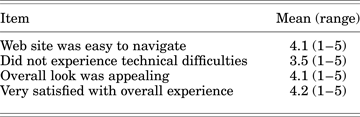
Data were analyzed in the winter of 2011, 18 months after the initial launch. Pre-course data (n = 318) revealed that the majority of course participants were nurses (68%); the next largest disciplinary group completing the pre-course survey were social workers (14%), with the remaining 18% comprising psychology, medicine, spiritual care (~3% each group) and another 9% self-identified as “other.” Post-course satisfaction data (n = 204) revealed that most people were satisfied with the course, scoring >4 on a 5 point scale (1 = totally disagree; 5 = totally agree) for three items (the web site was easy to navigate; the overall look of the website was appealing; I am very satisfied with my overall experience using this educational program) and a mean of 3.39 on the item “I did not experience any technical difficulties” (see Table 1). The program was designed to be completed in 5–6 hours. Post-course surveys for those who reported time (n = 164) revealed that 19% completed the program in <4 hours, 62% completed the program in 4–6 hours and 19% needed >6 hours to complete the program.
Course evaluation (N = 164)

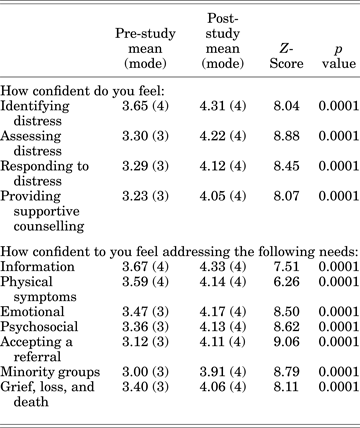
A total of 147 (30%) completed both the pre- and post-course follow-up survey. Significant changes were identified for all 11 items related to confidence. These included items such as: How confident do you feel assessing distress, responding to distress, and managing resistance to accepting a referral (see Table 2).
Matched pairs (N = 147)
1 = Strongly disagree to 5 = Strongly Agree
Qualitative Findings
The post-course survey included several narrative questions regarding the usefulness of the program to clinical practice and intended or actual changes to practice as a result of the program. A thematic analysis was completed and four themes were identified. These included: (1) increased awareness of patient and family distress, (2) comfort with difficult conversations, (3) substantiation of practice skills, and (4) visual presentation as helpful to inform practice.
Increased Awareness of Patients' Needs and Distress
Participants highlighted an increased awareness of several aspects of patient/family experiences in cancer care. Many expressed that the program broadened their view of the cancer experience on multiple levels. The importance of holistic care was highlighted: “It has made me more aware of the full impact of the cancer diagnosis on patients and their families.” The importance of attending to the “non physical needs” and an increased awareness of the pervasiveness of distress when experiencing cancer were also evident. For one participant, the course taught her “foremost that all patients experience some form of distress.” There was also a stated need to “be more aware of underlying emotional distress in treating physical symptoms.” This increased awareness extended beyond the person with cancer to include the distress and needs of the family; “this program has increased my sensitivity to the holistic needs of patients and their families.”
Comments from course participants revealed not only an awareness of the breadth of distress of patients and families but also nurses' intentions to make changes to their clinical practice. Comments such as the following were common: “I will make sure that I address the physical, practical, and emotional needs of the patient and family”; [I intend] “to be more mindful of the psychological impact of the cancer experience on patients and their families” and “more intentional and thorough in discussing various sorts of distress with my patients.” Another participant suggested that it was “a great help to be able to understand patient concerns and reasons why someone might refuse support or help [from a specialist].”
Comfort with Difficult Conversations
Many participants found the course beneficial in increasing their comfort and confidence in intervening with distress. Attention to the knowledge gained about the emotional aspects of the cancer experience was highlighted frequently.
I will be comfortable bringing up the emotional aspects of the disease. We are very good with the physical aspects and this course gave me the knowledge needed to deal with the emotional side.
For many, the increased comfort appeared related to the realization that creating opportunities for conversations about emotional aspects of the cancer experience did not mean they had to have to have “all the answers.” “One of the most important things I learned through this program is that I don't need to stress about finding solutions to client's problems all the time.” Some participants indicated a shift in their thinking from “fixing” to “facilitating.” This shift from fixer to facilitator portrayed a willingness to enter into conversations regarding the difficult aspects of living with cancer with a newly gained confidence and increased comfort level. As one participant highlighted:
I will have more confidence addressing these needs, feeling that I am more competent. In the past I was more reluctant to address these issues for fear I couldn't “fix” them for clients. I feel more that I am a guide and facilitator in the process.
Course participants indicated an increased awareness of the therapeutic relationship and the importance of spending more time attending to the relational aspects of cancer care. The course allowed many to “become much more aware of my listening and communication skills.” Some participants learned the value of “listening more and talking less” and that “simply listening and summarizing the client's thoughts will in itself help people to answer their own concerns.”
The conversation techniques and skills modelled in the course seemed to enable participants to see where and how they could support patients and families with their distress and offered some opportunities to expand their clinical repertoire. One example was in the use of questioning practices. One participant noted she “will be aware of what kind of questions to ask my patients to be able to assist with their needs,” whereas another suggested she was “more cognisant of techniques I can use to support patients along their journey.”
The course also provoked reflection about current practice. As one person stated: “you think you have a clue to what is going on only to realize you're not as smart as you thought you were. Knowledge is an ongoing lesson.”
Others also highlighted the need for continued practice of clinical skills.
I have already been using some of the techniques since taking this course, I just need practice and refinement. I am already using personal reflection in my practice and it has proved to be valuable in analysing my therapeutic interactions with patients.
There was also an appreciation for the message within the education program that the techniques presented could be, and should be, adapted to fit the practice area, one's practice style, and skill level. “Comments [provided in the program] that there is no right way that is correct and that everyone may have a bit different approach were important to me.”
Several participants highlighted the feasibility of screening for distress in a time-limited busy clinical practice setting. [This program] “made me more aware of the importance of distress screening and that it can be done in a timely manner.”
Confirmation of Practice Components
A number of participants stated that the program substantiated what they already knew and practiced: “It was very validating to know that I am 'on track' as a supportive professional working with families during this stressful time,” whereas another suggested that the program:
was an excellent review of the principles and theories as well as confirming aspects of practice that I do already. It helps me to reflect on my own interventions that I provide for my patients and families and be able to communicate better on some of those interventions with my colleagues, especially on the need for referral.
For others, the program offered a framework or a structure for clinical practice: “It validated things that I have been practicing but put it in context and order”; or “it formalized a lot of the skills I had attained over the last 25 years as an oncology nurse, but also gave me more confidence when approaching these aspects with clients.” Some seemed to find permission to take the time and assume the responsibility for attending to the psychosocial aspects of cancer.
Visual Presentation as Helpful to Inform Practice
One feature of the program was multiple video examples of the skills discussed in the program. The videos were one of the components of the program that were most frequently commented on, and seemed to play a key role in modeling and fostering confidence. This learning included not only what to expect from patients and families but also how to enter into conversations and how to proceed with interventions or referrals. One participant identified that she “really liked the videos as it gives me an idea of what to expect from patients & their families and discussions that may arise and how to deal with them” whereas another commented:
I found the video clips very useful in seeing how other healthcare professionals approach supportive care. I also appreciated that the professionals were younger as I am also younger and new to this type of work. It made me feel more confident in my choice to work in this type of job by seeing how effective the nurses were in the video. Sort of a “if they can do it, I can do it” attitude.
The videos provided an important role model of how screening for distress could be successfully accomplished in time-limited practice settings: “In attempting to do a targeted assessment of distress in a short amount of time – I learned much from the videos” and “the interview scenarios were good examples of how to approach screening and will provide me with direction on how to proceed, I just need practice.”
DISCUSSION
The evaluation of the education program suggests that it was effective in increasing knowledge and skills needed to integrate screening for distress into practice. The vast majority of the course participants were nurses; however, other disciplines also participated and found the program helpful. Our target of 5–6 hours to complete the program was met for the majority of participants.
Satisfaction with the course was consistently high. Technical difficulties were not infrequent, and this was the one area that required revision. The primary technical difficulty reported by participants was an inability to view the videos. Course videos were initially hosted on a university learning management system server. Participants reported problems less frequently when the videos were later uploaded to the Vimeo platform.
Statistically significant changes in the pre-post analysis were reported on all items. This including confidence in dealing with loss and grief, an area that did not receive high attention in the content of the course, but was modelled in the videos. There was evidence that the course shifted knowledge and attitudes, not only about screening for distress, but also with regard to providing initial responses to identified distress. Several participants described that they had shifted in thinking about their response to distress as being more of a “facilitator” than a “fixer” of the concern. This is likely a helpful and appropriate shift in attitude, particularly when the patient's concern is more psychosocial than biomedical.
Our findings also indicate that many course participants believed that they were already attending to distress in their day-to-day practice. However, many found that through participation in the course, confidence that they were “on track” increased, and they felt validated and given “permission” to attend to the psychosocial aspects of care. We have found in other IPODE project data that nurses, in particular, are inclined to believe that attending to psychosocial concerns is the purview of other disciplines, not theirs (McLeod et al., Reference McLeod, Curran and White2011). This is not an uncommon finding (Maguire & Pitceathly, Reference Maguire and Pitceathly2003; Kruijver et al. Reference Kruijver, Garssen and Visser2006). However, given that nursing standards of practice commonly cite responsibility for psychosocial aspects of care as an expectation of nurses' practice, particularly specialized oncology nurses (Canadian Association of Nurses in Oncology, 2006), it may suggest that nurses have inadequate opportunities to develop this aspect of their practice, and, perhaps, inadequate organizational support to enact this aspect of their role. The belief that this is not part of nurses' role certainly arises from somewhere other than nurses' formal education and their professional standards. It appears to be a common belief among other disciplines as well. For example, it is common when programs are designed to expand nurses' practice in psychosocial care, that nurses are described as “specially trained,” whereas other disciplines are not “specially trained” but rather described in other ways, such as being identified by their educational level (for one example, see Fenn et al., Reference Fann, Ell and Sharpe2012). We have suggested elsewhere (McLeod et al., Reference McLeod, Curran and White2011) that nurses should have the same level of education in counseling as other disciplines at the same educational preparation level. However, they receive far fewer opportunities to develop these skills in the workplace than do other disciplines in which the commitment to ongoing supervision, for example, is high. This would appear to be a major barrier to nurses' providing psychosocial care to the full scope of their licensure.
For nurses, and possibly other disciplines such as medicine and social work, in which high pressure, time-limited clinical settings encourage attention to quickly “fixing” identified problems versus facilitating with patients and family members, the development of their own solutions is an approach that is more congruent with tenets of patient-centered care (Gerteis et al., Reference Gerteis, Edgman-Levitan and Daley1993). When one is inclined to be more facilitative, listening skills gain higher priority. Such skills are needed if we hope to improve psychosocial care (Pinsker, Reference Pinsker1997; Maguire & Pitcealthy, Reference Maguire and Pitceathly2003; Douglas, Reference Douglas2008). The screening for distress education program provided participants with a vision for how one might accomplish this in practice.
The web-based format of the course allowed course participants to progress through the course in their own time, but also allowed repeated visits, a form of ongoing role modelling. Whereas it provided many benefits, there are obvious limitations to an independent study program such as this. We expected cancer centers to use the materials in their own education efforts, and have recently made this much more accessible by providing the program on DVD so that educators can use the components as they wish. We also expected that the program would not be completely “stand-alone”; rather we expected that centers would create opportunities for in-person practice of new skills. We are aware that in many instances this was indeed the case, but have no way of knowing how often that occurred. In smaller centers, however, the program may not be supplemented by any other educational activities. We see a need for some form of ongoing supervision as a standard of practice in psychosocial oncology, particularly for nurses, who may be less likely to engage in clinical supervision than are other disciplines such as social workers and psychologists.
CONCLUSION
Screening for distress is recognized as an integral component of cancer care guidelines and standards. Successful implementation of screening requires that frontline staff such as nurses are prepared and supported to not only discuss screening results but also to provide skilled supportive care in order for patient-reported outcomes to improve. Whereas patients experiencing more severe or complicated symptoms clusters will require referral to specialists, there is good evidence that with appropriate administrative and educational support, nurses and other frontline staff can provide good supportive care, and that such care falls within their scope of clinical practice. Furthermore, the literature has indicated that patients and their family members prefer continuity of care from a known, familiar healthcare professional.
Nurses may have fewer opportunities than other disciplines for ongoing education in the psychosocial aspects of care, and for clinical supervision. Although the scene in Canada is changing with the provision of university courses and continuing education through the IPODE project, most healthcare professionals learn about psychosocial care “on the job.” Brief education programs such as the one described here have good potential to address beginning learning needs related to screening for distress. However, follow-up practice and clinical mentoring/supervision are essential, if nurses and other healthcare professionals are to maintain and further develop the new skills learned in such programs.