This study analyzes the phenomenon of church paintings as subversive visual representations of Fascism and as an act of systematic rebellion against Fascist “ideological marking of space.” Slovene Expressionist painter and sculptor Tone Kralj's (1900−75) paintings functioned as ideological markers of national territory. He painted churches along the ethnic border as it was imagined by the Slovene community, delineating it with visual symbols of anti-Fascism and anti-Nazism. Kralj's undertaking can thus be interpreted as an instance of systematic “subversive coverage” of an ethnically exposed borderland with church paintings. Even today, his artistic “delineation” of the then-disputed ethnic border is a marking phenomenon that cannot be found anywhere else in Europe. If one of the most important authorities on Fascist ideology in Italy, Emilio Gentile, considers Fascist ideology to be a form of political religion and a modern manifestation of the sacralization of politics, then Tone Kralj's church paintings could be regarded as an instance of systematic introduction of the political and ideological into the religious context.Footnote 1 Perhaps the most ingenious feature of Kralj's ecclesiastical art is his fusion of Catholicism with the Slovene national idea for the purpose of ideologically marking and promoting anti-Fascism and anti-Nazism as well as Slovene nationalism and Slovene irredentism in the Julian March.
Historical Frame
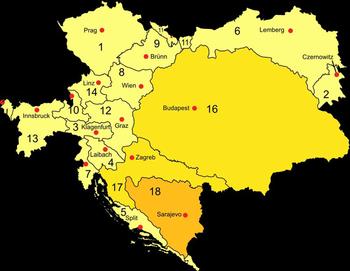
In the aftermath of World War I and the disintegration of Austria-Hungary, the Kingdom of Italy annexed the area along the Soča/Isonzo River. The area functioned as a natural border since antiquity: It separated the Roman Empire and Celtic tribes, the Germanic and Romance population, and the Slavic and Romance population; later, it functioned as the political border between the Venetian Republic and the Habsburg Empire; and in the nineteenth century, as the border between the Kingdom of Italy and Austria-Hungary (Figure 1). Since 1868, it was divided into three administrative units: Gorizia and Gradisca, Istria, and Trieste. As the symbolic towns of Italian irredentist eastward aspirations, Trieste and Gorizia were perceived as the two capitals of the “unredeemed lands” or terre irredente.
Austrian Littoral/Österreichisches Küstenland; No. 7 was one of the Crownlands of the Austrian Empire (1813–1918). Source in the public domain: https://commons.wikimedia.org/wiki/File:Austria-Hungary_map_de.svg.

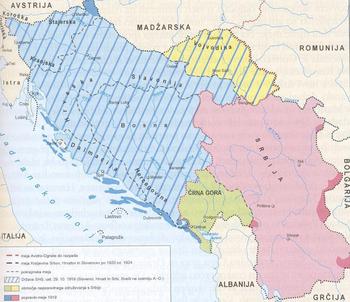
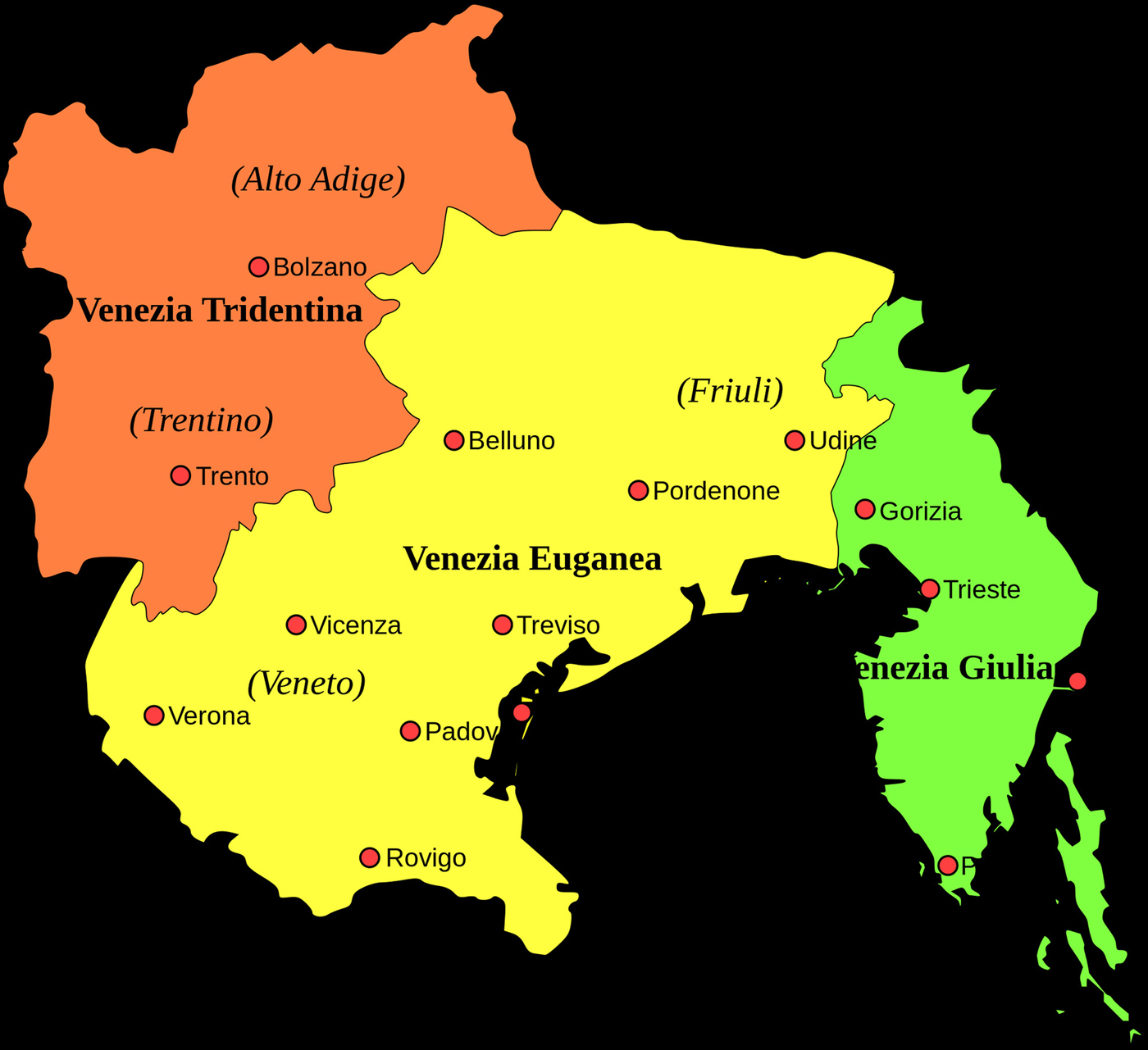
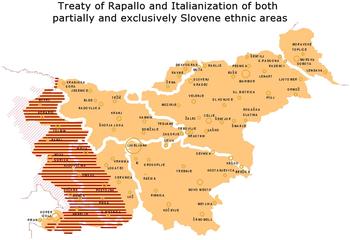
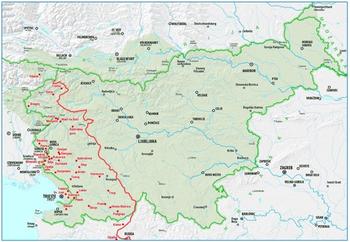
The end of World War I found Italy among the Triple Entente winners. Signed on 12 November 1920, the Treaty of Rapallo moved the political border of the Kingdom of Italy far to the east (Figure 2). Part of the former Austro-Hungarian territory thus became Italian, even though it had never been populated by Italian minorities. More than a quarter of the Slovene ethnic territory was now part of Italy, and in turn, more than 500,000 Slovenes and Croats who lived in the Julian March—the official name of the area annexed by the Kingdom of Italy—now formed Slovene and Croatian minorities within Italy and had no autonomy and no minority rights at all (Figures 3 and 4).Footnote 2 It was in this area that the ecclesiastical painter Tone Kralj created his lifework (Figure 5). Kralj's paintings—laden with anti-Fascist, Slovene irredentist, and nationalist ideological connotations—can be found in close to fifty churches in the Julian March.
The territory of Austria-Hungary that formed part of the Kingdom of Yugoslavia (marked with inclined lines) following its dissolution. Located in the upper left corner is the Julian March (with the dotted line representing the border between the two countries). Source in the public domain: http://historyofyugoslavia.com/sr/mape/.

Territory of the Julian March (Venezia Giulia in Italian) in November 1920, annexed by the Kingdom of Italy in accordance with the Treaty of Rapallo. ©Erinaceus/Wikimedia Commons/CC-BY-SA-3.0/GFDL Source: https://en.wikipedia.org/wiki/Triveneto#/media/File:Triveneto.svg.

The area shows the territory of the Julian March in the aftermath of the Treaty of Rapallo. The demarcation line represents today's border between the Republic of Slovenia and the Republic of Italy, which was moved back to the west after World War II. Source in the public domain: https://upload.wikimedia.org/wikipedia/commons/e/eb/Treaty_of_Rapallo.png.

Locations of Tone Kralj's church paintings in the Julian March (1921–75) are represented by the black dots. The full line delineates the eastern border of the territory annexed by the Kingdom of Italy in 1920, while the line (on the left) stands for today's border between Italy and Slovenia, which was determined at the Paris Peace Conference after the end of World War II and implemented in September 1947. Map made by Egon Pelikan.

The Status of Slovene and Croatian Minorities in the Julian March under Fascism
Italian Fascism neither acknowledged nor tolerated minority particularism and was especially aggressive toward the German minority in South Tyrol and the Slovene and Croatian minorities in the Julian March. As a result, the Fascists prohibited the use of the Slovene language in the Julian March, both in public and private—in the press, in toponymy, on tombstones, even in private communications, and in churches. The local population was even prohibited from giving their (Slovene) children “names offensive to Italianness.”Footnote 3 Confronted with these politics, the Slovene population in the Julian March revolted, but the state regime, police forces, and judiciary ruthlessly suppressed these gestures of revolt.
After the Holy See and the Mussolini's regime signed the Lateran Treaty in 1929, the former also became involved in suppression of minority rights.Footnote 4 In practice, the Vatican's ecclesiastical policy in the Julian March shared the same objective with the Fascists authorities: the settlement of the complicated situation in the Julian March. The only difference between them could be interpreted as the Vatican's intention to be more moderate in line with the famous Roman saying, fortiter in re-suaviter in modo (resolute in execution, gentle in manner). Events in the Julian March between the two World Wars reveal how this period was a unique manifestation of cuius regio, eius religio.Footnote 5 Similarly, the resistance of three hundred Slovene priests in the Julian March against the Vatican's and, simultaneously, Fascist Rome's policies appear to be a unique and radical phenomenon.
Between the two world wars, “Romanization” (understood as a synonym for Italianization) of the Church was the bone of contention between Slovenes and Italians within the Church in the Julian March. In his report to the Vatican Consistorial Congregation in 1932, the apostolic administrator of the Gorizia Archdiocese, Giovanni Sirotti, who did not hide his proregime orientation, made the following observations about his archdiocese: “The people blindly follow their priests in religious, national and political matters. If the clergy were less uncompromising and unbending when it comes to matters of national affiliation and politics, the people would be more pliable and open-minded, as well as respectful of the law … Slavic priests are also culpable for a heavier spiritual burden: they do not want to deliver sermons in the Italian language to the Italian minority. Owing to their intense hatred of Italy, they do not give up their irredentist stance and daydream about the border along the Isonzo River.”Footnote 6 In the midst of this general repression of Italy's Slavic population, the Slovene expressionist painter and sculptor Tone Kralj began creating a unique instance of “anti-marking” in the Slovene-Italian borderland (Yugoslav-Italian border at the time) of the Julian March by decorating church walls with subversive and monumental paintings. Kralj created the graphic language that was intelligible to the illiterate or, more precisely, to the people doomed to illiteracy, as was the case with Slovenes living under Fascist rule—the rule of Italianization—in the Julian March.
Methodological Frame
Over the last few decades, cultural landscape studies in Central Europe have increasingly employed the approach of the so-called spatial turn. The term implies the “reading” of historical palimpsests that mark the landscape by considering archeology, history (particularly cultural history), geography, town planning, and architecture. One of its aims is to answer the question regarding why a set of signs characteristic of a particular cultural landscape appears in a certain space.Footnote 7 One set of signs is regional identity or national semiotics, which, as a rule, implies a retrospective reading; as a result, characteristics and symbols created in the past to mark the landscape are today perceived as “national” (e.g., the “Slovene national landscape” is supposed to be represented by hayracks and church-topped hills, etc.). In the late nineteenth century, such traces left by national identities were ideologically related to the landscape and places in which meaning had been invested unknowingly and unintentionally, in other words, spontaneously.Footnote 8
Yet such investment of meaning in space can also be unspontaneous or, in other words, planned and systematic. In the twentieth century, Central Europe witnessed radical national and ideological encroachments on urban and nonurban spaces through the premeditated application of the semiotics of alleged “national essence” and other ideological identities produced by the twentieth-century ideologies. As a result of such encroachments, regions (e.g., Südtirol/Altoadige or Julian March/Venezia Giulia) saw the development of a special phenomenon of phantom borders: They appeared on the margins of spaces to which a certain national or ideological identity had been ascribed and, as a rule, are not in accord with today's political borders. To quote the Germanist Jörg Döring, “We can recognize them if we can read time in space.”Footnote 9 Thus the landscape can be understood as space that speaks ideological language.Footnote 10
Italianità and Spatial Marking by the Fascist Regime
During the Fascist era, the ideological marking of space in the Julian March was largely an act of the regime, which meant that space was marked to express “Italianness” (italianità). Coined during the nineteenth-century Risorgimento movement in Italy, this term signified ideational, political, and ideological unification of the imagined Italian area with the supposed “Italian essence.”Footnote 11 After the annexation of the new territories of Südtirol/Alto Adige and Julian March/Venezia Giulia to Italy at the end of World War I and the rise of Fascism, “authentic Italian identity” collided with historical spaces from completely different historical contexts.Footnote 12 The newly acquired Julian March and South Tyrol were the two regions that, in the aftermath of World War I and the disintegration of the Austro-Hungarian Monarchy, witnessed the erasure of the previous ideological spatial marking and the drawing of a new one as a result of radical political measures introduced by the Italian state and regime. Italianità (as well as romanità)—this allegedly authentic Italian identity, which was ideologically constructed—was supposed to encompass the arts, natural landscape, urban landscape, town planning, sacred and profane architecture, and even certain plants that testified to the Italianness of space. In urban space, Italianness was initially represented by architectural structures erected during the renovation of this borderland, which was demolished and devastated by World War I when it was part of the Isonzo Front.
During this period, the marking of space predominantly entailed the fields of architecture and town planning, with small towns and villages witnessing the construction of Fascist dopolavoro centers for recreation and relaxation, school complexes, churches, post offices, municipal buildings, Fascist party buildings (case del fascio), and train stations. One still finds them in the almost every single Slovene village located in the former Julian March. Today they are no longer only functional buildings but also memorials to the attempts to transfigure and to mark urban and rural space in line with the Fascist ideology and the notion of Italianness. This transfiguration often involved the appropriation of architectural styles. It was not a coincidence that onion-shaped Baroque tops of bell towers were replaced by pyramid-shaped Venetian-Aquileian types. However, the most representative markers of space were memorials to World War I constructed after 1918, which included ossuaries, obelisks, monuments to unknown soldiers, and memorial plaques that venerated Italian soldiers who gave their lives in regaining terra irredenta.Footnote 13
Church Paintings—Alternative Marking by the Slovene Painter
Kralj decorated the entire interior of forty-five churches, while in others he painted only the presbytery or one of the naves. As Figure 5 shows, he literally painted the entire “Slovene ethnic border,” as it was imagined by the Slovene community. He did not create similar church paintings on the other side of the border in the territory of Kingdom of Yugoslavia. His undertaking started when this part of the Slovene ethnic territory was under the rule of Fascist Italy (1922–43) and continued through the brief period during which this area was a part of the Nazi Operational Zone of Adriatisches Küstenland (1943–45) and in the aftermath of World War II, when it became a part of Tito's Yugoslavia (with the Paris Peace Treaties in 1947).
The characteristics of Kralj's wall paintings in the Slovene-Italian borderland created an alternative, anti-Fascist marking of space and are presented in the following text. Typically, his church paintings ideologically marked the space in a concealed yet obvious manner. We can observe motifs referring to Slovene and Yugoslav traditions, Slovene national colors (constellations of white, blue, and red), Slavic Saints Cyril and Methodius, and the Madonna dressed in the Slovene national colors as the protectress of Slovenes. Opponents of these figures and signs of the Slovene national idea are represented as bandits wearing clothing with the Italian tricolor of green, white, and red, as the rabble with their right arms raised in the Fascist salute (saluto romano), and as important representatives of the Fascist regime in the role of biblical villains. Depicted with irony, cynicism, provocativeness, and grotesqueness, religious motifs intertwine with national symbols and convey very unambiguous messages of Slovene anti-Fascism, irredentism, and nationalism. What arises in otherwise traditional, conservative church milieu is a special counterregime subculture—a subculture in conflict with the official, national, and exclusivist culture dictated by the Fascist regime. Given its didactic address to its target audience, this phenomenon is reminiscent of the medieval Biblia pauperum (Poor Man's Bible), especially in its declarative narrative of modern strip and in its rebellious nature of one of today's most characteristic visual expressions of subculture—socially engaged graffiti.
Two Case Studies: Šentviška Gora, 1941 (Parish Church of St. Vitus), and Hrenovice, 1942/1943 (Parish Church of St. Martin)
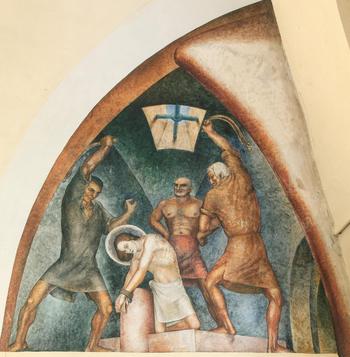
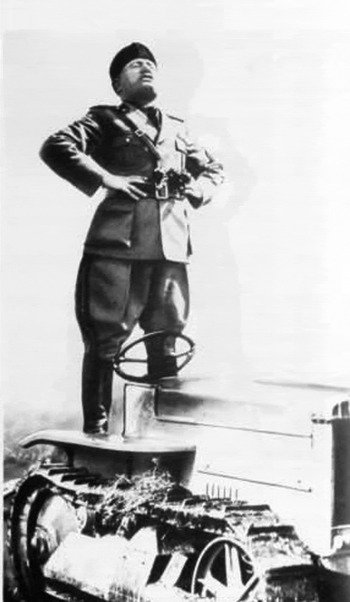
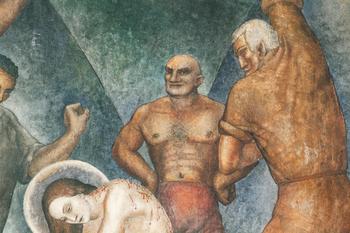
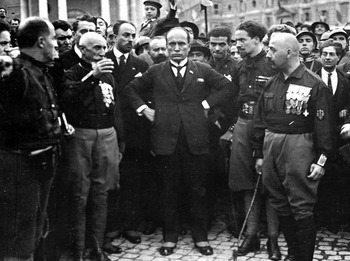
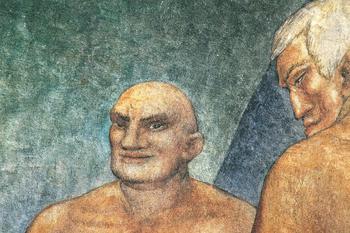
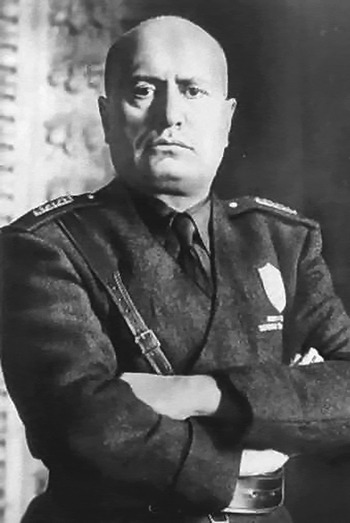
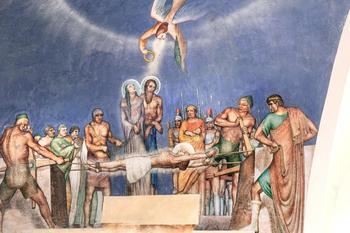
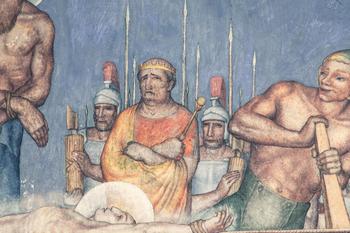
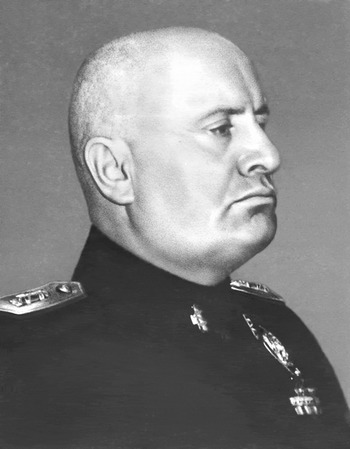
The locations of the churches that Tone Kralj painted (see Figure 5) reveals that Kralj's demarcation of space extended from the Julian Alps to the Adriatic Sea, that is, from the north to the south of the Julian March. Two of the churches located in the middle of this “invisible line” provide a detailed description of Kralj's subversive painting: the church atop the village called Šentviška Gora and the church in the village of Hrenovice. Kralj painted the following subjects in Šentviška Gora in 1941: The Liberation of St Peter, The Conversion of St. Paul in the Presbytery, St. Daniel in the Lions’ Den, St. Vitus on the Rack, The Boy Jesus in the Temple, the Healing of a Demon-Possessed Man, St. Vitus in the Cauldron, and The Flagellation of St. Vitus in the nave. In The Flagellation of St. Vitus (Figure 6), Kralj gave the Fascist leader Benito Mussolini the role of the supervisor of the flagellants of St. Vitus (Figure 7), representing the Slovene nation, with the latter being whipped by two torturers representing the two totalitarian ideologies: a Blackshirt (Italian Fascism) and a Brownshirt (German Nazism). Mussolini can be recognized owing to his typical posture with his hands on his hips (Figures 8 and 9), his chin protruding forward, and his typical sarcastic grimace (Figures 10 and 11). Many years later, the painter recalled: “From Sveta Lucija (Most na Soči) I went to Šentviška Gora. There I depicted St. Vitus as the symbol of the small Slovene nation: a child attacked by the beasts. On the side of the vault is a Slovene mother running away together with her child, while lying in the corner is the possessed man—this is a portrayal of Adolf Hitler. St. Vitus is exorcising the demon from him. Two men, one a Fascist in a black shirt, the other a Nazi in a brown shirt, are beating the imprisoned child. I painted many similar motifs there.”Footnote 14
Tone Kralj, The Flagellation of St. Vitus, Church of St. Vitus, Šentviška Gora, 1941. Photograph by Matjaž Prešeren.

Mussolini in a typical pose. Image in the public domain: https://commons.wikimedia.org/wiki/File:Mussolini_Catepillar.png.

Detail of the supervisor of the flagellation in The Flagellation of St. Vitus. Photograph by Matjaž Prešeren.

Benito Mussolini, during the March on Rome, 1922. Image in the public domain: https://commons.wikimedia.org/wiki/File:March_on_Rome.jpg.

Closer detail of The Flagellation of St. Vitus. The supervisor of the flagellation is portrayed with Mussolini's typical sarcastic grimace. Photograph by Matjaž Prešeren.

Mussolini's grimace. Image in the public domain: https://commons.wikimedia.org/wiki/Category:Benito_Mussolini#/media/File:Mussolini_mezzobusto.jpg.

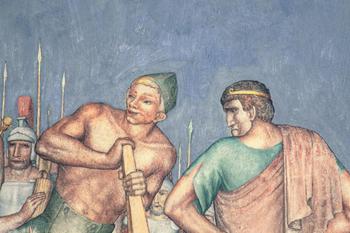
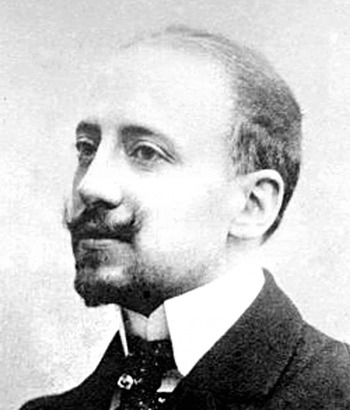
St. Vitus on the Rack (Figure 12) depicts a soldier wearing an Italian helmet, standing on the left, and a soldier wearing a German Nazi infantry cap, standing in leather breeches on the right. Like The Flagellation of St. Vitus, Mussolini is depicted supervising the torture, with two Fascist bundles of sticks visible in the background (Figures 13 and 14). Standing beside the torturer wearing the German military cap is the assistant to the supervisor, that is Mussolini (Figure 15). The assistant's image recalls Gabriele D'Annunzio, the icon of the Fascist regime, whom Kralj often depicted in his paintings (Figure 16).Footnote 15
Tone Kralj, St. Vitus on the Rack, Church of St. Vitus, Šentviška Gora, 1941. Photograph by Matjaž Prešeren.

Detail of Mussolini-like figure supervising torture in St. Vitus on the Rack. Photograph by Matjaž Prešeren.

Photograph of Mussolini. Image in the public domain: https://commons.wikimedia.org/wiki/File:Benito_Mussolini_portrait_as_dictator_(retouched).jpg.

Detail of torturers in St. Vitus on the Rack. Photograph by Matjaž Prešeren.

Photograph of Gabriele D'Annunzio. Image in the public domain: https://commons.wikimedia.org/wiki/File:Gabriele_D%27Annunzio.jpg.

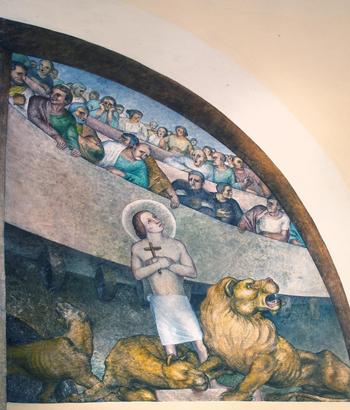
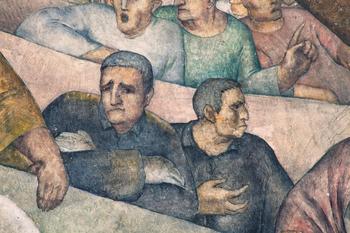
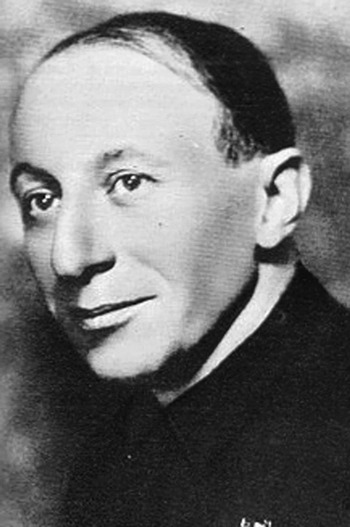
St. Vitus Being Thrown to the Beasts (Figure 17), which is visible above the choir loft, portrays a motif Kralj had already employed in Parish Church of St. Sylvester in Piuma/Pevma in 1934. Standing amid the enraptured crowd and enjoying the cruel scene of Christians being fed to the beasts are two twentieth-century men in black shirts with collars—Fascists (Figure 18). Their repulsive claws testify to the devil or the evil in them. One of them looks astonishingly similar to a former president of the Fascist party (Partito Nazionale Fascista—PNF), Augusto Turati (Figure 19).
Tone Kralj, St. Vitus Being Thrown to the Beasts, Church of St. Vitus, Šentviška Gora, 1941. Photograph by Matjaž Prešeren.

Detail of the crowd in St. Vitus Being Thrown to the Beasts. Photograph by Matjaž Prešeren.

Photograph of Augusto Turati. Image in the public domain: https://commons.wikimedia.org/wiki/File:Augusto_Turati.jpg.

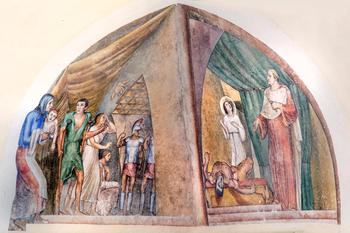
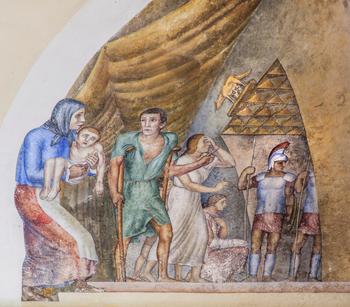
In The Sick and the Invalid on a Pilgrimage to St. Vitus (Figure 20), a mother is walking amid the poor and holding a child in her arms. The mother is dressed in the Slovene national colors: white, blue, and red (Figure 21). The upper-right corner contains the image of a she-wolf—the symbol of the Roman Empire that Fascism adopted. Fascist propaganda used historical motifs to compensate for its ideological deficiencies. In contrast to the Social Darwinism of Nazi racial ideology, which was more consistent despite its absurdity, Fascism lacked a clear ideological scheme. Fascists therefore based their ideology on their “direct” ancestors who were supposed “to evoke the Roman spirit and appear on stage of world history from time to time”: They found them in the Roman Empire (during the time of Caesar and not the Republic), in the role that the Venetian Republic played in the Adriatic, in Italian unification (Risorgimento), and finally in the culmination of the alleged unification of the nation—World War I.Footnote 16
Tone Kralj, The Sick and the Invalid on a Pilgrimage to St. Vitus, Church of St. Vitus, Šentviška Gora, 1941. Photograph by Matjaž Prešeren.

Detail of The Sick and the Invalid on a Pilgrimage to St. Vitus, showing the mother wearing the Slovene national colors with child. Photograph by Matjaž Prešeren.

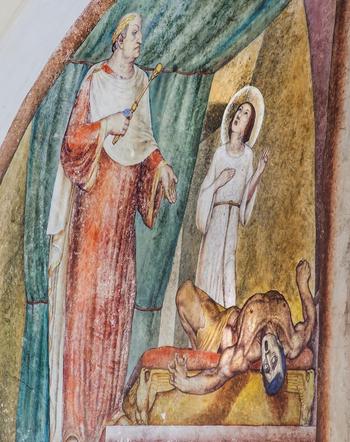
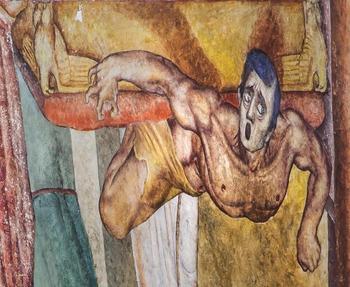
“The Roman spirit” (romanità), which from time to time over the course of Italian history “rose from the ashes of history,” was seen to reach its teleological “realization” in October 1922 when Fascists rose to power (anno I. dell'era fascista).Footnote 17 The Fascists used symbols representing the power of ancient Rome in their own ideological context and attributed positive connotations to them, perceiving them as constitutive ideological symbols of their Fascist state and society. Kralj's anti-Fascism employed the very same historical symbols in the same role—as the symbols of the Fascist regime—yet imbued them with clearly negative connotations. He used them subversively to depict the atrocities committed by the regime against Slovenes in Italy. He combined them with anti-Nazi motifs, thus ingeniously retelling biblical stories. For instance, in Healing a Demon-Possessed Man (Figure 22), the Führer's face can be recognized only if the image is turned upside down (Figure 23). On his left and right sides are two Nazi eagles. Tone Kralj decorated Slovene churches with these anti-Fascist and anti-Nazi motifs in the time when the two totalitarian regimes were at the height of their military and political power. Had he been discovered, Kralj would have paid for such audaciousness with his life.
Tone Kralj, Healing a Demon-Possessed Man, Church of St. Vitus, Šentviška Gora, 1941. Photograph by Matjaž Prešeren.

Detail of “the insane Führer” in Healing a Demon-Possessed Man. Photograph by Matjaž Prešeren.

Hrenovice, 1942/1943 (Parish Church of St. Martin)
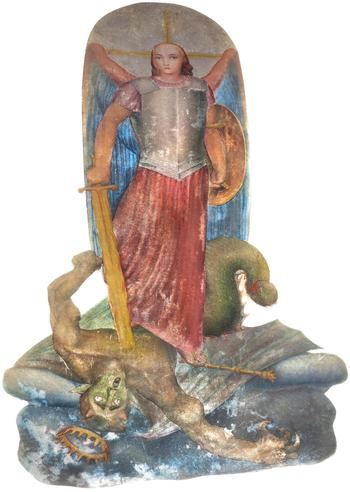
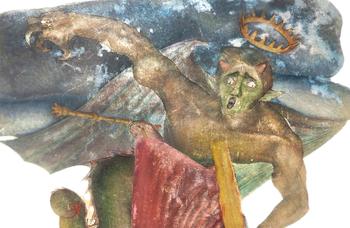
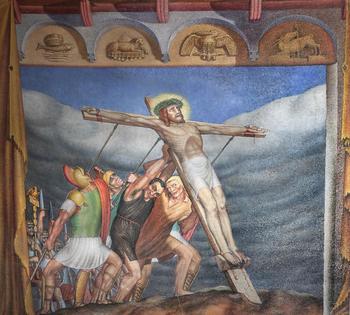
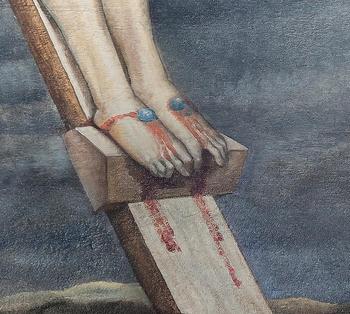
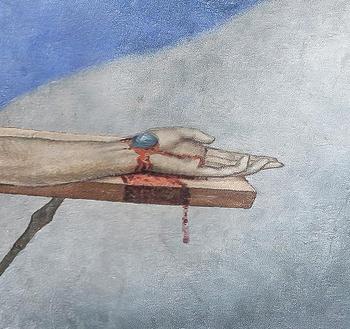
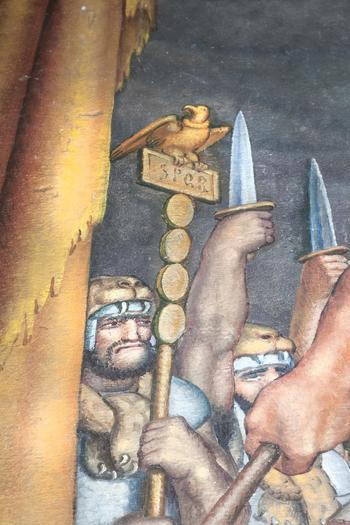
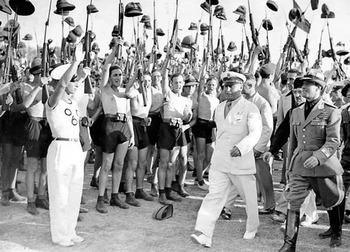
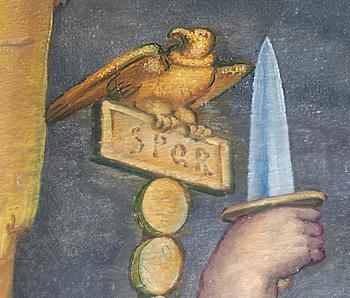
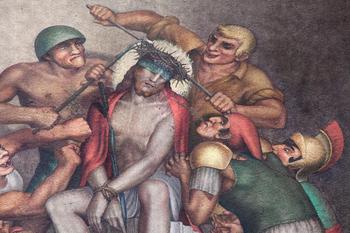
Kralj's anti-Fascist and Slovene national(ist) biblical narration reappears in the Church of St. Martin in the village of Hrenovice. Kralj painted the following subjects here in 1942 and 1943: The Death of the Virgin, Pentecost, St. Michael, Saints Cyril and Methodius, The Apostles to the Slavs, The Assumption, The Resurrection, and The Coronation of the Virgin in the presbytery. He decorated the nave with paintings of The Crucifixion, Jesus Meeting His Mother, The Crowning with Thorns, The Flagellation, Visitation, Jesus in the Temple, The Holy Family, and Christ on the Mount of Olives and the Annunciation on the chancel arch. Many years after the end of World War II, he commented on his work in an interview: “I left Šentviška Gora for Hrenovice. There I depicted the torments of the oppressed Slovene nation by exploring the subject of the Flagellation of Christ. The soldiers torturing Christ are wearing Italian helmets, while the Crucifixion features soldiers with Fascist sabers.”Footnote 18 In St. Michael (Figure 24), the Archangel Michael is depicted stabbing Satan from whose head falls the crown of the Nazi kingdom of evil. Like the mother in The Sick and the Invalid on a Pilgrimage to St. Vitus, Michael's clothes are in the Slovene national colors. When the image is turned upside down (Figure 25), we recognize Nazi Germany and its Führer with his typical moustache. The Crucifixion (Figure 26) features the collaboration of a Blackshirt and a blond-haired Brownshirt in the crucifixion (of the Slovene nation). A Roman soldier on the left side of the painting offers them support. The solider shares Mussolini's features and is painted in the Italian national colors of white, green, and red. The blue of the nails, the red of the blood, and the white of the wood and the skin evoke the Slovene tricolor (Figure 27). The motif of the Slovene national colors reappears in the image of the bleeding hand of the crucified Jesus (Figure 28). The lower right corner shows Italian legionaries greeting the crucifixion by raising their daggers in a typical Fascist salute (Figures 29 and 30). Kralj found such motifs in the contemporary press, on posters, and in the so-called Cinegiornale, newsreels that were mandatory in Fascist Italy, which served the same function as Wochenschau in Nazi Germany. Sitting on the legionaries’ insignia (Senatus Populusque Romanus) is not a Roman eagle but a hybrid of the hen and the griffon vulture waiting for the carcass of decaying Fascism (Figure 31).
Tone Kralj, St. Michael, Church of St. Martin, Hrenovice, 1943. Photograph by Matjaž Prešeren.

Detail of “the Führer” in St. Michael. Photograph by Matjaž Prešeren.

Tone Kralj, The Crucifixion, Church of St. Martin, Hrenovice, 1943. Photograph by Matjaž Prešeren.

Detail of The Crucifixion evoking the Slovene tricolor with blue nails, red blood, and white skin and wood. Photograph by Matjaž Prešeren.

Detail of The Crucifixion showing the image of the bleeding hand. Photograph by Matjaž Prešeren.

Detail of the Italian legionaries in The Crucifixion. Photograph by Matjaž Prešeren.

Mussolini reviewing Blackshirt youth, 1935. Image in the public domain: https://commons.wikimedia.org/wiki/Category:Benito_Mussolini_in_1935#/media/File:Has_seven_1_a.jpg.

Sitting on the legionaries’ insignia (Senatus Populusque Romanus) is not a Roman eagle but a hybrid of the hen and the griffon vulture waiting for the carcass of decaying Fascism. Photograph by Matjaž Prešeren.

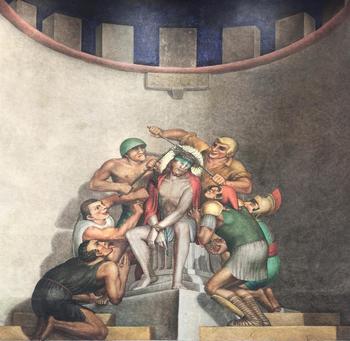
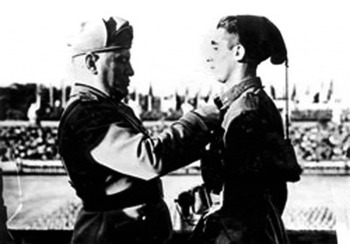
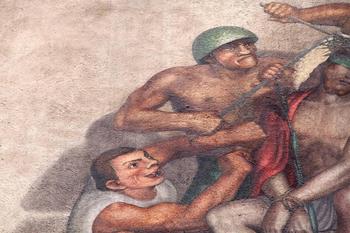
The Crowning with Thorns also features the collaboration of a Blackshirt and Brownshirt (Figure 32). Their assistants are wearing the Italian national colors. An ardent participant in the crowning of Jesus (again depicted in the Slovene national colors) is Mussolini wearing an Italian military helmet (Figures 35 and 36). Spitting in the martyred Christ's face is a figure in the Italian national colors covered with a typical Fascist cap worn in World War I by special units of the Italian army, the elite storm troops (arditi) who were fighting during World War I on the Isonzo front (Figure 33). After the end of war, several arditi soldiers became members of the Fasci of Combat (fasci di combattimento) (Figure 34).Footnote 19
Tone Kralj, Crowning with Thorns, Church of St. Martin, Hrenovice, 1943. Photograph by Matjaž Prešeren.

Detail of figure in Italian military helmet in Crowning with Thorns. Photograph by Matjaž Prešeren.

Photograph of Mussolini decorating a young Fascist with an arditi cap, 1942. Image in the public domain: https://commons.wikimedia.org/wiki/Category:Benito_Mussolini_in_1942#/media/File:Giovani_Fascisti_Foto_G11.jpg.

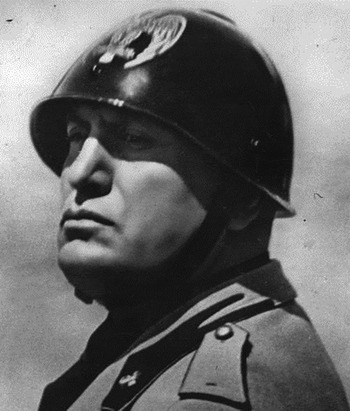
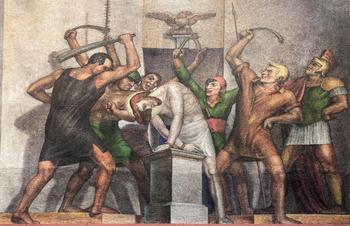
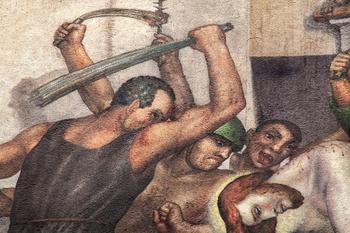
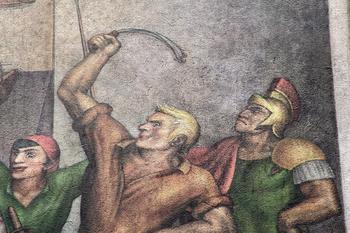
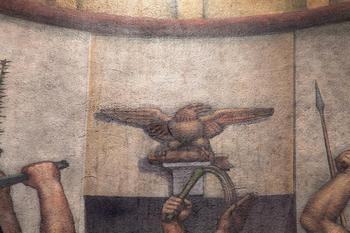
Colors similar to those employed in Crowning with Thorns are also used in The Flagellation (Figure 37). Supervising the flagellation in the right corner is Mussolini depicted in the Italian national colors and with his forward-jutting chin. But his face can also be observed in the left half of the picture, wearing the Italian helmet. This mode, that is the duplication of the same figures in the same scene, is one of the recurring features of Kralj's church paintings (Figures 38 and 36). Dressed in the praetorian uniform, the supervisor of the flagellation is again depicted with Mussolini's facial features (Figure 39). It also shows the Nazi eagle clutching the bundle—the symbol of Italian Fascism (Figure 40).
Mussolini-like figure holding the crown of thorns in Crowning with Thorns. Photograph by Matjaž Prešeren.

Mussolini wearing an Italian helmet. Image in the public domain: https://commons.wikimedia.org/wiki/File:Benito_Mussolini_Portrait.jpg.

Tone Kralj, The Flagellation, Church of St. Martin, Hrenovice, 1943. Photograph by Matjaž Prešeren.

Detail of figure in Italian military helmet in The Flagellation. Photograph by Matjaž Prešeren.

Detail of The Flagellation showing the supervisor, dressed in the praetorian uniform and depicted with Mussolini's facial features. Photograph by Matjaž Prešeren.

Detail of Nazi eagle in The Flagellation. Photograph by Matjaž Prešeren.

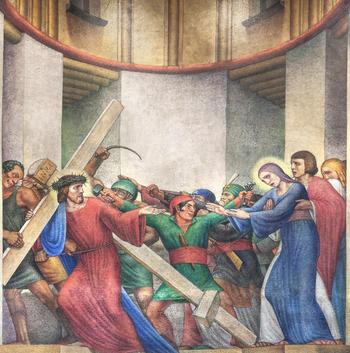
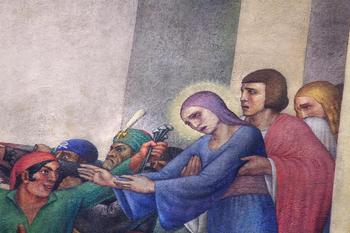
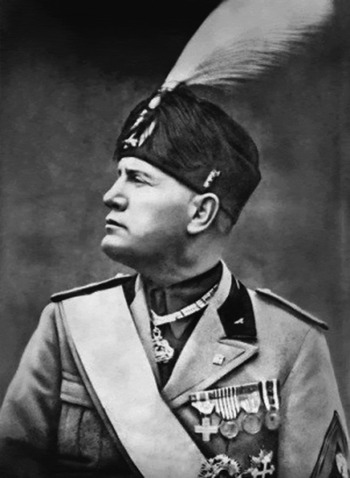
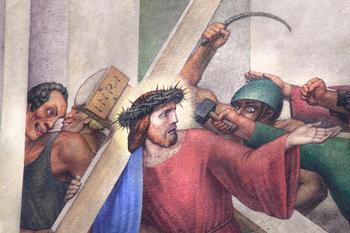
In Kralj's depiction of Jesus Meets His Mother on the Road to Calvary (Figure 41), Mary and her companion John the Evangelist are dressed in colors evoking the Slovene tricolor. Jesus meets his mother Mary. They are also both dressed in the Slovene national colors. The detail reveals another portrait of Mussolini. Wearing his habitual parade cap, he is urging people to move on (Figures 42 and 43). Once again, we can observe the duplication of his figure: Mussolini is also depicted as a soldier with the Italian military helmet and brandishing a whip above Jesus's head (Figure 44). Behind his head, there is a right arm extended in the Fascist salute (saluto romano).
Tone Kralj, Jesus Meets His Mother on the Road to Calvary, Church of St. Martin, Hrenovice, 1943. Photograph by Matjaž Prešeren.

Detail of Mussolini-like figure wearing a parade cap in Jesus Meets His Mother on the Road to Calvary. Photograph by Matjaž Prešeren.

Postcard of Mussolini with a parade cap. Property of Egon Pelikan family.

Detail of figure in Italian military helmet brandishing a whip in Jesus Meets His Mother on the Road to Calvary. Photograph by Matjaž Prešeren.

Conclusion
Tone Kralj's body of work makes Primorska part of the larger European story of the ideological marking of space. According to Rudolf Jaworski and Peter Stachel, when it comes to “the struggle for public space,” Central Europe turns out to be the very point in which instances of ideological marking condense in a paradigmatic manner and thereby reveal typical twentieth-century dynamics.Footnote 20 It is in this space that such dynamics are concentrated, entailing a multifaceted encounter of various identities and currents: religious, political, national, ideological, regional, local, and particular versus global and universal. As a phenomenon, Kralj's church paintings form part of this complicated Central European history and shed light on the complex and specific Slovene-Italian border space or “area of contact.” They undoubtedly put the area on the map in a very inventive, unique, and original way. The churches at Šentviška Gora and Hrenovice contain a typical selection of iconographic motifs that Kralj employed for his ideological spatial marking in churches along the Slovene-imagined Slovene-Italian border. He systematically marked space with motifs testifying to Slovene anti-Fascism, irredentism, and nationalism.
There is still no answer to the question of how it was possible that neither the Italian nor the German occupational regimes discovered Kralj's subversive artistic undertaking throughout the interwar years and World War II. Examination of materials from archives of prefectures and quaestorships in Gorizia and Trieste and of the secret police in Rome (Caselario politico centrale) reveals that there is no record of the painter either in police files or in other documents. It appears that various Fascist commissions, quaestors, prefects, and eventually the Nazi authorities during the time of Adriatisches Küstenland proved unable “to see the forest from the trees.” Inspectors saw the paintings in isolation because they visited just one church. Had they visited more churches at the same time, they might have noticed that the painter was playing a secret ideological game with them, hiding subversive images and messages in plain sight. A master with the brush, Tone Kralj painted a “phantom border” to mark the imagined Slovene ethnic territory. His paintings fused the ideas of anti-Fascism, anti-Nazism, and Catholicism with the Slovene irredentism and nationalism of the time. Central Europe has had many such phantom borders, yet this case is undoubtedly of a very particular spatial phenomenon in terms of political and ideological subversion.