Introduction
Tonsillectomy is one of the most popular surgical procedures. Although it is regarded as a safe operation, otolaryngologists should be aware of possible complications. Primary or secondary haemorrhage is the most common serious complication of tonsillectomy. Other typical complications include: pain, dysphagia, dehydration, weight loss, vocal changes and anaesthetic complications.Reference Colclasure and Graham1, Reference Hilton2
Taste distortions constitute a rare long-term complication of tonsillectomy. In a recent review on this topic,Reference Tomita and Ohtuka3 Tomita and Ohtuka described 12 cases of post-tonsillectomy dysgeusia reported in the literature since 1950. Direct or indirect damage to the lingual branch of the glossopharyngeal nerve (IXth cranial nerve) is considered a major cause of this complication.Reference Tomita and Ohtuka3–Reference Uzun, Adali and Karasalihoglu10
We describe the case of a 29-year-old man who suffered from severe post-tonsillectomy dysgeusia and phantogeusia with secondary weight loss and depression-like symptoms. In contrast to previous reports,Reference Tomita and Ohtuka3, Reference Collet, Eloy, Rombaux and Bertrand6–Reference Uzun, Adali and Karasalihoglu10 our patient had a normal taste threshold and sensitivity to touch on the posterior tongue, i.e. in the area innervated by the lingual branch of the IXth nerve. Elevated taste threshold and reduced sensitivity to touch was found on the caudal part of the soft palate (the palatoglossal arches).
Case report
A 29-year-old, white office worker underwent a tonsillectomy by the dissection technique, at a peripheral hospital, due to a long history of recurrent tonsillitis. The post-operative period was uneventful, and the patient was discharged from hospital three days later.
Seven days after surgery, the patient was admitted to the Department of Otolaryngology, Warsaw Medical Academy, because of secondary haemorrhage from the right tonsillar bed. The complication was successfully treated with electrocautery and suture ligation of bleeding vessels. An ear, nose and throat examination did not reveal any other abnormalities. Medical history and physical examination was unremarkable. The patient was a non-smoker and had never lived with smokers. On further questioning, the patient reported that some foods tasted bitter after the tonsillectomy. In particular, sour (e.g. orange juice) and sweet (e.g. chocolate) foods produced a strong bitter or bitter-metallic taste. This bad taste was experienced ‘in the back of the mouth, on both sides’ and was induced by food swallowing. However, the patient did not notice any difficulties with swallowing or speech articulation.
Within the next few weeks, the patient's dysgeusia increased in severity, to the point where all foods produced a long-lasting, bitter taste which could not be eliminated by mouth-washing or tooth-brushing (i.e. phantogeusia). The patient started to drink more water and eliminated sweets, white bread and sour foods from his diet. His body weight dropped from 77 to 70 kg (height: 184 cm) and his overall quality of life decreased significantly.
The patient was referred to a specialised taste and smell clinic for further diagnosis. Taste and olfactory function were examined twice, according to the procedure used in our previous studies.Reference Scinska, Sienkiewicz-Jarosz, Kuran, Ryglewicz, Rogowski and Wrobel11–Reference Wrobel, Skrok-Wolska, Ziolkowski, Korkosz, Habrat and Woronowicz13 The first examination occurred nine weeks after the tonsillectomy, and the second test was performed 11 weeks later, i.e. 20 weeks after surgery.
Taste and olfactory function was tested in a well ventilated and temperature-controlled room, between 4 p.m. and 6 p.m. The patient was asked to refrain from eating and drinking for at least one hour prior to testing. Electrogustometry was performed with the aid of the TR-06 electrogustometer (Rion, Tokyo, Japan). The initially ascending, single ‘staircase’ detection threshold procedure was used to assess electrogustometric thresholds.Reference Scinska, Sienkiewicz-Jarosz, Kuran, Ryglewicz, Rogowski and Wrobel11–Reference Wrobel, Skrok-Wolska, Ziolkowski, Korkosz, Habrat and Woronowicz13 Whole-mouth taste identification was assessed with the aid of a set of 12 filter paper discs.Reference Scinska, Sienkiewicz-Jarosz, Kuran, Ryglewicz, Rogowski and Wrobel11, Reference Sienkiewicz-Jarosz, Scinska, Kuran, Ryglewicz, Rogowski and Wrobel12 Identical paper discs (1.3 cm in diameter) were dipped into solutions of sucrose (6.25, 25 and 60 per cent weight for weight), quinine hydrochloride (0.025, 0.1 and 0.4 per cent), citric acid (0.25, 1 and 4 per cent) or sodium chloride (1.25, 5 or 20 per cent) and dried at room temperature. The patient saturated the filter paper with saliva, tasted the liberated tastant within the entire oral cavity and identified its taste using one of five categories: sweet, bitter, sour, salty or none of the above. Control subjects aged 51 to 75 years, recruited to one of our previous studies, correctly identified 10.3 ± 0.4 taste samples.Reference Scinska, Sienkiewicz-Jarosz, Kuran, Ryglewicz, Rogowski and Wrobel11 Olfactory identification was assessed with the aid of commercially available Sniffin' Sticks (Burghard, Wedel, Germany) and the forced choice procedure. Sixteen common odours were presented in pen-like odour-dispensing devices in front of both nostrils. The patient identified each odour using one of four descriptors.Reference Hummel, Kobal, Gudziol and Mackay-Sim14
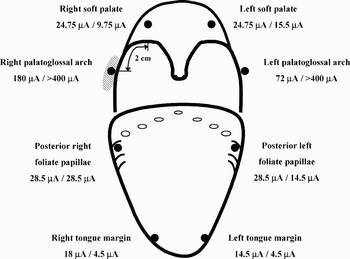
In the first test, the electrogustometric threshold on the right palatoglossal arch far exceeded that on the left palatoglossal arch. In other regions of interest (Figure 1), electrogustometric thresholds were within acceptable limits. Taste identification abilities were significantly impaired, as the subject identified only six of the 12 taste samples. Notably, none of the three bitter samples were correctly identified, mainly because bad taste in the mouth masked the taste of quinine. Olfactory identification was within normal limits.Reference Hummel, Kobal, Gudziol and Mackay-Sim14
Schematic drawing of the human tongue and soft palate, showing the location of areas examined with electrogustometry (black circles). A stimulus electrode was placed on the tongue tip (1.5 cm from the midline), the most posterior foliate papillae, the palatoglossal arches and the soft palate (0.5 cm caudally from the margin between the soft and hard palate). Data shown represent electrogustometric thresholds as assessed in the first and second test, i.e. 9 and 20 weeks after the surgery, respectively. The small, hatched area represents the region of the right palatoglossal arch where insensitivity to touch was found in the second test.

Neurological findings were unremarkable, except for a reduction of the gag reflex on the right palatoglossal arch and mild deviation of the uvula, possibly related to post-operative scar contracture. A strong gag reflex was found on both sides of the posterior tongue. Magnetic resonance imaging of the brain and skull base revealed no pathological changes. Neurological consultation excluded glossopharyngeal neuralgia.Reference Odeh and Oliven15
The patient's long-term dysgeusia with phantogeusia led to lowered mood, social withdrawal, reduced productivity, avoidance of sweet foods and weight loss, i.e. a depression-like symptomatology.Reference Griez, Faravelli, Nutt and Zohar16 However, detailed psychiatric examination excluded major depression, physical or social anhedonia, eating disorders, and drug and alcohol abuse. The psychological consequences of dysgeusia were attributed to the special role which taste sensation had played in the patient's life before tonsillectomy.
Dysgeusia and phantogeusia disappeared between the first and second examination. The patient still avoided chocolate and orange juice, but his overall quality of life improved greatly. He could enjoy meals again and started to gain weight (2 kg). At this stage, electrogustometric thresholds measured on the palatoglossal arches were found to be above the upper limit of the apparatus (>400 µA), indicating local ageusia. A part of the right palatoglossal arch was also completely insensitive to touch (Figure 1). The patient identified eight of the 12 taste samples. Two of the three bitter samples were correctly identified.
Discussion
Taste distortion is a rare but significant complication of tonsillectomy.Reference Tomita and Ohtuka3, Reference Goins and Pitovski8 Post-tonsillectomy dysgeusia is thought to result mainly from damage to the lingual branch of the IXth cranial nerve, which carries taste and general sensory information from the back of the tongue.Reference Beck4, Reference Goins and Pitovski8, Reference Gray17 To the best of our knowledge, the present case represents the first report of post-tonsillectomy dysgeusia accompanied by taste and sensory abnormalities on the palatoglossal arches, without major sensory deficits in the posterior tongue. A more marked elevation of electrogustometric threshold and insensitivity to touch on the right palatoglossal arch correlated with another complication of tonsillectomy, i.e. secondary haemorrhage from the right tonsillar fossa. Last but not least, the patient developed depression-like symptomatology which required psychiatric consultation. These unique findings are discussed briefly in the following paragraphs.
The presence of a low electrogustometric threshold and strong, symmetrical gag reflex on the posterior tongue argues against the possibility that the patient's complaints resulted from any damage to the lingual branch of the IXth nerve.Reference Tomita and Ohtuka3, Reference Tomofuji, Sakagami, Kushida, Terada, Mori and Kakibuchi9, Reference Uzun, Adali and Karasalihoglu10, Reference Gray17, Reference Rollin18 The relationship between the spontaneous recovery of taste complaints and the progressive loss of electrogustometric responses on both palatoglossal arches may suggest that dysgeusia originated in the soft palate. General sensory information from the soft palate and fauces is conducted by the tonsillar branches of the IXth nerve and by the palatine nerves from the maxillary nerve (the second branch of the Vth nerve). It is assumed that the greater superficial petrosal nerve from the VIIth nerve provides taste innervation to the soft palate.Reference Gray17, Reference Rollin18 However, both animalReference Cleaton-Jones19, Reference Miller and Spangler20 and human studiesReference Ikeda, Ikui and Tomita21 suggest that the tonsillar branches of the IXth nerve can also carry taste information from the caudal part of the palate. Thus, damage to the tonsillar branches, induced by surgery, could lead to degeneration of taste fibres and dysgeusia. Alternatively, one may hypothesise that tonsillectomy led to permanent damage of the greater superficial petrosal nerve endings. The two explanations of the patient's complaints are not mutually exclusive. Similarly, the localised insensitivity to touch found on the right palatoglossal arch might reflect damage to the palatine nerves and/or tonsillar branches of the IXth nerve.Reference Gray17
At first glance, the patient's reported low mood, social withdrawal, gustatory anhedonia, anorexia and weight loss might have been interpreted as depressive symptomatology.Reference Griez, Faravelli, Nutt and Zohar16 Somatic illness and surgical interventions, including tonsillectomy, increase the general risk of depression.Reference Cohen, Pine, Must, Kasen and Brook22, Reference Papakostas, Moraitis, Lancaster and McCormick23 The possible associations between gustatory abnormalities and depression are poorly understood. Severe chemosensory disorders can be highly disruptive for the otherwise healthy subject, leading to overwhelming stress, food avoidance habits, substantial weight loss and lowered mood. Dysgeusia and phantogeusia, perhaps more so than complete ageusia, can decrease food intake and the positive reinforcing properties of foods.Reference Schiffman24 In line with the above, LevensonReference Levenson25 has described two patients with dysgeusia induced by nifedipine, who were initially diagnosed as depressed. On the other hand, it is worth noting that 40 per cent of drug-free psychiatric patients with depression report the symptom of bad taste in the mouth.Reference Miller and Naylor26 Accordingly, post-tonsillectomy dysgeusia with depression-like symptomatology can reflect true depression rather than a medical complication of the surgery. Psychiatric consultation should be requested in difficult cases.
Acknowledgement
The preparation of the present report was supported by the Institute of Psychiatry and Neurology, Warsaw, Poland. The authors would like to thank Lukasz Swiecicki MD PhD, Pawel Zatorski MD and Przemyslaw Bienkowski MD PhD for their helpful comments.