

Introduction
From working within the Post Anaesthetic Care Unit (PACU) in a busy London hospital, it was seen that there were regular delays in patients returning to the wards in a timely manner and this impacted on the service. In order to establish the extent of the problem, two clinical audits were conducted that looked at the length of and reasons for these delays.
The first audit captured data regarding patient throughput, length of time from wards being called to patient discharge from PACU, reasons for a delay and where the patient was transferred to. The rationale for choosing these specific criteria were as a result of discussions about the information that needed to be elicited to find a solution to the delays.
Information to complete the audit was collected retrospectively at the end of each month from the patient admission books. These figures were then collected and represented graphically so that data could be visually compared. From this initial audit it was seen that patient input increased from the month of January to June, with the lengths of delay in discharge varying over the months, but peaked in June. When exploring the reasons for these delays, it was not always clearly documented, which meant that the exact nature of the delay could not be determined.
From this initial audit, a clear picture of the busiest wards emerged and meetings were arranged with the Matrons of these wards and the senior bed manager for the hospital to discuss the problems and attempt to identify potential solutions. As there was insufficient information about the reasons for the delays in discharge, due to incomplete documentation, more evidence was required about the specific problems/reasons for the delays, how these impacted on the PACU and how specific departments were involved. As a result, a project was then started that would investigate the problem further and a second clinical audit was conducted.
In order to identify the extent of the problem, process mapping of the patient's journey from the operating theatre to the PACU and finally to the ward was carried out. Process mapping was used as it was seen by Fairbanks [2007] as a valuable tool in helping to define the problem and decide what to measure. The aim of the process mapping was to identify the bottlenecks in the department, with bottlenecks being defined as ‘any part of the system where patient flow is obstructed causing waits & delays’ (NHS Institute for Innovation & Improvement, 2008, p. 7).
From the process mapping, the main cause of the flow problem was identified as discharging patients to their allocated wards. Another issue that also became clear, which was not evident from the original audit, was that the PACU was being used as a stopgap for Intensive Therapy Unit (ITU) patients whose beds were not yet ready on the unit. This caused a series of problems within the PACU, as capacity was quickly reached and the PACU could not accept any further patients from theatres. As a result, patients had to stay in theatres and be recovered by the anaesthetist, as there was no space for them in the PACU, which had an impact on the next cases starting on time, causing delays, cancellations and theatre lists to overrun. Theatre management within the trust has acknowledged that the PACU within main theatres is too small to meet the current demands of the theatre service.
The Association of Anaesthetists of Great Britain and Ireland (AAGBI; 2002, p. 3) recommend a minimum of 2 recovery beds per theatre and as a unit with 7 theatres, the 9 beds within this PACU falls substantially short of providing this service. However, as the pressure to utilise theatre sessions to their fullest, extend and add sessions continue, in order to meet waiting list demands, and the fact that there are no current plans to extend the unit, this is a problem that is set to continue. As a result, alternative solutions to the patient flow problem need to be found. Once the problems were identified from the process mapping, a review of the literature was undertaken.
Literature review
The aim of the literature review was to highlight and identify common problems that affect ‘patient flow’, as well as analysing the different approaches used in other units and acute service providers to overcome these problems.
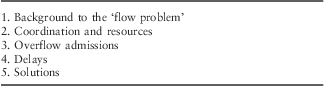
Databases including Athens, Canal, National Library for Health and Proquest were used to search for articles, and there was limited literature found in the United Kingdom, and the search was therefore extended to include international articles as well (Table 1).
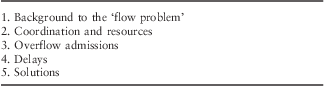
Key themes from literature review
Background to ‘Flow’ problem
Flow has been defined by the NHS Institute for Innovation and Improvement [2008] as ‘the movement of patients, information or equipment between departments, staff groups or organisations as part of the patients care pathway’ (p. 1). Waits, delays and cancellations are a common problem in healthcare, with a number of variables that affect this. Traditionally, this problem has been addressed by increasing both beds and the levels or numbers of staff. Schoenmeyr et al [Reference Schoenmeyr, Dunn and Gamarnik2009] believe that delays not only have a negative effect on resource utilisation, but also on staff morale. Haraden and Resar [Reference Haraden and Resar2004] found that delays are an issue of patient flow (as defined above), rather than lack of resources.
Spirulus et al [Reference Spirulus, DaSilva, Jacobs, Frazer and Jenlinek2006] have shown that there is an association between overcrowding and increased hospital mortality, especially when the occupancy exceeds 90%. This is supported by Cameron [Reference Cameron2006] who believes that an overcrowded hospital should be regarded as unsafe. Currently, UK hospitals are running at a high level of occupancy in order to achieve waiting list targets. Hospitals are ‘fined’ where patients breech the 18-week pathways [DOH, 2006]. As a result, there is a great pressure on operating theatre departments not to cancel cases, bed managers to find available beds and at ward level, increase the turnover of bed occupancy. Consequently, a clear picture is emerging of increased pressure over a whole service area to accommodate the demand for meeting targets and reducing costs due to fines. Linked to this, are the significant resource implications.
Coordination and resources
There is much literature regarding patient flow; however, most studies and articles concentrate on flow through the Accident and Emergency Department (A&E) rather than the PACU. This literature demonstrates a parallel problem of the service and is therefore useful to explore and apply the analysis to related problems in OTD. In a review of hospitals that have implemented integrated Information Technology (IT) systems to address communication and coordination problems in America, Raths [Reference Raths2009] believes that a lack of coordination between hospital departments can lead to patients waiting in A&E for an available ward bed, which in turn causes the department to go to divert status where patients and ambulances are diverted to another A&E Department. Lack of coordination is an issue that impacts on the PACU daily, and the day of surgery patients remain in PACU whilst a bed on a ward becomes available. Once PACU reaches full occupancy, then the flow from theatre is reduced or stopped and patients already operated on remain in theatre to recover. This results in delays, cancellations and overruns of the theatre list. The overruns lead to staff unable to go home and end a shift as patients still need care and monitoring; consequently, this leads to cost implications of overtime or time back. Staff morale lowers and willingness to constantly subsidise the service lessens. According to the European Working Time Directive, [2009] there needs to be an 11-hour break between work shifts. With the increase in demand for theatre services and overruns, three sessions for operating in 1 day are being considered as an option. However, Collins [Reference Collins2006] argues, an increase in activity generates extra costs and requires extra staff to support this. She asserts that there is an historical shortage of skilled theatre staff and anaesthetists, which impact on recruitment and retention and any plans to increase in capacity. Meeting current demands has highlighted the above staffing problems. Planning extra theatre sessions may help achieve waiting list initiatives, but unless the patient flow problem is addressed, this will only exacerbate the staffing issues.
Overflow admissions
Ziser et al [Reference Ziser, Alkobi, Markovits and Rozenberg2002] studied patient overflow admission to PACU. This study only involved patients where no appropriate ward or ICU bed was available over a period of 33 months. They concluded that a number of problems happen as a result of this, namely, PACU is not staffed, equipped nor designed to act as an ICU overflow and that this is a common problem but not represented in the literature. This study is controversial in the recommendations it made, considering that the lack of available ward beds affected 45.3% of the patients included, they suggest that PACU should accept and prepare for ICU overflow admissions. Alternatively, Ryan and Tobin [Reference Ryan and Tobin2003] believe that admission to PACU to save an ICU bed is unacceptable practice. They found that in their UK Trust, the PACU initially took 11–12% of the ICU admissions, regardless of whether cases were elective or emergency. They discovered that this disrupts the smooth running of the theatres and impacts on the nursing resources, they suggest that hospitals develop a Post-Operative Critical Care Unit, run by the on-call consultant anaesthetist to prevent inappropriate admissions.
Kiekkas et al [Reference Kiekkas, Poulopoulou, Papahatzi, Androutsopoulou, Maliouki and Prinou2005] support this view and identified that there is a worldwide trend to admit ICU overflow patients to the PACU when demand increases. This study primarily looked at the effect an ICU patient had on the nursing workload in PACU. They recorded the number and length of stay of ICU admissions to the PACU over an 18-month period. Using a workload measurement system to assess the patient activity and match it to the nurse staffing needs, they discovered a remarkable increase in the nursing workload. They also concluded that the nursing ratio may not always be increased to meet the workload demand and that patients remain in PACU for an extended period to avoid the use of an ICU bed. The literature shows that overflow patients impact on an already stretched PACU service not only with capacity but also on the nursing workload. The next step is to explore why these overflow admissions occur.
Delays
Clark et al [Reference Clark, Anderson and McIntyre2005] focused on the barriers to a timely discharge process. They found that discharging patients was not a priority for the consultants, doctors, ward nurses, physiotherapists and X-ray and laboratory services, for various reasons. Doctors were not communicating with the nursing staff regarding any pending discharges, the paperwork was not being filled in, there were transportation delays and many departments were unaware of the hospital discharge time.
These delays can greatly affect patient flow, as Clark et al [Reference Clark, Anderson and McIntyre2005] describe delays to patient flow as:
1. Delayed ward discharges lead to full bed occupancy.
2. Then ICU cannot transfer to step-down ward care.
3. A&E and PACU patients cannot be transferred to ICU or the wards.
4. New patients cannot be admitted, hospital may be forced to go on divert, inter-hospital transfers and operating lists may be cancelled.
Although this piece of work was carried out in America, there were some best-practice benchmarking solutions and recommendations made by the steering committee that would be worth considering and possibly trialling in this instance. Gilligan and Walters [Reference Gilligan and Walters2008] as part of the Institute of Healthcare Improvement (IHI) Impact Collaborative, believe that the focus is on improving patient flow, reducing length of stay, increasing efficiency and productivity to help meet the performance agenda and ensure financial stability of the trusts. The aim of this project was to reduce unnecessary delays and waste; the changes made led to a more reliable health care system and could reduce hospital mortality. This ties in well with the Department of Health's underlying principle from the 18-week Patient Pathway [2006], which advocates that patients should receive excellent care without unnecessary delay.
Solutions
Hospital Case management [2008] describes a patient throughput initiative in America, which reduced the patient holding hours within the A&E department and PACU. The solutions included, all admissions coordinated through one central point, bed status reports being issued every 4 hours to all departments and a colour coding system to indicate bed status issues within the hospital, for example, Red – PACU or A&E are holding patients, Yellow – increasing shortage of free beds and Green – patient flow is maintained. Some of the American research involves an integrated IT system that shows real time tracking of patients [Anonymous, 2007; Raths, Reference Raths2009]. These systems have had a positive impact on the flow of patients as they also have an escalation policy in place to address the change in status. Currently, UK trusts are slowly introducing IT systems and eventually a patient and bed tracking system may become a reality.
The IHI's suggestions include measuring the flow variation. There are many variables intrinsic to healthcare, some that cannot be reduced, for example, types of patients and when they present to hospital, and those that can be altered such as looking at the surgical schedule, separating emergency and elective cases into different areas and creating a different flow stream that does not result in elective cancellations. There should be a more efficient discharge planning and orchestration with discharge times identified. This would allow for transfer of patients from ITU/High Dependency Unit (HDU) to be synchronised effectively.
Chetter [Reference Chetter2009] supports this view and used this study to support her findings echoing the suggestion that hospitals prioritise redesigning the processes related to patient flow, reducing the sources of variation and therefore avoiding bottle necks.
Clark et al [Reference Clark, Anderson and McIntyre2005] made recommendations for expediting patient discharges. These included an official discharge policy, a discharge facilitator, ward rounds altered to accommodate early discharge and a focus on doctor's communication and naming and shaming of wards and consultants that failed to meet the discharge goals on an intranet site. The results of this showed the average discharge time dropped by 4 hours and 10 minutes. This significantly improved patient flow and the total number of admissions for the year, with a conservatively calculated increase of 5 million dollars in revenue from these increased admissions.
From reviewing the literature, it was clear that the patient flow problem experienced in our unit was not an isolated case, and that there are many variables that effect the situation, with a timely patient discharge from the ward maybe being one of the most important, because if steps are taken to facilitate this, then ITU can transfer patients to these step-down units/wards and bed managers will have beds available to allocate to A&E and PACU. It may even enable identified elective surgical patients to transfer straight to the ITU/HDU, rather than be held in the PACU, which can only have a positive effect on the overall care and satisfaction of all patients concerned.
Methodology and data collection
The aim of audit was to determine the number of bed hours that were lost due to inappropriate admissions and/or delays in the discharging of patients to their various wards, and investigation into the reasons for these delay.
Specific objectives of the study were:
(a) Measure the total length of stay in PACU.
(b) Measure the length of delay from the time PACU discharge criteria met, until transfer to the ward.
(c) Identify all ITU-holding admissions and the length of stay.
(d) Determine the ratio of admissions to delays.
(e) Identify reasons for the delay.
(f) Ensure the escalation protocol was being followed appropriately.
All members of the nursing staff within the PACU were informed of the intention to carry out the audit and the reason for conducting the audit (project aims and objectives) were explained to the team, and emphasis was placed in the importance of filling out the forms accurately. All members of the team appeared enthusiastic and guaranteed their support in collecting the relevant data. Again the audit was conducted on all patients who were admitted to PACU who experienced a delay of greater than 1 hour, in transferring to a ward. Also included were all ITU/HDU admissions, where no bed was available.
Patients who were transferred to the ward in under 1 hour were excluded, Saturdays and Sundays were also omitted from the study as bed delays were not seen to have an impact on the theatre flow due to running only emergency theatres and PACU capacity would not be compromised. Also, the decision was made to only focus on the main, 24-hour PACU, as this was the area where the delays had the largest impact. In addition, if all of the 5 in-patient PACUs were used, then the sample size would have been too large.
The audit form used for this project was more specific in the information that it would elicit than the original audit. For this audit, the data were collected over the course of each 24-hour period, and it was the responsibility of the nurse in charge of the shift to complete the form and then return it to the PACU team leader's office, where it was collected by the project coordinator the following morning. This was to ensure consistency of the information provided and also to ensure a level of accountability for accuracy of the data.
The audit form used closed-ended questions, which allowed for specific information to be gathered. The primary aim of the audit form was to identify the length of delay in discharging the patient to the ward. Other information collected included: total number of patients admitted in each 24-hour period; time of admission and subsequent discharge; name of the ward the patient was discharged to; type of procedure; reason for delay; and how the situation was escalated. Coding was used to list the reasons for both reason for delay and escalation.
Even though the audit forms were supposed to be completed on a daily basis by the nurse in charge of the shift and returned to the PACU Team Leader's office the next day, not all the forms were returned, nor were all the sections fully completed. Namely, the number of patients admitted for that day and length of stay, fortunately this information could be obtained by checking the admission book.
Findings
The data were analysed to identify any cause and effect relationships in the process.
Number of admissions
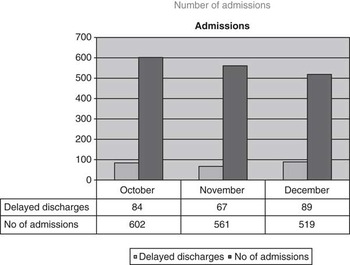
During October, the total number of admissions was 602; of these, 84 (14%) were delayed discharges to the ward, there were no HDU/ITU overflow admissions recorded in this time period. During November the total number of admissions was 561, of these 67 (12%) were delayed, 7 (10%) of these delays were HDU/ITU overflow admissions to the PACU. During December the total number of admissions was 519, of these 89 (17%) were delayed, 9 (10%) of these were HDU/ITU overflow admissions to the PACU (Fig. 1).
Number of admissions.

Over the 3-month monitoring period, the ratio of delays, the ratio of delays to admissions increased and the November/December period highlighted that ITU overflow patients were also impacting on the PACU. An explanation for this increase in the ration of delays to admission could be due to the fact that most hospitals suffer from ‘winter pressures’ at the end of each year. This is when overflow areas are opened up to accommodate the rise in demands for beds, in an attempt not to affect the elective surgery lists.
Length of stay
The next step was to consider the total length of stay that patients experienced in the PACU. The extent of the delay experienced was highlighted, by subtracting the actual recovery time from the total length of stay.
During October, the total time lost to bed delays was 136 hours and 45 minutes, with most patients experiencing a delay that doubled their time spent in the PACU.
In November, total time lost to bed delays was 146 hours and 16 minutes. The HDU/ITU patients had a large impact on this, as these were overflow admissions and did not technically have a recovery time period. These patients may have anything from a 30-minute to a 5-hour delay for bed on ITU. Not only did this have an effect on the patient flow through PACU, but also on the level of care that these patients required. ITU patients require specialist one-to-one nursing care, which a PACU is not staffed for and is very difficult to sustain, especially for periods of up to 5 hours.
In December, the total time lost to delays was 259 hours and 16 minutes. Again, there were a large number of HDU/ITU overflow patients. It is interesting to note that December had the largest number of delays, despite having the least amount of days included in the audit.
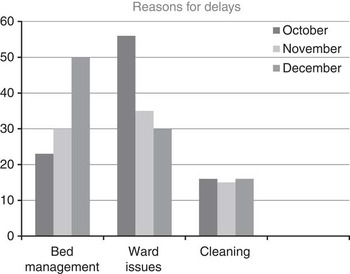
Reasons for delay (Figure 2)
The reasons for delay were grouped into three main categories: bed management; cleaning; and ward issues. There was quite a substantial increase in bed delays, especially in December. This can be attributed to the winter pressures. Most of the reasons given were bed not allocated yet, or bed moves had to be carried out before a bed could be allocated.
Reasons for delays.

There were a number of reasons given for delays related to ward issues. These were: not enough staff, ward is too busy. Even though there was an increased pressure on beds, the wards reduced the amount of delays over the period of time audited.
There was no real change over the 3-month period in the amount of delays due to cleaning.
Discussion
This audit provided the evidence needed to raise our concerns to a higher management level about PACU and its lack of capacity to meet our current demands. A working group was organised, including the Theatre General Manager, Senior Bed Manager, Matron and Sister for the Ward, Clinical Recovery Manager and the PACU Team Leader. This group met fortnightly to identify the issues and discuss ideas for solutions. Following the presentation of the audit findings, there was a consensus from all present that delays in PACU discharging was unacceptable practice and must be having a negative impact on the overall patient experience.
Over the 3-month period that the audit was conducted, the number of admissions decreased and the number of delays in discharge increased. There was also an increase in the amount of ICU/HDU patients being ‘held’ in PACU. As acknowledged in the literature review, ICU/HDU overflow patients are not an uncommon occurrence. However, there are a number of factors to consider that could possibly have a negative effect on the patients and staff in the PACU:
1. Staffing – this not only relates to the number of nurses but also those members of staff with the necessary skills and experience to provide care for ICU patients. One of the AAGBI's [2002] key recommendations is that the standard of nursing care is equal to that within the ICU.
2. Medical cover – there can be confusion determining whether the surgeons or anaesthetists are responsible for the overall care. The AAGBI [2002]suggest that an ICU-trained nurse should be responsible for the one-to-one care of the patient and the intensivists should facilitate discharge to an appropriate area as soon as possible.
3. Privacy and dignity – the PACU is an area that allows visibility of all patients, shielding the ventilated patient from the rest of the PACU may be difficult [Kiekkas et al, Reference Kiekkas, Poulopoulou, Papahatzi, Androutsopoulou, Maliouki and Prinou2005]. Patient's families also have to be considered as the PACU is an area where a minimum number of visitors are expected; however, it cannot be ignored that the family of ICU patients may need to visit [Ziser et al, Reference Ziser, Alkobi, Markovits and Rozenberg2002].
Length of stay
The audit results showed that there was quite a dramatic increase in the length of stay over the audited 3-month period from October to December. This was discussed by the working group and all were in agreement that there was an urgent need to reduce unnecessary delays and improve the patient flow. As mentioned in the literature review, delayed discharges can result in the cancellation of operations and the overrun of theatres. Not only does this have a huge financial implication for the trust, but the care and satisfaction issues of patients are also affected [Clark, Reference Clark, Anderson and McIntyre2005].
Reasons for delay
Clear trend emerged, showing a huge increase in bed management issues. Again, most of this can be attributed to the winter pressures on hospital admissions. Clearly, if the hospital is operating at critical capacity, existing patients cannot be transferred from the PACU to the ICU or appropriate wards, leading to a cancellation of operations due to unavailability of beds. The literature reviewed, shows that this can be due to a number of reasons including staffing issues, various discharge issues and inappropriate use of resources.
Alternatively, the wards, despite the added pressures, decreased the total length of their delays. This could be due to the reduced number of overall admissions and transfers from the PACU, lightening the workload of ward nurses slightly.
Solutions to the problems
Bed management issues
The importance of the escalation meeting in the morning was reiterated as an opportunity to inform the bed management team of the order of the theatre lists and therefore the priority of the bed allocation from the PACU perspective. There was much talk about the new IT system being employed by the trust as being able to alleviate many of the bed allocation issues. Much of the research discussed the benefits of an integrated IT system with a ‘live bed board’ showing an up-to-date bed status [Raths, Reference Raths2009]. This should allow for better resource allocation and management of patient flow [Dempsey, Reference Dempsey2009]. However, as the system was yet to ‘go live’, a more immediate solution was necessary. In order to avoid unnecessary bleeps and reduce the amount of duplicate phone calls between the bed management team and the PACU, it was agreed that the nurse in charge would be responsible for all contact made. The bed managers would make every reasonable effort to attend the escalation meeting and would also contact PACU before 3 pm with any outstanding allocations. Another important issue raised was that on occasion, although the beds had been allocated, they were not available to use as existing patients were waiting for transport home or for discharge prescriptions.
Ward discharges
The working party decided to investigate ways of expediting the discharge process from the wards. It was discovered that, although there was clear information given to patients regarding the hospital admission policy, there was no information given about the discharge times. The ward matron also reported that some of the delays were due to the doctors not carrying out ward rounds until the evening, making it too late to organise discharge for that day. The wards were very keen to trial nurse-led discharge for those patients that were uncomplicated in their surgery and recovery. It was decided this action would be taken forward by the ward matron. However, it was stressed that while nurse-led discharge may be a long-term goal, a more immediate solution was required. A decision was made for the surgical wards to trial using the medical discharge lounge for those patients waiting for their discharge prescriptions or for family to collect them. This move is not supported by the literature, which suggests a lack of nurse and patient confidence in the discharge lounges and that several hospitals have closed their lounges due to under utilisation [Clark, Reference Clark, Anderson and McIntyre2005]. The Matron also agreed to discuss with the consultants, changing their ward round times to facilitate earlier discharges and increase the turnaround time.
PACU responsibilities
The PACU Team Leader agreed to assist the wards wherever possible. This mainly involved the PACU staff-transferring patients back to the ward when appropriate. This practice already occurred with the agreement of some wards, mainly when there were staff shortages and it would not be possible for the ward to release a qualified member of staff to collect a patient from the PACU. It was also decided that the nurse in charge of PACU would escalate any extended delays to the ward matron, who would investigate the ward reasons and expedite the transfers.
The solutions identified and discussed, involved all of the departments working together to improve a situation that affected the patient's experience of our services. The agreements of change made by the working party to current practices are all measurable by the process of re-auditing the original criteria. However, in the PACU we have continued to audit the delayed discharges, but on a less detailed scale, showing a marked improvement in the number and length of delays experienced.
Conclusion
During the process of this audit many issues were highlighted. Some of the most relevant included an overall acceptance that ICU patients will overflow into the PACU when there are bed shortages in the hospital. The literature clearly supported the view that this is an unacceptable practice for many reasons. Despite this it may be necessary in the future to consider broadening the skills of the PACU nurse to encompass those of an ICU nurse.
The delay in discharging patients is not only experienced in the PACU, but also on the wards, clearly causing a bottleneck in the system. Since this audit was carried out, a trust wide initiative involving the transformation team has been implemented to improve the discharge process from the wards, part of this was to aim for a discharge time of 11 am.
An integrated IT system with a ‘live bed board’ status has also been recently installed within the trust. This is supposed to detail which beds are immediately available across the trust to enhance patient flow from all departments. Although this enables PACU to track which wards the patients have been designated to transfer to, it does not guarantee that the available bed is for PACU use as ICU and A&E patients have priority placement. The literature reviewed suggests that this system can improve the patient flow when combined with a 4-hourly bed status report to all departments and the use of an escalation policy to address the flow issues.
Both audits provided the basis for further, detailed investigation into the area of delayed discharge, exploring reasons for the delays and finding solutions to the problems. The PACU continues to audit the delays in the discharge of patients from the PACU to the ward and monitor the effectiveness of the solutions put in place following the second audit. The information gained from this audit process highlights the problems faced on a daily basis and raises awareness of the issues to senior management.