Introduction
For a few decades, politicians and social scientists have approached election polls from specific perspectives. The former tried to understand how citizens will vote in the next electoral contest, whereas the latter are interested to know whether the voting behaviour is influenced by polls. Such a preoccupation is legitimate in the context of generally decreasing party membership,Reference Dalton1, Reference Mair and van Biezen2 growing electoral volatility,Reference Bartolini and Mair3 and extended use of media and the internet. Numerous studies reveal that opinion polls before elections influence the votingReference McAllister and Studlar4–Reference Irwin and van Holsteyn8 mainly in the form of bandwagon and underdog effects. Both these situations are inextricably linkedReference Irwin and van Holsteyn8–Reference Donsbach10 and reflect shifts in voters’ attitudes once they learn about candidates’ chances to win.
With this picture in mind, in real-life politics the mechanism can be controlled. As soon as politicians are aware of such reactions in the electorate, they can use opinion polls to improve their situation. This instrumental approach applies once general trends are observed. By focusing on a single-case study as an illustrative example (e.g. the most recent presidential elections in Romania), this article reveals how strategic voting trends identifiable within the electorate can be channelled towards specific outcomes. Exit polls broadcast during Election Day in the first round made the difference between the two challengers competing to confront the incumbent in the second round. Our central argument evolves around the differences between the opinion polls and the election results, not encountered so far in post-communist Romania for the top candidates. Based on evidence from the past two decades and poll data from 2009, we show how a large share of the Romanian electorate avoids wasting votes and casts them for candidates with real winning chances. Facing this opportunity, candidates in pole-positions create their own safety net by displaying poll results that indicate them as winners during voting.
By adding this empirical piece to the general puzzle regarding the relationship between voters, opinions, and the importance/perceived importance of their cast votes, we bring a twofold contribution to the literature. We challenge the theoretical arguments of institutional and electoral system/reform scholars,Reference Duverger11, Reference Sartori12 according to which the two-round electoral system allows citizens to vote sincerely in the first round (and strategically in the second). We show how, for the Romanian elections, strategic voting is possible in the first round when citizens are exposed to the results of exit polls. Thus, we reveal the mechanism that advances election polls as effective and efficient tools of influencing citizens’ decision during voting. In this respect, at empirical level, we document how politicians can use their knowledge about electorates’ preferences to manipulate rational behaviours (e.g. strategic voting, cue-taking). Thus, we identify a supplementary source of pressure that builds on the existing willingness of the voters to avoid the low importance/effectiveness of their opinions. The latter comes at the expense of changing the personal preference and, in our case, modifying the structure of the second round of elections.
In the next part of the analysis we investigate the tendency of the Romanian electorate to orient itself towards the likely winners of elections in the entire post-communist period. The subsequent section includes the assessment of the bandwagon effect for the 2009 presidential elections based on aggregated poll data and statistical results. This sets the premises for using exit polls during elections as promoting tools for successful candidates. The third section explores in detail this mechanism and illustrates how voters were mobilized in a specific direction. Finally, our conclusions summarize the main findings and draw attention to the major implications of this single case study.
A Visible Pattern
Our exploratory endeavour starts from the general category summarizing voters’ behaviours that lead to bandwagon effects. BartelsReference Bartels13 distinguishes four different types of psychological processes that make the individual voter choose the side expected to win: contagion, supporting the winner, strategic voting, and cue-taking. The first refers to a situation in which voters associate with candidates perceived to suddenly improve their winning chances. Supporting the winner originates in the voters’ need to increase their self-esteem: some are happy to support the side that wins elections. Strategic voters base their choice on a rational calculus that indicates the candidates with higher chances to win the elections. Cue-takers back candidates with the highest chances to win among all contesters.14 To these four types, Kenney and RiceReference Kenney and Rice6 add the inevitability situation where citizens cast votes for the candidate that is perceived as inevitably winning the elections, although they prefer another candidate. Empirical studies display mixed evidence regarding the existence of such effects within the electorateReference Fleitas15–Reference Marsh17 and conceptually refine the differences between voters’ reasons to jump on the bandwagon. Aware of such nuances, our article emphasizes the strategic component of such behaviour, including all these emotional and rational decisions of the voters when casting their vote.
The empirical evidence from all the Romanian presidential elections from the post-communist period is in line with the theoretical considerations about the strategic behaviour. CoxReference Cox18 explains that, in general, there are three viable candidates in a two-round system and voters strategically desert non-viable candidates. On average, excluding the first elections of 1990 with three candidates, the Romanian elections have ten candidates. The elections are organized in a two-round system where the first two competitors get into the second round, since generally no one obtains 50% + 1 of votes. The 1990 elections were the only time the contest was won won from the first round, with 85.07% of the votes (Figure 1). Despite a large number of candidates, approximately 85% of the electorate in Romania regularly votes for the first three candidates in the first round. Figure 1 reveals the percentages obtained by candidates perceived as having real winning chances. For most of the election years, this is the sum of the votes obtained by the first three candidates, for 1990 we represent the percentage obtained by the winner, and for 2000 we included the first four candidates as the difference between the third and the fourth was approximately 2%.
Percentage of votes obtained by candidates with real winning chances (first round): 1990–2009.

Although straightforward, such a situation was blurry for many candidates that in those elections scored much less than opinion polls revealed. Apart from the difference between declared intention to vote and actual choice in the voting booth, there is also the trend of channelling options to diminish the waste of votes, to maximize personal happiness by voting with the winner and other similar causes. All these occur when the electorate had clear views regarding likely winners of the first round. Consequently, a vast majority of the electorate casts votes for a small number of competitors, irrespective of their names, party labels, etc, instead of dividing their options. Thus, their opinion becomes less important. The graph does not capture the votes of the Hungarian minority (5–7%) that constantly supports in the first round the candidate promoted by their party (the Democratic Alliance of Hungarians in Romania). In such conditions, more than 90% of the entire electorate appears to vote following two stable lines: the ethnic vote (i.e. the Hungarian minority) and the winner-oriented vote.
The opinion polls preceding the 2009 presidential elections indicate a similar pattern. Citizens deserted the non-viable candidates, although there were promising prospects when launching their candidacy, and focused on the first three candidates with the help of the media (as shown in the following section). The peculiar component of these elections is that the strategic behaviour was not limited to the shaping of preferences before the elections, but acted also during the voting process. Different from the previous elections, it was a two-stage process that implied in its final part a narrowing down from three to two options during the first round.
The Media Effect
Our argument includes the media as one of the main mediators and promoters of factual information.Reference Schmitt-Beck19 Apart from its feature that allows specific groups to convey truncated messages to a mass of voters,Reference Noelle-Neumann20 the media represents a relevant supplier of knowledge for voters needing to improve the basis of their decision-making. Through the publication of specific news, reports, and editorials on certain candidates, and by reporting polls, it influences voters’ perceptions about candidates’ odds to win elections. Whereas the first three tools of media coverage imply degrees of subjectivity, the reporting of polls does not have to be biased in order to influence voters’ perceptions. The bulk of factual information crucial for the decision-making and strategic voting resides in the percentages of support for candidates. Our case-study shows how this is a decisive factor in orienting voters’ choice towards the predicted outcome. Indeed, presenting the first half of the candidates’ list according to support and placing in the ‘another candidate’ category many competitors, amounts to a bias that diminishes the chances of the latter for visibility and actual support in the booth. All these instances contribute to the guidance of the voters lacking the default value of party/candidate identification.Reference Popkin9
Throughout the entire year, and during the electoral campaign for the Romanian presidential elections, the media environment was marked by numerous examples of biased reporting and/or truncated info. When citing opinion polls, Realitatea TV constantly referred to the first four candidates, completely obscuring the rest. Important news portals (hotnews.ro) generally presented only the figures predicted by pollsters for the first three candidates, while only attaching the ‘.pdf’ files with the rest of the predictions. There were three debates broadcasted nationally before the first round, and even the way they were organized implicitly reflected the desire of diminishing the vote shares of the candidates placed below the third position in polls. As a result of the various strategic calculations made by their staffs and the psychological wars between them,21 in the two most important electoral debates only the incumbent, Traian Basescu (supported by the Democratic-Liberal Party, PD-L) and the challengers with most chances: Mircea Geoana (from the Social Democratic Party, PSD) and Crin Antonescu (from the National Liberal Party, PNL), had the opportunity to participate. The national television organized a separate meeting for all the candidates playing in the ‘second league’.
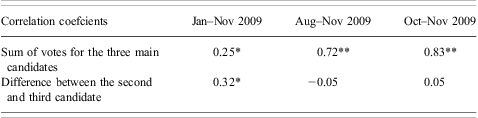
Together with these biased elements, the poll reporting in Romanian media contributes to voters’ perception of election winners. By considering 50 election polls conducted between January 20 and November 21 (the last day before elections), we observe a direct linear relationship between the time left until elections and the clustering of vote intentions around the three main candidates perceived as possible winners of the first round. The polls were based on national probabilistic samples using different stratification techniques, while only a small number of them deployed CATI. They were ordered either by the media trusts or by the parties/candidates. The first row of the coefficient values (Pearson r) presented in Table 1 indicates the strength of correlation between the time when polls are conducted and the sum of votes directed towards the first three candidates. For the entire period (January–November) there is a visible weak-to-medium tendency to cluster votes for these candidates. However, closer to elections (four months and two months before), the clustering is stronger (i.e. both the value of the coefficient and the statistical significance increase). Benefiting from a history of a few months, for the August–November period, voters reorient their preferences towards the best-positioned candidates. Every poll conducted closer to Election Day reveals higher numbers of vote intentions for one of the three. Such a relationship is the strongest in the last two months before elections when the value of the correlation coefficient reaches 0.83. Summing up, there is a progressive tendency for voters, with a peak in the last months before elections, to express their preference for one of the best positioned candidates.
This observation is strengthened by the evolution of support for candidates considered to be relevant challengers when announcing their candidacy (Figure 2). We limit the graphical representation to the last two months before elections. The candidates registering the highest drops between their initial and final levels of support are the independent Sorin Oprescu (mayor of Bucharest and former PSD member) and George Becali representing the New Generation Party, successful in the European elections on the list of the Greater Romania Party (PRM). Entering the race later, Oprescu reached average levels of 12–13% with peaks of 16% one month before elections. However, in November 2009, the decrease started and reached a minimum level of 5% one week before elections. His actual result was below this level. Becali maintained an average level of 5% in October, with peaks of 8% in some polls, ending with 1.3% in the polls one day before elections and similar results after the booths were closed. The most stable candidate from this cluster was Corneliu Vadim Tudor, leader of PRM, whose oscillations were minor and the decrease of support considerably smaller compared with Oprescu and Becali. Situated at 8% in early October, his support decreased to 5%, a situation also registered during voting.
Evolution of vote intentions for promising challengers.

Returning to the figures in Table 1, the difference between the second and third candidates (i.e. Geoana and Antonescu) is directly linked with the prospect of elections only when including the entire 2009 year in the analysis. Thus, for the period January–November, the value of the coefficient is medium (0.32) and statistically significant, indicating that the difference between these candidates has a moderate tendency to increase as soon as elections are closer. However, the rest of the numbers in the same table reveal that this is not the case for the last four months before elections. There is almost no relationship between the difference of support between the two candidates when analysing the August–November and October–November periods. In the isolated cases when the relationships occur (r = 0.05), their presence may be incidental (not statistically significant) and displays opposing trends. In this respect, the August–November period indicates a very weak tendency to witness the slight narrowing of distance as elections draw closer, whereas for the October–November period the opposite is visible: a very weak correlation between marginally increased difference and time. As a result, the distance between the two challengers did not suffer modifications in the last months before elections, although the general figure indicates that throughout the year Geoana increased the distance from Antonescu. Most of this process took place in March–July 2009 where the correlation is 0.29 (statistically significant, not reported in the table), which is very similar to what we witness for the entire January–November time span.22
Statistical relationship between time and votes intentions for the best-positioned three candidates
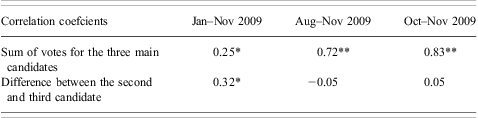
* Statistically significant at 0.05
** Statistically significant at 0.01
These issues constitute the premises for the Election Day political marketing based on exit polls conducted at the voting stations immediately after citizens cast their votes. With a bandwagon effect visible within the electorate in every previous election and in the most recent ten months, and with a rather stable distance between the second and third candidates, on 22 November the incumbent and main challenger could count on two benefits after revealing exit polls to the voters. On the one hand, they perpetuate the bandwagon during elections: people willing to vote for the third positioned candidate may give up or shift sides seeing the partial results. On the other hand, the figures above show that the distance from polls secured the main challenger a seat into the second round. The regular exit polls could also accomplish the simple mission of avoiding a spectacular turnover of the undecided. In this way, the possible occurrence of an underdog effect during elections could be controlled.
Exit Polls for the Public
Following the logic of the bandwagon effect and the trend of the Romanian electorate described above, the poll released on the eve of the elections is relevant. It indicates that the incumbent (Basescu) is supported by 36% of the electorate, the main challenger (Geoana) receives 25% of the votes, whereas the second challenger (Antonescu) gets 23.5% of the votes. Summing up these percentages and comparing them with the actual percentage of votes received (Figure 1), we observe an almost perfect match: 84% of the voters decided to cast votes for one of the three candidates. However, the election results indicate that the support for Basescu and Antonescu was overestimated, whereas for Geoana it was underestimated.23 As in all the polls the first position belonged to the incumbent and this was confirmed by the results, the stake of this first round of elections involved, as previously mentioned, the battle for the second position between Geoana and Antonescu. Overall, the average difference of support between the two was of approximately 5% in the polls. However, the last poll issued and three out of five polls in the final week before elections revealed smaller differences (1.5–2%).24 What could be done? The direct answer was to ensure voters during elections that the order of winning positions is similar to what they had been used to for 11 months. The tool at hand was to display exit poll results during voting.25 As the electoral law does not cover this issue, such a practice could be easily implemented. The mechanism was effective for two main reasons, both detailed below: the structure of the media and previous knowledge on the voters’ profile.
The Romanian media structure closely resembles the ‘polarized pluralist’ typology of media systems associated usually with Southern Europe.Reference Hallin and Mancini26 One of the most important characteristics of this is the ‘political parallelism’ of the media, and indeed almost every Romanian media outlet had a parti-pris in the presidential elections. There are two news channels that gather the largest audiences – Realitatea TV and Antena 3. The former belongs to the Realitatea-Caţavencu media corporation that bounced between the social-democrat candidate (slightly more favoured on Realitatea TV) and the incumbent president – whose supporters were grouped at the Cotidianul newspaper and then reorganized in the virtual opinion platform, Voxpublica. Similarly, Antena 3 is owned by the founder of the Conservative Party (PC), Dan Voiculescu, who had enforced a traditionally positive coverage of PSD, the party that has helped the PC surpass the electoral threshold each and every election since 2000. A popular show at this station (‘Sinteza Zilei’) criticized the incumbent president almost every day of his mandate.
During the entire day of the first round, Realitatea TV constantly advertised the exit polls. These were provided on its website, taking advantage of the fact that there is no internet regulation regarding these issues. Realitatea TV even presented the exit-polls live at 20.40,27 thus before the closing of the polls (Active Watch-Press Monitoring Agency, 2009). All exit polls presented during that day included only the figures for the first three candidates (Voxpublica, 2009; Academia Caţavencu, 2009). Exit-polls with similar or different figures from the rest also appeared on the journalists’ blogs (pesurse.ro, sutu.ro) and websites of smaller news portals (inpolitics.ro). By taking these actions, media corporations fulfilled the instrumental task of displaying information that may trigger bandwagon effects among voters during elections. The liberal candidate, directly affected by such practices filed an official complaint since presenting him at 20% or even below could depress significantly his electorate (Voxpublica, 2009).
The second component of the mechanism is represented by the voters’ profile. Research conducted during previous elections and data from the opinion polls reveal a certain pattern within the Romanian electorate: old, rural, and less-educated voters tend to vote in the morning hours, whereas young, urban, and highly educated people usually vote in the evening (Gândul, 2009). Each candidate and party attracted specific portions of the electorate. For example, Geoana is mainly voted for by people from the category that votes in the morning, whereas Basescu and Antonescu share the votes of people voting later during the day. In addition, 33.5% of the Romanian voters that have a university degree have preferred Antonescu, whereas Geoana gathered the votes of only 22.8% of them. Moreover, 38.6% of Geoana's voters have graduated only from primary school. In addition, 41.6% of the voters above 60 preferred Geoana, and no less than 36.3% of those living in rural areas (CURS exit poll on 18,000 people, in Evz.ro, 2009).
Consequently, the exit poll results presented to the public in the first hours reflect an overestimation of electoral support for Geoana and underestimation for Basescu and Antonescu. The latter was affected the most as he also occupied the third position in the opinion polls before elections. The triggered bandwagon effect worked against this candidate, favouring mostly the main challenger (Geoana). The strategy of promoting a specific candidate involves no costs from the party or the media and no biased information. At the end of the day, the results of the exit polls reflected the real results of voting. However, this approach does not allow capturing how much of this resemblance is caused by strategic voting, triggered by the public availability of early results. In other words, we cannot know for sure whether the poll results reflect reality or reality was influenced by poll results. By opening the possibility to further investigate this possible reversed causality, our case becomes more relevant.
The innovation of this political priming strategy lies in the combination of two components that cannot often go together. The presentation in a favourable light of a candidate during elections was done without breaking the laws (that forbid propaganda without signalling that is paid advertisement), but still running the risk of compromising the image of media corporations by clear association with a candidate. In the second strategy, the dissociation between media and candidate is possible through the ‘neutral’ approach of presenting what exit polls report. Here there are no value judgements, no truncation, and no interpretations done by the media channels. Voters are presented with raw facts and it is up to them to take a decision. However, this entire process is intentional and controlled as the message transmitter builds its actions on existing knowledge about the audience. The mechanism functioned and proved efficient: the election results indicate a difference of more than 11% between the two challengers (twice as much as the average difference between them registered in the 2009 polls). Although some polls predicted this difference in October and early November, the final result is highly likely to be due to the mechanism explained above.
Conclusions
This article challenges the existing literature on two-round electoral systems by providing one example in which voters behave strategically even in the first round. On the one hand, it reveals that sincere votingReference Duverger11 does not take place even when the prospects of wasting votes are low, such as in the first round. On the other hand, the Romanian case illustrates that the exposure to exit polls in the media reduced the number of three viable candidatesReference Cox18 to only two. As soon as the public was provided with information about the probability of the outcome in the first round, it acted strategically. The media did not have to provide biased information, but only to make available to the public the results of exit polls conducted throughout the entire Election Day. This simple model proved efficient when used.
These findings are strengthened by two empirical aspects. First, the total percentage of votes received by the top three candidates is similar in the opinion polls and the election results. The major difference occurs in their distribution. The post-communist electoral history of Romania shows that it is not a simple coincidence that voters desert the candidates with fewer chances to progress. Based on this observable pattern, the media published exit polls during the Election Day, available to all those who voted or were preparing to vote (i.e. starting at 10.00 am). Second, although our evidence does not support a deterministic process, the public exposure in the media of the exit poll results is the only newcomer in the system, all other components being constant compared with previous elections (e.g. party mobilization, electoral campaign, and so on). It coincides with the supplementary strategic behaviour within the electorate, having numerous reasons to believe that the two variables are linked, as we have shown in the text.
Although our study relies on the investigation of a single case, its implications are broader. It can be easily imported into other political systems, conditioned by the fulfilment of two preconditions. The first is to have a rather lax/non-regulated Web, and a structure of the media paralleling the political parties. The second condition is the volatility of the various electorates, and their eagerness to vote strategically. Both preconditions are common in many young democracies from Eastern Europe to South America.
The limitations of our research derive mainly from the sophistication and novelty of the investigated technique of triggering strategic voting. The statistical analysis uncovered some of these effects, but they still need to be corroborated by another type of data. That is why a way of improving the model we proposed is to add quantitative survey data, weighting the answers of voters who decided for whom to vote later in the campaign, or more importantly, who switched their preferences due to media exposure and a desire not to waste their vote.
Sergiu Gherghina is Research Officer at GESIS Leibniz Institute for the Social Sciences (Cologne). His areas of academic interest include party politics, legislative and voting behaviour, electoral systems and democratization.
Mihail Chiru is a PhD Candidate at the Department of Political Science, Central European University Budapest. His main academic interests are located in the fields of legislative studies (legislative recruitment, legislative careers and behaviour) and voting behaviour.