Introduction
Growing concern about the impact of an aging population on health care, together with an emphasis on maintaining health and wellbeing among older people, have increased the momentum for research into the psychology of older adults. There is a prevailing stereotype of the health anxious and “hypochondriacal” older person. Although health anxiety and hypochondriasis impact on health care use, and on the health and well-being of the individual, there is little or no research into this phenomenon among older people. This study seeks to provide preliminary insight into the topic.
Epidemiological evidence shows that the prevalence in the community of worry about health and illness is between 6% and 13% (Looper and Kirmayer, Reference Looper and Kirmayer2001; Rief et al., Reference Rief, Hessel and Braehler2001; Noyes et al., Reference Noyes, Carney, Hillis, Jones and Langbehn2005). Elevated health worry has been associated with anxiety, depression, high use of health care services, help-seeking, poor subjective health, and low physical function (Looper and Kirmayer, Reference Looper and Kirmayer2001; Taylor and Asmundson, Reference Taylor and Asmundson2004).
Worries about health and illness are a common experience and there is a perception that as a person ages, they become more preoccupied by and worried about their health. Presentation of anxiety disorders and sub-syndromal anxiety in both clinical and community samples of older adults tend to be dominated by health related fears (Snyder and Stanley, Reference Snyder, Stanley, Asmundson, Taylor and Cox2001). Factors that may contribute to increased health anxiety are psychological distress, medical morbidity, frailty and social isolation (Snyder and Stanley, Reference Snyder, Stanley, Asmundson, Taylor and Cox2001). As people age, they are more likely to worry about their health, particularly if they have an anxiety disorder (Montorio et al., Reference Montorio, Nuevo, Marquez, Izal and Losada2003; Lindesay et al., Reference Lindesay2006). In older populations, health worries are a feature of anxiety disorders such as panic, generalized anxiety disorder and obsessive compulsive disorder. Hence health anxiety has the potential to be a significant barrier to the health and well-being of older people.
Conversely, there is also evidence that older people may not be more vulnerable to health anxiety. As objective health deteriorates with age, most people adapt their subjective health assessments and consider themselves in better health than their medical status would imply (Pinquart, Reference Pinquart2001). This positive appraisal of health may be because of comparison with peers, declining “health aspirations” and physical sensations being attributed to age not illness (Lyons and Chamberlain, Reference Lyons and Chamberlain2006).
There is little research on the association between health anxiety and age. While some studies have shown a positive correlation between health worry and age (Rief et al., Reference Rief, Hessel and Braehler2001), there are no longitudinal studies on the prevalence of health anxiety to confirm this relationship (Asmundson et al., Reference Asmundson, Taylor, Sevgur, Cox, Asmundson, Taylor and Cox2001). There is one study that has examined the association between hypochondriasis (severe health anxiety) and age. This cross-sectional study compared hypochondriasis patients with a control group and found that, after controlling for the greater medical morbidity of older participants, hypochondriacal symptoms were unrelated to age (Barsky et al., Reference Barsky, Frank, Cleary, Wyshak and Klerman1991a). More recently, Bourgault-Fagnou and Hadjistavropoulos (Reference Bourgault-Fagnou and Hadjistavropoulos2009) reported that a group of older adults were not more health anxious than a younger comparison group.
The theoretical construct of “health anxiety” has been given many meanings. A current theoretical formulation, within the cognitive behavioral paradigm, defines health anxiety as a continuum of behaviors and cognitions from mild concern about bodily symptoms, through to obsessive thoughts about and preoccupation with illness, which may include individuals with a diagnosis of hyponchondriasis (Salkovskis and Warwick, Reference Salkovskis and Warwick1986; Warwick and Salkovskis, Reference Warwick and Salkovskis1990; Lucock and Morley, Reference Lucock and Morley1996). Cognitive behavioral theory of health anxiety assumes that innocuous symptoms and stimuli are (mis)interpreted as a serious threat to health or sign of illness (Warwick and Salkovskis, Reference Warwick and Salkovskis1990). These dysfunctional assumptions about health and illness arise from factors such as anxious temperament and childhood experiences of illness in self or others (Warwick and Salkovskis, Reference Warwick and Salkovskis1990). When vulnerable individuals are exposed to a stressor, negative cognitions about health are activated and health anxiety increases. The cognitive behavioral model of health anxiety has strong empirical support; however, there is no current empirical data to verify the applicability of the model to older people (Snyder and Stanley, Reference Snyder, Stanley, Asmundson, Taylor and Cox2001; Marcus et al., Reference Marcus, Gurley, Marchi and Bauer2007).
Examination of the central precepts of cognitive behavioral theory indicates that the model may be applicable to older adults. For example, selective attention to health-related stimuli is a key factor in the development of health anxiety (Snyder and Stanley, Reference Snyder, Stanley, Asmundson, Taylor and Cox2001; Marcus et al, Reference Marcus, Gurley, Marchi and Bauer2007). Attention to health may be heightened by actual disease and somatic change due to increased physical decline (Snyder and Stanley, Reference Snyder, Stanley, Asmundson, Taylor and Cox2001; Taylor and Asmundson, Reference Taylor and Asmundson2004). Changes in sensory and cognitive facilities may also contribute to increased attention to somatic clues (Snyder and Stanley, Reference Snyder, Stanley, Asmundson, Taylor and Cox2001). Medical morbidity means increasing interaction with medical personnel, which may in turn serve to focus attention on illness and increases the likelihood of iatrogenic effects (Snyder and Stanley, Reference Snyder, Stanley, Asmundson, Taylor and Cox2001). Lastly, older people have developed coping behaviors over time; although for most they are adaptive, in some more vulnerable people they may develop into safety behaviors which reinforce and maintain health anxiety (Snyder and Stanley, Reference Snyder, Stanley, Asmundson, Taylor and Cox2001). In addition, it is possible that decreasing physical function and cognitive decline may render the coping mechanisms less effective.
Health anxiety has a number of behavioral consequences that contribute to the maintenance of the condition. Of interest here is the group of behaviors that exist on a spectrum from adaptive coping behaviors that relieve anxiety to the less adaptive that are adopted to avert a frightening catastrophe (Salkovskis, Reference Salkovskis1991; Reference Salkovskis and Salkovskis1996). The concept of “safety behaviors” was developed as a means of describing this constellation of often idiosyncratic behaviors that reduce short-term anxiety and prevent long-term cognitive change (Salkovskis, Reference Salkovskis1991; Reference Salkovskis and Salkovskis1996). Clinical observation suggests that there are four types of safety behaviors in health anxiety: reassurance seeking from medical personnel, family, friends, medical texts, and internet sites; bodily checking; avoidance of medical information and exercise; and safety signals such as always carrying a doctor's phone number (Taylor and Asmundson, Reference Taylor and Asmundson2004). The relationship between health anxiety and safety behaviors has not been extensively studied.
Two studies have demonstrated the significance of safety behaviors in hypochondriasis (acute health anxiety). A case study by Salkovskis and Warwick (Reference Salkovskis and Warwick1986) illustrated the relationship between “reassurance” and the maintenance of health anxiety. More recently, Abramowitz and Moore (Reference Abramowitz and Moore2007) demonstrated that performing personally relevant safety behaviors produced a rapid reduction in anxiety in hypochondriasis patients, when compared with patients who engaged in non-safety behavior activities. The relationship between health anxiety and safety behaviors has also been demonstrated in a non-clinical sample. As part of a larger study by Abramowitz et al. (Reference Abramowitz, Deacon and Valentiner2007a), medically healthy university students completed measures of health anxiety and safety behaviors. The authors reported that health anxiety was a significant predictor of safety behaviors, which is consistent with the cognitive behavioral model of health anxiety.
Most studies of health anxiety have been conducted among adults under the age of 65. In order to provide preliminary data for an older population, this study has three aims: (a) to demonstrate whether a cohort of older adults is unduly health anxious; (b) to determine which demographic and health factors contribute to health anxiety; and (c) to investigate whether an aspect of the cognitive behavioral model of health anxiety is applicable to older adults. The last is examined by investigating the relationship between health anxiety and safety behaviors. Studies have shown that medical utilization among older adults is influenced by many factors, for example sociodemographic factors, mental health, health beliefs, medical morbidity, and physical function (e.g. Wolinsky et al., Reference Wolinsky, Coe, Miller, Prendergast, Creel and Chavaz1983). Because of these potential confounding factors the relationship between health anxiety and medical utilization is examined separately.
Methods
Participants
Participants were a convenience sample recruited from community-based organizations and retirement village communities in the Auckland area. In order to take part, respondents were required to be aged 65 years and over and living independently (i.e. not in a nursing home or hospital). Of 270 community-dwelling adults aged over 65 who were invited to participate in the study, 145 (41 men and 104 women) responded and completed the questionnaire (54% response rate). All of the respondents were over 65 and half were in the age range 75–85 years. Almost all (97.9%) were New Zealanders of European origin.
Measures
Demographic information: Participants were asked to provide demographic information regarding age, gender, ethnicity, marital status, whether they lived alone or with others, and subjective satisfaction with income.
Physical health: Participants were requested to list any health problems diagnosed by a health professional and verify this diagnosis by listing prescribed medication. When scoring the questionnaires, this information was converted into “number of physical illnesses” for each participant.
Physical function: This list of activities was taken from the physical functioning scale of the SF36 (Ware and Sherbourne, Reference Ware and Sherbourne1992). This comprises a ten item list of activities of increasing levels of difficulty, scored on a 3 item scale. Total scores range from 10 (low physical function) to 30 (high physical function).
Short Health Anxiety Inventory (SHAI): The SHAI (Salkovskis et al., Reference Salkovskis, Rimes, Warwick and Clark2002) measures health anxiety within a cognitive behavioral framework. The SHAI consists of two scales, a main scale and a negative consequences scale. The main scale contains 14 items that measure worry about health, feared consequences of having an illness, and bodily sensations. The negative consequences scale consists of four items that measure the feared consequences of a serious illness. Items are scored 0–3. The scale has good psychometric properties and consistent factor structure in both clinical and non-clinical populations (Salkovskis et al., Reference Salkovskis, Rimes, Warwick and Clark2002; Abramowitz et al., Reference Abramowitz, Deacon and Valentiner2007a; Reference Abramowitz, Olatunji and Deacon2007b). Importantly for this study, scores are not unduly influenced by physical illness (Salkovskis et al., Reference Salkovskis, Rimes, Warwick and Clark2002).
Medical utilization: Participants indicated how frequently they had used each of 12 medical services in the previous six months. In addition to general practitioner (GP), hospital, and nursing services, the list included items specific to the New Zealand context such as “Maori or Pacific Island Heath worker”.
Safety behaviors: Participants indicated how frequently they had engaged in 12 safety behaviors out of concern for their own health over the past month. The list of safety behaviors included common reassurance seeking, checking, and avoidant behaviors. These were scored on a 5-point scale (“not at all” to “all of the time/every day”).The format was modeled on the Medical Utilization Questionnaire (MUQ; Abramowitz et al., Reference Abramowitz, Deacon and Valentiner2007a).
Procedure
Participants were supplied with an information sheet and questionnaire. The information sheet detailed the aims of the study, and provided information regarding confidentiality, anonymity, and use and storage of data. Participants completed the questionnaire at home and returned it by post. Informed consent to participate in the research was implicit when the questionnaire was returned.
Ethics approval for this study was received from Massey University Human Ethics Committee: Northern. Application 08/022.
Analysis
Multivariate regression analysis is a flexible and powerful statistical technique used to assess the relationship between one dependent variable and several independent variables (Tabachnick and Fidell, Reference Tabachnick and Fidell2007). Regression permits comparison of the capacity of various independent variables to predict the dependent variable. For the present study, separate sequential multivariate regression analyses were carried out to determine predictors of SHAI scores, safety behaviors, and medical utilization. Independent variables were entered in groups from least important to most important. For regression analysis with potentially 10 independent variables, it is suggested that sample size is at least 104 + 10 = 114 (Tabachnick and Fidell, Reference Tabachnick and Fidell2007). This minimum number was exceeded as 145 valid questionnaires were returned.
Using SPSS Graduate Pack 16.0 for Windows, assumptions for regression analysis were evaluated. Inspection for missing data showed that of the 145 questionnaires returned, 15 were incomplete, which represented approximately 10% missing data. The majority of these missing data (nine cases) occurred in the health anxiety measure. To remedy this non-random loss of data in the small data-set, missing data were replaced by mean total scores for the measure (Tabachnick and Fidell, Reference Tabachnick and Fidell2007). Scores for SHAI, medical utilization, and safety behaviors all showed skewed distributions. Outliers were inspected, all appeared to be from the target population, and therefore the scores were reassigned as the highest score plus one, which reduced the skewness to within the acceptable limits of −1 < 0 < +1 (Tabachnick and Fidell, Reference Tabachnick and Fidell2007).
Results
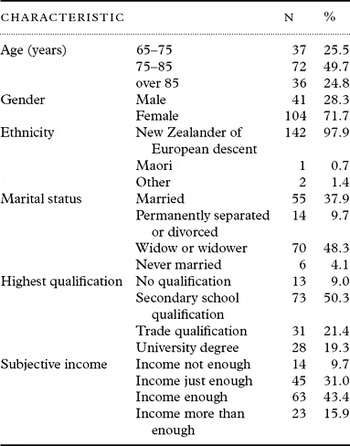
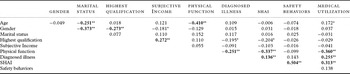
Demographic data are shown in Table 1 and correlations between study variables are given in Table 2
Demographic characteristics of sample (N = 145)

Pearson correlations between variables (N = 145)

Figures in bold = **Correlation significant at the 0.01 level (2-tailed).
*Correlation significant at the 0.05 level (2-tailed)
SHAI = Short Health Anxiety Inventory
Descriptive statistics
Demographic data: The majority of respondents were women (71.7 %), and half were in the age range 75 to 85. Almost all (97.9%) were New Zealanders of European origin. A majority lived alone (62%) and almost half were widowed (48%). Only 9.7% of participants considered that they had insufficient income; 40.7% had post school qualifications and 50.3% had secondary school qualifications. The cohort had a higher proportion of women than the Auckland population, and the age group 75–85 was over-represented. The participant group did not reflect the ethnic diversity of the Auckland region.
Health status: 11.7% of participants reported no health problems. The median number of physical illnesses was two (mean = 1.81, SD = 1.18, range 0–6). Participants had a median physical functioning score of 23 (mean = 22.39; SD = 5.45; mean transformed score = 62, which falls within the the SF36 range (physical functioning scale) in the U.S. population of 52 for elderly males to 84 for the general population). 2.8% of participants spent all or much of their time worrying about their health.
Health anxiety: Two scores are reported: main SHAI (SHAI), and total SHAI (sum of SHAI and Negative Consequences scales). Mean score for SHAI was 7.04 (SD = 4.31) and total SHAI was 9.62 (SD = 5.95). Previous work suggests SHAI scores of 15 or higher indicate acute health anxiety (Rode et al., Reference Rode, Salkovskis, Dowd and Hanna2006). 7.6% of participants scored higher than 15.
Safety behaviors: The mean of safety behaviors was 4.21 (SD = 2.69). 15% of participants scored 0 on the safety behavior scale. All of the safety behaviors were endorsed at least once. The most frequently endorsed behavior was “discussed your health with family or friends” at least once or twice in the previous month (n = 88, 61%).
Medical utilization: The median number of visits to medical facilities was three (mean = 3.57, SD = 3.14). The most frequently used service was the GP; 136 (94%) participants reported at least one visit to their GP in the previous six months.
Factors contributing to health anxiety
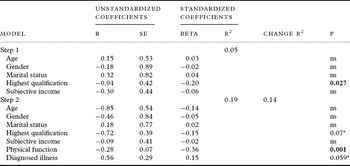
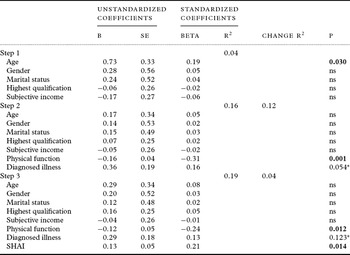
To determine which factors predicted health anxiety scores a sequential multivariate regression analysis was carried out with SHAI score as the dependent variable (DV). Two blocks of variables were entered: (a) demographic variables, followed by (b) health status variables. Results are shown in Table 3. At step 1, demographic variables as a group were not significant predictors of SHAI scores, and accounted for 5% of the variance. At step 2, health status variables accounted for an additional 14% of the variance and were significant predictors of SHAI scores (R = 0.43, Finc (2,137) = 12.00, p < 0.001). In the regression analysis, physical function was a significant predictor of health anxiety (t = -4.06, p < 0.001). Physical illness and highest qualification did not quite reach significance. In a post hoc analysis using total SHAI scores as DV, highest qualification and physical function were significant predictors of total SHAI scores. Diagnosed illness did not reach significance.
Predictors of health anxiety (SHAI) measure. (N = 145)

Figures in bold significant at p < 0.05 or better, ns = not significant, *significant trend at p < 0.1
Health anxiety, safety behaviors, and medical utilization
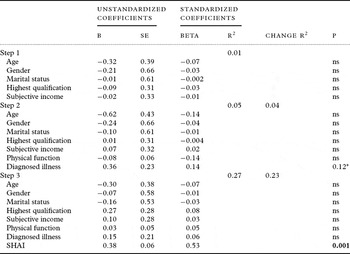
To determine factors that predicted safety behaviors and medical utilization, two separate sequential multivariate regression analyses were carried out with safety behaviors and then medical utilization as the DV. Three blocks of variables were entered: (a) demographic variables, (b) health status variables, and (c) SHAI scores. Results are shown in Tables 4 and 5.
Predictors of safety behaviors (N = 145)

Figures in bold significant at p < 0.05 or better, ns = not significant, *significant trend at p < 0.1.
SHAI = Short Health Anxiety Inventory
Predictors of medical utilization (N = 145)

Figures in bold significant at p < 0.05 or better, ns = not significant, *significant trend at p < 0.1
SHAI = Short Health Anxiety Inventory
SHAI scores predicted safety behaviors (R = 0.521, Finc (1,136) = 42.17, p < 0.001). Health anxiety accounted for 23% of variance in safety behavior scores. At step 1, demographic variables did not predict safety behaviors, and accounted for 1% of variance. Similarly at step 2, the health variables did not predict safety behaviors and accounted for only 4% of additional variance. At step 3, only SHAI scores predicted safety behavior.
Medical utilization was predicted by health status (R = 0.40, Finc (2,137) = 9.68, p < 0.001) and SHAI scores (R = 0.44, Finc (1,136) = 6.18, p < 0.05). At step 1 of the regression analysis, demographic variables accounted for 4% of variance in medical utilization. At step 2, health status variables accounted for a further 12% of variance. Physical functioning score (t = −3.51, p < 0.001) was the best predictor of medical utilization and physical illness (t = 1.94, p = 0.054) did not reach significance. At step 3, health anxiety scores added 4% variance. In this model, physical illness showed a significant trend and the best predictors were physical functioning score (t = −2.56, p < 0.05) and SHAI (t = 2.49, p < 0.05).
Discussion
This study had three major aims: to provide a preliminary indication of the levels of health anxiety in a group of adults aged over 65, to determine which demographic and health factors contribute to health anxiety in this cohort, and to examine whether an aspect of the cognitive behavioral model of health anxiety is applicable to older adults.
The prediction that this cohort would exhibit high levels of health anxiety was examined by first comparing SHAI scores obtained from the present study with those reported in other studies using the same health anxiety measure. In spite of stereotypes to the contrary, the study group of older people was not very health anxious. Approximately 3% of participants reported worrying about their health all or most of the time. Although a majority of the participant group reported some physical illness, mean SHAI and total SHAI scores for this group were similar to those reported in other studies for younger people without chronic illness (Salkovskis et al., Reference Salkovskis, Rimes, Warwick and Clark2002; Rode et al., 2005; Abramowitz et al., Reference Abramowitz, Deacon and Valentiner2007a). For example, mean total SHAI score for this group was 9.62 which is similar to the mean score of 10.59 reported by Abramowitz et al. (Reference Abramowitz and Moore2007) for a group of student participants who had no chronic illness.
There are several factors that may have contributed to the low level of health anxiety in this cohort. Previous findings indicate that while older adults worry most about their health; they worry less overall than younger people (Hunt et al., Reference Hunt, Wisocki and Yanko2003; Lindesay et al., Reference Lindesay2006). In addition, as noted previously, older people frequently have reduced health aspirations, a positive appraisal of health, and attribute unusual physical sensations to age not illness (Lyons and Chamberlain, Reference Lyons and Chamberlain2006). On the other hand, the low health anxiety scores may be due to cohort effects. This generation of older people are less likely to report negative feelings, which may have reduced health anxiety scores (Zarit and Zarit, Reference Zarit and Zarit2007). Furthermore, health is strongly associated with social and environmental living conditions (Lyons and Chamberlain, Reference Lyons and Chamberlain2006). Secondly, financial difficulties and low physical function contribute to high levels of worry (Looper and Kirmayer, Reference Looper and Kirmayer2001; Hunt et al., Reference Hunt, Wisocki and Yanko2003). Inspection of the demographic data indicates a high functioning, well-resourced group with good living conditions, which may have had a positive impact on their health and anxiety levels.
Although levels of health anxiety were generally low, there were a number of participants who exhibited high levels of health anxiety: 8% of participants had SHAI scores above the suggested cut off score of 15 for severe health anxiety (Rode et al., 2005). This was comparable with an incidence of severe health anxiety of up to 10% reported in general population studies (Looper and Kirmayer, Reference Looper and Kirmayer2001; Rief et al., Reference Rief, Hessel and Braehler2001; Noyes et al., Reference Noyes, Carney, Hillis, Jones and Langbehn2005). This finding indicates that severe health anxiety is at least as significant a problem for older adults as it is for younger individuals.
Factors that predicted health anxiety were similar to those found in other studies. A consistent significant predictor of health anxiety was decreased physical function; physical illness did not reach significance. When the total SHAI scores were considered, lower education reached significance as a predictor but other demographic factors were not significant. This is consistent with previous research which has suggested hypochondriacal concerns and illness worries are associated with lower education and reduced physical function (Kirmayer and Looper, Reference Kirmayer, Looper, Starcevic and Lipsitt2001; Looper and Kirmayer, Reference Looper and Kirmayer2001). Consistent with previous studies, physical illness did not predict health anxiety (Barsky, et al., Reference Barsky, Wyshak, Latham and Klerman1991b; Looper and Kirmayer, Reference Looper and Kirmayer2001). However, it should be noted that the physical illness measure was possibly confounded by participants under-reporting medical conditions because of memory difficulties, differing understandings of “illness”, and whether an individual had sought medical attention for the condition. These factors may have reduced the sensitivity of the measure and hence lessened the impact of the physical illness measure on the regression analyses.
The findings shown in the current study regarding the relationship between health anxiety, age, and physical function are similar to those found in a recent study of health anxiety among older people (Bourgault-Fagnou and Hadjistavropoulos, Reference Bourgault-Fagnou and Hadjistavropoulos2009). Health anxiety among older adults with high and low frailty (physical capability) was compared to health anxiety among younger adults. The study found that health anxiety was related to frailty not age and that low frailty older adults were less health anxious than the younger comparison group.
Consistent with the cognitive behavioral theory of health anxiety, SHAI scores predicted safety behaviors, and demographic and health status variables did not significantly affect this relationship. Health anxiety accounted for almost a quarter of the variance in safety behaviors. The result obtained here provides support for the applicability of the cognitive behavioral model of health anxiety to older people. Abramowitz et al. (Reference Abramowitz, Deacon and Valentiner2007a) also reported that, among their student participants, demographic variables were not significant contributors to safety behaviors and that health anxiety was a unique predictor of safety behaviors.
The majority of participants endorsed at least one safety behavior, and as expected, most responses were in the low frequency range of the scale. This pattern of response taken with the generally low levels of health anxiety may indicate that the majority of the behaviors were coping behaviors rather than safety behaviors as such. However, these conclusions can only be tentative as the differentiation between these two types of behavior relies upon the intention behind the behavior, which was not studied here (Salkovskis, Reference Salkovskis and Salkovskis1996).
Health anxiety predicted medical utilization; which again reflects the results found by Abramowitz et al. (Reference Abramowitz, Deacon and Valentiner2007a) for a younger cohort. As noted previously, there are several factors that influence utilization of medical services; therefore it is unsurprising that health anxiety accounted for only 4% of the variance in medical utilization.
The findings of the present study are a step towards empirical support for the applicability of the cognitive model of health anxiety to older people. This has implications for treatment of health anxiety in older adults. Cognitive behavioral therapy has empirical support as an effective treatment for health anxiety, although evaluation has been undertaken mainly in adults younger than 60 (Snyder and Stanley, Reference Snyder, Stanley, Asmundson, Taylor and Cox2001). This study indicates that cognitive behavioral principles may be useful in treating health anxiety among older people. In addition, safety behaviors are potentially a better indicator of problematic health anxiety than high use of medical services.
This study has a number of shortcomings that limit the generalizability of the results. The self-selected survey group was from a high functioning and well-resourced population in New Zealand, which limits ecological validity of the results. Surveying a randomly selected sample of the New Zealand population would increase the generalizability of the results. Secondly, self-report surveys are subject to response biases and cohort effects, which affect the strength of results. Lastly, it may be that the measures used in this study do not adequately capture some experiences of health anxiety among older people. For instance, some specific worry content such as concerns about becoming dependent on others, becoming disabled or cognitively impaired may not be adequately addressed. The relationship between worry content and health anxiety and other cohort specific concerns warrants further study.
There is much work to be done. Research on health anxiety among older populations is almost non-existent, and thus there are numerous possibilities for future research. Potential investigations include epidemiological studies to determine the incidence of health anxiety across different age groups in the community, investigation of the validity of the cognitive behavioral model of health anxiety in older cohorts, and validation of measures based on cognitive behavioral theory as diagnostic and therapeutic tools for older people.
Generally low levels of health anxiety among this cohort of older individuals challenge the pervasive stereotype of the “hypochondriacal” older person. It appears that in spite of physical illness, people who enjoy a physically active and well-supported old age are able to adapt to the challenges of increasing age, and are not more health anxious than younger individuals. Nevertheless, it should be noted that severe health anxiety appears to occur at similar rates to those in younger populations and the extent and consequences of this problem should not be ignored. This is possibly the first study to examine the cognitive behavioral model of health anxiety in a cohort of older adults. The findings provide preliminary support for the applicability of the model to adults over 65. This study is only a first step in gathering empirical data on the phenomenon of health anxiety among older adults, and it is hoped that this leads to further studies on this intriguing and under-researched topic.
Conflict of interest
None.
Description of authors’ roles
A. Boston carried out the design, data collection and analysis and wrote the paper. P. Merrick supervised and assisted in the design, analysis and writing of the paper.
Acknowledgments
The authors thank Professor Paul Salkovskis of South London and Maudsley Institute of Psychiatry for his permission to use the Short Health Anxiety Questionnaire and Dr Brett Deacon of the University of Wyoming for providing the Medical Utilization Questionnaire.