J. Liu comments: First, I would like to congratulate Wang et al. (Reference Wang, Yang, Han, Yao and Liu2014) for their important work on the dating of the Panxian fauna, a Triassic fossil Lagerstätte that has produced many exquisitely preserved marine reptiles (Motani et al. Reference Motani, Jiang, Tintori, Sun, Hao, Boyd, Hinic-Frlog, Schmitz, Shin and Sun2008) and that marks the full recovery of the marine ecosystem (Jiang et al. Reference Jiang, Motani, Hao, Rieppel, Sun, Tintori, Sun and Schmitz2009) following the Permian–Triassic marine mass extinction (PTME). Papers by Wang et al. (Reference Wang, Yang, Han, Yao and Liu2014) and alike are especially welcomed by vertebrate palaeontologists since they provide precise dating results for some of the most important vertebrate fossils in the world, such as the bizarre protorosaur Dinocephalosaurus orientalis (Li, Rieppel & LaBarbera, Reference Li, Rieppel and LaBarbera2004) and the earliest marine archosaur Qianosuchus mixtus (Li et al. Reference Li, Wu, Cheng, Sato and Wang2006). This related topic is also interesting because of the very recent debate about the timing of recovery from the PTME, the largest biodiversity crash during the Phanerozoic, from the predators’ perspective (Chen & Benton, Reference Chen and Benton2012; Scheyer et al. Reference Scheyer, Romano, Jenks and Bucher2014).
There are several fossil Lagerstätten recently discovered in China that have generated numerous beautifully preserved Triassic marine reptiles (Benton et al. Reference Benton, Zhang, Hu, Chen, Wen, Liu, Huang, Zhou, Xie, Tong and Choo2013). The Middle Triassic Panxian fauna (Motani et al. Reference Motani, Jiang, Tintori, Sun, Hao, Boyd, Hinic-Frlog, Schmitz, Shin and Sun2008; Jiang et al. Reference Jiang, Motani, Hao, Rieppel, Sun, Tintori, Sun and Schmitz2009) is one of them. Together with the time-equivalent Luoping biota (Hu et al. Reference Hu, Zhang, Chen, Zhou, Lv, Xie, Wen, Huang and Benton2011), they mark the full recovery of marine ecosystems from the PTME by the Anisian (Chen & Benton, Reference Chen and Benton2012; Benton et al. Reference Benton, Zhang, Hu, Chen, Wen, Liu, Huang, Zhou, Xie, Tong and Choo2013). However, the absolute dating of these fossil Lagerstätten was previously absent. Wang et al. (Reference Wang, Yang, Han, Yao and Liu2014) provided the first of such dating, improving our understanding of the timing of recovery from the PTME. However, one of the major conclusions of Wang et al. (Reference Wang, Yang, Han, Yao and Liu2014) is that the reported age is 14 Ma older than the previous estimation based on the conodont study. It is this conclusion that will lead to some confusion among vertebrate palaeontologists.
When Li, Rieppel & LaBarbera (Reference Li, Rieppel and LaBarbera2004) published their report about a new Dinocephalosaurus specimen, there was no conodont study available for the age of the strata generating Dinocephalosaurus and the associated Panxian fauna. Instead, Li, Rieppel & LaBarbera (Reference Li, Rieppel and LaBarbera2004) only generally pointed out that the specimen comes from the Anisian Guanling Formation. At the time they published their paper, the most updated geological time scale (GTS) available would have been the one by Palmer & Geissman (Reference Palmer and Geissman1999). The Anisian stage ranged from 242 Ma to 234 Ma in this edition of the GTS, so it remains unclear why Li, Rieppel & LaBarbera (Reference Li, Rieppel and LaBarbera2004) said that the new Dinocephalosaurus specimen dates to 230 Ma. Later on, Sun et al. (Reference Sun, Sun, Hao and Jiang2006) performed a detailed conodont study related to the Panxian fauna, and the paper clearly concluded that the age of the Panxian fauna is early Pelsonian based on the recognition of the Nicoraella kockeli condont zone. The current work on the Triassic geological time scale places the Pelsonian substage between about 244 and 245 Ma (Gradstein et al. Reference Gradstein, Ogg, Schmitz and Ogg2012). Thus, the radiometric dating by Wang et al. (Reference Wang, Yang, Han, Yao and Liu2014) provides a perfect match to the result of the conodont study (Sun et al. Reference Sun, Sun, Hao and Jiang2006), and in fact there is no 14 Ma difference between the new age and what was expected. All information, biostratigraphic and radiometric, agrees.
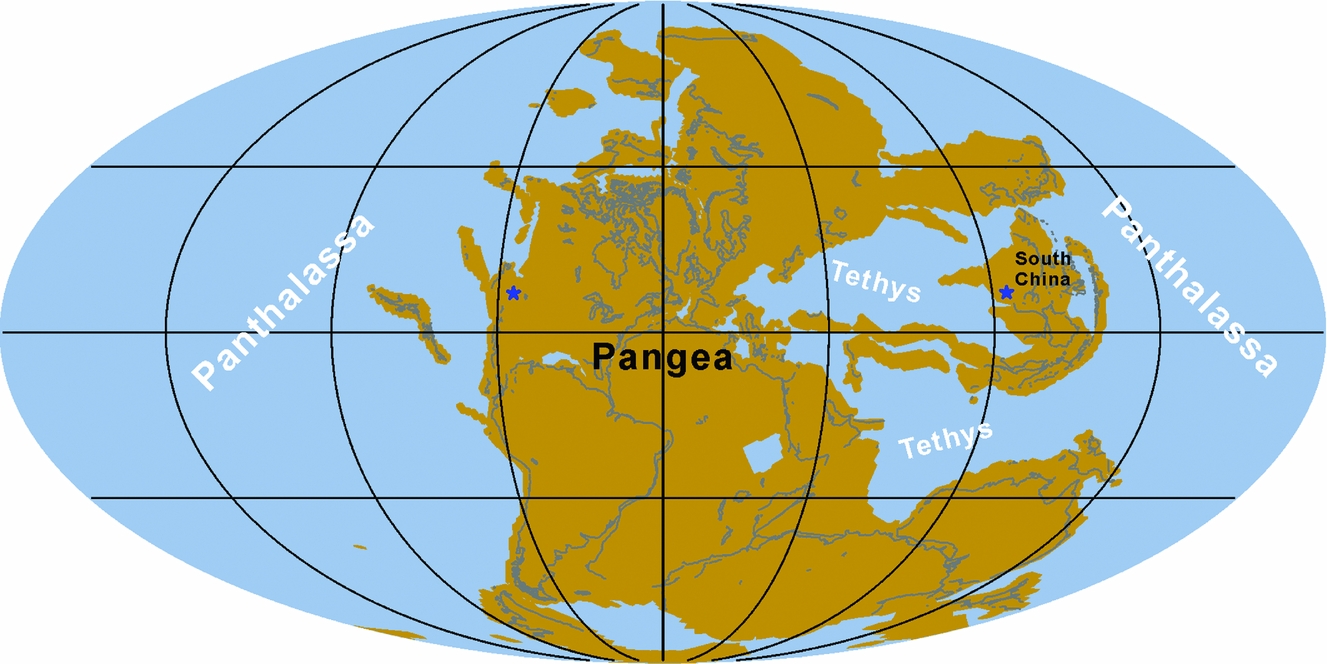
Wang et al.'s (Reference Wang, Yang, Han, Yao and Liu2014) result also has important implications for the timing of biotic recovery from the PTME. In the Triassic ocean, marine reptiles were the major large predators, the role of which is occupied by the marine mammals in the modern ocean (Massare, Reference Massare1987). After comparing them with the living marine mammals, Massare (Reference Massare1987) divided Mesozoic marine reptiles into seven more or less overlapping ecological guilds. The type with two cutting edges on their teeth, the cutting guild, was accepted as the apex predators in the relevant ecosystems (Massare, Reference Massare1987). In the Panxian fauna, Qianosuchus mixtus is such a large apex predator retaining dagger-like teeth (Li et al. Reference Li, Wu, Cheng, Sato and Wang2006). It is interesting to note that the only other Triassic macropredatory tetrapod, the ichthyosaur Thalattoarchon saurophagis, was also reported from the strata with an absolute age of 244–245 Ma (Fröbisch et al. Reference Fröbisch, Fröbisch, Sander, Schmitz and Rieppel2013). Since such large marine apex predators appeared simultaneously in both the Tethyan and Panthalassic oceans (Fig. 1) at 244–245 Ma when oceanic anoxia had just ended and key life modes such as coral reefs were just being re-established in the sea (Chen & Benton, Reference Chen and Benton2012), it seems that healthy and stable marine ecosystems had not been established globally until Middle Triassic time, unless the future discovery of such macropredatory predators in the Lower Triassic strata falsifies this hypothesis.
Palaeogeographic reconstruction showing the global distribution of Anisian macropredatory tetrapods in the sea (marked with the pentagram; the base is a 245 Ma map generated using the plotting software designed by John Alroy, available free at http://fossilworks.org/).

Acknowledgements
J. Liu acknowledges that this study is financially supported by the State Key Laboratory of Palaeobiology and Stratigraphy (Nanjing Institute of Geology and Palaeontology, CAS) (No. 143104); and the Fundamental Research Funds for the Central Universities of China.