Introduction
As organic farming usually coincides with an increase in production costs, consumers’ evaluation of the price-value ratio is of special interest. Consumers must be willing to pay a price premium for organic wine over conventional wine to make organic wine production worthwhile. In a highly competitive market, knowledge of the degree to which price effects consumers’ purchase behavior, i.e., price sensitivity, is essential in establishing targeted marketing strategies, especially in areas such as price setting and price promotions. Most research on consumers’ price sensitivity is based on purchase experiments and consumer surveys which are prone to socially desirable answers. Therefore, the potential to overestimate consumers’ willingness-to-pay for socially accepted products such as organic wine and to underestimate the role of price is high. Analyzing real purchase data is consequently of great advantage when it comes to the analysis of organic markets (Pearson et al., Reference Pearson, Henryks and Jones2011).
This paper is based on a German household panel provided by the market research company GfK—a data source of large sample size and high population coverage—which allows for the exploration of consumers’ daily purchase decisions from real market transactions. Emphasis is placed on the households’ purchase behavior regarding organic wine prices. The first objective of this study is to clarify if consumers react differently to price changes in organic and conventional wine. The extent to which prices influence consumers’ purchase behavior is often indicated in the literature as ‘price sensitivity’ (Mizdrak et al., Reference Mizdrak, Scarborough, Waterlander and Rayner2015; Guerrero-López et al., Reference Guerrero-López, Unar-Munguía and Colchero2017; Natarajan et al., Reference Natarajan, Balasubramanian and Kasilingam2017; Malasevska and Haugom, Reference Malasevska and Haugom2018) or ‘price responsiveness’ (Ludbrook et al., Reference Ludbrook, Holmes and Stockwell2014; Sharma et al., Reference Sharma, Sinha and Vandenberg2017) and is typically operationalized through the price elasticity of demand which is defined as the reaction of demand on price changes (Cornelsen et al., Reference Cornelsen, Mazzocchi, Green, Dangour and Smith2016). In this study, the term ‘price sensitivity’ is used and is measured through consumers’ price elasticity. Here it should be noted that price elasticity is only one part of consumers’ price behavior which also consists of internal processes such as price knowledge and attitudes toward prices (Rödiger and Hamm, Reference Rödiger and Hamm2015).
The second objective focuses on whether there is a difference in the willingness-to-pay for organic wine of domestic (German) origin compared with organic wine of foreign origin. Consumers’ willingness-to-pay for organic wine is defined as the price premium consumers actually paid for organic wine compared with conventional wine. Drawing on the studies of Ankamah-Yeboah et al. (Reference Ankamah-Yeboah, Nielsen and Nielsen2016), Lin et al. (Reference Lin, Smith and Huang2008) and Smith et al. (Reference Smith, Huang and Lin2009), this paper is the first to estimate revealed organic price premiums for organic wine in contrast to hypothetical willingness-to-pay estimates of stated preference studies.
For this purpose, the next three subsections give an overview on the current state of the art with respect to consumers’ price behavior for (organic) wine with a special focus on price sensitivity and willingness-to-pay. In section ‘Material and methods’, the household panel data set is presented, the method of panel analysis is described, and the applied regression models to measure consumers’ price sensitivity and willingness-to-pay are outlined. Results are given in section ‘Results’ and followed by the discussion in section ‘Discussion’. In section ‘Conclusions’, conclusions for price setting, marketing and implications for further research are outlined.
Literature review
Price sensitivity
Various studies have shown that the demand for wine is negatively correlated to price changes and have given evidence of a negative price-demand function. Overall, the economic demand for wine was proved to be inelastic on an aggregated level [for a meta-analysis, see Gallet (Reference Gallet2007), Fogarty (Reference Fogarty2009), Wagenaar et al. (Reference Wagenaar, Salois and Komro2009)], which means that the demand will decrease slightly when prices increase. However, previous research has shown that price elasticities for wine vary over income groups, societies and individual drinking behaviors (Wagenaar et al., Reference Wagenaar, Salois and Komro2009). As an example, the impact of price was lower for premium wine (Cembalo et al., Reference Cembalo, Caracciolo and Pomarici2014), red wine (Lynn, Reference Lynn2004) and for wine that was consumed outside the home, e.g., in bars or restaurants (Jiang et al., Reference Jiang, Livingston, Room and Callinan2016).
The studies reviewed in the meta-analysis predominantly analyzed national aggregated time-series data or cross-sectional data. Meng et al. (Reference Meng, Brennan, Purshouse, Hill-McManus, Angus, Holmes and Meier2014) advise analyzing repeated observations on purchases and prices of households or individuals as these data would be methodologically advantageous regarding unobserved heterogeneity and causal inference. Individual-level panel data would be helpful, especially considering the differentiated results regarding specific markets and consumer groups. Such high-frequency data would allow for the analysis of consumers’ responses to price changes including their reactions to products on sale which would otherwise be cancelled out. For wine, with its high degree of heterogeneity, a more disaggregated approach is essential.
As for organic products, comparatively little research has been conducted about price elasticities and existing studies have focused mainly on milk, fresh produce and meat. No study on organic wine was found. Up to now, there is a general consensus that prices are relevant factors for consumers’ purchases of organic products and that price and purchase quantities are negatively correlated (Schröck, Reference Schröck2012; Aschemann-Witzel and Zielke, Reference Aschemann-Witzel and Zielke2017). However, the degree to which prices of organic products influence purchase behavior is controversial, i.e., if consumers’ reaction is elastic or inelastic. The majority of studies have found that the demand for organic food is somewhat price elastic (Anders and Moeser, Reference Anders and Moeser2008) and in general, more price sensitive than for conventional food (Glaser and Thompson, Reference Glaser and Thompson2000; Lin et al., Reference Lin, Yen, Huang and Smith2009; Alviola and Capps, Reference Alviola and Capps2010; Fourmouzi et al., Reference Fourmouzi, Genius and Midmore2012; Kasteridis and Yen, Reference Kasteridis and Yen2012; Schröck, Reference Schröck2013) which is often attributed to the high-price premiums of organic products and their still minor market share. According to these findings, price reductions of organic food would lead to a revenue increase, as the change in price could be compensated by higher purchase quantities. However, some studies have found the demand for organic food to be inelastic (Zhang et al., Reference Zhang, Huang, Lin, Epperson and Houston2011; Schröck, Reference Schröck2012; Akaichi and Revoredo-Giha, Reference Akaichi and Revoredo-Giha2016) which indicates that lower prices would not be helpful in increasing revenues. Decreasing price elasticities were in line with the growth of the organic market, i.e., higher availability in different stores (Schröck, Reference Schröck2012) and growing market shares (Glaser and Thompson, Reference Glaser and Thompson2000).
In a recent review of Aschemann-Witzel and Zielke (Reference Aschemann-Witzel and Zielke2017) on consumer reactions toward price changes of organic food, the diverging results of the above mentioned studies were acknowledged. The variance in the results was ascribed to differences in product categories and consumer segments. For less processed, highly price-promoted products, and product categories with high purchase frequency and strong conventional brands, consumers’ price sensitivity was expected to be higher. Moreover, regular consumers were described as less price sensitive than occasional or non-buyers. However, even the typical organic consumer was defined as somehow reactive to organic food price changes. In light of these results, Schröck (Reference Schröck2012) concluded that new organic buyers could be attracted through price reductions.
Price as purchase barrier
From a consumer research perspective, price is among the most important wine attributes (Lockshin and Corsi, Reference Lockshin and Corsi2012) and could act as a purchase barrier due to consumers’ budget constraints (Brugarolas et al., Reference Brugarolas, Martinez-Carrasco Martinez, Bernabéu and Martinez-Poveda2010). However, contrary to economic theory, consumers did not always favor the cheapest wine. Not a lot of evidence for a negative linear effect of price was found in the area of wine consumer research (Hollebeek et al., Reference Hollebeek, Jaeger, Brodie and Balemi2007; Bernabéu et al., Reference Bernabéu, Brugarolas, Martínez-Carrasco and Díaz2008; Corsi et al., Reference Corsi, Mueller and Lockshin2012; Mann et al., Reference Mann, Ferjani and Reissig2012). Strong evidence was found, however, for an inverse quadratic relationship implying that mid-priced wines were preferred over lower priced and more expensive wines (Lockshin et al., Reference Lockshin, Jarvis, d'Hauteville and Perrouty2006; Mueller et al., Reference Mueller, Osidacz, Francis and Lockshin2010b; Chiodo et al., Reference Chiodo, Casolani and Fantini2011; Bazoche et al., Reference Bazoche, Issanchou, Brouard, Maratray and Ginon2015).
Most studies showed that the effect of price was segment specific (Mueller et al., Reference Mueller, Lockshin, Saltman and Blanford2010a). In literature, the level of involvement was mentioned most often as a determining factor for the degree of price sensitivity. Purchase experiments showed that less involved consumers simply relied on price information. Highly involved consumers used more cues for choosing wine and other characteristics such as the region of origin became more important (Lockshin et al., Reference Lockshin, Jarvis, d'Hauteville and Perrouty2006; Hollebeek et al., Reference Hollebeek, Jaeger, Brodie and Balemi2007). Moreover, the study of Durham et al. (Reference Durham, Pardoe and Vega-H2004) found evidence for a lower price sensitivity among red wine consumers. This result was attributed to red wine drinkers’ higher involvement level. However, Hollebeek et al. (Reference Hollebeek, Jaeger, Brodie and Balemi2007) emphasized that even involved consumers were price-conscious and paid attention to price promotions.
Thus price promotions were, for example, a commonly used tool to increase wine sales in supermarkets in the UK (Ritchie et al., Reference Ritchie, Elliott and Flynn2010) and Australia (Johnston et al., Reference Johnston, Stafford, Pierce and Daube2017). Accordingly, sales promotions were found to be an important motivator to purchase sustainable wine (Soosay et al., Reference Soosay, Fearne and Dent2012) and organic products (Bezawada and Pauwels, Reference Bezawada and Pauwels2013) in supermarkets. In particular, promotions were more effective in increasing sales for storable products than price reductions as they induce stockpiling (Bezawada and Pauwels, Reference Bezawada and Pauwels2013).
However, the downside was that price promotions direct consumers’ focus on the price of wine while attracting mainly low involved consumers (Hollebeek et al., Reference Hollebeek, Jaeger, Brodie and Balemi2007) for whom wine prices are very important (Lockshin et al., Reference Lockshin, Jarvis, d'Hauteville and Perrouty2006). Therefore, price promotions prevent a trading-up in supermarkets as these measures reduce the value of a brand and lower its image (Ritchie et al., Reference Ritchie, Elliott and Flynn2010). In a review on the future of consumer behavior research for wine, the negative long-term effects of promotions were emphasized. Moreover, it was outlined that this strategy is not effective in gaining many new customers, may not always increase demand, erodes reference prices and hurts profits (Lockshin and Corsi, Reference Lockshin and Corsi2012). Therefore, it is suggested that retailers find new ways to stimulate wine sales.
Price as quality cue
A meta-regression analysis on wine prices and quality ratings found strong empirical evidence for a moderate relation between price and sensory quality, and proved a strong price-reputation link (Oczkowski and Doucouliagos, Reference Oczkowski and Doucouliagos2014). Hence, it is not surprising that several consumer studies disclosed that wine prices were used as information tools and served as quality indicators in purchase decisions (Palma et al., Reference Palma, Ortúzar, Rizzi, Guevara, Casaubon and Ma2016). Wine prices were particularly used as a proxy for quality when there were few other product characteristics to evaluate and the product could not be tasted before purchase (Lockshin et al., Reference Lockshin, Jarvis, d'Hauteville and Perrouty2006). Moreover, price cues caused expectations about taste quality and thereby modified the sensory experience, meaning that higher prices increased experienced pleasantness (Plassmann et al., Reference Plassmann, O'Doherty, Shiv and Rangel2008; Schmidt et al., Reference Schmidt, Skvortsova, Kullen, Weber and Plassmann2017). The price cue did not only stress consumers’ budget constraints, but also functioned as a quality cue. The study of Palma et al. (Reference Palma, Ortúzar, Rizzi, Guevara, Casaubon and Ma2016) evidenced this ‘double—and conflicting—global effect’ of price on purchase probability.
The effect of price as a quality cue was also found for organic products (Ngobo, Reference Ngobo2011; Marian et al., Reference Marian, Chrysochou, Krystallis and Thøgersen2014). A mid-price strategy was supported due to an inverted U-shaped price function. Moreover, it was concluded that the price premium of organic products should not exceed a certain threshold as the price premium could eventually act as a barrier. Aschemann-Witzel and Niebuhr Aagaard (Reference Aschemann-Witzel and Niebuhr Aagaard2014) showed that the price premium consumers are willing to pay for organic, compared with conventional, products was, on average, 30% and the willingness-to-pay depended on the information about organic benefits and the competition with food from local origin or specialty foods.
So far, consumers’ willingness-to-pay for organic wine has frequently been analyzed through surveys and experiments (Bazoche et al., Reference Bazoche, Deola and Soler2008, Reference Bazoche, Issanchou, Brouard, Maratray and Ginon2015; Brugarolas et al., Reference Brugarolas, Martinez-Carrasco Martinez, Bernabéu and Martinez-Poveda2010; Pagliarini et al., Reference Pagliarini, Laureati and Gaeta2013; Schmit et al., Reference Schmit, Rickard and Taber2013; Ay et al., Reference Ay, Chakir and Marette2014; Wiedmann et al., Reference Wiedmann, Hennigs, Behrens and Klarmann2014; D'Amico et al., Reference D'Amico, Di Vita and Monaco2016; Delmas and Lessem, Reference Delmas and Lessem2017). Most of these studies reported consumers stated or revealed preferences and showed that consumers were willing to pay a price premium for organic wine when compared with a conventional one (Schäufele and Hamm, Reference Schäufele and Hamm2017). Interestingly, a recent study of Delmas and Lessem (Reference Delmas and Lessem2017) showed that organic wines of higher price levels or from a high-quality region did not receive a price premium for the organic production.
Few studies analyzed released wine prices. These studies accessed price data mostly through wine rating guides and analyzed data by means of the hedonic price method (Delmas and Grant, Reference Delmas and Grant2008; Kwong et al., Reference Kwong, Cyr, Kushner and Ogwang2011; Waldrop et al., Reference Waldrop, McCluskey and Mittelhammer2017; Abraben et al., Reference Abraben, Grogan and Gao2017). Relative price premiums for certified organic wine ranged, on average, between 12 and 22%. Similar to Delmas and Lessem (Reference Delmas and Lessem2017), a diminishing price premium was proved for increasing price and quality levels by Abraben et al. (Reference Abraben, Grogan and Gao2017). Moreover, the authors found that the importance of the organic label decreased when other quality attributes were present.
Material and methods
Data
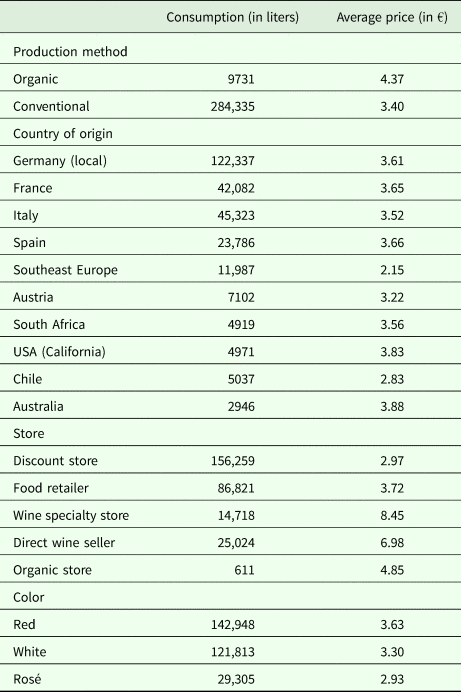
The GfK Group (Nuremberg, Germany) runs a panel of 30,000 households, representative of the population in Germany. The data set made available for the analysis at hand covered the 12-month period from December 1, 2014 to November 30, 2015. These were the latest data at the time of data delivery. In the following, this 12-month period is called 2015. We have focused our analysis on households that bought wine at least once in the year 2015 (N = 17,440). The GfK replaces households that did not report throughout whole periods and thus do not belong to the constant data pool. These households were excluded from our analysis due to low reliability. Finally, we came up with 11,367 households which conducted 146,698 wine purchases in 2015. For each purchase act, the data provided information on price, purchase quantity, shopping location, product characteristics (e.g., organic production, origin, wine color) and promotion activities. Table A1 in the appendix shows descriptive statistics on the average price paid and the current consumption (purchase quantity) for the different wine characteristics.
The observations revealed purchase behavior over 1 yr in unequal time intervals and were therefore different from traditional panel data with observations for certain points in time, e.g., years. Due to the high heterogeneity of wine quality and wine prices, a disaggregated approach was used. Through this method, it was possible to, first, analyze the effect of wine quality characteristics on price, and secondly, to decipher if the price of wine influences the volume purchased within the specific purchase situation. The data were prepared much like that of Ankamah-Yeboah et al. (Reference Ankamah-Yeboah, Nielsen and Nielsen2016) who also analyzed household panel data.
Panel data analysis
Due to the clustered structure of the data at hand, i.e., purchases of wine were nested within households, a panel model was applied (Wooldridge, Reference Wooldridge2013). Ignoring this structure would signify the assumption that observations (purchases) related to the same household are independent, which is not realistic. For example, households’ income or attitudes will typically influence their purchase behavior. Applying a pooled regression would therefore lead to biased and inefficient parameter estimates and standard errors because error terms of different observations within one household are correlated. To overcome this problem, panel models account for households’ individual unobserved heterogeneity (Verbeek, Reference Verbeek2012).
The two models of choice are the fixed- and the random-effects model. In the fixed-effects model, conclusions conditional on the effects are based on the sample, whereas the random-effects model allows for conclusions with respect to the population (Hsiao, Reference Hsiao2007). This indicates using the random model because we want to make inferences for the population in Germany. Moreover, the random-effects panel model has already been applied to estimate implicit prices for the organic attribute using household panel data (Huang and Lin, Reference Huang and Lin2007; Ankamah-Yeboah et al., Reference Ankamah-Yeboah, Nielsen and Nielsen2016). The random-effects model holds a composite error term ε which consists of an unobserved random household-specific effect αi and a remainder component u ij:
 $${\rm \varepsilon} = a_i + u_{ij}\quad i = 1 \ldots n\quad {\rm households},\quad j = 1 \ldots m\quad {\rm purchase\;\ acts}{\rm.} $$
To account for the non-linear relation of both models, a logarithmic transformation of the variables price and quantity was implied. Regarding the hedonic price analysis, this is a widely common procedure (Costanigro and McCluskey, Reference Costanigro, McCluskey, Lusk, Roosen and Shogren2012). To deal with the problem of heteroscedasticity and serial correlation, White's heteroscedasticity-consistent covariance matrix was estimated using the version of Arellano (White, Reference White1980; Arellano, Reference Arellano1987).
Hedonic price analysis
Hedonic price analysis was applied to identify consumers’ willingness-to-pay for organic wine. Previous studies already used this approach to analyze the willingness-to-pay for organic salmon (Ankamah-Yeboah et al., Reference Ankamah-Yeboah, Nielsen and Nielsen2016) and organic tomatoes (Huang and Lin, Reference Huang and Lin2007) with household panel data. The theoretical foundation of the hedonic price analysis is built on so-called characteristica models. The focus of interest is not on the product itself, but on its quality attributes. The hedonic model applied in this study follows the Consumer Goods Characteristics Model of Ladd and Suvannunt (Reference Ladd and Suvannunt1976) which is based on the consumer theory of Lancaster (Reference Lancaster1966). The model for the present study is specified as follows:
 $$\eqalign{\ln p_{ij} = &\,{\rm \beta} _0 + \; {\rm \beta} _1{\rm Organi}{\rm c}_{ij} + {\rm \beta} _2{\rm Organi}{\rm c}_{ij}{^\ast}{\rm German}{\rm y}_{ij} \cr &+ {\rm \beta} _3NovDec_{ij} + \mathop \sum \limits_{k = 1}^{10} {\rm \beta} _k{\rm Origi}{\rm n}_{kij}\; + \mathop \sum \limits_{l = 1}^5 {\rm \beta} _l{\rm Stor}{\rm e}_{lij} \cr &+ \mathop \sum \limits_{m = 1}^2 {\rm \beta} _m{\rm Colou}{\rm r}_{mij}\; + {\rm \alpha} _i + u_{ij\;},} $$
where p ij is the price for wine paid by the ith household in the jth purchase situation. The main focus of the price analysis was on the effect of the organic production method. An interaction term for organic production in Germany was introduced to differentiate the effect of domestic production on the price. The model controls for country of origin, store, wine color and the increased demand before Christmas (November–December).
The reason for differences in product prices is attributed to a variance in the valuation of relevant product characteristics. Thus, decision- and purchase-relevant product attributes can be identified. As market prices are simultaneously determined by demand and supply, implicit prices are also reflecting marginal costs of producers (Rosen, Reference Rosen1974). A detailed explanation of the influence of consumer preferences and producer costs on wine prices with regard to certain wine characteristics is given in Schäufele et al. (Reference Schäufele, Herrmann and Szolnoki2016).
Price elasticity
To analyze consumers’ reaction to prices within specific purchase situations (price elasticity), a single panel equation model was estimated with the purchase volume of wine (in liters) as the outcome variable. The price variable was interacted with organic production to understand if the effect differs according to the production method. Moreover, the purchase of wine in promotion offers was treated separately. The model controlled for the households’ individual characteristics of age, income and education, as well. The model was specified as follows:
 $$\eqalign{\ln q_{ij} & = {\rm \beta} _0 + \; {\rm \beta} _1\ln p_{ij} + {\rm \beta} _2\ln p_{ij}{^\ast}{\rm Organi}{\rm c}_{ij} + {\rm \beta} _3{\rm Organi}{\rm c}_{ij} \cr &\quad + {\rm \beta} _4{\rm Promotio}{\rm n}_{ij} + {\rm \beta} _5{\rm Household}\,{\rm Siz}{\rm e}_{ij} + \mathop \sum \limits_{k = 1}^5 {\rm \beta} _k{\rm Ag}{\rm e}_{kij} \cr &\quad+ \mathop \sum \limits_{l = 1}^4 {\rm \beta} _l{\rm Educatio}{\rm n}_{lij} + \mathop \sum \limits_{m = 1}^5 {\rm \beta} _m{\rm Incom}{\rm e}_{mij} + {\rm \alpha} _i + u_{ij\;},} $$
where q ij is the volume (in liters) bought by the ith household in the jth purchase situation. Coefficients of the price variables can be directly interpreted as price elasticities because both independent and dependent variables are logarithmized. All other relations are semi-logarithmic and coefficients therefore represent the percentage change in the dependent variable. In the case of dummy variables, the formula given by Halvorsen and Palmquist (Reference Halvorsen and Palmquist1980) must be applied. The relative effect of dummy variables is calculated as follows:
 $${\rm relative}\;{\rm change}\;{\rm in}\;Y = 100{^\ast}(e^{\rm {\beta}}-1).$$
At this point, it is important to notice that non-purchase information, which was most often considered in discrete choice models, was not given. Therefore, the conclusions of this analysis only refer to wine-buying households and their specific wine choices, and not to all German households. Moreover, we did not control for substitutional relationships as this would require aggregation of the single purchase decisions to a lower number of products. This is a common procedure in the case of homogeneous products such as milk (Schröck, Reference Schröck2012), but is not appropriate for heterogeneous products such as wine. Most often, demand analyses control for quality differences to estimate the pure effect of price changes on demand (Schröck, Reference Schröck2013). This study, however, was particularly dedicated to the question of how different prices and associated quality variations affect consumers’ purchase behavior.
Price categories
To account for the wine market's high heterogeneity and market segmentation (Costanigro et al., Reference Costanigro, McCluskey and Mittelhammer2007), price categories were established and price elasticity and willingness-to-pay models were re-estimated for each category. Due to the correlation of wine price and wine quality, this is a plausible way to segment the wine market to gain deeper insights for targeted marketing strategies. The development of demand as a function of the price was considered in the definition of price categories: the low-price category was defined as <€3 per bottle due to the strong decline of purchase acts for higher priced conventional and organic wines. For organic wine, an increase in demand was found for wine prices starting at a price of €5 and therefore the mid-price category (⩾€3 to <€5) and the premium-price category (⩾€5) were established.
Most purchases were conducted for wine bottles of 0.75 liter (59%), followed by 1.00 liter (31%). Item prices, i.e., prices per bottle rather than unit prices, were used because consumers’ perceived value of a product is not necessarily defined by the product's actual monetary value. Studies on the usage and awareness of unit prices showed that a significant share of consumers did not use unit prices due to a lack of cognitive ability (Manning et al., Reference Manning, Sprott and Miyazaki2003), motivation or time; consumers instead used heuristics such as special offers to save money or quality proxies such as brands to get the best value (Manning et al., Reference Manning, Sprott and Miyazaki2003; Mitchell et al., Reference Mitchell, Lennard and McGoldrick2003). For the regression analysis, however, prices were converted into prices per liter.
Results
Price sensitivity
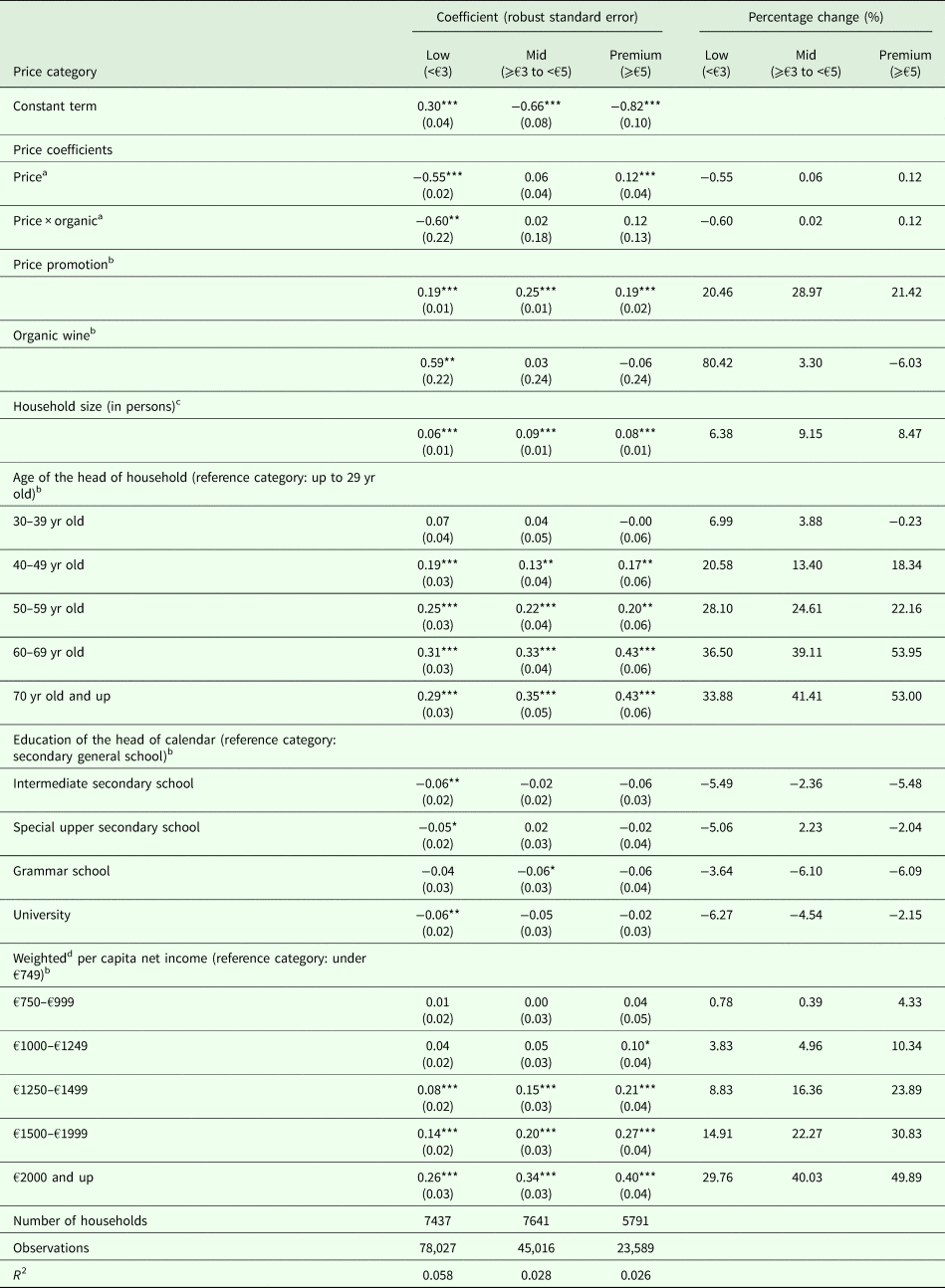
To measure consumer's price reaction within unique purchase situations, a quantity-dependent demand model was estimated controlling for the demographic variables of household size, age, education and income (see Table 1). The interaction term price × organic was introduced to differentiate the effect of price for organic and conventional wine. Significant interaction terms show that the impact of an independent variable (price) on a dependent variable is different regarding another independent variable (organic/conventional). Therefore, the overall effect for a variable with an interaction term consists of the main effect (price) and the interaction effect (price × organic). The main effect of price can only be interpreted as the unique effect if organic is 0, i.e., for conventional wines. To obtain the price sensitivity for organic wine, both coefficients need to be added (price + price × organic).
Price sensitivity model

∗∗∗ and ∗∗ indicate the 0.1 and 1% significance levels.
a Coefficients can be directly taken as price elasticity when the independent and the dependent variables are logarithmized.
b When interpreting the coefficients of dummy variables in semi-logarithmic regression equations, the formula given by Halvorsen and Palmquist (Reference Halvorsen and Palmquist1980) must be applied. The relative effect of dummy variables is calculated as follows:
Relative change in Y = 100·(e ß − 1).
c Coefficients represent the percentage change in the dependent variable when the independent variable is logarithmized.
d 1 × first adult + 0.7 × every subsequent adult + 0.5 × children.
The explanatory power of the model was rather low. That is, however, typical for household panel studies using an elevated level of disaggregation which results in high noise. For wine, external sources which are not controlled for are, for example, wines bought as a gift. In aggregated data, this unexplained variance is often averaged out which leads to higher R 2 (Wier et al., Reference Wier, O'Doherty Jensen, Andersen and Millock2008). This clearly illustrates that low R 2 is not necessarily an indicator for weak effect sizes and that it is very likely that the low scores in this study depend on the variance of independent and dependent variables.
For conventional wine, consumers’ price sensitivity was negative, meaning that higher priced conventional wines led to a reduced amount of purchase volume (in liters). The reaction was inelastic and amounted to −0.31. Due to the double-log specification of the relationship, the variables could be directly interpreted as elasticities: a 1.0% increase in price was associated with a −0.31% decrease in purchase quantity. For the effect of price in the case of organic wine, the coefficient of the interaction term price × organic of 0.36% had to be added to the price coefficient which resulted in a price elasticity of 0.05%. That means the price–quantity relation was positive and highly inelastic compared with conventional wine. The dummy variable organic shows that even though the influence of price on quantity was low, the purchase quantity was on average 36.6% lower compared with conventional wine. Price promotion, however, was associated with a 22.8% increase in purchase quantity.
Household size, age and income were positively related to purchase quantity. With every additional person in a household, purchase quantity increased by 7.44%. From the age of 40 and up, an increasing effect of age groups was found compared with persons under the age of 29. Income groups had a significant effect from an income of €1250 and up, with an increasing effect as well. For education, no clear relationship could be deducted.
Considering the heterogeneity of wine quality and its correlation with price, different models for three price categories (low, mid-price and premium) were estimated (see Table 2) and considerable differences from the aggregated model on Table 1 were found.
Price sensitivity model for wine in different price categories

∗∗∗, ∗∗ and ∗ indicate the 0.1, 1 and 5% significance levels.
a Coefficients can be directly taken as price elasticity when the independent and the dependent variables are logarithmized.
b When interpreting the coefficients of dummy variables in semi-logarithmic regression equations, the formula given by Halvorsen and Palmquist (Reference Halvorsen and Palmquist1980) must be applied. The relative effect of dummy variables is calculated as follows:
Relative change in Y = 100·(e ß − 1).
c Coefficients represent the percentage change in the dependent variable when the dependent variable is logarithmized.
d 1 × first adult + 0.7 × every subsequent adult + 0.5 × children.
Consumers’ reaction to price changes varied strongly within different price categories. The price–quantity relation was negative for the low-price category and positive for the mid-price and premium-price segment. For organic wines of the low-price segment, price sensitivity was high: the price coefficient was found to be elastic (−1.15%), whereas an inelastic reaction was detected for conventional wine (−0.55%). In the mid-price segment, no statistically significant relation was found for prices and quantities. Moreover, coefficients were rather low. For conventional wines of the premium-price segment, a positive inelastic relation of 0.12% was found, i.e., a 1% increase in price resulted in a 0.12% increase in purchase volume. For organic wine, this reaction was even higher, but statistically not significant. Price promotions played a significant role for purchase volume in all price categories, whereby they were most relevant for the mid-price segment (28.97%).
Household size was most relevant for mid-priced wines (9.15%). For low-priced wine, the importance was relatively lower (6.38%). The socio-demographic household characteristics age and income were found to be important influencing factors for wine purchases in all price categories. Being over 60 yr old was associated with a consumption increase for higher price categories, meaning that older people had a higher preference for more expensive wines. Likewise, the influence of a per head income of more than €1249 had a greater impact with each increasing price category.
Willingness-to-pay
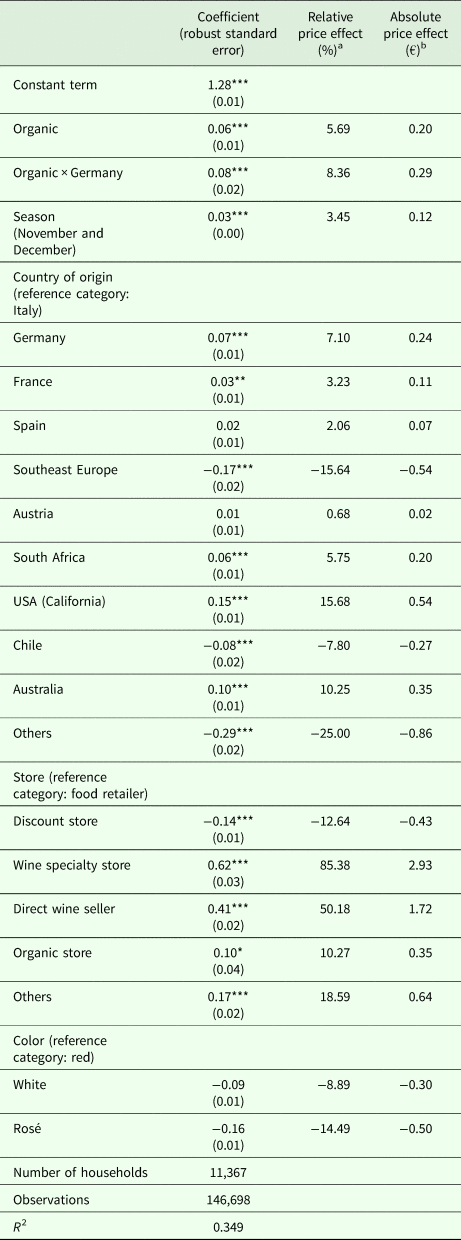
In Table 3, the results of the hedonic price analysis on the aggregated level (not price category specific) are presented. The resulting effects of the coefficients needed to be interpreted as willingness-to-pay estimates and ceteris paribus in relation to the reference: a conventional Italian red wine bought between January and October in a supermarket. The determination coefficient (R 2) indicated that the model explained 35% of the variation in price. High coefficients for the store variables showed that where wine consumers made their purchase had a strong impact on wine prices.
Willingnesss-to-pay model

∗∗∗,∗∗ and ∗ indicate the 0.1, 1 and 5% significance levels.
a When interpreting the coefficients of dummy variables in semi-logarithmic regression equations, the formula given by Halvorsen and Palmquist (Reference Halvorsen and Palmquist1980) must be applied. The relative effect of dummy variables is calculated as follows:
Relative change in Y = 100·(e ß − 1).
b Given the average prices of €3.43 per liter.
The significant interaction term (organic × German) showed that the willingness-to-pay for organic wine was different with regard to the origin, i.e., domestic (German) or foreign (all other countries). The main effect (organic) needed to be interpreted as the only effect if domestic is 0, i.e., for foreign wines. For organic wine from Germany, both coefficients must be added (organic + organic × Germany). This means that, for organic wine not originating from Germany, a price premium of 5.7% (absolute price effect: €0.20) was estimated compared with conventional wine. Organic wines of German origin (variable: organic × German) received an additional organic price premium of 8.4%. In total, a price premium of 14.1% was paid for German organic wine compared with the conventional wine of foreign origin. In absolute terms, the premium for German wine was €0.49 based on an average price of €3.43.
Regarding country of origin, New World wine-producing countries generally received higher price premiums compared with European countries. The highest coefficients were estimated for California and Australia with price premiums of 15.7 and 10.3% compared with Italian wine. The lowest premium existed for Spain (2.1%). A price deduction was given for Southeast Europe (−15.6%). An expectation was the price premium for German wine with an overall relative price effect of 15.5%.
Other variables which were controlled for showed the expected signs. For example, consumers were willing to pay slightly higher prices (about 3.5%) around Christmas time (November and December). Moreover, a price premium for red wine was estimated. White wine received a price deduction, which was even higher for rosé wine. Moreover, price premiums were highest for wine bought in specialty stores (85.4%) and directly at wine sellers (50.2%). Organic stores commanded a premium of 10.3%. The average price deduction for a wine sold at discount stores was 12.6% compared with supermarkets.
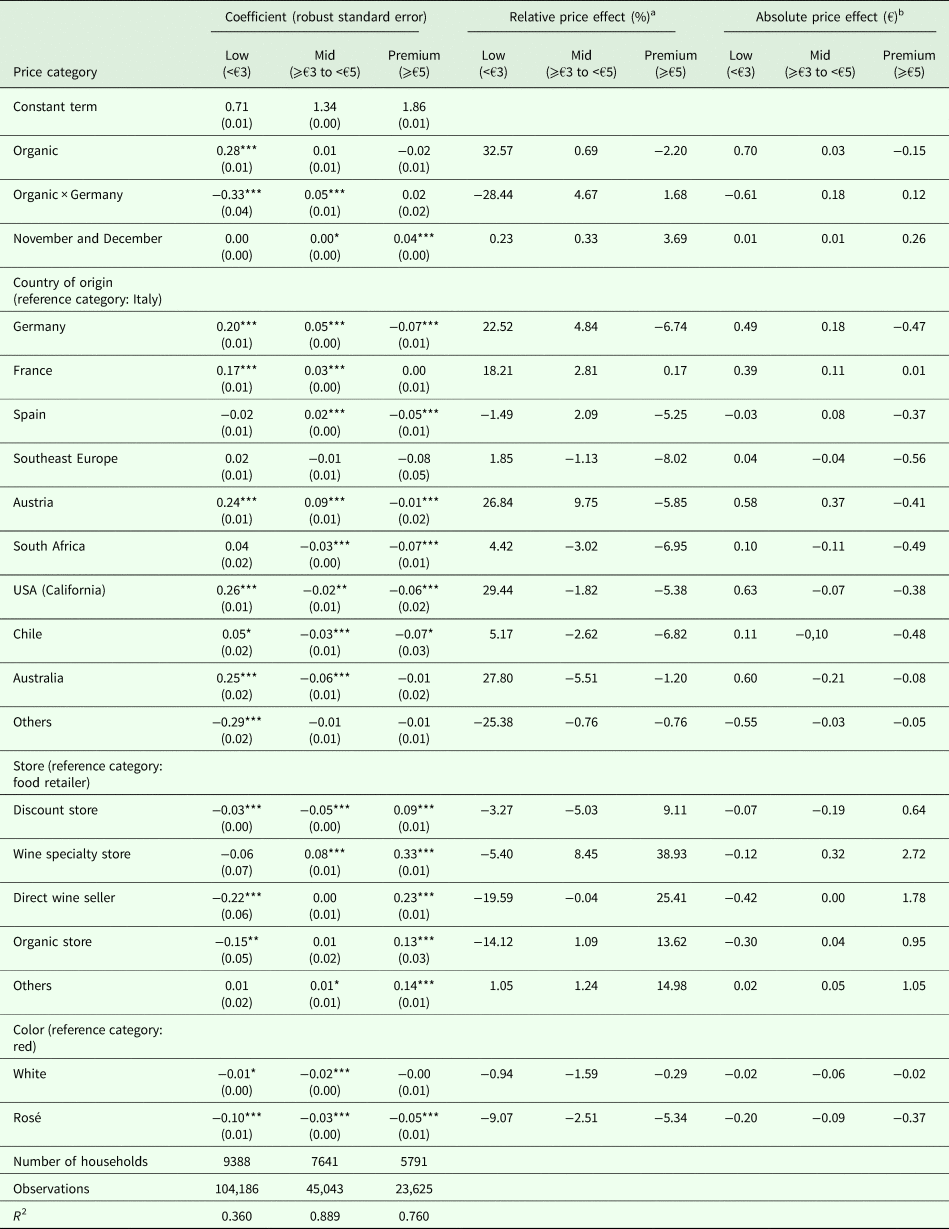
To account for differences in the effects of the coefficients in price categories, the equation of the price model presented above was re-estimated. The regression output is shown in Table 4. The explanatory power of the low-price segment (36%) was close to the average effect over all wines, whereas the mid-price (89%) and premium-price model (76%) explained a remarkably higher share of variance. The organic price premium for foreign wine was highest in the low-price model; the relative price effect of 32.6% and the absolute premium of €0.70 per liter were far higher compared with the aggregated model. The interaction variable organic × German showed a negative price coefficient of −28.4% in relative terms, which shows that organic German wines only received a small premium of 4.1% (€0.09 per liter) in the low-price segment. However, conventional domestic wines received a relative price premium of 22.5% within this segment, and for New World countries, high-price premiums were found compared with higher price segments. Store effects were mostly negative.
Willingnesss-to-pay model for wine characteristics in different price categories

∗∗∗, ∗∗ and ∗ indicate the 0.1, 1 and 5% significance levels.
a When interpreting the coefficients of dummy variables in semi-logarithmic regression equations, the formula given by Halvorsen and Palmquist (Reference Halvorsen and Palmquist1980) must be applied. The relative effect of dummy variables is calculated as follows:
Relative change in Y = 100·(e ß − 1).
b Given the average prices of €2.16 (low-price segment), €3.77 (medium-price segment) and €6.99 (premium-price segment) per liter.
Findings reversed in the mid-price segment. The main effect of the organic label was low (0.7%) and statistically not significant. However, organic wine from Germany received an additional premium of 4.7% (€0.12 per liter). Overall, country effects were much lower and largely negative compared with the low-price model. Wine specialty stores received a small premium in the mid-price segment of 8.5% (€0.32 per liter) compared with food retailers.
In the premium-price segment, no significant coefficient for organic production existed neither for foreign, nor for domestic wine. Country coefficients were small and slightly negative (except France). However, store effects became large, and in the season around Christmas time (November and December), prices were €0.26 per liter higher compared with the rest of the year.
Discussion
The presented findings were in line with elasticity estimates for wine found in previous review studies (Gallet, Reference Gallet2007; Fogarty, Reference Fogarty2009; Wagenaar et al., Reference Wagenaar, Salois and Komro2009) which proved the relation of price and purchase quantity to be negative and inelastic. This points to the general relevance of price for consumer behavior (Aschemann-Witzel and Zielke, Reference Aschemann-Witzel and Zielke2017) and more specifically for wine choices (Bernabéu et al., Reference Bernabéu, Brugarolas, Martínez-Carrasco and Díaz2008; Mann et al., Reference Mann, Ferjani and Reissig2012) due to the role of price as a budget constraint. The present analysis of high-frequency purchase data confirmed prior consumer studies based on stated preferences through the analysis of real purchase data.
However, for organic wine, low-price sensitivity was found, on average, across all price segments in contrast to most of the previous research on organic food (Fourmouzi et al., Reference Fourmouzi, Genius and Midmore2012; Schröck, Reference Schröck2013). This result points to the existence of specific preferences for organic wine, e.g., with regard to quality, taste, health and the environment (Schäufele and Hamm, Reference Schäufele and Hamm2017).
Price sensitivity for organic wine, however, differed strongly regarding price categories and these findings give new insights for price research. In the low-price segment, consumers were highly sensitive to price changes of organic wine, far more than for conventional wine. In the mid-price category, prices for both organic and conventional wine were not a decisive factor for wine sales. This result, based on actual purchase data, confirms previous survey and experimental studies which found evidence for a preference for mid-priced wines (Chiodo et al., Reference Chiodo, Casolani and Fantini2011; Bazoche et al., Reference Bazoche, Issanchou, Brouard, Maratray and Ginon2015). In the premium-price segment, positive price elasticities for organic and conventional wine give evidence that wine prices were used as quality cues as in previous experimental studies (Palma et al., Reference Palma, Ortúzar, Rizzi, Guevara, Casaubon and Ma2016; Schmidt et al., Reference Schmidt, Skvortsova, Kullen, Weber and Plassmann2017).
In line with preceding studies (Schäufele and Hamm, Reference Schäufele and Hamm2017), consumers were willing to pay price premiums for organic wine compared with conventional wine, on average, over all price categories. The hypothetical price premiums of former studies were confirmed through the estimation of revealed willingness-to-pay values. An additional price premium for organic wine of domestic origin was found in line with previous experimental studies for local organic wine (Grebitus et al., Reference Grebitus, Lusk and Nayga2013; Ay et al., Reference Ay, Chakir and Marette2014). However, real purchase data analysis revealed that country effects and organic premiums differ between price categories.
Organic wine of domestic origin was only preferred in the mid-price segment, whereas a preference for foreign organic wines was revealed for low-priced wines. In the premium-price category, however, the organic label no longer showed an effect on price, while the place of purchase (wine specialty stores and direct wine sellers) became most important. The results point to the importance of wine-selling services; for example, personal advice, wine presentation and instructed wine tastings. In prior studies, trust in the wine maker or the wine retailer was revealed as decisive factors for consumers’ behavior regarding organic wine (Kim and Bonn, Reference Kim and Bonn2015; Bonn et al., Reference Bonn, Cronin and Cho2016). The results imply that, in line with this development, labels like the organic one become less important for premium wines. Research studies analyzing only wines of the high-price category (Delmas and Grant, Reference Delmas and Grant2008; Abraben et al., Reference Abraben, Grogan and Gao2017) were therefore not able to find an organic label effect.
Overall, wine purchase behavior for the German population was highly determined by socio-demographic characteristics. Older and wealthier people showed higher preferences for wine and favored wines in higher price classes. Organic wine consumers purchased considerably less wine on each single purchasing occasion, perhaps due to their generally more health-conscious life style. Price promotion was an important driver for wine sales as in Australia (Johnston et al., Reference Johnston, Stafford, Pierce and Daube2017) and the UK (Ritchie et al., Reference Ritchie, Elliott and Flynn2010). Due to the storability of wine, this appears plausible. Moreover, price mark-ups paid for premium priced wines in the season around Christmas indicates the efficacy of promoting high-quality wines in this period.
Conclusions
New knowledge was generated through the analysis of a large amount of disaggregated data on single consumer purchases. This approach allowed price category-specific analyses and revealed interesting insights for the German wine market and future consumer behavior research. The previously found hypothetical results of earlier studies on consumers’ price behavior could be verified and embedded into a real market context.
In conclusion, foreign organic wine producers may benefit from producing organic wine in the low-price segment, but must be aware of consumer's high-price sensitivity. For German wine producers, the mid-price segment is the most attractive, and due to the low-price sensitivity, they are advised to expend the price barrier of €4.99. However, in the high-price segment, organic is not a relevant wine characteristic and wine producers may not directly benefit from organic certification.
To expand the currently minor organic wine market in Germany (market share: 5%), awareness of the quality benefits of organic production needs to be raised, especially in the premium segment. To communicate these benefits in a plausible manner, prices in the premium segment should be remarkably higher than those of corresponding conventional wines because prices are perceived as quality cues. To avoid the long-term negative effects of price promotions, marketing activities like tastings, leaflets or secondary placements are recommended instead.
Future studies should consider that consumers’ purchase behavior is price category-specific. Therefore, it is recommended to focus on particular price segments when analyzing drivers and barriers of organic wine consumption. Additional willingness-to-pay studies are needed which control for varieties and packaging characteristics (e.g., wine label, bottle, closure) since these characteristics are important for wine choices and are so far not examined with real purchase data. Moreover, future studies are advised to analyze the online and the out-of-home market for organic wine because these market areas remain unconsidered in this study.
The present study could not verify a causal relation between prices and purchase quantities. Moreover, the study is not able to finally clarify if price premiums could be exclusively interpreted as consumers’ willingness-to-pay since producer costs and bargaining power of intermediaries influence final consumer prices as well. Therefore, methodological triangulation is needed to enhance internal validity. Combining household panel data with choice experiments, surveys or price tests will be promising to overcome the above mentioned weaknesses and to benefit from a large amount of disaggregated data on single consumer purchases.
Acknowledgements
This work was supported by the Federal Ministry of Food and Agriculture (BMEL) in the framework of the Federal Program on Organic Farming and Other Forms of Sustainable Agriculture (grant number 2814OE014). We are very grateful to the GfK Verein for providing us with the household panel data set. We thank Anne Christopherson for proofreading and copyediting this paper.
Appendix
Descriptive statistics