On March 11, 2020, the World Health Organization (WHO) declared the outbreak of severe acute respiratory syndrome coronavirus 2 (SARS-CoV-2) a pandemic. This emerging infectious disease rapidly spread worldwide and, as of March 7, 2022, there were 445 096 612 confirmed cases and 5 998 301 deaths. 1 Italy registered the first SARS-CoV-2-positive patient on February 20, 2020. On February 21, 2020, the coronavirus disease (COVID-19) Regional Crisis Task Force (RCTF) and the COVID-19 Intensive Care Unit (ICU) network were established to coordinate the critical care response to the pandemic in Lombardy, the most affected region in the country. Reference Spina, Marrazzo and Migliari2
In Italy, prehospital emergency systems (EMS) are heterogeneous; in Lombardy, the Regional Emergency Agency (AREU) is in charge and decided to both assemble a specific crisis unit, to support extraordinary needs, and introduce a specific algorithm Reference Spina, Marrazzo and Migliari2 for early identification of SARS-CoV-2 cases. Initially, all potentially infected patients were gathered into preselected health facilities; soon afterward, all hospitals were required to organize separate entry routes for patients with and without suspected COVID-19 infection. At the same time, published surge capacity principles regarding command, control, and coordination; triage/reverse triage; cancellation of elective surgery; and activation of off-duty staff were implemented. Reference Koenig and Schultz3,Reference Grasselli, Pesenti and Cecconi4
In Lombardy, the precrisis number of empty ICU beds was 720. Reference Grasselli, Pesenti and Cecconi4 The emergency funds allocated by the Italian Government allowed, in just over a month, for the extraordinary expansion of hospitals’ regional surge capacity up to 1750. However, despite the aforementioned measures, by the third week of March, all ICUs were far beyond capacity and the regional health system stood on the edge of collapse. At this point, the institutions were forced to find alternative solutions in the absence of documented previous experience and/or protocols in similar circumstances. The best option, never proven on such a vast scale, was to quickly plan transfers not only to ICUs in other Italian regions Reference Grasselli, Pesenti and Cecconi4 but also abroad.
This paper describes the rapid implementation of medical evacuation (MEDEVAC) operations at the peak of the first wave of the SARS-CoV-2 pandemic in Lombardy and lessons learned from similar published research on this topic.
Methods
MEDEVAC Coordination and Organization in Lombardy
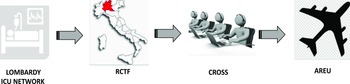
MEDEVAC missions started on March 7, 2020, and were organized according to previously published recommendations. Reference King, Niven and Beninati5 Patients’ evacuation required close operational collaboration among different actors: the Lombardy ICU Network, RCTF, AREU, and the Remote Health Operations Centre (CROSS) based in Pistoia (Tuscany), a body activated by the National Department of Civil Protection to support Italian regions in case of a health crisis (Figure 1).
Institutions involved in MEDEVAC operations. Lombardy ICU Network, Lombardy COVID-19 Intensive Care Unit network; RCTF, Regional Crisis Task Force; CROSS, Remote Health Operations Centre; AREU, Regional Emergency Agency.
The coordination mechanism functioned as follows: the COVID-19 Lombardy ICU Network sent a request of transfer to the RCTF. This request was then forwarded to CROSS, whose task consisted of, first, finding an ICU bed outside Lombardy and, second, deciding the most appropriate transport method, namely, ground emergency medical transport, rotary-wing (HEMS), or airplane. The destinations of these patients were ICUs in other Italian regions and, after having been approached by the German Embassy with an offer to help, also ICUs in Germany. At first, only subjects hospitalized in ICUs for pathologies other than COVID-19 were transported; this was done to clear space in ICUs for COVID-19 critically ill patients. Later, referrals were mostly organized for COVID-19 patients.
AREU was in charge of carrying out the transport on EMS ambulances. Whenever the referral was to be done by HEMS or plane, EMS ambulances also transported the patients to HEMS bases or airports where the handover between the local emergency service and transport medical teams took place. Airplanes and crews were provided by the Italian Ministry of Defense or German Air Force. In EMS ambulances, HEMS and medical flight patients were always assisted by Level 2 Advanced Cardiac Life Support (ACLS) Teams composed of EMS doctors and nurses, all experts in out-of-hospital care. Of note, in Italy, emergency medical technician–paramedics do not exist, and, instead, anesthesia/critical care physicians are trained as EMS doctors. An An advanced medical post, functioning as a temporary ICU, was set up in a hangar at the airport in case of a transfer of multiple patients.
Medical staff composition, equipment, and supplies complied with national recommendations for inter-health facility patient transport. Reference Cabrini, Caputo and de Blasio6 Because of the risk of infection transmission, all transfer medical staff were protected with personal protective equipment (PPE) as per the recommendations of the Italian National Institute of Health (ISS). 7
Population, Sample Size, and MEDEVAC Selection Criteria
The whole population of patients transferred by MEDEVAC from Lombardy to other ICUs in Italy and Germany during the first wave of COVID-19 was included.
At the peak of the outbreak in Lombardy, there was a paucity of literature on MEDEVAC for mechanically ventilated patients with acute respiratory distress syndrome (ARDS). Therefore, the COVID-19 Lombardy ICU Network defined, by expert consensus, and in line with the principles published by the Italian Society of Anaesthesia, Analgesia, Resuscitation and Intensive Care, Reference Ingravallo, Petrini and Zoia8 the following criteria for transfer eligibility:
-
Fraction of inspired oxygen (FiO2) less than 0.6 (60%)
-
Positive end expiratory pressure (PEEP) lower than 15 cm H2O
-
Arterial oxygen partial pressure (PaO2)/FiO2 ratio > 100 (better 150)
-
Oro-tracheal intubation for more than 2 days and less than 2 weeks
-
No renal replacement therapy
-
Low doses of vasoactive or inotropic agents (dopamine < 7.5 μg/kg/min, norepinephrine < 0.1 mg/kg/min
Eligible patients had to comply with all the aforementioned inclusion criteria.
Repatriation Process
By April 4, 2020, the downward trend of patients requiring ICU beds in Lombardy was evident; MEDEVAC missions ended, and patient return operations started. The Government of Lombardy accepted repatriation only for those patients whose clinical condition was improved to the point not to need ICU anymore. This time, the process was conducted the other way around; the Italian National Civil Department, through its liaisons with German and Regional authorities, inquired periodically about the clinical conditions of evacuated patients. Once a patient was ready to return, this was communicated to AREU who was responsible to identify the final destination in Lombardy (hospital, intermediate care facility, home) and provide for any need during transport.
Data Collection and Synthesis
During MEDEVAC and repatriation phases, basic demographic data and patients’ outcomes were prospectively collected using Microsoft manufacturer, Excel, version 16.43 (20110804), 2020. Data regarding logistical and operational aspects were also registered. Frequencies and proportions were used to present categorical variables while medians and interquartile ranges were used to describe continuous variables. Access to data stored in the internal server was possible only with authentication credentials with progressive security levels and, in any case, not from public IP addresses.
This study was approved by the Institutional Review Board Comitato Etico Milano Area 2 (September 9, 2022; study n° 6221).
Results
In total, 119 patients were transferred (Table 1): 80% were male; 55 (46%) were transferred by airplane, 33 (28%) by HEMS, and 31 (26%) by ambulance. Patients going to ICUs in other Italian regions were evacuated by HEMS and ambulance and were distributed as follows: 10/77 (13%) in southern regions; 29/77 (38%) in central regions; and 38/77 (49%) in northern regions. The 42 patients who transferred to Germany went by airplane in ICUs located in Koln/Bonn, Erlagen, Lipsia, Halle, Dresda, Bochum, Hamburg, Koblenz, Westerstede, Wurzburg, Kirchen, Regensburg, Hachenburg, Hasbach, and Neuwied. Most of the patients transferred (95/119 [80%]) were COVID-19-positive (all of those transferred to Germany (42), and 38/77 (49%) of those transferred to other Italian regions).
Demographic data of patients transferred by MEDEVAC

In total, 14/42 and 19/77 patients died in Germany and Italy, respectively (see Table 1); 86 patients survived and were repatriated. Of these, 23% went straight home, 39% needed a rehabilitation facility, and 38% continued in-patient medical treatment in hospitals.
The median time out of Lombardy was 40 days (IQR 26, min. 8, max. 93). Once the upstream health facility notified that the patient’s condition was adequate for transport, the median time to organize repatriation was 4 days. For the return missions, HEMS, ambulance, and medical flights were used for 14 (16%), 17 (20%), and 55 (64%) patients, respectively. Life-threatening events during transports weren’t reported, and no patient died during MEDEVAC or repatriation missions.
Limitations
This report explains a newly developed transfer process at the most crucial moment of a pandemic in Italy and was not conducted to determine whether the clinical course of any patient was improved or worsened by the care during the transfers or at the transfer hospital. Therefore, patients’ clinical data, comorbidities, and medical interventions during transport were not described. Likewise, commenting on standard operating procedures for the transport of these patients was beyond the objective of this study. Nor does this study prove or disprove the clinical rationale to transfer certain patients at certain times while the hospitals were increasing their individual and collective surge capacity. This discussion does not delve into the testing or classification process of persons under investigation or COVID-19-positive patients. Any study of transfer group versus a control group exceeded the intent of this study.
Discussion and Lessons Learned
Mass MEDEVAC and repatriation operations have been applied as the last resort in the context of a shortage of resources. The immediate solution to a lack of ICU beds is to increase the number of beds and staff available for critically ill patients. Reference Grasselli, Pesenti and Cecconi4 The next action is to adopt a step-by-step increasingly restrictive triage strategy for ICU admissions, always keeping in mind the general principles of distributive justice Reference Ingravallo, Petrini and Zoia8,Reference Vincent and Creteur9 ; however, after this, the accepted perspective is “utilitarian”—do the greatest good for the greatest number. In this perspective, MEDEVAC represented the best choice in an extreme low-resource situation.
Several studies have described MEDEVAC missions for hundreds of COVID-19 patients, most of them reporting MEDEVAC operations at the national level. Reference Sammito, Turc and Post10–Reference Turc, Dupré and Beaussac14 However, most of these studies focused on the clinical characteristics of evacuated patients Reference Sammito, Turc and Post10,Reference Martinez, Simon and Lely13,Reference Turc, Dupré and Beaussac14 with only 2 of them mentioning organizational aspects and patient outcomes after repatriation. Reference Mazzoli, Gamberini and Lupi11,Reference Berkeveld, Mikdad and Zandbergen12 This manuscript provided an overview of the complex functional and hierarchical liaisons rapidly put in place by the region of Lombardy in the most critical moment of the COVID-19 health crisis in Italy.
Before the pandemic, patient transfers were only carried out in case of the need for a higher level of care, diplomatic reasons, and repatriation for end-of-life care. Reference Martin15 The SARS-CoV-2 pandemic changed this perspective; the need for MEDEVAC arose in non-conflict, high-income countries and was mostly driven by the lack of ICU beds, staff, and equipment to face the unprecedented wave of critically ill patients in need of complex treatments. To avoid a catastrophe within the Lombardy health system, 119 patients had to be evacuated in a race against the clock, nationally and internationally. Because of the nuances of every MEDEVAC in terms of transport time, number of patients to be transferred, and international agreements in place, fast and effective coordination between different actors was required. In addition, 3 different transportation means (ambulance, rotary, and fixed wings), handled by different entities, had to be used.
Interestingly, recommendations on MEDEVAC and prehospital care in emergency contexts are scarce and lack a “gold standard.” Most of them are of military origin and thus limited to trauma patients. At the time of this writing, the Emergency Medical Teams Secretariat, under the umbrella of the WHO, has been working to define agreed minimum MEDEVAC standards and coordination mechanisms for emergency scenarios, including, infectious outbreaks. In the context of the current pandemic, some research, focused on the prevention of infection transmission, has been published. Reference Albrecht, Knapp and Theiler16–Reference Hilbert-Carius, Braun and Abu-Zidan18 However, recommendations for “whom to move,” “when to move,” and “how to move” in large-scale civilian operations are still unclear. This is well reflected in our study but also in recent MEDEVAC reports where transport eligibility criteria depended on discussion groups rather than relying upon collectively endorsed guidelines. Reference Sammito, Turc and Post10–Reference Turc, Dupré and Beaussac14
Lemay et al. suggested the early transfer of ARDS patients before refractory hypoxemia occurs as it may prevent the need for complex respiratory procedures during evacuation. Reference Lemay, Vanderschuren and Alain19 At the same time, these patients could be more likely to survive than others with longer time of mechanical ventilation or needing higher oxygen supplies. Interestingly, the most encountered adverse events in published research during air transport of critical COVID-19 patients are cardiovascular (transitory mild hypotension or hypertension mostly related to the changeover of vasoactive drugs in infusion pumps) and respiratory (ventilator asynchrony or desaturation). Life-threatening episodes are, instead, rare. This study is in line with previously published research demonstrating that, in carefully selected critical patients, benefits of evacuation may outweigh the risk posed by the transport itself and help ease the burden of the already overwhelmed health systems. However, more research is warranted to understand which patients, in terms of disease severity and comorbidities, would benefit more from MEDEVAC and which transport would be more suitable in each single case.
The high percentage of male patients evacuated from Lombardy reflects the results of other similar studies conducted in this region Reference Grasselli, Greco and Zanella20,Reference Ciceri, Castagna and Rovere-Querini21 and is also in line with other similar research. Reference Sammito, Turc and Post10,Reference Martinez, Simon and Lely13,Reference Turc, Dupré and Beaussac14,Reference Hilbert-Carius, Braun and Abu-Zidan18,Reference Beaussac, Boutonnet and Koch22 Also, the median age of patients transferred was similar to that described by Grasselli et al. Reference Grasselli, Greco and Zanella20 and Ciceri et al. Reference Ciceri, Castagna and Rovere-Querini21 The mortality rate (28%) was lower when compared with that described for mechanically ventilated patients in Lombardy;Reference Quah, Li, Phua and Phua 23 this could be explained by the restrictive eligibility criteria applied in this study. Furthermore, even if there was a weak association, in terms of higher mortality, for patients evacuated to Germany when compared to those transferred to other Italian regions, these data must be interpreted with caution since these results might be highly influenced by the evolution of the disease itself, patient comorbidities, and local treatment guidelines.
Few studies examined the logistical constraints of MEDEVAC operations during the COVID-19 pandemic. Reference Beaussac, Boutonnet and Koch22,Reference Karki and Sprinkle24 For example, Beaussac et al. Reference Beaussac, Boutonnet and Koch22 analyzed the average amount of oxygen needed for collective aeromedical evacuations: a total of 485–675 L/h per patient were necessary to complete the missions. This information, together with the need for standard drug dilution schemes, patient tracking numbers, and shared patient records should be considered in future MEDEVAC planning to improve patient safety, facilitate handover between transport and receiving health personnel, and enable patient follow-up. This study was able to track patients after repatriation, which still represents a limitation in most published research. Reference Sammito, Turc and Post10,Reference Berkeveld, Mikdad and Zandbergen12–Reference Turc, Dupré and Beaussac14 Data on the outcome of critically ill patients after long-distance transportation are crucial to draw conclusions on the adequacy of patient selection and assess whether MEDEVAC missions are worth implementing, in reference to the risk of infection transmission for transport health staff, bureaucratic and diplomatic hurdles, and resource consumption.
Regarding the training needs for MEDEVAC operations, several studies reported how medical teams were composed; however, even if the need for adequately trained staff is well recognized, Reference Martin15 specifics on educational requirements, curriculum, and competencies are limited. Reference Ragazzoni, Barco and Echeverri25 Focused training is of the utmost importance to avoid errors at the organizational level and during transports. For instance, MEDEVAC procedures for COVID-19 patients pose unique challenges such as the need for decontamination procedures and difficult communication during transport due to loud noise, PPE, and the limitations to use cell phones. Reference Lemay, Vanderschuren and Alain19 A universal curriculum, training requirements, and competencies should be defined.
Finally, what this pandemic has taught us so far is that MEDEVAC operations, by air or by land, must be part of ordinary disaster planning. However, this would be challenging in a country like Italy, characterized by a heterogeneous national medical infrastructure. Ideally, MEDEVAC planning should consider the injury pattern—to guide the choice of equipment and staff composition—and the type of event with its epidemiological considerations. As previously recommended, Reference King, Niven and Beninati5 pre-disaster formal agreements between health facilities, regional health authorities, and transport agencies would facilitate the evacuation process of critically ill patients in case of little pre-event notice. In addition, shared criteria are needed for MEDEVAC eligibility based on best available evidence and MEDEVAC expert consensus, possibly tailored to the selected transport means (ambulance, HEMS, train, or fixed wings).
Conclusions
The aim of this report was to describe the organization and coordination process at different levels of a national and international network created in the midst of an emerging infectious disease pandemic that rapidly overwhelmed the Lombardy Health Services. Lessons learned from this experience and other published research showed that when ICU beds rapidly became unavailable, as a consequence of the pandemic, several MEDEVAC operations could be safely implemented to ensure patients’ high-quality level continuity of care. MEDEVAC operations should be regularly included in disaster planning, and organizational agreements between health facilities, regional authorities, and transport agencies should be implemented before the next disaster or pandemic occurs. Lastly, eligibility criteria for patients who would benefit the most from MEDEVAC should be defined and endorsed by relevant organizations.
Acknowledgments
The authors thank the entire staff of AREU, the COVID-19 Lombardy ICU Network, the Italian National Department of Civil Protection, the CROSS, the Italian colleagues of other regions that helped Lombardy in these hard moments, and all the professionals (medical doctors, nurses, emergency medical technicians) involved in the response of COVID-19 in the out-of-hospital setting. Above all, we also thank all the German and Italian colleagues who helped accomplish these massive MEDEVAC operations. We also thank the relatives of all patients transferred.
Author contributions
Stucchi wrote the first draft of the manuscript; Ripoll-Gallardo performed a critical revision of the first draft, contributed to the final version of the manuscript, and approved the version to be published; Sechi approved the version to be published; Weinstein contributed to the final version of the manuscript and approved the version to be published; Villa contributed to the concept or design of the study and approved the version to be published; Frigerio contributed to the concept or design of the study and approved the version to be published; Federighi contributed to the concept or design of the study and approved the version to be published; Grasselli approved the version to be published and approved the version to be published; Zoli approved the version to be published and approved the version to be published; Bonora approved the version to be published and approved the version to be published; Fumagalli contributed to the final version of the manuscript and approved the version to be published; and AREU Crisis Unit approved the version to be published.
Competing interests
None.