The aim of this paper is to confront folk epistemic intuitions with Peter Baumann's (Reference Baumann2014) provocative thesis questioning a widely accepted view on the relation between the notions of knowledge and luck. According to widespread philosophical opinion, knowledge is incompatible with luck, or, in other words, the absence of luck is a necessary condition for knowledge possession. Baumann (Reference Baumann2014) calls this claim the No-Luck-Thesis. The roots of this idea can be found in Plato's Theaetetus. Later on it was endorsed by many other philosophers, including Peter Unger (Reference Unger1968), or, more recently, Duncan Pritchard (Reference Pritchard2004, Reference Pritchard2007).
It should be noted however, that the above formulation of the No-Luck-Thesis is far too vague. The meaning of ‘luck’ must be specified. Especially, since most philosophers would agree that not all luck is incompatible with knowledge – one can be lucky in some specific ways and still be a knower. For example, being lucky to obtain evidence in favor of one's true belief or possessing some rare cognitive ability by luck does not prevent one from having knowledge. The kind of luck that is normally recognized as knowledge-threatening is luck in the truth of the belief, also known as veritic luck (Pritchard Reference Pritchard2004) or resultant epistemic luck (Baumann Reference Baumann2014). Another belief widely shared by epistemologists is that the concept of veritic luck explains why we refuse to attribute knowledge in Gettier and Gettier-style cases.Footnote 1
Nevertheless, Baumann (Reference Baumann2014) argues that even this last variety of luck can coincide with knowledge possession. His contention, apart from some theoretical arguments he provides, rests on a series of thought experiments that, according to Baumann's expectations, should elicit intuitions that both luck and knowledge are present in the considered situations.Footnote 2 Even though he would agree that there are cases in which absence of knowledge coincides with veritic luck (like the famous Fake-Barns scenario, see Goldman Reference Goldman1976), he claims that it is not so when it comes to his own variants of other famous cases, including Bertrand Russell's (Reference Russell1948) Stopped-Clock scenario, or Alvin Goldman's (Reference Goldman1986) Thermometer case. He stresses that, since to challenge a claim postulating a necessary relation one counterexample is enough, in order for his view to receive support, only one of his scenarios needs to make us judge that there is both knowledge and luck present at the same time.Footnote 3 He explicitly says that an appropriate way of proving whether he is right or wrong would be to present these scenarios to a representative group of English speakers (Baumann Reference Baumann2014: 531). Following these suggestions, I ran an experiment designed to compare folk intuitions concerning knowledge and veritic luck in one case that Baumann takes to be in favor of his hypothesis, as well as in Fake-Barns and Thermometer cases.
1. EXPERIMENTAL DESIGN AND PROCEDURE
The study focused on three different Gettier-style cases: Fake-Barns case (high defeater version of the scenario adopted directly from Colaço et al., Reference Colaço, Buckwalter, Stich and Machery2014), Stopped-Clock case (modeled on one of the variants of this thought experiment by Baumann Reference Baumann2014: case (e)Footnote 4 ), and Thermometer case (modeled on the original Alvin Goldman's (Reference Goldman1986) example). For illustrative purposes, the Thermometer scenario is presented below (other vignettes can be found in the Appendix):
Stephen is a physician. A patient, Josh, enters his consulting room. Josh feels ill and looks for a correct diagnosis and appropriate treatment. He complains about having a cough, runny nose, and a rash on his skin.
Stephen examines the symptoms of Josh's disease in detail. He discovers that most of the patient's body is covered with small red spots and that his eyes are red as well. These symptoms, together with dry cough and runny nose make Stephen suspect that Josh is suffering from measles. Stephen wants to check whether Josh also has fever.
Stephen takes a box full of thermometers out of his medical cabinet. He picks one thermometer from the box and takes Josh's temperature. The thermometer indicates 98.6 degrees, leading Stephen to believe that the patient's temperature is normal, which is true. However, unbeknownst to Stephen, the thermometer he used is the only reliable thermometer in the box. All other thermometers in the box are defective and they would read 98.6 even if the patient had a fever. Still, the thermometer that Stephen used was working fine and gave the correct reading of the temperature.Footnote 5
Before evaluating the scenarios, all subjects were asked to give some demographic information about themselves, including their age, gender, and education. They were also asked whether they possess graduate philosophical training of any level and whether their native language is English. Afterwards, each respondent, depending on random assignment, was given one of the aforementioned scenarios. Every subject was also randomly assigned to one of two groups, either the control or test group. The groups did not differ in the wording of the scenarios, but in questions that the participants were asked. In the control group participants were asked to judge whether the protagonist of the story knows a proposition, which according to the assumptions of the designer of the experiment, is clearly known in the described situation. For example, in the Thermometer case the knowledge question was: Does Stephen know that his patient has a rash on his skin? On the other hand, in the test group, subjects were asked whether they would accept a Gettierized true belief held by the protagonist as knowledge or not. For example, in the Thermometer case the question was: Does Stephen know that the patient's temperature is 98.6? In both groups, respondents were giving their judgments using a 7-point scale, ranging from ‘0’ described as ‘doesn't know’ to ‘6’ described as ‘knows’. These solutions were inspired by the methodology used in the Colaço et al. (Reference Colaço, Buckwalter, Stich and Machery2014) study. Adopting the same methodology and using the exact same scenario as their high-defeater Fake-Barns case makes one part of my experiment an attempt at replicating some of the Colaço et al. (Reference Colaço, Buckwalter, Stich and Machery2014) findings.
In order to establish whether folk intuitions in Gettier-style cases support the No-Luck-Thesis, apart from giving their intuitions concerning knowledge, all subjects were also asked whether they agree with a sentence stating that the truth of the belief in question is a matter of luck (e.g. Do you agree with the following claim: ‘It is a matter of luck that Stephen's belief that his patient's temperature is 98.6 is true’?). The question pertaining to luck was also graded on a 7-point scale, where ‘0’ was defined as ‘strongly disagree’, and ‘6’ as ‘strongly agree’. Moreover, all respondents had to answer two yes-or-no comprehension questions testing whether they read the scenarios carefully enough, constructed in an analogous manner for all three cases taken into consideration (see Appendix).
Thus, the design of the experiment fits the between-subject two-dimensional ANOVA model. Two factors: Scenario (3) × Gettierization (2), yielded six distinct groups corresponding to different experimental conditions. There were two dependent variables: knowledge ascription and luck ascription.
The experiment was conducted via the Internet. The survey was designed using LimeSurvey, an open-source CMS software created strictly for the purpose of constructing online surveys (www.limesurvey.org).
2. SUBJECTS
Participants were recruited from Internet users registered as ‘workers’ on the Amazon Mechanical Turk website (www.mturk.com). Each respondent was paid $0.30 for her participation in the experiment. In total, 361 subjects submitted their answers to the survey; however, only 326 answers were included in the final analysis. Submissions from 35 respondents were rejected because they either failed to provide a correct answer to at least one comprehension question, reported being a non-native English speaker, or declared having a degree in philosophy. All further statistics concern the sample not including these 35 rejected responses.
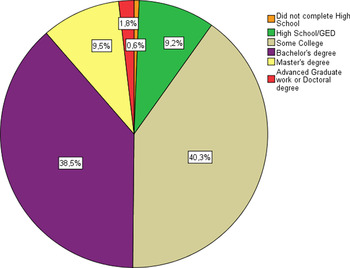
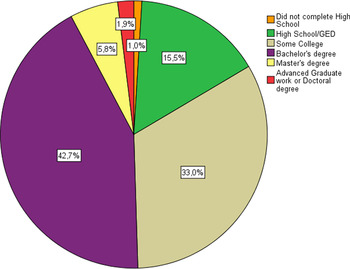
55.2% of participants were male, while 44.8% were female. The average age was 35.9 (SD = 11.77), ranging from 19 to 74 years. The distribution was slightly skewed towards younger people. Most of the participants either had a bachelor's degree (38.5%) or underwent some college education without receiving a degree (40.3%). The education of respondents is illustrated in Figure 1.
Levels of education of the participants.

3. HYPOTHESES
The predictions are based on Baumann's (Reference Baumann2014) expectations regarding the intuitions elicited by the scenarios chosen for the study. According to Baumann, the pattern of answers concerning luck should be similar for all three scenarios, while in cases of knowledge attribution, significant differences between the Stopped-Clock case and the other two scenarios should be observed. According to Baumann, there is an important difference between knowledge and luck attributions that warrants such predictions. Knowledge attributions, he claims, are “track-record”-related: considering whether a subject knows involves thinking about his or her performance over time. Thus, in some cases – for example in Baumann's version of the Stopped-Clock scenario – “time heals epistemic wounds.” Luck attributions, on the other hand, are more “origin”-related: whether some event is seen as lucky is a matter of how it originated. As Baumann puts it: “Therefore, we're ready to “rehabilitate” the epistemic subject after a certain amount of time while we stick with our attributions of luck even after time has passed” (Reference Baumann2014: 533).
Baumann's main claim is that knowledge does not necessarily exclude (veritic or epistemic resultant) luck. Therefore, there should be at least one case in which people will intuitively attribute knowledge, but still judge that the belief in question is true by luck. In particular, if Baumann is right, the results should confirm two following hypotheses:
(H1)
For all three scenarios (Fake-Barns, Stopped-Clock and Thermometer), people in the control group will disagree that the truth of the belief in question is a matter of luck, whereas people in the test group will agree that the truth of the belief is a matter of luck.
(H2)
For the Fake-Barns case and the Thermometer case people in the test group will be more reluctant to attribute knowledge than people in the control group, whereas with the Stopped-Clock case, people in both the control group and test group will attribute knowledge (and they will be equally likely to do so in both conditions).
4. RESULTS
4.1 Knowledge attributions
To analyze the data, a standard two-dimensional (Scenario × Gettierization) ANOVA analysis was performed. Main effects of both factors were obtained. On average, subjects were more likely to attribute knowledge in the control condition (M = 5.49; SD = 1.29) than in the test condition (M = 4.86; SD = 1.83) – F(1,320) = 17.72; p < 0.001; η2 = 0.052.Footnote 6 There were also differences between mean knowledge ratings for different scenarios – F(2,320) = 23.39; p < 0.001; η2 = 0.128. Post-hoc testsFootnote 7 revealed that, on average, subjects were less likely to attribute knowledge to the protagonist of the Stopped-Clock scenario (M = 4.47; SD = 2.21) than in the Thermometer (M = 5.77; SD = 0.69) or Fake-Barns (M = 5.31; SD = 1.22) cases.Footnote 8 No interaction effect between Scenario and Gettierization was observed.
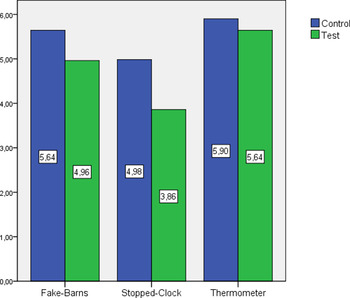
A crucial question for our discussion is, however, whether there were significant differences between knowledge ratings in test and control conditions within each scenario. Post-hoc tests found significant differences for the Fake-Barns scenario (control: M = 5.64; test: M = 4.96) and the Stopped-Clock case (control: M = 4.98; test: M = 3.86), but, importantly, not for the Thermometer case (control: M = 5.9; test: M = 5.64). These results seem to support our doubts about the No-Luck-Thesis – in fact there is one scenario of which people judged that a Gettierized belief is knowledge no less likely than a belief that is not Gettierized, while Gettierization played its predicted role in the Fake-Barns scenario. On the other hand, and contrary to our second hypothesis, it is not Baumann's Stopped-Clock case that elicited intuitions unfavorable to the No-Luck-Thesis.
Post-hoc testing revealed also some other differences for knowledge ratings. In the control group, subjects were less likely to attribute knowledge to the protagonist of the Stopped-Clock case (M = 4.98) than to the protagonist of the Thermometer case (M = 5.9). A similar pattern was found within the test group – here the average knowledge rating for the Stopped-Clock scenario (M = 3.86) was lower than the ratings for both Fake-Barns (M = 4.96) and Thermometer scenarios (M = 5.64). Moreover, there was a significant difference between these two last judgments. The results of the experiment with respect to knowledge attributions are illustrated in Figure 2.
Mean knowledge ratings depending on Gettierization and Scenario.

As we can see, there were significant drops in knowledge ratings between control and test conditions for Fake-Barns and Stopped-Clock cases, but what is also clearly visible is that these drops are really small and they are far from being a predicted shift from attributing to denying knowledge. Importantly, the average judgments concerning Gettierized beliefs are significantly above the midpoint of the scale (Fake-Barns: M = 4.96; SD = 1.36; t(53) = 10,61; p < 0.001; Stopped-Clock: M = 3.86; SD = 2.49; t(49) = 2,44 p = 0.018), which means that even in the condition where subjects found the knowledge ascription most dubious, on average, they still tended to attribute knowledge rather than deny it.
4.2 Intuitions concerning luck
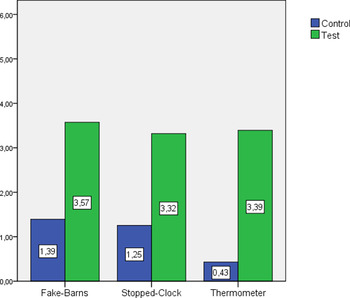
Subjects’ judgments regarding luck were also analyzed using a two-dimensional ANOVA, including Scenario and Gettierization as factors. However, the pattern of results is different. A stronger main effect of Gettierization was obtained – subjects were more likely to judge that the truth of the belief in question is a matter of luck in the test condition (M = 3.43; SD = 2.09) than in the control condition (M = 1.05; SD = 1.71) – F(1,320) = 131.14; p < 0.001; η2 = 0.29.Footnote 9 The main effect of Scenario, in contrast to the results for knowledge attributions, only reaches the border of statistical trend – F(2,320) = 2.55; p = 0.08; η2 = 0.016. This trend, however, is not supported by further post-hoc testing – it revealed no significant differences with respect to judgments concerning luck between the scenarios tested in the study (when test and control conditions are collapsed together). No interaction effect between Scenario and Gettierization was found either. Figure 3 illustrates the results of the study concerning luck ascriptions.
Mean luck ratings depending on Gettierization and Scenario.

Let us now focus on comparisons between six experimental conditions that are the result of combining both factors. When it comes to the comparison of control and test conditions within scenarios, post-hoc tests revealed statistical differences for all three examined cases: Fake-Barns (control: M = 1.39; test: M = 3.57), Stopped-Clock (control: M = 1.25; test: M = 3.32), and Thermometer (control: M = 0.43; test: M = 3.39). This means that people were in fact more likely to judge that the truth of the belief is a matter of luck when the belief in question was Gettierized than when it was not. Post-hoc tests comparing pairs of scenarios within test and control groups revealed only one significant difference: respondents were less likely to say that the belief in question is true by luck when evaluating the non-Gettierized belief in the Thermometer case (M = 0.43), than when evaluating the non-Gettierized belief in the Fake-Barns case (M = 1.39). There was no difference in average ratings of luck between scenarios for the Gettierized beliefs.
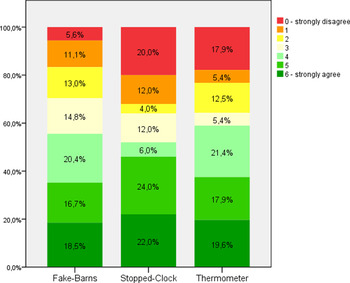
The results described above support the first of our hypotheses to some degree, but note that again, the differences between control and test conditions are not as big as predicted. Participants were in fact more likely to link the Gettierized beliefs with luck than the non-Gettierized beliefs. But on the other hand, it is not the case that, on average, they judged the former to be a matter of luck, as was expected. Actually, the judgments concerning luck in test conditions were almost perfectly ambivalent among all three scenarios – one-sample T-tests found statistical difference between the luck rating in the test group, and the middle point of the scale only for the Fake-Barns scenario (M = 3.57; SD = 1.83; t(53) = 2.3; p = 0.025), but, as we can see, even in this case the mean is really close to the middle point. Respondents evaluating Gettierized beliefs can be divided into two opposing groups – where roughly one third claimed that there is no luck at play, while around half agreed with the luck statement. This result is illustrated in Figure 4.
Distribution of judgments concerning luck in the test condition.

4.3 Do intuitions concerning luck explain intuitions concerning knowledge?
Besides investigating the influence of different scenarios and Gettierization on folk intuitions regarding knowledge and luck I computed some additional statistics to examine whether there was any relationship between knowledge and luck attributions. Recall that, according to the widely believed No-Luck-Thesis, knowledge is incompatible with veritic luck. To support this claim with folk intuitions, we would have to find a strong negative relationship between ascribing knowledge and judging that the truth of the belief in question is a matter of luck. To test this, I calculated the correlation of these two variables. For the whole sample, the relationship of the predicted kind turned out to be significant, but relatively low – r(326) = −0.228, p < 0.001. Giving a higher rating to the luck question predicts, to some small degree, reluctance to accept the knowledge attribution (and vice versa), but each variable explains only slightly more than 5% of the variance of the other variable. If one considers the correlations separately for different scenarios, the picture does not become much more favorable to the No-Luck-Thesis. In case of the Thermometer scenario, there is no significant correlation between variables (r(107) = −0.142; ns), while for the other two scenarios it is slightly stronger than for the sample as a whole (Fake-Barns: r(110) = −0.297, p = 0.002; Stopped-Clock: r(109) = −0.268; p = 0.005). Further analysisFootnote 10 of the combinations of knowledge and luck evaluations given by subjects reveals that the second biggest group, right after those who attributed knowledge and claimed there is no luck at play (54%), is the group of subjects agreeing with both knowledge and luck attributions (25.5%). The percentages in groups representing other seven combinations are marginal – in particular, only 4% of participants at the same time rejected the knowledge attribution and agreed that the truth of the belief in question is a matter of luck. Keep in mind, though, that only 8.6% of the whole sample denied the knowledge ascription, which means that 46.4% of participants giving a negative knowledge rating gave a positive judgment concerning luck. Taking all this into account, it seems that folk intuitions do not support the philosophical view according to which knowledge is incompatible with luck and luck explains lack of knowledge in Gettier-style cases.
5. DISCUSSION
The first thing worth noting about the results is that all the scenarios failed to make non-philosopher's verdicts concerning knowledge and luck shift from positive to negative along the lines of Gettierization. It turns out that for non-philosophers there is knowledge where, according to many philosophers, there is only a mere true belief. However, this is not entirely surprising. The results for the Fake-Barns case obtained in my experiment almost perfectly replicate the data collected in the Colaço et al. (Reference Colaço, Buckwalter, Stich and Machery2014) study. Presenting the exact same scenario to their respondents, they also observed a significant, but very slight shift in verdicts regarding knowledge between Gettierized and non-Gettierized beliefs. They didn't ask their respondents about luck, however. James Beebe and Joseph Shea (Reference Beebe and Shea2013) observed a similar pattern of answers for the Stopped-Clock case in the classic, Russellian version – it influenced subjects’ judgments, but not as much as armchair philosophers expected it would. Beebe and Shea's scenario was different (and simpler) than the version of the Stopped-Clock case used in my study. This shows that all the modifications introduced to the Stopped-Clock scenario by Baumann (Reference Baumann2014) failed to influence folk intuitions concerning knowledge in any different way than the standard version of the case.Footnote 11 The most interesting result of my study, however, is the fact that a similar pattern was not found for the Thermometer case. In regards to the Thermometer case there was no shift in attributing knowledge between Gettierized and non-Gettierized beliefs. But, interestingly, at the same time, the influence of Gettierization on folk intuitions regarding luck was analogous for all three scenarios. So, in the case of the Thermometer scenario, people were more likely to judge that the Gettierized belief is true by luck than that the non-Gettierized belief is luckily true, but they equally agreed in attributing knowledge in case of both these beliefs. One could take this particular result of my study to support Baumann's (Reference Baumann2014) hypothesis. After all, there was a shift in luck attribution without a corresponding shift in knowledge attribution. It seems then that we found a counter-example to the No-Luck-Thesis that is backed up by folk intuitions.
Unfortunately, I am afraid that this conclusion would be too hasty. First of all, it is not so clear whether it is legitimate to say that people judged the Gettierized belief is true by luck. Recall, that for each scenario the number of subjects giving this kind of judgment was slightly above 50%. It is significantly more than in the case of non-Gettierized beliefs, but still not enough to conclude that most people claim there is luck at play in Gettier-style cases. It is hard to explain why intuitions regarding luck were so disparate – in particular, it is difficult to say whether this high variance in judgments reflects real divergence in folk intuitions on this matter, or maybe it is only a sign that luck is a concept not fully grasped by non-philosophers and their intuitions on luck are simply fuzzy. The second reason for doubts is that there seems to be a plausible alternative interpretation of the lack of differences in judgments concerning knowledge attribution in the Thermometer case. When designing the scenario, I unconsciously introduced an additional difference between the protagonist of this case and the protagonists of the other two vignettes, not suspecting that this detail can influence subjects’ answers. In Fake-Barns and Stopped-Clock scenarios the putative knower was a “regular” person and the respondents had no reason to assume that he possesses any special abilities that put him in a favorable epistemic position with respect to the belief in question. In the Thermometer case, however, the protagonist is a physician, an expert on the considered matter who, supposedly, is more reliable in recognizing symptoms such as rash or fever than a “regular” person. This fact might have played a more important role in shaping subjects’ intuitions than Gettierization. And since a fever can be detected not only using a thermometer, but, for example, just by touching somebody's forehead, it seems even more probable that this was the case. Respondents might have predicted that even if the physician used a broken thermometer and the patient had a fever, he would nevertheless realize that the patient's temperature is raised by noticing other symptoms he is highly trained in recognizing. To test whether that was the main factor shaping subject responses to the Thermometer case, I ran a follow-up experiment with a variant of this scenario in which the protagonist is a “regular” person and there is no reason to assume that he is a specialist in recognizing fever symptoms.
6. A FOLLOW-UP STUDY
6.1 Experimental design
The follow-up experiment aimed at establishing whether folk intuitions concerning knowledge in the Thermometer case would remain insensitive to Gettierization even if there was no reason to suspect that the person to whom the knowledge is being attributed is in a favorable epistemic position with respect to the belief in question. The study focuses on a variant of the Thermometer scenario in which, contrary to the previous version, the temperature is not taken by a physician, but a history teacher (see Appendix).
The methodology of this additional experiment did not differ in any significant way from the one used in my original study. However, in the control condition subjects were asked whether the protagonist knows that his son (who replaced the role of the patient from the previous version of the scenario) has red eyes, instead of focusing on the belief concerning skin rash. It is because the subjects might have reasons to doubt that this latter belief is a clear case of knowledge – contrary to a physician, a history teacher may lack the skill needed to, for example, tell the difference between real rash and cleverly painted dots. The knowledge-question in the test condition, though, was similar to the original version of the Thermometer scenario. Apart from questions concerning knowledge, subjects were also asked to give their verdicts about luck. The follow-up experiment was conducted as an on-line survey, just like the original study.
6.2 Subjects
As before, the participants were recruited through Amazon Mechanical Turk. Each respondent was paid $0.3 for taking the survey. 119 subjects provided their answers to all the questions, but 15 of them failed to answer correctly the comprehension question, admitted not being native English speakers, or declared having a degree in philosophy. Thus, their answers were not included in further analysis.
67.3% of the participants were male. The average age was 36.3 years (with standard deviation 12.3 years), ranging from 19 to 69 years. Similarly as before, the majority of subjects (60%) were below 35 years old. The education of respondents is illustrated in Figure 5.
Levels of education of the subjects participating in the follow-up study.

6.3 Results
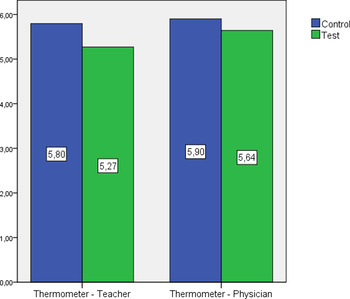
First, let us consider whether subjects’ verdicts concerning knowledge attribution for the alternative version of the Thermometer case were also insensitive to Gettierization, as it was in case of the initial formulation of the scenario. As predicted, it turned out that the profession of the putative knower played an important role in shaping subject's judgments. Contrary to the result obtained for the original version of the Thermometer scenario, in the case of the alternative version subjects were more reluctant to attribute knowledge in the test condition (M = 5.27; SD = 1.21) than in the control condition (M = 5.8; SD = 0.89) – t(102) = 2,49; p = 0.014. However, even though the influence of Gettierization on intuitions regarding knowledge was observed, it was similarly small as in the case of the Fake-Barns and Stopped-Clock scenarios. The comparison of results obtained for two alternative versions of the Thermometer case is presented in the chart below.
The way that Gettierization affected verdicts concerning luck in the alternative formulation of the Thermometer case did not differ in any important way from the influence observed for the three other scenarios tested in my experiment. Subjects were much more likely to judge that the truth of the belief in question is a matter of luck when evaluating the Gettierized belief (M = 3.49; SD = 2.08) than when assessing a clear case of knowledge (M = 0.96; SD = 1.91) – t(102) = −6.43; p < 0.001. But, again, it was not the case that when it comes to the Gettierized belief, the majority of people claimed that veritic luck was in play – similarly as before, only 54.6% of subjects gave such an answer. Most interestingly, though, almost all of the people who gave such an answer (90%) nevertheless accepted the knowledge attribution. There was a negative correlation between judgments concerning knowledge and luck – r(104) = −0.281; p = 0.004 – but still, it was far too weak to allow concluding that non-philosophers relate these notions in the same way as suggested by the No-Luck-Thesis.
Mean knowledge ratings depending on Gettierization for two versions of the Thermometer case.

7. FINAL DISCUSSION
The results of my experiments show that, contrary to Baumann's (Reference Baumann2014) suggestions, the intuitions concerning knowledge were subject to Gettierization to a similar degree in the Fake-Barns case, Baumann's modified Stopped-Clock case, and an adequately designed Thermometer case. Subjects’ verdicts concerning the initial version of the Thermometer scenario, in which the protagonist was a medical doctor, and the participants might have assumed that he is in a favorable epistemic position with respect to the belief in question, should not be taken into consideration when investigating the issues of Gettierization, knowledge and luck. The observation that in some cases a certain kind of expertise possessed by the agent may ‘immunize’ – at least according to non-philosophers – his or her beliefs to Gettierization is interesting on its own. As I argued, in the case of the Thermometer scenario with a physician as a protagonist, it is in fact reasonable to expect that the protagonist's belief is safe from error – even if he were not lucky to pick up the working thermometer and the patient had a fever, he would possibly notice this latter fact anyway. It would be interesting to further investigate the conditions upon which non-philosophers find experts immune to Gettierization. In particular, it is worth establishing if such a phenomenon is constant between different cases and, if yes, whether it is well-grounded in a way similar to the one suggested above, or maybe non-philosophers generally tend to attribute knowledge to agents seen as experts as a result of pure association (or maybe even submission to authority).
There are many well-researched psychological mechanisms that might be responsible for the observed difference in judgments concerning expert and lay agents. For example, according to the Heuristic-Systematic Model of Information Processing (HSM) designed to explain the mechanics of persuasion (e.g. Chaiken et al., Reference Chaiken, Liberman, Eagly, Uleman and Bargh1989), “Experts’ statements can be trusted” is one of the most prominent decision rules governing our reactions to persuasive messages. HSM assumes that there are two competing processes shaping such reactions: heuristic processing, based on simplified decision rules like the one mentioned above, which are triggered by heuristic cues (e.g. attributes of expertise such as wearing a white coat or having an academic degree); and systematic processing, involving an in-depth analysis of judgment-relevant information which requires more cognitive abilities and resources. Unless one is properly motivated or has a reason to doubt one's own immediate judgment, in most typical situations one uses the heuristic system, since it provides quick responses without spending much cognitive resources. If the insensitivity of judgments concerning knowledge to Gettierization obtained for the Physician-Thermometer scenario is a result of heuristic processing, we should regard the observed contrast between judgments for two variants of the Thermometer case as an effect of a cognitive bias. However, this is an open hypothesis that requires further empirical investigation.Footnote 12
Let us get back to our discussion regarding the No-Luck-Thesis. As we have seen, Gettierization made non-philosophers slightly more reluctant to attribute knowledge and considerably more likely to claim that there is veritic luck at play in the case of all three tested scenarios, which, to some degree, undermines Baumann's predictions. It should be noted, however, that in his paper he presents other cases in support of his claim that were not tested in my experiment, so the collected data are by no means decisive for assessing Baumann's doubts. Nevertheless, even if we conclude that none of the tested scenarios makes a clear counterexample to the No-Luck-Thesis that is supported by folk intuitions, I would still argue that the data I collected give us a serious reason to doubt that the No-Luck-Thesis accurately describes the folk conception of the relation between knowledge and luck. Recall that with regards to the Fake-Barns, Stopped-Clock, and corrected version of the Thermometer case, where Gettierization influenced subjects’ judgments concerning knowledge in a predicted way, the correlation coefficient between luck and knowledge ratings was really low. Many subjects at the same time agreed both with the claim that the belief in question is true by luck and with the knowledge attribution, which is completely inconsistent with the No-Luck-Thesis.
On the other hand, one might be interested in learning more about the psychological mechanisms underlying luck attributions, especially among those subjects who tend to judge that veritic luck and knowledge coincide. Unlike knowledge, veritic luck is a technical notion, and the questions concerning luck addressed in my study were considerably more complicated as well. Thus, it would be worth conducting more experiments aimed at establishing whether all subjects understand questions concerning luck in the intended way before drawing ultimate conclusions about the folk support (or lack of thereof) to the No-Luck-Thesis. Also, one needs to remember that the difference in knowledge ratings between control and test conditions was very slight even in these three scenarios where it was observed. One might suppose that this fact does not give much “space” for the expected relation between knowledge and luck to appear, since the variation of knowledge ratings was very small. Maybe then, if we managed to construct a case that would shift subjects’ judgments concerning knowledge from acceptance to denial, a more robust relation between knowledge and luck would be observed as well. So far, unfortunately, we still haven't found a Gettier-style case that would elicit folk intuitions fully fitting philosophical predictions. In fact, the ease with which non-philosophers attribute knowledge in cases where philosophers would strongly deny it may raise some doubts whether the folk conception of knowledge we uncover in experimental studies utilizing famous Gettier-style cases is really relevant to all those disputes on knowledge led by epistemologists. However, the discussion on the aims of philosophical analysis of the notion of knowledge (and, in particular, of the experimental conceptual analysis of knowledge carried out by experimental philosophers) is beyond the scope of this paper.Footnote 13
APPENDIX: VIGNETTES USED IN THE EXPERIMENT
Fake-Barns
Gerald is driving through the countryside with his young son Andrew. Along the way he sees numerous objects and points them out to his son. “That's a cow, Andrew,” Gerald says, “and that over there is a house where farmers live.” Gerald has no doubt about what the objects are. What Gerald and Andrew do not realize is the area they are driving through was recently hit by a very serious tornado. This tornado did not harm any of the animals, but did destroy most buildings. In an effort to maintain the rural area's tourist industry, local townspeople built house façades in the place of destroyed houses. These façades look exactly like real houses from the road, but are only for looks and cannot be used as actual housing.
Though he has only recently entered the tornado-ravaged area, Gerald has already encountered a large number of house façades. However, when he tells Andrew “That's a house,” the object he sees and points at is a real house that has survived the tornado.
-
(1) Comprehension Question: Does Gerald think he saw a [cow/house]?
-
(2) Comprehension Question: Did Gerald see a [cow/house]?
-
(3) Knowledge Question: Does Gerald know he saw a [cow/house]?
-
(4) Luck Question: Do you agree with the following claim: ‘It is a matter of luck that Gerald's belief that he saw a [cow/house] is true’?
Stopped-Clock
John is a watchmaker and has just finished another one of his famous handmade Fregeant-watches. To set the watch, John looks at a clock in his living room and sets the watch after it. However, unbeknownst to John, the clock in his living room had stopped exactly 12 hours before John looked at it. Even though the clock is not running anymore, it is indicating a correct time at this particular moment.
Thus, from now on, the new made watch indicates the correct time. These kinds of watches need not be set again for a long time. John then puts the watch into his display box containing 8 other watches of the same series. The other watches have been set earlier, after the same clock but when it was still running properly.
One hour later, Simon enters the store, wanting to buy a handmade watch from the Fregeant series. Simon picks the one John had just put into the display. To Simon, they all look the same. Simon doesn't set the watch because John tells him that it has just been set. Before Simon leaves the store, John shows him the workshop in which he makes the watches and explains why Fregeant-watches are so precise and reliable.
Next morning, Simon consults the watch for the first time after putting it on his wrist. Given the great reputation of Fregeant watches, Simon has no doubts and comes to truly believe that it is 7.30 am.
-
(1) Comprehension Question: Does Simon think [his new watch is handmade/it is 7.30 am when he consults the watch for the first time]?
-
(2) Comprehension Question: [Is Simon's new watch handmade/Is it 7.30 am when Simon consults the watch for the first time]?
-
(3) Knowledge Question: Does Simon know that [his new watch is handmade/it is 7.30 am when he consults his watch for the first time]?
-
(4) Luck Question: Do you agree with the following claim: ‘It is a matter of luck that Simon's belief that [his new watch is handmade/it is 7.30 am] is true’?
Thermometer (alternative version)
Stephen is a high school history teacher. One morning, Josh, his son, enters the kitchen. Josh feels ill. He complains about having a cough, runny nose, and a rash on his skin.
Stephen examines the symptoms of Josh's disease in detail. He discovers that most of his son's body is covered with small red spots. He also sees that Josh has red, bloodshot eyes. Stephen wants to check whether Josh also has a fever.
Stephen takes a box full of thermometers out of the kitchen cupboard. He picks one thermometer from the box and takes Josh's temperature. The thermometer indicates 98.6 degrees, leading Stephen to believe that his son's temperature is normal, which is true. However, unbeknownst to Stephen, the thermometer he used is the only reliable thermometer in the box. All other thermometers in the box are defective and they would read 98.6 even if Josh had a fever. Still, the thermometer that Stephen used was working fine and gave the correct reading of the temperature.
-
(1) Comprehension Question: Does Stephen think his [son has red eyes/son's temperature is 98.6]?
-
(2) Comprehension Question: [Does his son have red eyes/Is his son's temperature 98.6]?
-
(3) Knowledge Question: Does Stephen know his [son has red eyes/son's temperature is 98.6]?
-
(4) Luck Question: Do you agree with the following claim: ‘It is a matter of luck that Stephen's belief that his [son has red eyes/son's temperature is 98.6] is true’?