INTRODUCTION
During a benthic research cruise around the Arctic archipelago Spitzbergen in August/September 2009 several specimens of the mytilid bivalve Musculus discors (Linné, 1767) and one specimen of Musculus niger (Gray, 1824) were sampled in the northern part of the Hinlopen Strait around Tommeløyane (79°35.37′N 18°51.98′E) and Gyldenøyane (79°40.26′N 19°46.35′E). When examined, both species proved to have an associate amphipod, Metopa alderii (Bate, Reference Bate1857), living between the gills in the mantle cavity.
A mytilid–amphipod association has earlier been recorded for a related amphipod species, Metopa glacialis (Krøyer, 1842), that has been reported to live in association with Musculus discors in samples from the southern mouth of the Hinlopen Strait (78°40.71′N 21°26.39′E) and with Musculus niger and Musculus laevigatus (Gray, 1824) from the Barents Sea. It has also been reported for Musculus discors from the Beaufort Sea (Vader & Beehler, Reference Vader and Beehler1983).
MATERIALS AND METHODS
Musculus niger was collected with a Sneli sledge (Station JM-UNIS 33-09) at 79°35.37′N 18°51.98′E (69 m depth, 29 August 2009). Musculus discors was collected at 79°40.26′N 19°46.35′E (15 m depth, 30 August 2009) and 79°40.26′N 19°46.35′E (25 m depth, 30 August 2009) by SCUBA diving. The specimens collected were opened and examined under a stereo microscope (Leica MZ16) for amphipods. Collected specimens of Metopa alderii were photographed using a Canon EOS 5D Mark II and a Canon 65 mm 1–5× macro.
Voucher specimens of Metopa alderii (1 male, 1 female) and one specimen of the host Musculus discors have been deposited in the collection of the University Museum of Tromsø (catalogue nos. TSZCr 19045 (Metopa alderii) and TSZ 11982 (Musculus discors)).
RESULTS AND DISCUSSION
In the literature Metopa alderii is reported from the Arctic Ocean, the North Atlantic, the North Sea and the English Channel (Lincoln, Reference Lincoln1979; Dauvin, Reference Dauvin1999); from Bellsound at Spitsbergen (Goes, 1866; Oldevig, Reference Oldevig1959) to the southern parts of the North Sea by Helgoland (Reibisch, Reference Reibisch1905). It has been reported east to the Kara Strait (Stephensen, Reference Stephensen1931) and has also been found in the western Atlantic south to the Gulf of St Lawrence and the southern Bay of Maine (Dunbar, Reference Dunbar1954; Bousfield, Reference Bousfield1973). It has previously been reported only as free living and never before as a symbiont.
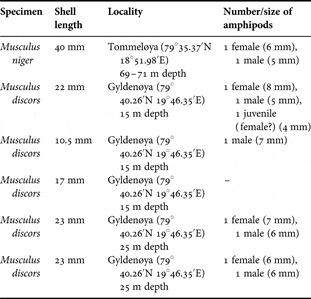
Metopa alderii was originally described from the coast of Northumberland (Bate, Reference Bate1857). The present record represents not only the northernmost record of M. alderii but also shows that the association with Musculus spp. seems to be fairly common. Out of five specimens of M. discors collected, amphipods were found in four (3 + 1 + 0 + 2 + 2) and in the single specimen of M. niger two specimens were found (Table 1; Figures 1 & 2). In a previous study 297 specimens of Musculus discors from the southern part of Hinlopen Strait were examined. In these samples only Metopa glacialis were found. The prevalence of amphipods was 75%.
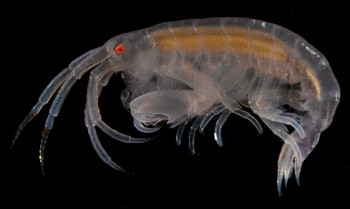
Male Metopa alderii (length 5 mm) from Musculus niger. Photograph: F. Pleijel.

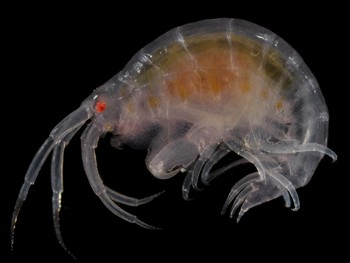
Female Metopa alderii (length 6 mm) from Musculus niger. Photograph: F. Pleijel.

Observations of Metopa alderii in Musculus spp. in northern Spitsbergen.

The fact that M. alderii was found in five of six examined specimens of Musculus suggests that the association may be fairly common in northerly waters, but the species may also have been previously overlooked due to its small size.
ACKNOWLEDGEMENTS
The authors wish to express their thanks to Bjørn Gulliksen and Jørgen Berge for inviting us to participate in the cruise (UNIS AB-321), and to the crew of RV ‘Jan Mayen’ for excellent working conditions.