Schizophrenia is a severe and chronic mental illness that affects 0.5% to 1.0% of the world's population, which amounts to about two million people in the United States alone. Its manifestations are varied from case to case, but usually involve hallucinations, delusions, and cognitive disorganization and often also affective flattening, avolition, and anhedonia. Because of the disability and repeated hospital care that often accompanies schizophrenia, the economic burden to society is enormous, estimated at over $62 billion per year in the United States alone (Wu et al., Reference Wu, Birnbaum, Shi, Ball, Kessler and Moulis2005).
The severity of this mental disorder and its impact on families and society have led it to be the focus of a very large body of research since it was delineated from other mental disorders about a century ago (Bleuler, Reference Bleuler and Zinkin1950; Kraepelin, Reference Kraepelin1919), but its specific etiology has remained a puzzle (Gottesman, Reference Gottesman1991; Gottesman & Shields, Reference Gottesman and Shields1982; MacDonald & Schulz, Reference MacDonald and Schulz2009). Norman Garmezy was drawn to the study of schizophrenia by the severity of the disorder, the puzzle of its etiology, the challenging nature of the search for its precursors, and the early influence of David Shakow (Shakow, Reference Shakow1962), Eliot Rodnick (Rodnick & Garmezy, Reference Rodnick and Garmezy1957), and Leslie Phillips (Phillips, Reference Phillips1953). Through Norm's superb mentoring, he inspired a series of graduate students and later their students and colleagues to pursue schizophrenia research (e.g., Sheldon Weintraub, Ray Knight, Lee Marcus, Jon Rolf, Keith Nuechterlein). This article chronicles Norm's influence on one student (K.N.) and later on his University of California, Los Angeles (UCLA), colleagues. It is written from the point of view of that former student, while including coauthors to acknowledge their key roles in later research at UCLA.
The presence of cognitive deficits in schizophrenia was recognized early during the delineation of this disorder, but appreciation for the centrality of cognitive deficits to vulnerability to the disorder and to functional outcome has increased dramatically over time. Emil Kraepelin initially viewed cognitive decline as sufficiently characteristic of the disorder that he used the term dementia praecox to describe it (Kraepelin, Reference Kraepelin1919). Kraepelin described a conspicuous attentional disturbance:
It is quite common for them to lose both inclination and ability on their own initiative to keep their attention fixed for any length of time. … In psychological experiments, the patients cannot stick to the appointed exercise; they feel no need to collect their thoughts in the appointed manner, or to reach a satisfactory solution. (p. 6)
Eugen Bleuler (Bleuler, Reference Bleuler and Zinkin1950), in his early descriptions of the nature of schizophrenia, also noted several cognitive disturbances, including the selective and inhibitory aspects of attention:
… it is evident that the uninterested or autistically encapsulated patients pay very little attention to the outer world. In contrast, however, it is remarkable how many of the events which the patients seem to ignore are registered nevertheless. The selectivity that normal attention ordinarily exercises among the sensory impressions can be reduced to zero so that almost everything is recorded that reaches the senses. Thus, the facilitating as well as the inhibiting properties of attention are equally disturbed. (p. 68)
The Initial Focus on Attention
The prominence of the concept of attentional disturbance in schizophrenia in experimental psychopathology during the 1970s (Garmezy, Reference Garmezy1978) led several of Norm's graduate students to focus their research on various aspects of this cognitive domain (Driscoll, Reference Driscoll, Watt, Anthony, Wynne and Rolf1984; Marcus, Reference Marcus1973; Nuechterlein, Reference Nuechterlein1977, Reference Nuechterlein1983; Phipps-Yonas, Reference Phipps-Yonas, Watt, Anthony, Wynne and Rolf1984). In an introduction to this field as part of Norm's Experimental Psychopathology seminar, I reviewed and critiqued the large literature on reaction time studies of schizophrenia, which focused primarily on attentional disturbances (Nuechterlein, Reference Nuechterlein1977).
For the present article, several aspects of that reaction time literature are noteworthy as they bear on the core cognitive deficits in schizophrenia. First, one prominent model of attentional disturbance in schizophrenia emphasized Shakow's construct of a loss of the ability to maintain a major set, which he referred to as segmental set (Shakow, Reference Shakow1962). This tendency for individuals with schizophrenia to lose the major goal or rule that guided perception and readiness to respond over time was evident in a marked inability to maintain response readiness in a simple reaction time situation in which the preparatory intervals varied from trial to trial (Rodnick & Shakow, Reference Rodnick and Shakow1940; Zahn, Rosenthal, & Shakow, Reference Zahn, Rosenthal and Shakow1963). Schizophrenia patients are unduly affected by the immediately preceding preparatory interval in this situation, seemingly unable to maintain optimal readiness to respond over the wider range of time intervals that occur across a series of trials. Two core deficits in schizophrenia emphasized in the current cognitive neuroscience of schizophrenia, problems in goal maintenance, and control of attention (Carter et al., Reference Carter, Barch, Buchanan, Bullmore, Krystal and Cohen2008), are related to this view that schizophrenia involves an inability to maintain a task set over time.
Second, another construct that was prominent in the reaction time literature of that period was a redundancy-associated deficit (Bellissimo & Steffy, Reference Bellissimo and Steffy1972). Steffy and students noted that simple reaction time in schizophrenia patients slowed when several preparatory intervals of the same length were presented in a row. Thus, temporal interval redundancy was shown to impair optimal readiness to respond across trials. In combination with the earlier observation that schizophrenia patients show an abnormally strong influence of the immediately preceding preparatory interval, it is apparent that optimal readiness to respond over time is easily disrupted by immediate context in a series of reaction time trials.
Third, a notable feature of the reaction time literature on set maintenance (Nuechterlein, Reference Nuechterlein1977) was that similar deficits were detectable in chronic schizophrenia (Rodnick & Shakow, Reference Rodnick and Shakow1940; Zahn, Shakow, & Rosenthal, Reference Zahn, Shakow and Rosenthal1961) and acute schizophrenia (Zahn & Rosenthal, Reference Zahn and Rosenthal1965), suggesting that this attentional disturbance was a pervasive feature of different phases of the illness rather than a transient disturbance limited to acute psychotic periods.
Children at Risk for Schizophrenia
The focus of experimental psychopathology in schizophrenia was initially on studies of schizophrenia patients themselves to characterize the cognitive deficits and the conditions that contributed to them, and Norm Garmezy's initial series of studies reflected this orientation (Garmezy, Reference Garmezy1952, Reference Garmezy1966; Garmezy & Rodnick, Reference Garmezy and Rodnick1959). However, Norm and other leading psychopathologists began to realize that studies of individuals at risk for developing schizophrenia offered exciting opportunities to examine features that precede the disorder and are vulnerability or proneness factors rather than consequences of the psychosis and its treatment (Erlenmeyer-Kimling & Cornblatt, Reference Erlenmeyer-Kimling and Cornblatt1987; Garmezy, Reference Garmezy1974; Garmezy & Streitman, Reference Garmezy and Streitman1974; Mednick & Schulsinger, Reference Mednick, Schulsinger, Rosenthal and Kety1968). This developmental orientation to studying schizophrenia led Norm to establish a project at the University of Minnesota that focused on children born to mothers with schizophrenia to identify factors in vulnerability to the illness as well as protective factors. Offspring of a parent with schizophrenia have a 5% to 15% risk of developing schizophrenia, compared to a 0.5% to 1.0% risk in the general population (Gottesman & Shields, Reference Gottesman and Shields1982), making them a “high-risk” group. The name of the broader project that included the Minnesota high-risk studies, Project Competence (Garmezy, Reference Garmezy1974; Garmezy & Devine, Reference Garmezy, Devine, Watt, Rolf and Anthony1984), reflected the inclusion of a search for determinants of positive outcomes that Norm later pursued much more broadly in his studies of resilience under stress (Garmezy, Masten, & Tellegen, Reference Garmezy, Masten and Tellegen1984).
One major theme in these studies of offspring of schizophrenic mothers under Norm's guidance was to determine whether cognitive disturbances were detectable in late childhood and adolescence, years before the onset of schizophrenia and related disorders in a subset of these offspring. Furthermore, these studies sought to determine the nature of any cognitive disturbances and their specificity to vulnerability to schizophrenia. Norm supervised a series of doctoral dissertations that pursued these themes. Lee Marcus (Reference Marcus1973) focused on simple reaction time and preparatory interval effects, Susan Phipps-Yonas (Reference Phipps-Yonas, Watt, Anthony, Wynne and Rolf1984) on visual versus auditory reaction time and cross-modal interference effects (Phipps-Yonas, Reference Phipps-Yonas, Watt, Anthony, Wynne and Rolf1984), and Regina Driscoll (Reference Driscoll, Watt, Anthony, Wynne and Rolf1984) on incidental and intentional learning, while I examined sustained, focused attention with vigilance tasks (Nuechterlein, Reference Nuechterlein1983).
A suggestion that children of a schizophrenic parent may have a subtle attentional disturbance was evident in the results of Marcus (Reference Marcus1973), who found a significant overall reaction time slowing among such children relative to their peers. This slowing was more pervasive across experimental conditions than slowing found in other comparison groups, particularly in that it cut across conditions providing information or incentives designed to improve performance. In contrast, it was not clear whether this overall simple reaction time slowing was due to attentional deficit, as the excessive impact of previous preparatory intervals and other features of major set disturbance were not present (Marcus, Reference Marcus1973).
To clarify whether a performance deficit was evident in other tasks used to detect attentional deficit, particularly failures to maintain focused attention over time, I examined variations of a vigilance task, the Continuous Performance Test (CPT). CPTs are a class of vigilance tasks in which simple stimuli, typically letters or numerals, are presented in a rapid sequence (e.g., 1/s) over several minutes, and the subject is asked to respond (e.g., with a button press) each time a specified target appears (Rosvold, Mirsky, Sarason, Bransome, & Beck, Reference Rosvold, Mirsky, Sarason, Bransome and Beck1956). A conventional CPT had shown sensitivity to target detection deficits in chronic schizophrenia (Orzack & Kornetsky, Reference Orzack and Kornetsky1966) and remitted schizophrenia (Wohlberg & Kornetsky, Reference Wohlberg and Kornetsky1973), and a specialized CPT using playing card stimuli had just been shown to detect a deficit among children of a schizophrenic parent (Rutschmann, Cornblatt, & Erlenmeyer-Kimling, Reference Rutschmann, Cornblatt and Erlenmeyer-Kimling1977). Thus, Norm and I felt that variations of this paradigm would be fruitful for detecting and clarifying an attentional disturbance that might be an indicator of vulnerability to schizophrenia.
Recognizing that the performance deficit in children at risk for schizophrenia was likely a more subtle one than is found in individuals with schizophrenia itself and wishing to isolate the nature of any attentional disturbance, I included in my dissertation study CPT versions that involved cognitive burdens that exceeded those of the conventional CPT (Nuechterlein, Reference Nuechterlein1983). One new CPT version involved highly blurred visual stimuli to burden early visual processing (the degraded stimulus CPT), while another new CPT involved a strong response inhibition demand (response reversal CPT). A conventional CPT (Rosvold et al., Reference Rosvold, Mirsky, Sarason, Bransome and Beck1956) and the playing card CPT (Rutschmann et al., Reference Rutschmann, Cornblatt and Erlenmeyer-Kimling1977) were included for comparison.
The children of schizophrenic mothers were found to have a subtle deficit in ability to discriminate targets from nontargets, an anomaly that was most clearly evident in a factor score that cut across the CPT conditions (Nuechterlein, Reference Nuechterlein1983). Children of mothers with other psychopathology, primarily mood disorder, did not show this disturbance. Hyperactive children also did not show this particular form of CPT disturbance, but instead had lowered response caution in signal detection theory analyses. The observation that the subtle deficit in signal/noise discrimination (d′) among children of schizophrenic mothers cut across incentive feedback conditions in the degraded stimulus CPT suggested that the vigilance disturbance was likely not a transient one that could be easily reversed by motivational feedback (Nuechterlein, Reference Nuechterlein1983; Nuechterlein, Phipps-Yonas, Driscoll, & Garmezy, Reference Nuechterlein, Phipps-Yonas, Driscoll, Garmezy and Goldstein1982). Thus, these findings supported the hypothesis that a subtle deficit in ability to maintain sustained, focused attention in order to detect target stimuli is a promising indicator of a vulnerability or proneness factor for schizophrenia.
Stability of Attentional Deficit Across Clinical State
Encouraged by these dissertation findings and by Norm's supportive and enthusiastic mentorship, I followed up this research direction in several ways with colleagues in my subsequent faculty position at UCLA. One key issue was whether the deficit in sustained, focused attention was stable across periods of psychosis and clinical remission in schizophrenia, as several theorists argued was a key feature of a vulnerability marker (Zubin & Spring, Reference Zubin and Spring1977) or endophenotype (Gottesman & Gould, Reference Gottesman and Gould2003) for schizophrenia.
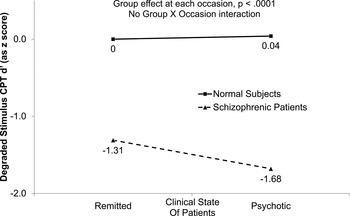
To address this issue, we examined individuals who had experienced a recent initial episode of schizophrenia and who could be assessed during a period of full remission from all psychiatric symptoms and again in a psychotic state on equivalent levels of medication (Nuechterlein et al., Reference Nuechterlein, Dawson, Gitlin, Ventura, Goldstein and Snyder1992). This longitudinal research design again showed the influence of Norm, who emphasized the virtues of research strategies that address the development of phenomena of interest over time. As shown in Figure 1, we found that deficits in signal/noise discrimination on the degraded stimulus CPT were large in both the clinically remitted and psychotic state and did not differ significantly in magnitude across these clinical states. We found a similar pattern of stable deficit across remitted and psychotic states on another measure that emphasized cognitive demands on early perceptual processes, target detection in a forced-choice span of apprehension task (Asarnow, Granholm, & Sherman, Reference Asarnow, Granholm, Sherman, Steinhauer, Gruzelier and Zubin1991). A version of the CPT that involves working memory by requiring detection of a sequence of stimuli (3 followed by 7) revealed a somewhat different pattern. Although deficits in this working memory version of the CPT were also significant in both remitted and psychotic states, they increased substantially in magnitude from remission to psychosis (Nuechterlein et al., Reference Nuechterlein, Dawson, Gitlin, Ventura, Goldstein and Snyder1992).
Attention/vigilance deficits on the degraded stimulus Continuous Performance Test are stable across remitted and psychotic states in recent-onset schizophrenia. Adapted from “Developmental Processes in Schizophrenic Disorders: Longitudinal Studies of Vulnerability and Stress,” by K. H. Nuechterlein, M. E. Dawson, M. J. Gitlin, J. Ventura, M. J. Goldstein, K. S. Snyder, et al., 1992. Schizophrenia Bulletin, 18, 387–425. Copyright 1992 by Oxford University Press. Adapted with permission.

This overall pattern suggests that deficits in schizophrenia involving early perceptual processes might be more stable across clinical state, whereas those involving use of working memory for contextual cueing might worsen as psychosis approaches. Therefore, we suggested that the former were stable vulnerability indicators for schizophrenia, whereas the latter might serve as mediating vulnerability factors (Nuechterlein et al., Reference Nuechterlein, Dawson, Gitlin, Ventura, Goldstein and Snyder1992). In this context, “mediating” is meant to suggest that a deficit might be a leading indicator of, and likely contributor to, the development of psychotic symptoms within individuals with schizophrenia (Nuechterlein & Dawson, Reference Nuechterlein and Dawson1984).
In a current series of studies in our Center for Neurocognition and Emotion in Schizophrenia at UCLA, we are seeking to isolate the nature of attentional dysfunction in schizophrenia much more fully and to further clarify longitudinal stability versus change in the initial prodromal and first episode periods of this illness (Nuechterlein, Pashler, & Subotnik, Reference Nuechterlein, Pashler and Subotnik2006). These studies employ a series of dual-task interference paradigms using choice reaction time tasks that are designed to isolate specific cognitive processes that cannot be completed in parallel in divided attention situations (Pashler, Reference Pashler1994). This translation of paradigms from basic cognitive psychology to the experimental psychopathology of schizophrenia should yield new insights into cognitive structure in this disorder that gives rise to the core attentional deficits.
Cognitive Deficits in Parents and Siblings of Schizophrenia Probands
Another key issue was whether the cognitive deficits detected among offspring of a schizophrenic parent would also be found among other first-degree relatives of schizophrenia probands, as would be hypothesized if these deficits were a reflection of increased genetic proneness to schizophrenia. Furthermore, given that the immediate relatives of schizophrenia probands show an increased frequency of certain personality disorders that are part of a schizophrenia spectrum (Kendler & Diehl, Reference Kendler and Diehl1993; Kendler & Gruenberg, Reference Kendler and Gruenberg1984), we felt it was important to clarify whether the cognitive deficits were closely tied to those personality disorder features or a separable indicator of vulnerability to schizophrenia.
To pursue these issues, Robert Asarnow and I led a project involving the biological parents and siblings of individuals with either adult-onset schizophrenia or childhood-onset schizophrenia, which we called the UCLA Family Study (Asarnow et al., Reference Asarnow, Nuechterlein, Subotnik, Fogelson, Torquato and Payne2002; Nuechterlein et al., Reference Nuechterlein, Asarnow, Subotnik, Fogelson, Payne and Kendler2002). In the initial phase of this project, we included the degraded stimulus CPT, the forced-choice span of apprehension task, and the Trail Making Test (Reitan, Reference Reitan1958) in order to examine sustained, focused attention, early perceptual processing, perceptual-motor speed, and working memory as potential cognitive features of vulnerability to schizophrenia. In addition, we conducted structured diagnostic interviews with each family member to examine psychiatric symptoms that might be part of a schizophrenia spectrum (Fogelson, Nuechterlein, Asarnow, Subotnik, & Talovic, Reference Fogelson, Nuechterlein, Asarnow, Subotnik and Talovic1991).
We found that we could detect cognitive deficits among these first-degree relatives of schizophrenia probands on the degraded stimulus CPT, forced-choice span of apprehension, and Trail Making Test—Part B that paralleled those found among individuals with schizophrenia (Asarnow et al., Reference Asarnow, Nuechterlein, Subotnik, Fogelson, Torquato and Payne2002; Nuechterlein et al., Reference Nuechterlein, Asarnow, Subotnik, Fogelson, Ventura, Torquato, Lenzenweger and Dworkin1998). For the degraded stimulus CPT and the Trail Making Test—Part B, performance of parents of childhood-onset schizophrenia probands was significantly worse than for the parents of community comparison or attention-deficit/hyperactivity disorder children, indicating some specificity for these cognitive deficits (Asarnow et al., Reference Asarnow, Nuechterlein, Subotnik, Fogelson, Torquato and Payne2002). A combination of low cognitive scores was also found to identify significantly more fathers and mothers of childhood-onset schizophrenia probands than parents of attention-deficit/hyperactivity disorder probands, as would be expected if some parents of schizophrenia probands carried a high level of cognitive vulnerability to the disorder.
By combining the samples of relatives of childhood-onset and adult-onset schizophrenia probands, we were able to examine through factor analysis the interrelationships of these cognitive scores with personality disorder symptom ratings for more than 300 biological relatives of schizophrenia patients (Nuechterlein et al., Reference Nuechterlein, Asarnow, Subotnik, Fogelson, Payne and Kendler2002). We found that cognitive performance on the Trail Making Test—Part B, span of apprehension, and degraded stimulus CPT loaded together on a factor with only one schizotypal symptom, odd or eccentric behavior. This cognitive disorganization factor was separable from factors representing positive schizotypy and negative schizotypy. In a broader factor analysis including other personality disorder symptoms, the cognitive disorganization factor was also separate from factors for paranoid symptoms, avoidant symptoms, schizoid symptoms, and borderline symptoms (Nuechterlein et al., Reference Nuechterlein, Asarnow, Subotnik, Fogelson, Payne and Kendler2002). Thus, the cognitive performance deficits in biological relatives of schizophrenia patients appear to represent a vulnerability factor for schizophrenia that is separable from any proneness to schizophrenia manifested through schizophrenia spectrum personality disorders.
Cognitive Factors as Key Contributors to Competence
The evidence that attentional disturbance and other cognitive deficits serve as vulnerability factors for schizophrenia, present in first-degree biological relatives of schizophrenia patients and continuing to be present even during clinical remission in individuals with schizophrenia, raises the question of whether these cognitive abnormalities play a role in everyday functioning in schizophrenia. The link between cognitive functioning and competence is one that was emphasized by Norm both in studies of psychopathology (Garmezy & Devine, Reference Garmezy, Devine, Watt, Rolf and Anthony1984) and in studies of stress resistance and resilience (Garmezy et al., Reference Garmezy, Masten and Tellegen1984). At UCLA the connection between cognitive deficits and everyday functioning in schizophrenia has been pursued extensively by my former postdoctoral fellow and long-time colleague, Michael Green (Reference Green1996; Green, Kern, Braff, & Mintz, Reference Green, Kern, Braff and Mintz2000).
To examine the practical consequences of cognitive deficits during the initial period of schizophrenia, we expanded the battery of cognitive tasks to include more working memory and episodic memory measures in addition to measures of attention and early perceptual processing that had been our initial focus (Nuechterlein et al., Reference Nuechterlein, Subotnik, Green, Ventura, Asarnow and Gitlin2011). We assessed these cognitive abilities in patients with a recent first episode of schizophrenia shortly after they joined our UCLA outpatient research clinic and then followed them for a year while being treated with a combination of antipsychotic medication, individual case management, group skills training, and family psychoeducation. We focused on predictors of return to work or school, as this functional outcome domain is particularly challenging for individuals with a recent onset of schizophrenia (Ventura et al., Reference Ventura, Subotnik, Guzik, Hellemann, Gitlin and Wood2011).
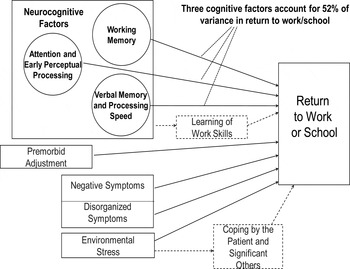
We derived three cognitive factors through factor analysis, representing working memory, attention and early perceptual processing, and verbal memory and processing speed. As shown in Figure 2, we found that these three cognitive performance dimensions were strong predictors of return to work or school by nine months after clinical stabilization, accounting for 52% of the variance in this outcome (Nuechterlein et al., Reference Nuechterlein, Subotnik, Green, Ventura, Asarnow and Gitlin2011). Thus, as has been demonstrated in later chronic phases of schizophrenia (Fett et al., Reference Fett, Viechtbauer, Dominguez, Penn, van Os and Krabbendam2011; Green, Kern, & Heaton, Reference Green, Kern and Heaton2004), the level of cognitive impairment in schizophrenia is a key rate-limiting factor in recovery of everyday functioning in the period after initial onset of psychosis.
A conceptual model showing possible factors influencing work functioning in recent-onset schizophrenic disorders. Adapted from “Neurocognitive Predictors of Work Outcome in Recent-Onset Schizophrenia,” by K. H. Nuechterlein, K. L. Subotnik, M. F. Green, J. Ventura, R. F. Asarnow, M. J. Gitlin, et al., 2011, Schizophrenia Bulletin, 37(Suppl. 2), S37. Copyright 2011 by Oxford University Press. Adapted with permission.

Improving Cognition in Schizophrenia
The mounting evidence that cognitive deficits in schizophrenia are enduring core features that are components of vulnerability to this illness, continue to be present in clinical remissions, and predict everyday functioning has made them a critical target for intervention development in recent years. The National Institute of Mental Health (NIMH) in the United States recognized the importance of developing new treatments to improve cognition in schizophrenia and decided to stimulate this effort by organizing a national initiative to bring together leading investigators in multiple relevant fields to develop pathways for evaluating promising new interventions. UCLA was fortunate to be awarded the NIMH contract to lead this effort, titled Measurement and Treatment Research to Improve Cognition in Schizophrenia (MATRICS), with Stephen Marder as Principal Investigator, Michael Green as Co-Principal Investigator, and Wayne Fenton as the leader at NIMH (Marder & Fenton, Reference Marder and Fenton2004).
Consultation with the US Food and Drug Administration (FDA) made it apparent that a critical aspect of the MATRICS initiative needed to be the development of a reliable and valid battery of cognitive measures that experts could agree was appropriate for clinical trials of interventions targeting cognition in schizophrenia. The absence of such a consensus cognitive battery was viewed by the FDA as a major roadblock to evaluating promising new pharmacological interventions that were possible cognitive enhancers in schizophrenia, as each clinical trial used a different set of cognitive measures, making it impossible to compare results across trials. Interventions based on cognitive training have substantial promise (Wykes, Huddy, Cellard, McGurk, & Czobor, Reference Wykes, Huddy, Cellard, McGurk and Czobor2011). However, although not regulated by the FDA, these interventions might also receive wider clinical acceptance if cognitive remediation studies used a standardized, well-accepted cognitive battery that allowed direct comparison of different approaches. Thus, a national committee of experts in cognition in schizophrenia, cochaired by Michael Green and Keith Nuechterlein, led a multistep process of identifying the major separable cognitive domains and selecting the most reliable and valid brief measures in each domain that would be appropriate for clinical trials (Green et al., Reference Green, Kern and Heaton2004; Nuechterlein et al., Reference Nuechterlein, Barch, Gold, Goldberg, Green and Heaton2004).
Through a consensus process that involved a careful examination of the scientific literature, we identified six cognitive domains in which prominent deficits in schizophrenia had been demonstrated, that were separable dimensions in factor analytic studies, and that appeared potentially reversible through interventions (Green, Nuechterlein, et al., Reference Green, Nuechterlein, Gold, Barch, Cohen and Essock2004; Nuechterlein et al., Reference Nuechterlein, Barch, Gold, Goldberg, Green and Heaton2004). We added one more domain, social cognition, for which the literature in schizophrenia was too recent to include factor analytic studies, but which has promise as an additional influence on functional outcome (Couture, Penn, & Roberts, Reference Couture, Penn and Roberts2006) and serves as a mediator of relationships between other cognitive deficits and everyday functioning (Sergi, Rassovsky, Nuechterlein, & Green, Reference Sergi, Rassovsky, Nuechterlein and Green2006).
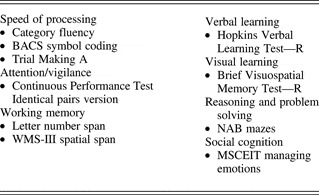
Using input from over 125 experts in cognition in schizophrenia, cognitive science, clinical trial methodology, psychometrics, biostatistics, and neuropharmacology, the MATRICS Neurocognition Committee evaluated over 90 possible cognitive tests (Nuechterlein et al., Reference Nuechterlein, Green, Kern, Baade, Barch and Cohen2008). The literature on the most promising 36 tests to measure the seven cognitive domains was carefully evaluated by a panel of experts, rating each relevant criterion for inclusion in a consensus battery. The 20 leading candidates from this step were directly evaluated for reliability and validity in a five-site study of schizophrenia patients. As a result, a final battery of 10 tests was selected for the MATRICS Consensus Cognitive Battery (Nuechterlein et al., Reference Nuechterlein, Green, Kern, Baade, Barch and Cohen2008), summarized in Table 1. A five-site study of a sample representative of the US census demographics for adults was completed to provide conorming for these tests to allow cognitive profiles to be examined and to enable the amount of change in each cognitive domain to be compared in clinical trials (Kern et al., Reference Kern, Nuechterlein, Green, Baade, Fenton and Gold2008).
Tests in the MATRICS Consensus Cognitive Battery

Note: MATRICS, Measurement and Treatment Research to Improve Cognition in Schizophrenia; BACS, Brief Assessment of Cognition in Schizophrenia; NAB, Neuropsychological Assessment Battery; WMS-III, Wechsler Memory Scale, Third Edition; MSCEIT, Mayer–Salovey–Caruso Emotional Intelligence Test.
Although this process was complex and time consuming, the result is a consensus cognitive battery that is endorsed by the NIMH and accepted by the FDA as the gold standard for clinical trials to evaluate interventions to improve cognition in schizophrenia. The MATRICS Consensus Cognitive Battery has been used in over 60 clinical trials evaluating potential treatments for the cognitive deficits in schizophrenia and other psychotic disorders (http://www.clinicaltrials.gov) and is now available in 15 languages. We are very hopeful that the availability of this battery will facilitate the successful research evaluation and clinical use of cognitive training and pharmacological approaches to improving the core cognitive deficits that play a critical role in limiting functional recovery of so many individuals suffering from schizophrenia.
Conclusions
The influence of Norman Garmezy on his students and through them on their students and colleagues is readily apparent in the research summarized in this article. The inspiration, guidance, and support that Norm provided in the dissertations of many graduate students at the University of Minnesota made him an amazing mentor. In this article we describe the initial influences on one former graduate student (K.H.N.), who was led by Norm to examine the literature on attention in schizophrenia initially in his graduate seminar and then through a dissertation study of attentional dysfunction in children at risk for later development of schizophrenia.
An initial review of the substantial literature on reaction time abnormalities in schizophrenia helped to set the stage for a career-long interest in the cognitive abnormalities that characterize schizophrenia. A dissertation demonstration that children born to a parent with schizophrenia have a subtle deficit in target detection during sustained attention tasks that was not found in children of a parent with other forms of psychopathology bolstered early support for the hypothesis that attentional dysfunction was a potential vulnerability factor and precursor of schizophrenia.
Later studies at UCLA have shown that the subtle deficits in target detection during sustained attention tasks as well as other deficits in early perceptual processing and working memory also characterize parents and siblings of individuals with schizophrenia, as hypothesized for a genetic vulnerability indicator or endophenotype for this disorder. In patients in the initial years of schizophrenia, these cognitive deficits are present across psychotic and clinically remitted states, with some measures showing unchanged levels of cognitive dysfunction during remission. Furthermore, the severity of cognitive deficits plays a strong predictive role in whether an individual with schizophrenia successfully returns to work or school after an initial psychotic episode, thereby highlighting the key role of these cognitive deficits in functional recovery.
As a result of findings such as these in the broader literature on the core role of cognitive deficits in schizophrenia, cognition has become a prominent target for development of new pharmacological and cognitive training interventions. The NIMH-supported MATRICS initiative marked the beginning of widespread recognition that pathways to facilitate development of more effective interventions to reverse core cognitive deficits in schizophrenia are critical to progress in this disorder. This effort continues at this time through research in many countries, testing various approaches to cognitive training and pharmacological intervention. We trust that Norman Garmezy would be pleased to see that his emphasis on the core role of cognitive processes in schizophrenia and in competence continues to play out in many ways as this field seeks ways to reverse the core cognitive deficits that otherwise limit functional recovery in this severe mental disorder.