Timely testing and treatment of Clostridium difficile infections (CDI) are important to improve outcomes and prevent disease transmission. However, unnecessary C. difficile testing in those not meeting the definition for CDI can lead to overdiagnosis, especially when using genetic-based testing. In a recent article, CDI incidence was 50% higher using polymerase chain reaction (PCR) assay than using a 3-step algorithm.Reference Longtin, Trottier and Brochu 1 This difference could be due to the detection of toxigenic C. difficile carriers who develop diarrhea from other causes.
According to guidelines,Reference Cohen, Gerding and Johnson 2 CDI is defined as diarrhea (≥3 unformed stools in 24 h) plus either a positive C. difficile stool test or detection of pseudomembranous colitis. Testing only unformed stool limits testing of asymptomatic patients, but it does not ensure that the patient meets criteria for CDI. For example, 1 unformed stool in 24 hours or a loose stool caused by laxative use does not meet the criteria for CDI. Treatment is not recommended for asymptomatic patients, yet such treatment is common.Reference Sydnor, Lenhart and Trollinger 3
In this study, we aimed (1) to evaluate C. difficile testing and treatment concordance with guidelines after the implementation of PCR-only C. difficile testing, before and after nursing education about the clinical definition of CDI and indications for stool testing and (2) to evaluate the impact of an antimicrobial stewardship intervention to improve C. difficile treatment, including nontreatment of asymptomatic patients.
Methods
We conducted a prospective before-and-after study to assess nursing education and feedback to house staff provided by clinical specialist pharmacists on CDI testing and treatment appropriateness. We included adult inpatients who had a C. difficile PCR assay processed in our microbiology laboratory. Stools were tested for toxin B gene (tcdB) using the BD GeneOhm C. difficile PCR assay. According to the policy, only loose stool is tested, and repeat testing is not performed within 7 days of a prior test. Patients admitted to an obstetrics unit were excluded. Oncology and solid-organ transplantation patients were excluded due to a concurrent C. difficile study.
Baseline data on concordance of C. difficile testing and treatment with guidelines were collected January 1, 2012, through February 4, 2012. Prior to the intervention period, the antimicrobial stewardship program provided education to all included nursing units regarding CDI testing indications (Appendix) and clinical pharmacists regarding CDI treatment. At our institution, these pharmacists are trained to perform stewardship interventions as part of their routine work. During the intervention period from March 6, 2012, to April 26, 2012, pharmacists received a daily report on C. difficile–tested patients from the microbiology database and completed an intervention form (Online Supplementary Material) for each patient who had a positive PCR assay or was receiving anti-CDI active therapy. The pharmacists contacted the teams to make recommendations in CDI testing and management in accordance with national guidelines.
Descriptive statistics were used to describe patient characteristics and study end points. Statistical analyses were performed using Stata software (version 9; StataCorp). Comparison of variables was performed using the 2-sided t test for continuous variables, the z test for comparison of proportions, and the χ2 test for categorical variables. All statistical tests were 2 tailed; differences were considered statistically significant at P≤0.05.
Results
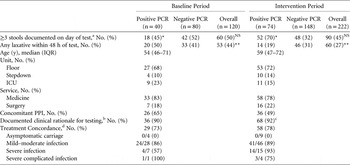
During the baseline period, the first consecutive 40 positive and 80 negative C. difficile PCR assays were included. During the preset 8-week intervention period, all 74 positive and the first 148 consecutive negative PCR assay patients were included. Most patients were nonsurgical, and similar proportions were observed in the ICU (Table 1).
Documentation of Diarrhea, Laxative Use, and Treatment Concordance in Patients with Positive C. difficile PCR Assays Before and During the Intervention Period

Note. PCR: polymerase chain reaction; NS: not statistically significant; IQR: Interquartile range; ICU: intensive care unit; PPI: proton pump inhibitor; *P=0.008; **P=0.001.
a Evidence of stool documentation was found in electronic nursing documentation.
b Defined as any loose or watery stools documented either in nurse charting or in physician notes and/or colitis on CT.
cAt the time of testing, 3 patients met clinical criteria, but symptoms either resolved prior to initiating treatment or the diarrhea was attributed to a non–C. difficile cause, resulting in 9 asymptomatically colonized patients.
d Treatment concordance was defined as follows: no treatment for asymptomatic carriage; metronidazole 500 mg PO TID for mild-to-moderate infection; vancomycin 125 mg PO QID for severe infection; and metronidazole 500 mg IV TID PLUS vancomycin 500 mg PO or PR QID for severe complicated infection.
Overall documentation in the medical record of ≥3 stools in 1 day was not different between the baseline and study periods (50% vs 45%, P=not significant), but it increased for those with positive C. difficile PCR results (45% vs 70%, P=0.008) (Table 1). Overall laxative use within 48 hours prior to the stool sample decreased from 44% to 27% (from 53 of 120 to 60 of 222, P=0.001), as did laxative use for those with positive C. difficile PCR results (from 20 of 40 to 14 of 74, P<0.001).
Between the baseline and the intervention period, guidelineReference Cohen, Gerding and Johnson 2 treatment concordance increased from 73% to 78% (from 29 of 40 to 58 of 74, P=0.48) (Table 1). There was no significant change in treatment concordance for mild-to-moderate infection (86% vs 89%) and for severe complicated infection (100% vs 75%). Treatment concordance for severe infection increased from 57% to 93% (from 4 of 7 to 14 of 15, P=0.04). At baseline and during the study period, all asymptomatically colonized patients (100%) were treated.
The overall C. difficile testing rate was 193 tests per 10,000 patient days during the study from February to June 2012 compared with 231 tests per 10,000 patient days from February to June 2011. This decrease was statistically significant (P<0.001). The overall CDI rate per 10,000 patient days during our study from February to June 2012 was 22 lab-identified cases per 10,000 patient days compared with 28 cases per 10,000 patient days from February to June 2011. This decrease was also statistically significant (P=0.015).
Discussion
This intervention was associated with improvement in overall testing appropriateness. Diarrhea documentation improved for patients with positive C. difficile tests, and fewer patients on laxatives were tested. There was a decrease in the overall testing rate and the C. difficile–positive rate following the intervention. The treatment intervention was successful for severe CDI, but recommendations for not treating asymptomatic colonization were unsuccessful.
This study demonstrates that inappropriate CDI testing does occur. In other published studies, only 62%–64% of patients tested for C. difficile had clinically significant diarrhea.Reference Dubberke, Han and Bobo 4 , Reference Peterson, Manson and Paule 5 Dubberke et alReference Dubberke, Han and Bobo 4 noted that 18.7% of patients at their institution received a laxative in the 48 hours prior to their C. difficile test. Infection control and antimicrobial stewardship programs should assess the frequency of inappropriate testing, and a multidisciplinary approach should be used with nurses, pharmacists, and providers to improve testing.
Inappropriate CDI testing is linked to inappropriate treatment; in this study, 100% of asymptomatic patients that tested positive for C. difficile colonization were treated. Recent studies demonstrate that 4%–15% of hospitalized patients have asymptomatic colonization on admission and that at least 3% develop colonization during their hospital stay.Reference Leekha, Aronhalt, Sloan, Patel and Orenstein 6 – Reference Alasmari, Seiler and Hink 8 According to a study by Johnson et al,Reference Johnson, Homann and Bettin 9 asymptomatic C. difficile colonization is transient and does not warrant antibiotic therapy. Despite these findings, clinicians have been reluctant to discontinue therapy in asymptomatic patients. To prevent inappropriate testing, the best approach may be to discourage testing patients who do not meet criteria for C. difficile infection.
In this study, we did not evaluate patient outcomes; however, in a recent study, a reduction in refractory disease was noted after implementing a severity-based C. difficile treatment policy.Reference Jardin, Palmer and Shah 10 Another limitation was the lack of didactic provider education immediately prior to the intervention period. However, appropriate C. difficile testing and treatment is addressed annually during house staff and fellow orientation in July, and pharmacists provided one-on-one feedback to house staff during the study intervention. No other major interventions occurred concomitantly; nonetheless, we cannot exclude the potential contributions of ongoing infection control activities, and we cannot determine the relative impact of nursing education and antimicrobial stewardship interventions.
Infection control and reducing unnecessary antimicrobial use are the most important strategies to reduce institutional C. difficile rates, but the new era of molecular assays adds another dimension. Nurse education and antimicrobial stewardship are strategies to address inappropriate testing and treatment. Improving testing appropriateness is important for 2 reasons: (1) testing patients without signs and symptoms of CDI may falsely increase an institution’s C. difficile rate with new lab-based testing reporting requirementsReference Longtin, Trottier and Brochu 1 and (2) identifying asymptomatic colonization frequently leads to treatment, which may potentially harm patients. In conclusion, we recommend documentation of symptoms in patients with C. difficile and a proactive approach toward educating providers and nurses on test appropriateness.
Acknowledgments
The authors thank the clinical pharmacists at The Johns Hopkins Hospital for their assistance with antimicrobial stewardship interventions; the infection control practitioners at The Johns Hopkins Hospital for their assistance with education to the nursing units; Taylor Carlson, for assistance with data collection; and Pranita Tamma, MD, MHS, for critical review of the manuscript.
Financial support. This study was supported by the 2011 Maryland Society of Health System Pharmacists (MSHP) Practitioner Grant. Its contents are solely the responsibility of the authors and do not necessarily represent the official view of MSHP.
Potential conflicts of interest. K.C. has received grant support from BD Diagnostics, BioFire, Inc., AdvanDx, Inc., and Nanosphere, Inc. and has served on scientific advisory boards for Quidel, Inc. and NanoMR, Inc. S.E.C. has served as a consultant for Novartis and has received research support from Pfizer. All other authors report no conflicts of interest relevant to this article.
Supplementary material
To view supplementary material for this article, please visit http://dx.doi.org/10.1017/ice.2014.19
APPENDIX
C. difficile nursing education handout
Clostridium difficile Infection
What is Clostridium difficile ?
Clostridium difficile (C. difficile) is a spore forming anaerobic bacteria that has the capability to produce toxins. It can also lead to C. difficile-associated diarrhea, colitis and in some cases death.
What is C. difficile infection?
Infection occurs when C. difficile causes inflammation in the colon, leading to watery diarrhea, nausea, abdominal pain/tenderness, loss of appetite and fever. In very severe cases, it can lead to pseudomembranous colitis requiring surgical removal of the colon.
How is C. difficile diarrhea defined?
Diarrhea is defined as the passage of 3 or more unformed stools in 24 or fewer consecutive hours. Other diarrheas may be defined differently.
Who is at risk for C. difficile infections?
The main risk factor for C. difficile infection is antibiotics, especially broad spectrum agents and prolonged durations of therapy, because they alter or deplete normal intestinal flora. Hospitalized patients and those living in nursing homes are at a higher risk of C. difficile infection.
Are all antibiotic-associated diarrheas caused by C. difficile ?
No. Some antibiotics cause diarrhea by other mechanisms. It is estimated that only 30% of hospitalized patients who have antibiotic-associated diarrhea will have C. difficile infection.
Who should be tested for C. difficile infection?
In most cases, testing for C. difficile should only be performed on patients who meet the definition for C. difficile associated diarrhea. If the diarrhea is due to laxative use or the patient has one or two episodes that resolve on their own, then a stool sample should not be sent.
How is C. difficile infection diagnosed at The Johns Hopkins Hospital?
A stool sample is tested for the presence of the C. difficile toxin B gene by polymerase chain reaction (PCR). Only patients with clinical signs and symptoms of infection (e.g., diarrhea) should be tested for C. difficile infection and subsequently treated if the test is positive.
What if a patient has C. difficile in the stool but no signs or symptoms of infection?
A patient who has a stool positive for C. difficile but no other signs or symptoms is considered to be colonized, and treatment is not indicated. A patient without diarrhea should not have a stool sample sent unless they have symptoms of severe complicated C. difficile infection with fevers, high white blood cell count, severe abdominal pain, distention and CT imaging consistent with C. difficile infection.
How often are people colonized with C. difficile ?
Colon colonization of C. difficile occurs in 3% of healthy adults; whereas, 20 – 40% of patients who are hospitalized are colonized.
Why is it important to appropriately document number and volume of stools?
Your assessment and documentation will directly assist the provider to make the best decision about whether to test and treat the patient. The goal is to only test a patient who has clinical symptoms and only to treat a patient who has clinical symptoms and a positive PCR for C. difficile. In patients with a normally functioning gut without clinically significant diarrhea, C. difficile colonization or a positive PCR does not require treatment.
How is C. difficile transmitted?
C. difficile is spread by spores in the stool. These spores can survive for months in the environment and are not killed by alcohol hand gels or traditional room cleaning procedures. Surfaces, devices, or materials can become contaminated with C. difficile and serve as a reservoir for C. difficile transmission. Healthcare personnel can transmit C. difficile spores via their hands by touching contaminated surfaces or items.
What can we do to prevent the spread of C. difficile ?
-
∙ Contact precautions for duration of the patient’s stay(spores can still be shed even 5 weeks after treatment)
-
∙ Soap and water for hand hygiene after caring for and/or exiting a C. difficile patient’s room
-
∙ Cleaning the environment daily and upon discharge using Oxivir
-
∙ Cleaning all equipment, including stethoscopes, using Oxivir
-
∙ Avoid unnecessary antibiotic use and minimize duration of therapy
Do I need to get a negative test to remove a patient from Contact Precautions?
C. difficile PCR tests are not recommended to remove a patient from Contact Precautions for C. difficile. By policy, a patient shall remain on Contact Precautions for C. difficile for the entirety of his or her hospitalization. Literature supports that a patient can shed C. difficile spores for up to 5 weeks following treatment. If the patient remains in the hospital for greater than five weeks, please contact your infection preventionist to discuss the appropriateness of removing the patient from Contact Precautions. HEIC is the only department that can remove isolation flags and take a patient off precautions.
References
1. Cohen SH, Gerding DN, Johnson S, et al. Clinical practice guidelines for Clostridium difficile infection in adults: 2010 update by the Society for Healthcare Epidemiology of America (SHEA) and the Infectious Diseases Society of America (IDSA). Inf Control Hosp Epi 2010;31(5):431-455.
2. Centers for Disease Control and Prevention(CDC): Frequently Asked Questions about Clostridium difficile for Healthcare Providers. Available online: http://www.cdc.gov/HAI/organisms/cdiff/Cdiff_faqs_HCP.html
3. Bartlett JG. Hopkins Abx Guide: Clostridium difficile. Available online: www.hopkinsguides.com/hopkins/ub/view/Johns_Hopkins_ABX_Guide/540134/all/Clostridium_difficile