Introduction
I believe the Arctic should have an international agreement like the Antarctic Treaty. It is unwise of them [the Arctic coastal states] to think only they have the sovereign rights in the Arctic.
This is a comment from a retired Japanese Antarctic explorer who was then overseeing a polar museum in the Tokyo suburbs. Although this was before Japan's application for observer status at the Arctic Council, the most influential intergovernmental forum on the Arctic, was accepted in 2013, I was surprised to hear the argument of an ‘Arctic Treaty’ which is now largely considered unrealistic, come from a relatively well-informed polar scholar. This conversation made me rethink whether Japan had a comprehensive polar policy as it claimed.
Indeed, according to conventional wisdom (shared at least in materials written in English), the Arctic and the Antarctic are categorised to be unique regions in that they are ‘poles apart’ from the rest of the world (Chaturvedi, Reference Chaturvedi1996, p. iv). The two polar regions are characterised by cold conditions and the presence of ice, snow and water, and they exert influence on the climate of a significant part of the globe (Anisimov et al., Reference Anisimov, Vaughan, Callaghan, Furgal, Marchant, Prowse, Walsh, Parry, Canziani, Palutikof, van der Linden and Hanson2007, p. 807). While there are various differences between them, the most significant difference is that the Arctic is a ‘frozen ocean surrounded by continental landmasses and open oceans’, while the Antarctic is a ‘frozen continent surrounded solely by oceans’ (Anisimov et al., Reference Anisimov, Vaughan, Callaghan, Furgal, Marchant, Prowse, Walsh, Parry, Canziani, Palutikof, van der Linden and Hanson2007, p. 807). Nonetheless, some argue that this geographical notion of the Arctic and the Antarctic as a unit should not be simply regarded as a fait accompli. Geography is the study of places transformed by human intervention (Livingstone, Reference Livingstone1992) and defining a region affects perceptions and understandings of its geographical, social and political shape (Bennett, Greaves, Riedlsperger, & Botella, Reference Bennett, Greaves, Riedlsperger and Botella2016). Some might also add that in the Arctic there is human settlement ‘where people must adapt to harsh, cold regimes’, while the Antarctic is uninhabited apart from research bases (Anisimov et al., Reference Anisimov, Vaughan, Callaghan, Furgal, Marchant, Prowse, Walsh, Parry, Canziani, Palutikof, van der Linden and Hanson2007, p. 807).
The signature or membership of international institutions related to the two polar regions will give us a rudimentary picture of various states’ attitude towards those regions. International organisations influence state behaviour through mechanisms such as membership conditionality, whereby institutions link admissions directly to behaviour, and socialisation-based methods that solely use norms to either persuade, shame or praise actors into changing their policies (Kelley, Reference Kelley2004). I refer to the 29 Antarctic Treaty signatories as well as the eight member and 13 observer states of the Arctic Council. I also consider the membership status of the Scientific Committee on Antarctic Research (SCAR) and the International Arctic Science Committee (IASC), the most significant international non-governmental organisations (NGOs) for scientific research in the Antarctic and the Arctic, respectively.
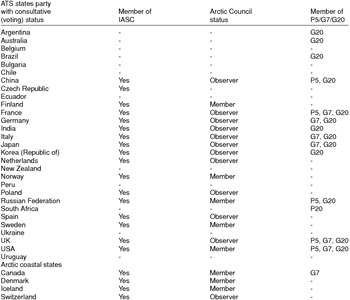
Table 1 shows that, of those countries, only 16 states are signatories of the Antarctic Treaty and members/observers of the Arctic Council. In other words, there are only 16 states that place equal priority on joining international institutions related to both the Arctic and the Antarctic. Moreover, of the 16 states, many are also members of hegemonic organisations such as the United Nations Security Council (UNSC), G8 or G20. Membership in the UNSC, in particular permanent membership, is considered a requirement to achieve ‘legitimate great power’ status (Suzuki, Reference Suzuki2008). In other words, only states that are significantly powerful to be the members of other hegemonic organisations, especially if the state does not have a natural ‘polar identity’ due to its geographical location or history, can afford to pay attention to the polar regions. Thus, having a comprehensive bi-polar policy is a reflection of both symbolic and actual power that a state wishes to exert.
Membership status of Arctic and Antarctic institutions.

The question arises then, how does a state that is not a ‘natural’ Arctic or Antarctic state (in the sense that it does not have any sovereign territories and therefore has to act in accord with accepted practices and ‘endless strategies of legitimation’ (Clark, Reference Clark2007, p. 2.) to be a legitimate member of the club) perceive the polar regions? How does it interpret their roles in its foreign policy and translate this into actual polar policy? These questions are essential to further understand how the polar regions are being (re)defined in today's context. In this paper, I will try to answer these questions in four parts. First, I will define concepts such as ‘images’, ‘perceptions’ or ‘state identity’ used in this paper and their functions in a state's polar policy. Second, the Arctic and Antarctic policies of Japan, one of the most prominent non-natural polar states, will be outlined. Third, I will compare the Arctic and Antarctic policies of Japan and analyse how Japan self-identifies in relation to the polar regions. Finally, implications based on Japan's experience will be discussed.
This paper shows that Japan's national perception of the polar regions as one entity began before World War II, primarily due to its imperial past by joining the race to the Antarctic and the Arctic alongside other imperial powers. However, from a policy point of view, for much of the last century the polar regions, for Japan, meant Antarctica. Japan, as a defeated power and a later-comer to the international system established after World War II, takes a liberal position in the governance of Antarctica. Having and maintaining a capability to travel to and conduct scientific research in the Antarctic via international decision-making institutions has been considered to be an important status marker associated with great power identity. Regarding the Arctic, Japan is attempting to replicate the general success of its Antarctic policy, backed by tools of science and technological diplomacy, with the aim of reviving Japan's domestic economy. Japan's scientific whaling in the Antarctic is primarily a domestic, identity-based political conflict between a nostalgia for Japan's imperial past and its more modern, liberal identity of today.
Definition of concepts
In studies of international relations, the concept of identity is central to the constructivist paradigm in a similar manner that power is to realism and wealth to liberalism (Lebow, Reference Lebow2016, p. 1). It is considered that a state can possess an identity just as an individual can. A state's identity is based on the descriptions of the state and their people generated by leaders and citizens alike (Lebow, Reference Lebow2016, p. 1). Although sometimes at odds, identities can be used to explain a person's behaviour or a state's policy. Self-identification helps shape behaviour, and behaviour in turn helps shape self-identification (Lebow, Reference Lebow2016, p. 3). States’ identities comprise several dimensions (subjective as well as intersubjective, cultural and historical); therefore they act like an ‘analytical prism’, through which different spectral dimensions converge into one ray of light, in understanding foreign policy (Urrestarazu, Reference Urrestarazu, Jørgensen, Link and Hellmann2015, p. 136). Indeed, state identity is a lens ‘through which citizens determine a framework for a state's appropriate response to the demands and challenges of the international environment’ (Oros, Reference Oros2008, p. 28).
A state's national self-identification is derived largely from roles (functions), affiliations and relationships to bodies and territories, with roles being the most significant source (Lebow, Reference Lebow2016, p. 73). In international society, roles are closely linked with a state's (self and externally recognised) power and responsibilities. For example, the USA has enjoyed the role and recognition as a superpower and states such as Switzerland and Sweden have succeeded in changing their roles from low-status neutral states to regional/middle powers (Lebow, Reference Lebow2016, p. 4). To become a great power, a state is required to obtain the ‘status markers’ linked to great power identity and convince existing great powers that it merits the status and legitimacy (Lebow, Reference Lebow2016, p. 487). Today, indicators such as national wealth, nuclear weapons, space exploration, Nobel prizes and Olympic medals are considered as typical markers of a great power (Lebow, Reference Lebow2016, p. 85). Therefore, for the purpose of this paper, it is assumed that an element of Japan's self-identification springs from the roles it regards itself as having towards the polar regions and their peoples, and this self-identification can be used to explain Japan's policies towards the two regions. Moreover, Japan's self-identifications have to be acknowledged as legitimate by existing powers in order for Japan to exercise its power influence.
In analysing Japan's roles towards the polar regions, the images and perceptions that its leaders and people have of those regions strengthen our understanding of the link between Japan's self-identifications and its foreign policy. Neorealists advocate the idea that perceptions of security that rest on estimates of relative power and assumptions about the intentions of other countries are important in understanding international relations. Specifically, a state has to consider whether the relationship with another country warrants accepting the lead (authority ranking), taking care of the other (communal sharing) or simply trading goods of equal amount of comparable market value. Alternatively, a state can perceive another country as representing a perceived opportunity, and as inferior in capability and lower in cultural status. An example of this image is the perception imperial leaders had of their colonies. A collection of such images and perceptions of a territory or people leads to a behavioural inclination to intervene and to impose control over it (Herrmann, Reference Herrmann, Huddy, Sears and Levy2013, p. 10).
Japan and the polar regions
Japan has been one of only a few non-Western states to conduct polar research, doing so since 1957, but it has mainly focused on Antarctica (Tonami & Watters, Reference Tonami, Watters and Heininen2012). This is not unrelated to the fact that the first Japanese Antarctic Expedition in 1911–1912, in which Nobu Shirase landed on Antarctica on 16 January 1912, is commemorated as the burgeoning of Japan's polar engagement. Although Japan's polar research has consistently been conducted both in the Arctic and the Antarctic, the Arctic research community had been smaller by comparison and researchers are dispersed among various institutions, consequently allowing the Antarctic voice to be stronger and more influential than that of the Arctic in polar policy-making.
In 2009, however, the Arctic finally began to attract significant public attention in Japan. In April, the Japanese Vice Foreign Minister released an official statement on the 50th anniversary of the Antarctic Treaty and announced Japan's intention to apply for observer status at the Arctic Council (Hashimoto, Reference Hashimoto2009). In July of the same year, the Japanese government officially submitted an application to the Arctic Council. This formal self-recognition of Japan's desire to be acknowledged in an intergovernmental body of Arctic governance sped up the policy-making processes with regards to the Arctic within the government. For the time-being, however, there is no unified polar policy that encompasses both polar regions.
Japan's Antarctic policy
Despite Japan's long history of Antarctic engagement, there is only a small volume of published studies describing the role of Japan and the governance of Antarctica. However, they do not necessarily reflect the latest state of Japan's Antarctic policy and its character. For instance, Joyner (Reference Joyner1989) described the history of the Antarctic Treaty System (ATS) and Japan's national interests in the Antarctic. They were regarded as: more cooperation with the Antarctic Treaty Consultative Party, economic interests and preservation of access for Japanese nationals to exploit living marine resources and minerals, scientific interests and preservation of the resources of the Antarctic for future exploitation. Japan's economic interests in the Antarctic and subsequent reluctance to ratify the Protocol on Environmental Protection to the Antarctic Treaty (the ‘Madrid Protocol’) was criticised before Japan finally ratified in 1997 (Blay, Reference Blay1992).
Others explored the politics and legal implications around Japan's renunciation of territorial rights in Antarctica in the San Francisco Peace Treaty of 1951 after defeat in World War II (Hara, Reference Hara1999; Reference Hara2006; Scott, Reference Scott1999). Recent studies of Japan and the Antarctic revolve around the controversial research whaling that Japan conducts in the Antarctic (Anton, Reference Anton2009) and so-called ‘eco-terrorism’ committed by an anti-whaling NGO against Japanese research whaling vessels (Roeschke, Reference Roeschke2009). The Antarctic Treaty is the centrepiece of the legal regime and governance of the Antarctic. The Treaty was signed in Washington on 1 December 1959 by the 12 countries whose scientists had been active in and around Antarctica during the International Geophysical Year (IGY) of 1957–1958 (Secretariat of the Antarctic Treaty, 2014). It entered into force in 1961 and currently the total number Party to the Treaty is 50. The Antarctic Treaty and related agreements are called the Antarctic Treaty System (ATS) and within the ATS, international relations with regards to Antarctica are regulated. Japan was one of the 12 original contracting states of the Antarctic Treaty and one of the 12 governments that had participated in the Washington Conference Treaty negotiations and ratified it, which brought the Treaty into force on 23 June 1961 (Joyner, Reference Joyner1989).
Japan does not claim territorial rights in Antarctica and does not recognise other nations' claims either. This is because Japan was forced to renounce its claim to Antarctica, together with a number of territories in the Asia-Pacific, in the San Francisco Peace Treaty of 1951 (Hara, Reference Hara2006). Shinsuke Tomotsugu, however, pointed out that the Japanese government was consistently opposed to the idea of a territorial claim even before World War II as the Antarctic offered little to no returns on resources and trade. For Japan, therefore, limiting other nations’ claims and maintaining accessibility were of utmost priority (Tomotsugu, Reference Tomotsugu2013).
In order to understand Japan's position on the Antarctic today, it is noteworthy to mention the five most important provisions of the Antarctic Treaty, which are (Secretariat of the Antarctic Treaty, 2014):
-
(1) Antarctica shall be used for peaceful purposes only (Article I);
-
(2) Freedom of scientific investigation in Antarctica and cooperation toward that end . . . shall continue (Article II);
-
(3) Scientific observations and results from Antarctica shall be exchanged and made freely available (Article III);
-
(4) Among the signatories of the Antarctic Treaty were seven countries (Argentina, Australia, Chile, France, New Zealand, Norway and the UK) with territorial claims, sometimes overlapping. Other countries do not recognise any claims. The USA and Russia maintain a ‘basis of claim’. All positions are explicitly protected in Article IV, which preserves the status quo;
-
(5) To promote the objectives and ensure the observance of the provisions of the Treaty, ‘all areas of Antarctica, including all stations, installations and equipment within those areas . . . shall be open at all times to inspection’ (Article VII).
Japan's position is that: (1) the basic goal is to place the Antarctic under international management, (2) Japan recognises the importance of continuing the system into the future based on the Antarctic Treaty, and (3) it is important to actively support the planning and the implementation of measures to promote the aims and principles of the Antarctic Treaty (NIPR, 2003). Japan is one of 27 members of the Antarctic Treaty Consultative Meetings, alongside other nations that have been active in scientific research in Antarctica. Japan has dispatched a regular scientific research expedition every year since 1956 (the Japanese Antarctic Research Expedition [JARE]). The first expedition reached East Ongul Island in Dronning Maud Land in January 1957 and opened the Showa Station, which is now the main station of JARE (NIPR, 2014). The expedition has been sent every year since, the latest being the 58th at the time of writing (NIPR, 2016).
Japan is one of the nations that does not support any mining activities in Antarctica, based on the Protocol on Environmental Protection to the Antarctic Treaty that Japan ratified in 1997 (Ministry of Foreign Affairs of Japan, 2013a). For the time-being, it appears a major part of Japanese Antarctic policy is related to JARE. There is a cross-ministerial, unified organisation called the Integration Promotion Headquarters of the Antarctic Region Observation (nankyoku chiiki kansoku tōgō suisin honbu) headed by the Ministry of Education, Culture, Sports, Science and Technology (MEXT). The headquarters consist of ten ministries and a panel of academic experts, but the most relevant ministerial bodies are: MEXT (and the National Institute of Polar Research [NIPR] under MEXT); the Ministry of Internal Affairs and Communications; the Ministry of Land, Infrastructure, Transport and Tourism (MLIT) (as well as the Geospatial Information Authority of Japan, the Japan Meteorological Agency and the Japan Coast Guard under MLIT); the Ministry of Defense (MoD); the Ministry of Foreign Affairs (MoFA); and the Ministry of Environment (MoE).
Under the auspices of MEXT, NIPR conducts Antarctic research and observation as the central agency of the Antarctic observation programme. The Geospatial Information Authority of Japan is responsible for the observation of the ionosphere and auroras. The Japan Meteorological Agency administers the surveying and mapping of Antarctica and observes the ozone layer and the upper air. The Japan Coast Guard oversees affairs related to marine physics, marine chemistry and tidal fluctuation. In terms of capacity to conduct maritime activities in the polar regions, Japan owns three icebreakers: Shirase, Soya and Teshio. Shirase is under the auspices of the Japan Maritime Self Defense Force (SDF). For this reason, there are legal restrictions on the scope of use for Shirase based on the SDF Act. At present, Shirase may only be used as a supply vessel for JARE under NIPR. Soya and Teshio are owned by the Japan Coast Guard and only used as patrol boats, operating from Hokkaido in northern Japan. The MoD engages in the transportation of JARE members and necessary supplies by sea and air. The MoFA represents the Japanese government in Antarctic Treaty Consultative Meetings. The MoE is responsible for the Act on Protection of the Environment in Antarctica, which is domestic legislation that corresponds to the Madrid Protocol, and administers procedures required for Antarctic tourism and visits.
Scientific whaling
The most controversial aspect of Japan's Antarctic policy is that Japan conducts research whaling in the Antarctic. Whaling, and fishing in general, was once a major industry in Japan, but today revenues from fisheries contribute less than one percent of Japan's GDP. The number of workers in fisheries boasted more than 700,000 in 1960 but decreased dramatically to 180,000 in 2013, and more than half of these workers are reported to be over 60 years old (The Mainichi Shimbun, 2015). It is ‘puzzling’ that Japan's whaling policy is at odds with its overall approach to environmental diplomacy, let alone foreign policy in general (Strausz, Reference Strausz2014). I argue that whaling is emotionally important for Japan, which influences its self-identification towards the Antarctic.
Japan joined the International Whaling Commission (IWC) in 1951 and under the International Convention for the Regulation of Whaling (ICRW) Japan implemented a commercial whaling moratorium in 1986. In 1987, Japan started its first research whaling programme in the Antarctic called JAPRA (Institute of Cetacean Research, 2013). The programme ended in 2004 but was immediately succeeded by JAPRA II. Japan's continuation of whaling has received much criticism, especially from abroad, examples being direct anti-whaling actions against Japan's Antarctic whaling expedition by the anti-whaling NGO Sea Shepherd Conservation Society since 2007 (Sea Shepherd, 2008). Furthermore, a legal case regarding Japanese whaling in the Antarctic was brought to the International Court of Justice (ICJ) by Australia (with New Zealand intervening), which Japan subsequently lost (International Court of Justice, 2014).
The Japanese government's official position regarding research whaling prior to the ICJ's ruling was that:
As with any other marine life, whales are a natural resource and can be utilised as such, so long as this is done in a manner that is supported by the best scientific evidence available to be sustainable (MoFA, 2013b).
Three entities are relevant to Japan's whaling policy in the Antarctic: the Japan Fisheries Agency under the Ministry of Agriculture, Forestry and Fisheries, the Institute for Cetacean Research and MoFA. In November 2014, the Japanese government announced a new scientific whaling programme called the New Scientific Whale Research Program in the Antarctic Ocean (NEWREP-A). On 6 October 2015, Japan made a new declaration related to the ICJ, Japan declared:
Considering that, as Japan is a State Party to the UNCLOS [United Nations Convention on the Law of the Sea] and continues to observe its obligations, it is more appropriate, as long as there is no special agreement, to apply dispute settlement procedure under the UNCLOS that establishes provisions regarding living resources of the sea as well as the involvement of experts from the scientific or technical perspective when an international dispute arises with respect to research on, or conservation, management or exploitation of, living resources of the sea (MoFA, 2015).
Existing research has tried to explain why Japan continues its scientific whaling while economic and political benefits of doing so are marginal (if not negative). Catalinac & Chan (Reference Catalinac and Chan2005) asserted that Japan's persistence in its right to conduct whaling is because the Japanese government regards the whaling dispute as ‘a threat to resource security and also a danger to inter-state respect for differences in custom and cuisine’. Ishii & Okubo (Reference Ishii and Okubo2007, p. 85) argued Japanese policy-makers regard non-issues like whaling as one of the few issues where they can relieve ‘diplomatic stress’ caused by the perception that Japan always has a weaker hand against Western powers such as the USA. Morikawa (Reference Morikawa2009, p. 1) pointed out that the Japanese government allowed the whaling issue to ‘take on a magnitude and significance far beyond its actual importance’ and ‘has made the continuation of whaling a national goal and a matter of national pride’ (Morikawa, Reference Morikawa2009, p. 19). Blok (Reference Blok2008; Reference Blok2011) investigated the issue of identity-based politics of whaling and said what whaling conflicts are ‘really’ about is ‘an essentially contested normative question’ and ‘national sentiments of pride and humiliation are clearly at stake for pro-whaling elites’ of Japan (Blok, Reference Blok2011, p. 74).
It can be said that Japan perceives the Antarctic as a region in need of being taken care of (communal sharing) but also as a region representing a perceived opportunity, and as inferior in capability and lower in cultural status. Especially among pro-whaling elites, scientific whaling adds an element of both national pride and humiliation to the Japanese image of Antarctica. Based on these perceptions of Antarctica, Japan self-identifies as a law-abiding, liberal actor holding a legitimate power as a member of a select ‘club’ of nations with the right to intervene and impose some level of control over Antarctica.
Japan's Arctic policy
Although comparatively smaller in scale than that of the Antarctic, Japan has a history of Arctic engagement that dates back to World War II (Naganobu, Reference Naganobu2012a). In June 1941, a Japanese ship sailed towards what is now known as the Northern Sea Route (NSR). The fishing vessel Kaiho of the Japanese Fisheries Agency had an ambitious plan to sail through the NSR and onwards to Europe, Africa, the Indian Ocean and eventually to the Antarctic. This ambition was ultimately overblown and did not succeed; after the Kaiho reached the Bering Strait, it had to change its route and return to Japan as Nazi Germany invaded the Soviet Union on 22 June and the course of the war in the Arctic changed (Naganobu, Reference Naganobu2012b). The legend of Kaiho and its shattered dreams lives on among Japanese polar scientists today (Tonami, Reference Tonami2016, p. 48).
After a long hiatus following the end of World War II and during the Cold War, Japan's general interest in the Arctic became more widely apparent in the early 1990s. In accordance with the general trend of Japan's environmental diplomacy of that period, Japan has taken a liberal position in the Arctic and tries to promote multilateral solutions (Hook, Gibson, Hughes, & Dobson, Reference Hook, Gibson, Hughes and Dobson2012, p. 320). One of the most evident signs of this liberal position is Japan's decision to join the IASC as a non-Arctic state in 1992. Japan was the first Asian state to do so, only two years after the committee was established. In 1993, the Ship and Ocean Foundation (now Ocean Policy Research Institute, the Sasakawa Peace Foundation) began a six-year research project called the International Northern Sea Route Programme (INSROP), which became the first international research project to prove the technical feasibility of the NSR as an international commercial sea lane (Liu & Kronbak, Reference Liu and Kronbak2010). This is backed by Japan's formal recognition of the role of science and technology in its economic development and diplomacy during that period. A symbolic example is the Science and Technology Basic Law that was enacted in November 1995. The law claimed that its objective was ‘to achieve a higher standard of science and technology, to contribute to the development of the economy and society of Japan. . .’ (Cabinet Office of Japan, 2015). In other words, the law gave clarity on the shared understanding of the Japanese decision-makers that, in order to shake off the long recession and the end of the era of Japan as a nation playing ‘catch-up’ to Western developed economies, it was indispensable to create new industries by developing creative and high-tech scientific technologies (Akashi, Reference Akashi2011).
While it is debatable when and how Japan began to recognise science and technology as an important tool to facilitate its economic growth and its national wealth, it is imperative to understand the Japanese interpretation of the role of science and technology in linking its domestic industrial and foreign policy. In the early 2000s, the Japanese government became aware of the need to support polar research. In December 2004, the Council for Science and Technology Policy, which is under the Cabinet Office, agreed on the Promotion Strategy of Earth Observation. This strategy included Japan's aim to realise a long-term, continuous observation of the polar regions and cryosphere (MEXT, 2010). From 2009, Japan's Arctic policy began to be set forth. As previously mentioned, in July 2009 Japan submitted its application for observer status at the Arctic Council. This came at a time when the council was beginning to take on new responsibilities related to safety of navigation and search and rescue, and it was viewed as an indication that the council itself was changing and that the positions of member states were shifting (Tonami, Reference Tonami2016, p. 60).
In part to impress the Arctic coastal states who had a say in Japan's application to the Arctic Council, and in part to prepare the ground for when/if Japan became an observer at the council, the government followed up the application with several domestic initiatives. These included the establishment an Arctic Task Force at the MoFA, a special public–private joint committee on the NSR organised by the MLIT, the addition of the word ‘Arctic’ 18 times to the renewed Basic Plan on Ocean Policy, setting up an inter-ministerial committee on the Arctic (the liaison committee among ministries and agencies on various issues related to the Arctic) and the appointment of Japan's own Arctic Ambassador. Nonetheless, the flagship of Japan's Arctic engagement has been considered to be, at least by the Japanese stakeholders, its scientific research.
Therefore, these government initiatives became ‘complete’ when they were complemented by nationwide, large-scale, government-funded scientific research projects that aimed to protect and understand the Arctic environment. In terms of ministerial bodies related to the Arctic, at present there is no cross-ministerial, unified organisation to deal with Arctic issues except for the aforementioned inter-ministerial committee on the Arctic. Among various ministries, business sectors and research institutes, the most relevant are: MEXT and the NIPR under MEXT; MoFA; MLIT; the Headquarters for Ocean Policy under the Cabinet Office; the Ocean Policy Research Institute under the Sasakawa Peace Foundation; the shipping sector; the ports and infrastructure industry; and the energy sector.
Two years after Japan was accepted to be an observer at the Arctic Council and became a full-fledged non-Arctic Arctic stakeholder, Japan announced its first official Arctic policy. At the Arctic Circle Assembly held in Reykjavik, Iceland in October 2015, the Japanese Arctic Ambassador Kazuko Shiraishi excitedly introduced the policy, prefacing:
[Today is] the most important day ever for Japan's Arctic policy. Just 6 hours ago, Prime Minister [Shinzo] Abe adopted a comprehensive Arctic policy for the first time in history. . .What is the key element of our new Arctic policy? Research and development.
The official Arctic policy lists global environment, indigenous peoples, science and technology, the rule of law and international cooperation, sea routes, natural resources and national security as areas of priority, and research and development, international cooperation and sustainable use (of natural resources) as specific initiatives (Headquarters for Ocean Policy, 2015). This rather all-encompassing Arctic policy is due to a policy-making process of an iron triangle comprised of bureaucracy, politicians and business groups, each of which hold varying interests (Tonami, Reference Tonami2016). Moreover, Tokyo recognises that Japan does not have a legal basis to participate in formal discussions regarding the Arctic other than through the UNCLOS or the International Maritime Organization, of which Japan is a member. Seen from this perspective, Japan's perception of the Arctic is as a region too difficult to generate any financial benefits in the short-term, but sufficiently important to continue planting flags to be used in the future. In other words, the Arctic represents opportunity, but somewhat inferior in capability and lower in cultural status and a region in need of being taken care of. A collection of such images and perceptions of a territory or people allows Japan to have a behavioural inclination to intervene and to impose control over it. In doing so, science and technology, including scientific research, is considered a useful tool.
Arctic and Antarctic policies
In the case of Japan, the nation's image of the polar regions began in the era of the Western powers’ race to the South Pole in the early eighteenth century. It was natural for Japan and its people to regard both ‘opposites’ of the globe as the polar regions due to this reminiscence of colonial past (or a lost desire to be a powerful imperial power) and the subsequent liberal position the country took with respect to the international order. However, from a strictly policy point of view, for Japan the polar regions long meant Antarctica. Indeed, Japan has historically placed a much higher priority on the Antarctic than on the Arctic. This reflects the fact that Antarctica has a much longer history of being governed through international, multilateral institutions and Japan has been a member of these decision-making processes and bodies from a very early stage. In other words, for Japan, as a defeated power and a late-comer to the international system established after World War II, having and maintaining a capability to travel to and conduct scientific research in the Antarctic via international decision-making institutions has been considered an important status marker associated with great power identity.
As previously mentioned, the government's overall position on the Antarctic has been to (1) become a member of the most relevant governance system of the region, (2) increase Japan's presence and influence indirectly through achievements of scientific research, and (3) prepare the domestic environment (policy and governmental/non-governmental institutions) to support achievement of these goals. The recent announcement of its official Arctic policy indicates that Japan is keen to incorporate its science-centric Antarctic approach into the Arctic as well. This partially explains a shortage of consideration to the human element in its Arctic policy, despite the fact that one of the most significant differences between the Arctic and the Antarctic is the presence of human settlement in the region. For instance, the official Arctic policy contains a paragraph titled Indigenous Peoples of the Arctic but there is no specific initiative on this issue. Moreover, it can be said that Japan's application to the Arctic Council and announcement of its Arctic policy is a sign that Japan recognised the membership of the Arctic decision-making club as one status marker of a great power.
At the same time there is a distinct difference between Japan's Arctic and Antarctic policies in their content. Under the circumstances, the key provisions of the Antarctic Treaty and the Environmental Protocol regarding issues such as the freezing of jurisdictional claims, the demilitarisation and denuclearisation of the entire continent and the prohibition on mining activities do not meet the needs of the Arctic states (Young, Reference Young, Young, King and Schroeder2008); hence it is highly unlikely that the Arctic states will conclude similar agreements in the near future. On the contrary, non-Arctic states are encouraged to invest in the Arctic region to fund expensive mining projects and boost somewhat stagnating regional economies. The example being the establishment of the Arctic Economic Council, whose first meeting was held in September 2014 (Arctic Economic Council, 2014). In this regard, as the nation that has pursued a great deal of state-led development, the Japanese government plays an important role in guiding relevant domestic industries to increase their involvement in the Arctic region. Moreover, the government and researcher community broadly recognise that the Japanese Arctic research deserves more assistance from the Japanese government and public in light of current climatic changes and the support that Antarctic research has received over the years. For instance, there is an ongoing discussion of building a new icebreaker dedicated to Arctic research. This aspect of economic opportunities (or lack thereof) in the region in question is mirrored in the related institutions; it is noteworthy that even though the protection of the natural environment is an important element of both Arctic and Antarctic policies, only the Antarctic policies are dealt with by the MoE.
The discussion above indicates that Japan's Antarctic policy encompasses more diplomatic tools that are more political in their character than its counterpart, the Arctic policy. Japan is an active member of ATS and IWC, two of the most relevant mechanisms for the governance of Antarctica. It also has a long history in Antarctica, since the beginning of the twentieth century, and its character is predominantly scientific due to Japan's adherence to the Antarctic Treaty. Different from the Arctic, Japan does not show (or is not allowed to show) any interest in mining activity in Antarctica because of the Madrid Protocol. Research whaling, one of Japan's most controversial external policies, is defined by the Japanese government as a necessary preparatory step to eventually resume commercial whaling. If we accept the Japanese government's position, scientific whaling can be considered as a tool of commercial diplomacy. However, given that whaling is actually not a major economic issue for Japan, it is a diplomatic tool that is used in the international fora but serves as a tool to achieve political goals in domestic identity-based politics surrounding national sentiments of pride and humiliation.
In summary, it can be said that the Japanese policies related to both the Arctic and Antarctic regions are primarily tools of diplomacy designed for Japan to obtain a great power status in a ‘social and socially legitimated hierarchy within international society’ (Suzuki, Reference Suzuki2008), seen through the prism of both poles. Examples are the Arctic/Antarctic scientific research programmes and joining international/multilateral institutions on the Arctic/Antarctic. Promotion of trade and investment for the future, such as the promotion of the NSR, is considered a secondary matter. In fact, the investigation of the feasibility of the NSR for Japanese businesses, as well as various investment projects in the natural resources exploration in the Arctic region, can be regarded as diplomatic tools that have a more political goal than an economic goal. In Antarctica, Japan's policy on research whaling appears idiosyncratic for a state that otherwise takes a liberal position on environmental governance. The issue of research whaling at present is used as an external tool to play identity-politics based on sentiments of pride and humiliation in the domestic political arena.
Conclusions
How do the Arctic and the Antarctic become ‘the polar regions’ as a set in a nation's imagination? How does this manifest itself as policy? In this paper, I tried to answer these questions by analysing the Arctic and Antarctic policies of Japan, one of the ‘newcomers’ to Arctic governance. In the case of Japan, the nation's image of the polar regions began during the era of the Western powers’ race to the South Pole in the early eighteenth century. Japan renounced its claim to Antarctica in the San Francisco Peace Treaty after defeat in World War II, and since then Japan has taken a liberal position on governance of regions that lie beyond its obvious sovereign territories. Therefore, due to this reminiscence of colonial past (or a lost desire to be a powerful imperial power) and the subsequent liberal position the country took with respect to the international order, it was natural for Japan and its people to regard both ‘opposites’ of the globe as the polar regions. The Arctic and Antarctic regions are considered as a combined region that share geographical and climatic conditions therefore common scientific knowledge can be applied. It is also a region that invites Japan's intervention because it presents opportunities but is inferior in capability and lower in cultural status. Japan's scientific whaling is a lingering ghost of the dilemma of a more imperialist identity from Japan's past and its more liberal identity of today.
In actual policies, the Antarctic has received much greater attention. The Arctic had to wait until the beginning of the 2000s, by which time Japan had experienced the remarkable economic growth after World War II and the subsequent long economic stagnation from the early 1990s. With the Science and Technology Basic Law (1995), Japan formally recognised that science and technology is the key to reviving its sluggish economy and for it to graduate from being a nation trying to catch up with the Western developed economies; this law and the ideas underlying it became the backbone to strengthening the government's support on polar research, including the Arctic. Today, although a state that is not a ‘natural’ Arctic or Antarctic state, in Japan's imagination the Arctic and the Antarctic are indeed ‘polar regions’. In addition, polar regions are regarded as potentially economically and strategically important peripheral regions, and having a say in the governance of the two regions is considered as one of the status markers of a great power in Japan's self-identification. In order to exert influence in these regions, despite its lack of perceived legitimacy, Japan attempts to engage in the polar regions using tools of science and technological diplomacy with primarily political goals.
Acknowledgements
The author would like to thank the participants to Nordic Association for the Study of Contemporary Japanese Society (NAJS) Conference 2014, Helsinki, Finland, and ISA Asia-Pacific Conference 2016, in particular the panel on Asia at the poles, Hong Kong, 26 June 2016, and two anonymous reviewers for their valuable comments.
Financial support
The author wishes to acknowledge the financial support provided by the Asian Dynamics Initiative, University of Copenhagen and by the Japan Society for the Promotion of Science (Global Initiatives FY2016 – Designing Social Infrastructure for Multicultural Democracy: International Joint Research for Institutions, Structure and Norms).