1. INTRODUCTION
Gas represents a unique case in the field of public services. As well as being the first urban networked infrastructure, in the 1970s, during the environmental and energy crisis, it regained its status as an available energy source.
The gas industry developed in Europe between the late eighteenth and the early nineteenth century.Footnote 1 The first commercial applications were implemented in Great Britain,Footnote 2 where expansion was so spectacular that by the mid-nineteenth century the gas industry was widespread.Footnote 3 Developments were slower on the continentFootnote 4 (even in the most advanced countries such as France and Germany), although it did reach the larger cities in the following decades.Footnote 5
As well as other supply and demand factors, it was probably the increasing demand for new lighting systems that led to such rapid expansion. Nevertheless, there were various obstacles to the production of coal gas across the continent such as the initial technical conditions of manufacturing gas, some over-optimistic estimates of supply costs (causing costs to rise), distribution systems that needed significant investment and the perception of insecurity amongst citizens.Footnote 6
Consequently, in the first half of the nineteenth century, coal gas was almost exclusively a lighting fuel and this increased with the demand for public lighting and industrial consumption.Footnote 7 It was not until the 1870s that gas was used for other purposes, in commercial premises and aristocratic households, lighting middle-class homes between 1840 and 1870. Over the next 20 years, cooking and heating gas reached middle-class kitchens;Footnote 8 however, gas was still a luxury fuel in the home, despite the rapid fall in gas prices as technology improved.Footnote 9
When electricity arrived in the late nineteenth century, it provided strong competition for the gas industry; hence the gas industry consolidated itself rather than actually grew.Footnote 10 Innovations in gas-lighting technology still sustained the gaslight business in the late nineteenth century, but this quickly declined as electric power became available.Footnote 11 From a situation of hegemony (whereby gas had occupied the main segments of consumption), the sector had to redesign its strategies in search of other market segments that might replace the foreseeable loss of demand caused by the development of electricity.Footnote 12 After the First World War, competition became tougher as the electricity industry was much more powerful than in earlier years.Footnote 13
In Spain, the gas industry followed a similar chronological pattern to that of the rest of Europe, although there are a couple of distinctive features. First, there was a relative delay in implementing coal gas. Second, the sector has been discontinuous; since networks were dismantled in the 1940s and 1950s in most regions, they thus had to be rebuilt after the 1990s to distribute natural gas. Most studies on the implementation of gas in Spain are predominantly local case studies written by executives of the gas companies themselves.
The main objective of this paper is to trace the long-term evolution of gas development in the Spanish region of Galicia.Footnote 14 This is significant, as it will allow a pattern to emerge that we can compare with other similar studies. Galicia is representative of the development of the gas industry compared with other Spanish and even peripheral European regions, most of which were scarcely industrialised and urbanised at that time. The difference between core and peripheral regionsFootnote 15 has been rather significant in the development of the gas industry in Europe, not only as regards timing but also in the availability of coal, regulations, profitability, demand, sources of capital, business structure and strategies. More particularly, we wish to analyse these issues in a specific environment that was representative of the small- and medium-sized cities in Spain. The paper is structured chronologically, in three major stages: the era of monopoly, the arrival of electricity as a competitor and the eventual replacement by electricity. These stages coincide with what occurred in the gas industry in the rest of Europe although in Spain they were somewhat delayed.
This article uses basic document sources from municipal lighting files, municipal records, reports from concessionaire companies and official statistics.
Municipal documentation is highly useful for providing background information, information on regulations and any conflicts between local authorities and concessionaires. Its main drawback is the lack of documentation about the economic development of the gas factories. On the other hand, due to the focus on public lighting, there is little or even no information on gas from the end of the nineteenth century when gas was substituted by electricity in street lighting.
Business sources are particularly relevant for learning about the evolution of the sector from the moment electricity became a competitor (as stated above). Unfortunately, we have found limited and relatively insignificant business documentation due to the service's early collapse and the strong discontinuity of (some foreign) company ownership.
Official statistics provide generic data but allow us to understand the chronology and establish comparisons.
2. Gas in the ERA of monopoly
The gas industry, alongside electricity, water, transportation and communication, has the attributes of a natural monopoly, since it is cheaper to supply the needs of a particular area from a single company rather than use several suppliers.Footnote 16 Moreover, the elimination of competition often generates the emergence of economies of scale,Footnote 17 as well as positive and negative external effects that cannot be captured by market mechanisms.Footnote 18 Nevertheless, some authors reject the idea of natural monopoly as situations exist whereby there is competition between more than one supplier.Footnote 19
The gas companies' monopoly in street lighting was strategically introduced to attract potential private demand.Footnote 20 Territorial expansion, through control of the area supplied, was the key to profitability in this strategy. Once the initial investment was made, the success of the gas industry would be assured if firms could expand their production, distribution and consumption. This would have implied a continued increase in private demand, a sector that would provide the greatest benefits and towards which companies in European industrial cities were focused.Footnote 21
The spread of gas infrastructures in the Western world suffered considerable failure in its infancy due to lack of capital, insecurity about potential demand, dependence on the quality and quantity of coal and the general lack of expertise. However, prior to 1830, innovation had spread throughout the major cities of Western Europe.Footnote 22 Great Britain, France and Belgium were the pioneers in this sector, due to their technological leadership and availability of capital, and all of them (particularly Great Britain) due to their abundant coal deposits. Until 1840, British technological hegemony in the European gas industry was almost absolute.Footnote 23 However, from that moment on, the situation tended to balance out, with increasing French presence. France's foreign expansion concentrated on the Mediterranean Sea, both on the northern shores (Spain and Italy) and in its North African colonies.Footnote 24
The gas industry in Spain did not begin until the 1840s and this was relatively late compared to other countries. This occurred during the second wave of investment in the sector, which covered peripheral Europe: Central Europe, Scandinavia,Footnote 25 Southern EuropeFootnote 26 and Eastern Europe, in that chronological order. A key element in making a gas plant viable is the supply of coal at low costs. This was an important handicap for countries such as Spain, which either had no coal or where the coal was of very poor quality and/or difficult to access easily. Hence, especially at the outset, coastal cities, and particularly economically dynamic cities (such as those of Catalonia),Footnote 27 were the first to provide this new service. One must also consider the delay with the railway infrastructure that many Spanish cities had to endure.Footnote 28 Expansion from large cities to smaller towns occurred, following the pattern of other developed countries.Footnote 29
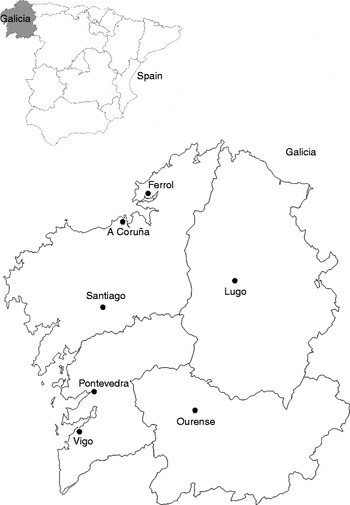
The example of Galicia (Fig. 1) confirms the need for a certain population threshold for profitable investment in the network, i.e. for around 25,000–30,000 inhabitants, a figure which is significantly higher than in most developed countries.Footnote 30 Alongside this demographic factor, there were others that, on the whole, were common worldwide: economic growth, income, characterisation of local elite and the emulation effect. A certain degree of socio-economic development (industrialisation and gross domestic product per capita) was necessary to guarantee the profitability of the investment. On the other hand, the dynamism of the local bourgeoisie and authorities and their ‘envy’ of other cities (the myth of Modernity) also played a relatively important role in stimulating the new public service.
Cities in Galicia and the location of the region in Spain.

This helps us understand the sequence of the introduction of gas in Galicia. First, one notes the early adoption in A Coruña (1855),Footnote 31 the main town in Galicia. Its population was mainly concentrated in its urban area, and its citizens enjoyed higher incomes amongst a modern and cosmopolitan local elite. This represents a different model from the other Galician cities, as we will subsequently see. Second, implementation was delayed, albeit only in those cities with a certain industrial base such as Ferrol (1883)Footnote 32 and Vigo (1884),Footnote 33 or those with historical importance and political rivalry with A Coruña (Santiago, 1873).Footnote 34 Conversely, other countries, such as Ireland (which traditionally has been compared with Galicia), enjoyed gas street lighting very early on (in the early 1820s), due to the British influence and its proximity to English coal.Footnote 35 By the middle of the decade, the main cities in Holland (another small, developed country) were using gas, again (as in the Irish case) using British capital.Footnote 36 Another nearby and comparable country to Galicia, Portugal, was equipped with gas lighting in the main cities between 1848 and 1859.Footnote 37
As in most countries, foreign capital played a significant role in the launch of the Spanish gas network, due to increased availability of capital, technology and experience in the sector. In the Spanish case, the French were the main investors, followed by the British, the two hegemonic gas powers in Europe. In Galicia, as supply was delayed, no autochthonous entrepreneurs were involved in the development.Footnote 38 The initiative came from a small company in Lyon,Footnote 39 which was the headquarters of the most important French and European gas holdings. In Galicia, this group was initially based in A Coruña,Footnote 40 and later controlled the factories of VigoFootnote 41 and Santiago.Footnote 42 On the eve of the First World War, it transferred all its Galician industrial facilities to regional electricity companies that were progressively controlled by the Sociedad General Gallega de Electricidad. The other gas company in Galicia was Catalana de Gas, the leading Spanish company in the sector, which managed the Ferrol factory.Footnote 43 Finally, a small company from Asturias, Menéndez Valdés y Compañía, began providing gas to Santiago de Compostela.Footnote 44
From a regulatory point of view, Spain is similar to other Western European countries. Compared with the prevalence of municipal property and management in several European countries (Germany, Scandinavian countries or major cities in Britain), private companies prevailed in Spain, as in Italy, France and Belgium. As there was no specific legislation to regulate gas infrastructure in Europe including Spain, the early facilities were made possible through a mechanism inherited from the Ancien Régime. At the start of some worldwide urban infrastructures (particularly gas) there were no legal precedents to adapt the different facets of a production, distribution and consumption process. Exclusive privileges were granted by the states and, in their name, by city councils. This allowed the first gas networks to develop in Europe in a situation of monopoly, as gas companies had no competition.
Later, between 1850 and 1870, privileges were replaced by concessions, which in practice were also a monopoly. The main advantage of the concession was that it could safeguard the interests of the gas companies. It was an important asset for companies, for if a city did not have a powerful industrial sector, necessary expansion of the network would be done should there be a need for increased gas production. In the opposite scenario, the concession would continue, waiting for a future consolidation of the industrial base.Footnote 45
In France and Spain, it was councils that granted the concession of this public service, albeit under the supervision of the central government.Footnote 46 The initial legislation was refined over time, especially regarding the definition of quality of service and control mechanisms.Footnote 47 The pursuit of exclusivity in street lighting was a key objective for the gas companies, as they needed a minimum guaranteed level of demand that would give them a return on the considerable fixed infrastructure costs. As for private demand, the situation was more ambiguous due to the various legal loopholes regarding municipal competence in this area and the interest of local authorities to regulate only what concerned the municipal institution. Given the physical and economic impossibility of competition in most Spanish cities, the duration of the concession was more relevant, because an assured market allowed better return on investment.Footnote 48
In the concessions, the so-called ‘scientific progress clause’ was included, which created a dilemma for the gas companies. Either they could adopt possible future findings in the field of energies or lose the concession. If, because of advances in technology and science, a cheaper and more efficient street lighting system of cities than gas was achieved, the gas entrepreneurs would have to be prepared to adopt it or lose the concession. However, both the privilege and the concession could be bought, sold or transferred, resulting in negative consequences for the installation of gas in many Spanish cities.Footnote 49 In this aspect, A Coruña was a pioneer, because this clause was introduced in 1854, much earlier than in larger cities such as Seville.
Municipal corporations provided direct benefits in Galicia, i.e. free transfer of land required for building the gas plant and exemption from municipal taxes on input used in the manufacturing process. Companies also needed to achieve a certain level to take advantage of this, and hence insisted on establishing a minimum mandatory number of lamps to contract by local councils. These numbers varied, depending not only on population and the area to illuminate but also on the relative strength of the local government and the concessionaire company. Besides the number of lamps, their operating hours also affected the total expenditure on lighting. Companies demanded that the annual hours of lighting be as high as possible, again with significant differences between municipalities.
The third variable that affected income for the companies from street lighting was the price. The rates for the municipality were significantly lower than those for homes. In fact, it has been often stated that the companies operated at a loss from their main customers, especially due to the repeated delays and unpaid dues caused by the structural weakness of municipal finance in Spain. For the companies, this would be a burden in compensation for the possibilities provided by the private market. In Galician cities, the latter supported a different rate to the administration, which in relative terms, ranged from 40 per cent in Santiago to 75 per cent in A Coruña. Consequently the concessionaire attempted to alleviate the reduced tariffs imposed by the municipality of A Coruña on its consumption through a greater percentage surcharge upon residential contracts.
Concessionaire companies were interested in obtaining the exclusive service and beneficial fees, but also wanted to guarantee the possibilities of market expansion, particularly amongst individual contracts. However, in order for this growth to be profitable, it would have to be done with a certain ratio of the number of customers and the extension of the network. This was because the infrastructure's high cost was passed on to consumers. On the other hand, municipalities and their neighbours were also interested in expanding the service to new places, streets and neighbourhoods, as it was a sign of social prestige. The key element that marked the profitability thresholds was the distance between the points of light (lanterns or consumers), so that companies sought the maximum planned distance to expand the network as little as possible.
Friction between the municipalities of Galicia and the concessionaire companies was visible both in the process of implementing the service and its subsequent management.Footnote 50 Local corporations were interested in carrying out work to lay pipes with the least possible damage to the pavement and within a reasonable timeframe. The reality, however, tended to be different, as the companies did not take a great deal of care over their work and faced problems with their contractors and surveyors or domestic difficulties of various kinds.Footnote 51
There was friction once again when the service began. First and foremost, there were issues with quality control, seen in the fulfilment of the contract clauses in terms of the number of light points, hours of operation and light intensity. The greatest difficulty was the measurement of the brightness quality of light points, mainly street lighting lanterns. First, it was difficult to establish benchmarks. The solution generally adopted was to compare it with the previous system, that is, oil-based lighting. Moreover, at least in the early days, corporations lacked the knowledge and the human and material resources to exert such control, being forced to resort to outsourcing. They used the company's material resources and recruited reports from university experts. Over time, local authorities gradually obtained professionals and technical instruments (photometry offices) that allowed them to obtain more objective control.
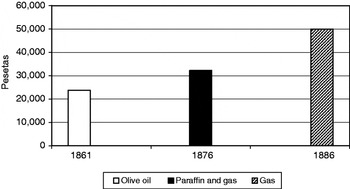
In general, contract terms were quite favourable to the companies, due to their greater negotiating experience. A Coruña in Galicia was an exception because of its greater strength. In some cases, production terms could become obsolete. Over time, these defects became more dramatic. Therefore, both parties, particularly corporations, sought renegotiation of the original agreements, a process that was not without tension. Contractual privileges and their interpretation led to various controversial situations.Footnote 52 Another cause of conflict between companies and corporations was the delays and the councils' unpaid street lighting bills.Footnote 53 It has generally been said that low gas prices (as compared with previous systems) were a major explanatory factor for change. However, the empirical evidence of the Galician cities puts that interpretation into question, since, in all cases, the costs of lighting increased significantly at the time of replacement, without having an appreciable increase in the number of lamps or the lighting area (see Figure 2).
Public lighting expenses in Santiago, in current pesetas (1861–1886). (Source: Archivo Histórico de la Universidad de Santiago de Compostela, Archivo Municipal. Alumbrado público, libros 1385–7.)

The gas companies'Footnote 54 main customers, the town councils, provided them with highly stable incomes. For that reason, the municipal delays and non-payment of debts (despite varying widely among municipalities)Footnote 55 were highly inconvenient. This behaviour was not exclusive to Galician municipalities and did not only affect the gas service. Municipalities did not have sufficient financial resources at their disposal (because of central government constraints) but at the same time they had to face citizens' new demands. However, some short- and medium-term cycles were detected, in which problems were more acute. Unpaid bills usually appeared in May or June, when each municipality's current budget was almost depleted. Debts arose in two specific situations: first, during the initial months of the service's operation (due to increased spending on gas for lighting as compared with that of its predecessor); and second, during the unstable period of the Sexenio Revolucionario in Spain (1868–1874). In general, municipal arrears are positively correlated with the length of service, in particular due to the impact of the Sexenio Revolucionario.
3. Competition from electric power and its coexistence with gas, 1890–1914
Towards the end of the nineteenth century, the worldwide gas industry had to face increasing competition from electricity.Footnote 56 Developments in electric lighting began by the 1870s. The first phase of installation of this system in American cities took place in the early 1880sFootnote 57 and subsequently (a few years later) in Europe. It began to capture the market as supply underwent a rapid growth from the 1890s,Footnote 58 gradually consolidating the change of the system at the turn of the century.Footnote 59
Several technical innovations then came to the aid of gas.Footnote 60 Competition from electricity, alongside those technical changes, favoured an increased diversification of uses for gas, expanding to the industrial sector and, above all, to the domestic sector, although this took time.Footnote 61 From the early twentieth century, electricity quickly replaced the gas industry's mainstay lighting market in the cities of developed countries,Footnote 62 although gas companies resolved to stay in business by marketing gas for heating and cooking purposes. Despite the fact that in the first, and especially in the second decade of the century, costs were reduced (thanks to the adoption of hydraulic procedures), gas began to see that its days were numbered.
In Spain, it was the start of the twentieth century when the situation deteriorated for gas. Electricity arrived in the final years of the nineteenth century and proved to be (just like everywhere else in the world) fierce competition for gas in the lighting market.Footnote 63 Whilst electricity was generated by thermal procedures (coal-fired power stations), the high production costs hindered its extension.Footnote 64 However, during the early years of the twentieth century, a promising horizon was opened up thanks to the launch of the first large hydropower plants and the implementation of new forms of transporting electricity. This gave rise to a widespread debate in Spanish cities on respective comparative advantages in terms of light power and costs. Although the outcome was inconclusive for a long time, the balance finally tilted in favour of electricity.
The collision between gas and electricity had initially taken many European cities by surprise, initiating a struggle for energy supply, although companies which implemented the networks also considered this an opportunity for future collaboration. In Spain, introducing electricity into cities was not easy due to the gas companies' resistance. However, after initial rejection, after some years, electricity was adopted by the gas companies. Companies had a legal instrument in their favour, i.e. the monopolistic concessions they had obtained from the councils.
In Galicia, there were several crucial projects for electric light installation ongoing in the last quarter of the nineteenth century. Private lighting mainly existed in those cities where there was already a monopoly of public lighting by gas. In 1901 there were 81 gas plants for lighting in Spain.Footnote 65 In Galicia, there were several gas plants, supplying major cities, which in several cases led to subsequent electrical companies. This feature is partly consistent with the pattern observed in other countries, although in those cases mergers took place amongst once-competitive gaslight and electric power firms, particularly in large urban areas, and especially during 1880–1910.Footnote 66 Gas production rose in Galicia, and in most Spanish cities, although in 1901 amounted only to 1.7 million m3.Footnote 67
Regional gas companies tried to pose many obstacles to the emergence of electricity companies,Footnote 68 but they could not prevent the introduction of electricity, as shown by the timing of its implementation in Galician cities: A Coruña in 1890, Ferrol in 1895, Lugo in 1899, Ourense in 1896, Pontevedra in 1888, Santiago in 1895 and Vigo in 1896. For instance, the company in A Coruña used the contract signed with the city council (which only required the adoption of technological improvements related to gas) to reject the use of electricity for public lighting,Footnote 69 although it gradually accepted the change of system, in order to try to maintain the monopoly in street lighting. For non-monopolistic demands (private lighting and power), new electricity companies soon began to be established.Footnote 70 The gas companies then created small-scale steam and gas plants to gain control of these markets, as occurred in A Coruña, where the company started supplying electricity to private customers in 1890.Footnote 71
By the turn of the century, electricity had also arrived in Santiago and Ferrol. In Santiago, in 1895, the Sociedad de Gas y Electricidad de Santiago was founded, becoming in 1900 the S.A. Compañía Popular de Gas y Electricidad, a company that absorbed other smaller electricity firms in the early twentieth century.Footnote 72 By the turn of the century, public lighting in the city began to be subject to several reforms. Gas lighting remained limited to the streets, and it seemed preferable to adopt electricity as a general lighting system.Footnote 73 In Ferrol, time was running out for the gas service, because at the time of its installation, it was no longer perceived as a technological breakthrough. The advantages and disadvantages of gas were well known, whereas electricity was emerging as the future.Footnote 74 Therefore, in 1893, both the company and the council agreed to cancel the public gas lighting contract due to lack of compliance of the terms by the company.Footnote 75
Another drawback for gas in Galicia (indeed in Spain as a whole) was the expiry of supply contracts between councils and companies in large numbers of cities. Tenders for the renovation of gas supplies were then announced in many Spanish cities, but were not granted, which led to the extension of prior contracts. Therefore, in general, companies and town councils continued to renew the contracts for gas lighting, e.g. in 1883 in Seville, whereby a new 30-year agreement was signed with the supplier.Footnote 76 Conversely, in other cities, such as Castellón, the duration of the new contract (from 1889) was fixed at 10 years.Footnote 77 In 1880 in Galicia, the city council of A Coruña had signed a contract extending the concession for 25 years.Footnote 78 However, there was vigorous objection from some city councillors to extending the service so substantially.
A Coruña witnessed ‘feverish’ municipal activity to obtain more efficient regulation of public lighting during the transition between the 1900s and the 1910s,Footnote 79 within a double context. First, there were debates in Europe on the systems of managing public utilities. During the nineteenth century, European city councils had neither the technical nor financial capacity to provide efficient public services, so private companies were considered the most suitable alternative.Footnote 80 Nevertheless, by the end of the century, the shortcomings of this sort of management model opened the way to municipalising public utilities. This opened a debate on the regulation of these services that lasted for the first two decades into the 1900s,Footnote 81 although its specificity in the field of regulation was characterised by significant differences at international level.Footnote 82
Second, the new ideological background of the regeneration movement in Spain (1898 onwards) had an outstanding influence, being optimistic that Spanish town councils could manage the operation of certain services.Footnote 83 Somewhat later, there were isolated attempts of some local authorities (especially the largest and most dynamic cities, but not Galician towns)Footnote 84 to take charge of these services and gain control of the gas supply.Footnote 85
The situation was more simplistic in other Galician cities. In Santiago, only very specific plots of energy supply could be retained.Footnote 86 The increasing demand led to a continued expansion of supply, but it concentrated exclusively on electricity, both for public and private use, cornering the gas in street lighting and in certain uses by individual customers, but not without retaining its monopoly.Footnote 87
Implementation arrived very late (i.e. in 1896) in Vigo. During the early years of the twentieth century, the two systems coexisted without significant hostility. However, there was a gradually increasing awareness of the need for supremacy.Footnote 88 Urban and industrial growth and the start of the tram network (amongst other factors) caused a significant expansion of energy demand, which predominantly opted for electricity.Footnote 89 In addition, a sense of urgency was felt by a number of councillors, who were aware of the accumulated delay in the adoption of gas, and were unwilling to let the opportunity pass by once again. In fact, a mere 12 years after the installation of gas lighting, the very company that supplied the gas set up the necessary machinery for the production of electricity.Footnote 90 The transition from gas to electricity was neither sudden nor traumatic, but took place gradually, beginning with certain streets, while public buildings continued to be lit with gas. However, the deterioration of the old gas facilities was also an excellent opportunity that facilitated technological change. Street lighting by gas disappeared completely in 1936.
4. The gradual shift towards electricity, 1914–1936
Before the First World War, electricity had not yet managed to replace gas. However, the war had a very damaging impact on the gas industry both in Europe as a whole and in Spain, as a result of the dismantling of the Atlantic shipping routes and the difficulty of transporting coal.Footnote 91 In Spain, the price of gas was higher than that of electricity, but this circumstance worsened during the conflict, and this caused the gas industry (which was dedicated to lighting, especially public lighting) to undergo a very steep decline.Footnote 92 Instead, the option of hydroelectric stations underwent an extraordinary thrust as a consequence of the expansion of the Spanish economy. This was derived from neutrality during the war and the aforementioned difficulties in coal supply. Electricity companies seized the opportunity, moving to the fore in the energy market.Footnote 93
At the beginning of the First World War, there were two gas plants in the province of A Coruña, one in the provincial capital and the other in Santiago. The number of factories was reduced, as opposed to what was happening in other cities in Spain such as Barcelona (the latter had the largest number of plants in Spain, 18).Footnote 94 As a result of the war, the Santiago plant had to be shut down, as did other installations such as in Castellón (1919),Footnote 95 Puerto de Santa María (1920) or Cádiz (1918), whose service was relaunched in 1921, on a date that was shortly after its sale to the City Council.Footnote 96
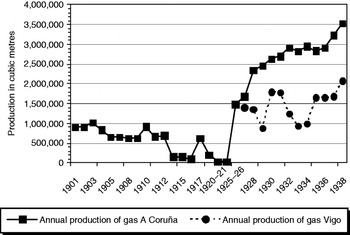
Coruña's plant's production suffered a severe blow, just like in other Spanish cities, from which it slowly recovered during the following years (see Figure 3).Footnote 97 In 1915, the annual production of the two factories in the province and the one in Vigo was much lower than at the beginning of the century.Footnote 98 This was also common in other Spanish plants, which reduced their emissions or were obliged to terminate the service.Footnote 99 The reasons were shortages, difficulties of importation and the increasing prices of the inputs and raw materials (especially coal).Footnote 100
Annual production of gas in A Coruña and Vigo, in m3 (1901–1938). (Source: Dirección General de Contribuciones, Estadística del impuesto sobre el consumo de luz de gas, electricidad y carburo de calcio, Madrid; and Ministerio de Industria, Estadística minera y metalúrgica de España, years 1927–1938.)

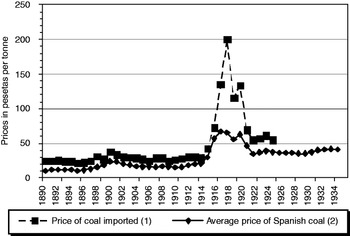
To tackle competition from electricity, gas was used in diverse ways, although its growth slowed down for various reasons until the civil war (1936). The most serious problem was the provision of coal, since the quality of gas and light was linked to raw materials. In addition, freight charges during the First World War remained very high, and fluctuated drastically (see Figure 4).Footnote 101 Consumption underwent a sharp decline, due to the high price of gas and its deficient quality. Even so, existing demand was enough to ensure the employment and the production (most of the time) for two of the seven furnaces that the Coruña plant operated during those years.Footnote 102
Coal prices in Spain, 1890–1935, in pesetas/tonne. Note (1): average price of coal imported on the Spanish coastline, 1870–1925, in pesetas/tonne. Note (2): average price of coal of Spanish origin, including coal, anthracite and lignite, 1877–1935, in pesetas/tonne. (Source: S. Coll and C. Sudrià, El carbón en España 1770–1961. Una historia económica, Madrid, 1987, 432, 435–38.)

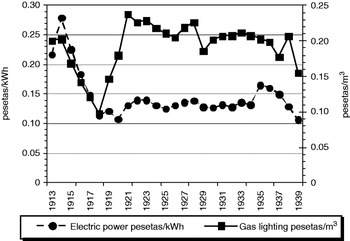
The inter-war period was significant for gas. At international level, the industry continued to expand, although at a slower pace than electricity.Footnote 103 The end of the First World War obliged companies to again revise their strategic policies. Competition became more severe in many countries, given that the electricity industry was much more powerful, achieving a favourable position in terms of costs, especially as there had not been any outstanding technological innovations in the gas industry.Footnote 104 In Spain, we notice a diverging trend in the prices of electricity and gas for lighting since the war, due to the slight decrease of the former and the increase of the latter (see Figure 5).
Nominal wholesale prices of energy in Spain, 1913–1939, in 1913 pesetas. (Source: Ministerio de Trabajo, Dirección General de Estadística, Boletín de Estadística. Número extraordinario. Precios al por mayor y números índices 1913 a 1941, Madrid, 1942, 128–43.)

The 1920s were a turning point in Spain's recent history of energy, because, during that decade, electricity finally came of age and electricity could be transported over long distances at relatively low costs. Thus, hydroelectric power could reach the major urban and industrial centres in conditions with which gas could not compete.Footnote 105 As a result, the Spanish gas industry was in a seriously inferior position to tackle competition from electricity, although domestic coal began to drop its pricesFootnote 106 in order to avoid being supplanted by British coal (at that time, coal reached the Spanish market at similar prices despite the difference in freight charges and tariffs) (see Figure 4). Consequently, the 1920s witnessed a gradual flagging of gas prices, not because of the business results but because of the less significant weight of gas in the production structure of the energy companies.
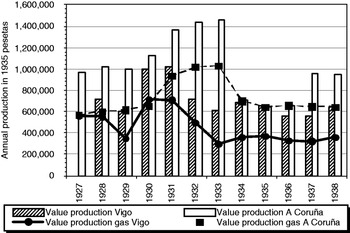
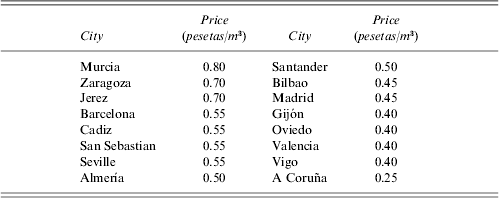
Although the First World War did not cause a substantial improvement for the Spanish gas industry, the Coruña plant regained its lost rhythm (Figure 6), with production figures reaching considerably higher levels than those during the conflict.Footnote 107 The company's strategy to diversify uses was fruitful, as seen by the expansion of private consumption. In addition, the lowering of rates put A Coruña's company at a very competitive level as compared with other Spanish cities. The minimum price per m3 was 0.25 pesetas, which was far below prices in other cities (see Table 1).
Total annual value of plant production of A Coruña and Vigo, in 1935 pesetas (1927–1938). (Source: Ministerio de Industria, Estadística minera y metalúrgica de España, years 1927–1938.)

Gas prices in A Coruña and other Spanish cities in 1921
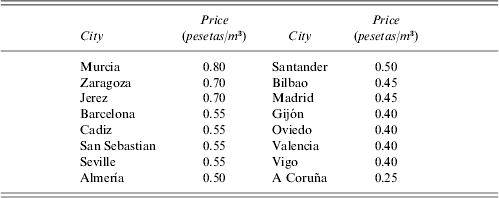
Source: Fábricas Coruñesas de Gas y Electricidad, S.A., year 1921, Memoria leída en la Junta general de Accionistas celebrada el día 14 de marzo de 1922 (La Coruña, 1922), 12.
Additionally, in those years, a new institutional framework to regulate the gas sector began to be implemented in Spain. During Miguel Primo de Rivera's dictatorship (1923–1930) there was a preoccupation with nationalisation and an economic policy that intended to promote the domestic industry. He chose to ‘Spanish-ise’ public utilities, also putting those services under the control of city councils. Until then, the State had assumed responsibility for local public utilities, with municipal administrations being subordinate to central authorities, so that although city councils continued to be in charge, they entrusted usage to an individual or a company who bore the economic risks.Footnote 108 Conversely, the new regime sought to establish new rules, granting privileges to the city councils to implement the direct management of public utilities. This was subsequently confirmed by the Municipal Act of 1935 and the Local Regime Acts of 1945 and 1953.
The result was the first case of municipalisation (during the 1920s and 1930), although it was not entirely successful, and only affected certain utilities (mainly water). In other countries, municipalisation came about because of complaints about the high price and poor quality of gas supplied by the companies.Footnote 109 Nevertheless, the financial position of Spanish councils meant that they had to leave the management of urban infrastructures in private hands, as had previously occurred.
Finally, the economic crisis of the 1930s (and regional, local and external factors linked to the recession) began to affect gas in Galicia.Footnote 110 Less business meant a smaller urban market, and hence diminishing demand for energy.Footnote 111 In Spain, as in other countries, there was new specialisationFootnote 112 (albeit belated, as this reorientation of the applications of gas had been going on in Europe since the late nineteenth century).Footnote 113 Gas had to make inroads into domestic cooking and heating, so the gas companies initiated several strategies for extending the benefits of gas to promote its use among domestic users. In A Coruña, coal gas was at that time mostly used in heating and cooking. Street lighting was reduced to a minimum, and its reuse in engines (formerly significant) was negligible.Footnote 114 However, the problem was that these uses were even more dependent on living standards and, given the decline in domestic demand, the industry recession was widespread.Footnote 115
Finally, in Vigo, on the eve of the civil war, production underwent a recovery, temporarily interrupting the downward trend that it had suffered in previous years, resulting in higher consumption of basic raw materials such as coal. Even gas output in relation to coal improved, by replacing the elements of manufacturing and emission cited above. However, the supply of coal was a bottleneck. In Spanish cities it was difficult to access regular and high-quality supplies of coal and oil at low cost. Coal mining sharply declined in the country in the 1930s, although the import of coal was also subject to fluctuation resulting from output crises and prices in the United Kingdom and Germany.Footnote 116
5. Conclusion
The manner in which gas was introduced in Galicia follows a similar pattern to that of other peripheral European regions: delays, predominance of foreign capital, lack of competition, reduced market size and accessibility to coal as the key elements, as well as public lighting as the initial driving force, and the private demand for further consolidation and expansion.
In Galicia we have observed two different models of institutional relations between city councils and the concessionaire companies. On the one hand, the city of A Coruña learned at an early stage to impose contractual rules upon quite demanding companies. The local bourgeoisie's extensive experience in the management of public utilities and services and the attractiveness of the market were favourable for the city. On the other hand, other Galician cities, which were small, not as dynamic, and with a low potential demand for energy, had to negotiate from a weak position. This resulted in contracts that were more harmful to municipal interests. The experience gained by both parties (especially by local authorities) and the implementation of street lighting in other cities meant that contracts were renegotiated more favourably for public interest. Whatever model was applied, conflict between municipalities and companies was especially prevalent with regard to service quality and unpaid municipal debts.
The turn of the century eventually brought with it a new competitor, electricity, which gradually replaced gas, firstly in street lighting and later on in other uses. Initially, the gas companies tried to hinder this new technology, with varying degrees of resistance but to no avail. In fact, the increasing advantages in terms of cost and quality led to gas companies agreeing to gradually change the public lighting system, keeping its supply for themselves. The remaining uses were filled by the new electricity companies. The First World War further eroded the position of the gas companies and, during the post-war period, the application of gas was relegated to domestic users, as in the rest of the world, despite a cyclical recovery in output and the number of customers.