This article brings a fresh coat to shopworn questions in political economy: what explains the adoption of labor legislation across a large and disparate group of countries in a brief time span before 1914, and why did the Old World see more intervention than the New World, a phenomenon that has persisted into the early twenty-first century? The standard explanation situates the origins of the regulatory state in a confluence of domestic factors that included the rise of per capita incomes, the extension of the vote, and demands for social reform of labor organizations and pressure groups, even those led by employers. But rich and poor countries, and the most and least democratic states, adopted similar laws before 1914. Our explanation is that domestic and international factors jointly mattered in the diffusion of social policy.Footnote 1 While others have given priority to learning from neighbors and emulation of social norms, in this article we identify trade flows between countries—the nuts and bolts of globalization—as pathways in the cross-border movement of social policy.Footnote 2
The crux of our argument is that international integration prompted states to emulate the stricter laws of major trading partners. The type of trade mattered as much as the volume. In the European core, intra-industry trade was important. If states failed to imitate the legislation of trading partners, they would have exposed themselves to embargos on exports and terms of trade shocks. In the New World, states were not compelled to adopt laws of major partners because world demand and supply determined prices of their less differentiated exports and, consequently, threats of market loss were not credible.
The complementary relation between trade and social protection stands in opposition to frequent claims, espoused in the first wave of globalization and echoed in the second, that competitive forces drive labor standards down in a race to the bottom. Our findings suggest that, even in the absence of international authorities like the World Trade Organization coordinating strategies and responses, decentralized forces promoted convergence in worker protection. Market access served as an important instrument to encourage the diffusion of labor regulations, and farsighted policymakers recognized that emulating partners’ laws would serve to bolster trade. This is not to imply that there was a race to the top in which one country leapfrogged another in the adoption of restrictive laws. Nor was it the case that states mimicked exactly the regulations of others. And states could delay emulating laws that imposed significant costs. Nonetheless, over the period, a rising tide in legislation swept countries upward and together.Footnote 3
Our methodology is based on models of policy diffusion applied, most recently, to the spread of environmental protection and health care provision across jurisdictions.Footnote 4 In contrast to standard country-year event history analysis, we focus on convergence in policy between pairs (or dyads) during particular years. This setup naturally allows for a clear demarcation of the relative weights of internal factors, such as the extension of the vote, and external pressures, such as trade, for each pair of countries. To be clear, the issue of adaptation—the effect of regulation on labor market outcomes—requires a different methodology and is beyond the scope of this article.
Our research strategy responds to our conception of economic and social policy formation in an interdependent world. The standard approach begins with the local interests of key protagonists, firms, sectors, or factors of production, whose preferences toward policy are defined by their location relative to others in the international economy; in the next phase, domestic institutions and politicians, whose objective may be to maximize support, broker competing interests and determine policy; in the final stage, the state, as if it were a unitary actor, brings these outcomes to the international level. Our view, which is in the spirit of studies in “open economy politics,” captures the likelihood that causality also runs in the other direction, from international institutions and pressures to domestic interests.Footnote 5 In this case, states do not take domestic and foreign interests as given, because the international context structures bargaining and affects outcomes relevant to constituents. Since states must contend with a complex and shifting amalgam of interests, they are anything but unitary actors. Robert Putnam put the problem simply: “Domestic politics and international relations are somehow often entangled. It is fruitless to debate whether domestic politics really determine international relations or the reverse. The answer to that question is clearly both sometimes.”Footnote 6
LABOR REGULATION: RECEIVED VIEWS AND BASIC DATA
At the most basic level, the widely accepted view is that labor laws were the stepchild of development, “the consequences,” Stanley Engerman wrote, “of higher national income, with accompanying changing preferences regarding work time and work arrangements as income rose.”Footnote 7 In the popular power resources model, the leading protagonists are the spread of the franchise and the rise of organized labor. Comparative approaches have built on national histories, juxtaposing domestic factors of one country against another.Footnote 8 The common denominator in this body of research is that regulation was a closed economy affair.
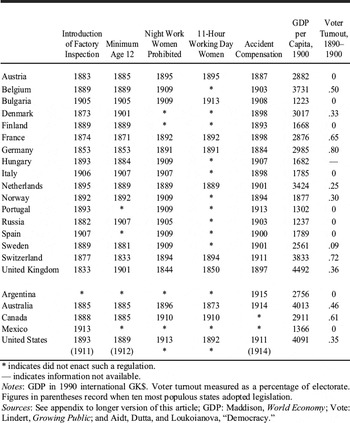
LABOR MARKET REGULATION, GDP PER CAPITA, AND VOTER TURNOUT, 1800–1914

* indicates did not enact such a regulation.
— indicates information not available.
Notes:
GDP in 1990 international GK$. Voter turnout measured as a percentage of electorate. Figures in parentheses record when ten most populous states adopted legislation.
Sources:
See appendix to longer version of this article; GDP: Maddison, World Economy; Vote: Lindert, Growing Public; and Aidt, Dutta, and Loukoianova, “Democracy.”
Curiously, the basic data reveal only a weak correspondence between income and voice and the adoption of labor laws. Table 1 gives dates of introduction of five major pieces of legislation for a broad sample of Old and New World countries. Putting aside issues of data availability, we have selected these regulations as representative of contemporary demands to protect children and women, improve factory conditions, and provide some form of compensation in case of workplace accidents.Footnote 9 The last two columns give GDP per capita in 1900 and average voter turnout in 1890–1900. Among Old World countries, the dispersion of income was large, as was voter turnout, but even the poorest and least democratic countries, Bulgaria, Italy, Portugal, Russia, and Spain, had several laws on the books. In the New World, Canada was relatively wealthy and had a large male electorate, but it was a laggard compared to Europe; Mexico after the revolution had pretty much the same level of regulation.Footnote 10 The calendar of adoption was also inconsistent with the income and voice model. Germany, Switzerland, and the United Kingdom were early movers, but beginning in the 1880s any systematic ordering is difficult to detect.Footnote 11
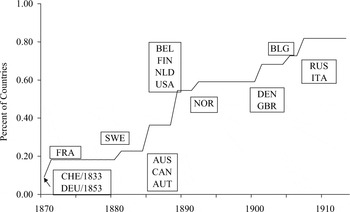
Figure 1 presents a competing perspective on the spread of labor laws showcasing their diffusion over a narrow time frame. The adoption of minimum age legislation of 12 years traces a classic S-shaped logistic curve, a pattern representative of other laws in Table 1, and similar to that which has been documented for the diffusion of democracy and economic and social policies, from Keynesianism to neoliberalism, across a range of countries in the late twentieth century.Footnote 12 The first movers behind age limits, Germany and Switzerland, were decidedly early. For this precocious club, regulation may have had different origins than for countries in the middle years. This phase, which had no obvious leader, saw the bulk of adoptions in small and large, and poor and rich countries alike—even the United Kingdom in 1901. In the last period, adoptions leveled off and were restricted chiefly to latecomers in the periphery. The pattern of diffusion gives us pause to reconsider the widely held view that situates the rise of labor regulation as a chapter of national history only.
INTERNATIONAL DIFFUSION OF MINIMUM AGE LAW

To be sure, historians have not ruled out the interdependence of domestic and international factors. Learning from neighbors—and rivals—and emulation of norms regarding women's and children's employment precipitated a “transfer in social technology.”Footnote 13 In the classic example of the demonstration effect, Lloyd George was full of praise for Germany's social programs after his visit to the continent in 1908, the year before he introduced unemployment insurance legislation in London.Footnote 14 Apart from these exchanges, transnational epistemic communities emerged late in the century. Founded in 1900, the International Association of Labour Legislation (IALL) coordinated research on working conditions and evolved into a well-organized pressure group for the harmonization of labor standards.Footnote 15 According to its historian, Daniel Rodgers, blueprints flowed across the Atlantic, and in both directions, the reform ideals of Henry George outpopularized those of the Webbs, let alone Marx.Footnote 16 The trouble with this line of argument is that the establishment of information channels does not explain how beliefs were translated into policy, the presumption being that regulation was adopted because of ideas in the “air.”Footnote 17 It remains unclear which ideas were persuasive and under what circumstances the new body of legislation was adopted, especially in countries where membership in communities in support of legislation was small.Footnote 18
A Closer Look at the Data
It may well be that the data in Table 1 cannot bear the weight of our argument. Any international comparison is flawed because the laws by their very nature were not identical across jurisdictions, owing to differences in coverage, application, and compliance. To minimize differences, we chose standards established at the international conference on labor legislation held in Berlin in 1890, the midpoint in our period of study.Footnote 19 The federal structures of the New World and Germany and Switzerland complicate issues of comparability because subnational authorities held responsibility for labor legislation. While Canadian provinces and Australian colonies and states passed legislation within short delays of neighbors, there were substantial differences in dates of adoption and in the heterogeneity of laws across U.S. jurisdictions.Footnote 20 To adjust for this, the table gives two dates for the introduction of each piece of legislation in the United States. The first when ten states achieved the level set at Berlin, and a second, in parentheses, when the ten most populated states achieved this norm.
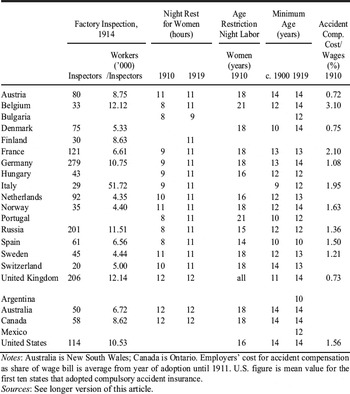
Notwithstanding these drawbacks, Table 1 is a meaningful point of departure to study adoption across countries. At the most practical level, when the United States, the most troublesome country in our sample, is omitted in the analysis that follows all our results go through.Footnote 21 Across national and subnational units, many dimensions of the laws tended to converge after their passage. The same pressures promoting international diffusion of the basic laws would have also affected the various dimensions of these laws. Table 2 reports the number of factory inspectors per establishment, some specifics of restrictions on women's night work, age limits for children, and the actual contributions employers paid out for accident compensation (measured as a percentage of the wage bill). Even before pressures to harmonize labor regulations that can be traced to the establishment of the International Labor Organization in 1919, dispersion across these dimensions was remarkably small—a testament to the forces of convergence in policy that we will describe below. There is only one obvious outlier in the table: the factory inspectorate in Italy was poorly staffed, a finding entirely consistent with contemporary observation and gives credence to the other values in the Table 2.
DIMENSIONS OF LABOR LEGISLATION

Notes:
Australia is New South Wales; Canada is Ontario. Employers’ cost for accident compensation as share of wage bill is average from year of adoption until 1911. U.S. figure is mean value for the first ten states that adopted compulsory accident insurance.
Sources:
See longer version of this article.
Finally, we restrict our use of Table 1 to study international diffusion. How workers and firms responded to labor regulation is a different question that requires another methodology and other types of information.Footnote 22 Consider the interdependent world of 1914 facing support-maximizing politicians. Their objective was to supply benefits to concentrated constituencies while diffusing costs as much as possible. To reduce the burden on their own constituents, policymakers would have prevailed upon partners to level the playing field. Under certain circumstances—and we consider this possibility below—countries may have had legislation imposed on them, regardless of local labor market conditions and how domestic forces lined up in support of or in opposition to regulation. The upshot is that domestic and foreign reform agendas were entangled. At some level, adoption and adaptation were related, but Table 1 serves as a starting point because it provides the timetable we need to study policy diffusion in an interconnected world.
INTERNATIONAL TRADE AND THE RISE OF LABOR REGULATION
In today's global economy, the claim is, national authorities care what social and economic policies get adopted elsewhere because they want to keep their exports competitive, contain imports, and keep their home markets open to foreign investment. Of course, in the long term, certain regulations may increase the capabilities of local workforces, but policymakers are driven by short-run considerations, and assume rivals vie for a fixed quantity of trade or investment. Polices adopted to harmonize markets across jurisdictions have tended to weaken local controls. Everywhere, the argument goes, global competition has unleashed a race to the bottom in all types and dimensions of regulation.
The late nineteenth century, the heyday of globalization, saw comparable competitive pressures. Bismarck, for one, asserted that “[a] normal workday could be established for Germany alone, if Germany were surrounded by a Chinese wall and were economically self-sufficient.”Footnote 23 The chancellor rejected demands to incorporate labor legislation in Germany's advanced program of social entitlements. Exploiting similar reasoning, the Swiss National Council, despite the early leadership of several cantons in policy adoption, delayed passage of the first set of federal labor laws in the early 1870s. The association of cotton textile employers had lobbied against proposals for limits on hours in order to preserve foreign and domestic markets.Footnote 24 Bending to employers, the Swiss government did not move ahead with protective legislation. Others have found direct evidence of a downward spiral in labor regulation. In 1891 Finland extended the length of the work day of minors (aged 12–14 years) to 8.5 hours from the level of 6.5 fixed in 1889, after its export firms found they had lost their competitive edge to rivals. Following the decision of its neighbor to loosen standards, Sweden reciprocated and lengthened the working day of 13-year-olds from 6 to 10 hours.Footnote 25 For the United States, Jacob Hacker and Paul Pierson claimed that capital's threat to divest locally and move their enterprises across state borders stunted, if not delayed, the development of the welfare state.Footnote 26 Canada, in turn, postponed legislation to limit women's work to meet the competitive North American environment.Footnote 27
There is an opposing way to conceptualize the role of competition. Countries imported and exported labor standards as they did goods. Globalization, in this view, was an effective deterrent and not the cause of a race to the bottom. Kyle Bagwell and Robert Staiger developed a model in which countries are motivated to preserve market access, the combined shares of exports they have acquired in foreign markets and of imports they have come to accept. Footnote 28 A country that unilaterally raises its labor standards will find its domestic market more vulnerable to imports and its exports less competitive, since adopting stricter laws is the equivalent of reducing trade barriers. Bagwell and Staiger empower any country in the WTO, as set in GATT Article XXIII, to impose sanctions on trading partners that fail to reciprocate because they have reneged on raising labor standards or lowering tariffs. There is no presumption labor standards will be harmonized internationally, only that the newly established level of regulation will preserve market access, thus giving politicians’ discretion to raise standards as they see fit.
In the absence of international oversight before 1914, states had other options to level the playing field. They could threaten import restrictions on selected products of trading partners; fail to renew or abrogate commercial treaties and most-favored-nation clauses; or, in extreme cases, initiate trade wars to cut off competitors’ entry into their markets.Footnote 29 The threat of market loss was credible in established and thick trading networks, such as the bulk of countries grouped in the middle period of Figure 1. Conversely, low degrees of integration reduced the ability to enforce labor standards, and there were also latecomers at the tail of the logistic curve, the handful of countries that did not play by the rules or did not know them, and which were more likely to defect. International associations used soft coercion or moral suasion on these countries, but in the absence of sanctions the incentive to cooperate was weak.
The distinction between intersectoral and intra-industry trade is relevant to the history of labor regulation because countries that sold differentiated goods were more susceptible to retaliation if they did not adopt the standards of their chief markets. While the hallmark trade in the period was exchange between the resource-abundant New World and labor-abundant Old World, trade in manufacturing was sizeable within the European core.Footnote 30 In the iconic world industry, cotton textiles, Europe was the foremost producer and largest consumer. Differentiation was based on type of machinery used, ring or mule spindles, quality and treatment of cotton fibers, and the final dressing and preparation of goods.Footnote 31 Many producers were dependent on restricted outlets, for instance Belgium on France, and Italy on France and Germany, and found themselves exposed to threats of market loss. Certainly, manufacturers could have modified or upgraded products to find new customers, but, in the short run, if states did not acquiesce to demands for a level playing field, they would have had to dump their goods at steep discounts.Footnote 32
Again the Swiss experience is illustrative. Recall it was reluctant to adopt limits on hours, fearing the loss of export markets if it introduced legislation ahead of major partners. Germany and France did introduce limits on women's work in 1891 and 1892. As it happens, the French National Assembly had initiated an inquiry into compulsory accident compensation in 1893, and opponents claimed that exporters and import-competing industries would not be able to pass on the increased costs.Footnote 33 The timing of the reform debate was propitious. Rejecting France's offer of the minimum rates in the Méline tariff schedule in exchange for import concessions, Switzerland initiated a trade war.Footnote 34 French exports fell, but the conflict was relatively more costly for Switzerland.Footnote 35 It could not find alternative outlets for its major exports to France, high-end cotton textiles and silks, clocks, and specialty cheeses. The French had an incentive to prolong the conflict since it provided the import-competing sector a respite to adjust to the new reforms. It was the Swiss who backed down first. Even before the end of the trade war in 1894, Switzerland agreed to restrictions on night work and an 11-hour working day for women.
Trade wars were costly for all parties. By the early 1900s states put aside the stick of retaliation for the carrot of conciliation. Policymakers realized that attempts to level the playing field did not have to come at the expense of trade between partners. The vehicle was bilateral labor accords, early versions of labor and environmental clauses in late-twentieth-century trade agreements.Footnote 36 The accords served to standardize the coverage and application of labor laws, and although they often revolved around single items, most often accident compensation, the expectation was, as stated clearly in the Germany and Austria-Hungary treaty of 1905, that a “broader” harmonization of legislation would follow.Footnote 37 Typically, the jurisdiction with initially weaker laws received greater access to its partner's market if it agreed to impose more stringent regulation. Workers and traders expected to be better off, or at least as well off as before. The other party anticipated reaping benefits because as labor costs of its partner rose so would exports. Gains for both parties may have been substantial in the presence of economies of scale. While epistemic communities behind the international movement had only moral suasion to put ideas into practice, bilateral accords pinned emulation to the benefits of trade.
Both episodes of retaliation and negotiation were infrequent in the New World since domestic concerns trumped external pressures. Regions of recent settlement mainly exported foods and raw materials whose prices were fixed in world markets. The pressure to comply with standards of major trading partners was less keen, because exporters could shift outlets without severe loss. Canada's wheat exports did not contract when Germany launched a trade war between 1903 and 1910 to protest Ottawa's preferential agreement with London; in fact, it was the United Kingdom that feared collateral damage.Footnote 38 Exceptionally, by 1914 the United States exported manufactured goods, although these were mainly standardized items.Footnote 39 Anyway, international trade played a small role in total production in the United States. Overall, the New World was insulated from external pressures to emulate the European model. Trade patterns reinforced the primacy of domestic factors in areas of recent settlement. There was a structural disconnect in the New World between commercial access negotiated at the national level and labor laws passed by subnational jurisdictions. In some regions, like Australia, labor power in key states was strong enough to use the ballot box to see through legislation, but it was difficult to mount the same force in North America. The aphorism that all politics is local was appropriate to the New World.
THE DECISION TO ADOPT: TESTING FOR DOMESTIC AND EXTERNAL FORCES
To study policy convergence, we implement a directed dyad-year event history analysis. The unit of analysis is the country-pair-year (or dyad-year). We seek to explain why country “A” converges to the labor standards already adopted by another country “B.” Convergence does not imply that policymakers emulate exactly the other country in the dyad. The dichotomous dependent variable takes on the value one if country A adopts at least one out the five labor standards (Table 1), given that B had already adopted that (those) particular standard(s) prior to the current year, and zero otherwise.Footnote 40 When A converges to all standards in B, this particular dyad is dropped from the sample, since no further convergence is possible.
A pair of countries can be present up to two times in each year since the order of adoption for each country may not have been the same across labor laws. We found that just over 50 percent of the “emulations” in the data are associated with convergence to a standard previously adopted by five or fewer countries. The number of leaders in our sample period is restricted by definition, and as a result most countries were followers in the diffusion process. To be clear, our procedure is inappropriate to explain fully why country B was in fact the first mover. Our primary interest is the transmission of policy between trade partners.
The directed dyad approach improves on the standard country-year event history model because it includes information on interaction effects between neighbors or trading partners and common features of the country pairs. In event history models, external factors are usually weighted-averages of arbitrarily defined “neighbors,” or other countries comprising the reference group. Our approach also permits countries to be leaders and followers over different policies and in different country pairs. To be sure, some degree of sample selection is unavoidable because B only appears when it has adopted at least one of the five pieces of legislation. For sample selection to force a change in the sign of a marginal effect, A's “error term” would have to be strongly correlated with B's. The selection problem increases in severity as the correlation between the included explanatory variables and B's error term becomes greater. We return to these issues below.
Our control variables consist of external and internal determinants of labor standards. For trade integration, we use the measure of trade costs developed by David Jacks, Christopher Meissner, and David Novy. The measure is related to the (geometric average of) bilateral trade shares of GDP, but it is derived explicitly from trade theory and is more precisely evaluated.Footnote 41 We invert the trade shares to obtain the tariff equivalent. In effect, the term measures the wedge between observed bilateral trade and that predicted by size alone, which would be the key driver in a world without barriers to trade. The variable is strongly related to observable proxies for barriers to trade including tariffs, transportation networks, exchange rate variability, and language differences. The measure for year t is calculated as
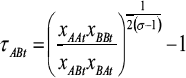
The variables xAA and xBB are proxies for intra-national trade, or domestic absorption, and xAB and xBA represent total exports from country A to country B and exports from B to A. The parameter σ is the elasticity of substitution between all goods, domestic and foreign (and foreign vs. foreign), and is assumed to be equal to 11.Footnote 42 The term can be interpreted as the extent to which foreign trade is more costly than domestic trade; it falls as countries trade more together. The estimated coefficient will have a negative sign if increased trade encourages A to adopt B's policy.
The baseline model includes the share of the labor force in agriculture of country A to control for the level of development, and also wealth and size (the logarithms of GDP and population) of each country in a pair. Central to Engerman's claim, A's demand for labor regulation would have risen with income per capita (a positive marginal effect of GDP for a fixed level of population). But larger countries faced weaker external pressures. They may have been less prone to imitate neighbors because they naturally traded less internationally and were more shielded from foreign competition. A proportional increase in GDP and population (an increase in size) would have lowered the likelihood of adoption. We include real GDP and population of country B to identify the roles of wealth and size in policy diffusion and emulation: was A more willing to adopt if B was big or rich?
The other determinants follow from previous discussion. Union density and voter turnout, the ratio of persons actually voting to the adult population (of the relevant enfranchised gender), stand in for the key determinants of the power resources model. Since convergence may have differed across regions, a dummy variable indicates whether country A is in the New World or not. We have also included an interaction variable between the presence of a New World country and voter turnout. This variable disentangles the roles of resources and political economy factors behind regulation. The decision to adopt might have also been dependent on the number of standards already in place, measured by the total number of laws (out of the five considered) A and B shared in the prior year.
The sample in the baseline regression consists of information on the adoption of five standards in 17 countries, across a maximum of 16 partners, and for the 33 years from 1881 to 1913. The exact number of observations per country depends on the length of time required to converge on a partner's law, and the number of standards and dates of adoption of each partner. Countries in the baseline sample (and occasions they initially appear as a follower/leader) are Argentina (14/0), Australia (5/6), Austria (5/12), Belgium (14/13), Canada (12/10), Denmark (11/9), France (6/15), Germany (2/15), Italy (10/8), the Netherlands (10/14), Norway (13/14), Portugal (15/2), Spain (15/7), Sweden (11/11), Switzerland (10/10), United Kingdom (11/16), and the United States (14/14). All countries behaved as followers and leaders which underscores the basic problem we explore: what drove pairs of countries to converge on labor laws?Footnote 43
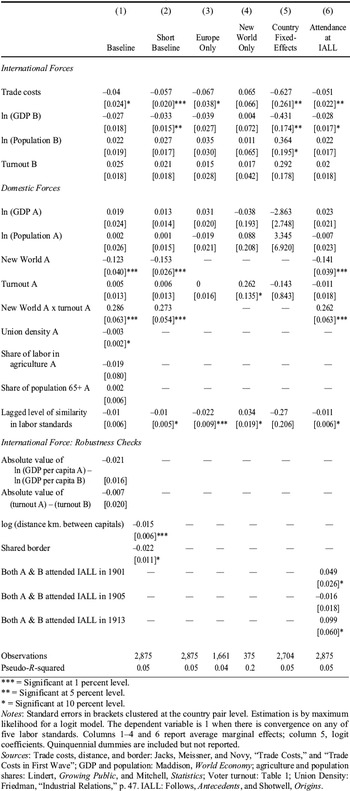
Table 3 gives results of a series of logit regressions for the policy convergence model. We report average marginal effects. Standard errors are clustered at the country-pair level (regardless of whether a country is located in position A or B) to correct for potential bias in the errors arising from arbitrary forms of serial correlation over time.Footnote 44 In the baseline specification of column 1, which includes all relevant independent variables, the trade cost marginal effect is negative and significant. Trade was a conduit of convergence. Contrary to claims, international competition did not lead to a downward cascade in social and labor policy. Wealthier, larger, or more democratic countries were not more likely to play leadership roles. It would appear that the impact of Germany's advanced legislation on British policy had as much to do with Lloyd George's storied visit to a large country as with the fact that the two were major trading partners.
In the baseline regression, domestic factors in A, with the exception of union density, have the expected signs, though their impact was not significant. The positive marginal effects of A's GDP (p-value 0.40) and population (p-value 0.94) are insignificant. The natural logarithm of GDP per capita (entered as a single variable in a separate unreported specification) has a positive but statistically insignificant marginal effect (p-value 0.32). The overall size of A was unimportant. Proportionally increasing GDP and population did not lead to a change in the probability of convergence. If we cannot detect that large and democratic countries were leaders, neither were small countries followers.
The salience of domestic and international factors varied across regions. In the Old World, voter turnout, while positive, is not significant. Our interpretation is that domestic voice was not sufficient to achieve the goals of social activists, although it may have interacted with other internal or external forces to advance the reform agenda. In one scenario, capital in B would have sought to form cross-border and cross-class coalitions with labor and reformers in A to level the playing field. These types of pressures may be captured in the trade costs term itself. Putting aside this explanation, the dynamic was different in the New World. Countries were less prone to converge, but sufficiently high levels of voter turnout offset the obstacles to regulation posed by the region's specialization in primary products and other idiosyncrasies.
DETERMINANTS OF CONVERGENCE IN LABOR REGULATIONS FOR COUNTRY PAIRS, 1881–1913

*** = Significant at 1 percent level.
** = Significant at 5 percent level.
* = Significant at 10 percent level.
Notes:
Standard errors in brackets clustered at the country pair level. Estimation is by maximum likelihood for a logit model. The dependent variable is 1 when there is convergence on any of five labor standards. Columns 1–4 and 6 report average marginal effects; column 5, logit coefficients. Quinquennial dummies are included but not reported.
Sources:
Trade costs, distance, and border: Jacks, Meissner, and Novy, “Trade Costs,” and “Trade Costs in First Wave”; GDP and population: Maddison, World Economy; agriculture and population shares: Lindert, Growing Public, and Mitchell, Statistics; Voter turnout: Table 1; Union Density: Friedman, “Industrial Relations,” p. 47. IALL: Follows, Antecedents, and Shotwell, Origins.
The sign of union density may appear to be counterintuitive, but worker organization was strongly correlated with the presence of a New World country.Footnote 45 Other studies have reported a positive relation between the share of population above 65 and social spending, a finding repeated in column 1, although the marginal effect is statistically insignificant. Older workers were less mobile than younger ones and more dependent on social entitlements. Populations were younger in the New World thus deepening the divergence between regions.
Countries with relatively weaker sets of labor laws were more prone to adopt. The negative sign on the lagged number of shared standards has, at least, two interpretations. Stragglers may have wanted to signal to residents and foreigners their willingness to move toward the new international norm of greater regulation, albeit at a slower pace; alternatively, they may have adopted legislation later than others because the cost of doing so was less.Footnote 46
Did countries with common features have the same regulatory outcomes? Neither differences in GDP nor turnout had a perceptible effect. We cannot conclude, as did Markus Lampe and Robert Pahre in separate studies of MFNs, that democracies were any more prone to emulate each other than autocracies.Footnote 47 We also consider in the baseline whether close neighbors were more likely to copy each other. The answer is mixed. A common border actually exerted pressure to diverge, but a smaller distance between capitals implied a greater chance in adopting a similar labor standard. Emulation effects, derived from culture—common language and legal origins, and shared histories—cannot be excluded even after controlling for trade relations.
In the remaining columns, we explore the robustness of these findings. We exclude unionization, agricultural share of the labor force, age distribution, differences in turnout and income per capita, and geographical variables. These variables did not prove to be robust determinants, and, in the short baseline of column 2, the trade cost coefficient actually increases in significance. The geographical variables are highly collinear with trade costs as the literature on trade and gravity models shows. The income and turnout differences are essentially controlled for already since A and B's respective levels are entered separately. The other structural variables are poorly measured across the sample and we are hesitant to rely on them further.
Columns 3 and 4 compare estimates of an Old World only sample and another which restricts country A to being in the New World. For European pairs, the results are in line with column 1. The dynamic was different in the New World: the trade cost term is positive but not significant, and the marginal effect of voter turnout is statistically significant. Recall Rodgers’ claim that reform blueprints flowed between continents; trade, however, does not appear to have been the conduit of transmission to the Americas and Australia. Voice was the main channel of policy diffusion in the region. In line with our previous discussion, local forces trumped global pressures in regions of new settlement.
Column 5 controls for (time-invariant) unobservable heterogeneity at the level of country A with a conditional logit model. GDP and population of B are now significant. GDP of A, which is strongly persistent and presumably highly correlated with country fixed-effects, is estimated to have no statistically significant impact on convergence. The high correlation between fixed factors and GDP shows up in the sign on the coefficient which is opposite to that in column 1. Regardless of specification, the effect of trade costs is robust, confirming the rising tide in labor standards as nations sought to keep up with levels of regulation provided by trading partners.
Alternative Models of Labor Standards
Our model and empirical evidence have several potential problems.Footnote 48 The procedure we have exploited may be restricted to policy adjustments, for instance the tweaking of current minimum age law in A to meet levels in B, as opposed to converging on new policies having no history between the pair. But states in our sample had previous interactions on immigration, commercial, and foreign policies, and in other ways such as legal systems they were not far apart. In light of broader historical and political interconnections, countries can be seen to be fine-tuning along an existing dimension of contact. We may have omitted some key determinants of convergence or measured incorrectly other variables. But the inclusion of other indicators, such as a new measure of political competition, substantiates the baseline results.
Our procedure may be flawed if we have not properly controlled for the sample selection problem because only pairs where B has already adopted one or more standards are included, thereby leaving out information for a number of dyads. The loss of information is attenuated since a country not appearing as B will likely show up as A; that said, a fraction of observations remain ineligible to converge and, hence, excluded from the estimation sample.Footnote 49 Bias in the marginal effects of the convergence equation depends on whether or not unobservables in country A that may have helped determine its decision to follow B were correlated with the latter's unobservables, and the extent to which included covariates in the convergence equation determine the probability of B adopting. The impact of the selection bias depends on the degree of correlation that is, arguably, not too great in our large sample. Concretely, the wave of adoptions in the short-time frame beginning in the 1880s created a large number of countries with the potential of being emulated. Finally, to address the problem of correlation in error terms, we control for as many observables as possible for A and B.
BRINGING UP THE LATECOMERS
The pressure to emulate at the tail of the logistic curve in Figure 1 was weak because countries were not well integrated in trade networks, or, because as latecomers in development, domestic forces in support of reform had not yet coalesced. The IALL spearheaded the transnational movement to level the playing field. The Belgians and Swiss were key players in founding the IALL in Paris in 1900, since, by themselves, small states had less leverage to coerce trading rivals than larger ones. The powers of the IALL were limited, however, to soft coercion and no procedure was put in place to ensure ratification. Still, attendance at the occasional conferences grew in the decade before the outbreak of war.Footnote 50 Most European governments in our sample sent delegates—the United States sent an observer to the first meeting—and although they were not completely persuaded by reformers, states became attuned to new social norms of worker protection that were being circulated. In the decade after the creation of the IALL, Italy, Portugal, Spain, and Sweden, all latecomers to the reform movement, prohibited night work of women.
There is modest statistical support for the role of the IALL as a purveyor of ideas. The quinqeunnial controls in the baseline estimations suggest a higher propensity of emulation later in the period, a change in trend coinciding with the emergence of a vocal and organized movement for international harmonization. Column 6 in Table 3 tests for the role of international coercion more directly. We include dummy variables if both countries A and B attended IALL conferences in 1901 (Basel), 1905 (Berne), and 1913 (Zurich and Berne).Footnote 51 We find attendance at all three meetings is related to a higher likelihood of adoption, although only for 1901 was it significant. The effects of the 1905 and 1913 conferences may be poorly estimated because the primary objective of the later meetings was to harmonize the dimensions of existing labor regulation, as most countries had some laws on the books by this period.
There were substantial costs involved in negotiating multiparty agreements and all states, even those which could easily meet the criteria set out, were wary of the diktats of a transnational body. States had little reason to ratify IALL conventions because the penalty or reward for doing so was small. After 1900 states negotiated bilateral labor accords which, as we previously described, ensured reciprocal commitments to level the playing field. The accords gave policymakers greater control over the reform agenda. Moreover, because accords were linked to market access, states had a motive to promote and abide by them. The intuition was clearly laid out by the German minister of the interior in parliamentary discussion on imperial commercial and social policy in 1902. Since import tariffs had reduced the purchasing power of workers, the degree of further commercial protection available to manufacturers was limited. Better to persuade commercial rivals to raise levels of social protection. “If we and our neighbors agree to common charges for worker protection, we will be able to lower our commercial duties. We should consider rivals which raise their levels of protection favorably.”Footnote 52 Exploiting strategically its higher tariffs, Germany exchanged increased access in its own market for greater labor protection abroad.Footnote 53 Germany had come to reject Bismarck's formulation of a “Chinese wall” in defense of social policy; instead, labor regulations and economic integration were now perceived as complements. In terms of the baseline model, the reduction in tariffs would lead to lower trade costs and higher likelihood of convergence.
The French-Italian labor treaty of 1904 represented an attempt by one trading partner to persuade a laggard to level the playing field in exchange for greater market access.Footnote 54 France and Italy had engaged in a trade war that began in 1886 and effectively lasted into the early 1900s. The war was especially hard on Italy because of its dependence on France for its exports of specialty goods.Footnote 55 While Italian silk was a relatively standardized item and producers readily found markets in Switzerland, its specialty wine producers were less fortunate and they had to dump their stock.Footnote 56 As part of the agreement ending the trade war, France demanded that Italy raise its labor standards to international norms, thus guaranteeing its producers greater market access. In exchange, France agreed to give Italian migrant workers the same level of benefits French workers received. It also enticed its trading partner by removing some commercial duties on Italian imports. Italy was not opposed to the French initiative. Its history of labor legislation was recent and, because the percentage of the population eligible to vote was low, the liberal government could exploit the French initiative to go around vested interests opposing reform.Footnote 57 The net result was that labor costs increased relatively more in Italy. After the accord, French exports to Italy rose by 61 percent; Italian exports to France by about 20 percent.Footnote 58
The strategy of linking regulation and market access was generalized across Europe. The French-Italian arrangement, which even dispassionate observers such as the U.S. Department of Labor viewed as groundbreaking, served as a model for the French-Belgian (1906) accord, and Germany's treaties with Italy (1904) and Austria-Hungary (1905).Footnote 59 In unreported regressions, we estimate that the negotiation of a labor treaty after 1900 reduced trade costs by 9 percent.Footnote 60 Countries had an incentive to converge on labor standards because they did not wish to forsake the gains from trade.
WERE ALL LABOR STANDARDS EQUAL?
In this section, we extend our analysis and examine the type of legislation countries adopted in response to the entanglement of domestic and foreign pressures. Consider the likelihood that country A had the choice between high- and low-cost standards, defined by the relative incidence of legislation on firms’ bottom line. On the domestic front, high-cost standards may have gained politicians a large and loyal constituency, but could have been perceived to do damage to the competitiveness of the economy. An alternative was to adopt policies having more symbolic than real effects. Now consider the “open political economy” aspects of the decision. Country B might demand that A adopt a high-cost standard like its own. Could A have gotten away with regulation imposing lower costs? It might have if it could have convinced its partner that adoption of low-cost standards, appropriate to its own level of development and size and wealth, was a prelude of tougher regulation. Country B may have not been entirely satisfied, but it at least had something to show its own constituents who may have been behind targeting A in the first place. In this way, even piecemeal regulation could have acted as gateway standards.Footnote 61
The Berne meeting of the IALL in 1905 distinguished between types of labor standards.Footnote 62 Delegates considered limits on the working hours of women and children as high cost. According to one observer, 1.4 million women in Europe would be affected by a curb on night work, benefiting, on average, from a shorter workday of 2.5 hours.Footnote 63 Factory inspection laws were deemed low cost, as determined by the number of inspectors states had actually hired, and so was accident compensation whose burden was shared by workers, firms, and governments (Table 2).
We estimated the baseline regression (column 2) of Table 3 separately for high- and low-cost standards. The results differed across the type of legislation. Conspicuously, across Old and New Worlds, trade failed to operate as a conduit of high-cost standards. As its per capita GDP rose, country A was more likely to implement limits on women's and children's work and converge to B. However, trade did matter for low-cost standards. And richer countries were less prone to imitate weaker standards. For both types of laws, emulation was more likely the higher the degree of convergence in the opposite group of standards. Our interpretation is that relatively poorer countries acted sequentially, adopting one category of legislation before moving on to the other, as conditions became more opportune. The introduction of factory inspection and accident compensation satisfied the demands of the domestic reform movement, and of trading partners and their constituents, because they were perceived to be a preliminary step to more stringent and comprehensive legislation. Still, while states were more cautious in adopting costly standards, the specter of a race to the bottom appears to have been exaggerated. In none of the specifications was the partial effect on the trade cost variable positive and significant.
CONCLUSION AND IMPLICATIONS
Everywhere labor regulation was on the rise in the decades before 1914. The prevailing narrative views this episode as a chapter in national history. Since countries developed economically and politically on parallel trajectories, they consequently adopted comparable policies. But globalization mattered too. Countries were under strong pressure to emulate the labor standards of major trading partners, although this did not mean adopting identical laws. And since the process was uncoordinated, trade flows actually strengthened national regulatory standards.
Our findings lead to a neglected but straightforward explanation of the origins of social Europe and liberal America—and possibly why the divergence between the two has persisted over the last century. Intra-industry trade was greater in the Old World. The threat of market loss was credible and enforceable against countries that failed to emulate the standards of partners. To avoid costly trade wars, policymakers negotiated bilateral labor treaties that exchanged market access for a level playing field. The New World exported undifferentiated products and countries were under no compulsion to adopt regulation of trading partners, the rise of labor legislation being predominately a local affair.
We have made a point of separating the determinants of adoption from the effects of regulation, studies of which have tended to find that new legal norms codified existing practice.Footnote 64 Why then did states feel compelled to adopt legislation? Politicians may have wished to demonstrate a concern for working people; social reformers may have wanted to curtail backsliding; employers may have thought otherwise. This article points to an alternative explanation of the persistent and loud demands for legislation, despite its null effects. Foreign intervention, in conjunction with or in opposition to domestic interests, had a voice in the timetable of reform. But since the adoption of new laws was conditional on guarantees of market access, trade and labor regulation rose together. As incomes and employment expanded along with trade, a self-adjusting mechanism ensured that the effects of legislation were neutralized.