Introduction
Bilingual children show signs of differentiating their two languages from early in development. From at least two years of age, bilingual children can choose the appropriate language for their interlocutor (e.g., Genesee, Nicoladis, & Paradis, Reference Genesee, Nicoladis and Paradis1995; Köppe & Meisel, Reference Köppe, Meisel, Milroy and Muysken1995), use translation equivalents in their two languages (e.g., Quay, Reference Quay1995), and use syntactical and phonological patterns distinctly in their two languages (e.g., Barlow, Reference Barlow and Skarabela2002; Meisel, Reference Meisel, Cenoz and Genesee2001; Paradis, Reference Paradis2001; Paradis & Genesee, Reference Paradis and Genesee1996). While they use their two languages distinctly, bilingual children's language use differs from that of monolingual children in ways that can be attributed to their other language, i.e. cross-linguistic influence (e.g., Hulk & Müller, Reference Hulk and Müller2000; see Meisel, Reference Meisel, Bhatia and Ritchie2004, for review and discussion). For example, a French–English bilingual might place an adverb in English like I want already to go home, based on an allowed adverbial placement in French. The result of cross-linguistic influence in this example is an ungrammatical construction. In this article, it is assumed that cross-linguistic influence may or may not result in ungrammatical constructions, although this assumption is still under discussion among researchers (e.g., Hulk & Müller, Reference Hulk and Müller2000; Yip & Matthews, Reference Yip and Matthews2007). In this article, cross-linguistic influence is used synonymously with cross-linguistic transfer, although other authors differentiate these two (e.g., Yip & Matthews, Reference Yip and Matthews2007). Cross-linguistic influence can affect bilingual children's phonology, morphology and syntax (e.g., Barlow, Reference Barlow and Skarabela2002; Brulard & Carr, Reference Brulard and Carr2003; Döpke, Reference Döpke1998; Hulk, Reference Hulk, Sorace, Heycock and Shillcock1997; Hulk & Müller, Reference Hulk and Müller2000; Hulk & van der Linden, Reference Hulk, van der Linden, Kellerman, Weltens and Borgaerts1996; Nicoladis, Reference Nicoladis1999; Paradis, Reference Paradis2001; Serratrice, Reference Serratrice2007; van der Linden & Blok-Boas, Reference van der Linden and Blok-Boas2005; Yip & Matthews, Reference Yip and Matthews2000; see review in Nicoladis, Reference Nicoladis2006).
Researchers have proposed several possible explanations of cross-linguistic influence in bilingual children. In this article, three possible explanations are discussed: (1) language dominance and/or proficiency; (2) overlap and ambiguity of linguistic structure; and (3) language processing. While other explanations have been proposed (see, for example, Serratrice, Sorace, & Paoli, Reference Serratrice, Sorace and Paoli2004), these are the three that are most relevant to the present study.
Turning first to an explanation of cross-linguistic influence in terms of language dominance and/or proficiency, it is important to keep in mind that bilingual children are often more proficient in one language than the other (see Nicoladis & Genesee, Reference Nicoladis and Genesee1997). The more proficient language is sometimes referred to as their dominant language. Some researchers have argued that cross-linguistic influence is more likely to be in the direction of their dominant language into their weaker language (Argyri & Sorace, Reference Argyri and Sorace2007; Bernardini, Reference Bernardini and Müller2003; Bernardini & Schlyter, Reference Bernardini and Schlyter2004; Döpke, Reference Döpke1998; Schlyter Reference Schlyter2001, Reference Schlyter, Hyltenstam and Viberg1993; Yip & Matthews, Reference Yip and Matthews2000). For example, one Cantonese–English bilingual child showed influence from Cantonese to English in relative clauses, as well as wh-in-situ interrogatives and null objects, during a period when the child was dominant in Cantonese (Yip & Matthews, Reference Yip and Matthews2000). However, in other studies, dominance did not account for the pattern of cross-linguistic influence found in bilingual children's speech (Argyri & Sorace, Reference Argyri and Sorace2007; Müller, Reference Müller1998; Müller & Hulk, Reference Müller and Hulk2001; Nicoladis, Reference Nicoladis2002, Reference Nicoladis2006). For example, one study showed that French–English bilingual children's dominance did not predict the degree to which they reversed noun–noun compounds in either language (Nicoladis, Reference Nicoladis2002).
Another possible explanation of cross-linguistic influence is in terms of the linguistic structures of the two languages known by a bilingual child. Cross-linguistic influence is hypothesized to occur when there is overlap/ambiguity in the languages being simultaneously learned by a bilingual child. Overlap refers to the existence of the same underlying structure in both of a bilingual's languages. Ambiguity refers to the existence of more than one linguistic structure with roughly the same meaning. When there is overlap in the two languages, cross-linguistic transfer is thought to occur from the ambiguous language. According to Müller and Hulk (Reference Müller and Hulk2001; also Hulk & Müller, Reference Hulk and Müller2000), the structural description takes place at the level of deep structure; cross-linguistic transfer is particularly likely at the pragmatics/syntax interface (Hacohen & Schaeffer, Reference Hacohen and Schaeffer2007; cf. Zwanziger, Allen, & Genesee, Reference Zwanziger, Allen and Genesee2005). Döpke (Reference Döpke1998) also argued that structural overlap/ambiguity could predict when cross-linguistic transfer occurs, although she hypothesized that structural description takes place at the level of surface structure. These variables can explain many cases of cross-linguistic influence (e.g., Döpke, Reference Döpke1998; Hacohen & Schaeffer, Reference Hacohen and Schaeffer2007; Hulk & Müller, Reference Hulk and Müller2000; Müller & Hulk, Reference Müller and Hulk2001; Nicoladis, Reference Nicoladis2003; Serratrice, Reference Serratrice2007; Serratrice et al., Reference Serratrice, Sorace and Paoli2004), but cannot fully explain all instances of cross-linguistic influence found in simultaneous bilingual children. For example, bilingual children show evidence of cross-linguistic influence when there is no structural ambiguity within their two languages (e.g., Nicoladis, Reference Nicoladis2002; Yip & Matthews, Reference Yip and Matthews2000). Also, some instances of language-specific usage have been shown where cross-linguistic influence would be predicted from structural overlap/ambiguity (Nicoladis, Rose, & Foursha-Stevenson, Reference Nicoladis, Rose and Foursha-Stevenson2010; Zwanziger et al., Reference Zwanziger, Allen and Genesee2005).
As neither of the previous explanations can fully account for bilingual children's cross-linguistic influence, researchers have started to consider the possibility that language processing might also be playing a role (e.g., Argyri & Sorace, Reference Argyri and Sorace2007; Serratrice, Reference Serratrice2007). Note that a processing model should not be considered an alternative explanation to an explanation in terms of linguistic structure (e.g., Döpke, Reference Döpke1998; Müller & Hulk, Reference Müller and Hulk2001), but rather an attempt to increase the predictability of the latter explanation. As the present study concerned speech production, we focus here on predictions about cross-linguistic influence from a speech production model (Nicoladis, Reference Nicoladis2006). According to speech production models (e.g., Ferreira & Dell, Reference Ferreira and Dell2000; Levelt, Roelofs, & Meyer, Reference Levelt, Roelofs and Meyer1999), a speaker who wished to convey a message would first choose the concepts (the conceptual level), then choose the specific words and syntactic frame to convey the message (the lemma level) and finally the phonological form of the words. At the conceptual level, a speaker formulates the message. There is some debate as to whether a speaker formulates his/her thoughts in language-specific ways at the conceptual level (compare, for example, de Groot, Reference de Groot, Frost and Katz1992; Miller & Kroll, Reference Miller and Kroll2002). Specifically in the context of predicting cross-linguistic transfer, Nicoladis et al. (Reference Nicoladis, Rose and Foursha-Stevenson2010) argued that children conceptualize in order to speak the target language at any particular moment, that is, in language-specific ways. After conceptualizing the message, at the lemma level, a speaker chooses the words and grammatical structures including word order, sentence structure and grammatical gender, relevant to conveying the message (e.g., Cubelli, Lotto, Paolieri, Girelli, & Job, Reference Cubelli, Lotto, Paolieri, Girelli and Job2005). Because there is always choice at the lemma level, a speaker experiences competition between different ways of lexicalizing a message (Ferreira & Dell, Reference Ferreira and Dell2000; Kroll, Michael, Tokowicz, & Dufour, Reference Kroll, Michael, Tokowicz and Dufour2002). One by-product of competition is speech errors (Levelt et al., Reference Levelt, Roelofs and Meyer1999). For example, a speaker who used both raincoat and macintosh might occasionally produce macincoat or raintosh. Finally, at the phonological level, a speaker chooses how to pronounce the words and grammatical structures chosen at the lemma level. There is also thought to be competition at the phonological level (Ferreira & Dell, Reference Ferreira and Dell2000), which can lead to errors in pronunciation.
Since bilinguals have both languages somewhat activated at all times (Grosjean, Reference Grosjean and Nicol2001), Nicoladis (Reference Nicoladis2006) argued that bilinguals would experience competition between their two languages at the lemma level, resulting in lexical or syntactic cross-linguistic influence. Recall that competition at the lemma level is not unique to bilinguals. Where bilinguals differ from monolinguals is in terms of competition between their two languages, since monolinguals have no other language to compete. That is, where there is overlap in the constructions available from the two languages (with overlap defined according to Döpke, Reference Döpke1998) at the lemma level, these constructions would be activated regardless of the language to be spoken. The construction associated with the language to be spoken would have a higher degree of activation and so would be the more likely one to be produced. However, in some cases, the lesser activation of a competing construction would result in the production of a construction influenced by the other language, resulting in cross-linguistic transfer. Cross-linguistic transfer is, then, a kind of speech error. This model can explain previous reports of cross-linguistic influence in children (Döpke, Reference Döpke1998; Hacohen & Schaeffer, Reference Hacohen and Schaeffer2007; Hulk & Müller, Reference Hulk and Müller2000, Müller & Hulk, Reference Müller and Hulk2001; Nicoladis, Reference Nicoladis2003; Serratrice, Reference Serratrice2007; Serratrice et al., Reference Serratrice, Sorace and Paoli2004) as well as the cases in which cross-linguistic influence has been observed in the absence of structural ambiguity (Nicoladis, Reference Nicoladis2002; Yip & Matthews, Reference Yip and Matthews2000) and cases of no cross-linguistic influence in the presence of structural ambiguity (Nicoladis et al., Reference Nicoladis, Rose and Foursha-Stevenson2010).
The primary purpose of the present study is to test predictions about cross-linguistic influence from a speech production model with possessive constructions in French–English bilingual children. There is an overlapping possessive construction in the two languages (a periphrastic one, like the bib of the baby) and there is ambiguity in English (i.e., also the use of X’s X, like the baby's bib). If overlap/ambiguity alone predicted bilingual children's cross-linguistic influence, there should be unidirectional influence from French to English. A speech production model predicts bidirectional transfer because the existence of two competing constructions should result in cross-linguistic influence in both languages. A speech production model does not preclude effects from overlap/ambiguity and/or dominance. Before turning to the details of this study, the literature on children's acquisition of possessive constructions in the two languages is reviewed.
Possessive constructions in French and English
Possessive constructions are among children's earliest two-word utterances (e.g., Bloom, Reference Bloom1970; Brown, Reference Brown1973; de Villiers & de Villiers, Reference de Villiers, de Villiers and Slobin1985). The earliest possessive constructions are often bare nouns usually in the appropriate order for the target language (e.g., Brown, Reference Brown1973). Around two to two-and-a-half years, English-speaking children start to use the possessive -’s on the possessor (Brown, Reference Brown1973).
As researchers conceptualize the word order of possessive constructions as acquired by around two to three years of age by English-speaking children, most other studies on older children's possessive constructions focus on their interpretation of ambiguous possessors (e.g., Golinkoff & Markessini, Reference Golinkoff and Markessini1980; Johnson, Bateman, Moore, Roeper, & de Villiers, Reference Johnson, Bateman, Moore, Roeper, de Villiers, Stringfellow, Cahana-Amitay, Hughes and Zukowski1996) or the semantics implied by possessive constructions (e.g., Tomasello, Reference Tomasello and Newman1998). For example, Deutsch and Budwig (Reference Deutsch and Budwig1983) showed that English-speaking preschool children used different constructions depending on whether the possession involved an unchanging state (as with body parts) or the possession was more separable from the possessor (as with toys).
One study focused on four-year-old English-speaking children's sensitivity to variation in the kind of possessive construction (Skarabela & Serratrice, Reference Skarabela and Serratrice2009). This study was based on the observation that English speakers have a strong preference for marking possession of human possessors with -’s (e.g., the mother's nose) rather than with the periphrastic X of X (e.g., the nose of the mother). The periphrastic construction is more acceptable for non-human possessors (e.g., the nose of the dog). Skarabela and Serratrice (Reference Skarabela and Serratrice2009) found that four-year-olds were less likely to be primed by the periphrastic construction than by the -’s construction when talking about human possessors. This finding suggests that four-year-olds are sensitive to the adult preference of the -’s construction for human possessors.
In French, possessive constructions are formed with a preposition (usually de “of/from” although sometimes à “to/at/for”) between the possessed and the possessor (e.g., le nez de Suzanne “the nose of Suzanne”). French requires determiners on common nouns, including within possessive constructions, as in la patte du chien “the paw of+the dog” or la tête de la girafe “the head of the giraffe”. French-speaking children's first possessive constructions consist of two bare nouns in the correct order (Clark, Reference Clark and Slobin1985). French- and Spanish-speaking children start to use de between two nouns to mark possession slightly earlier to around the same age as English-speaking children start to use -’s; around two-and-a-half years (Kvaal, Shipstead-Cox, Nevitt, Hodson, & Launer, Reference Kvaal, Shipstead-Cox, Nevitt, Hodson and Launer1988; van der Linden & Blok-Boas, Reference van der Linden and Blok-Boas2005).
If the overlap/ambiguity of French and English possessive constructions alone predicted cross-linguistic influence (Döpke, Reference Döpke1998; Hulk & Müller, Reference Hulk and Müller2000; Müller & Hulk, Reference Müller and Hulk2001), we would predict that there should be unidirectional influence from French to English. That is, we would expect bilingual children to use periphrastic constructions like the hat of the dog more often than English monolinguals but to use French possessive constructions in the same way as monolingual children do.
The possessive constructions of a few bilingual children have been studied. In a case study of a five-year-old Spanish-speaking child acquiring L2 English naturalistically, Hakuta and Cancino (Reference Hakuta and Cancino1977) showed that she went through a phase of using the English periphrastic construction X of X (e.g., frog of Freddie) just before mastering the English construction with -’s. This direction of influence is predicted by overlap/ambiguity, but Hakuta and Cancino (Reference Hakuta and Cancino1977) did not observe the child's Spanish and the child's sequential acquisition of her languages might not allow generalizations to simultaneous bilingual children. Van der Linden and Blok-Boas (Reference van der Linden and Blok-Boas2005) examined the possessive constructions in the spontaneous speech of four simultaneous bilingual children, all with Dutch as one language and either French or Italian as their other language. They found that the children used the periphrastic construction in Dutch more often than monolingual children did and occasionally used Dutch word order (i.e., possessor–possessed) in the Romance language. That is, they found bidirectional transfer in bilingual children. As their study concerned four children, it is important to test the generalizability of their findings with more children.
This study
The primary purpose of the present study was to test predictions from a speech production model of cross-linguistic influence for possessive constructions by French–English bilingual children. If the overlap/ambiguity of the linguistic constructions predict cross-linguistic influence on their own, then we should observe unidirectional transfer from French to English. In contrast, a speech production model predicts bidirectional cross-linguistic influence due to competing constructions in both languages (as in van der Linden & Blok-Boas, Reference van der Linden and Blok-Boas2005). It should be noted that a speech production model does not rule out influence from overlap/ambiguity, so it is possible that transfer in English is greater than transfer into French.
Children's possessive constructions were elicited to describe pictures. The children did not reliably use possessive morphemes (see also van der Linden & Blok-Boas, Reference van der Linden and Blok-Boas2005). For this reason, the measure of cross-linguistic influence was the word order of two-noun constructions. In English, the “French” word order referred to constructions in which the possessed preceded the possessor (e.g., the hat of the dog, the puzzle Suzanne). In French, the English word order referred to constructions in which the possessor preceded the possessed (e.g., le chien (de) chapeau, Suzanne puzzle).
A secondary purpose of this study was to examine the role of language dominance in predicting cross-linguistic influence. A speech production model does not rule out the possibility of language dominance playing a role. For example, the better-known or more frequently accessed construction might be easier to access. If dominance predicts cross-linguistic influence here, there should be a correlation between the proficiency measure (here, vocabulary scores) in one language and the degree of cross-linguistic influence in the other language.
The children in this study were aged between three and five years. The lower age band was chosen because monolingual children are thought to have acquired the target word order of possessive constructions by the age of two years (e.g., Brown, Reference Brown1973; Clark, Reference Clark and Slobin1985). The upper band was chosen because word order in constructions may continue to develop until about four or five years (see Tomasello, Reference Tomasello2000). To date, there has been little effect of age (between three and five years) on cross-linguistic transfer (e.g., Nicoladis, Reference Nicoladis2002). To test if age has little impact on cross-linguistic transfer in this study, the age of the children will be correlated with their rate of cross-linguistic transfer.
Method
Participants
The final sample of bilingual children for this study included 24 French–English bilingual children between the ages of 3;3 and 5;0 (average 4;5); 10 were girls and 14 were boys. Six other bilingual children were tested but were not included, as they did not produce two-word possessive constructions in either French or English. Out of these 24 children, 14 produced at least one two-word possessive construction in English (mean age 4;5) and 18 in French (mean age 4;5); ten children produced two-word possessive constructions in both languages. There were no significant differences based on an analysis of variance test in either English or French on either age or vocabulary scores between the bilingual children who produced two-word possessive constructions and those who did not (and were therefore excluded from the analyses).
We tested 46 English monolingual children, and included in the analyses the children who were the closest matched on age to the 14 bilingual children who produced two-noun possessive constructions in English. The final English monolingual sample consisted of 14 children between 3;3 and 5;0 (average 4;5); 7 were girls, 7 were boys. There was no significant difference in age between the bilingual group and the English monolingual group (F < 1).
We tested 17 French monolingual children and included in the analyses the 16 children who produced two-word possessive constructions. These children ranged in age between 3;3 and 5;3 (average 4;2); 8 were girls, 8 were boys. There was no significant difference in age between the bilingual group and the French monolingual group (F < 1). There was also no significant difference on age between the two monolingual groups (F < 1). All children were thought to be typically developing by their parents and their educators.
Materials
In English, the children's vocabulary scores were determined by the Peabody Picture Vocabulary Test, revised (PPVT-RIII: Dunn & Dunn, Reference Dunn and Dunn1997). In French, their vocabulary scores were determined with the Échelle de vocabulaire en images Peabody (EVIP: Dunn, Thériault-Whalen, & Dunn, Reference Dunn, Thériault-Whalen and Dunn1993). Both tests were administered according to the instructor's manual.
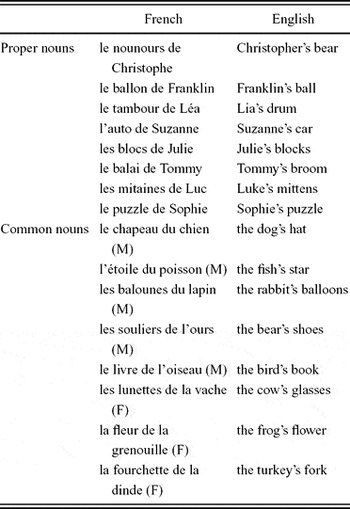
Sixteen items to elicit possessives were constructed, half with proper nouns and half with common nouns. In French, about half of the target constructions with common nouns contained masculine nouns. The list of target constructions is shown in Table 1.
Target constructions in French and English.

note: (M) = masculine possessor (F) = feminine possessor
In presenting the items, every set of two possessive test items was interspersed with an adjective–noun elicitation to break up any perseverance patterns (cf. Skarabela & Serratrice, Reference Skarabela and Serratrice2009). The presentation order of the items was randomized ten times. One of these ten versions was presented to children, with approximately equal presentation rates.
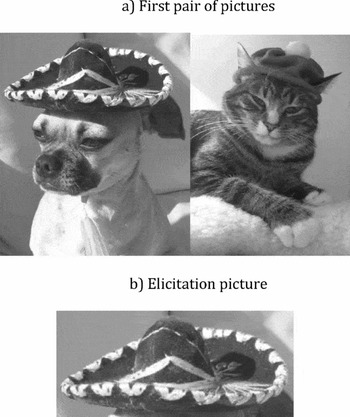
For each item, the children were first shown a pair of pictures consisting of either animals (for common nouns) or children (for proper nouns) with the same object. For example, in Figure 1, both animals have hats. The children were then shown an elicitation picture, consisting of just the object from one of the previous pictures. For example, in Figure 1, it is the dog's hat.
Example of stimulus item.

Procedure
A native or fluent speaker of the relevant language tested each child. A different experimenter tested the bilingual children in the two languages. Within each language session, the children were first administered the vocabulary test according to the tester's manual. After that, for each item, the children were first shown the two pictures of possessors, saying, “Here are two ______ with ______s” (e.g., “Here are two animals with hats” or “Here are two children with puzzles”). Then the children were shown the elicitation picture with a single possessed item and asked “What's this?” If the children gave a one-word answer, the experimenter persisted with “But whose is it?” Regardless of the child's answer to the second question, the experimenter proceeded to the next item.
Coding
One bilingual child declined the opportunity to do the vocabulary test in French. The statistics involving the vocabulary test in French are therefore based on data from the remaining 17 bilingual children.
For each item, a single answer was coded. If the child gave a single answer, only that one was coded. If the child gave a one-word answer and a two-noun answer, the two-noun answer was coded.
To code the order of the two-noun answers, we coded each answer as being either in English order or “French” order, with little regard for any intervening prepositions (as long as the prepositions were one of the following: of, at, to, de, and à) or morphology.Footnote 1 The English ordered responses were in the order Possessor−Possessed (e.g., dog hat, dog's hat, chien chapeau, chien de chapeau) and the “French” ordered responses were in the order Possessed−Possessor (e.g., hat dog, hat's dog, chapeau chien, chapeau du chien). In English, the bilingual children averaged 6.3 (SD = 3.8) two-noun constructions and the monolingual children 5.3 (SD = 3.5). There was no significant difference between the groups (F < 1). In French, the bilingual children averaged 5.9 (SD = 5.0) and the monolingual children averaged 8.5 (SD = 4.7) two-noun constructions in French. This difference did not reach significance (F(1, 32) = 2.39, p = .133, η2p = .069).
The dependent measure was the percentage of transferred two-word constructions out of the two-word possessive constructions in the relevant language. The transferred order refers to the preferred order in the non-target language, even when discussing the monolinguals, who should not be affected by cross-linguistic transfer.
Results
There were no significant differences between the two groups in terms of vocabulary scores in English (F(1,26) = 1.36, p = .254, η2p = .050), between the bilinguals (M = 61.2, SD = 19.2) and the monolinguals (M = 68.1, SD = 14.7). Nor were there differences between the two groups in French (F(1,31) = 2.79, p = .105, η2p = .083), between the bilinguals (M = 37.5, SD = 18.4) and the monolinguals (M = 48.2, SD = 18.4).
The bilingual children produced significantly more possessive constructions in the “French” order in English (M = 31.5%, SD = 37.8%) than the English monolingual children (M = 6.7%, SD = 15.4%) (F(1,26) = 4.36, p = .047, η2p = .143). The bilingual children produced significantly more English ordered possessive constructions in French (M = 17.7%, SD = 32.9%) than the French monolingual children (M = 0%) (F(1,32) = 4.65, p = .039, η2p = .127).
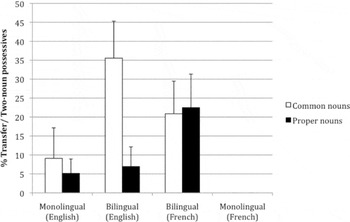
To see if the status of the noun made a difference in the order of the children's possessive constructions, we counted the percentage for common nouns and proper nouns. Not all the children produced both common nouns and proper nouns, so they were analyzed separately. Figure 2 shows the rate of periphrastic two-noun possessive constructions in English for the 13 bilingual children and the 12 monolingual children who produced multiword possessive constructions with common nouns in English. The difference for common nouns was significant (F(1,23) = 4.83, p = .038, η2p = .173). There were no significant differences for monolinguals or bilinguals on paired t-tests for common vs. proper noun. Figure 2 also shows the rate of “French” ordered possessive constructions in English for the 12 bilingual children and the 13 monolingual children who produced multiword possessive constructions with proper nouns in English. There was no significant difference between the groups on the rate of periphrastic constructions with proper nouns (F < 1, η2p = .005).
Average (SE) percentages of cross-language ordered two-word possessive constructions. Error bars indicate standard error.

In French, 17 bilinguals and 14 monolinguals were included in the analysis of common nouns and 13 bilinguals and 16 monolinguals were included in the analysis of proper nouns. Note that the monolinguals never produced an English-ordered possessive construction (see Figure 2). There was a significant difference on English-ordered possessive constructions both for common nouns (F(1,29) = 4.55, p = .042, η2p = .136) and for proper nouns (F(1,27) = 5.83, p = .023, η2p = .177).
French vs. English bilinguals
As for the two-noun responses, only 10 bilingual children used them in both languages. The rate of “French” ordered constructions in English was used by on average 44.0% of the time (SD = 45.0%) and the English order in French 23.9% (SD = 39.4%). This difference did not reach significance (F(1,9) = 1.02, n.s.). Seven bilingual children used common noun two-noun constructions in both languages: the “French” order was used in English for 51.9% of the time (SD = 39.8%) and the English order in French 24.0% (SD = 42.6%). This difference was not significant (F(1,6) = 1.42, n.s.). Only three children used two-word constructions with proper nouns in both languages, so no valid statistics could be calculated.
Correlations between transfer and age/vocabulary
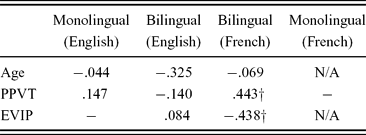
Table 2 summarizes the correlations between age or vocabulary scores and the percentage of two-noun constructions indicative of transfer. None of the correlations reached statistical significance, although in French there was a trend for the percentage of transferred constructions to be correlated positively with English vocabulary scores and negatively with French vocabulary scores.
Correlation coefficients between age/vocabulary and rate of transferred constructions

† p < .10
Discussion
The primary purpose of this study was to test for cross-linguistic influence in French−English bilingual children's production of possessive constructions. A speech production model would predict bidirectional cross-linguistic influence with possessive constructions while syntactic overlap/ambiguity variables alone predict unidirectional cross-linguistic influence (from French to English). The secondary purpose of this study was to examine the possible effects of dominance on cross-linguistic influence.
There was clear evidence of bidirectional cross-linguistic influence in the children's possessive constructions. The bilingual children used more “French”-ordered possessive constructions (that is, with the possessed preceding the possessor, as in the hat of the dog) than monolinguals in English, and more English-ordered possessive constructions than monolinguals in French. These results replicate and extend those of van der Linden and Blok-Boas (Reference van der Linden and Blok-Boas2005). These results are consistent with the bidirectional cross-linguistic influence predicted from a speech production model (Nicoladis, Reference Nicoladis2006). This prediction was based on the assumption that bilinguals’ activation of the typical word order of the possessive constructions in both their languages at the lemma level would lead to mis-ordering constructions in both their languages. This result suggests that the variables of syntactic ambiguity and overlap alone are insufficient to predict the directionality of cross-linguistic influence (see also Nicoladis, Reference Nicoladis2002; Yip & Matthews, Reference Yip and Matthews2000; Zwanziger et al., Reference Zwanziger, Allen and Genesee2005).
A speech production model does not rule out the possibility that syntactic ambiguity/overlap could also be playing a role. If this had been the case in this study, the children should have shown greater rates of cross-linguistic influence in English than in French. While the results generally did show slightly higher rates in English than in French, these differences did not reach significance. The lack of significance could be due to the small number of children who could be included in a direct comparison of French and English (N = 10). Thus, the lack of significant difference could be due to a lack of statistical power. A lack of statistical difference cannot be interpreted. In other words, this study showed no counter-evidence to the argument that structural overlap/ambiguity can play a role in predicting bilingual children's cross-linguistic influence (Döpke, Reference Döpke1998; Hulk & Müller, Reference Hulk and Müller2000). Given the number of studies that have been consistent with overlap/ambiguity, it is likely that these variables are also having an effect and that the effect was simply not detected in the present study.
One unpredicted finding of this study was that, in English, the bilinguals showed cross-linguistic transfer only with common nouns as possessors (like dog) and not with proper nouns as possessors (like Suzanne). In doing so, the bilinguals showed the same preference observed in English monolinguals in avoiding periphrastic possessive constructions for human possessors (this study; Skarabela & Serratrice, Reference Skarabela and Serratrice2009). In contrast, in French both common and proper nouns showed signs of cross-linguistic influence, at equivalent rates. The French monolinguals never used an English ordered possessive construction while the bilinguals did, approximately equally often with common and proper nouns as possessors. Given the current state of theory regarding possessive constructions, it is not clear how to explain this finding. Within a Universal Grammar framework, it may be possible to explain the transfer of only common nouns in terms of the interface between syntax and pragmatics (Hulk & Müller, Reference Hulk and Müller2000). Within a speech production framework, to be consistent with previous work on cross-linguistic transfer, the ordering of English possessive constructions based on the status of the noun would have to be chosen at the lemma level (cf. Nicoladis, Reference Nicoladis2006). Further theoretical work is required in these frameworks to be able to formulate coherent explanations.
This study found only weak effects of language proficiency on the rates of cross-linguistic influence with possessive constructions. Namely, there was a tendency for lower French vocabularies and higher English vocabularies to be correlated with a higher rate of transferred constructions in French. These findings add to the findings from previous studies showing variable effects of language dominance on cross-linguistic influence (Argyri & Sorace, Reference Argyri and Sorace2007; Bernardini, Reference Bernardini and Müller2003; Bernardini & Schlyter, Reference Bernardini and Schlyter2004; Döpke, Reference Döpke1998; Nicoladis, Reference Nicoladis2006; Schlyter, Reference Schlyter, Hyltenstam and Viberg1993, Reference Schlyter2001; Yip & Matthews, Reference Yip and Matthews2000). It is possible that, in the present study, these tendencies show up in French and not in English because of different degrees of acceptability of the transferred construction in the two languages. That is, in French the transferred construction is ungrammatical, while in English the transferred construction is simply dis-preferred. It is possible that the effects of dominance on cross-linguistic transfer in preschool children are stronger when the transferred construction is ungrammatical in the target language.
In sum, the two-noun possessive constructions showed bidirectional cross-linguistic influence. In English, transfer was only observed with common nouns as possessors, thus exaggerating the tendency observed in monolingual children to avoid periphrastic possessive constructions with proper nouns. In French, transfer was observed with both common and proper nouns. The data in this study did not rule out that the overlap/ambiguity of linguistic structure might also play a role in predicting children's cross-linguistic influence, although further theoretical work is required to explain why transfer is only observed with common nouns in English. There was a trend for the children's proficiency to be related to their production of transferred constructions, but only in French. The results are compatible with a speech production model. The viability of a speech production model suggests that cross-linguistic influence is not necessarily an issue of bilingual children's representation of their two languages (cf. Yip & Matthews, Reference Yip and Matthews2007), but often comes about in the processing of the languages (Argyri & Sorace, Reference Argyri and Sorace2007; Serratrice, Reference Serratrice2007).