Implications
Detrimental effects of the practice of supplementing livestock diets with antibiotics have become obvious and caused increasing public concern. In this study, dietary allicin was used to replace antibiotics and was found to improve piglet performance and reduce the incidence of diarrhoea. In addition, this study for the first time showed that dietary allicin could reduce attractiveness of faeces to flies. These diverse data provide new insight into the effects of dietary allicin and suggest some valuable roles for dietary garlic or allicin in on-farm pig production.
Introduction
Piglets weaned at 3 to 4 weeks of age are faced with a number of stressors, such as separation from their mother, change in the living environment and cessation of milk suckling (de Grau et al., Reference de Grau, Dewey, Friendship and de Lange2005). Bruininx et al. (Reference Bruininx, Schellingerhout, Binnendijk, Peet-Schwering Van der, Schrama, Hartong den, Everts and Beynen2004) found that some piglets refrained from eating for over 50 h after weaning. Low nutrient intake during the first days after weaning may be one of the major causes for the impaired intestinal function and integrity generally observed after weaning (Spreeuwenberg et al., Reference Spreeuwenberg, Verdonk, Gaskins and Verstegen2001). In an effort to reduce the impact of some of these early stressors, supplementation of animal feed with antibiotics has been practised since the 1950s. Supplementation of diets with antibiotics for nursery piglets remains common practice in many countries to improve growth performance and protect the animal from the adverse effect of pathogenic and non-pathogenic enteric microorganisms. However, overuse and misuse of antimicrobial agents have favoured the growth of resistant organisms. This antimicrobial resistance may spread to other microbial populations. Infectious diseases that have become resistant to standard antimicrobial treatment present a threat to human and animal health. The detrimental effects of dietary antibiotics have become obvious and consequently have caused increased public concern. Beginning in January 2006, the European Union banned all antibiotics used as growth promoters in animal feed in the European market. Thus, the development of alternatives to the use of dietary antibiotics is required.
Garlic (Allium sativum L. Alliaceae) has played a number of important roles in human diets and medicines in many countries, including China, since ancient times (Rivlin, Reference Rivlin2001). Nowadays, the medical use of garlic is widespread and growing (Bordia et al., Reference Bordia, Mohammed, Thomson and Ali1996; Rivlin, Reference Rivlin2001; Thomson and Ali, Reference Thomson and Ali2003). The effects of garlic extract or its major bioactive component, allicin, have been investigated extensively for human health benefits. These benefits include antimicrobial (Cellini et al., Reference Cellini, Di Campli, Masulli, Di Bartolomeo and Allocati1996), anti-thrombotic (Bordia et al., Reference Bordia, Mohammed, Thomson and Ali1996), anti-hypertensive (Foushee et al., Reference Foushee, Ruffin and Banerjee1982), anti-hyperglycaemic (Chang and Johnson, Reference Chang and Johnson1980), anti-hyperlipemic (Yeh and Yeh, Reference Yeh and Yeh1994; Eilat et al., Reference Eilat, Oestraicher, Rabinkov, Ohad, Mirelman, Battler, Eldar and Vered1995), antidote (for heavy metal poisoning) and hepatoprotective (Agarwal, Reference Agarwal1996; Rivlin, Reference Rivlin2001), anti-viral, anti-cancer and chemopreventive activities (Agarwal, Reference Agarwal1996; Banerjee and Maulik, Reference Banerjee and Maulik2002; Thomson and Ali, Reference Thomson and Ali2003). Thus, allicin is generally viewed as a principal bioactive disease-preventive dietary compound in garlic (reviewed by Amagase et al., Reference Amagase, Petesch, Matsuura, Kasuga and Itakura2001).
The effects of garlic extracts or allicin have also been investigated for potential use as feed additives in swine production. However, the results were not always consistent. Tatara et al. (Reference Tatara, Śliwa, Dudek, Mosiewicz and Studziński2005) reported that oral administration of aged garlic extract and allicin to pregnant sows and during 28 days of lactation improved piglet body weight (BW). Grela and Klebaniuk (Reference Grela and Klebaniuk2007) found garlic improved piglet BW gain and reduced piglet losses, and also found that garlic could reduce triglycerides and total cholesterol concentration in blood plasma. Recently, it has been observed that garlic extracts or garlic powder containing various sulphur compounds, effectively decreased the plasma concentration of cholesterol, resulting possibly from the inhibition of hepatic cholesterol synthesis (Yeh and Liu, Reference Yeh and Liu2001). Janz et al. (Reference Janz, Morel, Wilkinson and Purchas2007) showed that finishing pigs preferred the garlic-treated diet with both feed intake and average daily gain (ADG) significantly increased. However, Chen et al. (Reference Chen, Kim, Cho, Yoo, Wang, Wang and Huang2008) found that dietary garlic did not affect growth performance of finishing pigs with no difference between garlic treatment and control groups. Nevertheless, to our knowledge, little information is available on the potential effects of garlic extract or its major active compound, allicin, on piglet health. Further, it is reasonable to assume that the surroundings in the pens would be important for performance of the piglets as the hygiene of the surroundings could affect the comfort level of the piglets. However, we are not aware of any information on a potential effect of dietary garlic or allicin on this aspect of piglet husbandry. Therefore, this study was conducted to investigate the effect of dietary allicin on the health and growth performance of weanling piglets and on their surroundings. Our primary hypothesis was that allicin would improve growth performance of piglets.
Material and methods
Animal selection and allotment
At 21 days of age, 225 Duroc × (Landrace × Large Yorkshire) crossbred piglets from sows of parity three to five were weaned and selected from a commercial farm of Yixing Changxing Ecological Agricultural Co. Ltd (Yixing, Jiangsu, China) and were randomly divided into five groups. The piglets were raised in pens (2.7 m × 2.1 m) in a double-row confinement house with a 0.8-m wide central alley. The pens were installed with galvanized steel spindles 3.7 cm apart, with a 0.45 m deep manure pit under the fully slatted floor. Each treatment group had five pens with nine animals in each pen. For each treatment group, two pens were male piglets and three pens were female piglets. The piglets were fed ad libitum and had free access to water from nipple drinkers within a transverse aeration-cooling system. The ambient temperature of the inner house ranged from 24.54 ± 1.42°C (0600 to 0700 h) to 30.16 ± 2.71°C (1400 to 1500 h) with 27.35 ± 3.55°C on average, and with the highest recorded temperature of 36.0°C and the lowest of 22.0°C. The relative humidity ranged from 72.20% ± 6.89% (0600 to 0700 h) to 76.23% ± 5.48% (1400 to 1500 h) with 74.21% ± 6.57% on average, and with a highest recorded humidity of 82.0% and the lowest of 60.0%. The house was lighted naturally and the daily duration was about 14 h. Vaccination was administered according to the immunization rules of the experimental farm. Swine fever vaccine and swine pseudorabies vaccine (Nanjing Tianbang Bio-industry Co. Ltd, Nanjing, China ) were used at 4 and 7 weeks of age, respectively. Faecal cleaning was carried out twice daily by farm workers. The study and animal care protocol followed the guidelines from the Laboratory of Animal Management Association of Nanjing Agricultural University.
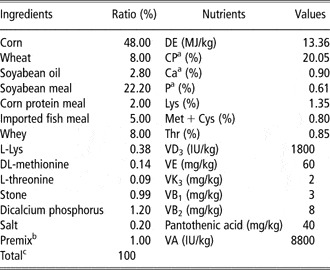
Piglets in the control group were fed basal diet supplemented with antibiotics, whereas the experiment groups were fed diets supplemented with an allicin product (Degao Biotech Co. Ltd, Shandong, China, including 25% of garlic oil, and the remaining component of silicate carrier) in the proportion of 0.10, 0.15, 0.20 and 0.25 g/kg in the diet, instead of antibiotics, respectively. The product was protected with an outer membrane and hence could be stored at room temperature and preserved for 2 years. As our aim was to compare dietary allicin to the current commercial practice of feeding a diet supplemented with antibiotics, we did not choose to include a ‘negative control’ unsupplemented diet group. Basal diet composition and nutrient contents are shown in Table 1. Diets were mixed and sampled weekly. Feed samples from each treatment were collected and analysed for dry matter, N, Ca and P according to the AOAC (Association of Official Analytical Chemists) procedures (AOAC, 1995).
Ingredient composition and nutrient contents of basal diet for experimental piglets

DE = digestible energy; V = vitamin.
aAnalysed contents, otherwise calculated value.
bPremix supplied per kilogram of diet: folic acid, 2 mg; VB6, 8 mg; VB12; 0.03 mg; nicotinic acid, 50 mg; Cu, 250 mg; Fe, 120 mg; Zn, 160 mg; Mn, 60 mg; I, 1 mg; Se, 0.3 mg.
cIncluding antibiotics in the diet of the control group: aureomycin, 75 mg/kg; arsanilic acid, 100 mg/kg; colistin sulphate, 20 mg/kg.
Data collection
Surplus feed remaining in the feeders of each pen (replicate) was cleared away daily. Feed intake was recorded daily. Pre-feeding BW of each piglet was recorded individually at the beginning (initial BW, W0), the end of the first week (W1), the end of the second week (W2) and the end of the whole experimental period (WT).
For collection of diarrhoea and death data, each episode of diarrhoea or deaths of experimental piglets, if any, were recorded daily. These inspections were performed three times per day, in the early morning before cleaning, during feeding and after feeding. If watery faeces were found on the floor, the anus of each piglet in the pen would be checked and judged. An episode of diarrhoea was accounted if the faeces was watery or was adherent to the anus. The incidence of diarrhoea was calculated as follows: incidence of diarrhoea (%) = total heads of diarrhoea pigs/(number of experimental pigs) × 100%. When death occurred, the BW of the dead piglet was recorded.
For collection of fly dissemination data, on the third and fifth day of each experimental week, similar amounts of fresh faeces from each pen of every treatment were collected before cleaning at about 0800 to 0900 h and similarly spread in an equal square area (about 10 × 10 cm2 for each) prepared beforehand in a flat area with a roof for rain protection about 100 m away from the nearest pigsty. The squares were arranged one by one in a line with about 1 m of spacing between the squares. Two trained observers who were blinded to the different treatments sat at the two ends of the line and each used a minicam to view and record all the squares. Flies alighting on the surface of the faeces of each square were recorded three times, from 1200 through 1205 h, from 1300 through 1305 h, and from 1400 through 1405 h. The observers analysed the data together based on the following criteria. If a fly landed on the surface of the manure in a single square and left but landed again on the same square, it was counted twice. If a fly landed on the surface of an area and then flew to the next, it was recorded once for each square. No matter how long a fly stayed on the surface of the manure in a square, it was counted as one whether it stayed for the entire 5 min or if it stayed only for 1 s.
Statistical analysis
All variables were subjected to statistical analysis of variance by using least squares regression to fit the general linear models in the GLM procedure in the statistical package, SAS (Statistical Analysis Systems Institute, 2002). In the analysis of the performance data, measures on individual pigs were used as a dependent variable. With respect to the data on diarrhoea weekly averages of daily occurrence were used as a dependent variable, whereas observational time was used in the data on fly attractiveness.
The model used for the analysis of performance data included treatment, sex and the interactions between treatment and sex as general fixed effect. The interactions between sex and repetition and between sex, repetition and treatment were used as random effects. If non-significant, the highest level of interactions of fixed effects were excluded. Estimation of the linear, quadratic and cubic effects was made by use of the contrast statement in GLM. Multiple comparisons were treated by use of the Student–Newman–Keuls test.
The model used for the analysis of the data on diarrhoea further included week and the significant interactions between week and treatment, week and sex, and week, treatment and sex as a general fixed effect. In addition, the interaction between sex, week and repetition was added as a random effect.
The model used for the analysis of the data on fly attractiveness included treatment, sex, observational time, observing date and the possible interactions between these effects as general fixed effects. The interactions between sex and repetition; between sex, repetition and treatment; between sex, repetition and observational time; between sex, repetition and observing date; between sex, repetition, treatment and observational time; and between sex, repetition, treatment and observing date were included as random effects.
The results of the statistical analyses are presented by the F-value and the degree of freedom for the investigated effect (d.f. = 1) and of the error term in the denominator (d.f. = 2). All analyses were carried out as two-tailed tests. Differences were regarded as significant at P ⩽ 0.05, whereas a value of P ⩽ 0.10 was designated as a tendency or trend. The results are presented as least square means and s.e.
Results
Growth performance
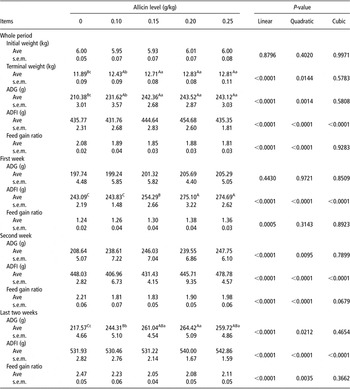
The effects of dietary allicin on growth performance of the experimental piglets are shown in Table 2. The initial BW of piglets in each treatment group did not show significant differences. Over the whole 28-day experiment, allicin supplementation significantly affected the growth performance of the piglets. ADG was significantly different between treatments (F4,12 = 6.59; P = 0.0048), but did not differ significantly between sexes. The interaction between sex and treatment was not significant either. No significant difference of average daily feed intake (ADFI) or feed gain ratio of experimental pigs was found. As the level of allicin supplementation increased, ADG increased linearly (F = 79.80; P < 0.0001) and quadratically (F = 10.46; P = 0.0014), whereas feed gain ratio decreased linearly (F = 43.08; P < 0.0001) and quadratically (F = 19.75; P < 0.0001).
Effects of allicin supplementation on the growth performance of the weaning piglets during the 28-day experiment (n = 5)Footnote #

Ave = average; ADG = average daily weight gain; ADFI = average daily feed intake.
A,B,C Values within a row with different superscripts are significantly different at P < 0.01.
a,b,c Values within a row with different superscripts are significantly different at P < 0.05.
# Pen was considered as an experimental unit for growth performance.
During the first week of the experiment, allicin supplementation had no significant effect on ADG of the piglets. ADFI of the piglets was significantly different between treatments (F 4,12 = 3.44; P = 0.0429), but was not significantly different between sexes. The interaction between sex and treatment was not significant either. Pigs had no significantly different feed gain ratio during the first week either. As the level of allicin supplementation increased, however, feed gain ratio decreased linearly (F = 12.37; P = 0.0005).
During the second week, allicin supplementation had no significant effect on growth performance of the piglets. As the level of allicin supplementation increased, however, ADG increased linearly (F = 19.38, P < 0.0001) and quadratically (F = 6.85, P = 0.0095), and feed gain ratio decreased linearly (F = 20.95; P < 0.0001), quadratically (F = 25.74; P < 0.0001) and tended to decrease cubically (F = 3.37; P = 0.0679).
During the third and fourth weeks, allicin supplementation significantly affected the growth performance of the piglets. ADG showed significant difference between treatments (F 4,12 = 5.79; P = 0.0078), but did not show significant difference between sexes. The interaction between sex and treatment was not significant. As the level of allicin supplementation increased, ADG increased linearly (F = 59.08, P < 0.0001) and quadratically (F = 5.39, P = 0.0212). No significant difference in ADFI or feed gain ratio of experimental pigs was found. Pigs had a significantly different feed gain ratio during the past 2 weeks. A statistically significant difference was found between treatments (F 4,12 = 3.57; P = 0.0386) and a tendency of significant difference was found between sexes (F 1,3 = 5.76; P = 0.0967). The interaction between sex and treatment was not significant. As the level of allicin supplementation increased, feed gain ratio decreased linearly (F = 49.26; P < 0.0001) and quadratically (F = 8.76; P = 0.0035).
Incidence of diarrhoea
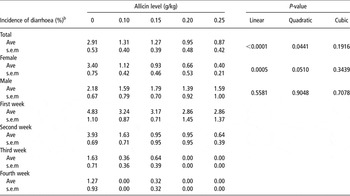
The effects of dietary allicin on the incidence of diarrhoea in the experimental piglets are shown in Table 3. Dietary allicin did not affect the incidence of diarrhoea of the piglets between treatments. There tended to be a significant difference between sexes (F 1,3 = 8.08; P = 0.0655) and weeks (F 3,9 = 18.71; P = 0.0003). The interactions between treatment and sex, between sex and week or between treatment and week were not significant. The incidence decreased linearly (F = 13.99; P = 0.0003) and tended to decrease quadratically (F = 3.32; P = 0.0716) as the level of allicin supplementation increased. This effect was mainly contributed by the female piglets. Female piglets showed a linear (F = 13.83; P = 0.0005) and tended to show a quadratic (F = 3.98; P = 0.0510) decrease in the incidence of diarrhoea as the level of allicin supplementation increased, whereas no significant effect was observed within male piglets.
Effects of allicin supplementation on the incidence of diarrhoea of the weaning piglets during the 28-day experiment (n = 5)Footnote a

Ave = average.
a Pen was considered as an experimental unit for incidence of diarrhoea.
b Episodes of diarrhoea of experimental piglets, if any, were recorded daily. It was calculated as follows: incidence of diarrhoea (%) = total heads of diarrhoea pigs/(number of experimental pigs) × 100%.
Fly attractiveness of the piglet faeces
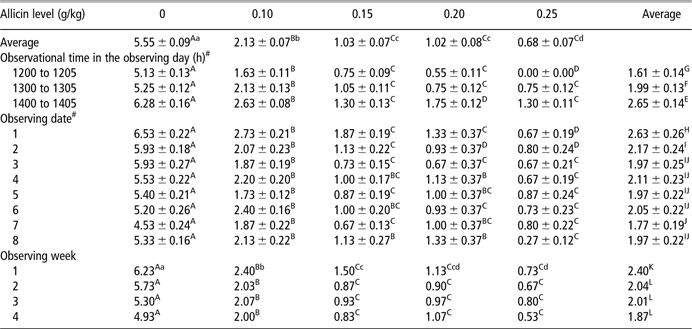
The effects of dietary allicin on fly attractiveness of piglet faeces are shown in Table 4. On average, for all three observational time periods and for all the observing dates, the number of flies alighting on the surface of the faecal sample of the experimental piglets in treatments was significantly reduced compared with the control (F 4,12 = 780.42; P < 0.0001). There was a significant difference in number of flies between observing days (F 7,21 = 9.07; P < 0.0001) and between different observing time periods (F 2,6 = 50.60; P = 0.0002). There was no significant difference between different sexes and no significant interactions between treatment and sex, between observing date and sex, between observing time and sex or between observing date and observing time. As the level of allicin (25%) supplementation increased from 0.10 to 0.25 g/kg, fly numbers alighting on the piglet faeces decreased both linearly (F = 3186.46; P < 0.0001), quadratically (F = 857.47; P < 0.0001) and cubically (F = 23.38; P < 0.0001).
Effects of allicin supplementation on fly attractiveness of faeces (number of flies alighting on the surface of the faeces, n = 5)Footnote *
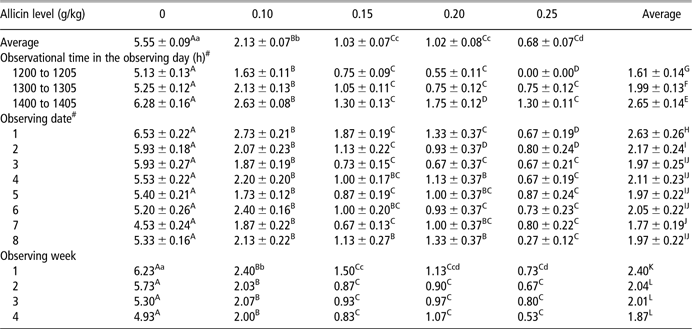
A, B, C, D Values within a row with different superscripts are significantly different at P < 0.01.
a, b, c, d Values within a row with different superscript are significantly different at P < 0.05.
E, F, G Values with different superscript within the same column of observational time in the observing day are significantly different at P < 0.01.
H, I, J Values with different superscript within the same column of observing date are significantly different at P < 0.01.
K, L Values with different superscript within the same column of observing week are significantly different at P < 0.01.
* The number of flies alighting upon the surface of the faeces was counted from 1200 through 1205 h, from 1300 through 1305 h and from 1400 through 1405 h.
# On the third and fifth day of each experimental week, fresh faeces from each treatment were collected and equally spread in an equal open area.
Discussion
This study showed that dietary allicin significantly improved growth performance of weanling piglets over the experimental period of 28 days in a dose-dependent manner. Dietary allicin increased ADG of the experimental piglets although it did not increase ADFI or improve the feed gain ratio. However, allicin supplementation improved the feed gain ratio in a dosage-dependent manner and the effect of allicin supplementation on ADG of experimental piglets was also increased in a dosage-dependent manner. Comparable results with improvement of growth performance have been previously reported. Tatara et al. (Reference Tatara, Śliwa, Dudek, Kowalik, Gawron, Piersiak, Dobrowolski and Studziński2005a and Reference Tatara, Śliwa, Dudek, Mosiewicz and Studziński2005b) reported positive influences of allicin administrated to pregnant and lactating sows on BW gain and gastrointestinal tract development of their piglets. Langendijk et al. (Reference Langendijk, Bolhuis and Laurenssen2007) also found improved feed intake of pre- and post-weaning piglets when the sows were exposed to garlic flavours. Grela and Klebaniuk (Reference Grela and Klebaniuk2007) found that garlic improved piglet BW gain and decreased piglet losses and reduced both triglycerides and total cholesterol concentrations in blood plasma from weaning to 28 days after weaning.
These results further showed that during the first week of the experiment, the piglets in all treatment groups including the controls had reduced feed intake and that allicin supplementation had no significant effect on weight gain. It seems likely that all piglets in all groups experienced stress caused by environmental change in the first week after transfer to the nursery pens (de Grau et al., Reference de Grau, Dewey, Friendship and de Lange2005; Su and Zhu, Reference Su and Zhu2006). Thus, this general stress may have masked any potential effect of allicin on feed intake in the first week. But the stress seemed to be alleviated when allicin was supplemented in the diet. ADFI of the piglets significantly increased in a dosage-dependent manner, although feed gain ratio of the piglets linearly increased as the level of allicin supplementation increased. Indeed, after the piglets adapted to the diet, a moderate level of dietary allicin (0.15 g/kg) appeared to improve growth performance from the second week onwards. Thus, allicin has the potential for use as feed additive in improving growth performance of weanling piglets. Specifically, these results showed that dietary allicin led to a significant dose-related increase of ADG during the entire experimental period after the first week post-weaning. Although we suspect that the general stress of weaning and relocation obscured a potential effect of treatment in the first week, it is also possible that as the piglets mature, they develop responsiveness to the presence of allicin in the diet in the latter weeks.
The beneficial effects of garlic are mainly attributed to the bioactive components of garlic, including volatile sulphur-containing compounds, such as allinin, diallylsulphides and allicin (Amagase et al., Reference Amagase, Petesch, Matsuura, Kasuga and Itakura2001). These compounds emit garlic odour and consequently we believe that it drives flies away that would otherwise be alighting on the surface of feed and faeces. This study showed that the number of flies alighting on the surface of the faeces from the piglets in each experimental treatment group was significantly lower than in the control. This effect was more evident when the supplemental level of dietary allicin was 0.15 g/kg and above (P < 0.01). As reviewed by Kornegay and Harper (Reference Kornegay and Harper1997), many attempts have been made to reduce the local environmental impact of animal production through reducing the nutrient excretion, odours and resultant flies. To our knowledge, little information is available on the fate of allicin once consumed and it remains unclear whether it is discharged in the urine and flows into cesspits thus prohibiting reproduction and growth of flies on excrement. Nevertheless, the new data suggest that dietary allicin may have a beneficial role to play in this aspect of livestock production.
Many studies have shown that garlic or allicin in in vitro studies may be effective in inhibiting pathogenic bacteria and protecting host cells against pathogens (Cellini et al., Reference Cellini, Di Campli, Masulli, Di Bartolomeo and Allocati1996; Ross et al., Reference Ross, O’Gara, Hill, Sleightholme and Maslin2001; Roselli et al., Reference Roselli, Britti, Le Huërou-Luron, Marfaing, Zhu and Mengheri2007). In our on-farm study, incidence of diarrhoea of the weaned piglets supplemented with dietary allicin reduced linearly and tended to decrease quadratically as the level of allicin supplementation increased. The positive effects of allicin was also reported by Tatara et al. (Reference Tatara, Śliwa, Dudek, Mosiewicz and Studziński2005a and Reference Tatara, Śliwa, Dudek, Kowalik, Gawron, Piersiak, Dobrowolski and Studziński2005b), who demonstrated that garlic or allicin administration induced positive effects on animals at early stages of their development. This suggests that garlic and its allicin compounds could be effective in reducing diseases during the weaning transition. Our results further showed that dietary allicin led to a significant dose-related linear decrease in the incidence of diarrhoea in female piglets, but inexplicably, not in male piglets. This may imply that females are more sensitive to the dose of allicin in the diet.
Several mechanisms of action may be responsible for the effect of allicin. Allicin is a known potent agonist for the transient receptor potential ankyrin-1 (TRPA1), which is a key member of the family of transient receptor potential channels that function as detectors for a wide variety of chemical and physical stimuli at a number of levels within the nervous system (Kosugi et al., Reference Kosugi, Nakatsuka, Fujita, Kuroda and Kumamoto2007). For example, allicin might act on gastrointestinal TRPA1 receptors (Penuelas et al., Reference Penuelas, Tashima, Tsuchiya, Matsumoto, Nakamura, Horie and Yano2007) to affect motility or other gut functions. Thus, increased surface area of the small intestine, as a positive consequence of allicin and aged garlic extract administration, may be postulated as a factor responsible for improved systemic development as suggested by Tatara et al. (Reference Tatara, Śliwa, Dudek, Kowalik, Gawron, Piersiak, Dobrowolski and Studziński2005b). In addition, as TRPA1 appears to play a role in visceral hyperalgesia (Yang et al., Reference Yang, Li, Zuo, Zhen, Yu and Gao2008), the effect of chronic or subchronic dietary allicin on gastrointestinal pain or comfort is an open question. The improved growth performance and reduced incidence of diarrhoea in piglets in this study may all relate to the effects on this type of underlying signalling mechanism.
In summary, this study showed that supplementation of the diet with allicin after weaning may improve growth performance and reduce the incidence of diarrhoea in weanling piglets as well as fly attractiveness of the faeces, which may reduce the dissemination of pathogens. Given the enormous production of garlic in China, our results suggest that there is vast potential for its use as feed for swine. To further evaluate the potential role of allicin in healthy and efficient pig production, more detailed research on physiology is needed.
Acknowledgements
This study was partly supported by the research fund for the Doctoral Program of Higher Education of China (20050307017) and Key Programs for Science and Technology Development of Jiangsu Province (BE2009330-1). Dr Zhang H from the South China Agricultural University, Dr Mao SY and Mr Zhou B from the Nanjing Agricultural University and Dr Chen CY from the University of Maryland had given some help in data statistics.